|
시장보고서
상품코드
1940804
싱가포르의 사이버 보안 : 시장 점유율 분석, 업계 동향과 통계, 성장 예측(2026-2031년)Singapore Cybersecurity - Market Share Analysis, Industry Trends & Statistics, Growth Forecasts (2026 - 2031) |
||||||
 Mordor Intelligence
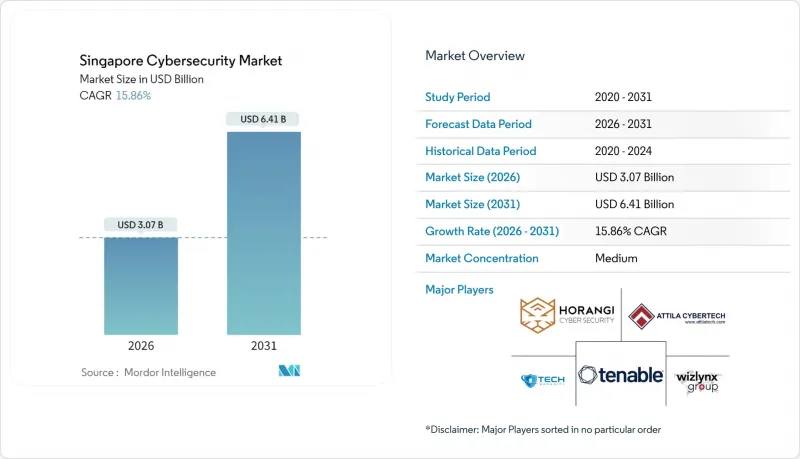
싱가포르의 사이버 보안 시장 규모는 2026년에 30억 7,000만 달러에 달할 것으로 예측됩니다.
이는 2025년 26억 5,000만 달러에서 성장한 수치이며, 2031년에는 64억 1,000만 달러에 달할 것으로 예측됩니다. 2026-2031년 연평균 복합 성장률(CAGR) 15.86%로 확대될 것으로 예상되며, 도시국가들이 동남아시아의 디지털 사령탑으로서의 입지를 확고히할 것으로 보입니다.
기업 경영진은 이러한 성장 요인으로 위협 증가(2023년 기록된 전체 범죄의 49.2%를 사이버 범죄가 차지)와 하이퍼스케일 데이터센터 투자 밀도 증가(2024년 중반까지 가동 중이거나 계약된 IT 부하가 1.4GW를 넘어설 것)를 꼽고 있습니다. 현재 조달 부서는 기능 수보다는 제공되는 위험 감소 효과로 제품을 평가하고 있으며, 2024년 계약에서 대기업의 67%가 주요 위험 지표를 명시할 것을 요구하고 있습니다. IT와 OT의 통합 방어에 대한 현저한 전환은 자동화 항만 터미널과 스마트 공장이 사일로화된 스택보다 단일 보안 제어 플레인을 선호하는 경향을 반영합니다. 2023년 중반 이후 은행의 권한 없는 접근 사례는 제로 트러스트 정책으로 인해 이미 42%나 감소했습니다.
싱가포르의 사이버 보안 시장 동향 및 인사이트
정부의 전국적인 제로 트러스트 아키텍처 의무화 추진
규제 당국은 현재 모든 중요 정보 인프라 소유자에게 제로 트러스트 로드맵 제출을 의무화하고 있으며, 2024년 11월까지 96%가 계획을 제출했습니다. 금융기관은 트래픽의 마이크로세분화을 실시하여 운영 개시 후 1년 만에 부정 권한 사례를 42% 감소시켰습니다. 예산 주기에서 보안 지출의 최대 28%를 신원 분석에 할당하여 상황 인식 접근 제어에 대한 높은 수요를 보여주고 있습니다. 여러 기관의 설계 심사 효율화로 정책 승인 기간이 34일로 단축되어 기존의 지연이 절반으로 줄었습니다. 이를 통해 벤더는 수익 인식 속도를 높일 수 있게 되었습니다. 이러한 움직임과 함께, 제로 트러스트가 주요 입찰의 핵심으로 자리 잡으면서 적응형 트러스트 스코어링을 지원하는 공급업체가 결정적인 우위를 점하고 있습니다.
차세대 BFSI 보안 지출을 주도하는 디지털 뱅킹 라이선스 가속화로 차세대 BFSI 보안 지출 가속화
디지털 풀뱅크 라이선스를 취득한 기관은 2024년 말까지 18억 싱가포르 달러의 예금을 모을 것이며, 이는 싱가포르 소매 저축 총액의 4%에 해당합니다. 신규 진출기업들은 첫 해에 영업 지출의 약 22%를 사이버 보안에 투자하고 있으며, 이러한 집중도는 기존 기업들에게도 나타나 2024년에는 회복탄력성 투자가 36% 증가한 4억 9,100만 싱가포르 달러에 달할 것으로 예측됩니다. 포스트 양자암호화 기술 시범 도입으로 국내 은행 간 거래의 12%가 이미 보호되고 있습니다. 현재 경쟁력의 균형은 신속한 위협 인텔리전스 수집과 자동화된 컴플라이언스 증명에 의존하고 있으며, 예산은 독립형 장비가 아닌 관리형 감지 및 대응 플랫폼으로 재분배되고 있습니다. 은행 부문의 조기 도입 추세는 결제, 자산운용, 자본 시장 시스템으로 파급되어 싱가포르의 사이버 보안 시장의 잠재적 수요를 확대시키고 있습니다.
CREST 인증 인력 부족으로 서비스 비용 증가
2024년 기준, 현지에서 활동하는 CREST 인증 전문가는 530명에 불과하며, 수요 1,200명 대비 56% 부족합니다. 시니어 애널리스트의 중간 급여는 14% 상승하여 117,000 싱가포르 달러에 이르렀으며, 이는 관리형 보안 서비스 제공업체(MSSP)의 수익률을 압박하는 요인으로 작용하고 있습니다. MSSP는 자동화를 통해 Tier-1 티켓 물량을 35% 줄였지만, 많은 기업들이 여전히 높은 좌석 라이선스 가격을 전가하는 방식으로 임금 상승분을 흡수하고 있습니다. 인력 부족이 지속되면서 대규모 도입이 지연되고, 가동 개시까지의 기간이 장기화되어 단기적인 수익화에 걸림돌이 되고 있습니다. 인력 양성 파이프라인이 크게 확대되지 않는 한, 인력 공급 부족은 싱가포르의 사이버 보안 시장 예측된 성장률을 달성하는 능력을 계속 제한할 것입니다.
부문 분석
2025년 싱가포르의 사이버 보안 시장 점유율의 59.60%는 서비스 부문이 차지할 것으로 예상되며, 관리형 보안 서비스 매출 23억 싱가포르 달러가 이를 뒷받침할 것으로 예측됩니다. 평균 감지 시간(MTDI)은 2022년 8시간에서 2024년 2시간으로 단축되어 24시간 365일 모니터링에 대한 투자 효과를 입증했습니다. 국경 간 위협 인텔리전스를 통합하는 공급자는 92%의 업데이트율을 달성해 업계 평균인 84%를 상회하는 것으로 나타났습니다. 고객들은 모니터링 서비스에 보험 브로커 업무나 사고 대응 계약을 결합하는 경향이 증가하고 있으며, MSSP(Managed Security Service Provider)에게는 연금과 같은 수익원을 창출하고 있습니다. 이러한 요인들은 싱가포르의 사이버 보안 시장의 두 자릿수 성장세를 지속시키고 있습니다.
클라우드 보안은 기업 클라우드 워크로드의 84% 보급을 배경으로 2031년까지 연평균 복합 성장률(CAGR) 15.52%를 유지할 것으로 예측됩니다. 싱가포르 금융관리국(MAS)의 개정 규정에 따라 필수 관리 목표가 8개 항목에서 11개 항목으로 확대되고, 실사 주기가 강화되는 한편, 대응 가능한 지출 규모가 확대되었습니다. 자세 관리와 자동 복구 기능을 결합한 벤더는 현재 클라이언트당월37건의 정책 업데이트를 실행하고 있으며, 이는 2022년 대비 3배에 달하는 규모다. 종량제는 EC 성수기의 급격한 스케일 아웃에 적합합니다. 그 결과, 싱가포르의 사이버 보안 시장에서는 클라우드 네이티브 솔루션이 어플라이언스 업데이트를 능가하는 성장세를 이어갈 것으로 예측됩니다.
2025년에도 On-Premise 설치가 싱가포르의 사이버 보안 시장 점유율의 54.30%를 차지할 것으로 예상되며, 금융권 데이터베이스의 71%가 신뢰할 수 있는 시설에 코로케이션될 것으로 예측됩니다. Tier 4 층 공간은 66만 평방미터에 달하며, 대형 은행 및 결제 네트워크에 지연 제어 환경을 제공합니다. 하이브리드 포렌식 워크플로우를 통해 증거 처리 시간을 27% 단축하고, 규제 대상 워크로드의 단계적 전환 경로를 입증했습니다. 이에 따라 기존 기업들은 클라우드 퍼스트 용도의 시범운영을 진행하면서 동시에 경계 하드웨어를 지속적으로 업데이트하고 있습니다.
클라우드 도입은 2025년부터 2027년까지 계획된 300MW의 추가 하이퍼스케일 IT 부하에 힘입어 16.93%의 연평균 복합 성장률(CAGR)을 보일 것으로 예측됩니다. 그린 데이터센터 기준을 충족하는 사업자는 PUE가 1.3 미만을 달성하고, 랙 내 보안 가속기에 대한 에너지 예산을 확보할 수 있습니다. CPU 초 단위로 청구되는 새로운 대량 라이선스 요금 체계는 월별 청구 금액의 변동성을 18% 감소시켜 CFO의 우려를 덜어주었습니다. 프로비저닝 시간 단축으로 스타트업은 몇 주가 아닌 몇 시간 만에 SOC 인프라를 가동할 수 있게 되었습니다. 이러한 장점으로 인해 클라우드 도입은 싱가포르의 사이버 보안 시장의 최전선에서 계속 유지될 것입니다.
싱가포르의 사이버 보안 시장 보고서는 제공 형태(솔루션, 서비스), 도입 모드(클라우드, On-Premise), 최종 사용자 업종(은행, 금융서비스 및 보험(BFSI), 의료, IT/통신, 산업/방위, 제조, 소매/전자상거래, 에너지/유틸리티, 기타), 최종 사용자 기업 규모(중소기업(SME), 대기업)에 따라 산업을 세분화하고 있습니다.
기타 특전:
- 엑셀 형식 시장 예측(ME) 시트
- 애널리스트의 3개월간 지원
자주 묻는 질문
목차
제1장 서론
제2장 조사 방법
제3장 주요 요약
제4장 시장 구도
제5장 시장 세분화
제6장 경쟁 구도
제7장 시장 기회와 향후 전망
LSH 26.03.10Singapore Cybersecurity market size in 2026 is estimated at USD 3.07 billion, growing from 2025 value of USD 2.65 billion with 2031 projections showing USD 6.41 billion, growing at 15.86% CAGR over 2026-2031 and confirming the city-state's status as Southeast Asia's digital command center.
Corporate boards attribute the growth to elevated threat volumes-cybercrime already formed 49.2% of all offences logged in 2023-and to the rising density of hyperscale data-center investments that surpassed 1.4 GW of active or committed IT load by mid-2024. Procurement teams now judge offerings on delivered risk reduction rather than feature counts, with 67% of large enterprises insisting on key-risk indicators in 2024 contracts. A pronounced shift toward converged IT-OT defence reflects automated port terminals and smart factories that prefer one security control plane over siloed stacks. Zero-trust policies, mandated across critical infrastructure, have already trimmed unauthorized-privilege cases at banks by 42% since mid-2023.
Singapore Cybersecurity Market Trends and Insights
Nationwide Zero-Trust Architecture Mandates from Government
Regulators now compel every critical information-infrastructure owner to file a zero-trust roadmap, and 96% had submitted plans by November 2024. Financial institutions responded by micro-segmenting traffic, cutting unauthorized-privilege cases by 42% within one year of go-live. Budget cycles allocate up to 28% of security outlays to identity analytics, underscoring demand for context-aware access controls. Streamlined multi-agency design reviews compressed policy-approval windows to 34 days, halving historical delays and allowing vendors to accelerate revenue recognition. Together, these moves place zero-trust enforcement at the heart of every major tender, giving suppliers that support adaptive trust scoring a decisive edge.
Accelerated Digital-Bank Licences Driving Next-Gen BFSI Security Spend
Digital full-bank licensees accumulated SGD 1.8 billion in deposits by end-2024, equal to 4% of Singapore's retail savings pool. Each new entrant channelled roughly 22% of operating expenditure into cybersecurity during its first year, an intensity mirrored by incumbents whose resilience investments grew 36% to SGD 491 million in 2024. Pilot deployments of post-quantum cryptography already protect 12% of domestic interbank traffic. Competitive parity now hinges on rapid threat-intelligence ingestion and automated compliance evidence, redirecting budgets toward managed detection and response platforms rather than standalone appliances. The banking cluster's early adoption curves ripple through payments, wealth management and capital-markets systems, magnifying total addressable demand for the Singapore Cybersecurity market.
Scarce Pool of CREST-Certified Talent Inflates Service Costs
Only 530 CREST-certified professionals operated locally in 2024 against demand for 1,200, equating to a 56% gap. Median senior-analyst pay climbed 14% to SGD 117,000, compressing margins for managed security service providers. MSSPs used automation to trim Tier-1 ticket volumes by 35%, yet many still absorb wage inflation by passing through higher seat-licence prices. Persistent scarcity delays large rollouts, elongating go-live timelines and dampening short-term revenue conversion. Unless training pipelines expand materially, talent supply will continue to limit the Singapore Cybersecurity market's ability to scale at the forecast rate.
Other drivers and restraints analyzed in the detailed report include:
- SGX-Listed Firms' Mandatory Cyber-Incident Disclosure Rules
- Heightened OT-Security Demand from Tuas Mega-Port and Jurong Island Revamp
- Fragmented SME Market Still Anchored on Legacy Antivirus
For complete list of drivers and restraints, kindly check the Table Of Contents.
Segment Analysis
Services contributed 59.60% to the Singapore Cybersecurity market share in 2025, helped by managed security service revenues of SGD 2.3 billion. Average mean-time-to-detect dropped from eight hours in 2022 to two hours in 2024, proving the return on 24/7 monitoring investments. Providers that integrate cross-border threat-intelligence achieved 92% renewal, outpacing the sector median of 84%. Clients increasingly bundle insurance broking and incident-response retainers with monitoring, creating annuity-like revenue for MSSPs. These factors sustain robust double-digit expansion for the Singapore Cybersecurity market.
Cloud security is on track for a 15.52% CAGR through 2031, riding on 84% enterprise cloud-workload penetration. Updated MAS rules expanded mandatory control objectives from eight to 11, intensifying due-diligence cycles yet enlarging addressable spend. Vendors that pair posture management with auto-remediation now execute 37 policy updates per client each month, triple 2022 volumes. Consumption-based pricing fits well with rapid scale-out during peak e-commerce seasons. As a result, cloud-native solutions will continue to outpace appliance refreshes inside the Singapore Cybersecurity market.
On-premise installations still held 54.30% of the Singapore Cybersecurity market share in 2025, with 71% of financial-sector databases co-located in trusted facilities. Tier-4 floor space reached 660,000 m2, providing large banks and payment networks with latency-controlled environments. Hybrid forensics workflows lowered evidence-processing time by 27%, validating a staged migration path for regulated workloads. Accordingly, most incumbents continue to refresh perimeter hardware even while piloting cloud-first applications.
Cloud deployments promise a 16.93% CAGR, buoyed by an extra 300 MW of hyperscale IT load planned for 2025-2027. Operators meeting the Green Data Centre standard report PUE below 1.3, releasing energy budgets for in-rack security accelerators. New bulk-licence tariffs priced per CPU-second reduced monthly invoice volatility by 18%, easing CFO concerns. Faster provisioning times allow startups to activate SOC infrastructure in hours rather than weeks. These advantages will keep cloud adoption at the forefront of the Singapore Cybersecurity market.
The Singapore Cybersecurity Market Report Segments the Industry Into by Offering (Solutions, and Services), Deployment Mode (Cloud, and On-Premise), End-User Vertical (BFSI, Healthcare, IT and Telecom, Industrial and Defense, Manufacturing, Retail and E-Commerce, Energy and Utilities, Others), and End-User Enterprise Size (Small and Medium Enterprises (SMEs), and Large Enterprises)
List of Companies Covered in this Report:
- Ensign InfoSecurity
- ST Engineering (Digital Systems)
- Horangi Cyber Security
- Palo Alto Networks (Singapore)
- Cisco Systems (Singapore)
- IBM Security Singapore
- Check Point Software Technologies (SG)
- Fortinet Singapore
- FireEye Mandiant (Singapore)
- Trend Micro Singapore
- CrowdStrike Singapore
- Darktrace Singapore
- Splunk Singapore
- SecureAge Technology
- Quann (Subsidiary of Certis)
- Group-IB Singapore
- V-Key
- Wizlynx Pte Ltd
- InsiderSecurity
- WebOrion
- GROUP8
- Blackpanda
Additional Benefits:
- The market estimate (ME) sheet in Excel format
- 3 months of analyst support
TABLE OF CONTENTS
1 INTRODUCTION
- 1.1 Study Assumptions and Market Definition
- 1.2 Scope of the Study
2 RESEARCH METHODOLOGY
3 EXECUTIVE SUMMARY
4 MARKET LANDSCAPE
- 4.1 Market Overview
- 4.2 Market Drivers
- 4.2.1 Nationwide zero-trust architecture mandates from Singapore Government
- 4.2.2 Accelerated digital-bank licences driving next-gen BFSI security spend
- 4.2.3 SGX-listed firms' mandatory cyber-incident disclosure rules
- 4.2.4 Heightened OT-security demand from Tuas mega-port & Jurong Island revamp
- 4.2.5 Roll-out of 5G SA networks necessitating cloud-native security functions
- 4.2.6 R&D tax-incentives for local cybersecurity IP creation
- 4.3 Market Restraints
- 4.3.1 Scarce pool of CREST-certified talent inflates service costs
- 4.3.2 Fragmented SME market still price-anchored on legacy antivirus
- 4.3.3 Data-sovereignty clauses limiting foreign MSSP data-lake hosting
- 4.3.4 High compliance overlap (CSA CCOP vs. MAS TRM) elongates sales cycles
- 4.4 Evaluation of Critical Regulatory Framework
- 4.5 Value Chain Analysis
- 4.6 Technological Outlook
- 4.7 Porter's Five Forces
- 4.7.1 Bargaining Power of Suppliers
- 4.7.2 Bargaining Power of Buyers
- 4.7.3 Threat of New Entrants
- 4.7.4 Threat of Substitutes
- 4.7.5 Competitive Rivalry
- 4.8 Key Use Cases and Case Studies
- 4.9 Impact on Macroeconomic Factors of the Market
- 4.10 Investment Analysis
5 MARKET SEGMENTATION
- 5.1 By Offering
- 5.1.1 Solutions
- 5.1.1.1 Application Security
- 5.1.1.2 Cloud Security
- 5.1.1.3 Data Security
- 5.1.1.4 Identity and Access Management
- 5.1.1.5 Infrastructure Protection
- 5.1.1.6 Integrated Risk Management
- 5.1.1.7 Network Security Equipment
- 5.1.1.8 Endpoint Security
- 5.1.1.9 Other Services
- 5.1.2 Services
- 5.1.2.1 Professional Services
- 5.1.2.2 Managed Services
- 5.1.1 Solutions
- 5.2 By Deployment Mode
- 5.2.1 On-Premise
- 5.2.2 Cloud
- 5.3 By End-User Vertical
- 5.3.1 BFSI
- 5.3.2 Healthcare
- 5.3.3 IT and Telecom
- 5.3.4 Industrial and Defense
- 5.3.5 Manufacturing
- 5.3.6 Retail and E-commerce
- 5.3.7 Energy and Utilities
- 5.3.8 Others
- 5.4 By End-User Enterprise Size
- 5.4.1 Small and Medium Enterprises (SMEs)
- 5.4.2 Large Enterprises
6 COMPETITIVE LANDSCAPE
- 6.1 Market Concentration
- 6.2 Strategic Moves
- 6.3 Market Share Analysis
- 6.4 Company Profiles {(includes Global level Overview, Market level overview, Core Segments, Financials as available, Strategic Information, Market Rank/Share for key companies, Products and Services, and Recent Developments)}
- 6.4.1 Ensign InfoSecurity
- 6.4.2 ST Engineering (Digital Systems)
- 6.4.3 Horangi Cyber Security
- 6.4.4 Palo Alto Networks (Singapore)
- 6.4.5 Cisco Systems (Singapore)
- 6.4.6 IBM Security Singapore
- 6.4.7 Check Point Software Technologies (SG)
- 6.4.8 Fortinet Singapore
- 6.4.9 FireEye Mandiant (Singapore)
- 6.4.10 Trend Micro Singapore
- 6.4.11 CrowdStrike Singapore
- 6.4.12 Darktrace Singapore
- 6.4.13 Splunk Singapore
- 6.4.14 SecureAge Technology
- 6.4.15 Quann (Subsidiary of Certis)
- 6.4.16 Group-IB Singapore
- 6.4.17 V-Key
- 6.4.18 Wizlynx Pte Ltd
- 6.4.19 InsiderSecurity
- 6.4.20 WebOrion
- 6.4.21 GROUP8
- 6.4.22 Blackpanda
7 MARKET OPPORTUNITIES AND FUTURE OUTLOOK
- 7.1 White-space and Unmet-Need Assessment