|
시장보고서
상품코드
1940810
태국의 사이버 보안 : 시장 점유율 분석, 업계 동향과 통계, 성장 예측(2026-2031년)Thailand Cybersecurity - Market Share Analysis, Industry Trends & Statistics, Growth Forecasts (2026 - 2031) |
||||||
 Mordor Intelligence
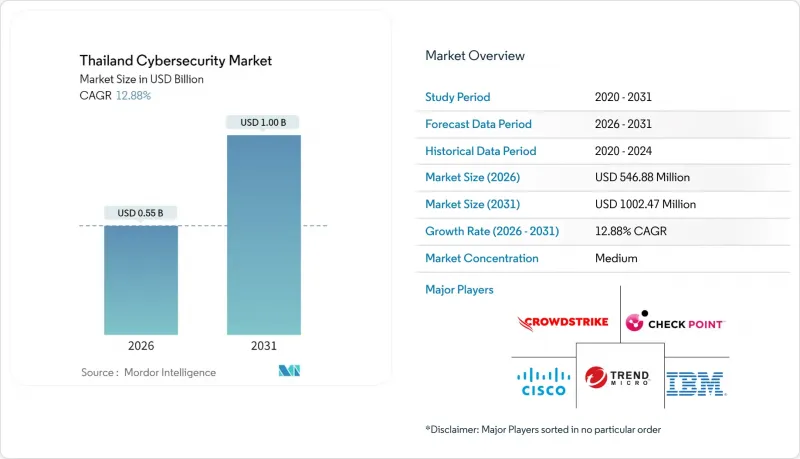
태국의 사이버 보안 시장은 2025년에 4억 8,448만 달러로 평가되었고, 2026년 5억 4,688만 달러에서 2031년까지 10억 247만 달러에 달할 것으로 예측됩니다.
예측 기간(2026-2031년)의 CAGR은 12.88%로 예상됩니다.
결제 시스템의 디지털화, 공공 부문의 클라우드 전환, 산업용 5G 도입으로 위협의 표면적이 확대되고 사이버 보안 지출이 중요 인프라 투자로 전환되고 있습니다. 국가 디지털 ID 플랫폼, PromptPay의 성장, G-Cloud 정책으로 인해 조직은 제로 트러스트 아키텍처와 클라우드 네이티브 보안 제어로의 전환을 추진하고 있습니다. 태국어 지원, PDPA 준수 자동화, 매니지드 서비스 제공이 결합된 벤더는 제품만 제공하는 경쟁사들을 지속적으로 능가하고 있습니다. 인력 부족과 중소기업의 비용 민감도는 여전히 제약 요인이지만, 랜섬웨어 피해 증가와 중요 인프라 규제로 인해 사이버 리스크는 전국적으로 경영진의 핵심 과제로 대두되고 있습니다.
태국의 사이버 보안 시장 동향 및 인사이트
태국 금융 서비스 산업에서 디지털 뱅킹 도입 가속화
2023년, PromptPay는 92억 건의 거래(총 13조 9,000억 태국 바트=4,270억 달러)를 처리하여 모바일 뱅킹과 오픈 API 뱅킹에 새로운 공격 대상 영역을 창출했습니다. 금융기관은 샌드박스 요건을 충족하고 모바일 채널을 보호하기 위해 용도 방화벽, 트랜잭션 수준 이상 징후 분석, ID 오케스트레이션을 도입하고 있습니다. 강력한 인증과 마이크로 세분화에 기반한 제로 트러스트 프레임워크가 방화벽 중심의 설계를 대체하고 있습니다. 지출의 우선순위는 사고 대응에서 금융기관 업무법을 충족하는 지속적인 위협 헌팅으로 전환되고 있습니다. 벤더의 차별화 요소는 컴플라이언스 보고를 자동화하고 하이브리드 환경 전반에서 평균 감지 시간을 단축하는 통합 플랫폼으로 이동하고 있습니다.
정부 클라우드 전환 가속화(G-Cloud 및 NDID)
디지털 정부 개발청은 2025년도에 클라우드 서비스에 10억 바트(3,000만 달러)를 배정하여 각 부처의 G-Cloud 도입에 박차를 가하고 있습니다. NDID 등록자 수가 5,000만 명을 돌파하며, 생체인증 아이덴티티 거버넌스 및 암호키 관리 조달을 촉진하고 있습니다. 각 기관은 2025 웹 사이트 보안 표준을 준수해야 하며, 암호화, 역할 기반 액세스, 사고 대응 플레이북이 의무화되어 있습니다. 국제 벤더들은 NCSA와 양해각서를 체결하고 위협 인텔리전스 피드의 현지화 및 태국어로 된 SOC 교육을 실시했습니다. 멀티 클라우드의 복잡성이 증가함에 따라 클라우드 보안 포지션 관리 및 컴플라이언스 자동화 도구가 입찰 목록을 지배하고 있습니다.
태국어 대응 가능한 사이버 보안 인력 부족
디지털 기술을 충분히 갖춘 국민은 58만 명에 불과하고, IT 분야 연간 졸업생은 약 3,500여 명에 불과합니다. 방콕의 25-30% 임금 상승으로 인해 기업들은 SOC 업무의 외주화 및 프로젝트 연기를 강요당하고 있습니다. 현지화 인증 프로그램이 여전히 부족하기 때문에 ISC2와 NCSA는 2026년까지 1만 명을 양성하는 프로그램을 시작했습니다. 그러나 대부분의 지방 기업들은 보안 도구 관리를 일반 IT 직원에게 의존하고 있어 방어 성숙도가 낮아지고 침해 위험이 증가하고 있습니다. 인력 부족으로 인해 조달 주기가 길어지고, 전문성을 통합한 매니지드 서비스 모델이 유리하게 작용하고 있습니다.
부문 분석
2025년 기준 솔루션 분야가 태국의 사이버 보안 시장 점유율의 최대 60.88%를 차지할 것으로 예상되며, 경계 통제에 대한 의존도가 여전히 남아있음을 보여줍니다. 이 분야는 지사 연결 및 OT 분리에서 여전히 중요하지만, 예산이 클라우드 내결함성으로 이동함에 따라 성장 속도가 느려지고 있습니다. 클라우드 보안은 G-Cloud 도입과 핀테크 및 EC 사업자의 멀티 클라우드 도입에 힘입어 16.05%의 연평균 복합 성장률(CAGR)로 혁신을 주도하고 있습니다. 워크로드 중심의 마이크로 세분화, CASB 기능, 컴플라이언스 대시보드를 통합하는 벤더는 NDID(Network Defense in the Deep)와의 정합성을 원하는 구매자의 니즈에 부합합니다. 기업이 복잡한 최적화 및 기술 부족에 직면하면서 전문 서비스 및 매니지드 서비스가 확대되는 추세입니다. 엔드포인트, 데이터, 아이덴티티 모듈에는 태국어 데이터 세트에서 학습하는 AI 기반 이상 징후 감지 기능이 통합되어 있어 팀의 경보 노이즈를 줄이고 대응을 가속화할 수 있도록 지원합니다.
클라우드 네이티브 보호는 PDPA 및 CII 표준에 대한 구성 벤치마킹을 위한 포지셔닝 관리 도구에 대한 수요도 증가시키고 있습니다. API 기반 뱅킹과 슈퍼 앱 생태계에 따라 용도 보안에 대한 지출이 증가하고 있습니다. 5,273건의 유출 사례로 인해 데이터 보안의 시급성이 대두되면서 결제 워크플로우 내 토큰화 및 DLP 도입이 추진되고 있습니다. 소매업체와 의료기관이 클라우드 전환 시한을 앞두고 민감한 분야의 암호화를 추진하면서 태국의 데이터 중심 제어를 위한 사이버 보안 시장 규모가 확대되고 있습니다. 제공 형태는 하드웨어 어플라이언스에서 위협 인텔리전스, 자동화, 지역별 컴플라이언스 아티팩트를 통합한 SaaS 플랫폼으로 전환되고 있으며, 이러한 추세는 2030년까지 조달 평가 모델의 재구축을 가져올 것으로 예측됩니다.
클라우드 도입은 2025년 태국의 사이버 보안 시장 규모의 64.26%를 차지할 것으로 예상되며, 2031년까지 연평균 복합 성장률(CAGR) 14.20%로 성장할 것으로 전망됩니다. 정부의 '클라우드 우선' 정책, AWS의 50억 달러 규모의 인프라 투자 약속, 마이크로소프트의 정부용 보안 프로그램과 함께 신규 프로젝트가 IaaS와 PaaS로 이동하고 있습니다. 현재 BFSI(은행, 금융, 보험) 규제 당국은 규제 샌드박스 내에서 퍼블릭 클라우드 워크로드를 허용하고 있으며, 은행의 비핵심 용도 마이그레이션과 API 보안 게이트웨이 도입을 촉진하고 있습니다. 국경을 넘나드는 데이터 흐름 요구사항으로 인해 테넌트 관리형 암호화 키와 국가 통신 사업자가 운영하는 소버린 클라우드 존의 채택이 증가하고 있습니다.
On-Premise 솔루션은 에어 갭과 확정적 지연이 중요한 유틸리티, 운송, 레거시 SCADA 사업자에게 여전히 지배적입니다. 플랜트가 OT 네트워크를 클라우드 분석 플랫폼에 연결함에 따라 하이브리드 환경이 부상하고 있습니다. 이를 위해서는 방화벽 어플라이언스와 클라우드 워크로드 에이전트를 아우르는 통합 관리 플레인이 필요합니다. 단일 정책 엔진으로 두 가지 폼팩터를 모두 제공하는 벤더가 인기를 끌고 있습니다. 태국의 사이버 보안 시장에서는 On-Premise 도입 비중이 점차 감소하고 있습니다. 프라이빗 데이터센터 내에서도 업데이트 주기가 가상 폼팩터에 우선순위를 두는 경향이 있기 때문입니다. 5G MEC 노드를 클라우드 대시보드에 통합하는 것은 이러한 수렴하는 도입 추세를 상징합니다.
기타 특전:
- 엑셀 형식 시장 예측(ME) 시트
- 애널리스트 지원(3개월)
자주 묻는 질문
목차
제1장 서론
제2장 조사 방법
제3장 주요 요약
제4장 시장 구도
제5장 시장 규모와 성장 예측
제6장 경쟁 구도
제7장 시장 기회와 향후 전망
LSH 26.03.10The Thailand cybersecurity market was valued at USD 484.48 million in 2025 and estimated to grow from USD 546.88 million in 2026 to reach USD 1002.47 million by 2031, at a CAGR of 12.88% during the forecast period (2026-2031).
Payment-system digitalization, public-sector cloud migration, and industrial 5G adoption are expanding the threat surface and turning cybersecurity spending into critical infrastructure outlays. The National Digital ID platform, PromptPay growth, and G-Cloud policy have pushed organizations toward zero-trust architectures and cloud-native security controls. Vendors that combine Thai-language support, PDPA compliance automation, and managed service delivery continue to out-perform product-only competitors. The talent gap and SME cost sensitivity remain constraints, yet rising ransomware incidents and CII regulations keep cyber risk on executive agendas nationwide.
Thailand Cybersecurity Market Trends and Insights
Accelerated Digital-Banking Adoption in Thai BFSI
PromptPay processed 9.2 billion transactions worth THB 13.9 trillion (USD 0.427 trillion ) in 2023, exposing new attack surfaces in mobile and open-API banking. Financial institutions are deploying application firewalls, transaction-level anomaly analytics, and identity orchestration to meet sandbox requirements and protect mobile channels. Zero-trust frameworks built on strong authentication and micro-segmentation are replacing firewall-centric designs. Spending priorities are shifting from incident response toward continuous threat hunting that satisfies the Financial Institutions Business Act. Vendor differentiation now favors integrated platforms that automate compliance reporting and reduce mean-time-to-detect across hybrid environments.
Fast-Track Government Cloud Migration (G-Cloud and NDID)
The Digital Government Development Agency allocated THB 1 billion (USD 0.03 billion) for cloud services in FY 2025, accelerating G-Cloud rollouts across ministries. NDID enrollment has surpassed 50 million citizens, driving procurement of biometric identity governance and encryption key management. Agencies must comply with the 2025 Website Security Standard, which mandates encryption, role-based access, and incident response playbooks. International vendors have entered memoranda with NCSA to localize threat-intelligence feeds and Thai-language SOC training. Cloud security posture management and compliance automation tools dominate tender lists as multi-cloud complexity rises.
Shortage of Thai-Language Cybersecurity Talent
Only 0.58 million citizens possess adequate digital skills, and annual IT graduate output is roughly 3,500 professionals. Salary inflation of 25-30% in Bangkok prompts firms to outsource SOC operations or delay projects. Localized certification pathways remain scarce, so ISC2 and NCSA launched a program to train 10,000 practitioners by 2026. Nevertheless, most provincial enterprises rely on generalist IT staff to manage security tooling, lowering defense maturity and elevating breach risk. The talent shortfall prolongs procurement cycles and favors managed service models that embed expertise.
Other drivers and restraints analyzed in the detailed report include:
- 5G Rollout Spurring IoT-Edge Security Demand
- Rapid Growth of Thailand E-Commerce GMV
- Price-Sensitive SME Buyer Behavior
For complete list of drivers and restraints, kindly check the Table Of Contents.
Segment Analysis
Solutions held the largest 60.88% Thailand cybersecurity market share in 2025, underscoring the residual reliance on perimeter controls. The segment remains vital for branch connectivity and OT segregation, but its growth pace is moderating as budgets pivot to cloud resilience. Cloud Security leads the innovation curve with a 16.05% CAGR, propelled by G-Cloud rollouts and multi-cloud adoption among fintech and e-commerce operators. Vendors that fuse workload-centric micro-segmentation, CASB functions, and compliance dashboards resonate with buyers seeking NDID alignment. Professional Services and Managed Services expand as enterprises confront complex optimization and skills shortages. Endpoint, data, and identity modules integrate AI-based anomaly detection that learns from Thai-language data sets, helping teams cut alert noise and accelerate response.
Cloud-native protection also amplifies demand for posture-management tools that benchmark configurations against PDPA and CII baselines. Application Security spending rises alongside API-driven banking and super-app ecosystems. Data Security urgency grows after 5,273 leak cases, pushing tokenization and DLP adoption inside payment workflows. Thailand cybersecurity market size for data-centric controls is climbing as retailers and hospitals encrypt sensitive fields ahead of cloud migration deadlines. The offering mix is shifting from hardware appliances toward SaaS platforms that bundle threat intelligence, automation, and localized compliance artifacts, a trend expected to reshape procurement scoring models by 2030.
Cloud deployments captured 64.26% share of the Thailand cybersecurity market size in 2025 and are set to grow at a 14.20% CAGR through 2031. The government's Cloud First policy, AWS's USD 5 billion infrastructure pledge, and Microsoft's Government Security Program have tipped new projects toward IaaS and PaaS. BFSI regulators now permit public cloud workloads in regulatory sandboxes, encouraging banks to migrate non-core applications and adopt API security gateways. Cross-border data-flow requirements drive uptake of tenant-controlled encryption keys and sovereign cloud zones operated by National Telecom.
On-premise solutions still hold sway in utilities, transport, and legacy SCADA operators where air-gaps and deterministic latency matter. Hybrid environments emerge as plants connect OT networks to cloud analytics platforms, requiring unified management planes that span firewall appliances and cloud workload agents. Vendors supplying both form factors with a single policy engine win favor. Thailand cybersecurity market share for on-premise deployments gradually declines as refresh cycles favor virtual form factors even inside private data centers. Integration of 5G MEC nodes into cloud dashboards exemplifies the converging deployment story.
The Thailand Cybersecurity Market Report is Segmented by Offering (Solutions, Services), Deployment Mode (On-Premise, Cloud), End-User Vertical (BFSI, Healthcare, IT and Telecom, and More), End-User Enterprise Size (Small and Medium Enterprises, Large Enterprises). The Market Forecasts are Provided in Terms of Value (USD).
List of Companies Covered in this Report:
- Cisco Systems, Inc.
- Palo Alto Networks, Inc.
- Fortinet, Inc.
- Check Point Software Technologies Ltd.
- Trend Micro Incorporated
- CrowdStrike Holdings, Inc.
- McAfee LLC
- International Business Machines Corporation
- Microsoft Corporation
- Amazon Web Services, Inc.
- Atos SE
- Thales Group
- NEC Corporation
- Accenture plc
- Deloitte Touche Tohmatsu Ltd.
- MFEC Public Company Limited
- G-Able Company Limited
- ACinfotec Company Limited
- National Telecom Public Company Limited
- Bangkok Systems and Software Co., Ltd.
Additional Benefits:
- The market estimate (ME) sheet in Excel format
- 3 months of analyst support
TABLE OF CONTENTS
1 INTRODUCTION
- 1.1 Study Assumptions and Market Definition
- 1.2 Scope of the Study
2 RESEARCH METHODOLOGY
3 EXECUTIVE SUMMARY
4 MARKET LANDSCAPE
- 4.1 Market Overview
- 4.2 Market Drivers
- 4.2.1 Accelerated digital-banking adoption in Thai BFSI
- 4.2.2 Fast-track government cloud migration (G-Cloud and NDID)
- 4.2.3 5G rollout spurring IoT-edge security demand
- 4.2.4 Rapid growth of Thailand E-commerce GMV
- 4.2.5 Surge in ransomware-as-a-service attacks on SMEs
- 4.2.6 OT/ICS security gaps in Eastern Economic Corridor
- 4.3 Market Restraints
- 4.3.1 Shortage of Thai-language cybersecurity talent
- 4.3.2 Price-sensitive SME buyer behavior
- 4.3.3 Legacy critical-infrastructure systems difficult to patch
- 4.3.4 Fragmented cyber-insurance landscape
- 4.4 Industry Value Chain Analysis
- 4.5 Porter's Five Forces
- 4.5.1 Bargaining Power of Suppliers
- 4.5.2 Bargaining Power of Buyers
- 4.5.3 Threat of New Entrants
- 4.5.4 Threat of Substitutes
- 4.5.5 Competitive Rivalry
- 4.6 Impact of Macroeconomic Factors on the Market
- 4.7 Regulatory Landscape
- 4.8 Technological Outlook
5 MARKET SIZE AND GROWTH FORECASTS (VALUE)
- 5.1 By Offering
- 5.1.1 Solutions
- 5.1.1.1 Application Security
- 5.1.1.2 Cloud Security
- 5.1.1.3 Data Security
- 5.1.1.4 Identity and Access Management
- 5.1.1.5 Infrastructure Protection
- 5.1.1.6 Integrated Risk Management
- 5.1.1.7 Network Security Equipment
- 5.1.1.8 Endpoint Security
- 5.1.2 Services
- 5.1.2.1 Professional Services
- 5.1.2.2 Managed Services
- 5.1.1 Solutions
- 5.2 By Deployment Mode
- 5.2.1 On-Premise
- 5.2.2 Cloud
- 5.3 By End-User Vertical
- 5.3.1 BFSI
- 5.3.2 Healthcare
- 5.3.3 IT and Telecom
- 5.3.4 Industrial and Defense
- 5.3.5 Manufacturing
- 5.3.6 Retail and E-commerce
- 5.3.7 Energy and Utilities
- 5.3.8 Others
- 5.4 By Enterprise Size
- 5.4.1 Small and Medium Enterprises (SMEs)
- 5.4.2 Large Enterprises
6 COMPETITIVE LANDSCAPE
- 6.1 Market Concentration
- 6.2 Strategic Moves
- 6.3 Market Share Analysis
- 6.4 Company Profiles {(includes Global level Overview, Market level overview, Core Segments, Financials as available, Strategic Information, Market Rank/Share for key companies, Products and Services, and Recent Developments)}
- 6.4.1 Cisco Systems, Inc.
- 6.4.2 Palo Alto Networks, Inc.
- 6.4.3 Fortinet, Inc.
- 6.4.4 Check Point Software Technologies Ltd.
- 6.4.5 Trend Micro Incorporated
- 6.4.6 CrowdStrike Holdings, Inc.
- 6.4.7 McAfee LLC
- 6.4.8 International Business Machines Corporation
- 6.4.9 Microsoft Corporation
- 6.4.10 Amazon Web Services, Inc.
- 6.4.11 Atos SE
- 6.4.12 Thales Group
- 6.4.13 NEC Corporation
- 6.4.14 Accenture plc
- 6.4.15 Deloitte Touche Tohmatsu Ltd.
- 6.4.16 MFEC Public Company Limited
- 6.4.17 G-Able Company Limited
- 6.4.18 ACinfotec Company Limited
- 6.4.19 National Telecom Public Company Limited
- 6.4.20 Bangkok Systems and Software Co., Ltd.
7 MARKET OPPORTUNITIES AND FUTURE OUTLOOK
- 7.1 White-space and Unmet-Need Assessment