

|
시장보고서
상품코드
1940811
영국의 지역 난방 : 시장 점유율 분석, 업계 동향과 통계, 성장 예측(2026-2031년)United Kingdom District Heating - Market Share Analysis, Industry Trends & Statistics, Growth Forecasts (2026 - 2031) |
||||||
 Mordor Intelligence
영국의 지역 난방 시장은 2025년에 15억 4,000만 달러로 평가되었고, 2026년 15억 9,000만 달러에서 2031년까지 18억 6,000만 달러에 이를 것으로 예측됩니다.
예측 기간(2026-2031년)의 CAGR은 3.17%로 예상됩니다.
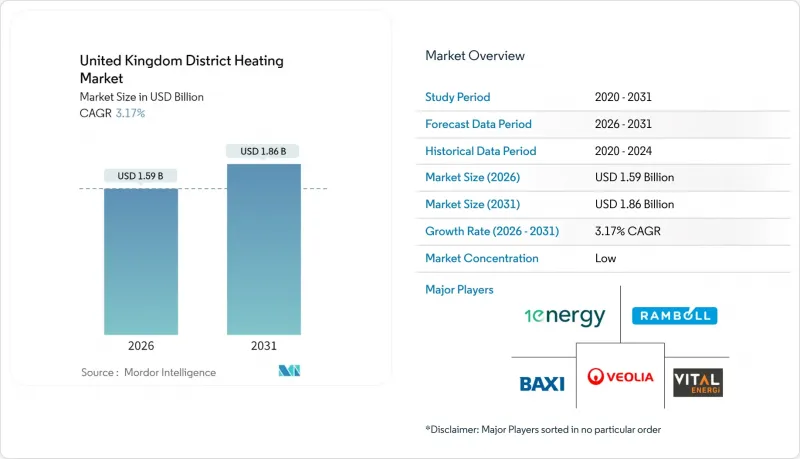
이 예측은 가스 의존형 자산에서 저탄소 히트펌프, 폐열회수, 대규모 열 저장으로 전체 시스템의 전환을 반영하고 있습니다. 의무화된 열 네트워크 구역 지정으로 법적 구속력이 있는 연결 구역이 설정되어 고객 확보에 대한 리스크를 줄일 수 있습니다. 한편, 녹색열 네트워크 기금은 폐기물 열에너지와 재생가능 전력을 이용하는 프로젝트의 자본 지출을 줄여줍니다. 정부 보조금은 현재 검증 가능한 탄소 감축을 실현할 수 있는 계획을 우선시하고 있으며, 사업자들은 하천, 광산수, 폐수 열원과 네트워크로 연결된 지열 히트펌프를 결합한 시스템 도입을 장려하고 있습니다. 투자자들은 이러한 정책적 신호에 반응하고 있습니다. 기관투자가들은 전문적 관리 하에 파편화된 네트워크를 통합하는 자산 롤업을 강화하고, 12시간 스토리지 피트와 같은 기술 업그레이드를 가속화하고 있습니다. 숙련된 노동력과 금속품공급망 제약은 여전히 역풍으로 작용하고 있지만, Ofgem(영국 에너지 시장 규제 기관)이 도입할 예정인 소비자 보호 제도는 최종 사용자의 신뢰를 강화하고 연결률 향상을 촉진할 것으로 기대됩니다.
영국의 지역 열 공급 시장 동향 및 전망
2025-26년도부터 법정 열 네트워크 구역 지정
열 네트워크 구역 지정을 통해 지방정부는 정해진 경계 내에서 고객 연결을 의무화할 수 있는 법적 권한을 획득하고, 상업적 타당성에 필수적인 열 밀도를 확보할 수 있습니다. 에너지 안보 및 넷제로부는 16개 지역을 대상으로 한 기회 보고서를 발표하여 버밍엄, 리즈, 뉴캐슬에 신축 건물 및 많은 개보수 대상지를 포함하는 의무 구역을 수립하도록 지도했습니다. 이 구역 지정은 지역 열 공급을 임의 기술에서 의무화하여 사업자 수요 리스크를 줄이고 장기 투자자에게 매력적인 예측 가능한 수익원을 제공하게 됩니다. 개발 사업자는 네트워크 규모와 단계적 확장에 대한 명확성을 얻을 수 있는 반면, 기존 건물 소유자는 탈탄소화에 대한 명확한 기한에 직면하게 됩니다. 따라서 본 정책은 신속한 자본투입과 검증된 운영 능력을 갖춘 네트워크 소유자에게 시장 지배력을 이전하는 정책입니다.
그린히트네트워크 기금 및 HNES 보조금
그린 히트 네트워크 기금은 설립 이래 3억 8,000만 파운드(4억 7,500만 달러) 이상을 지원했으며, 여기에는 리즈 에어 밸리 열전 네트워크에 1,950만 파운드, 런던대학교 블룸즈베리 에너지 네트워크에 7억 2,000만 파운드가 포함됩니다. 포함됩니다. 보조금은 가중평균자본비용을 낮추고, 폐기물 유래 대형 열원 개발을 촉진하며, 내부수익률을 최대 2%까지 향상시킬 수 있습니다. 채택 기준은 폐열회수와 히트펌프가 결합된 프로젝트를 평가 대상으로 하고 있으며, 50gCO2/kWh 미만의 목표를 달성할 수 있는 하이브리드 구성으로 시장 설계를 유도하고 있습니다. 자금조달의 확실성은 민간 금융기관의 진입을 촉진하고 있으며, 여러 시중은행들이 선순위 채권 발행 시 GHNF 보조금을 리스크 완화 수단으로 인정하고 있습니다.
초기 설비투자 급증
2024년부터 2025년까지 자재 인플레이션으로 인해 단열재 가격이 2-11.7% 상승했고, 구리 및 철강재 가격 변동으로 인해 대차대조표에 추가적인 부담을 가중시켰습니다. 얼루프의 추정에 따르면, 지열 네트워크의 건설 비용은 MWth당 200-400만 파운드이며, 시추 비용만 해도 지출의 최대 45%를 차지합니다. 이러한 자본 집약성은 회수 기간을 연장하고, 소규모 개발사의 자금 조달 가능성을 제한합니다. GHNF 보조금은 타당성 조사 및 인허가 단계에서 침몰 비용의 위험을 완화하지만, 완전히 제거하지는 않습니다. 이에 따라, 주식 투자자들은 더 높은 내부 수익률을 요구하고, 앵커 부하나 장기 열 구매 계약이 없는 프로젝트의 자금 조달 완료를 지연시키고 있습니다.
부문 분석
2025년 기준, 주택 연결이 영국의 지역 열 공급 시장의 57.60%를 차지했습니다. 이는 도시형 주택단지 및 복합용도 재개발 계획의 높은 열밀도가 기여하고 있습니다. 사회주택 시범사업은 그 가치 제안을 뒷받침하고 있으며, SHIELD 시험에서 저소득층 임대료의 40% 절감 가능성을 보여주면서 집주인의 개보수 의무도 충족하고 있습니다. 비주거용 수요는 ESG 요건과 공공 부문의 순 제로 목표에 힘입어 연평균 4.41%의 연평균 복합 성장률(CAGR)로 성장하고 있습니다. 대학과 병원은 자본 보조금과 장기 자산 계획을 배경으로 기저부하 수요를 고정하는 수 메가 와트 규모의 확장을 추진하고 있습니다.
상업용 부동산 소유주들은 미래의 건물 배출세 대책으로 열 네트워크를 헤지 수단으로 인식하는 경향이 강해지고 있습니다. 임대차 계약 시 운영단계의 탄소배출량 공개 의무화로 저탄소 계수를 보장하는 네트워크로의 전환이 촉진되고 있습니다. 한편, 지방정부는 주택용과 공공용 수요를 통합하여 규모의 경제를 실현하고, 대상 고객층을 더욱 확대하고 있습니다. 이를 통해 형성된 복합 고객 구성은 현금흐름을 안정화시키고, 민간 부채 시장에서 재융자를 가능하게 하며, 영국의 지역 열 공급 시장의 성장 궤도를 뒷받침하고 있습니다.
2025년 기준, 가스 연소 CHP는 영국의 지역 열 공급 시장 규모의 70.85%를 차지하고 있으나, 탄소 가격 책정 및 바이오매스 지속가능성 규제가 강화됨에 따라 그 우위는 감소하는 추세입니다. 저탄소 히트펌프 및 폐열 시스템은 CAGR 5.08%로 성장하고 있으며, 이는 GHNF 점수에서 높은 등급을 받을 수 있는 자격과 낮은 라이프사이클 배출량을 반영하고 있습니다. MEL Heat Network는 밀러힐 폐기물 발전시설에서 폐열을 회수하여 대형 히트펌프로 증강하여 쇼페어타운에 공급하고 있습니다. Vattenfall의 추정에 따르면, 이 하이브리드 시스템은 기준 배출량의 최대 90%를 줄일 수 있을 것으로 예측됩니다.
지열시스템은 주택단지 간 수직 시추공을 공유하는 네트워크형 배열로 규모 확대가 가능하며, 세대당 굴착비용을 1/3로 절감할 수 있습니다. 공기열원 유닛은 단독 공급원이 아닌 여름철 보조 열원으로 활용되는 경향이 강해져 계절별 성능 최적화가 이루어지고 있습니다. 도시에서는 미세먼지 규제로 인해 바이오매스가 여전히 틈새 시장으로 남아있지만, 지방의 단지에서는 지역 원료의 활용이 계속되고 있습니다. 내재해성 확보를 위해 백업용 가스보일러는 존치하고, 축열기술과 수요반응 개선에 따라 가동시간은 감소하는 추세입니다.
기타 특전:
- 엑셀 형식 시장 예측(ME) 시트
- 애널리스트의 3개월간 지원
자주 묻는 질문
목차
제1장 서론
제2장 조사 방법
제3장 주요 요약
제4장 시장 구도
제5장 시장 규모와 성장 예측
제6장 경쟁 구도
제7장 시장 기회와 향후 전망
LSH 26.03.11The UK district heating market was valued at USD 1.54 billion in 2025 and estimated to grow from USD 1.59 billion in 2026 to reach USD 1.86 billion by 2031, at a CAGR of 3.17% during the forecast period (2026-2031).
This measured trajectory reflects the systemwide pivot from gas-dominant assets toward low-carbon heat pumps, waste-heat recovery, and large-scale thermal storage. Mandatory heat-network zoning is creating legally enforceable connection areas that de-risk customer acquisition, while the Green Heat Network Fund reduces capital outlay for projects integrating energy-from-waste heat or renewable electricity. Government grants now prioritize schemes delivering verifiable carbon cuts, prompting operators to blend river, mine-water, and wastewater heat with networked ground-source heat pumps. Investors are responding to these policy signals: institutional capital has intensified asset roll-ups that pool fragmented networks under professional management, accelerating technology upgrades such as 12-hour storage pits. Supply-chain constraints in skilled labour and metal commodities remain headwinds, yet Ofgem's incoming consumer-protection regime is expected to strengthen end-user confidence and encourage higher connection rates.
United Kingdom District Heating Market Trends and Insights
Statutory heat-network zoning from 2025-26
Heat-network zoning gives local authorities legal power to mandate customer connections within defined boundaries, securing the heat density essential for commercial viability. The Department for Energy Security and Net Zero released opportunity reports for 16 areas, guiding Birmingham, Leeds, and Newcastle to map mandatory zones that cover new builds and many retrofit sites. Zoning transforms district heating from an optional technology into a compliance obligation, lowering demand risk for operators and offering predictable revenue streams attractive to long-term investors. Developers gain clarity on network sizing and phased expansion, while existing building owners face clear deadlines to decarbonize. The policy, therefore, shifts market power toward network owners capable of rapid capital deployment and proven operational competence.
Green Heat Network Fund and HNES grants
The Green Heat Network Fund has disbursed more than GBP 380 million (USD 475 million) since launch, including GBP 19.5 million for Leeds's Aire Valley Heat and Power Network and GBP 7.2 million for the University of London's Bloomsbury Energy Network. Grants reduce the weighted average cost of capital, unlock large energy-from-waste heat sources, and improve internal rates of return by up to 2 percentage points. Award criteria reward projects that combine waste-heat capture with heat pumps, pushing market design toward hybrid configurations that can meet sub-50 gCO2/kWh targets. Funding certainty has also catalysed private lenders; several commercial banks now accept GHNF awards as de-risking instruments when structuring senior debt.
High front-end capex
Material inflation lifted insulation prices by 2-11.7% during 2024-2025, while copper and steel volatility added further strain to balance sheets. Arup estimates geothermal networks cost GBP 2-4 million per MWth, with drilling alone accounting for up to 45% of expenditure. The capital intensity lengthens payback horizons and limits bankability for smaller developers. GHNF grants soften but do not eliminate the risk of sunk costs during feasibility and permitting. Equity investors, therefore, demand higher internal returns, slowing financial close for projects without anchor loads or long-term heat-offtake agreements.
Other drivers and restraints analyzed in the detailed report include:
- Waste-heat capture mandate (EfW and sewage)
- Falling cost of river and mine-water heat pumps
- Gas-power price-spread volatility
For complete list of drivers and restraints, kindly check the Table Of Contents.
Segment Analysis
Residential connections delivered 57.60% of UK district heating market share in 2025, benefiting from higher heat density in urban housing estates and mixed-use regeneration schemes. Social housing pilots underline the value proposition: the SHIELD trial indicates potential bill cuts of 40% for low-income tenants while meeting landlord retrofit obligations. Non-domestic demand is gaining momentum at 4.41% CAGR, driven by ESG imperatives and public-sector net-zero targets. Universities and hospitals, armed with capital grants and long asset-life planning horizons, now underwrite multi-megawatt expansions that lock in baseload demand.
Commercial property owners increasingly view heat networks as a hedge against future building-emissions taxes. Mandatory disclosure of operational carbon in leasing contracts pushes landlords toward networks that guarantee low-carbon coefficients. Meanwhile, local authorities bundle residential and municipal loads to unlock economies of scale, further widening the addressable base. The resulting blended customer mix stabilizes cash flows, positioning schemes for refinancing in private debt markets, and supporting the UK district heating market growth trajectory.
Gas-fired CHP retained 70.85% of UK district heating market size in 2025, though its dominance is eroding as carbon pricing and biomass-sustainability rules tighten. Low-carbon heat pumps and waste-heat systems expand at 5.08% CAGR, reflecting their eligibility for higher GHNF scoring and lower lifecycle emissions. The MEL Heat Network captures waste heat from the Millerhill Energy-from-Waste facility and boosts it with large heat pumps to serve Shawfair Town; Vattenfall calculates the hybrid system will avoid up to 90% of baseline emissions.
Ground-source configurations gain scale through networked arrays that share vertical boreholes across housing clusters, cutting per-dwelling drill costs by one-third. Air-source units increasingly act as summer top-up rather than sole supply, optimizing seasonal performance. Biomass remains niche in urban areas due to particulate limits, though rural estates still exploit local feedstock. Backup gas boilers persist for resilience, yet their runtime falls as storage and demand response improve.
The United Kingdom District Heating Market Report is Segmented by End User (Residential/Domestic, and Non-Domestic), Primary Heat Source (Gas-CHP, Low-Carbon HP and Waste-Heat, and More), Sector and Customer (Mixed-Use Regeneration District, Public and Social Housing, and More), Thermal-Storage Usage (No Integrated Storage, >=2 H Hot-Water Tanks, and >=12 H Pit/Tank Storage). The Market Forecasts are Provided in Terms of Value (USD).
List of Companies Covered in this Report:
- Vital Energi Utilities Ltd.
- 1Energy Group Ltd.
- Baxi Heating UK Ltd.
- Ramboll UK Ltd.
- Veolia Environnement SA
- Sweco UK Ltd.
- Vattenfall Heat UK Ltd.
- Equans Services Ltd.
- E.ON UK plc
- SSE Heat Networks Ltd.
- Metropolitan Infrastructure Ltd.
- ThamesWey Energy Ltd.
- Pinnacle Power Ltd.
- Fortum Carlisle Heat Networks Ltd.
- Cory Heat Networks Ltd.
- Kensa Utilities Ltd.
- Ener-Vate Ltd.
- Centrica Business Solutions UK Ltd.
- ENGIE (Energy Solutions UK) Ltd.
- Danpower UK Ltd.
Additional Benefits:
- The market estimate (ME) sheet in Excel format
- 3 months of analyst support
TABLE OF CONTENTS
1 INTRODUCTION
- 1.1 Study Assumptions and Market Definition
- 1.2 Scope of the Study
2 RESEARCH METHODOLOGY
3 EXECUTIVE SUMMARY
4 MARKET LANDSCAPE
- 4.1 Market Overview
- 4.2 Market Drivers
- 4.2.1 Statutory heat-network zoning from 2025-26
- 4.2.2 Green Heat Network Fund and HNES grants
- 4.2.3 Waste-heat capture mandate (EfW and sewage)
- 4.2.4 Falling cost of river/mine-water heat pumps
- 4.2.5 Mandatory landlord tariff disclosure
- 4.2.6 Aggregation of thermal storage into ESO flexibility
- 4.3 Market Restraints
- 4.3.1 High front-end capex
- 4.3.2 Gas-power price-spread volatility
- 4.3.3 Skilled-labour shortage (pipe-welders/HIU)
- 4.3.4 Consumer "monopoly billing" perception
- 4.4 Industry Value-Chain Analysis
- 4.5 Regulatory Landscape
- 4.6 Technological Outlook
- 4.7 Porter"s Five Forces Analysis
- 4.7.1 Bargaining Power of Suppliers
- 4.7.2 Bargaining Power of Buyers
- 4.7.3 Threat of New Entrants
- 4.7.4 Threat of Substitutes
- 4.7.5 Intensity of Competitive Rivalry
5 MARKET SIZE AND GROWTH FORECASTS (VALUE)
- 5.1 By End User
- 5.1.1 Residential / Domestic
- 5.1.2 Non-domestic
- 5.2 By Primary Heat Source
- 5.2.1 Gas-CHP
- 5.2.2 Low-carbon HP and Waste-heat
- 5.2.3 Biomass / Biogas
- 5.2.4 Other back-up (gas, electric)
- 5.3 By Sector and Customer
- 5.3.1 Mixed-use regeneration districts
- 5.3.2 Public and Social Housing
- 5.3.3 Universities and Hospitals
- 5.3.4 Commercial / Retail Parks
- 5.4 By Thermal-Storage Usage
- 5.4.1 No integrated storage
- 5.4.2 >=2 h hot-water tanks
- 5.4.3 >=12 h pit / tank storage
6 COMPETITIVE LANDSCAPE
- 6.1 Market Concentration
- 6.2 Strategic Moves
- 6.3 Market Share Analysis
- 6.4 Company Profiles (includes Global level Overview, Market level overview, Core Segments, Financials as available, Strategic Information, Market Rank/Share for key companies, Products and Services, and Recent Developments)
- 6.4.1 Vital Energi Utilities Ltd.
- 6.4.2 1Energy Group Ltd.
- 6.4.3 Baxi Heating UK Ltd.
- 6.4.4 Ramboll UK Ltd.
- 6.4.5 Veolia Environnement SA
- 6.4.6 Sweco UK Ltd.
- 6.4.7 Vattenfall Heat UK Ltd.
- 6.4.8 Equans Services Ltd.
- 6.4.9 E.ON UK plc
- 6.4.10 SSE Heat Networks Ltd.
- 6.4.11 Metropolitan Infrastructure Ltd.
- 6.4.12 ThamesWey Energy Ltd.
- 6.4.13 Pinnacle Power Ltd.
- 6.4.14 Fortum Carlisle Heat Networks Ltd.
- 6.4.15 Cory Heat Networks Ltd.
- 6.4.16 Kensa Utilities Ltd.
- 6.4.17 Ener-Vate Ltd.
- 6.4.18 Centrica Business Solutions UK Ltd.
- 6.4.19 ENGIE (Energy Solutions UK) Ltd.
- 6.4.20 Danpower UK Ltd.
7 MARKET OPPORTUNITIES AND FUTURE OUTLOOK
- 7.1 White-space and Unmet-Need Assessment


