|
시장보고서
상품코드
1940839
미국의 비료 : 시장 점유율 분석, 업계 동향과 통계, 성장 예측(2026-2031년)United States Fertilizers - Market Share Analysis, Industry Trends & Statistics, Growth Forecasts (2026 - 2031) |
||||||
 Mordor Intelligence
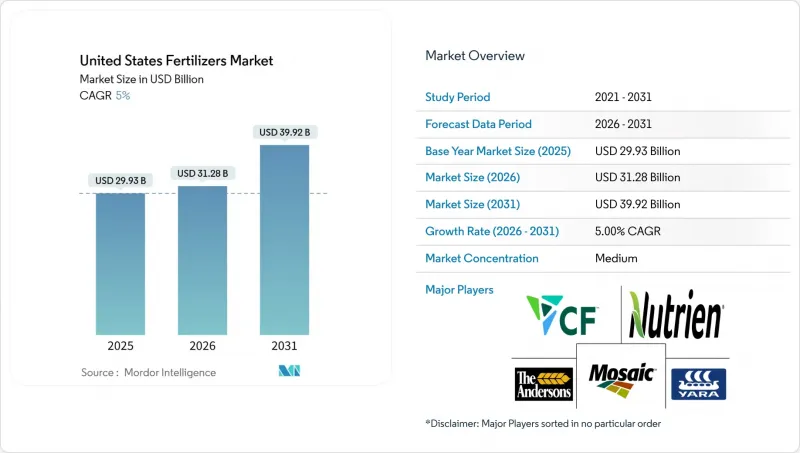
미국의 비료 시장은 2025년 299억 2,000만 달러에서 2026년에는 313억 달러로 성장하고, 2026-2031년 CAGR 4.62%로 성장을 지속하여, 2031년까지 392억 3,000만 달러에 이를 것으로 예측됩니다.
작물 영양소에 대한 강한 수요, 정밀농업 도입 확대, 고효율 비료 사용을 장려하는 정책적 인센티브가 규제 압력 증가에도 불구하고 수익 성장을 뒷받침하고 있습니다. 생산업체들은 천연가스 가격 변동 위험을 헤지하고 새로운 지속가능성 기준을 충족하기 위해 미국 멕시코만 지역의 청정 암모니아 생산 능력에 투자하고 있습니다. 한편, 미시시피 강 회랑의 복합운송 물류망 강화로 중서부 농가의 운송비용이 낮아져 원자재 가격 급등에 대한 시장의 흡수력이 높아지고 있습니다. 경쟁이 심화되고 있으며, 상위 5개 공급업체는 수직계열화 추진, 디지털 농업 플랫폼 확대, 특수 비료 및 방출 조절 비료로의 포트폴리오 재편 등을 추진하고 있습니다.
미국의 비료 시장 동향과 인사이트
정밀농업 도입 현황
가변 시비 시스템은 현재 옥수수와 콩 재배 면적의 70%에서 비료 배치를 유도하여 수확량을 보장하면서 질소 사용량을 15-20% 절감하고 있습니다. 아이오와주와 일리노이주에서는 도입률이 85%를 넘어섰으며, 위성영상, 토양 센서, 수확량 매핑이 연계되어 실행 가능한 처방을 제공합니다. 뉴트리엔은 센서 데이터와 제품 추천을 통합하는 디지털 농업학 플랫폼에 연간 2억 달러를 투자하고 있습니다. 이 모델은 자문 서비스를 판매와 연계하면서 영양소 이용 효율을 향상시키는 모델입니다. 더 많은 생산자들이 비용 절감과 생산성 향상을 체감함에 따라, 이 기술은 구매 결정을 '양'에서 '가치'로 전환하고, 작물 수요에 맞는 영양분 공급을 실현하는 서방형 제품의 채택을 촉진하고 있습니다. 감사원의 모델 추정에 따르면, 업계 전체가 도입하면 생산량을 희생하지 않고도 전국적으로 비료 사용량을 최대 12%까지 줄일 수 있다고 합니다. 이러한 데이터 기반 관리로의 전환은 미국의 비료 시장의 구조적 성장의 열쇠가 될 것입니다.
고효율 비료로의 전환
IRS 고시 2024-37에 따라 지속 가능한 항공 연료 크레딧(갤런당 1.75달러)은 질소 이용 효율 개선 증명과 연동되어 서방형 요소, 질산화 억제제 및 요소 분해 효소 억제제에 대한 수요가 크게 증가하고 있습니다. 이에 따라 생산자들은 생산능력 확대를 추진하고 있습니다. CF 인더스트리즈는 도널드슨빌 공장의 서방형 우레아 생산 시설 개보수에 미화 1억 5,000만 달러를 투자했으며, 바이엘의 탄소 프로그램은 농장에서의 직접적인 온실가스 감축을 증명하는 12만 5,000개 이상의 크레딧을 발행하고 있습니다. 발행하고 있습니다. 탄소시장과 세제정책이 융합되면서 수요는 틈새 원예분야에서 주요 농산물 재배면적으로 옮겨가고 있으며, 고객기반 확대와 특수배합 제품 공급업체의 매출 성장을 가속화하고 있습니다.
천연가스 가격 변동성
2024년 헨리허브 가격은 MMBtu당 2.10달러에서 6.80달러 사이를 오가며 224%의 변동폭을 기록했습니다. 원료비가 암모니아 생산 비용의 최대 80%를 차지하기 때문에 이러한 변동폭은 질소 생산 비용에 거의 직접적인 영향을 미칩니다. CF 인더스트리즈(CF Industries)에 따르면, 1달러의 가격 변동에 따라 연간 이익은 최대 5,500만 달러까지 변동합니다. 헤지 계약이 없는 소규모 생산자들은 2024년 3분기에 현물 가스 가격이 6달러를 돌파했을 때 생산량을 줄였습니다. 이로 인해 공급이 타이트해진 반면, 가격에 민감한 생산자층 수요는 억제되었습니다. 일리노이 대학의 분석에 따르면, 가스 가격이 5달러 이상 지속될 경우, 농부들이 저비용 대안을 찾기 위해 농약 사용량이 최대 12%까지 감소할 것으로 예상했습니다. 따라서 이러한 변동성은 단기적으로 총 영양소 소비를 억제하는 요인으로 작용합니다.
부문 분석
단일 비료는 토양 고유의 결핍을 목표로 하는 정밀 가변 비료 처방과 일치하기 때문에 2025년 미국의 비료 시장 매출의 77.35%를 차지했습니다. 옥수수와 대두의 재배 면적이 꾸준히 증가하면서 미국 단일 비료 시장 규모는 2031년까지 연평균 복합 성장률(CAGR) 4.74%로 확대될 것으로 예측됩니다. 옥수수 재배면적은 2024년 9,410만 에이커에 달할 것으로 예상되며, 고질소 시비량에 대한 의존도가 지속되고 있어 안정적인 수요가 예상됩니다. 복합비료의 경우, 일률적인 영양소 비율이 현장별 처방과 일치하지 않는 경우가 많아 생육을 제한하는 경우가 많습니다. 아연, 붕소 등 미량 영양소는 그리드 토양 샘플링을 통해 집약적 윤작에서 수확량 제한 요인이 되는 결핍이 확인됨에 따라 매년 15-20%씩 증가하고 있습니다. 2차 영양소, 특히 유황에 대한 수요는 회복 추세에 있습니다. 이는 1990년 이후 산업유래의 황 침착이 급격히 감소하여 많은 토양이 충족 기준치 이하로 떨어졌기 때문입니다.
대규모 경영에서는 소매점에서 판매 시점에 정확한 배합을 조정할 수 있기 때문에 현장 수준의 경제성 때문에 여전히 단일 영양소 비료가 선호됩니다. 그러나 소규모 농장이나 시비 서비스가 제한된 지역에서는 편의성 때문에 복합비료의 사용이 계속되고 있습니다. 미국 내 미량 영양소 첨가제 비료 시장 점유율은 더 많은 주에서 광범위한 결핍이 확인됨에 따라 상승할 것으로 예측됩니다. 미네소타와 노스다코타 주에서 철분제를 집중 살포한 결과, 콩 수확량을 에이커당 최대 12부셸까지 증가시켜 투자 대비 효과를 입증했습니다. 따라서 생산자들은 고수익의 새로운 수익원을 확보하기 위해 미량 영양소를 벌크 NPK 혼합비료와 함께 포장하여 고수익을 창출하고 있습니다. 단일 제품이 가장 큰 점유율을 유지하는 반면, 보조 영양제는 점진적인 성장을 가져올 것입니다.
기존 과립형 및 프릴 비료는 잘 구축된 공급망, 낮은 단가, 기존 살포기와의 호환성으로 인해 2025년 매출의 76.10%를 차지했습니다. 그러나 생산자들이 환경 규제 준수와 영양소 이용 효율을 중시하는 경향이 강화되면서 특수 배합 비료는 CAGR 5.18%로 성장하고 있습니다. 고분자 코팅 우레아 등 서방형 비료는 작물의 흡수 시기에 맞추어 안정적인 질소 공급이 가능하여 옥수수 벨트 지역의 옥수수 재배 시스템에서 25%의 채용 확대를 실현하고 있습니다. 미국 내 특수형 비료 시장 규모는 가변 비율 시비를 지원하는 분무기 제품군과 통합 가능한 액체 솔루션에 의해 뒷받침되고 있습니다. 수용성 배합품은 정밀한 영양소 투여로 폐기물을 억제하고 품질을 향상시키는 온실재배나 수경재배에서 높은 가격대 수요를 확보하고 있습니다.
EPA 작업자 보호 기준은 분진 및 살포 작업자의 노출을 줄이는 제품을 권장하고 있으며, 이는 액체 비료 및 코팅 과립제에 대한 수요를 촉진하고 있습니다. 뉴트리엔은 2024년 정밀농업용 서방형 제품 및 액상 제품 수주 호조에 힘입어 특수 비료 부문에서 큰 폭의 매출 성장을 보고했습니다. 이 성장 궤도는 가속화될 것으로 예측됩니다. 특수 배합 비료는 영양 효율 개선 증명을 요구하는 탄소 프로그램 및 세제 혜택의 대상이 되기 때문에 규제 강화 환경에서 다목적 솔루션으로 자리매김하고 있기 때문입니다.
미국의 비료 시장은 유형별(복합비료, 단일비료), 형태별(재래식, 특수), 시용방법별(시비관개, 엽면살포, 토양살포), 작물별(밭작물, 원예작물, 잔디 및 관상용 식물)로 분류됩니다. 시장 예측은 금액(USD) 및 수량(미터톤)으로 제공됩니다.
기타 특전:
- 엑셀 형식 시장 예측(ME) 시트
- 애널리스트의 3개월간 지원
자주 묻는 질문
목차
제1장 서론
제2장 보고서 제공
제3장 주요 요약 주요 조사 결과
제4장 주요 산업 동향
제5장 시장 규모와 성장 예측(수량과 금액)
제6장 경쟁 구도
제7장 CEO에 대한 주요 전략적 질문
LSH 26.03.11The United States fertilizers market is expected to grow from USD 29.92 billion in 2025 to USD 31.3 billion in 2026 and is forecast to reach USD 39.23 billion by 2031 at 4.62% CAGR over 2026-2031.
Strong demand for crop nutrients, growing adoption of precision agriculture, and policy incentives that reward enhanced-efficiency fertilizer use are sustaining revenue growth even as regulatory pressures tighten. Producers are investing in clean-ammonia capacity on the Gulf Coast to hedge natural gas volatility and meet emerging sustainability criteria. Meanwhile, intermodal logistics upgrades along the Mississippi River corridor are lowering delivered costs for Midwestern growers and helping the market absorb feedstock price shocks. Competitive intensity is rising as the five largest suppliers pursue vertical integration, expand digital agriculture platforms, and reposition portfolios toward specialty and controlled-release formulations.
United States Fertilizers Market Trends and Insights
Precision Agriculture Uptake
Variable-rate systems now guide fertilizer placement on 70% of corn and soybean acres, trimming nitrogen use by 15-20% while safeguarding yields . Adoption exceeds 85% in Iowa and Illinois, where satellite imagery, soil sensors, and yield mapping converge to deliver actionable prescriptions. Nutrien invests USD 200 million annually in digital agronomy platforms that integrate sensor data with product recommendations, a model that links advisory services to sales while improving nutrient use efficiency. As more growers verify savings and productivity gains, the technology is shifting purchasing decisions from volume to value, encouraging uptake of controlled-release products that match nutrient delivery to crop demand. Government Accountability Office modeling suggests industry-wide implementation could trim nationwide fertilizer use by as much as 12% without sacrificing output. This pivot toward data-driven management is therefore a structural growth lever for the United States fertilizers market.
Enhanced-Efficiency Fertilizers Shift
IRS Notice 2024-37 links a USD 1.75 per gallon sustainable aviation fuel credit to proof of enhanced-efficiency nitrogen use, creating an outsize pull for controlled-release urea, nitrification inhibitors, and urease inhibitors. Producers are scaling capacity in response; CF Industries earmarked USD 150 million to retrofit its Donaldsonville complex for controlled-release urea, while Bayer's Carbon Program has issued more than 125,000 credits tied to such products, confirming direct greenhouse-gas reductions on the farm. As carbon markets converge with tax policy, demand is migrating from niche horticulture into core commodity acreage, widening the customer base and accelerating top-line growth for suppliers of specialty formulations.
Natural Gas Price Volatility
Henry Hub prices oscillated between USD 2.10 and USD 6.80 per MMBtu in 2024, driving a 224% range that translates almost directly into nitrogen production costs because feedstock accounts for up to 80% of ammonia expenditure. CF Industries notes that every USD 1.00 swing moves annual margins by as much as USD 55 million. Small producers without hedged contracts curtailed output during the third quarter of 2024 when spot gas breached USD 6.00, tightening supply while curbing demand among price-sensitive growers. University of Illinois analysis indicates that sustained gas over USD 5.00 reduces application rates by up to 12% as farmers seek lower-cost alternatives. The volatility, therefore, acts as a near-term drag on total nutrient consumption.
Other drivers and restraints analyzed in the detailed report include:
- High Corn and Soybean Commodity Prices
- Regenerative Farming Carbon-Credit Programs
- Tighter Nutrient-Runoff Regulations
For complete list of drivers and restraints, kindly check the Table Of Contents.
Segment Analysis
Straight fertilizers captured 77.35% of 2025 revenue in the United States fertilizers market because their single-nutrient formulations align neatly with precision variable-rate prescriptions that target soil-specific deficiencies. The United States fertilizers market size for straight formulations is projected to expand at a 4.74% CAGR through 2031 as corn and soybean acreage remains robust. Corn plantings reached 94.1 million acres in 2024 and continue to rely on high nitrogen rates, driving stable demand. For complex fertilizers, their blanket nutrient ratios often fail to align with site-specific prescriptions, thereby limiting growth. Micronutrients such as zinc and boron are increasing by 15-20% annually, as grid soil sampling identifies yield-limiting deficiencies in intensive rotations. Secondary nutrient demand, especially sulfur, is rebounding because industrial sulfur deposition has fallen sharply since 1990, pushing many soils below sufficiency thresholds.
Field-level economics still favor straight nutrients for large operations because retailers can blend to precise formulas at the point of sale. However, smaller farms and areas with limited custom application services continue to use complex grades for convenience. The United States fertilizers market share for micronutrient additives is likely to rise as more states document widespread deficiencies. Targeted iron applications in Minnesota and North Dakota lifted soybean yields by up to 12 bushels per acre, demonstrating the return on investment. Producers are therefore packaging micronutrients with bulk NPK blends to capture emerging high-margin revenue streams. Straight products will keep commanding the largest share, yet supplementary nutrients will provide incremental growth.
Conventional granular and prilled fertilizers delivered 76.10% of sales in 2025 owing to established supply chains, low per-unit cost, and compatibility with existing spreader equipment. Nevertheless, specialty formulations are expanding at a 5.18% CAGR as growers increasingly weigh environmental compliance and nutrient use efficiency. Controlled-release fertilizers such as polymer-coated urea allow steady nitrogen availability that synchronizes with crop uptake, leading to an adoption growth of 25% in Corn Belt corn systems. The United States fertilizers market size for specialty forms is bolstered by liquid solutions that integrate with sprayer fleets for variable-rate placement. Water-soluble formulations command high premiums in greenhouse and hydroponic operations where precise nutrient dosing curbs waste and boosts quality.
EPA Worker Protection Standards favor products that limit dust and applicator exposure, nudging demand toward liquids and coated granules. Nutrien reported significant revenue growth in its specialty division in 2024, citing strong orders for controlled-release and liquid products used in precision agriculture. The growth trajectory is expected to accelerate because specialty blends qualify for carbon programs and tax rebates that require demonstrated increases in nutrient efficiency, positioning them as multipurpose solutions in a tightening regulatory environment.
The United States Fertilizers Market is Segmented by Type (Complex, Straight), Form (Conventional, Specialty), Application Mode (Fertigation, Foliar, Soil), and Crop Type (Field Crops, Horticultural Crops, Turf & Ornamental). The Market Forecasts are Provided in Terms of Value (USD) and Volume (Metric Tons).
List of Companies Covered in this Report:
- CF Industries Holdings, Inc.
- Nutrien Ltd.
- The Mosaic Company
- The Andersons Inc.
- Yara International ASA
- Haifa Group
- ICL Group Ltd
- Koch Industries Inc.
- Sociedad Quimica y Minera de Chile SA
- Wilbur-Ellis Company LLC (Wilbur-Ellis Holdings Inc.)
- Intrepid Potash Inc.
- Compass Minerals International Inc.
- J.R. Simplot Company
- Growmark Inc.
- CHS Inc.
Additional Benefits:
- The market estimate (ME) sheet in Excel format
- 3 months of analyst support
TABLE OF CONTENTS
1 INTRODUCTION
- 1.1 Study Assumptions and Market Definition
- 1.2 Scope of the Study
- 1.3 Research Methodology
2 REPORT OFFERS
3 EXECUTIVE SUMMARY & KEY FINDINGS
4 KEY INDUSTRY TRENDS
- 4.1 Acreage Of Major Crop Types
- 4.1.1 Field Crops
- 4.1.2 Horticultural Crops
- 4.2 Average Nutrient Application Rates
- 4.2.1 Micronutrients
- 4.2.1.1 Field Crops
- 4.2.1.2 Horticultural Crops
- 4.2.2 Primary Nutrients
- 4.2.2.1 Field Crops
- 4.2.2.2 Horticultural Crops
- 4.2.3 Secondary Macronutrients
- 4.2.3.1 Field Crops
- 4.2.3.2 Horticultural Crops
- 4.2.1 Micronutrients
- 4.3 Regulatory Framework
- 4.4 Value Chain & Distribution Channel Analysis
- 4.5 Market Drivers
- 4.5.1 Precision agriculture adoption and technology integration
- 4.5.2 Enhanced-efficiency fertilizer development and policy support
- 4.5.3 Commodity price impacts on farmer purchasing power
- 4.5.4 Regenerative farming and carbon-credit programs
- 4.5.5 Gulf Coast green-ammonia capacity build-out
- 4.5.6 Mississippi intermodal fertilizer corridors
- 4.6 Market Restraints
- 4.6.1 Natural gas price volatility effects on nitrogen costs
- 4.6.2 Tighter nutrient-runoff regulations
- 4.6.3 Biologic nutrition substitutes in specialty crops
- 4.6.4 Aging ammonia pipeline network risks
5 MARKET SIZE AND GROWTH FORECASTS (VALUE AND VOLUME)
- 5.1 Type
- 5.1.1 Complex
- 5.1.2 Straight
- 5.1.2.1 Micronutrients
- 5.1.2.1.1 Boron
- 5.1.2.1.2 Copper
- 5.1.2.1.3 Iron
- 5.1.2.1.4 Manganese
- 5.1.2.1.5 Molybdenum
- 5.1.2.1.6 Zinc
- 5.1.2.1.7 Others
- 5.1.2.2 Nitrogenous
- 5.1.2.2.1 Ammonium Nitrate
- 5.1.2.2.2 Anhydrous Ammonia
- 5.1.2.2.3 Urea
- 5.1.2.2.4 Others
- 5.1.2.3 Phosphatic
- 5.1.2.3.1 DAP
- 5.1.2.3.2 MAP
- 5.1.2.3.3 SSP
- 5.1.2.3.4 TSP
- 5.1.2.4 Potassic
- 5.1.2.4.1 MoP
- 5.1.2.4.2 SoP
- 5.1.2.4.3 Others
- 5.1.2.5 Secondary Macronutrients
- 5.1.2.5.1 Calcium
- 5.1.2.5.2 Magnesium
- 5.1.2.5.3 Sulfur
- 5.1.2.1 Micronutrients
- 5.2 Form
- 5.2.1 Conventional
- 5.2.2 Speciality
- 5.2.2.1 CRF
- 5.2.2.2 Liquid Fertilizer
- 5.2.2.3 SRF
- 5.2.2.4 Water Soluble
- 5.3 Application
- 5.3.1 Soil
- 5.3.2 Foliar
- 5.3.3 Fertigation
- 5.4 Crop Type
- 5.4.1 Field Crops
- 5.4.2 Horticultural Crops
- 5.4.3 Turf & Ornamental
6 COMPETITIVE LANDSCAPE
- 6.1 Key Strategic Moves
- 6.2 Market Share Analysis
- 6.3 Company Landscape
- 6.4 Company Profiles
- 6.4.1 CF Industries Holdings, Inc.
- 6.4.2 Nutrien Ltd.
- 6.4.3 The Mosaic Company
- 6.4.4 The Andersons Inc.
- 6.4.5 Yara International ASA
- 6.4.6 Haifa Group
- 6.4.7 ICL Group Ltd
- 6.4.8 Koch Industries Inc.
- 6.4.9 Sociedad Quimica y Minera de Chile SA
- 6.4.10 Wilbur-Ellis Company LLC (Wilbur-Ellis Holdings Inc.)
- 6.4.11 Intrepid Potash Inc.
- 6.4.12 Compass Minerals International Inc.
- 6.4.13 J.R. Simplot Company
- 6.4.14 Growmark Inc.
- 6.4.15 CHS Inc.