|
시장보고서
상품코드
1940880
환경 컨설팅 : 시장 점유율 분석, 업계 동향과 통계, 성장 예측(2026-2031년)Environmental Consulting - Market Share Analysis, Industry Trends & Statistics, Growth Forecasts (2026 - 2031) |
||||||
 Mordor Intelligence
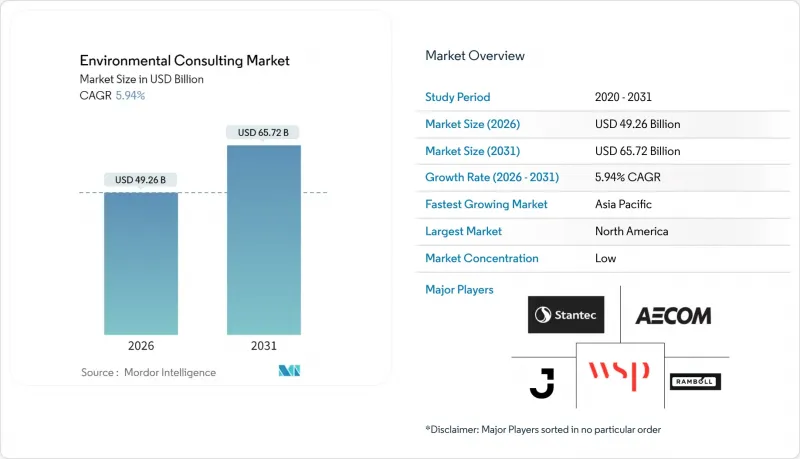
환경 컨설팅 시장은 2025년에 465억 달러로 평가되며, 2026년 492억 6,000만 달러에서 2031년까지 657억 2,000만 달러에 달할 것으로 예측됩니다.
예측 기간(2026-2031년)의 CAGR은 5.94%로 예상됩니다.
이러한 지속적인 성장은 OECD 및 G20 국가들의 기후 정책 요구의 동기화, 기업의 공시 의무 강화, 그리고 자문 제공 비용을 절감하고 자문 범위를 확대하는 급속한 디지털화를 반영하고 있습니다. 규제 표준화로 인해 컴플라이언스가 임의적 지출에서 필수 인프라로 전환됨에 따라 고부가가치 분야, 특히 환경영향 평가(EIA) 및 ESG 자문 등 고부가가치 분야에 수요가 집중되고 있습니다. 기업의 넷제로 목표, 녹색금융의 성장, 산업 탈탄소화 기금으로 대상 프로젝트군이 확대되는 한편, AI를 활용한 현장 특성 평가 등의 기술이 컨설팅의 생산성을 향상시키고 있습니다. 경쟁의 강도는 균형을 유지하고 있으며, 전문 특화형 기업은 틈새 기술업무를 확보하는 한편, 대형 종합기업은 서비스 간 시너지를 활용하여 기본료 압박에도 불구하고 이익률을 유지하고 있습니다.
세계 환경 컨설팅 시장 동향과 인사이트
OECD 및 G20 경제권의 기후 정책 의무 준수 의무화
기후 규제의 수렴으로 컨설팅 수요는 단발성 프로젝트에서 표준화 및 반복 가능한 서비스 라인으로 변모하고 있습니다. 업데이트된 OECD 환경 성과 검토는 정량화된 탈탄소화 경로를 요구하고 있으며, 탄소 국경 조정 메커니즘의 도입으로 국경을 초월한 공급망 검증의 필요성이 대두되고 있습니다. 컨설팅 기업은 단일 조사 기법을 여러 관할 구역에 적용함으로써 맞춤형 비용을 절감하고 고객 기반을 확대할 수 있습니다. 컴플라이언스가 선택사항에서 의무사항으로 전환됨에 따라 서비스 파이프라인의 예측가능성이 높아져 장기적인 리소스 계획과 디지털 딜리버리 플랫폼에 대한 투자가 가능해집니다.
기업의 넷제로 및 ESG 공시 의무
EU 기업 지속가능성 보고 지침은 2024년부터 5만개 이상의 기업에 적용되며, 기존 자율 가이드라인을 넘어선 상세한 환경 공개를 의무화합니다. 많은 기업은 사업 활동을 분류 기준에 따라 분류할 수 있는 내부 전문 지식이 부족하여 수년간의 자문 업무가 쌓여 있는 경우가 많습니다. 미국 증권거래위원회(SEC)와 다른 규제 당국이 검토 중인 유사한 규정은 이러한 수요 패턴을 전 세계에서 확대할 것입니다. 그 결과, 환경 컨설팅 시장의 관계는 단기적인 컴플라이언스 업무에서 시나리오 모델링 및 보증 준비를 포함한 지속적인 전략적 파트너십으로 전환되고 있습니다.
프레임워크 계약으로 인한 지속적인 요금 압박
기업 구매자는 연간 비용 절감 조항을 포함하는 다년 계약 프레임워크를 통해 벤더를 통합합니다. 일상적인 컴플라이언스 업무는 상품화되어 가고 있으며, 컨설턴트들은 PFAS 오염방지, 자연친화적 회계 등 전문성이 높은 고부가가치 분야로 다변화해야 하는 상황에 처해 있습니다. 대기업은 규모와 교차판매를 통해 이익률을 유지하는 반면, 중소 전문업체는 독자적인 기술 깊이를 무기로 프리미엄 요금을 제시하고 있습니다.
부문 분석
환경영향 평가는 2025년 기준 환경 컨설팅 시장의 30.25%를 차지할 것으로 예상되며, 이는 주요 경제권에서 프로젝트 허가 과정에서 확고한 입지를 반영합니다. 그 규모에도 불구하고 표준화된 디지털 워크플로우로 인한 현지 조사 기간 단축으로 인해 보상 단가가 압박을 받고 있습니다. 한편, ESG 보고 및 지속가능성 전략은 프로젝트 단위가 아닌 지속적인 참여를 요구하는 공시 의무화로 인해 CAGR 6.12%로 확대될 것으로 예측됩니다. 기후 변화 컨설팅 분야의 환경 컨설팅 시장 규모는 전환 경로 모델링이 경영진의 우선순위가 되면서 가속화되고 있으며, 컨설턴트들은 자본 배분에 대한 전략적 조언자로서의 입지를 다지고 있습니다.
상하수도 관리 분야는 인프라 부양책과 EPA의 납 및 구리 규제 개선안 등 새로운 오염물질 규제의 수혜를 받아 2030년까지 450억 달러 규모의 대응 가능한 프로젝트가 창출될 것입니다. PFAS 오염 대책 전문 컨설턴트는 수문지질학적 전문지식과 첨단 처리 설계가 필요한 복잡한 다년간의 계약을 수주하고 있습니다. 한편, AI를 활용한 오염현장 평가는 기존의 현장 작업을 효율화하는 동시에 데이터 분석 및 원격탐사 해석의 새로운 수입원을 개발하고 있습니다.
지역별 분석
북미는 2025년 환경 컨설팅 시장 점유율의 35.53%를 차지할 것으로 예상되며, 환경영향 평가 및 복원 수요를 지원하는 '국가환경정책법' 등 성숙한 규제를 활용하고 있습니다. 연방 인프라 계획은 기후 변화에 대한 내성 강화, 상수도 시스템, 전력망 갱신에 초점을 맞춘 장기 프로젝트를 추가하여 매출 전망을 높이고 있습니다. 주정부 차원의 기후 변화 정보 공개 법안이 통과되면, 컨설팅 파이프라인이 더욱 확대될 것으로 예측됩니다.
아시아태평양은 2031년까지 연평균 6.31%의 연평균 복합 성장률(CAGR)로 지역 성장을 촉진할 것입니다. 중국의 '생태환경법' 초안은 분산된 규제를 통합하고 산업 사업자에게 표준화된 컨설팅 지원을 요청하고 있습니다. 인도의 재생에너지 목표와 '메이드 인 인디아' 제조 확대는 환경 허가 수요를 증가시키고, 동남아시아 국가들은 탄소 가격 책정 및 ESG 보고 프레임워크를 채택하고 있습니다. 현지 규제에 정통하고 세계 기술 리소스를 보유한 컨설턴트가 선구자적 우위를 확보합니다.
유럽에서는 EU Taxonomy와 기업 지속가능성 보고 지침으로 인해 수천개 기업에 공시의무를 제도화하는 활동이 활발히 진행되고 있습니다. 컨설턴트는 유사한 프레임워크를 채택하는 지역으로 경험을 수출함으로써 유럽의 전문성을 세계 경쟁력으로 전환합니다. 중동 및 아프리카에는 메가 프로젝트 및 물 부족 해결과 관련된 고성장 지역이 존재하지만, 규제 집행의 불균일성으로 인해 시장 속도를 억제하고 있습니다. 라틴아메리카는 광업 투자와 재생에너지 확대의 수혜를 입는 한편, 정치적 불안정성과 허가 절차의 장기화에 직면해 있습니다.
기타 특전:
- 엑셀 형식 시장 예측(ME) 시트
- 애널리스트의 3개월 지원
자주 묻는 질문
목차
제1장 서론
제2장 조사 방법
제3장 개요
제4장 시장 구도
제5장 시장 규모와 성장 예측
제6장 경쟁 구도
제7장 시장 기회와 향후 전망
KSA 26.03.06The environmental consulting market was valued at USD 46.50 billion in 2025 and estimated to grow from USD 49.26 billion in 2026 to reach USD 65.72 billion by 2031, at a CAGR of 5.94% during the forecast period (2026-2031).
This sustained performance reflects synchronized climate-policy mandates across OECD and G20 economies, rising corporate disclosure obligations, and rapid digitization that compresses delivery costs while expanding advisory scope. Demand concentrates in high-value segments, particularly Environmental Impact Assessment and ESG advisory, because regulatory standardization turns compliance from discretionary spending into essential infrastructure. Corporate net-zero commitments, growth in green finance, and industrial decarbonization funds deepen the addressable pool of projects, while technology such as AI-enabled site characterization elevates consulting productivity. Competitive intensity remains balanced: specialized boutiques capture niche technical mandates, whereas large integrated players leverage cross-service synergies to defend margins despite framework fee pressure.
Global Environmental Consulting Market Trends and Insights
Mandatory Climate-Policy Compliance in OECD and G20 Economies
Converging climate rules transform consulting demand into a standardized, repeatable service line rather than episodic project work. Updated OECD Environmental Performance Reviews require quantified decarbonization pathways, while carbon-border adjustment mechanisms introduce supply-chain verification needs that transcend national boundaries.Consulting firms deploy single methodological frameworks across multiple jurisdictions, lowering customization costs and enlarging their client base. As compliance shifts from voluntary to mandatory, service pipelines become more predictable, enabling long-term resource planning and investment in digital delivery platforms.
Corporate Net-Zero and ESG Disclosure Mandates
The EU Corporate Sustainability Reporting Directive applies to more than 50,000 companies starting in 2024, compelling detailed environmental disclosures that exceed prior voluntary guidelines. Many firms lack in-house expertise to map operations to taxonomy criteria, producing a multi-year backlog of advisory assignments. Similar rules under consideration by the U.S. Securities and Exchange Commission and other regulators extend the same demand pattern globally. Consequently, environmental consulting market relationships migrate from short-term compliance engagements to continuous strategic partnerships that include scenario modeling and assurance readiness.
Persistent Fee-Pressure from Framework Contracts
Corporate buyers consolidate vendors under multiyear frameworks that embed annual cost-down clauses. Routine compliance tasks become commoditized, forcing consultants to diversify toward specialized, high-value niches such as PFAS remediation or nature-positive accounting. Larger firms leverage scale and cross-selling to defend margins, whereas smaller boutiques rely on unique technical depth to command premium rates.
Other drivers and restraints analyzed in the detailed report include:
- Growth of Green and Transition Bonds Requiring 3rd-Party Verification
- Industrial Decarbonization Funds Tied to Advisory Spend
- Delayed Permitting for Large Infrastructure in Emerging Markets
For complete list of drivers and restraints, kindly check the Table Of Contents.
Segment Analysis
Environmental Impact Assessment captured 30.25% of the environmental consulting market in 2025, reflecting its entrenched role in project permitting across every major economy. Despite its scale, fee rates face pressure as standardized digital workflows shorten field programs. Conversely, ESG Reporting and Sustainability Strategy is forecast to increase at a 6.12% CAGR, propelled by mandatory disclosure rules that necessitate continuous rather than project-based engagement. The environmental consulting market size for climate-change consulting accelerates as transition pathway modeling becomes a board-level priority, positioning consultants as strategic advisors on capital allocation.
Water and wastewater management benefits from infrastructure stimulus and new contaminant regulations such as the EPA Lead and Copper Rule Improvements, which unlock USD 45 billion of addressable projects through 2030. Consultants specializing in PFAS remediation secure complex, multi-year assignments requiring hydrogeological expertise and advanced treatment design. Meanwhile, AI-driven contaminated-site assessment compresses traditional fieldwork yet opens new revenue streams in data analytics and remote sensing interpretation.
The Environmental Consulting Market Report is Segmented by Service Type (Climate Change Consulting, EHS, Environmental Impact Assessment, Water and Wastewater Management, and More), End-User Industry (Energy and Power, Mining and Metals, Public Sector, Manufacturing, and More), and Geography. The Market Forecasts are Provided in Terms of Value (USD).
Geography Analysis
North America held 35.53% of environmental consulting market share in 2025, leveraging mature rules such as the National Environmental Policy Act that underpin steady demand for impact assessments and remediation. Federal infrastructure packages add long-cycle projects focused on climate resilience, water systems, and grid renewal, enhancing revenue visibility. Emerging state-level climate disclosure bills further amplify advisory pipelines.
Asia-Pacific leads regional growth at a 6.31% CAGR through 2031. China's draft Ecological and Environmental Code consolidates fragmented regulations, compelling industrial operators to seek standardized consulting support. India's renewable-energy targets and Make-in-India manufacturing expansion elevate demand for environmental permitting, while Southeast Asian countries adopt carbon-pricing and ESG reporting frameworks. Consultants with local regulatory fluency and global technical resources gain first-mover advantage.
Europe maintains robust activity through the EU Taxonomy and Corporate Sustainability Reporting Directive, which institutionalize disclosure obligations for thousands of firms. Consultants export their experience to jurisdictions adopting similar frameworks, transforming European expertise into a global competitive asset. Middle East and Africa present pockets of high growth tied to megaprojects and emerging water scarcity solutions, though uneven regulatory enforcement tempers market velocity. Latin America benefits from mining investments and renewable build-out but continues to battle political volatility and elongated permitting.
- Jacobs Solutions Inc.
- AECOM
- WSP Global Inc.
- Tetra Tech, Inc.
- Stantec Inc.
- Ramboll Group A/S
- ERM International Group Limited
- Arup Group Limited
- GHD Group Pty Ltd
- Sweco AB
- Arcadis N.V.
- John Wood Group PLC (Wood)
- SNC-Lavalin Group Inc. (AtkinsRealis)
- HDR, Inc.
- SLR Consulting Limited
- Antea Group N.V.
- Mott MacDonald Group Limited
- Montrose Environmental Group, Inc.
- Brown and Caldwell, Inc.
- Worley Limited
- ICF International, Inc.
- EA Engineering, Science, and Technology, Inc., PBC
- Cardno Limited
- Golder Associates Ltd.
Additional Benefits:
- The market estimate (ME) sheet in Excel format
- 3 months of analyst support
TABLE OF CONTENTS
1 INTRODUCTION
- 1.1 Study Assumptions and Market Definition
- 1.2 Scope of the Study
2 RESEARCH METHODOLOGY
3 EXECUTIVE SUMMARY
4 MARKET LANDSCAPE
- 4.1 Market Overview
- 4.2 Market Drivers
- 4.2.1 Mandatory Climate-Policy Compliance in OECD and G20 Economies
- 4.2.2 Corporate Net-Zero and ESG Disclosure Mandates
- 4.2.3 Growth of Green and Transition Bonds Requiring 3rd-Party Verification
- 4.2.4 Industrial Decarbonisation Funds Tied to Advisory Spend
- 4.2.5 AI-Enabled Rapid Site-Characterisation Tools Cut Due-Diligence Time
- 4.2.6 "Nature-Positive" Impact Accounting Frameworks Emerge
- 4.3 Market Restraints
- 4.3.1 Persistent Fee-Pressure from Framework Contracts
- 4.3.2 Delayed Permitting for Large Infrastructure in Emerging Markets
- 4.3.3 Scarcity of Licensed Hydro-geologists and Toxicologists
- 4.3.4 Client Shift to In-House Digital EHS Platforms
- 4.4 Regulatory Landscape
- 4.5 Technological Outlook
- 4.6 Porter's Five Forces Analysis
- 4.6.1 Threat of New Entrants
- 4.6.2 Bargaining Power of Suppliers
- 4.6.3 Bargaining Power of Buyers
- 4.6.4 Threat of Substitutes
- 4.6.5 Intensity of Competitive Rivalry
- 4.7 Impact of Macroeconomic Shocks
5 MARKET SIZE AND GROWTH FORECASTS (VALUE)
- 5.1 By Service Type
- 5.1.1 Climate Change Consulting
- 5.1.2 EHS
- 5.1.3 Environmental Impact Assessment
- 5.1.4 Water and Wastewater Management
- 5.1.5 ESG Reporting and Sustainability Strategy
- 5.1.6 Other Service Types (Includes Contaminated Site Assessment)
- 5.2 By End-User Industry
- 5.2.1 Energy and Power
- 5.2.2 Mining and Metals
- 5.2.3 Public Sector
- 5.2.4 Manufacturing
- 5.2.5 Pharmaceuticals
- 5.2.6 Other End-user Industries (Construction and Infrastructure, Transportation, etc.)
- 5.3 By Geography
- 5.3.1 North America
- 5.3.1.1 United States
- 5.3.1.2 Canada
- 5.3.1.3 Mexico
- 5.3.2 South America
- 5.3.2.1 Brazil
- 5.3.2.2 Argentina
- 5.3.2.3 Rest of South America
- 5.3.3 Europe
- 5.3.3.1 Germany
- 5.3.3.2 United Kingdom
- 5.3.3.3 France
- 5.3.3.4 Italy
- 5.3.3.5 Spain
- 5.3.3.6 Poland
- 5.3.3.7 Russia
- 5.3.3.8 Rest of Europe
- 5.3.4 Asia Pacific
- 5.3.4.1 China
- 5.3.4.2 India
- 5.3.4.3 Japan
- 5.3.4.4 South Korea
- 5.3.4.5 Australia
- 5.3.4.6 Rest of Asia Pacific
- 5.3.5 Middle East and Africa
- 5.3.5.1 Middle East
- 5.3.5.1.1 Saudi Arabia
- 5.3.5.1.2 United Arab Emirates
- 5.3.5.1.3 Turkey
- 5.3.5.1.4 Rest of Middle East
- 5.3.5.2 Africa
- 5.3.5.2.1 South Africa
- 5.3.5.2.2 Nigeria
- 5.3.5.2.3 Egypt
- 5.3.5.2.4 Rest of Africa
- 5.3.5.1 Middle East
- 5.3.1 North America
6 COMPETITIVE LANDSCAPE
- 6.1 Market Concentration
- 6.2 Strategic Moves
- 6.3 Market Share Analysis
- 6.4 Company Profiles (includes Global level Overview, Market level overview, Core Segments, Financials as available, Strategic Information, Market Rank/Share for key companies, Products and Services, and Recent Developments)
- 6.4.1 Jacobs Solutions Inc.
- 6.4.2 AECOM
- 6.4.3 WSP Global Inc.
- 6.4.4 Tetra Tech, Inc.
- 6.4.5 Stantec Inc.
- 6.4.6 Ramboll Group A/S
- 6.4.7 ERM International Group Limited
- 6.4.8 Arup Group Limited
- 6.4.9 GHD Group Pty Ltd
- 6.4.10 Sweco AB
- 6.4.11 Arcadis N.V.
- 6.4.12 John Wood Group PLC (Wood)
- 6.4.13 SNC-Lavalin Group Inc. (AtkinsRealis)
- 6.4.14 HDR, Inc.
- 6.4.15 SLR Consulting Limited
- 6.4.16 Antea Group N.V.
- 6.4.17 Mott MacDonald Group Limited
- 6.4.18 Montrose Environmental Group, Inc.
- 6.4.19 Brown and Caldwell, Inc.
- 6.4.20 Worley Limited
- 6.4.21 ICF International, Inc.
- 6.4.22 EA Engineering, Science, and Technology, Inc., PBC
- 6.4.23 Cardno Limited
- 6.4.24 Golder Associates Ltd.
7 MARKET OPPORTUNITIES AND FUTURE OUTLOOK
- 7.1 White-Space and Unmet-Need Assessment