|
시장보고서
상품코드
1940890
5G 기지국 : 시장 점유율 분석, 업계 동향과 통계, 성장 예측(2026-2031년)5G Base Station - Market Share Analysis, Industry Trends & Statistics, Growth Forecasts (2026 - 2031) |
||||||
 Mordor Intelligence
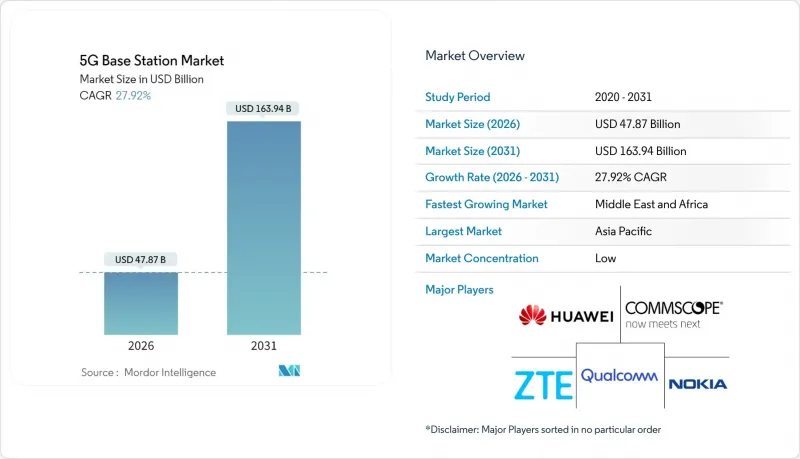
5G 기지국 시장은 2025년에 374억 4,000만 달러로 평가되었고, 2026년 478억 7,000만 달러에서 2031년까지 1,639억 4,000만 달러에 이를 것으로 예측됩니다.
예측 기간(2026-2031년)의 CAGR은 27.92%로 예상됩니다.
정부의 주파수 경매를 인프라 부양책으로 전환하고, 사업자들이 Open-RAN으로 업그레이드하고, 기업들이 자동화 및 공공 안전 시스템을 위해 초 고신뢰성, 저지연 연결을 요구하고 있는 것이 견조한 성장의 원인으로 분석됩니다. 중국에서는 이미 440만 개 이상의 운영 사이트가 운영되고 있으며, 미국 및 주요 유럽 시장에서는 벤더 리스크 감소와 혁신 촉진을 위해 오픈 아키텍처가 강조되고 있습니다. 최근 반도체 부족으로 공급망 다변화가 시급한 상황에서 각 업체들은 지역별로 제조 거점을 추가하거나 각 사이트의 전력 비용을 최대 50%까지 절감할 수 있는 질화갈륨 파워앰프 도입을 추진하고 있습니다. 스마트 팩토리, 항만, 스마트 시티 회랑의 사설 네트워크에 대한 수요는 스몰셀, 대규모 MIMO 라디오, mm파 노드를 통한 고밀도화를 더욱 가속화하고 있습니다.
세계 5G 기지국 시장 동향 및 인사이트
정부의 주파수 경매와 인프라 부양책
각국 정부는 전파 판매를 정책적 도구로 활용하여 커버리지 확대와 지역 제조업의 진흥을 도모하고 있습니다. 미국은 인프라 투자 및 일자리 창출법에 따라 424억 5,000만 달러를 배분하여 미 서비스 미제공 카운티의 지방 광대역 및 5G 구축을 추진. 인도는 120억 달러 규모의 생산 연동형 장려금 제도를 통해 무선기와 안테나의 국내 생산을 촉진하고, 공급망 단축과 지방 진출을 가속화하기 위해 노력하고 있습니다. 안정적인 경매 계획과 보조금 프로그램을 통해 사업자는 현금 흐름을 예측할 수 있고, 다년간의 투자 주기를 가질 수 있으며, 매크로셀과 스몰셀 계층 모두에서 5G 기지국 시장을 활성화할 수 있습니다.
개방형 RAN을 통한 기존 설비 업그레이드 주기
개방형 RAN은 무선 장비, 베이스밴드, 소프트웨어를 분리하기 때문에 통신사업자는 각 분야의 최고 벤더를 결합하여 조달 비용을 절감하고 업데이트를 자동화할 수 있습니다. 보다폰은 2027년까지 영국 내 2,600개 사이트에서 Open-RAN 전환을 약속하며, 30%의 비용 절감과 공급업체 다변화를 목표로 하고 있습니다. Deutsche Telekom은 유연성 향상과 국내 혁신 촉진을 위해 독일과 폴란드에서 멀티벤더 테스트를 확대 중입니다. 시스템 통합은 여전히 복잡하지만, 조기 상용화를 통한 성능 검증이 향후 고밀도화 물결에 대한 조달 기준에 영향을 미치며 5G 기지국 시장을 견인하고 있습니다.
고액의 설비투자 및 장기적인 투자 회수 기간 소요
통신 사업자들은 기존 세대 네트워크보다 회수 기간이 더 긴 수십억 달러 규모의 도입에 직면해 있습니다. Verizon은 5G 무선 장비와 파이버 백홀에 연간 100억 달러 이상을 지출하고 있으며, LTE의 약 5년 대비 7-10년 정도의 회수 기간을 예상하고 있습니다. 지방 프로젝트는 더더욱 수익성이 낮고, 보조금으로 수익성 차이를 보완하지 않는 한 사업자는 인구 밀집 도시 지역에 집중할 수밖에 없습니다. 자금난으로 인해 전국적인 커버리지 구축 속도가 느려지고, 저소득 국가에서의 5G 기지국 시장 확대가 제한되고 있습니다.
부문 분석
매크로셀은 2025년 기준 5G 기지국 시장 점유율의 60.62%(226억 9,000만 달러)를 차지하며, 광역 커버리지와 모바일 앵커 서비스를 제공합니다. 그러나 스몰셀은 CAGR 28.85%로 성장하여 2031년까지 5G 기지국 시장 규모에서 736억 달러 규모의 점유율을 차지할 것으로 예측됩니다. 통신 사업자들은 스포츠 시설, 교통 회랑, 기업 캠퍼스에서 매크로 기지국 혼잡을 완화하기 위해 수천 개의 노상 레벨 노드를 배치하고 있습니다. 버라이즌만 해도 실내의 전파가 닿지 않는 지역을 보완하고 대칭형 기가비트 통신을 가능하게 하는 저전력 유닛을 5만대 이상 설치했습니다.
허가 취득의 어려움과 경관 규제가 스몰셀 확대를 가로막고 있었지만, 연방통신위원회의 규제 완화로 지자체 심사 기간이 수개월에서 60일 이내로 단축되었습니다. 프라이빗 네트워크에 대한 수요도 더욱 증가하고 있으며, 스몰셀은 공공 스펙트럼에 의존하지 않고 전용 On-Premise 커버리지를 실현할 수 있습니다. 크라운캐슬과 같은 수직 자산 소유자는 실내 계약 체결 건수가 세 자릿수 성장을 보고하고 있으며, 이는 고밀도화가 세계 5G 기지국 시장을 뒷받침하고 있음을 입증하고 있습니다.
2025년 기준, 비스탠드얼론 방식의 도입이 57.95%의 점유율을 차지하고 있으며, 통신사들은 기존 LTE 코어를 활용하여 신속한 서비스 출시를 실현하고 있습니다. 그러나 독립형 시장 규모는 CAGR 29.35%라는 가파른 성장세를 유지하고 있으며, 2031년까지 전체 5G 기지국 시장의 60% 이상을 차지할 것으로 예측됩니다. AT&T는 확정적인 지연이 필요한 산업 고객을 위해 독립형 슬라이스를 운영하고 있으며, T-Mobile은 차별화된 성능 수준을 제공하는 전국적인 독립형 커버리지를 확대했습니다.
독립형 아키텍처는 네트워크 슬라이싱, 분산형 엣지 컴퓨팅, 고급 암호화 등 비독립형 방식으로는 구현할 수 없는 기능을 구현합니다. Dish Network는 레거시 기반을 피하고 완전히 클라우드 네이티브한 네트워크를 구축합니다. 이를 통해 운영 비용 절감과 빠른 기능 출시 주기를 실현했습니다. 코어 마이그레이션은 복잡성과 기술 요구 사항을 증가시키지만, 통신 사업자들은 장기적인 수익 향상 가능성을 인식하고 지원되는 무선 장비 및 핵심 소프트웨어 주문을 가속화하고 있습니다.
지역별 분석
아시아태평양은 중국의 440만 개의 가동 사이트와 2025년까지 거의 전국적인 커버리지 의무화로 인해 2025년 41.10%의 점유율을 차지할 것으로 예측됩니다. 일본과 한국은 일찌감치 독립형 및 엣지 컴퓨팅을 도입하여 제조업과 미디어 서비스를 위한 네트워크 슬라이싱을 상용화한 바 있습니다. 인도에서는 2024년 주파수 경매를 통해 버티 에어텔과 릴라이언스 지오로부터 자본이 유입됩니다. 2025년에는 23개 도시에서 1단계로 시행되며, 2027년까지 지방으로 확대될 예정입니다. 대만과 한국의 반도체 산업 클러스터가 부품 공급을 지원하여 이 지역의 세계 5G 기지국 시장에서의 영향력을 강화하고 있습니다.
북미는 규모면에서는 약간 뒤처지지만, mm파 기술 혁신에서는 선도적인 위치에 있습니다. Verizon은 26개 주에서 기가비트 고정형 무선 액세스를 운영하고 있으며, AT&T는 클라우드 엣지 워크로드를 위한 기업용 프라이빗 셀룰러 사업에 집중하고 있습니다. 캐나다에서는 주파수 경매를 통해 지방 확장 자금을 조달하고, 오픈 액세스 로밍이 의무화되면서 기지국 수요가 더욱 증가하고 있습니다. 카운티 및 시 단위의 규제 차이로 인해 일부 지역에서는 허가 취득이 지연되고 있지만, 경기부양책 자금과 타워 회사들의 건설 임대 계약으로 북미는 5G 기지국 시장에서 건전한 기여를 유지하고 있습니다.
중동 및 아프리카은 29.55%의 연평균 복합 성장률(CAGR)로 가장 빠르게 성장하고 있습니다. 사우디의 '비전 2030' 디지털 계획은 전국적인 5G 구축을 위한 재정적 지원을 통해 리야드를 아랍어 컨텐츠 전송의 기술 허브로 자리매김하고 있습니다. 아랍에미리트에서는 인구 밀집 지역의 97%에 5G를 구축했으며, 현재 5G 어드밴스드 서비스 시범운영을 진행하고 있습니다. 아프리카에서는 케냐와 나이지리아가 광대역과 핀테크 보급을 위해 광섬유보다 무선에 우선순위를 두고 있지만, 통화 리스크와 에너지 비용으로 인해 프로젝트 예산이 증가하고 있습니다. 따라서 다자간 은행과 벤더 파이낸싱 제도는 대륙의 5G 구상 실현에 있어 더욱 중요한 역할을 담당하고 있습니다.
기타 특전:
- 엑셀 형식 시장 예측(ME) 시트
- 애널리스트의 3개월간 지원
자주 묻는 질문
목차
제1장 서론
제2장 조사 방법
제3장 주요 요약
제4장 시장 구도
제5장 시장 규모와 성장 예측
제6장 경쟁 구도
제7장 시장 기회와 향후 전망
LSH 26.03.11The 5G Base Station Market was valued at USD 37.44 billion in 2025 and estimated to grow from USD 47.87 billion in 2026 to reach USD 163.94 billion by 2031, at a CAGR of 27.92% during the forecast period (2026-2031).
Robust growth stems from governments turning spectrum auctions into infrastructure stimulus, operators upgrading to Open-RAN, and enterprises seeking ultra-reliable low-latency connections for automation and public-safety systems. China already operates more than 4.4 million live sites, while the United States and key European markets emphasize open architectures to cut vendor risk and spur innovation. Supply-chain diversification has become urgent after recent semiconductor shortages, pushing vendors to add regional manufacturing and gallium-nitride power amplifiers that lower energy bills by up to 50% at each site. Demand for private networks in smart factories, ports, and smart-city corridors further accelerates densification with small cells, massive-MIMO radios, and millimeter-wave nodes.
Global 5G Base Station Market Trends and Insights
Government Spectrum Auctions and Infrastructure Stimulus
Governments are turning spectrum sales into policy tools that expand coverage and local manufacturing. The United States allocated USD 42.45 billion under the Infrastructure Investment and Jobs Act, targeting rural broadband and 5G build-outs in underserved counties. India's USD 12 billion Production-Linked Incentive scheme rewards domestic production of radios and antennas, shortening supply chains and accelerating rural rollouts. Stable auction roadmaps and subsidy programs give operators cash-flow visibility that unlocks multi-year investment cycles and lifts the 5G base station market across both macro and small-cell layers.
Open-RAN Driven Brown-Field Upgrade Cycle
Open-RAN disaggregates radios, baseband, and software so carriers can blend best-of-breed vendors, slash procurement cost, and automate updates. Vodafone committed to swapping 2,600 United Kingdom sites to Open-RAN by 2027, targeting 30% cost savings and broader supplier diversity. Deutsche Telekom is extending multivendor trials across Germany and Poland to raise flexibility and spur domestic innovation. Although system integration remains complex, early commercial launches validate performance and are influencing procurement criteria for upcoming densification waves, boosting the 5G base station market.
High CAPEX and Long ROI Horizon
Operators face multi-billion-dollar rollouts with longer payback than prior network generations. Verizon disclosed spending above USD 10 billion per year on 5G radios and fiber backhaul and estimates a seven-to-ten-year return window versus about five years for LTE. Rural projects are even less economical, forcing carriers to focus on dense urban clusters unless subsidies cover viability gaps. The stretched cash cycle tempers the pace of nationwide coverage and limits 5G base station market expansion in lower-income countries.
Other drivers and restraints analyzed in the detailed report include:
- mmWave Small-Cell Roll-Outs for Private Industrial 5G
- Energy-Efficient GaN Power Amplifiers Cutting Total Site OPEX
- RF-Front-End Component Supply Bottlenecks
For complete list of drivers and restraints, kindly check the Table Of Contents.
Segment Analysis
Macro cells represented USD 22.69 billion and 60.62% of the 2025 5G base station market share, providing umbrella coverage and mobility anchor services. Yet small cells are forecast to expand at a 28.85% CAGR, pushing their slice of the 5G base station market size toward USD 73.6 billion by 2031. Carriers deploy thousands of street-level nodes to relieve macro congestion in sports venues, transit corridors, and enterprise campuses. Verizon alone installed more than 50,000 low-power units that fill indoor dead zones and enable symmetrical gigabit rates.
Permitting challenges and aesthetic restrictions once hampered small-cell scaling, but streamlined Federal Communications Commission rulings shortened municipal review from several months to under 60 days. Private networks further lift demand because small cells create dedicated on-premises coverage without relying on public spectrum. Vertical asset owners such as Crown Castle now report triple-digit growth in signed indoor contracts, underscoring how densification underpins the global 5G base station market.
Non-standalone deployments still held 57.95% share in 2025 as operators leveraged existing LTE cores for quick service launches. However the standalone cohort is maintaining a steep 29.35% CAGR, and its share of the 5G base station market size will exceed 60% by 2031. ATandT activated standalone slices for industrial clients needing deterministic latency, while T-Mobile extended nationwide standalone coverage that enables differentiated performance tiers.
Standalone architecture unlocks network slicing, distributed edge computing, and advanced encryption that non-standalone cannot deliver. Dish Network avoided legacy anchors and built an entirely cloud-native network, demonstrating lower operating expenses and rapid feature release cycles. Although core migration raises complexity and skills requirements, operators recognize the long-term revenue upside, accelerating orders for compatible radios and core software.
The 5G Base Station Market Report is Segmented by Type (Small Cell, Macro Cell), Architecture (Stand-Alone SA, Non-Stand-Alone NSA), Frequency Band (Sub-6 GHz, Mmwave 24-40 GHz), Power Rating (<=10 W, 10-40 W, >=40 W), MIMO Technology (Conventional MIMO, Massive MIMO >=64T64R), End User (Commercial Mobile Operators, Residential/Consumer FWA, and More), and Geography. The Market Forecasts are Provided in Terms of Value (USD).
Geography Analysis
Asia-Pacific commanded 41.10% share in 2025 thanks to China's 4.4 million live sites and a national mandate for near-universal coverage by 2025. Japan and South Korea moved early into standalone and edge-computing deployments, commercializing network slicing for manufacturing and media services. India's 2024 spectrum auctions unlocked capital from Bharti Airtel and Reliance Jio, with first-wave deployments in twenty-three cities during 2025 and rural extensions scheduled by 2027. Local semiconductor clusters in Taiwan and South Korea anchor component supply, reinforcing the region's influence on the global 5G base station market.
North America trails only marginally in volume and leads on millimeter-wave innovation. Verizon activated gigabit fixed wireless access in twenty-six states, while ATandT concentrates on enterprise private-cellular projects for cloud and edge workloads. Canada's auctions raised funding for rural expansion and mandated open-access roaming, stimulating incremental base-station demand. Regulatory patchwork at county and city levels slows permitting in some corridors, yet stimulus funds and tower-company build-leases sustain a healthy North American contribution to the 5G base station market.
The Middle-East and Africa region is the fastest-growing at 29.55% CAGR. Saudi Arabia's Vision 2030 digital blueprint finances nationwide 5G and positions Riyadh as a tech-hub for Arabic content delivery. The United Arab Emirates rolled out 5G across 97% of populated areas and now trials 5G-Advanced services. In Africa, Kenya and Nigeria favor wireless over fiber for broadband and fintech inclusion, but currency risk and energy cost inflate project budgets. Multilateral banks and vendor-financing schemes thus play a bigger role in realizing the continent's 5G aspirations.
- Huawei Technologies Co. Ltd
- ZTE Corporation
- Nokia Corporation
- Telefonaktiebolaget LM Ericsson
- Samsung Electronics Co. Ltd
- CommScope Holding Company Inc.
- Qualcomm Incorporated
- Qorvo Inc.
- Alpha Networks Inc.
- NEC Corporation
- Fujitsu Ltd
- Airspan Networks Holdings Inc.
- Mavenir Systems Inc.
- Parallel Wireless Inc.
- Baicells Technologies Co. Ltd
- JMA Wireless
- Comba Telecom Systems Holdings
- Sercomm Corp.
- ACE Technologies Corp.
- NEC Platforms, Ltd.
Additional Benefits:
- The market estimate (ME) sheet in Excel format
- 3 months of analyst support
TABLE OF CONTENTS
1 INTRODUCTION
- 1.1 Study Assumptions and Market Definition
- 1.2 Scope of the Study
2 RESEARCH METHODOLOGY
3 EXECUTIVE SUMMARY
4 MARKET LANDSCAPE
- 4.1 Market Overview
- 4.2 Market Drivers
- 4.2.1 Rising mobile data traffic and smartphone penetration
- 4.2.2 Superior latency and bandwidth advantages of 5G
- 4.2.3 Government spectrum auctions and infrastructure stimulus
- 4.2.4 Open-RAN driven brown-field upgrade cycle
- 4.2.5 mmWave small-cell roll-outs for private industrial 5G
- 4.2.6 Energy-efficient GaN PAs cutting total site OPEX
- 4.3 Market Restraints
- 4.3.1 High CAPEX and long ROI horizon
- 4.3.2 Spectrum fragmentation and regulatory delays
- 4.3.3 RF-front-end component supply bottlenecks
- 4.3.4 Sustainability compliance inflating site costs
- 4.4 Value / Supply-Chain Analysis
- 4.5 Regulatory Landscape
- 4.6 Technological Outlook
- 4.7 Porter's Five Forces
- 4.7.1 Bargaining Power of Suppliers
- 4.7.2 Bargaining Power of Buyers
- 4.7.3 Threat of New Entrants
- 4.7.4 Intensity of Competitive Rivalry
- 4.7.5 Threat of Substitutes
- 4.8 Investment Analysis
5 MARKET SIZE AND GROWTH FORECASTS (VALUE)
- 5.1 By Type
- 5.1.1 Small Cell
- 5.1.2 Macro Cell
- 5.2 By Architecture
- 5.2.1 Stand-Alone (SA)
- 5.2.2 Non-Stand-Alone (NSA)
- 5.3 By Frequency Band
- 5.3.1 Sub-6 GHz
- 5.3.2 mmWave (24-40 GHz)
- 5.4 By Power Rating
- 5.4.1 Less than or equal to 10 W
- 5.4.2 10-40 W
- 5.4.3 More than or equal to 40 W
- 5.5 By MIMO Technology
- 5.5.1 Conventional MIMO
- 5.5.2 Massive MIMO (More than 64T64R)
- 5.6 By End User
- 5.6.1 Commercial Mobile Operators
- 5.6.2 Residential/Consumer FWA
- 5.6.3 Industrial Private Networks
- 5.6.4 Government and Defense
- 5.6.5 Smart Cities and Public Safety
- 5.6.6 Other End Users
- 5.7 By Geography
- 5.7.1 North America
- 5.7.1.1 United States
- 5.7.1.2 Canada
- 5.7.1.3 Mexico
- 5.7.2 South America
- 5.7.2.1 Brazil
- 5.7.2.2 Argentina
- 5.7.2.3 Chile
- 5.7.2.4 Rest of South America
- 5.7.3 Europe
- 5.7.3.1 United Kingdom
- 5.7.3.2 Germany
- 5.7.3.3 France
- 5.7.3.4 Italy
- 5.7.3.5 Spain
- 5.7.3.6 Russia
- 5.7.3.7 Rest of Europe
- 5.7.4 Asia-Pacific
- 5.7.4.1 China
- 5.7.4.2 India
- 5.7.4.3 Japan
- 5.7.4.4 South Korea
- 5.7.4.5 Australia
- 5.7.4.6 Indonesia
- 5.7.4.7 Thailand
- 5.7.4.8 Malaysia
- 5.7.4.9 Vietnam
- 5.7.4.10 Philippines
- 5.7.4.11 Rest of Asia-Pacific
- 5.7.5 Middle East and Africa
- 5.7.5.1 Middle East
- 5.7.5.1.1 Saudi Arabia
- 5.7.5.1.2 United Arab Emirates
- 5.7.5.1.3 Turkey
- 5.7.5.1.4 Israel
- 5.7.5.1.5 Qatar
- 5.7.5.1.6 Rest of Middle East
- 5.7.5.2 Africa
- 5.7.5.2.1 South Africa
- 5.7.5.2.2 Nigeria
- 5.7.5.2.3 Kenya
- 5.7.5.2.4 Egypt
- 5.7.5.2.5 Rest of Africa
- 5.7.5.1 Middle East
- 5.7.1 North America
6 COMPETITIVE LANDSCAPE
- 6.1 Market Concentration
- 6.2 Strategic Moves
- 6.3 Market Share Analysis
- 6.4 Company Profiles (includes Global level Overview, Market level overview, Core Segments, Financials as available, Strategic Information, Market Rank/Share for key companies, Products and Services, and Recent Developments)
- 6.4.1 Huawei Technologies Co. Ltd
- 6.4.2 ZTE Corporation
- 6.4.3 Nokia Corporation
- 6.4.4 Telefonaktiebolaget LM Ericsson
- 6.4.5 Samsung Electronics Co. Ltd
- 6.4.6 CommScope Holding Company Inc.
- 6.4.7 Qualcomm Incorporated
- 6.4.8 Qorvo Inc.
- 6.4.9 Alpha Networks Inc.
- 6.4.10 NEC Corporation
- 6.4.11 Fujitsu Ltd
- 6.4.12 Airspan Networks Holdings Inc.
- 6.4.13 Mavenir Systems Inc.
- 6.4.14 Parallel Wireless Inc.
- 6.4.15 Baicells Technologies Co. Ltd
- 6.4.16 JMA Wireless
- 6.4.17 Comba Telecom Systems Holdings
- 6.4.18 Sercomm Corp.
- 6.4.19 ACE Technologies Corp.
- 6.4.20 NEC Platforms, Ltd.
7 MARKET OPPORTUNITIES AND FUTURE OUTLOOK
- 7.1 White-Space and Unmet-Need Assessment