|
시장보고서
상품코드
1940898
지속가능성 컨설팅 서비스 : 시장 점유율 분석, 업계 동향과 통계, 성장 예측(2026-2031년)Sustainability Consulting Services - Market Share Analysis, Industry Trends & Statistics, Growth Forecasts (2026 - 2031) |
||||||
 Mordor Intelligence
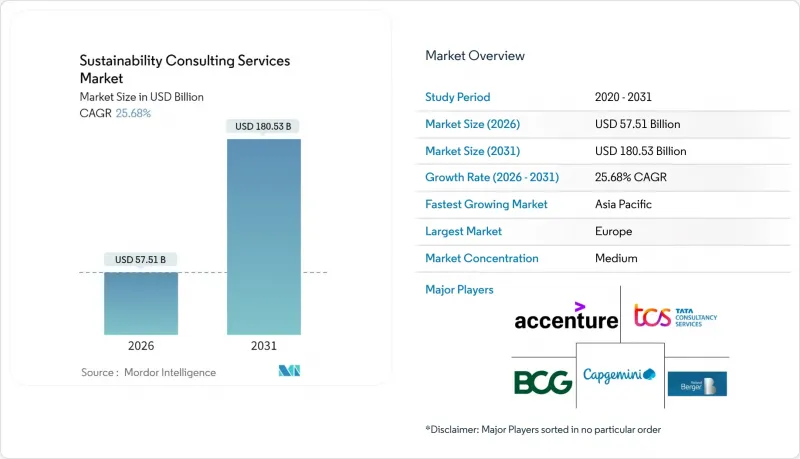
지속가능성 컨설팅 서비스 시장은 2025년에 457억 5,000만 달러로 평가되며, 2026년 575억 1,000만 달러에서 2031년까지 1,805억 3,000만 달러에 달할 것으로 예측됩니다.
예측 기간(2026-2031년)의 CAGR은 25.68%로 예상됩니다.
규제 요건의 강화, 기업의 넷제로 공약의 급증, 디지털 탄소 데이터 플랫폼의 확산으로 환경, 사회, 지배구조(ESG) 관리는 이사회 차원의 우선순위로 변모하고 있습니다. 유럽연합(EU)의 '기업 지속가능성 보고 지침'만 해도 5만개 이상의 기업이 공시의무 대상에 포함되면서 전문적인 가이던스에 대한 수요가 급증하고 있습니다. 동시에 투자자들이 기후 변화 대응에 부합하는 자산에 자본을 재분배하는 움직임이 가속화되고 있으며, 기업은 탈탄소화 계획에 대한 외부 검증을 요구하고 있습니다. 기술 도입이 진행되면서 AI 탑재 탄소회계 엔진이 데이터 수집을 자동화하고, 컨설턴트가 고부가가치 자문 업무에 집중할 수 있는 환경이 조성되면서 서비스 제공 형태가 재편되고 있습니다. 경쟁은 치열해지고 있지만, 시장은 여전히 충분히 세분화되어 있으므로 세계 대기업과 틈새 전문 기업 모두 생물 다양성, 순환 경제, 자연 기반 솔루션과 같은 신흥 분야에서 점유율을 확보할 수 있는 기회가 있습니다.
세계 지속가능성 컨설팅 서비스 시장 동향 및 인사이트
기업의 순 제로 목표가 컨설팅 지출을 가속화
대기업은 현재 넷제로 목표를 단순한 목표가 아닌 엄격한 준수 기한으로 간주하고 있습니다. 이사회는 과학에 기반한 목표를 공급망 매핑, 기술 선택, 이해관계자 참여를 포함하는 운영 로드맵으로 전환해야 합니다. Scope 3 배출량이 전체 배출량의 70%를 초과하는 것이 일상화되어 복잡성을 증가시키고, 제3자의 가이던스의 필요성을 높이고 있습니다. 전 세계 2,000대 기업 중 16%만이 2050년 넷제로를 달성하기 위한 궤도에 올라선 것으로 나타나, 외부 자문단이 채워야 할 실행 측면의 큰 격차가 존재한다는 점을 강조하고 있습니다. 규제 강화와 조사 방법론의 발전에 따라 지속적인 모니터링, 목표 재조정, 보증 요건이 다년간의 컨설팅 계약을 지원하고 있습니다.
확대되는 ESG 및 지속가능성 공시 규정
EU의 CSRD(Corporate Sustainability Reporting Directive)는 이중 중요성 분석, 구조화된 디지털 태깅, 제3자 보증을 도입하여 유럽에 진출한 기업에게 가파른 학습 곡선을 만들어내고 있습니다. 2024-2026년까지 단계적으로 적용되는 일정으로 인해, 보고 의무가 있는 기업 그룹에서 자문 수요는 높은 수준으로 지속될 것입니다. EU 역외에 기반을 둔 다국적 기업이라도 해당 지역에 상당한 매출액이 있는 경우 적용 대상이 되며, 컴플라이언스 프로젝트가 전 세계로 확대됩니다. 요구되는 데이터 수집의 깊이로 인해 보고 프로세스, IT 시스템, 내부 통제의 업그레이드가 요구되고 있으며, 컨설팅 업체들은 이러한 분야에서 평가, 설계, 변경 관리 서비스를 제공합니다.
심각한 인력 부족으로 청구 단가가 상승
기후과학, 규제 지식, 전략적 컨설팅을 융합한 전문가에 대한 수요는 공급을 훨씬 능가하고 있습니다. 특히 생물다양성 평가, 순환형 제품 설계, AI 기반 배출량 분석 등의 전문 인력은 여전히 부족합니다. 기업은 보수를 인상하고, 경쟁사로부터 인재를 끌어들이고, 기술 향상 프로그램에 투자하고 있지만, 인재 파이프라인의 제약은 여전히 지속되고 있습니다. 치솟은 일당은 일부 중견기업 고객사의 발길을 돌리게 하고, 프로젝트 물량을 감소시켜 지속가능성 컨설팅 서비스 시장에 자연스레 제동을 걸고 있습니다. 기술을 활용한 제공 모델이 부족한 부분을 일부 보완하고 있지만, 여전히 복잡한 사안에 대해는 사람의 전문성이 필요합니다.
부문 분석
지속가능성 컨설팅 서비스 시장에서 기후 변화 컨설팅은 2025년 매출의 29.12%를 차지했습니다. 순환 경제 및 자원 효율화 관련 프로젝트는 규모는 작지만, 폐기물 감소와 재생 디자인에 대한 기업의 관심이 높아짐에 따라 2031년까지 18.05%의 가장 높은 CAGR을 나타낼 것으로 예측됩니다. ESG 보고 자문은 공시 의무 확대에 따라 수요가 증가하고 있으며, 그린 빌딩 컨설팅은 규제 강화와 인증제도 확산에 따른 수혜를 받고 있습니다.
순환경제 전략을 추구하는 고객사들은 제품 재설계, 역물류 계획, 새로운 매출모델 개발을 요구하고 있습니다. 자문팀은 의사결정을 지원하기 위해 수명주기 평가 툴와 재무적 영향 모델링을 통합하여 의사결정을 지원하고 있습니다. 원자재 가격 상승과 매립 규제 강화에 따라 경영진은 순환성을 리스크 감소와 가치 창출의 양면으로 보고 지속가능성 컨설팅 서비스 시장의 장기적인 확대를 추진하고 있습니다.
에너지 및 전력 기업은 2025년 지출의 23.78%를 차지할 것으로 예상되며, 이는 에너지 및 전력 부문이 세계 탈탄소화에서 핵심적인 역할을 담당하고 있음을 보여줍니다. 한편, 제조업은 공급망 규제 확대와 인더스트리 4.0 투자가 자원 효율화 목표와 맞물려 CAGR 15.74%로 성장을 촉진할 것으로 예측됩니다. 금융 서비스 업계 고객들은 기후 리스크 시나리오 분석과 지속가능한 금융 상품 설계를 요구하고 있으며, 건설 및 부동산 분야에서는 그린 빌딩 기준과 탄소 매장량 추적이 주요 업무로 꼽히고 있습니다.
제조업체는 Scope 3 배출량 보고, 고객 주도형 공급업체 규범 준수, 에너지 강도 감소 등의 압박을 받고 있습니다. 컨설팅 업무는 매트리얼 플로우 매핑, 재생에너지 조달, 디지털 트윈 도입 등 다양한 분야에 걸쳐 있습니다. 규제와 상업적 요인이 결합되면서 산업계 고객들은 지속가능성 컨설팅 서비스 시장 규모에서 점점 더 큰 비중을 차지하고 있습니다.
지속가능성 컨설팅 서비스 시장은 서비스 유형(기후 변화 컨설팅, 그린 빌딩 컨설팅 등), 최종사용자 산업(에너지 및 전력, 건설-부동산 등), 컨설팅 제공 모델(전략-자문 등), 지속가능성 중점 분야(기후 변화, 넷제로 등), 지역별로 구분됩니다. 지속가능성 중점 영역(기후 변화, 넷제로 등), 지역별로 구분됩니다. 시장 예측은 금액(USD)으로 제공됩니다.
지역별 분석
유럽은 2025년 매출의 38.74%를 차지할 것으로 예상되며, 이는 규제 도입과 성숙된 기업의 지속가능성 실천을 반영합니다. CSRD(기업지속가능경영보고지침), EU Taxonomy, 각국의 기후중립법 등이 다년간의 자문 프로젝트를 지속할 수 있도록 지원하고 있습니다. 예를 들어 독일 연방 기관은 컨설턴트를 고용하여 부문별 탈탄소화 로드맵을 수립하고 2045년 중립 목표를 향한 진행 상황을 모니터링하고 있습니다. 복잡한 이중물성평가와 디지털 태깅 규정은 법률, 재무, 기술 분야를 통합한 전문 지식에 대한 수요를 더욱 증가시키고 있습니다.
아시아태평양은 2031년까지 16.92%의 가장 빠른 CAGR을 달성할 것으로 예측됩니다. 산업화, 공급망의 수출 의존도, 국부펀드 운용 정책 등이 결합되어 컨설팅 지출을 촉진합니다. 중국, 인도 등의 국가들이 배출권 거래 시범사업과 녹색금융 프레임워크를 시작하면서 국내 기업은 컴플라이언스 대응과 기회 획득에 대한 지침을 필요로 하고 있습니다. 블룸버그 NEF는 이 지역이 2050년까지 74-89조 달러의 전환 자본을 필요로할 것으로 예측하고 있으며, 이는 대규모 지속가능성 컨설팅 서비스 시장의 기반이 될 것으로 전망하고 있습니다. 세계 노하우를 활용하면서 서비스를 현지화하는 사업자가 가장 유리한 위치에 있습니다.
북미 시장은 성숙해졌지만 여전히 규모가 크고, 기업의 자발적 노력, 주정부 차원의 청정에너지 기준, 투자자의 적극적인 참여가 꾸준한 성장을 지원하고 있습니다. 그러나 종합적인 연방 규제의 부재가 가속화를 억제하고 있습니다. 남미에서는 다국적 기업공급망 요구사항이 다운스트림으로 확대되면서 수요가 증가하고 있으며, 중동 및 아프리카에서는 자원 부문의 다각화 계획과 정부 펀드의 ESG 목표가 시장을 촉진하고 있습니다. 지역별로 다른 정책 성숙도에 따라 서비스 구성에 차이가 발생하여 지속가능성 컨설팅 서비스 시장의 세계 회복탄력성을 강화하고 있습니다.
기타 특전:
- 엑셀 형식 시장 예측(ME) 시트
- 애널리스트의 3개월간 지원
자주 묻는 질문
목차
제1장 서론
제2장 조사 방법
제3장 개요
제4장 시장 인사이트
제5장 시장 규모와 성장 예측
제6장 경쟁 구도
제7장 시장 기회와 향후 전망
KSA 26.03.06The sustainability consulting services market was valued at USD 45.75 billion in 2025 and estimated to grow from USD 57.51 billion in 2026 to reach USD 180.53 billion by 2031, at a CAGR of 25.68% during the forecast period (2026-2031).
Heightened regulatory mandates, fast-rising corporate net-zero pledges and digital carbon-data platforms are turning environmental, social and governance management into a board-level priority. The European Union's Corporate Sustainability Reporting Directive alone brings more than 50,000 firms into mandatory disclosure scope, multiplying demand for specialized guidance. At the same time, investors are reallocating capital toward climate-aligned assets, prompting companies to seek external verification of decarbonization plans. Technology adoption is reshaping service delivery as AI-enabled carbon-accounting engines automate data capture, freeing consultants to focus on high-value advisory. Competition is intensifying, yet the market remains sufficiently fragmented for both global majors and niche boutiques to capture share in emerging areas such as biodiversity, circularity and nature-based solutions.
Global Sustainability Consulting Services Market Trends and Insights
Corporate Net-Zero Commitments Accelerating Advisory Spend
Large enterprises now treat net-zero targets as hard compliance deadlines rather than aspirational statements. Boards must translate science-based targets into operational roadmaps that span supply-chain mapping, technology selection and stakeholder engagement. Scope 3 emissions regularly exceed 70% of total footprints, amplifying complexity and elevating the need for third-party guidance. Only 16% of the world's 2,000 largest firms remain on track for 2050 net-zero, underscoring a vast execution gap that external advisors are hired to close . Continuous monitoring, target recalibration and assurance requirements sustain multi-year consulting engagements as regulations tighten and methodologies evolve.
Expanding ESG and Sustainability Disclosure Regulations
The EU CSRD introduces double materiality analysis, structured digital tagging and third-party assurance, creating a steep learning curve for companies with European operations. Staggered adoption timelines from 2024 to 2026 keep advisory demand elevated across successive cohorts of filers. Non-EU multinationals with significant regional sales also fall within scope, extending compliance projects worldwide. Required data-collection depth forces upgrades to reporting processes, IT systems and internal controls, areas where consultancies provide assessment, design and change-management services.
Acute Talent Shortage Inflating Billing Rates
Demand for professionals who blend climate science, regulatory insight and strategic consulting far outweighs supply. Specialized roles in biodiversity valuation, circular-product design and AI-driven emissions analytics remain especially scarce. Firms raise compensation, poach competitors and invest in upskilling programs, yet pipeline constraints persist. Elevated day rates deter some midmarket clients, dampening project volumes and placing a natural brake on the sustainability consulting services market. Technology-enabled delivery models partly offset the shortfall, but complex engagements still require human expertise.
Other drivers and restraints analyzed in the detailed report include:
- AI-Enabled Carbon-Accounting Platforms Driving Integration Projects
- Public-Sector Decarbonization Stimulus Programs
- Off-the-Shelf SaaS Sustainability Tools Disintermediating Consulting
For complete list of drivers and restraints, kindly check the Table Of Contents.
Segment Analysis
Climate-change consulting accounted for 29.12% of 2025 revenue within the sustainability consulting services market. Circular-economy and resource-efficiency engagements, though smaller, will post the strongest 18.05% CAGR to 2031, reflecting growing corporate interest in waste elimination and regenerative design. ESG-reporting advisory gains traction as disclosure obligations expand, while green-building consulting benefits from stricter codes and certification schemes.
Clients pursuing circular-economy strategies demand product redesign, reverse-logistics planning and new revenue-model development. Advisory teams integrate life-cycle assessment tools with financial-impact modeling to guide decision-making. As material costs rise and landfill regulations tighten, leaders view circularity as both risk mitigation and value creation, reinforcing long-run expansion of the sustainability consulting services market.
Energy and power companies generated 23.78% of 2025 spending, underscoring the sector's central role in global decarbonization. Manufacturers, however, will pace growth at a 15.74% CAGR as supply-chain mandates propagate and Industry 4.0 investments intersect with resource-efficiency goals. Financial-services clients request climate-risk scenario analysis and sustainable-finance product design, while construction and real estate engagements revolve around green-building codes and embodied-carbon tracking.
Manufacturers face mounting pressure to report scope-3 emissions, comply with customer-driven supplier codes and reduce energy intensity. Consulting assignments span material-flow mapping, renewable-energy sourcing and digital twin deployment. As regulatory and commercial drivers converge, industrial clients contribute an ever-larger slice of the sustainability consulting services market size.
Sustainability Consulting Services Market is Segmented by Service Type (Climate-Change Consulting, Green-Building Consulting, and More), End-User Industry (Energy and Power, Construction and Real Estate, and More), Consulting Delivery Model (Strategy and Advisory, and More), Sustainability Focus Area (Climate-Change and Net-Zero, and More), and Geography. The Market Forecasts are Provided in Terms of Value (USD).
Geography Analysis
Europe generated 38.74% of 2025 revenue, reflecting early regulatory adoption and mature corporate sustainability practices. The CSRD, EU Taxonomy and national climate-neutrality laws sustain multiyear advisory pipelines. German federal agencies, for instance, enlist consultants to draft sector-specific decarbonization roadmaps and monitor progress toward the 2045 neutrality goal. Complex double-materiality assessments and digital tagging rules reinforce demand for integrated legal, financial, and technical expertise.
Asia-Pacific will deliver the fastest 16.92% CAGR to 2031. Industrialization, supply-chain export exposure and sovereign-wealth-fund mandates converge to spur consulting spend. Nations such as China and India launch emissions-trading pilots and green-finance frameworks, compelling domestic firms to seek guidance on compliance and opportunity capture. BloombergNEF projects the region needs USD 74-89 trillion in transition capital through 2050, anchoring a sizeable sustainability consulting services market. Service providers that localize offerings while leveraging global playbooks are best positioned.
North America remains sizeable though maturing. Voluntary corporate commitments, state-level clean-energy standards and investor activism underpin steady growth, yet lack of comprehensive federal regulation tempers acceleration. South American demand is emerging as multinational supply-chain requirements extend downstream, whereas the Middle East and Africa benefit from resource-sector diversification agendas and sovereign-fund ESG goals. Varied policy maturity across geographies ensures differentiated service mixes, bolstering global resilience of the sustainability consulting services market.
- Accenture plc
- Boston Consulting Group, Inc.
- Tata Consultancy Services Ltd.
- Capgemini SE
- Roland Berger GmbH
- Bain and Company, Inc.
- KPMG International Ltd.
- Ernst and Young Global Ltd.
- Deloitte Touche Tohmatsu Ltd.
- PricewaterhouseCoopers LLP
- McKinsey and Company, Inc.
- AECOM
- WSP Global Inc.
- Environmental Resources Management Ltd.
- Jacobs Solutions Inc.
- Arcadis N.V.
- Wood Group plc
- Tetra Tech, Inc.
- Ramboll Group A/S
- Stantec Inc.
Additional Benefits:
- The market estimate (ME) sheet in Excel format
- 3 months of analyst support
TABLE OF CONTENTS
1 INTRODUCTION
- 1.1 Study Assumptions and Market Definition
- 1.2 Scope of the Study
2 RESEARCH METHODOLOGY
3 EXECUTIVE SUMMARY
4 MARKET INSIGHTS
- 4.1 Market Overview
- 4.2 Market Drivers
- 4.2.1 Corporate net-zero commitments accelerating advisory spend
- 4.2.2 Expanding ESG and sustainability disclosure regulations (e.g., CSRD)
- 4.2.3 Investor pressure for climate-risk-aligned capital allocation
- 4.2.4 Public-sector decarbonization stimulus programs
- 4.2.5 AI-enabled carbon-accounting platforms driving integration projects
- 4.2.6 Sovereign-wealth-fund sustainability mandates in emerging markets
- 4.3 Market Restraints
- 4.3.1 Acute talent shortage inflating billing rates
- 4.3.2 Regulatory-certainty gaps and greenwashing litigation risk
- 4.3.3 Off-the-shelf SaaS sustainability tools disintermediating consulting
- 4.3.4 Carbon-credit price volatility undermining ROI narratives
- 4.4 Value Chain Analysis
- 4.5 Regulatory Landscape
- 4.6 Technological Outlook
- 4.7 Porter's Five Forces Analysis
- 4.7.1 Bargaining Power of Suppliers
- 4.7.2 Bargaining Power of Buyers
- 4.7.3 Threat of New Entrants
- 4.7.4 Threat of Substitutes
- 4.7.5 Competitive Rivalry
- 4.8 Industry Ecosystem Analysis
- 4.9 Key Use Cases and Case Studies
- 4.10 Assessment of Macroeconomic Trends
- 4.11 Investment Analysis
5 MARKET SIZE AND GROWTH FORECASTS (VALUE)
- 5.1 By Service Type
- 5.1.1 Climate-Change Consulting
- 5.1.2 Green-Building Consulting
- 5.1.3 ESG and Reporting Advisory
- 5.1.4 Circular-Economy and Resource-Efficiency Consulting
- 5.1.5 Sustainability Strategy and Governance
- 5.2 By End-User Industry
- 5.2.1 Energy and Power
- 5.2.2 Construction and Real Estate
- 5.2.3 Manufacturing and Industrials
- 5.2.4 Financial Services and Insurance
- 5.2.5 Public Sector and NGOs
- 5.3 By Consulting Delivery Model
- 5.3.1 Strategy and Advisory
- 5.3.2 Implementation and Integration
- 5.3.3 Managed Services / Outsourcing
- 5.3.4 Digital Platforms and Analytics
- 5.3.5 Training and Capacity-Building
- 5.4 By Sustainability Focus Area
- 5.4.1 Climate-Change and Net-Zero
- 5.4.2 Biodiversity and Nature-Based Solutions
- 5.4.3 Circular-Economy and Waste-Management
- 5.4.4 Social Impact and DEI
- 5.4.5 Sustainable Finance and Reporting
- 5.5 By Geography
- 5.5.1 North America
- 5.5.1.1 United States
- 5.5.1.2 Canada
- 5.5.1.3 Mexico
- 5.5.2 South America
- 5.5.2.1 Brazil
- 5.5.2.2 Argentina
- 5.5.2.3 Colombia
- 5.5.2.4 Rest of South America
- 5.5.3 Europe
- 5.5.3.1 Germany
- 5.5.3.2 United Kingdom
- 5.5.3.3 France
- 5.5.3.4 Italy
- 5.5.3.5 Spain
- 5.5.3.6 Russia
- 5.5.3.7 Netherlands
- 5.5.3.8 Rest of Europe
- 5.5.4 Asia-Pacific
- 5.5.4.1 China
- 5.5.4.2 Japan
- 5.5.4.3 South Korea
- 5.5.4.4 India
- 5.5.4.5 Australia
- 5.5.4.6 Singapore
- 5.5.4.7 Rest of Asia-Pacific
- 5.5.5 Middle East and Africa
- 5.5.5.1 Middle East
- 5.5.5.1.1 Saudi Arabia
- 5.5.5.1.2 United Arab Emirates
- 5.5.5.1.3 Rest of Middle East
- 5.5.5.2 Africa
- 5.5.5.2.1 South Africa
- 5.5.5.2.2 Egypt
- 5.5.5.2.3 Rest of Africa
- 5.5.5.1 Middle East
- 5.5.1 North America
6 COMPETITIVE LANDSCAPE
- 6.1 Market Concentration
- 6.2 Strategic Moves
- 6.3 Market Share Analysis
- 6.4 Company Profiles (includes Global level Overview, Market level overview, Core Segments, Financials as available, Strategic Information, Market Rank/Share for key companies, Products and Services, and Recent Developments)
- 6.4.1 Accenture plc
- 6.4.2 Boston Consulting Group, Inc.
- 6.4.3 Tata Consultancy Services Ltd.
- 6.4.4 Capgemini SE
- 6.4.5 Roland Berger GmbH
- 6.4.6 Bain and Company, Inc.
- 6.4.7 KPMG International Ltd.
- 6.4.8 Ernst and Young Global Ltd.
- 6.4.9 Deloitte Touche Tohmatsu Ltd.
- 6.4.10 PricewaterhouseCoopers LLP
- 6.4.11 McKinsey and Company, Inc.
- 6.4.12 AECOM
- 6.4.13 WSP Global Inc.
- 6.4.14 Environmental Resources Management Ltd.
- 6.4.15 Jacobs Solutions Inc.
- 6.4.16 Arcadis N.V.
- 6.4.17 Wood Group plc
- 6.4.18 Tetra Tech, Inc.
- 6.4.19 Ramboll Group A/S
- 6.4.20 Stantec Inc.
7 MARKET OPPORTUNITIES AND FUTURE OUTLOOK
- 7.1 White-space and Unmet-Need Assessment