|
시장보고서
상품코드
2035085
글루카르산 시장 : 점유율 분석, 업계 동향 및 통계, 성장 예측(2026-2031년)Glucaric Acid - Market Share Analysis, Industry Trends & Statistics, Growth Forecasts (2026 - 2031) |
||||||
 Mordor Intelligence
글루카르산 시장 규모는 2025년 7억 8,000만 달러에서 2026년에는 8억 4,000만 달러로 확대되어 2026년부터 2031년까지 CAGR 7.78%로 성장을 지속하여, 2031년까지 12억 2,000만 달러에 이를 것으로 예측됩니다.
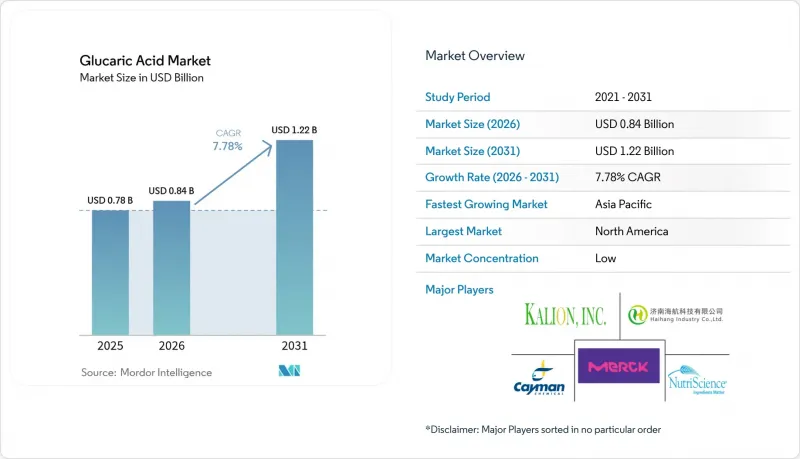
엄격한 환경 규제와 지속 가능한 화학 대체품을 찾는 전 세계적인 움직임에 힘입어 글루카르산 시장은 괄목할 만한 성장세를 보이고 있습니다. 이러한 상승 추세의 주요 요인으로는 생명공학 기술의 발전과 제약 및 식품 가공 분야에서의 용도 확대를 들 수 있습니다. 석유화학제품에 대한 의존도를 낮추려는 움직임도 시장 확대를 더욱 부추기고 있습니다. 현재 시장을 주도하는 것은 정제된 형태의 제품이며, 상업적 성숙도와 광범위한 용도를 보여주고 있습니다. 그러나 건강보조식품 분야의 유도체는 증가 추세에 있으며, 가까운 시일 내에 더 빠른 보급률을 보일 것으로 예측됩니다. 건강과 웰빙에 대한 소비자의 인식이 높아지면서 이 부문의 성장을 주도하고 있습니다. 용도별로는 세제가 1위를 차지하고 있지만, 클린 라벨 및 기능성 원료에 대한 수요 증가를 배경으로 식품 등급에서의 이용이 눈에 띄게 증가하고 있습니다. 이러한 추세는 식품 생산의 투명성과 지속가능성으로의 광범위한 전환과 일치합니다. 선진국은 잘 구축된 산업 인프라와 지원적인 규제에 힘입어 여전히 가장 큰 시장 점유율을 차지하고 있습니다. 그러나 급속한 산업화와 환경적 지속가능성을 촉진하는 강력한 정책 이니셔티브에 힘입어 아시아태평양은 가장 빠르게 성장하는 지역으로 주목받고 있습니다. 이 지역의 중산층 확대와 가처분 소득 증가도 시장 성장에 기여하고 있습니다. 혁신이 최전선에 서고, 지역적 트렌드가 작용하는 가운데, 시장은 변혁적 진화를 겪고 있습니다.
세계 글루카르산 시장 동향 및 인사이트
무독성 및 무알러지성 첨가제에 대한 소비자 선호도가 산업 전반으로 확산되고 있습니다.
무독성 및 무알러지성 첨가제에 대한 수요가 증가함에 따라 산업 전반에 걸쳐 화학물질 조달 전략이 변화하고 있으며, 글루카르산은 기존 킬레이트제의 대안으로 부상하고 있습니다. 2024년 8월부터 시행되는 미국 환경보호청(EPA)의 '세이퍼 초이스 기준' 개정안은 제품 인증에 있어 성분의 투명성 향상과 라이프사이클 분석을 의무화하여 바이오 유래 대체품의 채택을 촉진하고 있습니다. 이는 환경 주장에 대한 검증과 지속가능성 라벨에 대한 제3자 인증을 의무화하고, 근거 없는 '친환경' 마케팅 주장을 배제하는 유럽연합(EU) 지침 2024/825에 부합합니다. 이러한 규제 변경은 정량화 가능한 환경적 이점을 입증할 수 있는 글루카르산 제조업체에 유리하게 작용할 수 있습니다. 산업용 구매자는 책임 리스크를 최소화하고 기업의 지속가능성 목표를 달성하기 위해 무독성 첨가제를 우선시하고 있으며, 평가 기준을 비용 요소에만 국한하지 않고 평가 기준을 확대되고 있습니다. 제약업계의 글루카르산칼슘의 대사 건강 제품 사용은 혈당 조절에 대한 효능을 뒷받침하는 임상 연구로 뒷받침되며, 안전성 고려가 가격 전략에 어떤 영향을 미치는지 보여주고 있습니다.
디톡스 및 대사 건강에 대한 소비자의 관심 증가
대사성 질환의 유병률이 증가함에 따라 글루카르산 유도체, 특히 글루카르산 칼슘에 대한 시장 수요가 크게 증가하고 있습니다. 이러한 성장은 주로 대사 건강 관리에 대한 소비자의 인식이 높아지고, 기존 의약품을 대체할 수 있는 과학적으로 입증된 천연 유래의 대안을 찾는 움직임에 기인합니다. 글루카르산 화합물은 GLP-1 반응 경로를 조절하는 데 있어 큰 잠재력을 보여주며, 확대되는 체중 관리 시장에서 처방약을 대체할 수 있는 신뢰할 수 있는 대안으로 자리매김하고 있습니다. 의료기관에서는 다양한 대사성 질환에 대한 비용 효율적인 치료법으로 이러한 화합물을 치료 프로토콜에 통합하는 움직임이 점점 더 확산되고 있습니다. 고령화와 당뇨병 발병률 증가라는 인구통계학적 변화가 동시에 진행되면서, 특히 예방의학 및 대사 지원 분야에서 글루카르산을 기반으로 한 건강 솔루션에 대한 시장 기반이 탄탄하게 구축되고 있습니다. 예를 들어, 세계은행 자료에 따르면 2023년 기준 일본은 65세 이상 고령자 비율이 인구의 30%로 가장 높고, 이탈리아가 24%로 그 뒤를 잇고 있습니다.
복잡하고 에너지 집약적인 정제 공정
제약 및 식품 등급의 글루카르산에 대한 엄격한 정제 요건이 시장 성장을 억제하고 있으며, 특히 중소규모의 생명공학 기업에 영향을 미치고 있습니다. 기존의 정제 방법은 여러 번의 결정화 공정과 엄격한 불순물 관리 조치가 필요합니다. 특정 지역의 높은 에너지 비용은 정제 과정을 제한하고 있으며, 저렴한 청정 에너지를 이용할 수 있는 생산자만이 혜택을 받고 있습니다. 전기투석이나 막분리 등의 첨단기술이 대안이 될 수 있지만, 이러한 조사방법은 막대한 설비투자와 전문적 기술지식이 필요합니다. 다양한 원료와 발효 매개변수에 걸쳐 표준화된 제품 품질을 유지하는 고유의 복잡성은 기존 제조 기업에게 경쟁 우위를 제공합니다. 또한, 미국 식품의약국(FDA)과 유럽의약품청(EMA)이 제정한 규제 프레임워크는 종합적인 문서화 및 검증 프로토콜을 요구하고 있으며, 이는 소규모 생산자에게 큰 운영상의 장벽으로 작용하고 있습니다. 이러한 요인들이 결합되어 글루카르산 산업 시장 성장 궤적과 운영 역학에 큰 영향을 미치고 있습니다.
부문 분석
2025년 순도 D-글루카르산은 순도가 최우선시되는 제약, 산업 및 연구 분야에서 중요한 역할을 하는 배경에 따라 시장 점유율의 30.12%를 차지했습니다. 이 부문의 성장은 특히 수처리 분야에서 확립된 생산 기술과 규제 준수에 의해 뒷받침되고 있습니다. 여기서는 유해물질관리법(TSCA)에 따른 승인이 경쟁 우위를 가져다주고 있습니다. 순수 D-글루카르산에 대한 수요는 화학 중간체에서 친환경 솔루션에 이르기까지 다양한 용도로 활용될 수 있다는 점에서 더욱 뒷받침되고 있으며, 이는 지속가능성에 대한 관심이 높아지는 추세와도 일치합니다. 또한, 생산 기술의 발전으로 인해 효율성이 향상되고 비용이 절감될 것으로 예상되며, 이는 다양한 부문에서 채택을 더욱 촉진할 것으로 보입니다. 한편, 칼슘 D-글루카레이트는 의약품 용도 및 대사 건강 관련 임상 연구에 대한 관심에 힘입어 2031년까지 연평균 복합 성장률(CAGR) 9.01%로 확대될 것으로 예측됩니다. 칼슘 염 형태는 유리산 형태에 비해 우수한 생체 이용률과 안정성을 자랑하며, 영양 보충제에서 최적의 선택이 될 수 있습니다. 건강과 웰빙에 대한 소비자의 인식이 높아지면서 영양 보충제에서 칼슘 D-글루카레이트에 대한 수요 증가에 기여하고 있습니다.
칼륨 및 나트륨-D-글루카레이트계 제품은 주로 산업 분야, 특히 용해도와 pH 안정성이 매우 중요한 세제 제제에서 주요 용도가 있습니다. 이 제품들은 특히 경수 조건에서 세정제의 성능을 향상시키는 역할을 하기 때문에 주목을 받고 있습니다. D-글루카르산-1,4-락톤은 고분자 화학 및 합성 반응에서 독자적인 틈새 시장을 개척하고 있습니다. 독특한 화학적 특성으로 인해 고성능 소재 및 첨단 제조 공정에 필수적인 성분으로 사용되고 있습니다. '기타' 카테고리에는 다양한 신흥 유도체와 특정 산업 분야에 맞게 조정된 배합물들이 포함되어 있습니다. 시장 세분화는 기초 화학 응용에서 고급 의약품 및 특수 제품으로의 전환을 보여줍니다. 생명공학 기업들이 최전선에 서서 성능을 향상시킬 뿐만 아니라 고가에 판매할 수 있는 유도체를 개발하고 있습니다. 파생상품 개발의 지속적인 혁신은 특히 약물 전달 시스템 및 첨단 산업 공정과 같은 고부가가치 응용 분야에서 시장 성장을 위한 새로운 길을 열어줄 것으로 기대되고 있습니다.
지역별 분석
2025년 북미는 30.74%의 압도적인 시장 점유율을 차지했으며, 그 배경에는 탄탄한 생명공학 인프라, 엄격한 환경 규제, 그리고 지속 가능한 화학에 대한 광범위한 노력이 있습니다. 이 지역의 주요 기업들은 발효 기반 생산 기술을 선도적으로 개발하여 수처리 분야에서 규제 당국의 승인을 획득했습니다. '세이프 초이스(Safer Choice)' 기준의 개정과 강화된 환경 규제 준수 요건이 바이오 대체품에 대한 꾸준한 수요를 촉진하고 있습니다. 한편, 이 지역에서는 기존 제약 및 특수화학 부문이 수익성 높은 시장 기회를 제공합니다. 또한, 첨단 연구시설의 존재와 혁신에 대한 강한 집중력은 북미 시장에서의 입지를 더욱 공고히 하고 있습니다. 변화하는 규제 환경에 적응할 수 있는 능력과 지속가능성에 대한 관심으로 북미는 바이오 솔루션의 보급을 주도하는 주요한 역할을 하고 있습니다.
아시아태평양은 2031년까지 연평균 복합 성장률(CAGR) 9.21%를 기록하며 가장 높은 성장세를 보이고 있습니다. 이러한 급격한 성장은 R&D 시설에 대한 대규모 투자, 바이오 화학 물질의 채택 확대, 제약 부문 수요 증가에 힘입어 이루어지고 있습니다. 정부 주도의 지속 가능한 화학물질 생산 촉진 노력, 제조업체의 환경 인식 증가, 식품 보존에서 퍼스널케어에 이르는 광범위한 응용 분야가 이 지역의 성장을 더욱 촉진하고 있습니다. 또한, 이 지역은 대규모로 빠르게 증가하는 인구의 혜택을 누리고 있으며, 이는 다양한 산업에서 지속 가능한 제품에 대한 수요를 주도하고 있습니다. 또한, 세계 기업의 진출 확대와 현지 제조업체와의 제휴가 아시아태평양의 바이오 기술 개발 및 보급을 가속화하고 있습니다.
유럽 시장에서는 엄격한 REACH 규제와 순환 경제에 대한 노력에 따라 지속가능성을 추구하는 소비자 트렌드에 힘입어 바이오 화학제품에 대한 수요가 급증하고 있습니다. 이 지역의 강력한 규제 프레임워크는 일관된 품질 및 안전 기준을 보장하고 있으며, 이는 바이오 대체품의 채택을 더욱 촉진하고 있습니다. 또한, 유럽이 탄소 배출량을 줄이고 기후 목표를 달성하기 위해 집중하고 있는 것은 지속 가능한 제품에 대한 수요 증가와 일치합니다. 한편, 남미, 중동 및 아프리카에서는 급성장하는 농업 부문, 바이오 정유에 대한 투자 확대, 화학제품 생산에서 석유 의존도를 낮추기 위한 협력적 노력의 원동력으로 도입이 초기 단계에 있습니다. 이들 지역에서는 풍부한 천연자원을 활용하여 바이오 화학제품을 개발할 수 있는 기회도 모색하고 있으며, 이를 통해 세계 시장에서 신흥 기업로 자리매김할 수 있습니다.
기타 특전:
- 엑셀 형식 시장 예측(ME) 시트
- 3개월간 애널리스트 지원
자주 묻는 질문
목차
제1장 서론
제2장 조사 방법
제3장 주요 요약
제4장 시장 구도
제5장 시장 규모와 성장 예측
제6장 경쟁 구도
제7장 시장 기회와 향후 전망
JHS 26.05.20The glucaric acid market size is expected to grow from USD 0.78 billion in 2025 to USD 0.84 billion in 2026 and is forecast to reach USD 1.22 billion by 2031 at 7.78% CAGR over 2026-2031.
Driven by stringent environmental regulations and a global push for sustainable chemical alternatives, the glucaric acid market is gaining significant momentum. Key drivers of this upward trend include advancements in biotechnology and an increasing application in pharmaceuticals and food processing. The growing focus on reducing dependency on petrochemical-based products further supports the market's expansion. Purified forms currently lead the market, showcasing their commercial maturity and widespread application. Yet, derivatives aimed at the health supplement segments are on the rise, with expectations of a faster adoption rate in the near future. The increasing consumer awareness regarding health and wellness is driving this segment's growth. While detergents hold the top spot in applications, there's a notable surge in food-grade uses, driven by a growing demand for clean-label and functional ingredients. This trend aligns with the broader shift toward transparency and sustainability in food production. Mature economies, bolstered by established industrial infrastructures and supportive regulations, still command the largest market share. However, the Asia-Pacific region is making waves as the fastest-growing area, propelled by swift industrialization and robust policy initiatives championing environmental sustainability. The region's expanding middle-class population and rising disposable incomes further contribute to the market's growth. With innovation at the forefront and regional dynamics in play, the market is poised for a transformative evolution.
Global Glucaric Acid Market Trends and Insights
Consumer Preference for Non-Toxic, Allergen Free Additives Across Industries
The increasing demand for non-toxic, allergen-free additives is transforming chemical procurement strategies across industries, with glucaric acid emerging as an alternative to conventional chelating agents. The Environmental Protection Agency (EPA)'s Safer Choice Standard amendments, taking effect in August 2024, mandate improved ingredient transparency and lifecycle analysis for product certification, supporting the adoption of bio-based alternatives . This aligns with the European Union's Directive 2024/825, which requires verification of environmental claims and third-party certification for sustainability labels, eliminating unsubstantiated "eco-friendly" marketing claims. These regulatory changes provide advantages to glucaric acid manufacturers who can demonstrate quantifiable environmental benefits. Industrial purchasers prioritize non-toxic additives to minimize liability risks and meet corporate sustainability goals, expanding their evaluation criteria beyond cost factors. The pharmaceutical industry's use of calcium glucarate in metabolic health products illustrates how safety considerations influence pricing strategies, as supported by clinical studies that confirm its effectiveness in glucose management.
Surging Consumer Focus on Detox and Metabolic Health
The increasing prevalence of metabolic health conditions has generated substantial market demand for glucaric acid derivatives, particularly calcium glucarate. This growth is primarily attributed to consumers' heightened awareness of metabolic health management and their pursuit of scientifically validated natural alternatives to conventional pharmaceutical interventions. Glucaric acid compounds have demonstrated significant potential in modulating GLP-1 response pathways, positioning them as credible alternatives to prescription medications within the expanding weight management market. Healthcare institutions are increasingly integrating these compounds into their treatment protocols as cost-effective interventions for various metabolic disorders. The concurrent demographic shifts toward aging populations and the rising incidence of diabetes create a strong market foundation for glucaric acid-based health solutions, particularly in preventive healthcare and metabolic support applications. For instance, according to World Bank data, in 2023, Japan reported the highest proportion of individuals aged 65 or older at 30% of its population, with Italy following at 24% .
Complex and Energy-Intensive Purification Process
Stringent purification requirements for pharmaceutical and food-grade glucaric acid restrain market growth, particularly affecting smaller biotechnology companies. Traditional purification methods demand multiple crystallization steps and strict impurity control measures. High energy costs in certain regions limit purification processes, benefiting only producers with access to affordable clean energy. Although advanced technologies such as electrodialysis and membrane separation present viable alternatives, these methodologies necessitate considerable capital expenditure and specialized technical expertise. The inherent complexity of maintaining standardized product quality across diverse feedstock materials and fermentation parameters creates a competitive advantage for established manufacturing entities. Furthermore, the regulatory framework established by the Food and Drug Administration (FDA) and European Medicines Agency (EMA) mandates comprehensive documentation and validation protocols, presenting substantial operational barriers for smaller-scale producers. These combined factors significantly influence the market's growth trajectory and operational dynamics within the glucaric acid industry.
Other drivers and restraints analyzed in the detailed report include:
- Increasing Regulatory Push for Phosphate-Free Detergents
- Rising Demand for Bio-Based Chemicals as Sustainable Alternatives
- Price Sensitivity in Mass-Market
For complete list of drivers and restraints, kindly check the Table Of Contents.
Segment Analysis
In 2025, pure D-glucaric acid commands a 30.12% share of the market, driven by its critical role in pharmaceuticals, industry, and research, where purity is paramount. This segment's expansion is bolstered by established production techniques and adherence to regulations, especially in water treatment. Here, approvals under the Toxic Substances Control Act (TSCA) confer a competitive edge. The demand for pure D-lucaric acid is further supported by its versatility in applications, ranging from chemical intermediates to environmentally friendly solutions, which align with the growing emphasis on sustainability. Additionally, advancements in production technologies are expected to enhance efficiency and reduce costs, further driving their adoption across various segments. Meanwhile, calcium D-glucarate is on track to expand at a 9.01% CAGR through 2031, fueled by its pharmaceutical uses and clinical research focus on metabolic health. Its calcium salt form boasts superior bioavailability and stability over its free acid counterpart, making it a prime choice for dietary supplements. The increasing consumer awareness regarding health and wellness is also contributing to the rising demand for calcium-D-glucarate in dietary formulations.
Potassium and sodium-D-glucarate variants find their primary application in the industrial segments, notably in detergent formulations where both solubility and pH stability are paramount. These variants are also gaining traction due to their role in enhancing the performance of cleaning agents, particularly in hard water conditions. D-glucaric acid-1,4-lactone carves out a specialized niche in polymer chemistry and synthesis reactions. Its unique chemical properties make it an essential component in high-performance materials and advanced manufacturing processes. The 'other' category encompasses a range of emerging derivatives and tailored formulations for distinct industrial applications. This market segmentation indicates a transition from fundamental chemical uses to premium pharmaceutical and specialty products. Biotechnology firms are at the forefront, crafting derivatives that not only enhance performance but also fetch premium prices. The ongoing innovation in derivative development is expected to open new avenues for market growth, particularly in high-value applications such as drug delivery systems and advanced industrial processes.
The Global Glucaric Acid Market is Segmented by Product Type (Pure D-Glucaric Acid, Calcium-D-Glucarate, Potassium/Sodium-D-Glucarate, D-Glucaric Acid-1, 4-Lactone, and Others), by Application (Food Ingredients, Detergents, Pharmaceuticals, and Others), and by Geography (North America, Europe, Asia-Pacific, South America, and Middle East and Africa). The Market Forecasts are Provided in Terms of Value (USD).
Geography Analysis
In 2025, North America commands a dominant 30.74% market share, bolstered by its robust biotechnology infrastructure, stringent environmental regulations, and a broad embrace of sustainable chemistry. Major companies in the region are pioneering fermentation-based production technologies and obtaining regulatory nods for water treatment. Modifications to the Safer Choice Standard and heightened environmental compliance demands fuel a steady appetite for bio-based alternatives. Meanwhile, the region's well-established pharmaceutical and specialty chemical segments present lucrative market opportunities. Additionally, the presence of advanced research facilities and a strong focus on innovation further strengthens North America's position in the market. The region's ability to adapt to evolving regulatory landscapes and its emphasis on sustainability make it a key player in driving the adoption of bio-based solutions.
Asia-Pacific is on track to achieve the highest growth trajectory, boasting a 9.21% CAGR through 2031. This surge is fueled by significant investments in research and development facilities, a rising embrace of bio-based chemicals, and an escalating demand from the pharmaceutical sector. Government-backed initiatives championing sustainable chemical production, heightened environmental awareness among manufacturers, and a broadened scope of applications from food preservation to personal care further bolster the region's growth. The region also benefits from its large and rapidly growing population, which drives demand for sustainable products across various industries. Furthermore, the increasing presence of global players and collaborations with local manufacturers are accelerating the development and adoption of bio-based technologies in Asia-Pacific.
European markets, navigating under stringent REACH regulations and circular economy initiatives, are witnessing a surge in bio-based chemicals, spurred by a growing consumer inclination towards sustainability. The region's strong regulatory framework ensures consistent quality and safety standards, which further encourage the adoption of bio-based alternatives. Additionally, Europe's focus on reducing carbon emissions and achieving climate goals aligns with the increasing demand for sustainable products. Meanwhile, South America and the Middle East and Africa are in the nascent stages of adoption, driven by their burgeoning agricultural sectors, escalating investments in bio-refineries, and a concerted effort to diminish reliance on petroleum for chemical production. These regions are also exploring opportunities to leverage their abundant natural resources to develop bio-based chemicals, which could position them as emerging players in the global market.
- Merck KGaA
- Kalion Inc.
- Haihang Group
- Cayman Chemical Company
- NutriScience Innovations, LLC
- Rivertop Renewables
- Johnson Matthey plc
- Anmol Chemicals Pvt.Ltd
- Alfa Chemistry
- AK Scientific Inc.
- Jungbunzlauer Suisse AG
- Shanpar Industries Private Limited
- Jiaan Biotech
- Tokyo Chemicals Industry Pvt Ltd
- Geocon Products
- Spectrum Chemical Mfg. Corp.
- Hindustan Bec Tech India Pvt. Ltd.
- Santa Cruz Biotechnology, Inc.
- Surfachem Group Ltd
- Kanto Chemical Co., Inc.
Additional Benefits:
- The market estimate (ME) sheet in Excel format
- 3 months of analyst support
TABLE OF CONTENTS
1 INTRODUCTION
- 1.1 Study Assumptions and Market Definition
- 1.2 Scope of the Study
2 RESEARCH METHODOLOGY
3 EXECUTIVE SUMMARY
4 MARKET LANDSCAPE
- 4.1 Market Overview
- 4.2 Market Drivers
- 4.2.1 Consumer Preference for Non-Toxic, Allergien Free Additives Across Industries
- 4.2.2 Surging Consumer Focus on Detox and Metabolic Health
- 4.2.3 Increasing Regulatory Push for Phosphate-Free Detergents
- 4.2.4 Rising Demand for Bio-Based Chemical as Sustinable Alternatives
- 4.2.5 Industrial Shift Towards Safer and Non-Corrosive Acid Alternatives
- 4.2.6 Wide Application of Glucaric Acid in Detergent and Cleaning Products
- 4.3 Market Restraints
- 4.3.1 Complex and Energy-Intensive Purification Process
- 4.3.2 Price Sensitivity in Mass-Market
- 4.3.3 Low Solubility in Organic Solvents
- 4.3.4 Patent Constraints in Key Synthesis Technologies
- 4.4 Supply Chain Analysis
- 4.5 Regulatory Outlook
- 4.6 Porter's Five Forces
- 4.6.1 Threat of New Entrants
- 4.6.2 Bargaining Power of Buyers/Consumers
- 4.6.3 Bargaining Power of Suppliers
- 4.6.4 Threat of Substitute Products
- 4.6.5 Intensity of Competitive Rivalry
5 MARKET SIZE AND GROWTH FORECASTS (VALUE)
- 5.1 By Product Type
- 5.1.1 Pure D-Glucaric Acid
- 5.1.2 Calcium-D-Glucarate
- 5.1.3 Potassium/Sodium-D-Glucarate
- 5.1.4 D-Glucaric Acid-1,4-Lactone
- 5.1.5 Others
- 5.2 By Application
- 5.2.1 Food Ingredients
- 5.2.2 Detergents
- 5.2.3 Pharmaceuticals
- 5.2.4 Others
- 5.3 By Geography
- 5.3.1 North America
- 5.3.1.1 United States
- 5.3.1.2 Canada
- 5.3.1.3 Mexico
- 5.3.1.4 Rest of North America
- 5.3.2 Europe
- 5.3.2.1 Germany
- 5.3.2.2 United Kingdom
- 5.3.2.3 Italy
- 5.3.2.4 France
- 5.3.2.5 Spain
- 5.3.2.6 Netherlands
- 5.3.2.7 Rest of Europe
- 5.3.3 Asia-Pacific
- 5.3.3.1 China
- 5.3.3.2 India
- 5.3.3.3 Japan
- 5.3.3.4 Australia
- 5.3.3.5 Rest of Asia-Pacific
- 5.3.4 South America
- 5.3.4.1 Brazil
- 5.3.4.2 Rest of South America
- 5.3.5 Middle East and Africa
- 5.3.5.1 South Africa
- 5.3.5.2 Saudi Arabia
- 5.3.5.3 United Arab Emirates
- 5.3.5.4 Rest of Middle East and Africa
- 5.3.1 North America
6 COMPETITIVE LANDSCAPE
- 6.1 Market Concentration
- 6.2 Strategic Moves
- 6.3 Market Ranking Analysis
- 6.4 Company Profiles (includes Global-level Overview, Market-level Overview, Core Segments, Financials (if available), Strategic Information, Market Rank/Share, Products and Services, Recent Developments)
- 6.4.1 Merck KGaA
- 6.4.2 Kalion Inc.
- 6.4.3 Haihang Group
- 6.4.4 Cayman Chemical Company
- 6.4.5 NutriScience Innovations, LLC
- 6.4.6 Rivertop Renewables
- 6.4.7 Johnson Matthey plc
- 6.4.8 Anmol Chemicals Pvt.Ltd
- 6.4.9 Alfa Chemistry
- 6.4.10 AK Scientific Inc.
- 6.4.11 Jungbunzlauer Suisse AG
- 6.4.12 Shanpar Industries Private Limited
- 6.4.13 Jiaan Biotech
- 6.4.14 Tokyo Chemicals Industry Pvt Ltd
- 6.4.15 Geocon Products
- 6.4.16 Spectrum Chemical Mfg. Corp.
- 6.4.17 Hindustan Bec Tech India Pvt. Ltd.
- 6.4.18 Santa Cruz Biotechnology, Inc.
- 6.4.19 Surfachem Group Ltd
- 6.4.20 Kanto Chemical Co., Inc.