|
시장보고서
상품코드
2035105
인쇄회로기판(PCB) 검사 장비 시장 : 점유율 분석, 업계 동향 및 통계, 성장 예측(2026-2031년)Printed Circuit Board Inspection Equipment - Market Share Analysis, Industry Trends & Statistics, Growth Forecasts (2026 - 2031) |
||||||
 Mordor Intelligence
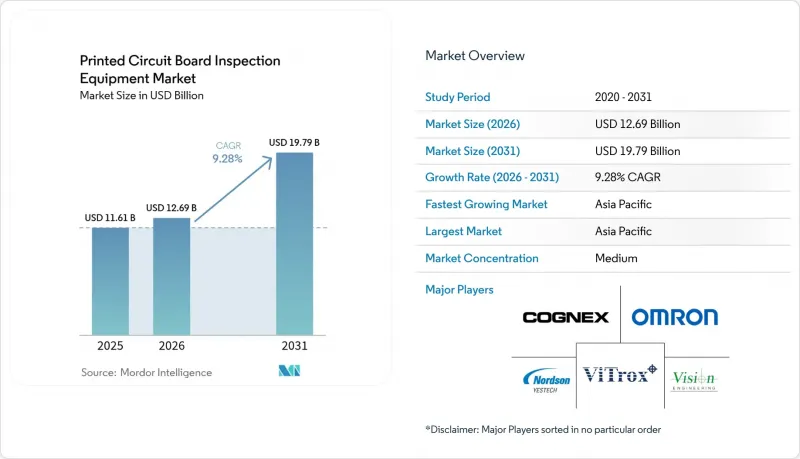
2026년 인쇄회로기판(PCB) 검사 장비 시장 규모는 126억 9,000만 달러로 추정되며 2025년 116억 1,000만 달러에서 성장하여 2031년에는 197억 9,000만 달러에 이를 것으로 예측됩니다.
2026년부터 2031년까지 연평균 복합 성장률(CAGR) 9.28%를 나타낼 것으로 예측됩니다.
급속한 소형화, 자동차 및 의료용 전자제품의 무결점 의무화, 첨단 패키징의 서브마이크론 공차 요구사항으로 인해 투자 우선순위가 재편되고 있습니다. 현재 인라인 자동 광학 검사(AOI) 플랫폼이 수요의 대부분을 차지하고 있지만, 고밀도 인터커넥트 및 칩렛 기판에서 체적 이미징, 공평성 측정 및 미세 공극 검출이 필수적이기 때문에 3D AOI 및 3D X선 시스템의 도입이 가속화되고 있습니다. 또한, 전자기기 제조업체들은 설비 비용과 처리량을 연동하는 '검사당 과금' 서비스 모델로 전환하고 있으며, 인공지능(AI)을 활용한 결함 분류를 통해 오검출이 감소하고 유효 생산 능력이 향상되고 있습니다. 매출은 아시아태평양이 주도하고 있으며, 전기자동차(EV) 1대당 1,500-2,000달러의 전자부품이 추가됨에 따라 자동차용 일렉트로닉스이 가장 빠르게 성장하고 있는 최종 사용자 부문으로 부상하고 있습니다.
세계 PCB 검사 장비 시장 동향과 인사이트
전자기기의 소형화 및 부품 밀도 향상으로 인한 소형화 추세
스마트폰의 부품 피치는 이미 0.3mm까지 좁아지고 있으며, 제조업체들은 수작업 육안 검사를 폐지하고 20µ&m 이하의 미세구조를 식별할 수 있는 AOI 시스템으로 전환하고 있습니다. 50µ&m에서 150µ&m의 마이크로 비아, 블라인드 비아 및 매립 비아 스택, 재배선 층 아래에 있는 구리 기둥 등은 2D 그레이 스케일 이미지에서는 확인할 수 없습니다.
대만 산업기술연구원은 2024년 칩렛 기판의 미세한 균열을 검출하는 20nm 해상도의 딥 자외선(DUV) 20nm 해상도 프로토타입을 시연했습니다. 5,000달러의 데이터센터용 GPU 기판에서 단 한 개의 결함이 폐기 비용을 초래하는 현재, 기판당 15초 만에 수행할 수 있는 인라인 3D 검사는 경제적으로 정당화될 수 있습니다.
자동차 전장 및 전기자동차의 성장
세계 전기차 생산량은 2024년 1,400만 대에 달했고, 2030년까지 4,000만 대를 넘어설 것으로 예측됩니다. 각 EV에는 파워 모듈, 배터리 관리 보드, 운전 보조 컨트롤러가 내장되어 있으며, 이로 인해 PCB 탑재량은 내연기관차 대비 3배에 달할 전망입니다.
Tier 1 공급업체는 IATF 16949의 신뢰성 기준을 충족하기 위해 100% 인라인 X-Ray 검사로 전환하고 있으며, ISO 26262에서는 안전 관련 어셈블리의 검사 결과를 전자적으로 추적할 수 있도록 요구하고 있습니다. 검사가 엄격해짐에 따라 3D AOI와 3D 컴퓨터 단층 촬영(CT) 플랫폼에 대한 수요가 증가하고 있습니다.
고급 AOI 및 AXI 시스템에는 많은 초기 투자가 필요합니다.
레이저 삼각측량 방식의 3D AOI 플랫폼의 가격은 15만-40만 달러이며, 서브미크론 정밀도의 CT 엑스레이 시스템은 60만 달러 이상의 가격대를 형성하고 있습니다. 이러한 고비용은 특히 비용에 민감한 시장에서 사업을 영위하는 기업들에게 막대한 선투자를 필요로 하기 때문에 큰 도전이 되고 있습니다. 2022년부터 2024년까지 금리 상승으로 인해 가중평균자본비용(WACC)이 150-200bp 상승하고, 투자 회수 기간이 길어지고 설비 발주가 지연되면서 재원 부담이 더욱 커졌습니다. 이러한 재정적 압박으로 인해 많은 기업들이 자본 배분 전략을 재검토해야 하는 상황에 처해 있습니다. EaaS(Equipment-as-a-Service) 서비스는 설비투자(CAPEX)를 운영비(OPEX)로 전환하여 기업의 초기 재정적 부담을 줄여주지만, 그 도입은 여전히 선진국에 국한되어 있습니다. 이러한 제한적인 보급은 이들 지역의 높은 수준의 인프라, 양호한 규제 환경, 그리고 높은 기술적 성숙도 등의 요인에 기인합니다.
부문 분석
자동 광학 검사는 2025년 매출의 56.93%를 차지했으며, 이는 2D 및 신흥 3D 광학 기술로 처리할 수 있는 작업의 폭이 넓다는 것을 보여줍니다. 한편, X-Ray 검사는 볼 그리드 어레이(BGA), QFN, SiP 모듈의 보급에 따라 2031년까지 연평균 복합 성장률(CAGR) 10.74%로 확대될 것으로 예측됩니다. 컴퓨터 단층 촬영 장비는 1µm 복셀 해상도로 마이크로 범프와 실리콘 관통 전극(TSV) 내 공극을 가시화하여 파괴적인 단면 검사를 대체합니다. 0.5mm 피치 이상의 부품의 경우, 광학 검사 스테이션은 여전히 비용 효율성이 뛰어나지만, 0.3mm 피치가 주류가 되면서 그 적용 범위가 좁아질 것입니다. 솔더 페이스트 검사는 표면 실장 라인에 완전히 통합되어 스텐실 결함을 조기에 감지하여 다운스트림 공정의 재작업을 80% 이상 줄였습니다.
X선 검사의 도입은 반도체 패키징의 추세에 따라 칩렛 아키텍처를 PCB 조립 현장으로 밀어붙이는 반도체 패키징의 추세에 힘입은 것입니다. Comet, Waygate 등의 업체들은 현재 반도체 수준의 해상도와 컨베이어식 핸들링을 결합한 고처리량 기판 라인에 최적화된 CT 스캐너를 제공합니다. 광학 검사 장비는 여전히 리스크가 낮은 민수용 제품이 주류를 이루고 있지만, 스마트폰에서도 언더 디스플레이 카메라나 접이식 플렉서블 테일의 체적 검사가 증가하고 있습니다. 전반적으로 엑스레이 검사의 성장은 가시광선으로는 도달할 수 없는 검사 영역을 개척함으로써 PCB 검사 장비 시장을 견인하고 있습니다.
인라인 시스템은 2025년 수요의 60.72%를 차지했으며, CAGR 11.68%로 모든 폼팩터 중 가장 높은 성장률을 나타낼 것으로 예측됩니다. 컨베이어와의 통합을 통해 생산 흐름을 중단하지 않고 기판 한 장당 15-30초 만에 100% 검사할 수 있습니다. 프린터 및 실장기와의 폐쇄 루프 피드백을 통해 결함 검출을 즉각적인 공정 수정으로 전환할 수 있으며, 이는 오프라인 스테이션에서는 실현할 수 없는 기능입니다. 검사별 과금 계약은 검사를 소량 생산에 연동된 변동비로 취급하여 경제성을 더욱 인라인 구매로 기울이고 있습니다.
오프라인 및 벤치탑 스테이션은 유연성이 속도보다 중요한 엔지니어링 실험실, 초도품 검사, 소량 생산 의료기기 및 항공 전자 제품 제조에 계속 활용되고 있습니다. 그러나 수탁 제조업체가 여러 작업을 하나의 인라인 노드에 통합함에 따라 그 도입량은 점차 감소하고 있습니다. 따라서 PCB 검사 장비 시장은 규모뿐만 아니라 스마트팩토리 환경에서 요구되는 데이터의 상세성 측면에서도 인라인 플랫폼에 의존하고 있습니다.
지역별 분석
아시아태평양은 2025년 전 세계 매출의 37.88%를 차지했으며, 2031년까지 연평균 복합 성장률(CAGR) 11.12%로 확대될 것으로 전망됩니다. 중국에서만 전 세계 전자제품 제조의 28%를 차지하고 있으며, Foxconn, Luxshare Precision과 같은 위탁 조립 업체들이 거점을 두고 스마트폰, 노트북, 웨어러블 제품 라인에서 인라인 AOI를 필수적으로 사용하고 있습니다. 한국과 대만은 메모리 모듈 및 데이터센터용 가속기용 HDI 기판을 전문적으로 생산하고 있으며, 일본은 자동차 및 산업용 전자기기 분야에서 프리미엄 틈새 시장을 유지하고 있어 CT 검사를 조기에 도입할 수 있는 요인이 되고 있습니다. 중국의 '중국제조 2025', 한국의 'K-반도체 전략'과 같은 정부 프로그램은 스마트팩토리를 위한 툴을 지원하고 있으며, 이는 지역 수요를 더욱 촉진하고 있습니다.
북미와 유럽은 2025년 매출의 약 44.62%를 차지했습니다. 미국의 'CHIPS and Science Act'는 반도체 및 첨단 패키징 공장에 520억 달러를 할당하고 있으며, 그 중 상당 부분은 기판 및 인터포저 생산라인을 위한 검사 장비를 조달하는 데 사용됩니다. 독일, 프랑스, 이탈리아는 자동차 전장 생산능력을 확충하고 있으며, 배터리 팩과 파워 모듈의 품질을 보장하기 위해 CT X선 검사를 도입하고 있습니다. 의료기기용 FDA 21 CFR 820 및 항공우주용 AS9100과 같은 규제 제도는 오프라인 CT 및 음향 현미경의 판매 기반을 확보하고 있습니다.
중동 및 아프리카, 남미는 점유율은 작지만 지역별로 고른 성장세를 보이고 있습니다. 이스라엘의 방산 및 의료기기 분야는 IPC 클래스 3의 추적성을 필수로 요구하고 있으며, 이는 CT의 구매를 촉진하고 있습니다. 사우디아라비아와 아랍에미리트는 경제 다각화 정책의 일환으로 국내 전자제품 프로그램을 시작하면서 중급형 AOI 수요를 창출하고 있습니다. 브라질과 아르헨티나에서는 지역 소비를 위한 가전제품 및 산업용 제어 장비의 조립이 이루어지고 있으며, 비용 경쟁력이 있는 2D AOI 장비가 선호되는 한편, 인더스트리 4.0의 데이터 수집도 점차 도입되고 있습니다. 이러한 신흥 거점들은 기존의 주요 시장을 넘어 인쇄회로기판 검사장비 시장 규모를 확대되고 있습니다.
기타 특전:
- 엑셀 형식 시장 예측(ME) 시트
- 3개월간 애널리스트 지원
자주 묻는 질문
목차
제1장 서론
제2장 조사 방법
제3장 주요 요약
제4장 시장 구도
제5장 시장 규모와 성장 예측
제6장 경쟁 구도
제7장 시장 기회와 향후 전망
JHS 26.05.20printed circuit board inspection equipment market size in 2026 is estimated at USD 12.69 billion, growing from 2025 value of USD 11.61 billion with 2031 projections showing USD 19.79 billion, growing at 9.28% CAGR over 2026-2031.
Rapid miniaturization, zero-defect mandates in automotive and medical electronics, and sub-micron tolerance requirements in advanced packaging are reshaping investment priorities. Inline automatic optical inspection (AOI) platforms dominate current demand, yet 3D AOI and 3D X-ray systems are accelerating because volumetric imaging, coplanarity measurement, and micro-void detection are now essential for high-density interconnect and chiplet substrates. Electronics manufacturers are also shifting toward pay-per-inspection service models that align equipment costs with throughput, while artificial-intelligence-enabled defect classification reduces false calls and lifts effective capacity. Asia-Pacific leads revenue generation, and automotive electronics is the quickest-expanding end-user segment as electric vehicles (EVs) add USD 1,500-2,000 of electronic content per unit.
Global Printed Circuit Board Inspection Equipment Market Trends and Insights
Increasing Miniaturization and Higher Component Densities in Electronics
Component pitch in smartphones has already tightened to 0.3 mm, forcing manufacturers to retire manual visual checks in favour of AOI systems able to resolve features below 20 µm. Microvias between 50 µm and 150 µm, blind or buried via stacks, and copper pillars beneath redistribution layers are invisible to 2D grayscale imaging.
Taiwan's Industrial Technology Research Institute demonstrated a deep-UV 20 nm-resolution prototype in 2024 that identifies micro-cracks in chiplet substrates. As a single defect on a USD 5,000 data-center GPU substrate now drives scrap cost, inline 3D inspection at 15 s per board is economically justified.
Growth in Automotive Electronics and Electric Vehicles
Global EV output climbed to 14 million units in 2024 and is expected to surpass 40 million units by 2030. Each EV integrates power modules, battery-management boards, and driver-assistance controllers that collectively triple PCB content versus internal-combustion vehicles.
Tier-1 suppliers have moved to 100% inline X-ray inspection to meet IATF 16949 reliability standards, while ISO 26262 mandates electronic traceability of inspection results for safety-related assemblies. Increased inspection intensity lifts demand for both 3D AOI and 3D computed tomography (CT) platforms.
High Initial Capital Investments for Advanced AOI And AXI System
Prices for a laser-triangulation 3D AOI platform range from USD 150,000 to 400,000, whereas a sub-micron CT X-ray system commands a price tag exceeding USD 600,000. These high costs pose significant challenges for companies, particularly those operating in cost-sensitive markets, as they require substantial upfront investments. Between 2022 and 2024, rising interest rates pushed the weighted average cost of capital up by 150 to 200 basis points, further straining financial resources by elongating payback periods and causing delays in equipment orders. This financial pressure has led many businesses to reassess their capital allocation strategies. While equipment-as-a-service offerings transform capital expenditure into operational expenditure (OPEX), enabling companies to reduce initial financial burdens, their adoption remains largely confined to mature economies. This limited uptake is attributed to factors such as the availability of advanced infrastructure, favorable regulatory environments, and higher levels of technological readiness in these regions.
Other drivers and restraints analyzed in the detailed report include:
- Rising Adoption of Industry 4.0 Smart Manufacturing Lines
- Deployment of Advanced AI-Enabled Defect Classification Reducing False Calls
- Shortage Of Skilled Technicians for System Programming and Maintenance
For complete list of drivers and restraints, kindly check the Table Of Contents.
Segment Analysis
Automatic optical inspection delivered 56.93% of 2025 revenue, demonstrating the breadth of tasks addressable by 2D and emerging 3D optics. X-ray inspection, however, is forecast to expand at an 10.74% CAGR through 2031 as ball-grid arrays, QFNs, and SiP modules proliferate. Computed-tomography units visualize voiding in micro-bumps and through-silicon vias at 1 µm voxel resolution, replacing destructive cross-sectioning. Optical-only stations remain cost-effective for components above 0.5 mm pitch, but their addressable share will narrow as 0.3 mm pitch becomes mainstream. Solder-paste inspection is fully integrated into surface-mount lines to catch stencil defects early, reducing downstream rework by more than 80%.
X-ray adoption draws support from semiconductor packaging trends that push chiplet architectures onto PCB assembly floors. Vendors such as Comet and Waygate now offer CT scanners tailored for high-throughput board lines, merging semiconductor-class resolution with conveyorized handling. Optical stations still dominate low-risk consumer products, yet even in smartphones volumetric checks are rising for under-display cameras and folded flex tails. Overall, x-ray growth lifts the printed circuit board inspection equipment market by unlocking inspection windows unreachable by visible light.
Inline systems held 60.72% of 2025 demand and are projected to progress at a 11.68% CAGR, the fastest among all form factors. Their conveyor integration enables 100% board coverage at 15-30 s per piece without interrupting flow. Closed-loop feedback with printers and placement machines converts defect detection into immediate process correction, a capability that offline stations cannot match. Pay-per-inspection agreements further tilt economics toward inline purchases by treating inspection as a variable cost tied to low volume.
Offline and benchtop stations continue to serve engineering labs, first-article inspections, and low-volume medical, and avionics builds where flexibility outweighs speed. Yet their installed base is slowly declining as contract manufacturers consolidate multiple tasks into single inline nodes. The printed circuit board inspection equipment market therefore leans on inline platforms not only for scale but also for data granularity needed in smart-factory environments.
The Printed Circuit Board Inspection Equipment Market Report is Segmented by Inspection Method (Automatic Optical Inspection, and More), System Type (Inline Systems, and More), Technology (2D AOI, 3D AOI, and More), End User (Consumer Electronics, Automotive Electronics, and More), PCB Type (Rigid PCBs, Flexible and Rigid-Flex PCBs, and More), and Geography. The Market Forecasts are Provided in Terms of Value (USD).
Geography Analysis
Asia-Pacific delivered 37.88% of global revenue in 2025 and is expected to expand at an 11.12% CAGR to 2031. China alone accounts for 28% of worldwide electronics manufacturing and hosts contract assemblers such as Foxconn and Luxshare Precision that mandate inline AOI across smartphone, laptop, and wearable lines. South Korea and Taiwan specialize in HDI substrates for memory modules and data-center accelerators, while Japan maintains a premium niche in automotive and industrial electronics that justifies early adoption of CT inspection. Government programs like China's Made in China 2025 and South Korea's K-Semiconductor Strategy subsidize smart-factory tools, further lifting regional demand.
North America and Europe jointly held roughly 44.62% of 2025 turnover. The United States CHIPS and Science Act allocate USD 52 billion for semiconductor and advanced-packaging plants, many of which will source inspection equipment for substrate and interposer lines. Germany, France, and Italy are upgrading automotive electronics capacity, installing CT X-ray to safeguard battery-pack and power-module quality. Regulatory regimes such as FDA 21 CFR 820 for medical devices and AS9100 for aerospace secure a baseline of offline CT and acoustic microscopy sales.
The Middle East, Africa, and South America contribute smaller shares but demonstrate patchy growth. Israel's defense and medical-device sector insist on IPC Class 3 traceability, prompting CT purchases. Saudi Arabia and the United Arab Emirates have launched domestic electronics programs as part of diversification agendas, adding mid-tier AOI demand. Brazil and Argentina assemble consumer electronics and industrial controls for regional consumption, favouring cost-competitive 2D AOI units yet gradually incorporating Industry 4.0 data collection. These emerging hubs collectively enlarge the printed circuit board inspection equipment market footprint beyond traditional strongholds.
- Nordson Corporation
- Koh Young Technology Inc.
- Omron Corporation
- ViTrox Corporation Berhad
- Mirtec Co., Ltd.
- Viscom AG
- Saki Corporation
- CyberOptics Corporation
- Test Research Inc.
- KLA Corporation
- Camtek Ltd.
- Yamaha Motor Co., Ltd. (Yamaha SMT)
- Unicomp Technology Co., Ltd.
- Nikon Corporation
- Comet Yxlon GmbH
- Waygate Technologies GmbH
- Shenzhen JT Automation Equipment Co., Ltd.
- GOPEL electronic GmbH
- Machine Vision Products Inc.
- Pemtron Corporation
Additional Benefits:
- The market estimate (ME) sheet in Excel format
- 3 months of analyst support
TABLE OF CONTENTS
1 INTRODUCTION
- 1.1 Study Assumptions and Market Definition
- 1.2 Scope of the Study
2 RESEARCH METHODOLOGY
3 EXECUTIVE SUMMARY
4 MARKET LANDSCAPE
- 4.1 Market Overview
- 4.2 Market Drivers
- 4.2.1 Increasing Miniaturization and Higher Component Densities in Electronics
- 4.2.2 Rising Adoption of Industry 4.0 Smart Manufacturing Lines
- 4.2.3 Growth in Automotive Electronics and Electric Vehicles
- 4.2.4 Deployment of Advanced AI-Enabled Defect Classification Reducing False Calls
- 4.2.5 Pay-Per-Inspection and Equipment-as-a-Service Business Models Lowering CapEx Barriers
- 4.2.6 Demand for Sub-Micron 3D Inspection in Advanced Packaging and Chiplet PCBs
- 4.3 Market Restraints
- 4.3.1 High Initial Capital Investments for Advanced AOI/AXI Systems
- 4.3.2 Shortage of Skilled Technicians for System Programming and Maintenance
- 4.3.3 Rapid Technology Obsolescence Leading to Compressed ROI Cycles
- 4.3.4 Radiation Safety Compliance Costs for High-Power X-Ray Inspection Lines
- 4.4 Value-Chain Analysis
- 4.5 Regulatory Landscape
- 4.6 Technological Outlook
- 4.7 Impact of Macroeconomic Factors on the Market
- 4.8 Porter's Five Forces Analysis
- 4.8.1 Threat of New Entrants
- 4.8.2 Bargaining Power of Buyers
- 4.8.3 Bargaining Power of Suppliers
- 4.8.4 Threat of Substitute Products
- 4.8.5 Intensity of Competitive Rivalry
5 MARKET SIZE AND GROWTH FORECASTS (VALUE)
- 5.1 By Inspection Method
- 5.1.1 Automatic Optical Inspection (AOI)
- 5.1.2 X-Ray Inspection (AXI)
- 5.1.3 Solder Paste Inspection (SPI)
- 5.1.4 Other Specialized Methods (Acoustic, Laser, Thermography)
- 5.2 By System Type
- 5.2.1 Inline Systems
- 5.2.2 Offline / Benchtop Systems
- 5.3 By Technology
- 5.3.1 2D AOI
- 5.3.2 3D AOI
- 5.3.3 2D X-Ray
- 5.3.4 3D / CT X-Ray
- 5.4 By End User
- 5.4.1 Consumer Electronics Manufacturers
- 5.4.2 Automotive Electronics Manufacturers
- 5.4.3 Industrial and Energy Electronics
- 5.4.4 Aerospace and Defense
- 5.4.5 Medical Device Manufacturers
- 5.5 By PCB Type
- 5.5.1 Rigid PCBs
- 5.5.2 Flexible and Rigid-Flex PCBs
- 5.5.3 High-Density Interconnect (HDI) PCBs
- 5.5.4 Advanced Packaging Substrates
- 5.6 Geography
- 5.6.1 North America
- 5.6.1.1 United States
- 5.6.1.2 Canada
- 5.6.1.3 Mexico
- 5.6.2 Europe
- 5.6.2.1 United Kingdom
- 5.6.2.2 Germany
- 5.6.2.3 France
- 5.6.2.4 Italy
- 5.6.2.5 Rest of Europe
- 5.6.3 Asia-Pacific
- 5.6.3.1 China
- 5.6.3.2 Japan
- 5.6.3.3 India
- 5.6.3.4 South Korea
- 5.6.3.5 Rest of Asia
- 5.6.4 Middle East
- 5.6.4.1 Israel
- 5.6.4.2 Saudi Arabia
- 5.6.4.3 United Arab Emirates
- 5.6.4.4 Turkey
- 5.6.4.5 Rest of Middle East
- 5.6.5 Africa
- 5.6.5.1 South Africa
- 5.6.5.2 Egypt
- 5.6.5.3 Rest of Africa
- 5.6.6 South America
- 5.6.6.1 Brazil
- 5.6.6.2 Argentina
- 5.6.6.3 Rest of South America
- 5.6.1 North America
6 COMPETITIVE LANDSCAPE
- 6.1 Market Concentration
- 6.2 Strategic Moves
- 6.3 Market Share Analysis
- 6.4 Company Profiles (includes Global Level Overview, Market Level Overview, Core Segments, Financials as available, Strategic Information, Market Rank/Share for key companies, Products and Services, and Recent Developments)
- 6.4.1 Nordson Corporation
- 6.4.2 Koh Young Technology Inc.
- 6.4.3 Omron Corporation
- 6.4.4 ViTrox Corporation Berhad
- 6.4.5 Mirtec Co., Ltd.
- 6.4.6 Viscom AG
- 6.4.7 Saki Corporation
- 6.4.8 CyberOptics Corporation
- 6.4.9 Test Research Inc.
- 6.4.10 KLA Corporation
- 6.4.11 Camtek Ltd.
- 6.4.12 Yamaha Motor Co., Ltd. (Yamaha SMT)
- 6.4.13 Unicomp Technology Co., Ltd.
- 6.4.14 Nikon Corporation
- 6.4.15 Comet Yxlon GmbH
- 6.4.16 Waygate Technologies GmbH
- 6.4.17 Shenzhen JT Automation Equipment Co., Ltd.
- 6.4.18 GOPEL electronic GmbH
- 6.4.19 Machine Vision Products Inc.
- 6.4.20 Pemtron Corporation
7 MARKET OPPORTUNITIES AND FUTURE OUTLOOK
- 7.1 White-Space and Unmet-Need Assessment