
|
시장보고서
상품코드
2043827
전착 코팅(E-coat) 시장 : 점유율 분석, 업계 동향과 통계, 성장 예측(2026-2031년)Electrocoating (E-coat) - Market Share Analysis, Industry Trends & Statistics, Growth Forecasts (2026 - 2031) |
||||||
 Mordor Intelligence
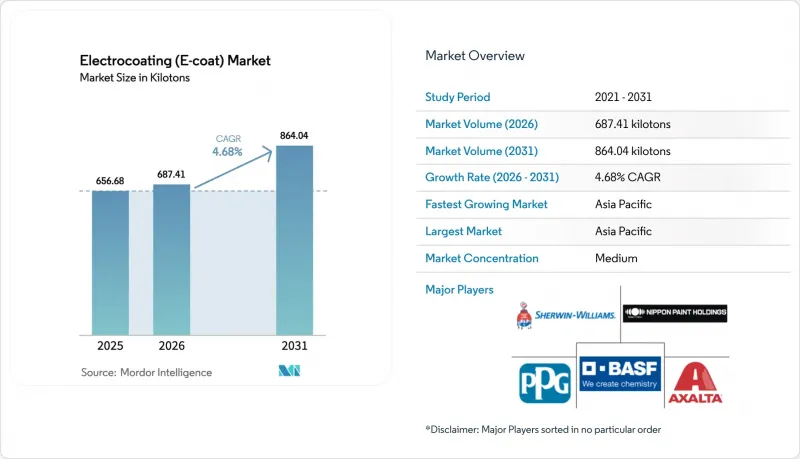
전착 코팅 시장 규모는 2025년 656.68 킬로톤, 2026년 687.41 킬로톤에서, 2031년까지 864.04 킬로톤으로 확대한다고 예측되고 있으며 2026년부터 2031년까지 연평균 복합 성장률(CAGR)은 4.68%를 보일 전망입니다.
세 가지 주요 변화가 시장 구조를 재편하고 있습니다. 아시아태평양의 자동차 생산 증가, 800V 이상 시스템용 전기자동차(EV) 배터리 하우징에 대한 유전체 차폐 의무화, 라틴아메리카의 농기계 조립의 현지화 등이 그것입니다. 이러한 구조조정으로 인해 코팅 수요는 기존의 중심지였던 유럽과 북미에서 벗어나고 있습니다. 높은 절연 내력과 우수한 전착 효율로 알려진 음극 에폭시계 시스템이 최적의 선택으로 떠오르고 있습니다. 이러한 이점을 통해 자동차 및 가전제품 OEM 제조업체는 엄격한 부식 방지 및 지속가능성 기준을 충족할 수 있을 뿐만 아니라 기존 스프레이 프라이머에 비해 휘발성 유기 화합물(VOC) 배출을 크게 줄일 수 있습니다.
세계 전착 코팅(E-coat) 시장 동향 및 인사이트
아시아태평양의 자동차 생산 성장
2024년 아시아태평양에서는 중국과 인도가 주요 기여국이 되어 엄청난 수의 차량이 생산되었습니다. 이 생산량은 구조용 코팅 수요에서 이 지역의 우위를 확고히 했습니다. 10년동안 OEM의 부식 보증을 충족시키기 위해 모든 화이트 바디는 음극 전착 코팅 침지 처리를 거쳤습니다. 2025년 GST(물품 서비스세) 인하에 따라 인도 국내 자동차 판매는 큰 폭의 성장을 이루었고, 도장업체들은 2교대 근무제를 도입할 수밖에 없었습니다. 태국과 한국에서도 비슷한 증가세를 보였습니다. 또한, EV의 배터리 팩이 무거워짐에 따라 규제에 따라 차체 하부의 도막 두께를 강화하도록 의무화되어 있습니다. 생산이 특정 지역에 집중되어 있기 때문에 배합 제조업체는 전략적으로 공장을 같은 부지에 배치하여 유통기한이 짧은 에폭시 분산액에 따른 재고 위험을 효과적으로 감소시켰습니다. 이러한 추세는 2031년까지 전착 코팅 시장 규모의 상당 부분을 차지할 것으로 예측됩니다.
용제계 프라이머에 대한 우수한 내식성
음극형 전착 코팅은 솔벤트계 프라이머에 비해 우수한 염수분무 시험 내구성을 나타냅니다. 이러한 장점은 OEM의 보증 기간이 연장됨에 따라 더욱 두드러지고 있습니다. 높은 전착 효율로 인해 오버 스프레이로 인한 폐기물이 크게 감소하고, 차량 당 VOC 배출량을 줄일 수 있습니다. 이러한 발전은 미국 EPA Tier 3 및 EU Stage V 규정 준수를 용이하게 합니다. BASF의 'CathoGuard 800 RE'는 소부 온도를 낮추는데 성공하여 최적의 에지 피복성을 유지하면서 천연가스 소비를 줄였습니다. 신규 침지 라인 구축에는 많은 투자가 필요하지만, 이 비용을 장기적으로 분산시킴으로써 단위당 도장 비용을 경쟁력 있는 수준으로 유지할 수 있으며, 2026년부터 2031년의 예측 기간 동안 전착 코팅 시장의 성장을 뒷받침할 수 있을 것으로 보입니다.
외장용 플라스틱 부품의 낮은 UV 안정성
340nm의 자외선에 장시간 노출되면 에폭시계 전착 코팅은 초킹이 발생합니다. 그 결과, OEM 업체들은 특히 범퍼나 미러캡에 파우더 클리어 코팅을 적용하거나 아크릴계 프라이머를 선택하는 경우가 많습니다. 아크릴계 전착 코팅은 QUV-A 테스트에 의한 장시간 노출 후에도 광택을 유지하지만, 에폭시계 전착 코팅은 그다지 좋은 결과를 보여주지 않습니다. 그러나 아크릴계도 한계가 있어 엣지 코팅의 내구성과 절연 강도가 부족합니다. 중동이나 호주와 같이 일조량이 많은 지역에서는 고급차 프로그램에서 도색되지 않은 검은색 플라스틱으로 전환이 진행되고 있습니다. 이러한 추세로 인해 단위 면적당 전착 코팅 가능한 표면적이 감소하고 있습니다. 현재 특허 출원 현황으로 볼 때, 수지 기술에서 가까운 시일 내에 큰 진전이 없을 것으로 예상되며, 2026년부터 2031년까지의 예측 기간 동안 전착 코팅 시장에 지속적인 도전이 될 것으로 예측됩니다.
부문 분석
2025년에는 음극 시스템이 시장을 장악하여 판매량의 97.72%를 차지해, 2026-2031년의 예측 기간 동안 연평균 4.67%의 성장률을 보일 것으로 예측됩니다. 그 우위는 높은 염수 분무 저항과 우수한 절연 내력과 같은 특성에 기인하며, 이는 모두 현대 전기자동차(EV)의 차체에 필수적인 요소입니다. 이 부문은 2025년 전착 코팅 시장에서 큰 비중을 차지할 것으로 예측됩니다. 지속적인 배합 개선을 통해 음극형 제품은 우수한 에지 커버율을 유지하면서 EU의 REACH 규제에 대한 적합성을 확보하고 있습니다. 양극형 전착 코팅은 알루미늄 압출 성형품에 대한 틈새 시장을 차지하고 있으며, 접착력을 향상시키는 산화막 형성의 장점이 있지만, 전체 전착 코팅 시장에 비해 성장 속도가 느리다. 양극전착조는 더 많은 금속을 용해하고 더 높은 슬러지 부하를 발생시키기 때문에 많은 건축가 및 가전제품 제조업체(OEM)가 분체 코팅으로 전환하고 있습니다. 이러한 전환은 양극 전착 코팅의 성장 가능성을 제한하는 한편, 비철금속 기판에 대한 우수한 접착력을 강조하고 있습니다.
신규 진입을 막는 음극 기술의 거의 독점 상태에도 불구하고, 바이오 에폭시 분산액과 나노 안료 패키지에는 기회가 존재합니다. 이러한 혁신 기술은 은폐된 공동 부위의 도막 두께 최적화를 더욱 발전시킬 수 있습니다. ISO 12944의 인증 주기가 최대 24개월에 이르는 점을 감안할 때, 기존 음극계 공급업체에 도전하려는 혁신적인 화학 기술은 분명한 지속가능성 또는 비용적 우위를 보여줘야 합니다. 향후 2031년까지 양극 코팅은 전착 코팅 분야에서 작은 시장 점유율을 유지할 것으로 예상되며, 주로 건축용 알루미늄 및 일부 가전제품 케이스에 초점을 맞출 것으로 예측됩니다.
본 "전착 코팅 시장 보고서"는 유형(음극계 및 양극계), 기술(에폭시 코팅 기술 및 아크릴 코팅 기술), 용도(승용차, 상용차, 자동차 부품 및 액세서리, 중장비, 가전제품, 기타), 지역(아시아태평양, 북미, 유럽 등)별로 분류하여 조사 분석하였습니다. 분류되어 있습니다. 시장 예측은 수량(톤) 기준으로 제시되어 있습니다.
지역별 분석
2025년 아시아태평양은 전착 코팅 시장을 장악하여 생산량의 55.45%를 차지했습니다. 예측에 따르면, 2026년부터 2031년까지 예측 기간 동안 CAGR 5.05%의 꾸준한 성장이 예상됩니다. 중국의 견조한 생산량과 더불어 GST(상품 및 서비스세)에 힘입은 인도에서의 판매 급증은 이러한 성장을 견인하고 있습니다. 2025년, 중국의 BEV(배터리 전기자동차) 생산은 유전체 차폐재에 대한 수요를 급증시켰습니다. 동시에 태국과 한국에서는 하이브리드 자동차 생산 라인이 도입되어 더 무거운 배터리 팩에 대응하기 위해 25μm 두께의 필름이 필요하게 되었습니다. 일본의 하이브리드 자동차로의 전환으로 일본의 기본 생산량은 안정적으로 유지되고 있습니다.
2025년 큰 점유율을 자랑하는 북미는 꾸준한 성장이 예상됩니다. 멕시코에서는 수출이 급증함에 따라 과나후아토와 케레타로 주에 새로운 침지 탱크가 신설되어 자동차 및 농기계 프레임에 공급되고 있습니다. 그러나 EV 관련 자산의 대폭적인 손상 처리로 인해 초고압 배터리 트레이에 대한 열정이 식어가고 있습니다. 미국에서는 숙련된 작업자 부족으로 인해 설비 가동률이 제한되고 있으며, 초기 수율은 최적에 가깝지만 그 속도는 느리다.
2025년 생산량의 상당 부분을 차지하는 유럽은 꾸준한 성장 궤도에 올라서고 있습니다. 이 지역에서는 BEV의 보급이 예상보다 늦어지고, 주석 촉매에 대한 엄격한 규제로 인해 비용이 많이 드는 배합 변경을 강요당하는 등 여러 가지 문제에 직면했습니다. 독일이 수요를 주도하는 가운데, OEM 업체들이 비용 효율성이 높은 동부 공장으로 생산 거점을 옮기면서 영국과 이탈리아의 생산량은 감소했습니다. 남미에서는 브라질과 아르헨티나의 트랙터 니어쇼어링이 성장의 원동력이 되었으며, 점유율은 소폭 하락했지만, 남미에서는 브라질과 아르헨티나의 트랙터 니어쇼어링이 성장의 원동력이 되었습니다. 반면, 중동은 현지에서의 자동차 조립이 제한적이고, 프리코팅 제품에 대한 의존도가 높아 성장세가 둔화되었습니다.
기타 특전:
- 엑셀 형식 시장 예측(ME) 시트
- 3개월간 애널리스트 지원
자주 묻는 질문
목차
제1장 서론
제2장 조사 방법
제3장 주요 요약
제4장 시장 역학
제5장 시장 규모와 성장 예측
제6장 경쟁 구도
제7장 시장 기회와 향후 동향
JHS 26.06.11The Electrocoating Market size is projected to expand from 656.68 kilotons in 2025 and 687.41 kilotons in 2026 to 864.04 kilotons by 2031, registering a CAGR of 4.68% between 2026 to 2031.
Three key shifts are reshaping the landscape: the Asia-Pacific region is increasing its vehicle production, electric-vehicle (EV) battery housings now mandate dielectric shielding for systems surpassing 800 V, and agricultural-equipment assembly is moving closer to home in the Latin America region. This realignment is shifting coating demand away from traditional centers in Europe and North America. Cathodic epoxy systems, known for their high dielectric strength and impressive transfer efficiency, have emerged as the preferred choice. This advantage enables automotive and appliance OEMs to not only adhere to stringent corrosion and sustainability benchmarks but also to significantly reduce volatile organic compound (VOC) emissions compared to conventional spray primers.
Global Electrocoating (E-coat) Market Trends and Insights
Automotive Production Growth in Asia-Pacific
In 2024, the Asia-Pacific region produced a significant number of vehicles, with China and India being major contributors. This output solidified the region's dominance in structural coating demand. To meet a decade-long OEM corrosion warranty, every body-in-white underwent cathodic e-coat immersion. Following a GST reduction in 2025, India's local vehicle sales experienced substantial growth, compelling toll coaters to implement second shifts. Both Thailand and South Korea saw similar upticks. Additionally, as EVs now bear heavier battery packs, regulations mandate thicker films on their underbodies. With production concentrated in specific areas, formulators strategically co-located plants, effectively mitigating inventory risks associated with short-shelf-life epoxy dispersions. These trends are projected to account for a significant portion of the Electrocoating market volume by 2031.
Superior Corrosion-Resistance vs. Solvent-Borne Primers
Cathodic e-coat exhibits superior salt-spray durability compared to solvent primers. This advantage has become more prominent as OEM warranties have extended. Due to its high transfer efficiency, overspray waste is significantly reduced, leading to lower VOC output per vehicle. This development facilitates compliance with U.S. EPA Tier 3 and EU Stage V regulations. BASF's CathoGuard 800 RE has successfully reduced bake temperatures, which decreases natural gas consumption while maintaining optimal edge coverage. Although establishing a greenfield dip line requires substantial investment, spreading this cost over time ensures that the per-unit coating expense remains competitive, supporting the growth of the Electrocoating market during the forecast period of 2026-2031.
Limited UV Stability for Exterior Plastic Parts
Extended exposure to 340 nm UV light causes epoxy e-coats to chalk. Consequently, OEMs often apply powder clearcoats or choose acrylic primers, particularly on bumpers and mirror caps. While acrylic e-coats preserve their gloss after extended QUV-A exposure, epoxy e-coats do not fare as well. However, acrylics have limitations, lacking in edge-coverage toughness and dielectric strength. In sun-drenched regions like the Middle-East and Australia, premium vehicle programs are gravitating towards unpainted black plastics. This trend has resulted in a decreased e-coatable surface per unit. Current patent filings indicate no forthcoming advancements in resin technology, posing a continuing challenge for the Electrocoating market, with projections extending through the forecast period of 2026-2031.
Other drivers and restraints analyzed in the detailed report include:
- EV Battery Housings Adopting E-Coat for Dielectric Shielding
- Nano-Enabled Formulas Improving Throw Power
- Skilled-Operator Gap for Automated Dip-Tank Processes
For complete list of drivers and restraints, kindly check the Table Of Contents.
Segment Analysis
In 2025, cathodic systems dominated the market, capturing 97.72% of the volume, and are projected to grow at a compound annual growth rate (CAGR) of 4.67% during the forecast period of 2026-2031. Their dominance is attributed to features such as a high salt-spray endurance and strong dielectric ratings, both of which are crucial for modern electric vehicle (EV) bodies. This segment represented a significant portion of the Electrocoating market in 2025. Ongoing reformulations ensure that cathodic options remain compliant with EU REACH regulations while maintaining strong edge-coverage ratios. Although anodic e-coat occupies a small niche for aluminum extrusions, benefiting from oxide formation that enhances adhesion, its growth rate lags behind the broader Electrocoating market. Anodic baths, which dissolve more metal and generate higher sludge loads, have led many architects and appliance original equipment manufacturers (OEMs) to shift toward powder coatings. This transition, while limiting anodic coatings' growth potential, highlights their favorable adhesion properties on non-ferrous substrates.
Despite the near-monopoly of cathodic technology, which stifles new entrants, opportunities exist in bio-based epoxy dispersions and nano-pigment packages. These innovations could further optimize film build in concealed cavities. Given that ISO 12944 qualification cycles span up to 24 months, any disruptive chemistries aiming to challenge established cathodic suppliers must demonstrate clear sustainability or cost advantages. Looking ahead, anodic coatings are expected to maintain a small market share in the Electrocoating sector through 2031, focusing primarily on architectural aluminum and select consumer electronics housings.
The Electrocoating Market Report is Segmented by Type (Cathodic and Anodic), Technology (Epoxy Coating Technology and Acrylic Coating Technology), Application (Passenger Cars, Commercial Vehicles, Automotive Parts and Accessories, Heavy Duty Equipment, Appliances, and Other Applications), and Geography (Asia-Pacific, North America, Europe, and More). The Market Forecasts are Provided in Terms of Volume (Tons).
Geography Analysis
In 2025, the Asia-Pacific region dominated the electrocoating market, accounting for 55.45% of the volume. Projections indicate steady growth at a CAGR of 5.05% during the forecast period of 2026-2031. China's robust output, coupled with a sales surge in India, driven by the GST, fuels this expansion. In 2025, China's production of BEVs spiked the demand for dielectric shielding. Concurrently, Thailand and South Korea rolled out hybrid lines, necessitating thicker 25 μm films for their heavier battery packs. Japan's pivot towards hybrids has ensured its base volumes remain stable.
North America, boasting a significant share in 2025, is poised for consistent growth. Mexico's export boom has spurred the creation of new dip tanks in Guanajuato and Queretaro, serving both automotive and agricultural machinery frames. However, a notable write-down on EV assets has tempered enthusiasm for ultra-high-voltage battery trays. In the United States, a shortage of skilled operators has constrained capacity utilization, inching first-pass yields towards their optimal mark.
Europe, commanding a substantial portion of the 2025 volume, is on a steady growth path. The region faced hurdles with a slower-than-expected BEV adoption and stringent tin catalyst restrictions, resulting in costly reformulations. While Germany led the demand charge, the United Kingdom and Italy experienced volume declines as OEMs pivoted to more cost-effective eastern plants. South America, with its modest share, saw growth driven by tractor nearshoring in Brazil and Argentina. In contrast, the Middle-East lagged, hindered by limited local vehicle assembly and a reliance on pre-coated imports.
- Axalta Coating Systems
- B.L DOWNEY Company LLC
- BASF SE
- Burkard Industries
- Dymax Corporation
- Electro Coatings Inc.
- Greenkote
- H.E. Orr Company
- Hawking Electrotechnology Limited
- Henkel AG & Co. KGaA
- Lippert Components Inc.
- Nippon Paint Holdings Co., Ltd.
- PPG Industries Inc.
- The Sherwin-Williams Company
- Valmont Industries Inc.
Additional Benefits:
- The market estimate (ME) sheet in Excel format
- 3 months of analyst support
TABLE OF CONTENTS
1 Introduction
- 1.1 Study Assumptions
- 1.2 Scope of the Study
2 Research Methodology
3 Executive Summary
4 Market Dynamics
- 4.1 Drivers
- 4.1.1 Automotive production growth in Asia-Pacific
- 4.1.2 Superior corrosion-resistance vs. solvent-borne primers
- 4.1.3 EV battery housings adopting e-coat for dielectric shielding
- 4.1.4 Nano-enabled formulas improving edge-coverage and throw-power
- 4.1.5 Nearshoring of ag-equipment production in LATAM Countries
- 4.2 Restraints
- 4.2.1 Limited UV stability for exterior plastic parts
- 4.2.2 Skilled-operator gap for automated dip-tank processes
- 4.2.3 Volatile supply of bio-based epoxy dispersions
- 4.3 Industry Value Chain Analysis
- 4.4 Porter's Five Forces Analysis
- 4.4.1 Bargaining Power of Suppliers
- 4.4.2 Bargaining Power of Consumers
- 4.4.3 Threat of New Entrants
- 4.4.4 Threat of Substitute Products and Services
- 4.4.5 Degree of Competition
5 Market Size and Growth Forecasts (Volume)
- 5.1 By Type
- 5.1.1 Cathodic
- 5.1.2 Anodic
- 5.2 By Technology
- 5.2.1 Epoxy Coating Technology
- 5.2.2 Acrylic Coating Technology
- 5.3 By Application
- 5.3.1 Passenger Cars
- 5.3.2 Commercial Vehicles
- 5.3.3 Automotive Parts and Accessories
- 5.3.4 Heavy Duty Equipment
- 5.3.5 Appliances
- 5.3.6 Other Applications
- 5.4 By Geography
- 5.4.1 Asia-Pacific
- 5.4.1.1 China
- 5.4.1.2 India
- 5.4.1.3 Japan
- 5.4.1.4 South Korea
- 5.4.1.5 Rest of Asia-Pacific
- 5.4.2 North America
- 5.4.2.1 United States
- 5.4.2.2 Canada
- 5.4.2.3 Mexico
- 5.4.3 Europe
- 5.4.3.1 Germany
- 5.4.3.2 United Kingdom
- 5.4.3.3 Italy
- 5.4.3.4 France
- 5.4.3.5 Rest of Europe
- 5.4.4 South America
- 5.4.4.1 Brazil
- 5.4.4.2 Argentina
- 5.4.4.3 Rest of South America
- 5.4.5 Middle-East and Africa
- 5.4.5.1 Saudi Arabia
- 5.4.5.2 South Africa
- 5.4.5.3 Rest of Middle-East and Africa
- 5.4.1 Asia-Pacific
6 Competitive Landscape
- 6.1 Market Concentration
- 6.2 Strategic Moves
- 6.3 Market Share(%)/Ranking Analysis
- 6.4 Company Profiles (includes Global Overview, Market Overview, Core Segments, Financials, Strategic Information, Products and Services, Recent Developments)
- 6.4.1 Axalta Coating Systems
- 6.4.2 B.L DOWNEY Company LLC
- 6.4.3 BASF SE
- 6.4.4 Burkard Industries
- 6.4.5 Dymax Corporation
- 6.4.6 Electro Coatings Inc.
- 6.4.7 Greenkote
- 6.4.8 H.E. Orr Company
- 6.4.9 Hawking Electrotechnology Limited
- 6.4.10 Henkel AG & Co. KGaA
- 6.4.11 Lippert Components Inc.
- 6.4.12 Nippon Paint Holdings Co., Ltd.
- 6.4.13 PPG Industries Inc.
- 6.4.14 The Sherwin-Williams Company
- 6.4.15 Valmont Industries Inc.
7 Market Opportunities and Future Trends
- 7.1 White-space and Unmet-need Assessment