

|
시장보고서
상품코드
2043833
폴리페닐렌 설파이드(PPS) 수지 시장 : 점유율 분석, 업계 동향과 통계, 성장 예측(2026-2031년)Polyphenylene Sulfide (PPS) Resin - Market Share Analysis, Industry Trends & Statistics, Growth Forecasts (2026 - 2031) |
||||||
 Mordor Intelligence
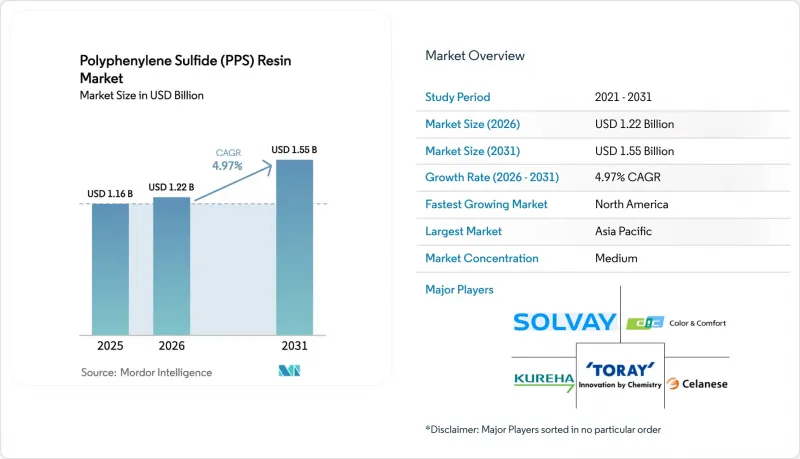
폴리페닐렌 설파이드 수지 시장 규모는 2025년에 11억 6,000만 달러로 평가되었고 2026년 12억 2,000만 달러에서 2031년까지 15억 5,000만 달러에 이를 것으로 예측되며, 예측 기간(2026-2031년) CAGR은 4.97%를 나타낼 전망입니다.
전자기기의 소형화, 수소 연료전지 시스템의 급증, 190℃ 이상에서 안정적으로 작동해야 하는 산업용 배기가스 여과 시스템의 업그레이드에 힘입어 시장은 꾸준한 성장세를 보이고 있습니다. 아시아태평양이 소비량에서 1위를 차지하고 있지만, 북미는 배터리 국내 생산 촉진책에 힘입어 그 격차를 좁혀가고 있습니다. 한편, 유럽에서는 무할로겐 난연성 수지로의 전환이 진행되고 있습니다. 중국 내 생산능력 확대는 가격 상승을 억제하고 있지만, 기존 공급업체들은 특수 등급 집중, 컴파운딩 수직계열화, 디지털 프로세스 강화 등 전략적 구조조정을 진행하고 있습니다. 요컨대, 폴리페닐렌설파이드(PPS) 수지 시장은 비용 압박에 직면하고 있으며, 범용 열가소성 수지로는 대응하기 어려운 고온 및 규제 준수 응용 분야로 명확하게 이동하고 있습니다.
세계 폴리페닐렌 설파이드(PPS) 수지 시장 동향과 인사이트
소형화가 진행되는 5G 및 AI 전자기기에는 유전체 특성이 안정적인 PPS가 필요합니다.
5G mm파 라디오와 엣지 AI 하드웨어는 10GHz 이상에서 낮은 유전체 손실을 나타낼 뿐만 아니라 260°C에서 무연 솔더 리플로우를 견딜 수 있는 기판을 필요로 합니다. 새롭게 상용화된 저유전율 PPS 필름은 이러한 엄격한 기준을 충족하며, 흡습성이 매우 낮고 반복적인 열충격에도 기계적 강도를 유지합니다. 스마트폰 제조업체, 자동차 ECU 공급업체, 기지국 제조업체들은 액정 폴리머를 대체할 수 있는 비용 효율적인 대안으로 이 필름을 채택하는 경향이 증가하고 있습니다. 5G의 확대에 따라 도레이, DIC, 유니티카 등 업계 대기업들은 최근 새로운 생산능력을 투입하고 있습니다. 이러한 시너지 효과가 폴리페닐렌 설파이드(PPS) 수지 시장을 주도하고 있으며, 특히 고주파 커넥터 및 안테나 하우징 분야에서는 할로겐계 첨가제에 의존하지 않고 UL 94 V-0 표준을 달성하면서 두께를 얇게 만드는 것이 요구되고 있습니다.
2025년 이후 미국 및 EU의 독성 규제에 따른 무염소 PPS 등급으로의 전환
2025년, 데클로란 플러스가 EU의 잔류성 유기오염물질 규제(POPs 규제)에 추가되어 2028년까지 허용 농도가 거의 제로에 가깝게 설정되었습니다. 이러한 규제 변경으로 인해 전자기기 OEM 업체들은 할로겐계 난연제에서 탈피해야 하는 상황에 처해 있습니다. 중요한 점은 PPS는 얇은 단면에서도 UL 94 V-0 표준을 자연스럽게 충족하기 때문에 공급업체는 비용이 많이 드는 배합 변경을 피할 수 있다는 점입니다. 무할로겐 솔루션에 대한 수요가 급증함에 따라 2025년 독일과 미국에 새로운 컴파운딩 공장이 가동되어 유럽과 북미 고객에 대한 리드 타임이 크게 단축될 것으로 예측됩니다. 이러한 빠른 규제 적응은 아시아태평양의 수출업체들에게도 영향을 미칠 것으로 예상되며, 폴리페닐렌 설파이드(PPS) 수지 시장은 다양한 가치사슬에서 컴플라이언스 준수를 위한 최적의 선택으로 자리매김할 것으로 보입니다.
저가의 고온용 나일론과의 경쟁 심화
폴리프탈아미드는 비교추적지수(CTI) 600 V를 확보하여 0.4 mm 두께로 UL 94 V-0 인증을 획득했습니다. 90-110°C의 온도에서 금형 성형되는 이 소재들은 현재 수많은 자동차 커넥터에서 PPS와 경쟁하고 있습니다. 2025년,BASF는 Ultramid T6000을 출시했습니다. 연속 사용 온도 범위가 150-160°C로 충분함에도 불구하고, OEM 업체들은 부품 비용 절감을 위해 사양을 조정하고 있으며, 그 결과 비용 중심의 폴리페닐렌 설파이드(PPS) 수지 시장에 대한 의존도를 낮추고 있습니다.
부문 분석
2025년 기준 선형 PPS는 폴리페닐렌 설파이드(PPS) 수지 시장에서 56.11%의 점유율을 차지하고 있으며, 2026년부터 2031년까지 예측 기간 동안 CAGR 5.03%를 나타낼 것으로 예측됩니다. 선형 PPS는 점도가 낮고 표준 사출 성형 장비와의 호환성이 높기 때문에 박막 성형, 특히 자동차 고전압 커넥터 및 펌프 임펠러에 적합합니다. 중합 후 가교 처리를 거친 경화 PPS는 200°C 이상에서도 엄격한 치수 공차를 유지할 수 있어 항공우주용 덕트, 산업용 펌프 부품 등 틈새 용도에 사용되고 있습니다. 분기형 PPS는 재활용성을 확보하면서 높은 탄성률을 제공하기 때문에 전기자동차(EV)용 배터리 구조 부품에 적합합니다. 2024년, DIC는 5G 안테나 하우징용 금속화 가능한 PPS 컴파운드를 출시했습니다. 이를 통해 직접 메탈라이제이션이 가능해졌고, 금속 인서트가 필요 없어져 경량화를 실현했습니다. 이러한 용도 확대에 따라 선형 및 분기형 등급의 출하량이 증가하고 있으며, 특수 경화형 변형은 높은 가격대에 거래되고 있습니다.
지역별 분석
2025년 아시아태평양은 폴리페닐렌 설파이드(PPS) 수지 시장을 장악하여 시장 규모의 67.26%를 차지했습니다. 이러한 선도적 지위는 중국, 일본, 한국, 대만 등의 국가에서 신에너지 자동차 생산이 급증하고 전자제품 공급망이 호황을 누리면서 더욱 강화되었습니다. 중국의 생산능력은 2024년에 확대될 것이며, 일부 대형 프로젝트의 추진력으로 2027년까지 2배 이상 증가할 것으로 예측됩니다. 이러한 시장 변화에 대응하기 위해 기존 공급업체들은 심화되는 시장 경쟁에 대응하기 위해 차별화된 등급과 기술 서비스 강화에 주력하고 있습니다.
북미는 배터리 및 수소 분야에 대한 견고한 국내 투자에 힘입어 2026-2031년의 예측 기간 동안 연평균 5.16%의 가장 높은 성장률로 성장세를 보이고 있습니다. 이러한 성장은 Fortron Industries의 윌밍턴 공장에서 PPS의 현지 소비에 의해 더욱 촉진되고 있습니다.
한편, 유럽에서는 할로겐 및 재활용 함량에 대한 엄격한 규제가 이슈가 되고 있습니다. 이러한 규제는 대체 재료 도입의 기회를 가져오는 한편, 규제 준수 비용을 증가시켜 중소형 컨버터에게는 어려운 상황을 초래하고 있습니다. 한편, 남미, 중동 및 아프리카는 신흥 시장으로 부상하고 있으며, 산업용 여과 및 석유 및 가스 분야에서의 사용으로 인해 제한된 수요가 발생하고 있습니다.
기타 특전:
- 엑셀 형식 시장 예측(ME) 시트
- 3개월간 애널리스트 지원
자주 묻는 질문
목차
제1장 서론
제2장 조사 방법
제3장 주요 요약
제4장 시장 구도
제5장 시장 규모와 성장 예측
제6장 경쟁 구도
제7장 시장 기회와 향후 전망
JHS 26.06.11The Polyphenylene Sulfide Resin Market size was valued at USD 1.16 billion in 2025 and is estimated to grow from USD 1.22 billion in 2026 to reach USD 1.55 billion by 2031, at a CAGR of 4.97% during the forecast period (2026-2031).
Driven by the miniaturization of electronics, a surge in hydrogen fuel-cell systems, and upgrades in industrial flue-gas filtration that require consistent service above 190°C, the market is witnessing steady momentum. The Asia-Pacific region leads in consumption, while North America is catching up, spurred by battery onshoring incentives. Meanwhile, Europe is pivoting toward halogen-free, flame-retardant resins. Although price increases are being moderated by capacity expansions in China, established suppliers are strategically repositioning themselves, focusing on specialty grades, vertically integrating into compounding, and enhancing digital processes. In essence, the Polyphenylene Sulfide (PPS) resin market is grappling with cost pressures but is distinctly shifting toward high-temperature, regulatory-compliant applications, an area where commodity thermoplastics struggle.
Global Polyphenylene Sulfide (PPS) Resin Market Trends and Insights
Miniaturized 5G and AI Electronics Need Dielectric-Stable PPS
5G millimeter-wave radios and edge AI hardware require substrates that not only exhibit low dielectric loss above 10 GHz but can also withstand lead-free solder reflow at 260°C. Newly commercialized low-dielectric PPS films meet these stringent criteria, boasting minimal moisture uptake and maintaining mechanical integrity even under repeated thermal shocks. Smartphone manufacturers, automotive ECU suppliers, and base-station producers are increasingly adopting these films as cost-effective alternatives to liquid-crystal polymers. In tandem with the expansion of 5G, industry giants Toray, DIC, and Unitika have rolled out new capacities in recent years. This collective momentum is propelling the Polyphenylene Sulfide (PPS) resin market, particularly in high-frequency connectors and antenna housings, which must achieve UL 94 V-0 standards at thinner sections without relying on halogenated additives.
Shift to Chlorine-Free PPS Grades After 2025 US and EU Toxicity Regulations
In 2025, Dechlorane Plus was added to the EU's Persistent Organic Pollutants Regulation, with a near-zero allowable concentration set for 2028. This regulatory shift has spurred electronics OEMs to move away from halogenated flame retardants. Importantly, PPS naturally meets the UL 94 V-0 standard at thin sections, enabling suppliers to avoid costly reformulations. Responding to the surging demand for halogen-free solutions, new compounding plants in Germany and the United States began operations in 2025, drastically cutting lead times for clients in Europe and North America. This rapid regulatory adaptation is expected to resonate with Asia-Pacific exporters, positioning the Polyphenylene Sulfide (PPS) resin market as the preferred choice for compliance across diverse value chains.
Rising Competition from Lower-Cost High-Temperature Nylons
Polyphthalamides have secured a Comparative Tracking Index of 600 V and achieved UL 94 V-0 certification at a thickness of 0.4 mm. These materials, processed in molds at temperatures between 90-110°C, are now rivaling PPS in numerous automotive connectors. In 2025, BASF introduced its Ultramid T6000. Although a continuous-use temperature range of 150-160°C is adequate, OEMs are adjusting specifications to reduce bills of material, thereby decreasing their stake in the cost-sensitive Polyphenylene Sulfide (PPS) resin market.
Other drivers and restraints analyzed in the detailed report include:
- On-Board Hydrogen Fuel-Cell Balance-of-Plant Adoption
- AI-Optimized Compounding Cuts Scrap and Widens PPS Use
- Recycling End-of-Life Hurdles for Cross-Linked PPS
For complete list of drivers and restraints, kindly check the Table Of Contents.
Segment Analysis
In 2025, Linear PPS held a 56.11% share of the Polyphenylene Sulfide (PPS) resin market and is projected to grow at a 5.03% CAGR through the forecast period of 2026-2031. Its lower viscosity and compatibility with standard injection equipment make Linear PPS ideal for thin-wall molding, particularly in automotive high-voltage connectors and pump impellers. Cured PPS, which undergoes post-polymerization cross-linking, maintains tight dimensional tolerances above 200°C and is used in niche applications such as aerospace ducts and industrial pump parts. Branched PPS offers a higher modulus while ensuring recyclability, making it suitable for structural components in electric vehicle (EV) batteries. In 2024, DIC launched a plateable PPS compound for 5G antenna housings, enabling direct metallization and eliminating the need for metal inserts, thereby reducing weight. This broadened application spectrum boosts the volume of linear and branched grades, while specialty cured variants command premium prices.
The Polyphenylene Sulfide (PPS) Resin Market Report is Segmented by Type (Linear PPS, Cured PPS, and Branched PPS), End-User Industry (Automotive, Electrical and Electronics, Industrial, Aerospace, and Other End-User Industries), and Geography (Asia-Pacific, North America, Europe, South America, Middle-East and Africa). The Market Forecasts are Provided in Terms of Value (USD).
Geography Analysis
In 2025, the Asia-Pacific region dominated the Polyphenylene Sulfide (PPS) resin market, accounting for 67.26% of its size. This leadership position was strengthened by the burgeoning production of new-energy vehicles and a thriving electronics supply chain in nations such as China, Japan, South Korea, and Taiwan. China's production capacity saw a boost in 2024, with forecasts suggesting it could more than double by 2027, thanks to the momentum from several large-scale projects. In response to these market shifts, established suppliers are now focusing on differentiated grades and enhanced technical services to counter heightened price competition.
North America is on a growth trajectory, boasting the fastest rate at a CAGR of 5.16% through the forecast period of 2026-2031, driven by robust domestic investments in batteries and hydrogen. This growth is further supported by local consumption of PPS at Fortron Industries' Wilmington plant.
On the other hand, Europe faces challenges with its stringent halogen and recycled-content regulations. While these rules open doors for substitutions, they also inflate compliance costs, making it tough for smaller converters. Meanwhile, South America, the Middle-East, and Africa are emerging as fledgling markets, with their limited demand for PPS being spurred by industrial filtration and oil-and-gas applications.
- Celanese Corporation
- Chengdu Letian Plastics Co. , Ltd
- Chevron Phillips Chemical Company LLC.
- DIC Corporation
- Ensinger
- Glion
- IDEMITSU FINE COMPOSITES CO., LTD.
- Kolon Plastics Inc.
- KUREHA CORPORATION
- NHU Materials Co.
- Polyplastics Co. Ltd
- RTP Company
- SABIC
- SK Innovation
- Solvay
- TEIJIN LIMITED.
- TORAY INDUSTRIES, INC.
- Tosoh Corporation
Additional Benefits:
- The market estimate (ME) sheet in Excel format
- 3 months of analyst support
TABLE OF CONTENTS
1 Introduction
- 1.1 Study Assumptions and Market Definition
- 1.2 Scope of the Study
2 Research Methodology
3 Executive Summary
4 Market Landscape
- 4.1 Market Drivers
- 4.1.1 Miniaturised 5G/AI electronics need dielectric-stable PPS
- 4.1.2 Shift to chlorine-free PPS grades after 2025 US/EU tox regs
- 4.1.3 On-board hydrogen fuel-cell balance-of-plant adoption
- 4.1.4 AI-optimised compounding cuts scrap and widens PPS use
- 4.1.5 Rapid Asia-Pacific filter-bag upgrades for ultra-low-NOx boilers
- 4.2 Market Restraints
- 4.2.1 Rising competition from lower-cost high-temp nylons
- 4.2.2 Recycling-end-of-life hurdles for cross-linked PPS
- 4.2.3 Talent gap in high-temperature polymer processing
- 4.3 Value Chain Analysis
- 4.4 Porter's Five Forces
- 4.4.1 Bargaining Power of Suppliers
- 4.4.2 Bargaining Power of Buyers
- 4.4.3 Threat of New Entrants
- 4.4.4 Threat of Substitutes
- 4.4.5 Degree of Competition
5 Market Size and Growth Forecasts (Value)
- 5.1 By Type
- 5.1.1 Linear PPS
- 5.1.2 Cured PPS
- 5.1.3 Branched PPS
- 5.2 By End-user Industry
- 5.2.1 Automotive
- 5.2.2 Electrical and Electronics
- 5.2.3 Industrial
- 5.2.4 Aerospace
- 5.2.5 Other End-user Industries
- 5.3 By Geography
- 5.3.1 Asia-Pacific
- 5.3.1.1 China
- 5.3.1.2 India
- 5.3.1.3 Japan
- 5.3.1.4 South Korea
- 5.3.1.5 ASEAN Countries
- 5.3.1.6 Rest of Asia-Pacific
- 5.3.2 North America
- 5.3.2.1 United States
- 5.3.2.2 Canada
- 5.3.2.3 Mexico
- 5.3.3 Europe
- 5.3.3.1 Germany
- 5.3.3.2 United Kingdom
- 5.3.3.3 Italy
- 5.3.3.4 France
- 5.3.3.5 Rest of Europe
- 5.3.4 South America
- 5.3.4.1 Brazil
- 5.3.4.2 Argentina
- 5.3.4.3 Rest of South America
- 5.3.5 Middle-East and Africa
- 5.3.5.1 Saudi Arabia
- 5.3.5.2 South Africa
- 5.3.5.3 Rest of Middle-East and Africa
- 5.3.1 Asia-Pacific
6 Competitive Landscape
- 6.1 Market Concentration
- 6.2 Strategic Moves
- 6.3 Market Share(%)/Ranking Analysis
- 6.4 Company Profiles (includes Global Overview, Market Overview, Core Segments, Financials, Strategic Information, Products and Services, Recent Developments)
- 6.4.1 Celanese Corporation
- 6.4.2 Chengdu Letian Plastics Co. , Ltd
- 6.4.3 Chevron Phillips Chemical Company LLC.
- 6.4.4 DIC Corporation
- 6.4.5 Ensinger
- 6.4.6 Glion
- 6.4.7 IDEMITSU FINE COMPOSITES CO., LTD.
- 6.4.8 Kolon Plastics Inc.
- 6.4.9 KUREHA CORPORATION
- 6.4.10 NHU Materials Co.
- 6.4.11 Polyplastics Co. Ltd
- 6.4.12 RTP Company
- 6.4.13 SABIC
- 6.4.14 SK Innovation
- 6.4.15 Solvay
- 6.4.16 TEIJIN LIMITED.
- 6.4.17 TORAY INDUSTRIES, INC.
- 6.4.18 Tosoh Corporation
7 Market Opportunities and Future Outlook
- 7.1 White-space and Unmet-need Assessment


