|
시장보고서
상품코드
2043841
유럽의 소매 분석 : 시장 점유율 분석, 업계 동향 및 통계, 성장 예측(2026-2031년)Europe Retail Analytics - Market Share Analysis, Industry Trends & Statistics, Growth Forecasts (2026 - 2031) |
||||||
 Mordor Intelligence
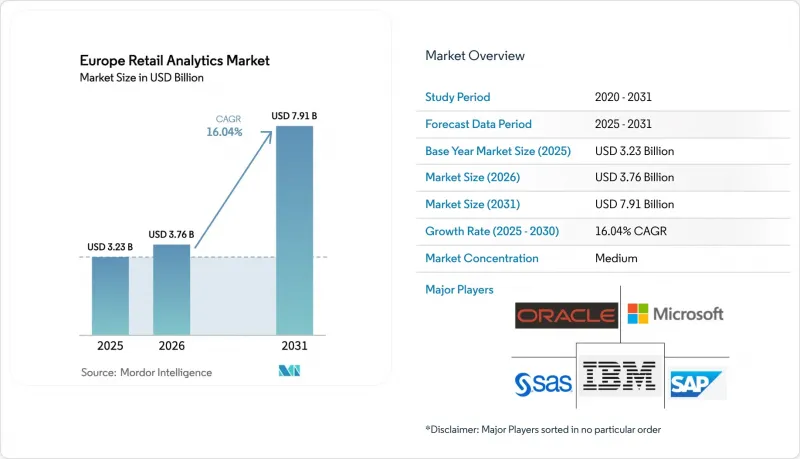
유럽의 소매 분석 시장 규모는 2025년에 32억 3,000만 달러로 평가되었습니다. 2026년 37억 6,000만 달러에서 2031년까지 79억 1,000만 달러에 이를 것으로 예측되며, 2026년부터 2031년에 걸쳐 CAGR 16.04%를 나타낼 전망입니다.
퍼스트 파티 데이터 플랫폼에 대한 투자 급증, 인플레이션에 따른 수익률에 대한 압박, 통합 커머스에 대한 요구 사항으로 인해 이 지역 전체에서 플랫폼 업데이트가 가속화되고 있습니다. 소매업체들이 실시간 가격 책정 및 컴퓨터 비전 관련 워크로드를 도입함에 따라, 탄력적 컴퓨팅과 고급 AI를 결합한 클라우드 네이티브 서비스가 점점 더 선호되고 있습니다. 프라이버시 강화 기술에 대한 의존도가 높아짐에 따라, 설계 단계부터 동의 관리 및 설명가능성 기능을 통합한 벤더에 대한 지출이 증가하고 있습니다. 한편, 기존 ERP 벤더들이 분석 기능을 핵심 워크플로우에 통합하고, 데이터 플랫폼 전문 업체들이 오픈 아키텍처와 EU 데이터 거주 요건 대응을 차별화 요소로 내세우면서 경쟁은 더욱 치열해지고 있습니다.
유럽의 소매 분석 시장 동향 및 인사이트
데이터 기반 개인화를 통해 매장 내 전환율을 높이는 방법
유럽의 소매 체인은 예측 모델을 키오스크, 모바일 앱, POS 단말기에 통합하여 개별적인 제안을 표시함으로써 구매 금액 증가와 재방문을 유도하고 있습니다. 어도비의 2024년 벤치마크 조사에 따르면, 통합 고객 데이터 플랫폼은 패션 및 식료품 분야의 전환율을 20-30% 향상시켰다고 합니다. GDPR(EU 개인정보보호규정)이 제시하는 '가치 교환' 원칙에 따라 이러한 개인화는 차별화 요소라기보다는 경쟁의 필수 요건이 되고 있습니다. KPMG의 보고서에 따르면, 소매업체의 68%가 2026년까지 AI 기반 개인화 예산을 늘릴 계획이라고 합니다. AI 에이전트가 쇼핑객을 대신해 상품 세트와 결제를 협상하는 '에이전트형 커머스'의 시범 도입으로 실시간 프로파일 요구사항은 더욱 까다로워질 것입니다. 데이터 공유에 대한 동의를 얻는 것이 어려워지는 가운데, 사업자는 퍼스트 파티 관계를 유지하기 위해 구체적인 혜택을 제시해야 합니다.
AI를 활용한 가격 책정 엔진, 인플레이션에 시달리는 유럽에서 수익률 최적화
인플레이션의 변동으로 인해 식료품점과 패션 소매업체들은 주 단위의 가격 주기를 하루에도 몇 번씩 재고 가격을 재조정하는 알고리즘으로 대체해야 했습니다. McKinsey의 2025년 식료품 산업 조사에 따르면, 2024년 생활비 상승기에 이 알고리즘을 도입한 기업들은 매출 총이익률이 1-2% 포인트 상승했다고 합니다. 최신 엔진은 경쟁사 데이터, 날씨 정보, 지역 이벤트 정보를 수집하고, 브랜드 이미지를 훼손하지 않도록 배려하면서 할인 일정을 최적화합니다. BCG는 투명성 확보 조치로 규제 당국과 소비자의 우려를 해소할 경우, 2027년까지 100억-150억 유로(113억-169억 달러)의 증분 이익이 발생할 것으로 예상하고 있습니다. 현재 각 벤더들은 EU AI법(AI-Act)의 공개 조항을 준수하기 위해 설명가능성 대시보드를 패키지화하여 제공합니다.
GDPR(EU 개인정보보호규정) 및 e-프라이버시 규정에 따른 데이터 프라이버시 강화
제안된 e-프라이버시 규정은 쿠키, 기기 지문인식, 위치정보 분석에 대한 명시적 동의 요건을 확대하고, 개인화 및 어트리뷰션 모델을 지원하는 제3자 식별자의 사용을 제한합니다. 유럽연합 집행위원회는 2025년 추적 동의 거부율이 62%에 달하고, 캠페인의 도달 범위가 축소될 것으로 예측했습니다. GDPR(EU 개인정보보호규정) 제22조는 자동화된 의사결정에 대한 '휴먼 인 더 루프(Human in the Loop)' 의무를 도입하여 동적 가격 책정의 도입을 늦추고 있습니다. 소매업체들은 차등 프라이버시, 연합 학습, 합성 데이터셋을 시험적으로 도입하고 있지만, 성숙한 도구가 부족해 비용과 복잡성이 증가하고 있습니다.
부문 분석
2025년, 클라우드는 유럽의 소매 분석 시장 점유율 63.13%를 차지했습니다. 이는 실시간 가격 책정 및 비전 워크로드를 위해 확장 가능한 인프라로의 전환이 진행되고 있음을 반영합니다. 퍼블릭 클라우드로의 전환은 관리형 AI, 재해복구, 멀티 리전 복제를 가능하게 하고, 하드웨어 업데이트 주기에 따른 총소유비용(TCO)을 절감할 수 있습니다. 레거시 ERP와 엄격한 데이터 거주 요건 계약을 맺고 있는 식료품 소매업체, 특히 독일과 프랑스 기업들은 여전히 On-Premise 환경을 유지하고 있습니다. 하이브리드 아키텍처는 컴플라이언스 대책으로 부상하고 있으며, 기밀성이 높은 트랜잭션은 On-Premise에 남겨두고, 부하가 높은 분석 일괄 처리를 클라우드에서 실행할 수 있게 해줍니다. 마이크로소프트의 2025년판 하이브리드 SKU는 완전한 마이그레이션 없이 POS 데이터를 Azure Synapse에 동기화합니다. Snowflake의 2024 데이터 거주성 관리 기능을 통해 소매업체는 단일 인터페이스를 통해 분산형 데이터 웨어하우스를 쿼리할 수 있으며, EU 일반 데이터 보호 규정(GDPR(EU 개인정보보호규정)) 제44조에 따른 국경 간 데이터 이전 장벽을 피할 수 있습니다.
탄력성 향상을 통해 소매업체는 가격 책정 및 이미지 처리 워크로드가 최고조에 달했을 때 GPU 클러스터를 가동한 후 종료함으로써 유휴 비용을 크게 절감할 수 있습니다. 각 벤더들은 다년 계약의 클라우드 이용에 대해 라이선스 할인을 제공함으로써 SAP나 Oracle로의 전환을 촉진하고 있으며, 사실상 전환 프로젝트에 자금을 지원하고 있습니다. 따라서 클라우드에 의한 유럽의 소매 분석 시장 규모는 2031년까지 선두를 차지할 것으로 예상되는 반면, 규제 대상 부문에서는 하이브리드 형태가 서서히 성장세를 보이고 있습니다. 소매업체들이 매장 내 엣지 컴퓨팅 노드를 통합함에 따라, 매장 내 저지연과 클라우드 규모의 트레이닝 사이클을 모두 필요로 하는 워크로드에는 하이브리드 토폴로지가 주류가 될 것입니다.
마케팅 및 고객 인사이트 제품군은 2025년 매출의 27.54%를 차지했으며, 개인화 및 소매 미디어 측정에 대한 수요가 여전히 높다는 것을 보여줍니다. 그러나 공급망 및 이행 도구는 운전 자본을 확보하는 자율 보충 및 라스트 마일 최적화 엔진에 힘입어 CAGR 18.02%로 가장 빠른 성장세를 보이고 있습니다. Zalando는 AI 기반 수요 예측을 도입한 후 과잉 재고를 15% 줄이고 재고 정확도 98%를 달성했습니다. 액센츄어는 도입 기업에서 안전 재고를 10-20% 절감하고, 디지털 분야에 재투자할 수 있는 자금을 확보했다고 보고했습니다. 공급망 모듈과 관련된 유럽의 소매 분석 시장 규모는 2031년까지 기존 구색 계획 스위트 시장 규모를 능가할 것으로 예측됩니다. 카메라 가격 하락과 ESG 프레임워크에 따른 식품 폐기물 보고 요청에 따라 컴퓨터 비전과 재고 감소 분석을 융합한 손실 방지 솔루션이 확산되고 있습니다.
도입 추이는 소매업체의 성숙도에 따라 달라질 수 있습니다. 수직통합형 패션기업은 브랜드 가치를 유지하기 위해 배분 및 가격 인하 최적화에 주력하는 반면, 식료품 체인은 신선식품의 손실을 억제하기 위해 수요 예측을 우선시하고 있습니다. 카테고리 관리 제품군은 수십 년에 걸친 비즈니스 규칙이 뿌리 깊게 자리 잡고 있어 정착률이 높고, 새로운 AI 퍼스트 제품에 비해 성장이 제한되어 있습니다. 한편, 손익계산서(P&L)와 업무 지표를 통합한 재무 성과 대시보드는 여러 레거시 BI 시스템을 단일 뷰로 통합하여 의사결정자의 워크플로우를 효율화합니다.
기타 혜택 :
- 엑셀 형식 시장 예측(ME) 시트
- 3개월간 애널리스트 지원
자주 묻는 질문
목차
제1장 서론
제2장 조사 방법
제3장 주요 요약
제4장 시장 구도
제5장 시장 규모와 성장 예측
제6장 경쟁 구도
제7장 시장 기회와 향후 전망
KTH 26.05.29The Europe retail analytics market size is projected to be USD 3.23 billion in 2025, USD 3.76 billion in 2026, and reach USD 7.91 billion by 2031, growing at a CAGR of 16.04% from 2026 to 2031.
Surging investment in first-party data platforms, inflation-era margin pressure, and unified commerce mandates are accelerating platform renewals across the region. Cloud-native services that blend elastic compute with advanced AI are increasingly preferred as merchants deploy real-time pricing and computer-vision workloads. Growing reliance on privacy-enhancing technologies is steering spending toward vendors that embed consent management and explainability features by design. Competitive intensity, meanwhile, is rising as ERP incumbents embed analytics into core workflows and data-platform specialists differentiate on open architecture and EU data-residency options.
Europe Retail Analytics Market Trends and Insights
Data-Driven Personalization Lifts In-Store Conversion
European chains are embedding predictive models into kiosks, mobile apps, and point-of-sale terminals to surface individualized offers that lift basket size and drive repeat visits. Adobe's 2024 benchmarking found that unified customer-data platforms improved fashion and grocery conversion rates by 20%-30%. GDPR's value-exchange ethos makes such personalization a competitive necessity rather than a differentiator. KPMG reported that 68% of retailers plan to boost AI-led personalization budgets by 2026. Agentic commerce pilots, where AI agents negotiate bundles and payments on a shopper's behalf, will further intensify real-time profile requirements. As data-sharing consent becomes harder to secure, merchants must showcase tangible benefits to retain first-party relationships.
AI-Powered Pricing Engines Optimize Margin in Inflationary Europe
Inflation volatility pushed grocers and fashion retailers to replace weekly price cycles with algorithms that recalibrate shelf prices several times per day. McKinsey's 2025 grocery study documented 1-2 percentage-point gross-margin lifts among adopters during the 2024 cost-of-living squeeze. Modern engines ingest competitor feeds, weather updates, and local events, then optimize markdown calendars while guarding brand perception. BCG forecasts EUR 10 billion-EUR 15 billion (USD 11.3 billion-USD 16.9 billion) in incremental margin by 2027, provided transparency safeguards assuage regulator and consumer concerns. Vendors now bundle explainability dashboards to comply with EU AI-Act disclosure clauses.
Data-Privacy Tightening Under GDPR and ePrivacy Regulation
Proposed ePrivacy rules broaden explicit-consent demands for cookies, device fingerprinting, and location analytics, curtailing third-party identifiers that feed personalization and attribution models. The European Commission recorded a 62% refusal rate for tracking consent in 2025, shrinking campaign reach. Article 22 of GDPR introduces human-in-the-loop mandates for automated decision-making, slowing dynamic pricing rollouts. Retailers are piloting differential privacy, federated learning, and synthetic datasets, but lack of mature tooling raises cost and complexity.
Other drivers and restraints analyzed in the detailed report include:
- Unified Commerce Mandates Single View of Customer
- Proliferation of Edge Analytics for Real-Time Shelf Monitoring
- Shortage of Retail Data-Science Talent Pool
For complete list of drivers and restraints, kindly check the Table Of Contents.
Segment Analysis
Cloud captured 63.13% of Europe retail analytics market share in 2025, reflecting merchants' shift toward scalable infrastructure for real-time pricing and vision workloads. Public-cloud migration also unlocks managed AI, disaster recovery, and multi-region replication, reducing total cost of ownership for mid-cycle hardware refreshes. On-premise estates persist among grocers with legacy ERP and stringent data-residency contracts, notably in Germany and France. Hybrid architectures are emerging as a compliance hedge, allowing sensitive transactions to stay on-premise while heavy analytics batches run in the cloud. Microsoft's 2025 hybrid SKU syncs point-of-sale data to Azure Synapse without full migration. Snowflake's 2024 residency controls let merchants query distributed warehouses through one interface, sidestepping Article 44 cross-border hurdles.
Greater elasticity means retailers can spin up GPU clusters during peak pricing or vision workloads, then shut them down, slashing idle costs. Vendors incentivize the transition to SAP and Oracle by discounting licenses for multi-year cloud terms, effectively funding migration projects. The Europe retail analytics market size attributable to cloud is thus forecast to widen its lead through 2031, while hybrid gains incremental traction among regulated sectors. As retailers embed edge-compute nodes inside stores, hybrid topologies will likely dominate workloads requiring both in-store latency and cloud-scale training cycles.
Marketing and customer insight suites held 27.54% revenue in 2025, underscoring continued appetite for personalization and retail-media measurement. Yet supply-chain and fulfillment tools are expanding fastest at an 18.02% CAGR, driven by autonomous replenishment and last-mile optimization engines that release working capital. Zalando cut overstock by 15% and achieved 98% in-stock accuracy after rolling out AI-based demand sensing. Accenture recorded 10%-20% safety-stock reductions among adopters, freeing cash for digital reinvestment. The Europe retail analytics market size attached to supply-chain modules is expected to outstrip legacy assortment-planning suites through 2031. Loss-prevention solutions fusing computer vision with shrinkage analytics are gaining ground as camera prices drop and ESG frameworks demand food-waste reporting.
Adoption trajectories differ by retailer maturity. Vertically integrated fashion houses focus on allocation and markdown optimization to preserve brand equity, while grocery chains prioritize demand forecasting to curb perishables. Category-management suites remain sticky because decades-old business rules are hard-wired, capping their growth relative to newer AI-first products. Meanwhile, financial-performance dashboards that blend P&L with operational metrics are consolidating multiple legacy BI stacks into single views, streamlining decision-maker workflows.
The Europe Retail Analytics Market Report is Segmented by Mode of Deployment (On-Premise, Cloud, and Hybrid), Module Type (Strategy and Planning, Marketing and Customer Insights, and More), Business Size (Small and Medium Enterprises, and Large Enterprises), Retail Format (Brick-And-Mortar, E-Commerce, and Omnichannel Retail), and Country (Germany, Italy, and More). The Market Forecasts are Provided in Terms of Value (USD).
List of Companies Covered in this Report:
- SAP SE
- Oracle Corporation
- IBM Corporation
- SAS Institute Inc.
- Microsoft Corporation
- Fractal Analytics
- Tableau Software LLC
- MicroStrategy Incorporated
- Sensormatic Solutions
- Alteryx Inc.
- RetailNext Inc.
- Blue Yonder GmbH
- NielsenIQ
- ThoughtSpot Inc.
- Sisense Ltd.
- Domo Inc.
- Looker Data Sciences (Google)
- Snowflake Inc.
- Databricks Inc.
- C3.ai Inc.
Additional Benefits:
- The market estimate (ME) sheet in Excel format
- 3 months of analyst support
TABLE OF CONTENTS
1 INTRODUCTION
- 1.1 Study Assumptions and Market Definition
- 1.2 Scope of the Study
2 RESEARCH METHODOLOGY
3 EXECUTIVE SUMMARY
4 MARKET LANDSCAPE
- 4.1 Market Overview
- 4.2 Market Drivers
- 4.2.1 Data-Driven Personalization Lifts In-Store Conversion
- 4.2.2 AI-Powered Pricing Engines Optimise Margin in Inflationary Europe
- 4.2.3 Proliferation of Edge Analytics for Real-Time Shelf Monitoring
- 4.2.4 Unified Commerce Mandates Single View of Customer
- 4.2.5 Retail Media Network Analytics Unlocking Incremental Revenue Streams
- 4.2.6 ESG-Aligned Shrinkage Analytics Integrating Computer Vision
- 4.3 Market Restraints
- 4.3.1 Shortage of Retail Data-Science Talent Pool
- 4.3.2 Data-Privacy Tightening Under GDPR and ePrivacy Regulation
- 4.3.3 Legacy POS Fragmentation Impedes Data Integration
- 4.3.4 Capital-Expenditure Freeze Among SME Retailers
- 4.4 Industry Value Chain Analysis
- 4.5 Regulatory Landscape
- 4.6 Technological Outlook
- 4.7 Porter's Five Forces Analysis
- 4.7.1 Threat of New Entrants
- 4.7.2 Bargaining Power of Buyers
- 4.7.3 Bargaining Power of Suppliers
- 4.7.4 Threat of Substitutes
- 4.7.5 Intensity of Competitive Rivalry
- 4.8 Impact of Macroeconomic Factors on the Market
5 MARKET SIZE AND GROWTH FORECASTS (VALUE)
- 5.1 By Mode of Deployment
- 5.1.1 On-Premise
- 5.1.2 Cloud
- 5.1.3 Hybrid
- 5.2 By Module Type
- 5.2.1 Strategy and Planning
- 5.2.2 Marketing and Customer Insights
- 5.2.3 Financial Management
- 5.2.4 Store Operations and Loss Prevention
- 5.2.5 Merchandising and Category Optimisation
- 5.2.6 Supply-Chain and Fulfilment
- 5.3 By Business Size
- 5.3.1 Small and Medium Enterprises
- 5.3.2 Large Enterprises
- 5.4 By Retail Format
- 5.4.1 Brick-and-Mortar
- 5.4.2 E-Commerce
- 5.4.3 Omnichannel Retail
- 5.5 By Country
- 5.5.1 United Kingdom
- 5.5.2 Germany
- 5.5.3 France
- 5.5.4 Italy
- 5.5.5 Spain
- 5.5.6 Rest of Europe
6 COMPETITIVE LANDSCAPE
- 6.1 Market Concentration
- 6.2 Strategic Moves
- 6.3 Market Share Analysis
- 6.4 Company Profiles (includes Global Level Overview, Market Level Overview, Core Segments, Financials as available, Strategic Information, Market Rank/Share for Key Companies, Products and Services, and Recent Developments)
- 6.4.1 SAP SE
- 6.4.2 Oracle Corporation
- 6.4.3 IBM Corporation
- 6.4.4 SAS Institute Inc.
- 6.4.5 Microsoft Corporation
- 6.4.6 Fractal Analytics
- 6.4.7 Tableau Software LLC
- 6.4.8 MicroStrategy Incorporated
- 6.4.9 Sensormatic Solutions
- 6.4.10 Alteryx Inc.
- 6.4.11 RetailNext Inc.
- 6.4.12 Blue Yonder GmbH
- 6.4.13 NielsenIQ
- 6.4.14 ThoughtSpot Inc.
- 6.4.15 Sisense Ltd.
- 6.4.16 Domo Inc.
- 6.4.17 Looker Data Sciences (Google)
- 6.4.18 Snowflake Inc.
- 6.4.19 Databricks Inc.
- 6.4.20 C3.ai Inc.
7 MARKET OPPORTUNITIES AND FUTURE OUTLOOK
- 7.1 White-Space and Unmet-Need Assessment