

|
시장보고서
상품코드
2043874
대체 연료차 : 시장 점유율 분석, 업계 동향 및 통계, 성장 예측(2026-2031년)Automotive Alternative Fuel Vehicle - Market Share Analysis, Industry Trends & Statistics, Growth Forecasts (2026 - 2031) |
||||||
 Mordor Intelligence
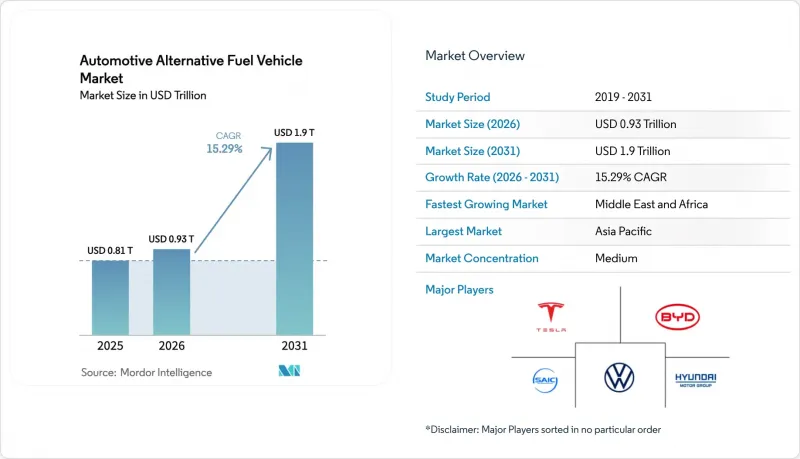
대체 연료차 시장 규모는 2025년 8,100억 달러로 평가되었습니다. 2026년 9,300억 달러로 확대되어 2026년부터 2031년에 걸쳐 CAGR 15.29%를 나타내, 2031년까지 1조 9,000억 달러에 이를 것으로 예측됩니다.
미국, 유럽연합(EU), 중국, 인도, 일본의 탈탄소화 규제 강화로 신규 내연기관차 출시에 대한 경제적 여지가 좁아지면서 구매자들은 배터리 전기차, 수소차, 가스연료차로 전환하고 있습니다. 2025년 배터리 팩 가격 하락과 함께 수소 탱크 비용이 kW시당 12달러까지 하락하고, 3개 대륙에서 급속 충전 네트워크가 확대됨에 따라 기존의 주행거리 불안과 긴 급유 시간에 대한 우려는 해소되고 있습니다. 차량 운영자들은 Scope 3 보고 의무를 충족하기 위해 구매를 가속화하고 있으며, 주요 물류 기업들은 디젤 가격 변동에 대한 헤지 수단으로 대체 구동 시스템을 점점 더 중요하게 여기고 있습니다. 한편, 완성차 업체들은 미국의 국내 조달 비율 규제 준수와 유럽연합(EU)의 2035년 내연기관 단계적 폐지 조항을 피하기 위해 배터리 공급망 현지화를 서두르고 있습니다.
세계의 대체 연료차 시장 동향과 인사이트
정부의 탈탄소화 의무화 및 구매 인센티브 제공
제로 에미션 규제로 인해 자동차 제조업체의 제품 사이클의 자유도가 좁아지고 있습니다. 미국 인플레이션 억제법(Inflation Reduction Act)은 세액공제를 2032년까지 연장하고, 중고 전기차에 대한 인센티브를 도입하는 한편, 현지 조달 비율 기준을 엄격하게 적용하고 있습니다. 유럽연합(EU)의 차량 평균 CO2 배출량 목표는 2025년 93.6g/km로 하향 조정되며, 초과 1g당 95유로(약 112달러)의 과태료가 부과되었습니다. 이는 자동차 제조업체 당 10억 유로(약 10억 달러) 이상에 달할 가능성이 있습니다. 중국의 듀얼 크레딧 제도에서는 배터리 전기자동차 판매 1대당 많은 양의 거래 가능한 포인트를 부여하여, 사실상 할당량을 초과하는 제조업체에 대한 교차 보조금을 지급하고 있습니다. 인도의 PLI 계획은 셀 제조에 35억 달러를 투입하여 연료전지 이륜차까지 대상을 확대되고 있습니다. 일본의 녹색성장 전략은 연료전지 자동차의 증분 비용의 50%를 보조금으로 충당하고, 보조금을 인증된 수소충전소 계약자인 구매자에게만 한정하고 있습니다.
배터리 팩 및 수소 탱크 비용의 급격한 감소
2025년까지 리튬 인산철 화학, 셀-투-팩 통합 및 나트륨 이온 기술의 발전으로 인해 배터리 팩의 비용은 2022년에 비해 크게 하락했습니다. CATL의 'Shenxing Plus' 셀은 급속 충전을 통한 항속거리 연장을 실현하여 휘발유 자동차의 급유 시간에 필적할 수 있게 되었습니다. 금속 라이닝 방식보다 가벼운 복합형 IV 수소 실린더는 시스템 비용을 절감하여 클래스 8 트럭에 채택할 수 있게 되었습니다. BYD는 보증거리를 연장하여 중고시장에서 구매자의 잔존가치에 대한 우려를 해소했습니다. 한편, 도요타의 초기 단계에 있는 전고체 배터리 프로토타입은 에너지 밀도가 크게 향상되었지만, 전해액 생산 규모에 의해 여전히 제약을 받고 있습니다.
높은 초기 가격 vs. 여러 대체 연료 차종에서 ICE 차량과의 가격 차이
2025년 소형 배터리 전기자동차(BEV) 세단은 휘발유차보다 높은 가격이었습니다. 이 가격 차이는 수익률을 확보하기 위해 전기차 모델에 추가된 강화된 인포테인먼트 및 안전 장비에 기인합니다. 반면, 연료전지 세단은 각 스택에 백금이 주로 사용되기 때문에 여전히 고가의 연료전지 세단이었습니다. 그러나 업계 로드맵은 2028년까지 백금 사용량을 줄이는 것을 목표로 하고 있습니다. 연간 주행거리가 긴 차량군(fleet)의 경우 총소유비용(TCO)의 균등화가 이루어졌지만, 단거리를 주행하는 개인 소유주에게는 투자회수 기간이 길어지는 상황이 발생했습니다. 인도에서는 보급형 EV 배터리가 차량 MSRP(제조업체 희망소비자가격)의 상당 부분을 차지했습니다. 이 비율이 높은 이유는 소용량 팩의 생산량이 한정되어 있어 규모의 경제를 실현할 수 없고, 수입 규제로 인해 부품 가격이 상승했기 때문입니다.
부문 분석
전기자동차는 대체 연료차 시장에서 가장 큰 점유율을 차지하며 매출의 60.12%를 차지했습니다. 인산철 리튬 배터리의 원가 하락, 급속 충전 네트워크의 정비, 판매점에서의 높은 보급률이 단기적인 우위를 뒷받침하고 있습니다. 그러나 초기 도입층 시장이 포화상태에 이르고 일부 주요 경제권에서 보조금이 단계적으로 축소되면서 성장이 둔화되고 있습니다.
수소 플랫폼은 2025년 시장 규모에서 차지하는 비중은 미미하지만, 주요 화물 운송 경로의 충전소 밀도가 증가하고 2028년까지 백금 사용량 감소로 인해 스택 비용이 감소함에 따라 2031년까지 연평균 24.01% 성장할 것으로 예측됩니다. 장거리 트럭 운송, 시내버스, 항만 하역 장비는 15분이라는 충전 시간을 중시하여 부피가 큰 배터리로 인해 제약되는 자산 가동률을 유지하고 있습니다. CNG, LNG, LPG는 국내 가스 생산이 있는 시장에서 디젤 연료에 비해 40% 저렴한 펌프 가격에 힘입어 틈새 시장 점유율을 유지하고 있습니다. 한편, 에탄올 혼합 의무화로 인해 바이오연료는 안정적인 점유율을 유지하고 있으며, 기존 연소식 차량이 다수 존재하는 지역으로의 전환 솔루션을 제공합니다.
2025년에는 승용차가 수익의 대부분을 차지하여 대체 연료차 시장 점유율의 56.33%를 차지할 것으로 예측됩니다. 그러나 재정적 인센티브가 축소되고 중산층 가구가 가격의 추가 평준화를 기다리며 구매를 미루고 있어 성장이 둔화되고 있습니다. 중형 및 대형 트럭은 2031년까지 연평균 복합 성장률(CAGR) 19.23%로 가장 빠르게 성장할 것입니다. 이는 디젤 가격 변동으로부터 운임을 보호하고자 하는 소매업체와 3PL 사업자들의 계약 구매가 뒷받침되고 있기 때문입니다.
전용 디포에서는 메가와트급 충전기와 700bar급 수소펌프 도입이 가능하며, 주행거리가 긴 노선의 경우 투자 회수 기간을 3년 이내로 단축할 수 있습니다. 이륜차 및 삼륜차는 인도와 동남아시아에서 압도적인 판매량을 차지하고 있으며, 이들 지역에서는 배터리 교체 네트워크가 가정용 충전의 장벽을 피하고 있습니다. 소형 상용 밴은 회생 제동과 스톱 앤 고(stop-and-go) 주행 사이클이 에너지 비용을 크게 절감할 수 있다는 것을 입증하고 있으며, 이는 택배 업체들이 전동화 로드맵에 대한 노력을 가속화하고 있습니다.
지역별 분석
2025년 아시아태평양은 지역별로 가장 큰 매출을 창출했으며, 전체 차량 인도량의 38.12%를 차지했습니다. 이는 중국의 1,649만 대의 신에너지 자동차 등록과 인도의 급속한 이륜차 전동화에 힘입은 것입니다. 중국의 '듀얼 크레딧' 정책에 따라 자동차 제조업체는 2026년까지 신에너지 자동차(NEV)의 일정 생산량을 달성해야 하며, 합작사는 자체 플랫폼을 확장하거나 크레딧을 구매해야 합니다. 이러한 압력은 사실상 국내 배터리 전문 기업에 대한 보조금 지급으로 이어지고 있습니다. 인도의 '생산 연동형 인센티브(PLI)' 제도는 셀 공장 현지화에 35억 달러가 지원되고, 여러 주에서 구매 보조금을 추가하여 전기 스쿠터는 1km당 총 비용에서 가솔린 차량보다 저렴한 가격을 실현하고 있습니다. 일본의 수소 로드맵은 수소충전소 보급과 연료전지차 1대당 가격차이의 50%를 보전하고 있지만, 등록대수는 여전히 목표치를 밑돌고 있습니다. 한국은 구매환급금을 특정 가격대의 차량에 묶어 정책을 조정하여 국산 브랜드인 현대와 기아를 육성하고 있습니다.
중동 및 아프리카는 시장 규모는 작지만 2031년까지 연평균 복합 성장률(CAGR) 17.24%로 확대될 것으로 예측됩니다. 사우디의 공공 투자 기금은 Ceer 브랜드 조립 공장에 자금을 지원하고 있으며, 2030년까지 연간 50만 대 생산을 목표로 하고 있습니다. 아랍에미리트(UAE)는 2030년까지 다수의 공공 충전기를 설치할 계획을 세우고 있으며, 무공해 차량에 대한 무료 주차를 허용함으로써 프리미엄 부문의 보급을 촉진하고 있습니다. 남아공의 풍부한 백금 자원은 광산 사업에서 수소 파일럿 차량 도입을 촉진하고 있으며, 디젤 연료를 제거함으로써 팬보다 저렴한 비용으로 지하 갱도 환기를 가능하게 합니다. 이집트와 튀르키예는 관세 면제를 활용해 중국 기업과의 제휴를 유치하여 저렴한 EV를 공급하고, 현지 공급업체 생태계를 확장하고 있습니다. 북아프리카 연안의 풍력 및 태양광 자원은 EU의 합성연료 시장을 겨냥한 그린 수소 프로젝트의 기반이 되고 있습니다.
북미와 유럽은 2025년 매출에서 각각 두드러진 점유율을 차지했습니다. 미국에서는 인플레이션 억제법(인플레이션 억제법)에 따른 소비자 세액 공제(단, 배터리 현지 조달을 조건으로 함)에 힘입어 EV 판매량이 크게 증가했습니다. 캐나다도 유사한 세제혜택을 도입하여 동쪽에서 서쪽으로의 충전 회랑을 빠르게 구축하고 있습니다. 유럽에서는 등록대수가 눈에 띄게 증가했으며, 노르웨이의 경우 부가가치세(VAT) 면제로 인해 다른 국가와 달리 90%가 넘는 비율로 등록이 이루어졌습니다. 독일의 'Fit-for-55' 정책으로 인해 폭스바겐 등 완성차 업체들은 전기화를 위한 막대한 투자를 약속할 수밖에 없는 상황이지만, BMW와 메르세데스 벤츠는 인프라 구축이 완료될 때까지 수익성이 높은 하이브리드 차량에 집중하고 있습니다. 브라질은 플렉스 연료 차량 운영과 27% 에탄올 혼합 연료 도입으로 액체 바이오연료 분야에서 리더십을 이어가고 있지만, 배터리 팩 수입 관세와 충전기 부족으로 전기차 보급률은 여전히 낮은 수준에 머물러 있습니다.
기타 혜택 :
- 엑셀 형식 시장 예측(ME) 시트
- 3개월간 애널리스트 지원
자주 묻는 질문
목차
제1장 서론
제2장 조사 방법
제3장 주요 요약
제4장 시장 구도
제5장 시장 규모 및 성장 예측(금액(달러) 및 수량(단위))
제6장 경쟁 구도
제7장 시장 기회와 향후 전망
KTH 26.05.29The automotive alternative fuel vehicle market size is expected to grow from USD 0.81 trillion in 2025 to USD 0.93 trillion in 2026 and is forecast to reach USD 1.90 trillion by 2031 at a 15.29% CAGR over 2026-2031.
Intensifying decarbonization mandates in the United States, the European Union, China, India, and Japan are compressing the economic window for new internal-combustion launches, nudging buyers toward battery-electric, hydrogen, and gaseous-fuel platforms. Falling battery-pack prices in 2025, alongside hydrogen-tank costs sliding to USD 12 per kilowatt-hour, and fast-charging corridors scaling in three continents together neutralize historical range-anxiety and refueling-time objections. Fleet operators are accelerating purchases to meet Scope 3 reporting obligations, and logistics majors increasingly treat alternative drivetrains as a hedge against diesel-price volatility. Meanwhile, automakers are racing to localize battery supply chains to comply with the United States domestic-content rules and to sidestep the European Union's 2035 combustion-engine sunset clause.
Global Automotive Alternative Fuel Vehicle Market Trends and Insights
Government Decarbonization Mandates and Purchase Incentives
Zero-emission regulations are compressing automaker product-cycle latitude. The United States Inflation Reduction Act extends credits through 2032 and introduces an incentive for used EVs while tightening local-content thresholds. The European Union's fleet-average CO2 target dropped to 93.6 g/km in 2025, with penalties of EUR 95 (~USD 112) per excess gram, which can accumulate to over EUR 1 billion (~USD 1 billion) per carmaker . China's dual-credit scheme awards significant tradable points per battery-electric sale, effectively cross-subsidizing manufacturers that outpace quotas. India's PLI plan channels USD 3.5 billion into cell manufacturing and widens eligibility to fuel-cell two-wheelers. Japan's Green Growth Strategy covers 50% of the incremental cost of fuel-cell cars and ties subsidies to buyers subscribing to certified hydrogen stations.
Rapid Decline in Battery-Pack and H2-Tank Costs
By 2025, advancements in lithium-iron-phosphate chemistry, cell-to-pack integration, and sodium-ion technology significantly reduced battery-pack costs compared to 2022. CATL's Shenxing Plus cells now offer extended range with rapid charging, matching the refueling time of gasoline vehicles. Composite type-IV hydrogen cylinders, being lighter than their metal-lined counterparts, have lowered system costs, enabling adoption in class-8 trucks. BYD has extended warranties to cover longer distances, alleviating concerns about residual values for secondary-market purchasers. Meanwhile, Toyota's early-stage solid-state prototypes have achieved notable energy density improvements, though they're still limited by the scale of electrolyte production.
High Upfront Price Gap vs. ICE Parity Across Several Alt-Fuel Lines
In 2025, compact battery-electric sedans were priced higher than their gasoline counterparts. This price difference stemmed from enhanced infotainment and safety packages added to the electric models to safeguard profit margins. Meanwhile, fuel-cell sedans remained expensive, primarily due to the use of platinum in each stack. However, industry roadmaps aim to reduce platinum usage by 2028. While fleets covering significant distances annually achieved total-cost-of-ownership parity, private owners driving shorter distances faced extended payback periods. In India, entry-level EV batteries constituted a substantial portion of the vehicle's MSRP. This high percentage is attributed to limited small pack volumes, which hinder economies of scale, and import restrictions that drive up component prices.
Other drivers and restraints analyzed in the detailed report include:
- Expansion of EV-Charging / H2-CNG Refueling Corridors
- Fleet-Electrification Commitments by Logistics and E-Commerce Majors
- Grid-Stability Limits on High-Power Charging in Emerging Markets
For complete list of drivers and restraints, kindly check the Table Of Contents.
Segment Analysis
Electric vehicles generated the largest slice of the automotive alternative fuel vehicle market, accounting for 60.12% of revenue. Cost declines in lithium-iron-phosphate cells, fast-charging corridors, and widespread dealer familiarity anchor near-term dominance. Yet growth moderates as early-adopter consumer pools saturate and subsidies step down in several large economies.
Hydrogen platforms, though only a nominal share of 2025 volume, are forecast to compound at 24.01% annually to 2031 as refueling density improves on major freight corridors and as platinum-loading reductions shave the stack cost by 2028. Long-haul trucking, municipal buses, and port-handling equipment value the 15-minute refuel window, retaining asset utilization that bulky batteries would otherwise curtail. CNG, LNG, and LPG retain a niche share, buoyed by 40% pump-price discounts versus diesel in markets with domestic gas production. Meanwhile, mandated ethanol blends keep biofuels at a steady share, supplying a transition solution for regions with vast existing combustion fleets.
Passenger cars dominated revenue in 2025, representing 56.33% of the automotive alternative fuel vehicle market share. Growth, however, flattens as fiscal incentives taper and middle-income households delay purchases pending further price parity. Medium and heavy-duty trucks grow the fastest at a 19.23% CAGR through 2031, underpinned by contractual purchase agreements by retailers and 3PL operators eager to insulate freight rates from diesel volatility.
Dedicated depots allow megawatt chargers or 700-bar hydrogen pumps, compressing payback periods below three years in high-mileage lanes. Two-wheelers and three-wheelers capture outsized unit volumes in India and Southeast Asia, where battery-swap networks sidestep home-charging hurdles. Light commercial vans further illustrate that regenerative braking plus stop-start duty cycles slash energy costs, enticing parcel couriers to commit to electrification road-maps.
The Automotive Alternative Fuel Vehicle Market Report is Segmented by Fuel Type (CNG/LNG/LPG/Autogas, Electric Vehicles, and More), Vehicle Type (Two-Wheelers, Three-Wheelers, and More), Propulsion Technology (Hybrid, Battery-Electric, and More), End-User (Private Users, Fleet Operators, and More), and Geography. The Market Forecasts are Provided in Terms of Both Value (USD) and Volume (Units).
Geography Analysis
Asia-Pacific generated the largest regional turnover in 2025, equal to 38.12% of deliveries, propelled by China's 16.49 million new-energy-vehicle registrations and India's rapidly electrifying two-wheeler segment. Beijing's dual-credit policy obliges automakers to achieve a significant NEV output in 2026, forcing joint-ventures either to ramp proprietary platforms or buy credits, a pressure that effectively subsidizes domestic battery specialists. India's Production-Linked Incentive scheme disburses USD 3.5 billion to localize cell factories, while several states top up purchase grants, enabling electric scooters to underprice gasoline rivals in total cost per kilometer. Japan's hydrogen-roadmap underwrites both station roll-outs and 50% of the incremental price gap per fuel-cell car, yet registrations still trail headline targets. South Korea aligns its policy by linking purchase rebates to specific price range vehicles, nurturing domestic brands Hyundai and Kia.
The Middle East and Africa region, although a small base, is forecast to advance at 17.24% CAGR through 2031. Saudi Arabia's Public Investment Fund finances the Ceer brand's assembly complex, targeting 500,000 annual units by 2030. The United Arab Emirates earmarks a significant number of public chargers by 2030 and permits free parking for zero-emission cars, stimulating premium-segment uptake. South Africa's platinum endowment fosters hydrogen pilot fleets in mining operations, where eliminating diesel ventilates underground shafts more cheaply than fans. Egypt and Turkey leverage tariff exemptions to attract Chinese partnerships that deliver affordable EVs and expand local supplier ecosystems. North African coastal wind and solar resources also underpin green-hydrogen projects aimed at EU synthetic-fuel markets.
North America and Europe each captured a notable share of 2025 revenue. The United States recorded a significant number of EV sales, lifted by the Inflation Reduction Act's generous consumer credits, albeit conditioned on localized battery content. Canada mirrors tax incentives and accelerates East-to-West charging corridor build-outs. Europe posted notable registrations, with Norway uniquely above 90% due to VAT exemptions. Germany's Fit-for-55 policy forces OEMs such as Volkswagen to pledge a significant investment toward electrification, whereas BMW and Mercedes hedge with higher-margin hybrids until infrastructure certainties improve . Brazil continues to exemplify liquid-biofuel leadership, operating flex-fuel cars and blending ethanol at 27%, though EV take-up remains low due to import tariffs on battery packs and charger scarcity.
- Tesla Inc.
- BYD Co. Ltd.
- Toyota Motor Corporation
- Volkswagen AG
- Hyundai Motor Company
- BMW AG
- Mercedes-Benz Group AG
- Ford Motor Company
- General Motors Company
- Honda Motor Co., Ltd.
- Nissan Motor Co., Ltd.
- Kia Corporation
- SAIC Motor Corp.
- Stellantis N.V.
- Volvo Group
- Tata Motors Ltd.
- Audi AG
- Maruti Suzuki Ltd.
Additional Benefits:
- The market estimate (ME) sheet in Excel format
- 3 months of analyst support
TABLE OF CONTENTS
1 Introduction
- 1.1 Study Assumptions and Market Definition
- 1.2 Scope of the Study
2 Research Methodology
3 Executive Summary
4 Market Landscape
- 4.1 Market Overview
- 4.2 Market Drivers
- 4.2.1 Government Decarbonization Mandates and Purchase Incentives
- 4.2.2 Rapid Decline in Battery-Pack and H2-Tank Costs
- 4.2.3 Expansion of EV-Charging / H2-CNG Refueling Corridors
- 4.2.4 Fleet-Electrification Commitments by Logistics and E-Commerce Majors
- 4.2.5 Commercial Pilots of Synthetic Drop-in E-Fuels for Legacy ICE Fleets
- 4.2.6 Growing Adoption of Second-Life Batteries for Stationary Storage
- 4.3 Market Restraints
- 4.3.1 High Upfront Price Gap vs. ICE Parity Across Several Alt-Fuel Lines
- 4.3.2 Grid-Stability Limits on High-Power Charging in Emerging Markets
- 4.3.3 Infrastructure Gaps for H2 and Advanced-Biofuel Supply Chains
- 4.3.4 Volatility in Critical-Mineral Supply Chains (Li, Ni, Co, Pt)
- 4.4 Value / Supply-Chain Analysis
- 4.5 Regulatory Landscape
- 4.6 Technological Outlook
- 4.7 Porter's Five Forces
- 4.7.1 Threat of New Entrants
- 4.7.2 Bargaining Power of Buyers
- 4.7.3 Bargaining Power of Suppliers
- 4.7.4 Threat of Substitutes
- 4.7.5 Competitive Rivalry
5 Market Size & Growth Forecasts (Value (USD) and Volume (Units))
- 5.1 By Fuel Type
- 5.1.1 CNG / LNG / LPG / Autogas
- 5.1.2 Electric Vehicles (EV)
- 5.1.3 Hydrogen Fuel-Cell (FCEV)
- 5.1.4 Biofuels (Ethanol, Biodiesel)
- 5.2 By Vehicle Type
- 5.2.1 Two-Wheelers
- 5.2.2 Three-Wheelers
- 5.2.3 Passenger Cars
- 5.2.4 Light Commercial Vehicles
- 5.2.5 Medium and Heavy-Duty Trucks
- 5.2.6 Buses and Coaches
- 5.2.7 Off-Highway / Construction and Agri Equipment
- 5.3 By Propulsion Technology
- 5.3.1 Hybrid
- 5.3.1.1 Series Hybrid
- 5.3.1.2 Parallel Hybrid
- 5.3.2 Battery-Electric
- 5.3.3 Fuel-Cell Electric
- 5.3.4 Dual-Fuel (CNG-Gasoline / LPG-Gasoline)
- 5.3.1 Hybrid
- 5.4 By End-User
- 5.4.1 Private Users
- 5.4.2 Fleet Operators
- 5.4.3 Government and Municipal Transport
- 5.4.4 Others
- 5.5 By Geography
- 5.5.1 North America
- 5.5.1.1 United States
- 5.5.1.2 Canada
- 5.5.1.3 Rest of North America
- 5.5.2 South America
- 5.5.2.1 Brazil
- 5.5.2.2 Argentina
- 5.5.2.3 Rest of South America
- 5.5.3 Europe
- 5.5.3.1 Germany
- 5.5.3.2 United Kingdom
- 5.5.3.3 France
- 5.5.3.4 Italy
- 5.5.3.5 Spain
- 5.5.3.6 Russia
- 5.5.3.7 Rest of Europe
- 5.5.4 Asia-Pacific
- 5.5.4.1 China
- 5.5.4.2 Japan
- 5.5.4.3 India
- 5.5.4.4 South Korea
- 5.5.4.5 Rest of Asia-Pacific
- 5.5.5 Middle East and Africa
- 5.5.5.1 Saudi Arabia
- 5.5.5.2 United Arab Emirates
- 5.5.5.3 Egypt
- 5.5.5.4 Turkey
- 5.5.5.5 South Africa
- 5.5.5.6 Rest of the Middle East and Africa
- 5.5.1 North America
6 Competitive Landscape
- 6.1 Market Concentration
- 6.2 Strategic Moves
- 6.3 Market Share Analysis
- 6.4 Company Profiles (Includes Global Level Overview, Market Level Overview, Core Segments, Financials as Available, Strategic Information, Market Rank/Share for Key Companies, Products and Services, SWOT Analysis, and Recent Developments)
- 6.4.1 Tesla Inc.
- 6.4.2 BYD Co. Ltd.
- 6.4.3 Toyota Motor Corporation
- 6.4.4 Volkswagen AG
- 6.4.5 Hyundai Motor Company
- 6.4.6 BMW AG
- 6.4.7 Mercedes-Benz Group AG
- 6.4.8 Ford Motor Company
- 6.4.9 General Motors Company
- 6.4.10 Honda Motor Co., Ltd.
- 6.4.11 Nissan Motor Co., Ltd.
- 6.4.12 Kia Corporation
- 6.4.13 SAIC Motor Corp.
- 6.4.14 Stellantis N.V.
- 6.4.15 Volvo Group
- 6.4.16 Tata Motors Ltd.
- 6.4.17 Audi AG
- 6.4.18 Maruti Suzuki Ltd.
7 Market Opportunities and Future Outlook
- 7.1 White-space and Unmet-Need Assessment


