|
시장보고서
상품코드
2043875
자동차용 자동 주차 시스템 : 시장 점유율 분석, 업계 동향 및 통계, 성장 예측(2026-2031년)Automotive Automated Parking System - Market Share Analysis, Industry Trends & Statistics, Growth Forecasts (2026 - 2031) |
||||||
 Mordor Intelligence
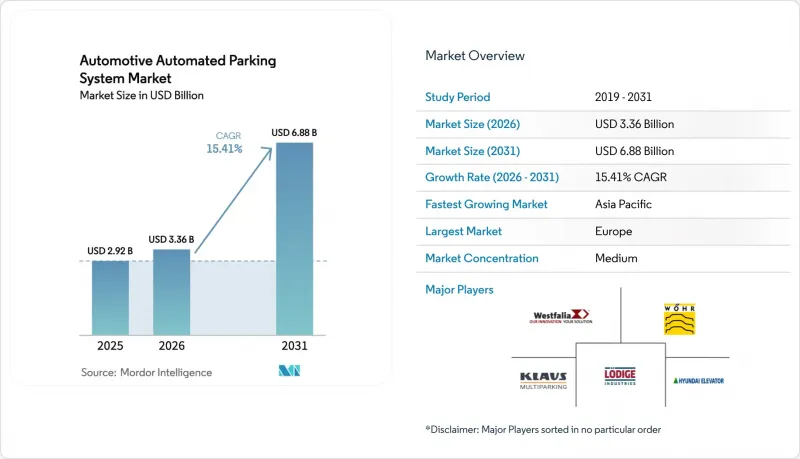
자동차용 자동 주차 시스템 시장 규모는 2025년 29억 2,000만 달러로 평가되었습니다. 2026년 33억 6,000만 달러로 확대되어 2026년부터 2031년에 걸쳐 CAGR 15.41%를 나타내, 2031년까지 68억 8,000만 달러에 이를 것으로 예측됩니다.
도심의 지가 급등, 부지 면적 축소를 장려하는 구역 설정 우대 조치, 차량 전동화의 꾸준한 발전으로 인해 개발업체들은 공간 절약형 로봇식 주차장으로 향하고 있습니다. 사업자들은 하드웨어뿐만 아니라 소프트웨어 구독 서비스를 도입하여 단발성 건설 프로젝트를 지속적인 수익원으로 전환하고 있습니다. 자동 발레파킹에 관한 ISO 표준은 완전 자동화의 도입을 가속화하고 있으며, ESG 평가 프레임워크는 열섬현상을 억제하는 밀폐형 에너지 효율적인 구조물에 구체적인 가치를 부여하고 있습니다. 이러한 요인들이 복합적으로 작용하여 견조한 성장을 뒷받침하고 있지만, 일부 지역에서는 높은 초기 투자비용과 사이버 보안 리스크가 도입을 저해하는 요인으로 작용하고 있습니다.
세계의 자동차용 자동 주차 시스템 시장 동향과 인사이트
도시 토지 부족과 부동산 가격 폭등
맨해튼에서는 분양 아파트의 주차 공간의 가치가 매우 높습니다. 한편, 도쿄, 싱가포르, 시드니 등의 도시에서는 2020년부터 2025년까지 건설비용이 크게 상승했습니다. 자동 주차 시스템은 1대당 필요한 공간을 줄여 임대 가능한 면적을 확보하는 동시에 프로젝트의 내부수익률(IRR)을 향상시킵니다. 예를 들어, 암스테르담의 비젤그라흐트 타워는 기존의 경사형 주차장에 비해 훨씬 적은 부지가 필요하며, 장기 서비스 계약에 따라 운영되고 있습니다. 마찬가지로 마이애미 브릭켈 지역의 개발업체들도 이러한 이점을 활용하고 있으며, 아파트 가격 상승을 통해 몇년안에 자동 주차 시스템에 대한 투자를 회수하고 있습니다.
커넥티드 주차 인프라 관련 스마트시티 의무화 의무화
2027년까지 워싱턴 D.C.에서는 신축 상업용 건물에 대해 주차 공간의 일부에 전기차(EV) 충전용 배선을 미리 설치하도록 의무화할 예정입니다. 한편, 캘리포니아 주 CalGreen 코드에서는 자동화 솔루션을 사용하여 주차 공간의 최소 기준을 충족하는 사업자에게 용적률 우대 혜택을 제공합니다. 유럽 공항도 대응을 진행하고 있습니다. 2025년 프랑크푸르트 공항은 초음파 센서를 설치하여 모바일 앱을 통해 운전자에게 빈 주차 공간을 안내할 수 있도록 했습니다. 이러한 노력으로 V2X 링크를 통해 실시간으로 가동 상황 데이터를 전송할 수 있는 클라우드 연결 시스템에 대한 수요가 증가하고 있습니다.
높은 설비투자 및 ROI의 불확실성
도시 지역에서는 대당 설비투자 금액이 높아 투자 회수 기간이 길어질 수 있습니다. 교외에서는 인구 밀도가 낮고 수요가 적기 때문에 회수 기간이 더 길어집니다. 브릭엘 하우스에서는 초기 세대 시스템이 며칠간 시스템 중단으로 인해 운영에 차질을 빚어 2024년에 거액의 손해배상 판결이 내려졌습니다. 이 사례는 특히 시스템의 안정적인 성능에 의존하는 부동산 소유주에게 가동 중단에 따른 심각한 재정적 위험을 강조하고 있습니다. '서비스로서의 주차'는 초기 투자를 줄여 초기 재정적 부담을 줄여주지만, 서비스 제공업체가 징수하는 수익 배분은 장기적으로 수익률을 떨어뜨려 전체 투자 수익률에 영향을 미칠 수 있습니다.
부문 분석
2025년 매출 중 하드웨어가 66.25%를 차지했지만, 소프트웨어는 CAGR 18.65%로 성장하며 하드웨어에 비해 괄목할만한 성장세를 보였습니다. 자동차용 자동 주차 시스템 시장에서 소프트웨어 플랫폼 시장 규모는 사업자들이 데이터, 라이선싱, 모바일 결제를 통해 수익을 창출함에 따라 2026년부터 2031년까지 큰 폭의 매출 증가가 예상됩니다. Smart Parking Limited의 2024년 결산은 이 모델을 잘 보여주었며, 클라우드 사용료, 번호판 인식(ANPR)을 통한 위반금 및 분석 서비스가 상당한 매출총이익률을 뒷받침했습니다.
기존 설비에 대한 후장 수요는 견조한 임베디드니다. 올랜도 국제공항은 2025년 기존 5개 주차장에 카메라 기반 유도 시스템을 도입하기 위해 1,300만 달러가 넘는 계약을 체결하여 운전자가 주차 공간을 찾는 시간을 40% 단축할 수 있게 되었습니다. 벤더들도 소프트웨어의 수익률이 60-80%인 반면 하드웨어는 15-25%에 불과하다는 업계 전반의 추세를 지적하며, 가동률과 안정적인 현금 흐름을 보장하는 10-15년의 종합적인 서비스 계약을 장려하고 있습니다.
완전 자동화 설계는 2025년 매출의 55.03%를 차지했으며 CAGR 23.01%로 확대될 것으로 예측됩니다. 리옹 공항에서는 여러 대의 Stan AGV가 2분 이내에 차량을 주차하거나 빼내는데, 이는 운전자가 팔레트에 차량을 정렬해야 하는 반자동 리프트에서는 불가능한 지표입니다. 마이애미의 주거용 타워에서도 비슷한 속도를 구현하고 있으며, 4분 이내에 차량을 빼내면 15-30%의 프리미엄 요금을 책정할 수 있습니다.
반자동 플랫폼은 설비투자(CAPEX)가 20-30% 낮기 때문에 여전히 회전율이 낮은 오피스 빌딩에 적합하지만, ISO 23374-1을 준수하는 ISO 23374-1은 차량 소유자가 핸즈프리로 차량을 맡길 수 있는 시스템으로 향하고 있습니다. 완전 자동화 구성의 자동 주차 시스템 시장 점유율은 2031년까지 크게 증가하여 현재의 선두를 더욱 확대할 것으로 예측됩니다.
팔레트 기반 아키텍처는 기존 주차장에 쉽게 개조할 수 있고, 고장난 팔레트 1개를 교체하는 데 며칠이 아닌 몇 시간이면 충분하기 때문에 2025년 매출의 58.12%를 차지했습니다. 뒤셀도르프의 MIZAL과 같은 유럽의 복합애플리케이션 개발 프로젝트에는 EV 충전용 접점이 있는 팔레트가 내장되어 있어 전동화 가속화에 대비하여 주차 공간의 미래를 보장합니다.
팔레트 없는 AGV 솔루션은 CAGR 16.05%로 빠르게 성장하고 있으며, 신축 시설에서 설계자가 각 층의 천장 높이를 8인치(약 20cm) 낮출 수 있도록 돕고 있습니다. AGV는 바퀴를 직접 잡기 때문에 팔레트로 인한 중량 증가의 부담 없이 무거운 전기 SUV에도 대응할 수 있습니다. 스탠리 로보틱스의 3톤급 로봇은 입방미터당 수용 밀도를 최대 50%까지 향상시켜, 부지가 한정된 공항에서 결정적인 공간 절약을 실현합니다.
"자동차용 자동 주차 시스템 보고서"는 시스템(하드웨어 및 소프트웨어), 자동화 수준(반자동 및 완전 자동), 플랫폼 유형(팔레트식 및 비팔레트식), 구동 기술(유압식, 전기기계식 등), 주차 레벨 구성(지상 타워식 등), 최종 사용자(주거용 등), 판매 형태, 지역별로 구분하여 분석합니다. 사용자(주거용 등), 판매 형태 및 지역별로 분류되어 있습니다. 시장 예측은 금액(USD) 기준으로 제공됩니다.
지역별 분석
유럽은 2025년 매출의 40.18%를 차지하며 자동 주차 시스템 시장을 주도했으며, 2031년까지 상당한 CAGR을 보일 것으로 예측됩니다. EN 14010에 따른 명확한 표준과 TUV 인증으로 허가 취득 기간이 최소 9개월로 단축되어 Klaus Multiparking과 같은 독일 공급업체에게 홈그라운드에서 우위를 점하고 있습니다. 스칸디나비아 국가의 도시에서는 해안가 땅을 자전거 도로로 전환하기 위해 로봇식 주차장을 도입하고 있으며, 영국에서는 100년 이상 된 지하실을 개조하는 데 주력하고 있습니다.
아시아태평양은 CAGR 16.35%로 가장 가파른 성장세를 보이고 있습니다. 중국에서는 여러 자동화 시설이 가동되고 있으며, 상하이에서만 스마트시티 구상에 따른 지하주차장 시범운영이 이루어지고 있습니다. 등록 차량이 많은 인도의 대도시에서는 지상 주차장공급이 수요를 따라잡지 못해 공간 절약형 타워형 주차장 수요가 급증하고 있습니다. 일본에서는 지진이 많은 지질 조건으로 인해 유압식 댐퍼를 장착한 사일로형이 주류를 이루고 있지만, 한국은 2026년까지 AGV 플랫폼의 수출 체제를 갖추려 하고 있습니다. 북미는 2025년 시장에서 두드러진 점유율을 차지했습니다. 오스틴 버그스트롬과 올랜도 공항을 포함한 미국 공항들은 2025년부터 2026년까지 스마트 차고에 많은 투자를 하여 수익과 이용객 편의에 대한 집중을 보여주고 있습니다. 마이애미와 토론토의 경우, 분양 아파트 개발업체들이 엄격한 구역 규제에 대응하기 위해 로봇식 주차장을 도입하고 있으며, 캘리포니아주의 CalGreen 법안은 경전철 역 주변에 자동화 시스템 도입을 촉진하고 있습니다.
중동 및 아프리카도 세계 수익에 기여했습니다. 두바이에서는 UAE의 야심찬 2050년 순 제로 목표에 따라 LEED 플래티넘 인증을 획득한 초고층 빌딩에 자동 주차공간이 내장되어 있습니다. 한편, 리야드의 '비전 2030'은 메가 프로젝트 내에 여러 개의 다층형 로봇 주차장을 계획하고 있습니다. 그러나 사하라 사막 이남 아프리카에서는 불안정한 전력망과 제한된 프로젝트 자금이 보급의 걸림돌로 작용하고 있어 퍼즐식 리프트가 주류 선택이 되고 있습니다. 점유율은 작지만, 남미에서는 경제의 변동에 직면해 있습니다. 상파울루 쇼핑몰에서 AGV를 시범 운영 중이지만, 환율 변동으로 인해 정식 주문은 미뤄지고 있습니다. 부에노스 아이레스에서는 상업용 부동산 소유주들이 새로운 시설의 건설보다는 기존 시설의 이용률을 높이기 위해 센서의 개보수를 선택하고 있습니다.
기타 혜택 :
- 엑셀 형식 시장 예측(ME) 시트
- 3개월간 애널리스트 지원
자주 묻는 질문
목차
제1장 서론
제2장 조사 방법
제3장 주요 요약
제4장 시장 구도
제5장 시장 규모와 성장 예측(금액(달러))
제6장 경쟁 구도
제7장 시장 기회와 향후 전망
KTH 26.05.29The automotive automated parking system market size is expected to grow from USD 2.92 billion in 2025 to USD 3.36 billion in 2026 and is forecast to reach USD 6.88 billion by 2031 at 15.41% CAGR over 2026-2031.
Surging land prices in dense downtowns, zoning incentives that reward footprint reduction, and the steady electrification of vehicle fleets are pushing developers toward space-saving robotic garages. Operators are layering software subscriptions on top of hardware, converting one-time construction projects into recurring revenue streams. ISO-based standards for automated valet parking are accelerating fully automated deployments, while ESG scoring frameworks now assign tangible value to enclosed, energy-efficient structures that curb heat-island effects. Collectively, these forces underpin robust growth even as high capital outlays and cybersecurity exposure temper adoption in some regions.
Global Automotive Automated Parking System Market Trends and Insights
Urban Land Scarcity and Real-Estate Inflation
In Manhattan, condominium parking spaces are highly valued. Meanwhile, construction costs have significantly increased in cities like Tokyo, Singapore, and Sydney during 2020-2025. Automated parking systems reduce the space required per car, freeing up leasable area and enhancing the internal rates of return for projects. For example, Amsterdam's Vijzelgracht tower requires substantially less land compared to a traditional ramp garage and operates under a long-term service contract. Similarly, developers in Brickell, Miami, are leveraging these benefits, recovering their automated parking investments within a few years through higher condo prices.
Smart-City Mandates for Connected Parking Infrastructure
By 2027, Washington, D.C. will require new commercial buildings to pre-wire a portion of their bays for electric vehicle (EV) charging. Meanwhile, California's CalGreen code offers density bonuses to those who meet parking minimums using automated solutions. European airports are also adapting: In 2025, Frankfurt Airport installed ultrasonic sensors, enabling mobile apps to direct drivers to available parking slots. These initiatives are driving up the demand for cloud-connected systems that can relay occupancy data in real-time through V2X links.
High Capex and ROI Uncertainty
In urban centers, capital outlays per stall can lead to extended payback periods, with suburban areas experiencing even longer durations due to lower population density and reduced demand. At Brickell House, an early-generation system encountered multi-day outages, which disrupted operations and culminated in a substantial legal judgment in 2024. This incident underscores the significant financial risks associated with operational downtime, particularly for property owners relying on consistent system performance. Although Parking-as-a-Service eases the upfront financial burden by reducing initial capital requirements, the revenue share taken by the service provider diminishes long-term profit margins, potentially impacting the overall financial viability of such investments.
Other drivers and restraints analyzed in the detailed report include:
- Rising Vehicle Ownership and Congestion in Mega-Cities
- Automated Valet Parking (AVP) Roll-Outs for Level-4 AV Fleets
- Operational Reliability and Safety Concerns
For complete list of drivers and restraints, kindly check the Table Of Contents.
Segment Analysis
Hardware commanded 66.25% of 2025 revenue, yet software is expanding at an 18.65% CAGR, a notable increase posted by hardware. The automotive automated parking system market size for software platforms is projected to add significant revenue between 2026 and 2031 as operators monetize data, licensing, and mobile payments. Smart Parking Limited's FY 2024 results showcase the model, with cloud fees, ANPR penalties, and analytics underwriting significant gross margins .
Retrofit demand is strong: Orlando International Airport awarded over USD 13 million in 2025 to overlay camera-based guidance across five existing garages, cutting driver search time by 40%. Vendors echo a wider industrial shift where software enjoys 60-80% margins versus 15-25% for hardware, prompting bundled 10-15-year service contracts that guarantee uptime and steady cash flow.
Fully automated designs controlled 55.03% of 2025 sales and are climbing at 23.01% CAGR. At Lyon Airport, several Stan AGVs park or retrieve a vehicle in under two minutes, a metric impossible for semi-automated lifts that demand driver alignment onto pallets. Residential towers in Miami replicate the speed, retrieving cars within four minutes and enabling 15-30% premium fees.
Semi-automated platforms still suit low-turnover office blocks due to 20-30% lower capex, but ISO 23374-1 compliance is pushing fleet owners toward systems capable of hands-free drop-off. The automated parking system market share for fully automated configurations is expected to rise significantly by 2031, widening today's lead.
Pallet-based architectures held 58.12% of 2025 revenue because they retrofit easily into older garages, and a single seized pallet can be swapped in hours rather than days. European mixed-use developments, such as Dusseldorf's MIZAL, embed pallets fitted with EV-charging contacts, future-proofing stalls as electrification accelerates.
Non-palleted AGV solutions are scaling quickly with a 16.05% CAGR, where new builds allow designers to shave eight inches of headroom per level. AGVs directly grasp wheels, accommodating heavier electric SUVs without the pallet weight penalty. Stanley Robotics' 3-ton robots raise per-cubic-meter density by up to 50%, a decisive saving in land-scarce airports.
The Automotive Automated Parking System Report is Segmented by System (Hardware and Software), Automation Level (Semi-Automated and Fully Automated), Platform Type (Palleted and Non-Palleted), Drive Technology (Hydraulic, Electro-Mechanical, and More), Parking-Level Configuration (Above-Ground Tower, and More), End User (Residential and More), Mode of Sales, and Geography. Market Forecasts are Provided in Terms of Value (USD).
Geography Analysis
Europe led the automated parking system market with 40.18% of 2025 revenue and is poised for a notable CAGR to 2031. Clear codes under EN 14010 and TUV certifications compress permitting to as little as nine months, giving German suppliers like Klaus Multiparking a home-field edge . Scandinavian cities deploy robotic garages to reclaim waterfront acreage for bicycle lanes, while the United Kingdom leans on retrofits that tuck systems into century-old basements.
Asia-Pacific delivers the steepest ascent at 16.35% CAGR. China fields several automated facilities and is piloting subterranean bays in Shanghai alone, aligning with its smart-city blueprint. With a significant number of registered vehicles, India's metros are outpacing surface supply, driving a surge in demand for space-efficient towers. In Japan, the earthquake-prone landscape leans towards hydraulic-damped silos, while South Korea gears up to export its AGV platforms by 2026. North America held a notable share of the market in 2025. United States airports, including Austin-Bergstrom and Orlando, invested heavily in 2025-2026 on smart garages, highlighting a focus on revenue and passenger ease. In Miami and Toronto, condo developers are turning to robotic parking to navigate stringent zoning laws, and California's CalGreen code is spurring automated setups close to light-rail stations.
The Middle East and Africa contributed to the global revenue. In Dubai, automated parking bays are being integrated into LEED-Platinum skyscrapers, aligning with the UAE's ambitious 2050 net-zero goals. Meanwhile, Riyadh's Vision 2030 is planning several multi-level robotic garages within its mega-projects. However, in sub-Saharan Africa, unreliable power grids and limited project financing hinder broader adoption, leaving puzzle lifts as the prevalent choice. South America, with a small share, grapples with economic fluctuations. While malls in Sao Paulo are testing AGV pilots, currency volatility has postponed definitive orders. In Buenos Aires, commercial landlords are opting for retrofit sensors to boost existing utilization instead of constructing new facilities.
- Westfalia Parking
- Wohr Parking
- Klaus Multiparking
- Lodige Industries
- CityLift Parking
- Parkmatic
- Unitronics Corporation
- ShinMaywa Industries
- Robotic Parking Systems Inc.
- ParkPlus Inc.
- Boomerang Systems
- Stanley Robotics (HL Robotics)
- Hyundai Elevator Co., Ltd.
- Valeo (Park4U)
- TreviPark
Additional Benefits:
- The market estimate (ME) sheet in Excel format
- 3 months of analyst support
TABLE OF CONTENTS
1 Introduction
- 1.1 Study Assumptions and Market Definition
- 1.2 Scope of the Study
2 Research Methodology
3 Executive Summary
4 Market Landscape
- 4.1 Market Overview
- 4.2 Market Drivers
- 4.2.1 Urban Land Scarcity and Real-Estate Inflation
- 4.2.2 Smart-City Mandates for Connected Parking Infrastructure
- 4.2.3 Rising Vehicle Ownership and Congestion in Mega-Cities
- 4.2.4 Automated Valet Parking (AVP) Roll-Outs for Level-4 AV Fleets
- 4.2.5 Parking-as-a-Service Revenue Models for Property Owners
- 4.2.6 ESG and Green-Building Incentives for Low-Footprint Car Bays
- 4.3 Market Restraints
- 4.3.1 High Capex and ROI Uncertainty
- 4.3.2 Operational Reliability and Safety Concerns
- 4.3.3 Cyber-Security Risks in IoT-Connected Parking Towers
- 4.3.4 Regulatory Lag in Robotic-Tower Building Codes
- 4.4 Value/Supply-Chain Analysis
- 4.5 Regulatory Landscape
- 4.6 Technological Outlook
- 4.7 Porter's Five Forces
- 4.7.1 Threat of New Entrants
- 4.7.2 Bargaining Power of Buyers
- 4.7.3 Bargaining Power of Suppliers
- 4.7.4 Threat of Substitute Products
- 4.7.5 Intensity of Competitive Rivalry
5 Market Size and Growth Forecasts (Value (USD))
- 5.1 By System
- 5.1.1 Hardware
- 5.1.2 Software
- 5.2 By Automation Level
- 5.2.1 Semi-Automated
- 5.2.2 Fully Automated
- 5.3 By Platform Type
- 5.3.1 Palleted
- 5.3.2 Non-Palleted
- 5.4 By Drive Technology
- 5.4.1 Hydraulic
- 5.4.2 Electro-Mechanical
- 5.4.3 Robotic (AGV/Shuttle)
- 5.5 By Parking-Level Configuration
- 5.5.1 Above-ground Tower
- 5.5.2 Underground Silo
- 5.5.3 Puzzle/Stacker
- 5.5.4 Shuttle and AGV based
- 5.5.5 Hybrid Structures
- 5.6 By End User
- 5.6.1 Residential
- 5.6.1.1 Single-family homes
- 5.6.1.2 Multi-family complexes
- 5.6.2 Commercial
- 5.6.2.1 Office buildings
- 5.6.2.2 Shopping malls and Retail centers
- 5.6.2.3 Hotels and Hospitality
- 5.6.2.4 Airports and Transportation hubs
- 5.6.2.5 Hospitals and Healthcare facilities
- 5.6.2.6 Universities and Education
- 5.6.3 Government and Municipal
- 5.6.4 Industrial and Logistics facilities
- 5.6.1 Residential
- 5.7 By Mode of Sales
- 5.7.1 New Installation
- 5.7.2 Retrofit
- 5.8 By Geography
- 5.8.1 North America
- 5.8.1.1 United States
- 5.8.1.2 Canada
- 5.8.1.3 Rest of North America
- 5.8.2 South America
- 5.8.2.1 Brazil
- 5.8.2.2 Argentina
- 5.8.2.3 Rest of South America
- 5.8.3 Europe
- 5.8.3.1 Germany
- 5.8.3.2 United Kingdom
- 5.8.3.3 France
- 5.8.3.4 Italy
- 5.8.3.5 Spain
- 5.8.3.6 Russia
- 5.8.3.7 Rest of Europe
- 5.8.4 Asia-Pacific
- 5.8.4.1 China
- 5.8.4.2 Japan
- 5.8.4.3 India
- 5.8.4.4 South Korea
- 5.8.4.5 Rest of Asia-Pacific
- 5.8.5 Middle East and Africa
- 5.8.5.1 Saudi Arabia
- 5.8.5.2 United Arab Emirates
- 5.8.5.3 Turkey
- 5.8.5.4 South Africa
- 5.8.5.5 Nigeria
- 5.8.5.6 Rest of Middle East and Africa
- 5.8.1 North America
6 Competitive Landscape
- 6.1 Market Concentration
- 6.2 Strategic Moves
- 6.3 Market Share Analysis
- 6.4 Company Profiles (Includes Global Level Overview, Market Level Overview, Core Segments, Financials as Available, Strategic Information, Market Rank/Share for Key Companies, Products and Services, SWOT Analysis, and Recent Developments)
- 6.4.1 Westfalia Parking
- 6.4.2 Wohr Parking
- 6.4.3 Klaus Multiparking
- 6.4.4 Lodige Industries
- 6.4.5 CityLift Parking
- 6.4.6 Parkmatic
- 6.4.7 Unitronics Corporation
- 6.4.8 ShinMaywa Industries
- 6.4.9 Robotic Parking Systems Inc.
- 6.4.10 ParkPlus Inc.
- 6.4.11 Boomerang Systems
- 6.4.12 Stanley Robotics (HL Robotics)
- 6.4.13 Hyundai Elevator Co., Ltd.
- 6.4.14 Valeo (Park4U)
- 6.4.15 TreviPark
7 Market Opportunities and Future Outlook
- 7.1 White-space and Unmet-Need Assessment