|
시장보고서
상품코드
2043912
크산테이트 : 시장 점유율 분석, 업계 동향 및 통계, 성장 예측(2026-2031년)Xanthates - Market Share Analysis, Industry Trends & Statistics, Growth Forecasts (2026 - 2031) |
||||||
 Mordor Intelligence
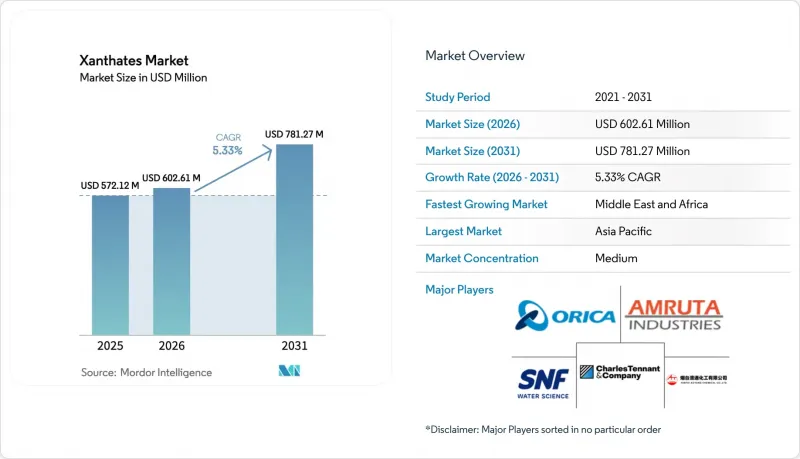
크산테이트 시장 규모는 2025년 5억 7,212만 달러로 평가되었습니다. 2026년 6억 261만 달러에서 2031년까지 7억 8,127만 달러로 확대되며 2026년부터 2031년까지 연평균 복합 성장률(CAGR)은 5.33%를 나타낼 전망입니다.
콩고민주공화국(DRC), 잠비아, 칠레, 페루에서는 구리, 코발트, 리튬을 위한 새로운 부양 회로의 도입으로 인해 수집가들 수요가 급증하고 있습니다. 이들 프로젝트를 통해 황화광석 처리량은 사상 최고치를 갱신하고 있습니다. 아시아태평양이 계속해서 소비의 중심이 될 것으로 예상되는 가운데, 중동이 다른 모든 지역을 능가하는 성장을 보일 것으로 예측됩니다. 이러한 변화는 콩고의 선광장과 잠비아의 제련소 공급사업이 시약 예산을 확대하고 있는 것에서도 알 수 있습니다. 액체 크산테이트 제제의 인기가 높아지고 있습니다. 이는 분진 처리의 위험을 줄이고 이황화탄소(CS2)의 방출을 감소시킵니다. 이러한 추세는 미국 및 유럽연합(EU)의 직업적 노출 및 꼬리 광물에 대한 엄격한 규제와 일치합니다. 동시에 인공지능(AI)을 활용한 투약 플랫폼이 수집가의 총 소비량을 끌어올리고 있습니다. 이는 톤당 시약 사용량이 감소하는 가운데 저급 광석 재고 더미에서 순현재 가치를 극대화함으로써 이러한 성과를 달성하고 있습니다.
세계의 크산테이트 시장 동향 및 인사이트
아프리카와 라틴아메리카의 주요 광물 프로젝트가 빠르게 성장하고 있습니다.
2025년, 콩고민주공화국(DRC)에 위치한 아이반호 마인즈의 카모아 카클라(Kamoa-Kakra) 광산 단지는 연간 환산 구리 생산량을 달성했습니다. 2027년까지 이 복합시설은 3단계 선광 플랜트를 가동할 계획이며, 이로 인해 이소프로파일락산나트륨 수요가 증가할 것으로 예측됩니다. 동시에 칠레의 센티넬라 및 케브라다 블랑카 2단계의 생산능력 확대와 아르헨티나의 PSJ 코브레 멘도시노(PSJ Cobre Mendocino) 개발로 인해 2027년까지 구리 정광 생산량이 전반적으로 증가할 것으로 예측됩니다. 이러한 성장은 2026년부터 2031년까지의 예측 기간 동안 새로운 집광제에 대한 수요를 견인할 것으로 예측됩니다. 이러한 발전과 함께 안데스 회랑과 중앙아프리카 구리 벨트는 크산테이트 시장의 주요 기업로서 입지를 확고히 하고 있습니다.
원격지 광산에서 액체 크산테이트 물류로의 이행
클라리언트의 HOSTAFLOT 액체 등급은 현장의 용해 탱크가 불필요하고 시약 준비 시간을 단축하여 운영의 효율성을 높였습니다. 이러한 장점은 칠레의 리튬 염수 채굴 사업과 호주의 철광석 채굴 현장에서 입증된 바 있습니다. 페루의 안데스 고산지대 구리 벨트에서 안타미나 광산과 라스 밤바스 광산에서 미리 용해된 이소프로파일산나트륨으로 전환한 후 시약 취급 사고가 현저히 감소했다고 보고되었습니다. 또한, 이러한 액체 수집기는 CS2의 휘발을 억제하여 광산이 유럽연합(EU)의 엄격한 상한선인 50 mg/m3 및 OSHA의 장기 평균 한계치인 20 ppm을 준수할 수 있도록 도와줍니다. 이러한 규제 강화는 제품 구성을 액체 솔루션으로 빠르게 전환하는 계기가 되었습니다.
배위자계 크산테이트 프리 회수제 상용화 추진
칠레에서 진행된 파일럿 테스트에서 솔베이의 티오노카르바메이트 계열 제품인 Aero MX 5004는 이소프로파일락산나트륨보다 더 높은 구리 회수율을 달성하는 등 우수한 성능을 보였습니다. 또한, DS 90 수질 기준을 준수하여 광미 내 CS2 농도를 허용치 이하로 낮추는데 성공하였습니다. 한편, 2025년에는 BASF의 루프로민-D(hydroxamate)를 통해 필리핀의 니켈 광산에서 산화물 회로에서 크산틴산염을 완전히 제거할 수 있게 되었습니다. 기존 방식에 비해 투여량을 크게 줄이고 폐기물 처리 비용도 절감할 수 있어 이 광산은 눈에 띄게 운영 비용을 절감할 수 있었습니다. 이는 배출 규제가 엄격한 지역에서 특히 중요하며, 그 결과 크산테이트 시장의 장기적인 성장을 억제할 수 있습니다.
부문 분석
2025년, 이소프로파일산나트륨은 구리-황철광 분리에서 우수한 선택성과 반암 광상에서의 강력한 존재감을 바탕으로 크산테이트 시장에서 34.28%의 점유율을 차지했습니다. 이 주요 등급은 프리미엄 혼합 수집기 시스템의 기초를 형성하고 있으며, 에틸산나트륨과 비교하여 더 높은 회수율을 제공합니다. 칼륨 아밀크산테이트는 2031년까지 연평균 복합 성장률(CAGR) 6.18%를 나타내며 가장 빠르게 성장하는 제품으로 부상하고 있습니다. 그 강점은 특히 난선금광이나 복잡한 다금속 광석에서 미립자 황화물에 대한 흡착력이 강하다는 점입니다. 이소부틸산나트륨은 납-아연 플로우 시트, 특히 호주의 브로큰힐과 중국의 클라우드난성에서 여전히 선호되는 선택이 되고 있습니다. 중간 정도의 사슬 길이는 흡착력과 선택성의 이상적인 균형을 이루고 있습니다. 한편, 에틸산나트륨은 비용 효율성이 우수함에도 불구하고 고품질 구리 및 금 회로에서 추진력을 잃고 있습니다. 이러한 회로에서는 현재 더 엄격한 이황화탄소(CS2) 배출 제한과 야금 성능 개선이 요구되고 있습니다.
크산테이트 시장에서 칼륨염은 주로 용해도가 높기 때문에 칼륨염이 주목을 받고 있습니다. 이러한 특성으로 인해 취급량이 줄어들어 아프리카나 호주의 외딴 곳에 위치한 광산에는 물류 측면에서 큰 이점이 됩니다. 또 다른 급성장 분야는 블렌딩 제제입니다. 예를 들어, 2025년 페루의 다금속 광산에서 이소프로파일락산테이트와 아밀크산테이트를 60대 40의 비율로 혼합하여 구리와 아연의 총 회수율을 향상시켰습니다. 이러한 성공은 공급업체가 맞춤형 프리믹스 제품 개발에 집중하고 있음을 보여줍니다. 이러한 추세는 사슬 길이, 용해도 및 블렌딩 기술에 초점을 맞춘 혁신이 크산테이트 시장 경쟁 구도를 재편할 것임을 시사합니다.
지역별 분석
2025년 아시아태평양이 전체 매출의 46.38%를 차지하며 시장을 주도했습니다. 탄탄한 크산테이트 생산 능력을 갖춘 중국의 통합 클러스터는 주로 인도네시아, 베트남, 필리핀 등 인근 국가로의 수출을 주도했습니다. 인도에서는 힌두스탄 징크(Hindustan Zinc)의 람프라 아구차(Rampra Agcha) 광산과 콜 인디아(Coal India)의 미분탄 부양 프로젝트 확장으로 수요가 급증하여 집광제 인계량이 증가했습니다. 호주는 자급자족형 하위 시장으로 부상했으며, BHP와 Rio Tinto는 주로 Orica와 Coogee Chemicals로부터 액체 크산틴산염을 조달했습니다. 이러한 전략적 선택은 필바라 및 퀸즐랜드 주에 위치한 회사의 운영 리스크를 줄이기 위한 것이었습니다.
중동 및 아프리카 시장 점유율은 작지만 2026년부터 2031년까지 예측 기간 동안 5.93%의 가장 높은 CAGR을 나타낼 것으로 예측됩니다. 이러한 성장은 2028년까지 수집기 수요 증가가 예상되는 콩고민주공화국의 카모아 카클라 광산과 잠비아의 칸산시 광산과 엔터프라이즈 광산의 확장에 힘입어 성장세를 이끌었습니다. 남아공에서 Bushfeld의 Platinum Group은 기계적 교반의 감소를 보완하기 위해 컬럼 부양에 의한 크산테이트 투여량을 증가시켰습니다. 동시에 사우디 아덴의 인산염 사업은 중력 선광법에서 크산테이트 보조 부양법으로 전환하여 이 지역의 시약 동향에 다양성을 가져왔습니다.
북미는 애리조나 및 유타(구리/몰리브덴), 온타리오(금), 알래스카 및 유콘 준주 아연 광산 프로젝트가 2025년 매출에 크게 기여했습니다. 유럽은 침체된 모습을 보였습니다. 폴란드와 핀란드의 광산 폐쇄로 인해 기준 사용량이 상쇄되었지만, Woodsmith와 같은 신규 사업에서는 CS2(이황화탄소) 문제를 피하기 위해 크산테이트 사용을 피하고 있습니다. 시장 점유율이 높은 남미에서는 코델코(Codelco)가 각 사업 부문에서 크산틴산염을 광범위하게 소비했습니다. Scope 3의 목표에 따라 2026년부터 이소프로파일 나트륨의 일부 사용량을 Aero MX 티오노카르바메이트(Aero MX Thionocarbamate)로 대체하는 것을 목표로 전략적 전환을 검토하고 있습니다. 또한, 구리벨트 지역의 철도 병목현상을 비롯한 인프라 측면의 과제가 지속되면서 운임 프리미엄이 급등하고, 현장 합성에 대한 관심이 높아졌습니다. 이 방법이 보급되면 시판되는 제품 수요량을 감소시킬 수 있는 잠재력을 가지고 있습니다.
기타 혜택 :
- 엑셀 형식 시장 예측(ME) 시트
- 3개월간 애널리스트 지원
자주 묻는 질문
목차
제1장 서론
제2장 조사 방법
제3장 주요 요약
제4장 시장 구도
제5장 시장 규모와 성장 예측
제6장 경쟁 구도
제7장 시장 기회와 향후 전망
KTH 26.05.29The Xanthates Market size is projected to expand from USD 572.12 million in 2025 and USD 602.61 million in 2026 to USD 781.27 million by 2031, registering a CAGR of 5.33% between 2026 to 2031.
Collector demand is surging in the Democratic Republic of Congo (DRC), Zambia, Chile, and Peru, driven by new flotation circuits for copper, cobalt, and lithium. These projects are pushing sulfide-ore throughput beyond historical levels. While the Asia-Pacific region continues to anchor consumption, the Middle-East is poised to outpace all others. This shift is evident as Congolese concentrators and Zambian smelter-feed operations expand their reagent budgets. Liquid xanthate formulations are becoming increasingly popular. They mitigate dust-handling risks and reduce carbon-disulfide (CS2) off-gassing. This trend aligns with the United States and European Union's stringent limits on occupational exposure and tailings water. Concurrently, artificial-intelligence (AI) dosing platforms are boosting overall collector consumption. They achieve this by maximizing net present value from lower-grade stockpiles, even as the intensity of reagents per tonne decreases.
Global Xanthates Market Trends and Insights
Booming Critical-Minerals Projects in Africa and Latin America
In 2025, Ivanhoe Mines' Kamoa-Kakula complex in the DRC achieved an annualized copper output. By 2027, the complex is set to roll out a Phase 3 concentrator, which is expected to increase the demand for sodium isopropyl xanthate. Simultaneously, capacity expansions at Chile's Centinela and Quebrada Blanca Phase 2, along with Argentina's PSJ Cobre Mendocino development, are projected to collectively augment copper-concentrate output by 2027. This growth is anticipated to drive new collector offtake during the forecast period of 2026-2031. With these advancements, the Andean-Corridor and the Central-African Copperbelt are solidifying their positions as leading players in the xanthates market.
Shift to Liquid Xanthate Logistics at Remote Mines
Clariant's HOSTAFLOT liquid grades have streamlined operations by eliminating the need for on-site dissolution tanks and reducing reagent preparation time. These advantages have been realized at lithium brine operations in Chile and iron ore sites in Australia. In Peru's high-Andes copper belt, both Antamina and Las Bambas reported a notable drop in reagent-handling incidents after transitioning to pre-dissolved sodium isopropyl xanthate. Furthermore, these liquid collectors, by curbing CS2 volatilization, help mines comply with the European Union's stringent cap of 50 mg/m3, and OSHA's average limit of 20 ppm over time. This regulatory push is catalyzing a rapid shift in the product mix toward liquid solutions.
Commercialisation of Ligand-Based Xanthate-Free Collectors
In Chilean pilot trials, Solvay's Aero MX 5004 thionocarbamate outperformed sodium isopropyl xanthate, achieving higher copper recovery. Additionally, it successfully reduced tailings CS2 levels to below the permissible limit, adhering to the DS 90 water-quality standard. Meanwhile, in 2025, BASF's Lupromin-D hydroxamates enabled a nickel mine in the Philippines to completely eliminate xanthate from its oxide circuits. With dosing levels significantly reduced compared to conventional methods and a decrease in waste-treatment costs, the mine realized notable operating savings. This is particularly significant in regions with stringent emissions regulations, which in turn curtail the long-term growth of the xanthates market.
Other drivers and restraints analyzed in the detailed report include:
- AI-Optimized Reagent Dosing Boosting Collector Consumption
- Surge in Alkaline Battery Recycling Requiring Xanthate Leaching Aids
- EU Tailings Directive Lowering Allowable CS2 Emissions
For complete list of drivers and restraints, kindly check the Table Of Contents.
Segment Analysis
In 2025, sodium isopropyl xanthate commanded a 34.28% share of the xanthates market, driven by its superior selectivity in copper-pyrite separation and a strong presence in porphyry deposits. This leading grade forms the backbone of premium blended-collector systems, achieving recovery gains over sodium-ethyl counterparts. Potassium amyl xanthate has emerged as the fastest-growing player, boasting a 6.18% CAGR through 2031. Its edge comes from a stronger adsorption on fine-grained sulfides, particularly in refractory gold and intricate polymetallic ores. Sodium isobutyl xanthate remains a favored choice in lead-zinc flowsheets, notably in Australia's Broken Hill and China's Yunnan Province. Its mid-chain length strikes an ideal balance between power and selectivity. Meanwhile, sodium ethyl xanthate, despite its cost-effectiveness, is losing traction in premium copper and gold circuits. These circuits are now leaning toward stricter CS2 limits and enhanced metallurgical performance.
Potassium salts are gaining traction in the xanthates market, primarily due to their heightened solubility. This attribute reduces handling volumes, a significant logistical advantage for remote mining sites in Africa and Australia. Another burgeoning segment is blended formulations. For instance, a 60:40 mix of isopropyl and amyl xanthate boosted combined copper-zinc recovery at a Peruvian polymetallic mine in 2025. This success underscores suppliers' momentum toward tailored pre-mixes. Such developments indicate that innovations focusing on chain length, solubility, and blending techniques will reshape the competitive landscape of the xanthates market.
The Xanthates Market Report is Segmented by Product Type (Sodium Ethyl Xanthate, Sodium Isopropyl Xanthate, Sodium Isobutyl Xanthate, Potassium Amyl Xanthate, and Other Product Types), Application (Mining, Rubber Processing, Agrochemicals, and Other Applications), and Geography (Asia-Pacific, North America, Europe, South America, and Middle-East and Africa). Market Forecasts are Provided in Terms of Value (USD).
Geography Analysis
In 2025, the Asia-Pacific region led the market, capturing 46.38% of total revenue. China's integrated clusters, with their robust xanthate capacity, primarily fueled exports to neighboring nations such as Indonesia, Vietnam, and the Philippines. In India, demand surged due to expansions at Hindustan Zinc's Rampura Agucha and Coal India's fine-coal flotation projects, resulting in increased collector offtake. Australia emerged as a self-sufficient sub-market, with BHP and Rio Tinto predominantly sourcing liquid xanthates from Orica and Coogee Chemicals. This strategic choice aimed to mitigate hazards in their operations located in Pilbara and Queensland.
While the Middle-East and Africa held a smaller market share, they boasted the fastest projected CAGR of 5.93% during the forecast period of 2026-2031. This growth was fueled by expansions at DRC's Kamoa-Kakula and Zambia's Kansanshi and Enterprise, which anticipated a heightened demand for collectors by 2028. In South Africa, Bushveld's platinum group augmented xanthate dosages via column flotation to compensate for reduced mechanical agitation. Simultaneously, Saudi Arabia's Ma'aden phosphate operations shifted from gravity methods to xanthate-assisted flotation, diversifying the regional reagent landscape.
North America made a significant contribution to the 2025 revenue, driven by projects in Arizona and Utah (copper and molybdenum), Ontario (gold), and zinc operations in Alaska and the Yukon. Europe experienced stagnation; while mine closures in Poland and Finland balanced out the baseline usage, new ventures like Woodsmith avoided xanthates to evade CS2 issues. South America, with a substantial market share, witnessed Codelco's widespread xanthate consumption across its divisions. The company is considering a strategic shift, aiming to substitute a segment of its sodium isopropyl volumes with Aero MX thionocarbamates starting in 2026, in line with its Scope 3 objectives. Additionally, persistent infrastructure challenges, notably the Copperbelt rail bottlenecks, elevated freight premiums and ignited interest in on-site synthesis. If this method gains traction, it holds the potential to diminish merchant volume.
- Amruta Industries
- Charles Tennant and Company
- Coogee Chemicals
- CTC Energy & Mining Company
- Florrea Chemicals
- Kemcore
- Merck KGaA
- Orica Limited
- Qingdao Ruchang Mining Industry
- QiXia TongDa Flotation Reagent Co. Ltd
- Senmin International (Pty) Ltd
- SNF Flomin
- SNF Group
- Thermo Fisher Scientific Inc.
- Tieling Flotation Reagent Co. Ltd
- Vanderbilt Chemicals LLC
- Y&X Beijing Technology
- Yantai Humon Chemical Auxiliary Co. Ltd
Additional Benefits:
- The market estimate (ME) sheet in Excel format
- 3 months of analyst support
TABLE OF CONTENTS
1 Introduction
- 1.1 Study Assumptions and Market Definition
- 1.2 Scope of the Study
2 Research Methodology
3 Executive Summary
4 Market Landscape
- 4.1 Market Overview
- 4.2 Market Drivers
- 4.2.1 Booming critical-minerals projects in Africa and Latin America
- 4.2.2 Shift to liquid xanthate logistics at remote mines
- 4.2.3 AI-optimised reagent dosing boosting collector consumption
- 4.2.4 Surge in alkaline battery recycling requiring xanthate leaching aids
- 4.2.5 Tightening Asia-Pacific supply of carbon-disulfide feedstock inflates prices
- 4.3 Market Restraints
- 4.3.1 Commercialisation of ligand-based xanthate-free collectors
- 4.3.2 EU tailings directive lowering allowable CS2 emissions
- 4.3.3 On-site CS2 cracking units enabling captive collector synthesis
- 4.4 Value Chain Analysis
- 4.5 Porter's Five Forces
- 4.5.1 Bargaining Power of Suppliers
- 4.5.2 Bargaining Power of Buyers
- 4.5.3 Threat of New Entrants
- 4.5.4 Threat of Substitutes
- 4.5.5 Degree of Competition
5 Market Size and Growth Forecasts (Value)
- 5.1 By Product Type
- 5.1.1 Sodium Ethyl Xanthate
- 5.1.2 Sodium Isopropyl Xanthate
- 5.1.3 Sodium Isobutyl Xanthate
- 5.1.4 Potassium Amyl Xanthate
- 5.1.5 Other Product Types
- 5.2 By Application
- 5.2.1 Mining
- 5.2.2 Rubber Processing
- 5.2.3 Agrochemicals
- 5.2.4 Other Applications
- 5.3 By Geography
- 5.3.1 Asia-Pacific
- 5.3.1.1 China
- 5.3.1.2 India
- 5.3.1.3 Japan
- 5.3.1.4 South Korea
- 5.3.1.5 Rest of Asia-Pacific
- 5.3.2 North America
- 5.3.2.1 United States
- 5.3.2.2 Canada
- 5.3.2.3 Mexico
- 5.3.3 Europe
- 5.3.3.1 Germany
- 5.3.3.2 United Kingdom
- 5.3.3.3 France
- 5.3.3.4 Italy
- 5.3.3.5 Rest of Europe
- 5.3.4 South America
- 5.3.4.1 Brazil
- 5.3.4.2 Argentina
- 5.3.4.3 Rest of South America
- 5.3.5 Middle-East and Africa
- 5.3.5.1 Saudi Arabia
- 5.3.5.2 South Africa
- 5.3.5.3 Rest of Middle-East and Africa
- 5.3.1 Asia-Pacific
6 Competitive Landscape
- 6.1 Market Concentration
- 6.2 Strategic Moves
- 6.3 Market Share(%)/Ranking Analysis
- 6.4 Company Profiles (includes Global Overview, Market Overview, Core Segments, Financials, Strategic Information, Products and Services, Recent Developments)
- 6.4.1 Amruta Industries
- 6.4.2 Charles Tennant and Company
- 6.4.3 Coogee Chemicals
- 6.4.4 CTC Energy & Mining Company
- 6.4.5 Florrea Chemicals
- 6.4.6 Kemcore
- 6.4.7 Merck KGaA
- 6.4.8 Orica Limited
- 6.4.9 Qingdao Ruchang Mining Industry
- 6.4.10 QiXia TongDa Flotation Reagent Co. Ltd
- 6.4.11 Senmin International (Pty) Ltd
- 6.4.12 SNF Flomin
- 6.4.13 SNF Group
- 6.4.14 Thermo Fisher Scientific Inc.
- 6.4.15 Tieling Flotation Reagent Co. Ltd
- 6.4.16 Vanderbilt Chemicals LLC
- 6.4.17 Y&X Beijing Technology
- 6.4.18 Yantai Humon Chemical Auxiliary Co. Ltd
7 Market Opportunities and Future Outlook
- 7.1 White-space and Unmet-Need Assessment