

|
시장보고서
상품코드
2043982
세슘 : 시장 점유율 분석, 산업 동향 및 통계 데이터, 성장 예측(2026-2031년)Cesium - Market Share Analysis, Industry Trends & Statistics, Growth Forecasts (2026 - 2031) |
||||||
 Mordor Intelligence
세슘 시장 규모는 2026년에 3.32 킬로톤에 달할 것으로 예상되며 예측 기간(2026-2031년) CAGR 5.43%를 나타내, 2031년까지 4.33 킬로톤에 이를 것을로 전망되고 있습니다.
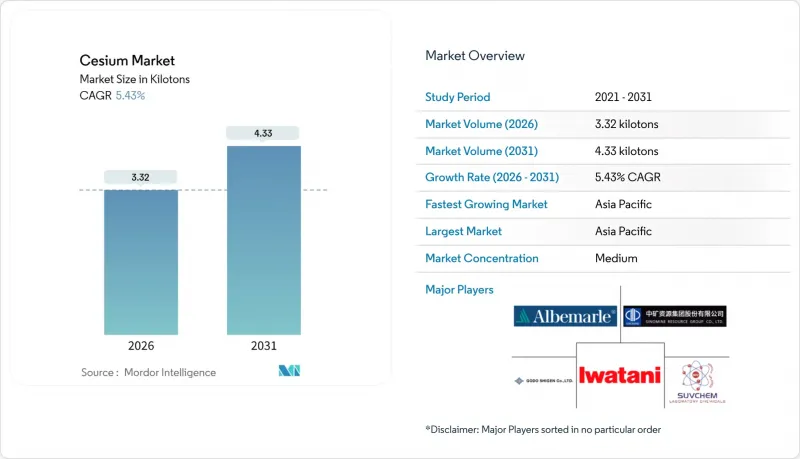
고압 고온(HPHT) 시추 활동 증가, 급성장하는 5G 및 향후 6G 인프라, 그리고 새로운 의료용 영상 진단 용도으로 인해 주요 폴루사이트 광석 공급 파이프라인이 여전히 부족한 상황에서도 수요는 증가하고 있습니다. 이에 수직계열화된 공급업체들은 희소성 있는 원료를 확보하기 위해 시추 서비스 업체와 다년 계약을 체결하는 한편, 2024년 가격을 인상하는 대응을 취했습니다. 아시아태평양은 중국이 세계 세슘염의 대부분을 정제하고 일본이 정밀 전자기기 응용 분야를 지배하고 있어 소비와 가공 모두에서 선도적인 위치를 차지하고 있습니다. 북미와 유럽에서는 해양 HPHT 완성 공사 및 방산 프로그램이 안정적인 수요 기반을 유지하고 있지만, 구매자는 Sinomine과 Albemarle을 중심으로 한 단일 공급원 리스크에 노출되어 있습니다.
세계의 세슘 시장 동향 및 인사이트
초심도 HPHT 유정에서 세슘 포름산 유체 이용 급증
고밀도로 지층 손상을 최소화하는 세슘 포름산 세슘 염수는 20,000psi 이상의 저류층에서 주요 완성액으로 부상하고 있습니다. 북해, 멕시코만, 브라질의 사업자들은 지층의 무결성이 유지되고 평생 회수율이 향상되어 1년 이내에 유체 비용을 회수할 수 있다는 것을 입증했습니다. 전 세계 세슘 포름산 세슘 재고는 한정되어 있으며, 더 깊은 우물에 대한 수요가 증가함에 따라 공급이 타이트한 상황입니다. 이에 따라 시노마인은 애버딘과 베르겐에 전용 회수기지를 설립하고, 브렌트유 선물과 연동된 장기 공급 계약을 체결하였습니다. 이러한 전략적 조치는 수익률을 보호할 뿐만 아니라 HPHT 서비스 체인의 신규 시장 진출기업에 대한 진입장벽이 되어 세슘 시장에서 시노마인의 지배적 지위를 확고히 하고 있습니다.
초안정적인 세슘 클럭을 필요로 하는 5G/6G 네트워크의 보급
통신사업자들은 GPS에 의존하지 않고 장기간 높은 정확도를 유지할 수 있는 세슘 원자시계로 루비듐 발진기 교체를 가속화하고 있습니다. 이러한 전환은 5G 협동 다지점 전송의 요구사항인 서브마이크로초 수준의 동기화 요구가 주요 요인으로 작용하고 있습니다. 보더폰 튀르키예의 2024년 도입은 중국, 한국, 미국에서 빠르게 확산되고 있는 이러한 추세의 한 예에 불과합니다. 실험실 환경에서는 광격자 시계가 세슘 시계보다 더 높은 정확도를 달성했지만, 규제 계량학에서는 여전히 9.19GHz의 세슘 133 전이를 기반으로 한 SI 초를 채택하고 있습니다. 표준화 기관이 이 정의를 유지하는 한, 세슘의 우위, 그리고 세슘 시장은 확고한 지위를 유지할 것입니다.
상업적으로 운영되는 펄사이트 광산의 수가 제한되어 있습니다.
2024년, 지속적으로 운영되는 주요 폴리우사이트 광산이 존재하지 않았기 때문에 시추 유체 이외의 용도로 사용되는 세슘염 수요는 기존 재고와 탄코의 간헐적인 공급에 의존할 수밖에 없었습니다. 시노마인의 주도적인 위치에도 불구하고, 탄코는 연속 가동이 아닌 일괄 처리를 선택했는데, 이는 광석의 등급이 낮거나 현재 가격 수준을 고려할 때 처리의 수익성이 낮다는 것을 의미합니다. 2000년대 초 이후 세슘산화물(Cs2O)의 세계 매장량에서 눈에 띄는 새로운 발견이 없는 가운데, 항공우주 및 방위 부문은 고순도 탄산세슘과 금속을 비축하기 시작했습니다. 이러한 움직임은 운전자금 수요를 증가시킬 뿐만 아니라 세슘 시장 수요 탄력성을 떨어뜨리는 결과를 초래했습니다.
부문 분석
화합물 세슘 시장 규모는 전체 시장의 73.45%를 차지하고 있으며, 2031년까지 연평균 6.02% 성장할 것으로 예측됩니다. 이 부문은 포름산 염수가 주도하고 있으며, 탄산염은 제약용 촉매 및 고굴절률 유리 제조를 지원하고 있습니다. 요오드화 및 브로마이드는 신틸레이터 및 적외선 광학 시장에 공급되고 있습니다. 금속 부문은 순도가 높아질수록 높은 수익률을 확보하고 있습니다. CSAC(염화세슘)의 단위당 금속 사용량은 적지만, 방산 관련 구매자는 일반 소금에 비해 훨씬 더 높은 가격을 지불할 의향이 있기 때문에 이 하위 부문은 전체 시장의 변동에 영향을 덜 받는 상황입니다.
세계 인프라 및 의료 지출이 증가함에 따라 HPHT 시추, 특수 유리, 의료용 영상진단을 중심으로 한 세슘 화합물 수요는 앞으로도 지속될 것으로 예측됩니다. 금속 수요는 국방 조달과 통신망 업그레이드에 따라 간헐적인 성장세를 보일 뿐, 전체 생산량의 균형을 바꾸지 않습니다. 수산화세슘, 불화세슘, 안티몬화세슘과 같은 다른 세슘 유도체는 에칭용 화학물질 및 광음극용 화학물질로 전체 시장의 일부에 불과한 틈새 시장에 머물러 있습니다. 따라서 세슘 화합물과 금속에 대한 수직적 통합이 업계 수요 변동에 대응하는 가장 확실한 전략으로 떠오르고 있습니다.
'세계 세슘 시장' 보고서는 제품 유형별(세슘 금속, 세슘 화합물, 기타 제품 유형), 용도별(석유 및 가스, 전자기기, 의료 및 헬스케어, 기타 용도), 지역별(북미, 유럽, 아시아태평양, 기타 지역(ROW))로 분류되어 있습니다. 시장 예측은 수량(톤) 기준으로 제공됩니다.
지역별 분석
아시아태평양은 2025년 세슘 시장 점유율의 43.86%를 차지했으며, 2031년까지 연평균 6.56%의 가장 높은 성장률을 나타낼 것으로 예측됩니다. 세계 최대의 정제 클러스터를 보유한 중국은 캐나다와 짐바브웨에서 조달한 폴라이트를 탄산염, 요오드화물, 초건조 포름산염으로 전환하는 데 능숙합니다. 한편, 고도시겐과 이와야산업을 필두로 한 일본 전문업체들은 원자시계용 소금을 국내 전자기기 산업에 공급할 뿐만 아니라 잉여분을 북미와 유럽으로 수출하고 있습니다. 한국의 전국적인 5G 네트워크 고도화에 따라 세슘 발진기에 대한 지역적 수요가 증가하고 있습니다. 동시에 남중국해에서 중국의 해양 탐사는 포름산 수요를 촉진하고 있습니다. 그러나 우려되는 점은 수출 허가 체계가 미정인 상황에서 고순도 세슘이 국내 항공우주 및 통신 분야 수요를 우선적으로 충족시키기 위해 전용될 가능성이 있다는 점입니다.
북미와 유럽은 성숙한 시장이지만 전략적으로 중요한 시장 클러스터를 형성하고 있습니다. 세슘 금속과 그 특수 화합물의 유럽과 미국에서의 정제는 독일에 위치한 알베마르의 랑겔스하임 공장을 중심으로 이루어지고 있습니다. 멕시코만의 제3기 하층 고압고온(HPHT) 우물과 북해의 노후화된 고압 저류층은 포름산의 안정적인 인수를 보장합니다. 그러나 두 지역 모두 시노마인이 공급하는 업스트림 광석에 크게 의존하고 있는 것이 현실입니다. 미국에서는 국방부가 CSAC 프로그램을 위해 세슘 금속을 비축하고 있으며, 리드 타임이 길어지고 고순도 보장 비용이 증가하더라도 그 태도는 변하지 않을 것입니다. 대서양을 사이에 두고 유럽에서는 수입업체들이 EU 중요 원자재법의 추적성 요건에 직면해 있습니다. 이러한 요구사항은 조달 주기를 연장시키는 한편, 특히 가격이 임계치를 넘어설 경우 북미 폴루사이트 채굴 사업의 부활로 이어질 가능성도 있습니다.
기타 지역(ROW)은 현재 제한된 역할만 수행하고 있지만, 그 잠재력은 분명 전략적인 측면이 있습니다. 브라질의 프리솔트층에서는 페트로브라스와 파트너사들이 수심 7,000m 이상의 수심에서 포름산수를 추출하고 있으며, 이는 2030년까지 지속될 수 있는 수요를 시사합니다. 서아프리카의 심해 개발은 유가 변동에 영향을 받지만, 인프라 구축이 진행됨에 따라 장기적으로 유망한 전망을 보이고 있습니다. 그러나 세슘 공급국으로서 아프리카의 잠재력은 리튬 가격의 회복과 밀접한 관련이 있습니다. 나미비아, 짐바브웨, 콩고민주공화국(DRC)의 레피도라이트(광석)가 풍부한 지역의 프로젝트들은 세슘의 공동처리를 수익성 있게 만들기 위해 리튬 가격 상승에 기대를 걸고 있습니다. 이러한 가격 회복이 없다면, 이들 국가는 유망한 공급국으로서 주변적인 위치에 머물러 세계 세슘 시장은 극소수의 생산지에만 집중될 것입니다.
기타 혜택 :
- 엑셀 형식 시장 예측(ME) 시트
- 3개월간 애널리스트 지원
자주 묻는 질문
목차
제1장 서론
제2장 분석 방법
제3장 주요 요약
제4장 시장 구도
제5장 시장 규모 및 성장률 예측
제6장 경쟁 구도
제7장 시장 기회와 향후 전망
KTH 26.05.29The Cesium Market size is estimated at 3.32 kilotons in 2026, and is expected to reach 4.33 kilotons by 2031, at a CAGR of 5.43% during the forecast period (2026-2031).
Rising high-pressure high-temperature (HPHT) drilling activity, fast-growing 5G and future 6G infrastructure, and new medical-imaging uses are expanding demand even as the pipeline of primary pollucite ore remains thin. Vertically integrated suppliers have reacted by raising prices in 2024 while locking in multiyear contracts with drilling-service companies to secure scarce feedstock. Asia-Pacific leads both consumption and processing because China refines the bulk of global cesium salts, and Japan dominates precision-electronics applications. In North America and Europe, offshore HPHT completions and defense programs sustain a stable demand base but expose buyers to a single-supplier risk centered on Sinomine and Albemarle.
Global Cesium Market Trends and Insights
Surging Use of Cesium-Formate Fluids in Ultra-Deep HPHT Wells
Cesium-formate brines, with high densities and minimal formation damage, have emerged as the go-to completion fluid for reservoirs exceeding 20,000 psi. Operators in the North Sea, Gulf of Mexico, and Brazil have demonstrated that they can recover the cost of these fluids within a year, thanks to preserved formation integrity and enhanced lifetime recovery. The global inventory of cesium-formate is limited, and the supply is tightening as the demand for deeper wells grows. In response, Sinomine has established dedicated recovery bases in Aberdeen and Bergen, and has tied long-term supply contracts to Brent oil futures. These strategic moves not only safeguard profit margins but also create barriers for new competitors in the HPHT service chain, solidifying Sinomine's dominance in the cesium market.
Proliferation of 5G/6G Networks Requiring Ultra-Stable Cesium Clocks
Telecom operators are increasingly replacing rubidium oscillators with cesium atomic clocks, which can maintain GPS-free accuracy for an extended period. This shift is largely driven by the need for sub-microsecond synchronization, a requirement for 5G coordinated multipoint transmission. Vodafone Turkey's 2024 deployment is just one example of a trend that's rapidly gaining momentum in China, South Korea, and the United States. While optical lattice clocks have achieved greater accuracy than cesium in laboratory settings, the regulatory metrology still recognizes the SI second based on the 9.19 GHz cesium-133 transition. As long as standards bodies uphold this definition, cesium's dominant position-and the market for cesium-remains firmly established.
Limited Number of Commercially Active Pollucite Mines
In 2024, the absence of a continuously operating primary pollucite mine compelled the demand for cesium salts-used outside of drilling fluids-to depend on existing inventories and sporadic outputs from Tanco. Despite Sinomine's leadership, Tanco has opted for batch processing over continuous operations, hinting at either subpar ore grades or challenging processing economics given the current price levels. With global reserves of cesium oxide (Cs2O) showing no significant discoveries since the early 2000s, aerospace and defense sectors have begun stockpiling high-purity cesium carbonate and metal. This move has not only heightened their working-capital demands but also dampened the demand's elasticity in the cesium market.
Other drivers and restraints analyzed in the detailed report include:
- Growing Demand for Cs-Based Scintillators in Advanced Medical Imaging
- Rise of Mini-Cs Atomic Clocks for Autonomous and Defense UAV Fleets
- Tight Export Controls on Strategic Alkali Metals
For complete list of drivers and restraints, kindly check the Table Of Contents.
Segment Analysis
The cesium market size for compounds stood equals to 73.45% of total volume, and is forecast to grow at 6.02% through 2031. Formate brines lead this segment, while carbonate supports pharmaceutical catalysis and high-refractive-index glass. Iodide and bromide cater to scintillator and infrared-optics markets. The metal segment commands premium margins as purity levels increase. Although each CSAC unit requires only small amounts of metal, defense buyers are willing to pay significantly higher prices compared to commodity salts, insulating this sub-segment from broader market fluctuations.
As global infrastructure and healthcare spending rise, the demand for cesium compounds-driven by HPHT drilling, specialty glass, and medical imaging-is set to continue. While metal demand will see episodic growth aligned with defense procurement and telecom upgrades, it won't alter the overall tonnage balance. Other cesium derivatives like hydroxide, fluoride, and antimonide will remain niche players, catering to etching chemistry and photocathodes, collectively making up a minor portion of the market. Thus, vertical integration into both cesium compounds and metal emerges as the most reliable strategy against demand fluctuations in the industry.
The Cesium Market Report is Segmented by Product Type (Cesium Metal, Cesium Compounds, and Other Product Types), Application (Oil and Gas, Electronics, Medical and Healthcare, and Other Applications), and Geography (North America, Europe, Asia-Pacific, and Rest of the World). The Market Forecasts are Provided in Terms of Volume (Tons).
Geography Analysis
Asia-Pacific accounted for 43.86% of the cesium market share in 2025 and is anticipated to log the fastest 6.56% CAGR to 2031. China, boasting the world's largest refinery cluster, adeptly transforms pollucite sourced from Canada and Zimbabwe into carbonate, iodide, and ultra-dry formate. Meanwhile, Japan's specialized producers, spearheaded by GODO SHIGEN and Iwatani, not only cater to domestic electronics with atomic-clock-grade salts but also export their surplus to North America and Europe. South Korea's nationwide 5G Advanced upgrade amplifies the regional demand for cesium oscillators. Concurrently, Chinese offshore explorations in the South China Sea bolster the demand for formate. However, a looming concern is the pending export-license frameworks, which may redirect high-purity cesium to prioritize domestic aerospace and telecom needs.
North America and Europe, while mature, represent a market cluster of strategic significance. Western refining of cesium metal and its specialty compounds finds a cornerstone in Albemarle's Langelsheim plant in Germany. The Lower Tertiary HPHT wells in the Gulf of Mexico and the aging high-pressure reservoirs of the North Sea guarantee a steady offtake of formate. Yet, both regions find themselves heavily reliant on upstream ore supplied by Sinomine. In the U.S., defense sectors are stockpiling cesium metal for CSAC programs, even if it means accepting longer lead times and incurring higher purity-assurance costs. Across the Atlantic, European importers face challenges with the traceability mandates of the EU Critical Raw Materials Act. While these mandates extend procurement cycles, they might also set the stage for a revival of North American pollucite operations, especially if prices surpass a critical threshold.
While the Rest of the World currently plays a modest role, its potential is undeniably strategic. In Brazil's pre-salt fields, Petrobras and its partners are tapping into formate brines for depths surpassing 7,000 m, signaling a demand that could stretch through 2030. West Africa's deepwater activities, though swayed by oil-price fluctuations, hint at a promising long-term trajectory as infrastructure continues to develop. However, Africa's potential as a cesium supplier is closely tied to a rebound in lithium prices. Projects in lepidolite-rich regions of Namibia, Zimbabwe, and the DRC are banking on higher lithium values to make cesium co-processing viable. Without this price recovery, these nations remain on the periphery as prospective suppliers, leaving the global cesium market heavily concentrated in a select few producing locales.
- Albemarle Corporation
- GODO SHIGEN Co., Ltd.
- Iwatani Corporation
- Sinomine Resource Group Co., Ltd.
- Suvchem
Additional Benefits:
- The market estimate (ME) sheet in Excel format
- 3 months of analyst support
TABLE OF CONTENTS
1 Introduction
- 1.1 Study Assumptions and Market Definition
- 1.2 Scope of the Study
2 Research Methodology
3 Executive Summary
4 Market Landscape
- 4.1 Market Overview
- 4.2 Market Drivers
- 4.2.1 Surging use of cesium-formate fluids in ultra-deep HPHT wells
- 4.2.2 Proliferation of 5G/6G networks requiring ultra-stable cesium clocks
- 4.2.3 Growing demand for Cs-based scintillators in advanced medical imaging
- 4.2.4 Rise of mini-Cs atomic clocks for autonomous and defense UAV fleets
- 4.2.5 Pilot-scale extraction of cesium from lepidolite tailings in Africa
- 4.3 Market Restraints
- 4.3.1 Limited number of commercially active pollucite mines
- 4.3.2 Tight export controls on strategic alkali metals
- 4.3.3 Volatile pricing due to by-product dependence on Li supply
- 4.4 Value Chain Analysis
- 4.5 Supply Chain Analysis
- 4.6 Regulatory Policy Analysis
- 4.6.1 Export Controls and Trade Restrictions
- 4.6.2 Environmental Regulations
- 4.7 Pricing Analysis
- 4.7.1 Historical Price Trend
- 4.7.2 Price Influencing Factors
- 4.8 Trade Analysis
- 4.9 Production Cost Analysis
- 4.10 Porter's Five Forces
- 4.10.1 Threat of New Entrants
- 4.10.2 Bargaining Power of Suppliers
- 4.10.3 Bargaining Power of Buyers
- 4.10.4 Threat of Substitutes
- 4.10.5 Competitive Rivalry
- 4.11 List of Cesium Mines, By Company
- 4.12 Supply Analysis
- 4.13 Regulatory Policy Analysis
- 4.14 Trade Analysis
- 4.15 Price Trend Analysis
- 4.16 Production Cost Analysis
5 Market Size and Growth Forecasts (Volume)
- 5.1 By Product Type
- 5.1.1 Cesium Metal
- 5.1.2 Cesium Compounds
- 5.1.3 Other Product Types
- 5.2 By Application
- 5.2.1 Oil and Gas
- 5.2.2 Electronics
- 5.2.3 Medical and Healthcare
- 5.2.4 Other Applications
- 5.3 By Geography
- 5.3.1 North America
- 5.3.2 Europe
- 5.3.3 Asia-Pacific
- 5.3.4 Rest of the World
6 Competitive Landscape
- 6.1 Market Concentration Analysis
- 6.2 Strategic Moves
- 6.3 Market Share/Ranking Analysis
- 6.4 Company Profiles (includes Global level Overview, Market level overview, Core Segments, Financials as available, Strategic Information, Products and Services, Recent Developments)
- 6.4.1 Albemarle Corporation
- 6.4.2 GODO SHIGEN Co., Ltd.
- 6.4.3 Iwatani Corporation
- 6.4.4 Sinomine Resource Group Co., Ltd.
- 6.4.5 Suvchem
7 Market Opportunities and Future Outlook
- 7.1 White-Space and Unmet-Need Assessment


