|
시장보고서
상품코드
2044034
D2D(Direct-to-Device) 위성 연결 : 시장 점유율 분석, 업계 동향 및 통계, 성장 예측(2026-2031년)Direct-to-Device Satellite Connectivity - Market Share Analysis, Industry Trends & Statistics, Growth Forecasts (2026 - 2031) |
||||||
 Mordor Intelligence
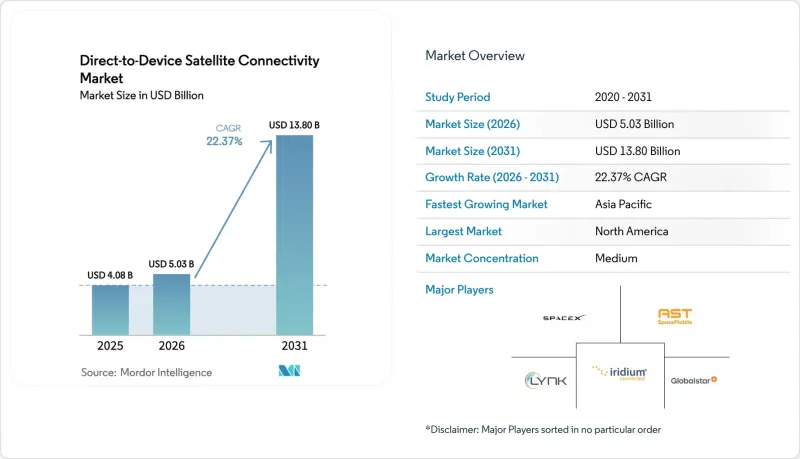
D2D(Direct-to-Device) 위성 연결 시장 규모는 2025년에 40억 8,000만 달러로 평가되었습니다. 2026년 50억 3,000만 달러에서 2031년까지 138억 달러에 이를 것으로 예상되며, 예측 기간(2026-2031년) CAGR은 22.37%를 나타낼 전망입니다.
스마트폰 및 웨어러블 기기 제조업체들이 3GPP를 준수하는 비지상파 네트워크(NTN) 칩셋을 빠르게 채택하고, 소형 위성 발사 비용이 낮아지고, 주요 경제권에서 농촌 지역 통신망 구축이 의무화됨에 따라, 위성 통신은 틈새 시장인 안전 기능에서 소비자 소비자 기기의 주류 통신 계층으로 전환되었습니다. 북미, 아시아태평양 및 유럽의 이동통신사들은 현재 프리미엄 요금제에 위성 문자 및 음성 통신을 번들로 제공하고 있으며, 이는 일반 소비자층에 대한 인지도를 빠르게 높이고 저궤도(LEO) 위성 별자리 투자 회수 기간을 단축시키고 있습니다. 기존 위성전화 요금보다 훨씬 저렴한월15-20달러의 가격대로 소비자는 상시 연결 환경에 대해 기꺼이 지불할 의향이 있습니다. 한편, 기업들은 위성 IoT를 물류의 혼란에 대한 보험으로 인식하고 있습니다. 수직 통합형 LEO 사업자들이 발사 시 규모의 경제를 활용하고, 칩셋 벤더들이 NTN 통합 비용을 다수의 단말기 브랜드에 분산시키는 수평적 제휴를 추구함에 따라 경쟁이 심화되고 있습니다.
세계의 D2D(Direct-to-Device) 위성 연결 시장 동향과 인사이트
NTN 지원 스마트폰의 급속한 확대
2025년에는 Release-17 NTN 무선 기능이 탑재된 단말기가 1억 5,000만 대 이상 출하되었으며, 위성 연결은 플래그십 모델과 상위 미드레인지 모델에서 표준 기능이 되었습니다. Apple, Samsung, Huawei 및 여러 Android OEM 업체들은 자체 지상 인프라를 피하기 위해 수평적 칩셋 플랫폼을 활용했습니다. 한편, 미국 연방통신위원회(FCC)의 '우주로부터의 보완적 커버리지(Supplemental Coverage from Space)' 규정으로 미국 내 규제상의 모호성이 해소되었습니다. 이러한 규모 효과로 인해 통합 비용이 보다 광범위한 기반에 분산되어 소매 가격의 추가 비용이 절감되고, 사용자는 지상 통신 지역을 떠날 때에도 끊김없는 폴백 연결을 기대할 수 있습니다.
공동발사 및 재사용형 로켓으로 발사 비용 절감 가능
스페이스X는 팔콘9의 동승자 미션에서 200kg의 페이로드에 100만 달러 미만의 발사 가격을 정기적으로 제시하고 있으며, 이는 2020년 일반 일회용 로켓에 비해 60% 절감된 가격입니다. 발사 설비 투자를 줄임으로써 Sateliot과 Lynk Global과 같은 신생 사업자들은 소량의 위성을 궤도에 올려놓고 현지에서 테스트한 후 개선하는 방식으로 위성 컨스텔레이션 구축 기간을 단축할 수 있습니다. 2026년 가동될 것으로 예상되는 블루 오리진의 뉴 글렌 로켓은 발사 능력을 확장하고, 배치 가속화 및 추가 용량의 저비용화라는 선순환 구조를 강화할 것입니다.
지상 이동통신사업자(MNO)와의 주파수 대역 공존
이동통신사들은 위성의 다운링크가 국제이동통신(IMT) 대역으로 파급되어 도시 지역의 업링크 품질을 떨어뜨린다고 주장하고 있습니다. 미국 규제에서는 불필요한 방사선을 -20 dBW/MHz로 제한하고 있지만, 유럽에서는 아직 기준치 통일이 이루어지지 않아 국가별 승인이 필요하기 때문에 보급이 늦어지고 있습니다. 고도의 빔포밍 기술을 갖추지 못한 중소 위성 사업자들은 비용이 많이 드는 설계 변경을 해야 하고, 기존 지상 통신 사업자들의 로비 활동으로 인해 더욱 엄격한 제한이 요구되고 있어 단기적인 전개 리스크가 발생하고 있습니다.
부문 분석
L-band는 D2D(Direct-to-Device) 위성 연결 시장에서 2025년 매출의 41.53%를 차지했습니다. 이는 기존 칩셋과 상호 운용이 가능하고, 나무나 경량 구조물을 투과하는 이리듐(Iridium)과 세계스타(Globalstar)의 수십 년간의 자산이 기여하고 있습니다. 이러한 특성은 공공 안전 요구 사항과 기업 원격 근무자를 위한 키트를 지원하며 상당한 규모의 도입 기반을 유지하고 있습니다. 그러나 데이터 소비가 많은 이용 사례로 인해 Ku 대역과 Ka 대역에 대한 관심이 높아지고 있습니다. 이 대역에서는 더 넓은 채널 폭을 통해 모바일 기기에서 화상회의와 클라우드에 접속할 수 있습니다. 3GPP Release-18은 Ka 대역 NTN 시그널링 표준화를 통해 27-40GHz 대역 링크에 최적화된 안테나 통합을 주저했던 규제 장벽을 제거했습니다.
Ka-band 출하량은 CAGR 25.61%를 나타낼 것으로 예상되며, 여러 통신사업자들이 전용 저궤도(LEO) 위성 발사에 앞서 기존 정지궤도 용량을 임대하여 서비스를 개시하고 있습니다. 이 하이브리드 모델은 자본을 보존하면서 시장 출시를 가속화할 수 있습니다. 예측 기간 동안 BlueBird, OneWeb-Eutelsat, Viasat가 개조되지 않은 휴대폰에서 수 Mbps의 통신을 시연함에 따라 D2D(Direct-to-Device) 위성 연결 시장에서 Ka 대역의 점유율은 L 대역과의 격차를 좁혀갈 것으로 예측됩니다. 줄어들 것으로 예측됩니다. 경쟁 우위는 전력 예산을 단말기의 한도 내에 맞추는 첨단 빔포밍 기술과 도시 지역의 간섭을 피하기 위한 조정된 주파수 대역 권리에 달려 있으며, 이러한 요인으로 인해 공급은 기술적으로 진보된 소수의 기업에게 집중될 가능성이 높습니다.
지역별 분석
북미는 2025년 매출의 39.22%를 차지했으며, FCC의 규제 명확화와 서비스 미제공 지역의 위성 서비스를 지원하는 204억 달러 규모의 'Rural Digital Opportunity Fund(농촌 디지털 기회 기금)'에 힘입어 성장세를 이어갈 것으로 보입니다. SpaceX와 T-Mobile은 2026년 초까지 300만 명 이상의 직접 휴대폰 연결 가입자를 확보하여 소비자 수요를 뒷받침하고 단말기 공급업체가 NTN 지원 단말기를 출하하도록 유도하는 네트워크 효과를 창출했습니다. 캐나다는 북극과 대평원 지역 커뮤니티를 위해 Telesat의 Lightspeed LEO 네트워크를 활용하고 있으며, 멕시코는 연방 정부의 연결 프로그램을 위해 Starlink의 백홀을 고려하고 있습니다. 벤처캐피털의 집적도, 재사용 가능한 로켓 분야의 리더십, 그리고 민군겸용에 대한 관심 등의 요인이 결합되어 이 지역의 우위를 유지하고 있습니다.
아시아태평양은 중국이 화웨이와 샤오미 단말기에 BeiDou 통신 기능을 통합한 점, 인도가 OneWeb-Eutelsat 및 Jio-SES에 대한 주파수 할당을 행정적으로 결정하고 경매 마찰을 해소한 점, 그리고 일본의 KDDI-AST SpaceMobile과 Starlink 및 Rakuten-AST SpaceMobile의 제휴에 힘입어 CAGR 26.62%를 나타낼 것으로 예측됩니다. 호주의 '지역 통신 검토(Regional Telecommunications Review)에서는 내륙 지역의 기본 옵션으로 위성 통신을 권장하고 있으며, 텔스트라(Telstra)는 현재 원격지 기지국을 위해 스타링크(Starlink)의 백홀을 번들로 제공합니다. 한국과 같이 인구가 밀집된 도시 시장에서는 위성통신이 주로 해상지역 커버 및 재난 복구에 활용되고 있지만, 자율주행차의 장기적인 수요로 인해 도심 내 실내 이용 사례가 확대될 가능성이 있습니다.
나머지 시장은 유럽, 남미, 중동 및 아프리카가 나눠 가지고 있습니다. 유럽에서의 전개는 CEPT의 조화로운 공존 규칙의 수립을 기다리고 있는 상황이며, Vodafone과 Orange와의 Eutelsat OneWeb 시범사업이 있음에도 불구하고 본격적인 상용 서비스 시작이 늦어지고 있습니다. 브라질의 Anatel은 아마존 분지 커버를 의무화하고 있으며, 학교와 진료소에 위성 통신이 유일하게 확장 가능한 솔루션으로 자리매김하고 있습니다. 중동 및 아프리카에서는 Yahsat과 Thuraya가 정부, 에너지, NGO 사용자에게 서비스를 제공합니다. 성장은 단말기 가격 하락과 현지 구매력에 맞는 선불형 IoT 요금제에 달려있습니다.
기타 혜택 :
- 엑셀 형식 시장 예측(ME) 시트
- 3개월간 애널리스트 지원
자주 묻는 질문
목차
제1장 서론
제2장 조사 방법
제3장 주요 요약
제4장 시장 구도
제5장 시장 규모와 성장 예측
제6장 경쟁 구도
제7장 시장 기회와 향후 전망
KTH 26.05.29The Direct-to-Device Satellite Connectivity Market size was valued at USD 4.08 billion in 2025 and is estimated to grow from USD 5.03 billion in 2026 to reach USD 13.80 billion by 2031, at a CAGR of 22.37% during the forecast period (2026-2031). Rapid adoption of 3GPP-compliant non-terrestrial network (NTN) chipsets by smartphone and wearable makers, falling small-satellite launch costs, and explicit rural-coverage mandates in major economies have moved satellite links from a niche safety feature to a mainstream layer in consumer devices. Mobile network operators in North America, Asia-Pacific, and Europe now bundle satellite text and voice in premium plans, accelerating mass-market awareness and compressing payback periods for low-Earth-orbit (LEO) constellations. Consumer willingness to pay for ubiquitous coverage is helped by monthly price points of USD 15-20, well below legacy satellite-phone tariffs, while enterprises view satellite IoT as an insurance policy against logistics disruptions. Competitive intensity is rising as vertically integrated LEO players leverage launch economies of scale and chipset vendors pursue horizontal partnerships that spread NTN integration costs across many handset brands.
Global Direct-to-Device Satellite Connectivity Market Trends and Insights
Rapid Expansion of NTN-Compatible Smartphones
More than 150 million handsets shipped in 2025 with Release-17 NTN radios, making satellite connectivity a default feature in flagship and upper-midrange tiers. Apple, Samsung, Huawei, and multiple Android OEMs leveraged horizontal chipset platforms to avoid proprietary ground infrastructure, while the Federal Communications Commission's Supplemental Coverage from Space rules removed regulatory ambiguity in the United States. This scale effect spreads integration cost across a broader base, reduces retail price premiums, and primes users to expect seamless fallback when leaving terrestrial coverage.
Falling Launch Costs Due to Rideshare and Reusable Rockets
SpaceX regularly posts launch prices below USD 1 million for 200 kg payloads on Falcon 9 rideshare missions, a 60% reduction compared to typical expendable rockets in 2020. Lower launch capex lets emerging operators such as Sateliot and Lynk Global orbit small batches, test in situ, then iterate, compressing constellation build-out timelines. Blue Origin's New Glenn vehicle, expected to be online in 2026, will expand launch capacity, reinforcing a virtuous cycle of faster deployment and cheaper incremental capacity.
Spectrum Coexistence with Terrestrial MNOs
Mobile operators argue that satellite downlinks spill into International Mobile Telecommunications bands, degrading urban uplinks. While U.S. rules cap unwanted emissions at -20 dBW/MHz, Europe has yet to harmonize thresholds, forcing country-by-country approvals that slow rollouts. Smaller satellite players lacking advanced beam-forming face costly redesigns, and lobbying by terrestrial incumbents seeks even stricter limits, injecting short-term deployment risk.
Other drivers and restraints analyzed in the detailed report include:
- 3GPP Release-17 NTN Standardization Uptake
- National Rural-Coverage Mandates
- Limited Revenue-Generating Use-Cases Beyond SOS/Messaging
For complete list of drivers and restraints, kindly check the Table Of Contents.
Segment Analysis
L-band captured 41.53% of 2025 revenue within the direct-to-device satellite connectivity market, benefiting from decades-old Iridium and Globalstar assets that interoperate with existing chipsets and penetrate foliage and light structures. These characteristics underpin public-safety mandates and enterprise remote-worker kits, sustaining a sizable installed base. However, data-hungry use cases are drawing attention to Ku- and Ka-bands, where wider channels enable video conferencing and cloud access on handheld devices. 3GPP Release-18 standardized Ka-band NTN signaling, clearing a regulatory hurdle that had discouraged handset vendors from integrating antennas optimised for 27-40 GHz links.
Ka-band shipments are forecast to grow at a 25.61% CAGR, and several operators are leasing existing geostationary capacity to seed service before the launch of dedicated LEO craft. This hybrid model accelerates go-to-market while preserving capital. Over the forecast, Ka-band's share of the direct-to-device satellite connectivity market size is projected to close the gap with L-band as BlueBird, OneWeb-Eutelsat, and Viasat demonstrate multi-Mbps links on unmodified phones. Competitive advantage will hinge on beam-forming sophistication that keeps power budgets within handset limits and on coordinated spectrum rights that avoid urban interference, factors likely to consolidate supply around a handful of technically advanced players.
The Direct-To-Device Satellite Connectivity Market Report is Segmented by Frequency Band (L-Band, S-Band, Ku-Band, Ka-Band, More), Device Type (Smartphones, Iot Modules and Sensors, Wearables, Laptops and Tablets, and Connected Vehicles), End-User Industry (Consumer Electronics, Maritime, and More), and Geography. The Market Forecasts are Provided in Terms of Value (USD).
Geography Analysis
North America retained 39.22% of 2025 revenue, anchored by FCC rule clarity and the USD 20.4 billion Rural Digital Opportunity Fund, which subsidizes satellite service in unserved areas. SpaceX and T-Mobile added over 3 million direct-to-cell subscribers by early 2026, validating consumer appetite and creating network effects that encourage handset vendors to ship NTN-ready devices. Canada leverages Telesat's Lightspeed LEO network for Arctic and prairie communities, while Mexico eyes Starlink backhaul for federal connectivity programs. Venture capital density, reusable-rocket leadership, and dual-use military interest collectively sustain the region's lead.
Asia-Pacific is forecast to post a 26.62% CAGR, propelled by China's integration of Beidou messaging in Huawei and Xiaomi handsets, India's administrative spectrum allocation that removes auction friction for OneWeb-Eutelsat and Jio-SES, and Japan's KDDI-Starlink and Rakuten-AST SpaceMobile partnerships. Australia's Regional Telecommunications Review endorsed satellite as the default option for its outback, and Telstra now bundles Starlink backhaul for remote towers. Dense urban markets such as South Korea use satellite mainly for maritime coverage and disaster resilience, but long-term demand from autonomous vehicles could expand indoor urban use cases.
Europe, South America, and Middle East, and Africa split the remainder. European rollouts await harmonized coexistence rules from CEPT, delaying broad commercial service despite Eutelsat OneWeb pilots with Vodafone and Orange. Brazil's Anatel mandates coverage of the Amazon basin, positioning satellite as the only scalable solution for schools and clinics. In the Middle East and Africa, Yahsat and Thuraya serve government, energy, and NGO users; growth hinges on handset price declines and prepaid IoT plans that match local spending power.
List of Companies Covered in this Report:
- Space Exploration Technologies Corp.
- AST SpaceMobile, Inc.
- Lynk Global, Inc.
- Iridium Communications Inc.
- Globalstar, Inc.
- Viasat, Inc.
- Eutelsat S.A.
- Omnispace LLC
- Sateliot, S.L.
- Skylo Technologies, Inc.
- Kepler Communications Inc.
- Al Yah Satellite Communications Company PJSC
- Hiber Global B.V.
- Qualcomm Incorporated
- MediaTek Inc.
- Apple Inc.
- Bullitt Group Ltd.
- Samsung Electronics Co., Ltd.
- Huawei Technologies Co., Ltd.
- T-Mobile US, Inc.
Additional Benefits:
- The market estimate (ME) sheet in Excel format
- 3 months of analyst support
TABLE OF CONTENTS
1 INTRODUCTION
- 1.1 Study Assumptions and Market Definition
- 1.2 Scope of the Study
2 RESEARCH METHODOLOGY
3 EXECUTIVE SUMMARY
4 MARKET LANDSCAPE
- 4.1 Market Overview
- 4.2 Market Drivers
- 4.2.1 Rapid Expansion of NTN-Compatible Smartphones
- 4.2.2 Falling Launch Costs Due to Rideshare and Reusable Rockets
- 4.2.3 3GPP Release-17 NTN Standardization Uptake
- 4.2.4 National Rural-Coverage Mandates (US, India, AU, BR)
- 4.2.5 Demand from Unmanned Systems (UAVs and UGVs)
- 4.2.6 Emerging Pay-As-You-Go IoT Micro-Data Plans
- 4.3 Market Restraints
- 4.3.1 Spectrum Coexistence With Terrestrial MNOs
- 4.3.2 User-Terminal Power-Budget Constraints Inside Handsets
- 4.3.3 Regulatory Uncertainty on Cross-Border Service Rights
- 4.3.4 Limited Revenue-Generating Use-Cases Beyond SOS/ Messaging
- 4.4 Industry Value Chain Analysis
- 4.5 Regulatory Landscape
- 4.6 Technological Outlook
- 4.7 Porter's Five Forces Analysis
- 4.7.1 Bargaining Power of Suppliers
- 4.7.2 Bargaining Power of Buyers
- 4.7.3 Threat of New Entrants
- 4.7.4 Threat of Substitutes
- 4.7.5 Competitive Rivalry
5 MARKET SIZE AND GROWTH FORECASTS (VALUE)
- 5.1 By Frequency Band
- 5.1.1 L-Band
- 5.1.2 S-Band
- 5.1.3 Ku-Band
- 5.1.4 Ka-Band
- 5.1.5 Other Frequency Bands (UHF, X-Band)
- 5.2 By Device Type
- 5.2.1 Smartphones
- 5.2.2 IoT Modules and Sensors
- 5.2.3 Wearables
- 5.2.4 Laptops and Tablets
- 5.2.5 Connected Vehicles
- 5.3 By End-User Industry
- 5.3.1 Consumer Electronics
- 5.3.2 Maritime
- 5.3.3 Aviation
- 5.3.4 Logistics and Transportation
- 5.3.5 Agriculture
- 5.3.6 Energy and Utilities
- 5.3.7 Government and Defense
- 5.3.8 Other End-user Industries
- 5.4 By Geography
- 5.4.1 North America
- 5.4.1.1 United States
- 5.4.1.2 Canada
- 5.4.1.3 Mexico
- 5.4.2 South America
- 5.4.2.1 Brazil
- 5.4.2.2 Argentina
- 5.4.2.3 Rest of South America
- 5.4.3 Europe
- 5.4.3.1 Germany
- 5.4.3.2 United Kingdom
- 5.4.3.3 France
- 5.4.3.4 Russia
- 5.4.3.5 Rest of Europe
- 5.4.4 Asia-Pacific
- 5.4.4.1 China
- 5.4.4.2 Japan
- 5.4.4.3 India
- 5.4.4.4 South Korea
- 5.4.4.5 Rest of Asia-Pacific
- 5.4.5 Middle East and Africa
- 5.4.5.1 Middle East
- 5.4.5.1.1 Saudi Arabia
- 5.4.5.1.2 United Arab Emirates
- 5.4.5.1.3 Rest of the Middle East
- 5.4.5.2 Africa
- 5.4.5.2.1 South Africa
- 5.4.5.2.2 Nigeria
- 5.4.5.2.3 Rest of Africa
- 5.4.5.1 Middle East
- 5.4.1 North America
6 COMPETITIVE LANDSCAPE
- 6.1 Market Concentration
- 6.2 Strategic Moves
- 6.3 Market Share Analysis
- 6.4 Company Profiles (includes Global level Overview, Market level overview, Core Segments, Financials as available, Strategic Information, Market Rank/Share for key companies, Products and Services, and Recent Developments)
- 6.4.1 Space Exploration Technologies Corp.
- 6.4.2 AST SpaceMobile, Inc.
- 6.4.3 Lynk Global, Inc.
- 6.4.4 Iridium Communications Inc.
- 6.4.5 Globalstar, Inc.
- 6.4.6 Viasat, Inc.
- 6.4.7 Eutelsat S.A.
- 6.4.8 Omnispace LLC
- 6.4.9 Sateliot, S.L.
- 6.4.10 Skylo Technologies, Inc.
- 6.4.11 Kepler Communications Inc.
- 6.4.12 Al Yah Satellite Communications Company PJSC
- 6.4.13 Hiber Global B.V.
- 6.4.14 Qualcomm Incorporated
- 6.4.15 MediaTek Inc.
- 6.4.16 Apple Inc.
- 6.4.17 Bullitt Group Ltd.
- 6.4.18 Samsung Electronics Co., Ltd.
- 6.4.19 Huawei Technologies Co., Ltd.
- 6.4.20 T-Mobile US, Inc.
7 MARKET OPPORTUNITIES AND FUTURE OUTLOOK
- 7.1 White-space and Unmet-Need Assessment