|
시장보고서
상품코드
2044062
더트 바이크 : 시장 점유율 분석, 업계 동향 및 통계, 성장 예측(2026-2031년)Dirt Bike - Market Share Analysis, Industry Trends & Statistics, Growth Forecasts (2026 - 2031) |
||||||
 Mordor Intelligence
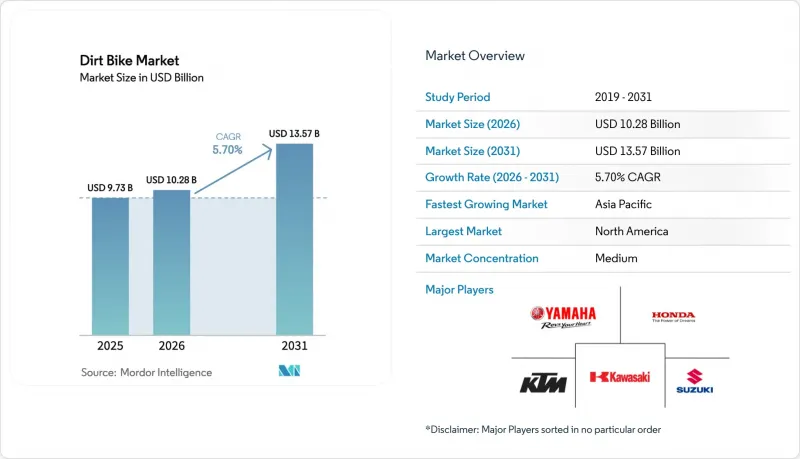
더트 바이크 시장 규모는 2025년에 97억 3,000만 달러로 평가되었습니다. 2026년 102억 8,000만 달러에서 2031년까지 135억 7,000만 달러에 이를 것으로 예측되며, 2026년부터 2031년에 걸쳐 CAGR 5.70%를 나타낼 전망입니다.
수요의 배경에는 전동화에 대한 규제 압력, 신규 아마추어 라이더의 꾸준한 증가, 그리고 오프로드 바이크를 오지의 레크리에이션에 대한 입문 수단으로 오프로드 바이크를 포지셔닝하는 어드벤처 투어리즘의 확대가 있습니다. 모토크로스는 방송 계약과 스트리밍 서비스의 성장을 통해 높은 인지도를 유지하고 있으며, 이는 바이크 판매로 직결되고 있습니다. 한편, 경량 소재의 혁신으로 비 현가 질량이 감소하여 승차감이 향상되었습니다. 이와 함께, 디지털 네이티브 구매층이 투명한 가격 책정과 가정 배송을 요구하면서 온라인 DTC(Direct-to-Consumer) 채널이 성장세를 보이고 있습니다. 한편, 딜러들은 시승, 보상판매의 편의성, 그리고 금융의 침투를 통해 점유율을 지키고 있습니다. 단기적인 역풍으로는 코스 이용을 제한하는 토지 이용 규제, 전기 자전거의 비용 예측을 불투명하게 만드는 리튬 가격 변동, 총 소유 비용을 높이는 타이어의 빠른 마모 등을 들 수 있습니다. 그러나 정책적 인센티브와 배터리 생산 비용의 하락으로 인해 더트 바이크 시장은 단계적인 전기화 추세로 나아가고 있습니다.
세계의 더트 바이크 시장 동향 및 인사이트
모터크로스 및 오프로드 레이스의 인기 상승
2025년 프로 모터크로스 챔피언십은 스트리밍 시청자 수가 크게 증가하여 미국 내 각 라운드마다 많은 관중들이 경기장을 가득 채웠습니다. 이는 모터크로스가 더트 바이크 판매를 견인하는 데 있어 매우 중요한 역할을 하고 있음을 보여줍니다. 호르헤 프라도(Jorge Prado), 안토니오 카일로리(Antonio Cailori)와 같은 유럽의 팩토리 라이더들이 현재 미국 대회에 참가하고 있는 것은 이 스포츠의 세계가 통합되고 브랜드 노출이 확대되고 있다는 것을 보여줍니다. 풀뿌리 프로그램도 이에 호응하고 있습니다. '몬스터 에너지 AMA 아마추어 내셔널 모터크로스 챔피언십'은 '프로스펙트(Prospect)' 앱을 도입해 순위 추적과 동영상 클립 공유를 통해 젊은 층의 참여를 현대적으로 발전시켰습니다. 영국의 오토사이클 유니온은 새로운 여자 청소년 카테고리를 신설하여 참가자의 폭을 넓히고, 가족 단위의 자전거 구매를 장려하고 있습니다. 미디어 업체들이 생중계권이나 디지털 하이라이트의 수익화를 추진하는 가운데, 스폰서들은 상금 총액을 늘리고, 인지도는 참가자를 불러들이고, 참가자들은 장비 구매를 촉진하는 선순환을 더욱 가속화하고 있습니다.
레크리에이션-어드벤처 라이딩과 관광의 성장
미국 내 여러 노선에서 '오지 디스커버리 루트'는 관광 소비를 크게 촉진했습니다. 이는 특히 고급 장비를 선호하는 부유층 라이더들 사이에서 며칠간의 듀얼 스포츠 여행의 매력이 두드러진다는 것을 보여줍니다. 미국 토지관리청(BLM)은 공공 소유지에 대한 레크리에이션 목적의 방문이 크게 증가했으며, 고속도로 외 차량 허가 건수도 눈에 띄게 증가했다고 보고하여 트레일에 대한 견고한 수요를 강조하고 있습니다. 캘리포니아주의 '오프 하이웨이 차량 접근 및 강화 계획'에 따라, 도심으로부터 단거리 지역 내에 새로운 라이딩 구역이 도입되었습니다. 이러한 노력은 더트 바이크와 캠핑, 낚시, 하이킹과 같은 가족 단위의 활동을 매끄럽게 결합하고 있습니다. 이러한 정책적 결정은 오프로드 바이크 시장을 활성화시키고, 오프로드 바이크를 다양한 아웃도어 활동의 입구로 자리매김하고 있습니다. 이에 따라 각 제조업체들은 러기지 랙과 와이드 비율의 변속기를 장착한 경량 듀얼 스포츠 모델을 속속 출시해 트레일에서의 기동성과 뒷길에서의 편안함의 균형을 맞추고 있습니다.
높은 구매 및 유지보수 비용
아르곤 국립연구소의 연구에 따르면, 전기 오토바이(e-bike)는 내연기관(ICE) 장착 모델에 비해 가격 프리미엄이 있는 반면, 유지비 절감의 이점도 누리고 있다고 합니다. 이 가격 프리미엄은 견고한 배터리 하우징과 강화된 프레임과 같은 개선 사항으로 인한 것이며, 이로 인해 대당 가격이 상승하고 있습니다. 한편, ICE 자전거는 비용 상승에 직면해 있습니다. 증발가스 규제와 진단 시스템 의무화가 강화되면서 OEM(Original Equipment Manufacturer)은 더 고가의 연료 시스템을 개선해야 했고, 그 결과 소매가격이 상승하고 있습니다. 또한, 모터크로스 애호가들에게는 상당한 비용 부담이 발생합니다. 마모가 심한 부품과 자주 필요한 피스톤 및 밸브 트레인 교체는 현역 레이서에게 연간 상당한 비용이 소요될 수 있습니다. 미래를 내다보면, 배터리 팩의 비용은 2032년까지 하락할 것으로 예상되지만, 예측할 수 없는 가격 변동 시나리오로 인해 가격 평준화 달성 시기가 더 늦춰질 수 있습니다. 이러한 복잡한 비용 구조로 인해 더트 바이크 시장은 '부유한 애호가'와 '예산 중심의 라이더'라는 두 개의 뚜렷한 부문으로 나뉩니다. 후자는 중고 오토바이와 보다 저렴한 중국산 수입차를 선호하는 경향이 있습니다.
부문 분석
2025년 기준, 모터크로스는 전체 더트 바이크 시장의 33.25%를 차지했으며, 탄탄한 방송 계약, 젊은 층의 육성 시스템, 그리고 장비 교체를 가속화하는 잦은 모델 업그레이드로 인해 CAGR 5.93%를 나타낼 것으로 예측됩니다. 반면, 엔듀로와 트레일 카테고리는 테크니컬한 싱글트랙과 내구성을 선호하는 라이더들이 선호하며, 그 결과 소유 주기가 길어지고 있습니다. 듀얼 스포츠 바이크는 DOT 표준 장비로 온로드와 오프로드를 연결하는 반면, 어드벤처 모델은 며칠간의 여행을 위해 더 큰 엔진과 수하물을 통합하여 더 큰 엔진과 수하물을 통합합니다. 미니와 유스 클래스는 미래의 고객을 육성하고, OEM이 후원하는 금융 및 보상판매 프로그램은 가족 단위의 진입장벽을 낮추고 있습니다. 지속적인 미디어 노출을 통해 모터크로스는 계속해서 동경의 대상이 되고 있으며, 이 경기가 더트 바이크 시장에서 우위를 유지할 수 있도록 보장하고 있습니다.
아마추어 레이서들은 보통 1-2시즌마다 자전거를 교체하며 경쟁을 계속하기 위해 자전거를 구입하고, 공급 파이프라인에 지속적인 수요를 가져옵니다. 프로용 머신에 부착된 스폰서 로고는 액세서리 구매에 영향을 미쳐 애프터마켓의 가치를 더욱 높이고 있습니다. 엔듀로 라이더는 신뢰성을 중시하기 때문에 부품 판매는 견조하지만, 신차 교체 주기는 완만합니다. 듀얼 스포츠 오너들은 배기가스 규제 준수와 오프로드 성능을 저울질하고, 고속도로 주행 적합성을 확보하기 위해 어느 정도 공도 주행에 가까운 사양을 받아들이는 경우가 많습니다. 어드벤처 바이크는 편안함과 적재 능력을 원하는 노년층을 끌어들이지만, 좁은 지형에서의 기술적 성능은 떨어집니다. 청소년용 모델은 가볍고, 자동이며, 가격이 저렴하여 부모들의 구매 결정을 촉진하고 참여자 저변을 넓히고 있습니다. 이를 종합해 볼 때, 모터크로스가 주력 역할을 유지하면서 여러 소비자층에 걸쳐 더트 바이크 시장 규모가 계속 확대될 것이 확실합니다.
2025년 판매량에서 내연기관은 72.16%를 차지했으며, 이는 잘 구축된 딜러 서비스 네트워크, 신속한 급유, 익숙한 성능 범위를 뒷받침합니다. 그럼에도 불구하고 배출가스 규제 강화와 운영 비용 절감에 힘입어 전기 모터사이클은 2031년까지 연평균 복합 성장률(CAGR) 7.12%를 나타낼 것으로 예측됩니다. 캘리포니아주는 2035년까지 전기 오토바이 판매 비율을 50%로 설정하고 있으며, 제조업체들이 SKU의 복잡성을 최소화함에 따라 이 정책은 미국 전역으로 확산되고 있습니다. 인도와 동남아시아에서는 보조금과 배터리 교체 스테이션을 통해 판매량을 견인하고 있으며, 인구가 밀집된 도시 지역에서는 소형 배터리 팩의 설계가 비용 효율적이라는 것이 밝혀졌습니다.
내연기관(ICE) 파워트레인은 항속거리와 급유속도가 중요한 장거리 내구레이스에서 우수하지만, 증발가스 규제와 OBD(차량 진단 시스템) 의무화로 인해 비용 증가에 직면해 있습니다. 반면, 전기 모터사이클은 30-60마일의 항속거리로 충분하고, 소음 규제로 인해 정숙성이 중시되고 회생제동으로 유지보수 비용이 절감되는 공원과 같은 환경에서 그 진가를 발휘합니다. 배터리의 무게는 여전히 장벽이 되고 있지만, 에너지 밀도의 지속적인 향상으로 이 문제는 점차 해소되고 있습니다. 교체 가능한 배터리 팩 시스템은 충전으로 인한 다운 타임 문제를 해결하지만 대규모 표준화가 필요하며 현재 중국 만이이를 제공하는 유일한 국가입니다. 따라서 추진 시스템의 점유율은 이용 사례에 따라 나뉘며, 도시 근교 공원에서는 전동화가 주류를 이루는 반면, 산간 지역이나 경주 형식에서는 내연기관이 계속 주도권을 잡을 것입니다.
지역별 분석
2025년 북미는 전 세계 더트 바이크 시장 매출의 35.12%를 차지했습니다. 이는 성숙한 경주 생태계, 높은 가처분 소득, 그리고 연방 정부가 관리하는 트레일 시스템에 힘입은 것입니다. 캘리포니아주의 단계적 전기화 의무화로 인해 OEM 업체들은 무공해 차량 공급에 박차를 가하고 있으며, 이 지역은 수요의 중심지이자 규제 선구자로서의 역할을 강화하고 있습니다. 교외 지역의 트레일 폐쇄는 지역 성장을 둔화시키고 있지만, 주립 오프 하이웨이 공원의 확장은 접근성 상실을 부분적으로 상쇄하고 있습니다. 캐나다는 주정부의 트레일패스 지원금에 힘입어 미국의 트레일 선호도를 반영하여 봄부터 가을까지 안정적인 매출을 기록했습니다.
아시아태평양은 가장 빠르게 성장하고 있는 지역으로 2031년까지 연평균 복합 성장률(CAGR)이 6.81%를 나타낼 것으로 예측됩니다. 이는 인도와 중국에서 소득 증가와 정책적 보조금이 맞물려 전기 이륜차 보급이 촉진되고 있기 때문입니다. 도시화로 인해 주요 도시에서 2시간 이내의 단거리 레크리에이션 수요가 증가하고 있습니다. 한편, 중국의 배터리 교환 네트워크는 집에서 충전할 필요가 없는 당일 사용을 지원하고 있습니다. 동남아시아는 기반은 작지만 현지 조립에 대한 특혜와 인도네시아와 태국의 관광 지향적 트레일 클러스터에 힘입어 그 뒤를 잇고 있습니다. 일본과 한국은 규모는 작지만 기술력이 높은 시장으로, 고사양의 트레일 바이크와 듀얼 스포츠 바이크가 선호되고 있습니다.
유럽에서는 험준한 알프스 지형과 FIM 공인 레이스 캘린더에 힘입어 엔듀로, 듀얼 스포츠, 어드벤처 클래스에서 균형 잡힌 수요를 볼 수 있습니다. 더 엄격한 유로5 배기가스 규제와 소음 규제로 인해 OEM 업체들은 소배기량화 및 전기 파워트레인으로의 전환을 강요받고 있지만, 국가별 보조금이 제각각이기 때문에 보급률은 지역별로 편차가 있습니다. 남미에서는 가성비를 중시하는 수입차에 의존하고 있으며, 브라질은 이륜차 산업정책에 따라 생산기지로서의 역할을 하고 있습니다. 경기 변동으로 인해 판매량 증가세는 둔화되고 있지만, 열대우림과 안데스 산맥 루트의 매력으로 인해 동경심을 원동력으로 한 구매 수요는 유지되고 있습니다. 중동 및 아프리카의 일부 지역, 걸프 국가와 남아프리카공화국에서는 제한적이지만 활동이 증가하고 있습니다. 그러나 주요 제약 요인은 기후와 트레일 접근성입니다.
기타 혜택 :
- 엑셀 형식 시장 예측(ME) 시트
- 3개월간 애널리스트 지원
자주 묻는 질문
목차
제1장 서론
제2장 조사 방법
제3장 주요 요약
제4장 시장 구도
제5장 시장 규모와 성장 예측(금액(달러) 및 수량(단위))
제6장 경쟁 구도
제7장 시장 기회와 향후 전망
KTH 26.05.29The dirt bike market size is projected to be USD 9.73 billion in 2025, USD 10.28 billion in 2026, and reach USD 13.57 billion by 2031, growing at a CAGR of 5.70% from 2026 to 2031.
Demand is underpinned by regulatory pressure for electrification, a steady influx of new amateur riders, and the expansion of adventure tourism that frames dirt bikes as gateway vehicles for remote recreation. Motocross maintains high visibility through broadcast contracts and streaming growth that translate directly into bike sales, while lightweight material innovations cut unsprung mass and improve ride comfort. In parallel, online direct-to-consumer (DTC) channels gain traction as digitally native buyers seek transparent pricing and doorstep delivery, even as dealerships defend share through test rides, trade-in convenience, and financing penetration. Near-term headwinds include land-use restrictions that limit track availability, lithium price volatility that clouds electric cost projections, and rapid tire wear that elevates total cost of ownership, yet policy incentives and cost declines in battery production continue to steer the dirt bike market toward gradual electrification.
Global Dirt Bike Market Trends and Insights
Rising Popularity of Motocross and Off-Road Racing
In 2025, the Pro Motocross Championship experienced a significant increase in streaming viewership and attracted a large number of live attendees at various United States rounds, underscoring motocross's pivotal role in driving dirt bike sales. European factory riders such as Jorge Prado and Antonio Cairoli now compete in the United States, underscoring the sport's global convergence and escalating brand exposure. Grass-roots programs respond in kind: the Monster Energy AMA Amateur National Motocross Championship integrated the Prospect app to track rankings and share video clips, modernizing youth engagement. The United Kingdom's Auto-Cycle Union created new women's youth categories that widen the participant funnel and stimulate family bike purchases. As media outlets monetize live rights and digital highlights, sponsors increase purse levels, further fueling a cycle in which visibility drives participation, and participation sustains equipment turnover.
Growth in Recreational Adventure Riding and Tourism
Across several United States routes, Backcountry Discovery Routes spurred significant tourism spending. This underscores the allure of multi-day dual-sport trips, particularly among affluent riders keen on premium gear. The Bureau of Land Management reported substantial recreation visits to public lands, with a notable uptick in off-highway vehicle permits, highlighting the robust demand for trails. California's Off-Highway Vehicle Access and Enhancement Plan has introduced new riding areas within a short radius of metro centers. This initiative seamlessly integrates dirt biking with family activities like camping, fishing, and hiking. Such policy decisions bolster the dirt bike market, positioning off-road motorcycles as gateways to diverse outdoor pursuits. In response, manufacturers are rolling out lightweight dual-sport models, equipped with luggage racks and wide-ratio transmissions, striking a balance between trail agility and backroad comfort.
High Purchase and Maintenance Costs
Studies from Argonne reveal that while electric motorcycles (e-motorcycles) enjoy a price premium over internal combustion engine (ICE) counterparts, they also benefit from reduced maintenance costs. This premium largely stems from enhancements like rugged battery housings and reinforced frames, which add high costs per unit. On the flip side, ICE motorcycles grapple with rising costs. Stricter evaporative and diagnostic mandates compel original equipment manufacturers (OEMs) to undertake pricier fuel-system revisions, consequently driving up retail prices. Additionally, motocross enthusiasts face significant expenses: high-wear parts and piston and valve-train refreshes required frequently can result in substantial annual costs for active racers. Looking ahead, while battery pack costs are anticipated to drop by 2032, unpredictable volatility scenarios might push the timeline for achieving price parity further out. This intricate expense landscape carves the dirt bike market into two distinct segments: affluent enthusiasts and budget-conscious riders, the latter often gravitating towards used bikes or more affordable Chinese imports.
Other drivers and restraints analyzed in the detailed report include:
- Regulatory Push Toward Electric Dirt Bikes
- Lightweight Materials and Suspension Innovations
- Track Closures Due to Land-Use and Noise Rules
For complete list of drivers and restraints, kindly check the Table Of Contents.
Segment Analysis
Motocross contributed 33.25% to the dirt bike market in 2025 and is set to grow at 5.93% CAGR through robust broadcast deals, youth feeder systems, and frequent model upgrades that accelerate equipment turnover. In contrast, enduro and trail categories appeal to riders who favor technical single-track and endurance, resulting in longer ownership cycles. Dual-sport bikes bridge on- and off-road with DOT equipment, while adventure models integrate larger engines and luggage for multi-day travel. Mini and youth classes cultivate future customers; OEM-sponsored financing and trade-in programs lower the entry barrier for families. Ongoing media exposure keeps motocross aspirational, ensuring that this discipline retains primacy within the dirt bike market.
Amateur racers typically replace bikes every one to two seasons to remain competitive, injecting continuous demand into the pipeline. Sponsorship logos on professional machines influence accessory purchases, further lifting aftermarket value. Enduro riders focus on reliability, fueling steady parts sales but slower new-unit turnover. Dual-sport owners weigh emissions compliance against off-road capability, often accepting some street bias for freeway legality. Adventure bikes pull older demographics seeking comfort and load capacity, but surrender technical prowess in tight terrain. Youth models are lightweight, automatic, and affordable, supporting parental purchasing decisions and broadening the participant base. Combined, these dynamics ensure that the dirt bike market size continues to expand across multiple consumer cohorts while motocross maintains the flagship role.
Internal combustion engines held 72.16% of 2025 unit sales, underscoring entrenched dealer service networks, fast refueling, and familiar performance envelopes. Even so, electric bikes deliver a 7.12% CAGR to 2031, buoyed by tighter emissions laws and lower running costs. California targets 50% electric motorcycle sales by 2035, a policy that cascades nationwide as manufacturers minimize SKU complexity. India and Southeast Asia drive volume through subsidies and battery-swap stations, revealing the cost-effectiveness of small-pack designs in dense urban corridors.
ICE powertrains excel in remote endurance events where range and refuel speed dominate, but they face rising costs from evaporative and OBD mandates. Electric bikes shine in park environments where a 30-60 mile range suffices, noise caps favor silent operation, and regenerative braking cuts maintenance. Battery weight remains a hurdle, though continuous energy-density gains chip away at this penalty. Swappable pack systems answer charge downtime but require standardization that only China currently offers at scale. Therefore, propulsion share will diverge by use case, with urban-proximate parks tilting electric while back-country and race formats keep ICE in command.
The Dirt Bike Market Report is Segmented by Type (Motocross, Enduro, and More), Propulsion (Internal Combustion Engine (ICE) and Electric), Engine Displacement (<=125 Cc, 126-250 Cc, and More), End-User (Professional, Amateur/Recreational, and More), Price Range (Low-Cost, Mid-Range, and More), Distribution Channel (Dealerships and Showrooms and More), and Geography. Market Forecasts Provided in Value (USD) and Volume (Units).
Geography Analysis
North America generated 35.12% of the global dirt bike market revenue in 2025, driven by mature racing ecosystems, high discretionary income, and federally managed trail systems. California's phased electric mandate compels OEMs to accelerate zero-emission offerings, reinforcing the region's role as both demand center and regulatory bellwether. Track closures in suburban corridors slow local growth, yet expansion of state off-highway parks partially offsets access loss. Canada contributes stable spring-to-fall sales that mirror the United States trail preferences, buoyed by provincial trail-pass funding.
Asia-Pacific is the fastest expanding region, scoring a 6.81% CAGR through 2031 as India and China combine rising incomes with policy subsidies to elevate electric two-wheeler adoption. Urbanization fuels demand for short-haul recreation within two hours of major cities, while battery-swap networks in China support day-trip usage without home charging. Southeast Asia follows, albeit from a small base, helped by local assembly incentives and tourism-oriented trail clusters in Indonesia and Thailand. Japan and South Korea remain modest but technology-rich markets that favor high-spec trail and dual-sport machines.
Europe exhibits balanced demand across enduro, dual-sport, and adventure classes, backed by rugged alpine terrain and FIM-sanctioned race calendars. Stricter Euro 5 tailpipe rules and noise caps push OEMs toward smaller displacement and electric powertrains, although fragmented national subsidies create uneven adoption rates. South America leans on value-oriented imports, with Brazil serving as a production hub under its motorcycle industrial policy. Economic volatility tempers unit growth, yet the allure of rainforest and Andean routes sustains aspirational purchases. Middle East and Africa pockets show limited but rising activity in Gulf states and South Africa, constrained mainly by climate and trail access.
- Honda Motor Co., Ltd.
- KTM AG
- Yamaha Motor Co., Ltd.
- Kawasaki Heavy Industries, Ltd.
- Betamotor S.p.A.
- Suzuki Motor Corporation
- Triumph Motorcycles Ltd.
- Sherco Motorcycles
- TM Racing S.p.A.
- Fantic Motor S.p.A.
- Rieju S.A.
- Segway Powersports
- BMW AG
- Hero MotoCorp Ltd.
- Loncin Motorcycle
- CFMoto
- AJP Moto
Additional Benefits:
- The market estimate (ME) sheet in Excel format
- 3 months of analyst support
TABLE OF CONTENTS
1 Introduction
- 1.1 Study Assumptions and Market Definition
- 1.2 Scope of the Study
2 Research Methodology
3 Executive Summary
4 Market Landscape
- 4.1 Market Overview
- 4.2 Market Drivers
- 4.2.1 Rising Popularity of Motocross and Off-Road Racing
- 4.2.2 Growth in Recreational Adventure Riding and Tourism
- 4.2.3 Regulatory Push Toward Electric Dirt Bikes
- 4.2.4 Lightweight Materials and Suspension Innovations
- 4.2.5 Expansion of Less Than or Equal to 500 cc Entry-Level Models
- 4.2.6 OEM-Run E-Sport/Virtual MX Platforms
- 4.3 Market Restraints
- 4.3.1 High Purchase and Maintenance Costs
- 4.3.2 Track Closures Due to Land-Use and Noise Rules
- 4.3.3 Battery-Grade Lithium Price Volatility
- 4.3.4 Rapid Tire Attrition Elevating TCO
- 4.4 Value / Supply-Chain Analysis
- 4.5 Regulatory Landscape
- 4.6 Technological Outlook
- 4.7 Porter's Five Forces
- 4.7.1 Threat of New Entrants
- 4.7.2 Bargaining Power of Buyers
- 4.7.3 Bargaining Power of Suppliers
- 4.7.4 Threat of Substitutes
- 4.7.5 Intensity of Competitive Rivalry
5 Market Size and Growth Forecasts (Value (USD) and Volume (Units))
- 5.1 By Type
- 5.1.1 Motocross
- 5.1.2 Enduro
- 5.1.3 Trail
- 5.1.4 Dual-Sport
- 5.1.5 Adventure
- 5.1.6 Mini / Youth
- 5.2 By Propulsion
- 5.2.1 Internal Combustion Engine (ICE)
- 5.2.2 Electric
- 5.3 By Engine Displacement
- 5.3.1 Less than and equal to 125 cc
- 5.3.2 126 to 250 cc
- 5.3.3 251 to 500 cc
- 5.3.4 More than 500 cc
- 5.4 By End-User
- 5.4.1 Professional (Race Teams)
- 5.4.2 Amateur / Recreational
- 5.4.3 Commercial (Rental, Industrial, Defense)
- 5.5 By Price Range
- 5.5.1 Low-Cost
- 5.5.2 Mid-Range
- 5.5.3 Premium
- 5.6 By Distribution Channel
- 5.6.1 Dealerships and Showrooms
- 5.6.2 Online Direct-to-Consumer
- 5.6.3 Specialty Motorsport Retailers
- 5.7 By Geography
- 5.7.1 North America
- 5.7.1.1 United States
- 5.7.1.2 Canada
- 5.7.1.3 Rest of North America
- 5.7.2 South America
- 5.7.2.1 Brazil
- 5.7.2.2 Argentina
- 5.7.2.3 Rest of South America
- 5.7.3 Europe
- 5.7.3.1 Germany
- 5.7.3.2 United Kingdom
- 5.7.3.3 France
- 5.7.3.4 Spain
- 5.7.3.5 Russia
- 5.7.3.6 Rest of Europe
- 5.7.4 Asia-Pacific
- 5.7.4.1 China
- 5.7.4.2 India
- 5.7.4.3 Japan
- 5.7.4.4 South Korea
- 5.7.4.5 Australia and New Zealand
- 5.7.4.6 Rest of Asia-Pacific
- 5.7.5 Middle East and Africa
- 5.7.5.1 Egypt
- 5.7.5.2 Turkey
- 5.7.5.3 Saudi Arabia
- 5.7.5.4 United Arab Emirates
- 5.7.5.5 Rest of the Middle East and Africa
- 5.7.1 North America
6 Competitive Landscape
- 6.1 Market Concentration
- 6.2 Strategic Moves
- 6.3 Market Share Analysis
- 6.4 Company Profiles (includes Global Level Overview, Market Level Overview, Core Segments, Financials as Available, Strategic Information, Market Rank/Share for Key Companies, Products and Services, SWOT Analysis, and Recent Developments)
- 6.4.1 Honda Motor Co., Ltd.
- 6.4.2 KTM AG
- 6.4.3 Yamaha Motor Co., Ltd.
- 6.4.4 Kawasaki Heavy Industries, Ltd.
- 6.4.5 Betamotor S.p.A.
- 6.4.6 Suzuki Motor Corporation
- 6.4.7 Triumph Motorcycles Ltd.
- 6.4.8 Sherco Motorcycles
- 6.4.9 TM Racing S.p.A.
- 6.4.10 Fantic Motor S.p.A.
- 6.4.11 Rieju S.A.
- 6.4.12 Segway Powersports
- 6.4.13 BMW AG
- 6.4.14 Hero MotoCorp Ltd.
- 6.4.15 Loncin Motorcycle
- 6.4.16 CFMoto
- 6.4.17 AJP Moto
7 Market Opportunities and Future Outlook
- 7.1 White-Space and Unmet-Need Assessment