

|
시장보고서
상품코드
2044077
디지털 아트 : 시장 점유율 분석, 업계 동향 및 통계, 성장 예측(2026-2031년)Digital Art - Market Share Analysis, Industry Trends & Statistics, Growth Forecasts (2026 - 2031) |
||||||
 Mordor Intelligence
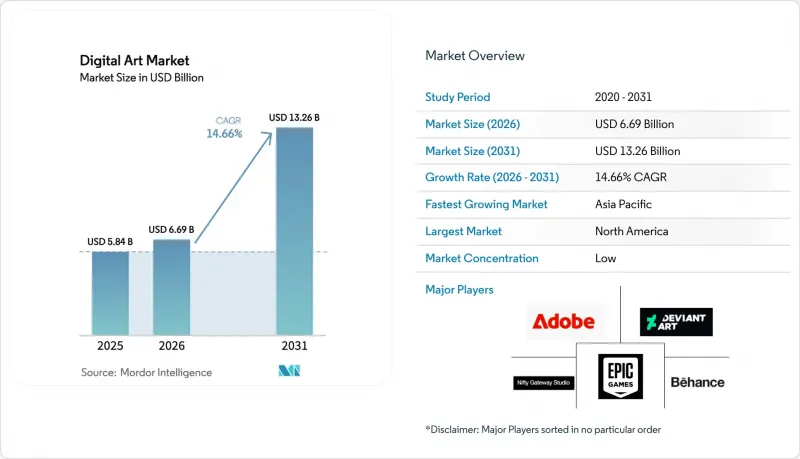
디지털 아트 시장 규모는 2025년에 58억 4,000만 달러로 평가되었습니다. 2026년 66억 9,000만 달러에서 2031년까지 132억 6,000만 달러에 이를 것으로 예측되며, 2026년부터 2031년에 걸쳐 CAGR 14.66%를 나타낼 전망입니다.
이러한 견조한 성장은 기업들이 브랜드 경험 예산을 몰입형 콘텐츠에 재분배하고, 수집가들 사이에서 토큰화된 이력에 대한 수용이 확산되고 있으며, 아티스트의 경제적 참여를 유지하는 블록체인 기반 로열티 수익 흐름이 주류로 자리 잡고 있음을 반영합니다. 생성형 AI는 제작 주기를 몇 주에서 몇 시간으로 단축하고, 에이전시들이 클라이언트와의 미팅 전에 여러 시각적 콘셉트를 테스트할 수 있게 해줍니다. 한편, 공간 컴퓨팅 하드웨어의 발전은 인터랙티브 스토리텔링을 위한 캔버스를 확장하고 있습니다. 온라인 마켓플레이스는 즉각적인 이력 확인과 전 세계 도달 범위를 결합하여 유동성을 더욱 높이고 있으며, 이전에는 갤러리를 직접 방문해야만 얻을 수 있었던 신뢰를 구매자에게 제공합니다.
세계의 디지털 아트 시장 동향 및 인사이트
NFT 기반 수집품의 폭발적인 확산이 디지털 아트 수익화를 주도하고 있습니다.
NFT 컬렉터블은 1차 및 2차 수익을 창작자에게 돌려주는 스마트 컨트랙트를 통합하여 디지털 아트 시장을 혁신적으로 변화시켰습니다. 2025년 하반기, 기관투자자들이 토큰을 투기적 수단이 아닌 주로 이력 확인 수단으로 활용하기 시작하면서 유동성이 급증하고, 수요가 단기적인 가상화폐 가격 변동과 분리되면서 유동성이 급등했습니다. 어도비는 크리에이티브 클라우드의 워크플로우에 암호화된 인증 정보를 직접 통합했습니다. 이를 통해 작가들은 민트 전에 작품의 독창성을 증명할 수 있게 되었고, 갤러리의 도입 장벽을 낮출 수 있게 되었습니다. 그럼에도 불구하고 주요 거래소의 주간 거래량은 이더리움 현물 가격과 연동하여 변동하고 있으며, 이는 투기적 심리가 단기적인 판매에 있어 잠재적인 위험요소로 작용하고 있음을 보여줍니다.
AR/VR 설치를 통한 몰입형 브랜드 스토리텔링에 대한 기업 수요 증가
현재 브랜드들은 체험형 마케팅 예산의 더 많은 부분을 AR 및 VR 활성화에 할당하여 정적인 스토리를 인터랙티브한 공간으로 바꾸고 있습니다. 고급 브랜드들은 2025년까지 헤드마운트 디스플레이와 매장 내 공간 설치를 활용하여 체류시간과 전환율에서 두 자릿수 성장률을 나타냈습니다. 미술관에서는 물리적 전시 교체보다 디지털 업데이트 비용이 저렴하기 때문에 임시 AR 오버레이 라이선싱 도입이 진행되어 관람객 1인당 수익이 확대되고 있습니다. 그러나 높은 하드웨어 비용으로 인해 도입은 플래그십 시설에 집중되어 있으며, 중형 갤러리에서는 고휘도 스크린의 상각에 어려움을 겪고 있습니다. 애플의 Vision Pro 출시로 공간 콘텐츠에 대한 소비자의 인식이 높아졌지만, 동시에 제작 품질에 대한 기대도 높아져 에이전시에게는 실시간 엔진의 숙달이 요구되고 있습니다.
가상화폐 가격 변동이 NFT 거래량을 혼란스럽게 하고 있습니다.
많은 아트 NFT가 이더로 가격이 표시되기 때문에 토큰 가격의 급격한 변동은 구매자의 신뢰를 떨어뜨리고 있습니다. 2024년 초 이더리움이 4,000달러에서 2,400달러로 떨어졌을 때, 오픈씨의 주간 거래량은 60% 급감했습니다. 고액 수집가들은 관망세로 돌아섰고, 플랫폼 측은 최저 입찰가 유지에 어려움을 겪었습니다. 2025년에는 스테이블 코인 기반의 새로운 마켓플레이스가 등장하여 이러한 위험을 어느 정도 완화시켰지만, 기업 구매자 외에는 여전히 보급이 제한적일 것으로 보입니다. 상품 선물과 같은 헤지 수단이 없기 때문에 갤러리는 수익을 안정화할 수 있는 신뢰할 수 있는 구조가 없어 환위험을 스스로 부담하거나 작가에게 전가할 수밖에 없는 상황으로 내몰리고 있습니다.
부문 분석
제너레이티브 아트는 CAGR 15.87%로 성장하고 있으며, 전체 카테고리 중 가장 빠른 성장세를 보이고 있습니다. 한편, 디지털 페인팅은 2025년 디지털 아트 시장 점유율의 39.24%를 차지했습니다. 이 속도는 제품 발표와 공간 인터페이스를 채색하는 알고리즘 생성 비주얼에 대한 기업의 열정을 반영합니다. 기존 회화 커뮤니티는 충성도 높은 컬렉터 층을 유지하고 있지만, 빠른 반복 제작에 집중하는 에이전시는 현재 제너레이티브 아트의 결과물을 기본 출발점으로 삼고 있습니다. 디지털 콜라주는 편집 스토리텔링 분야에서 계속 호황을 누리고 있으며, 3D 조각은 입체적인 깊이가 몰입도를 높여주는 메타버스 쇼룸에서 인기를 끌고 있습니다.
제너레이티브 워크플로는 아티스트의 경력 경로를 수작업 제작에서 프롬프트 디자인 및 모델 미세 조정으로 전환하고 있습니다. 이러한 변화에 적응한 아티스트는 높은 프로젝트 디렉터 보수를 받을 수 있는 반면, 변화에 뒤처진 아티스트는 클라이언트가 AI를 활용한 대안과 요금을 비교 검토하는 과정에서 수익률 하락의 위험에 직면하고 있습니다. 바이오 아트나 데이터 시각화와 같은 실험적인 틈새 분야는 아직 전체 디지털 아트 시장 규모에 영향을 미치기에는 규모가 너무 작지만, 센서 입력과 라이브 데이터 피드에 대한 혁신을 일으키고 있으며, 향후 주류 채널로 전환될 수 있습니다. 가능성이 있습니다.
AR/VR 인터랙티브 작품은 CAGR 15.61%로 증가하여 기존 포맷을 능가할 것으로 예상되지만, 2025년 디지털 아트 시장 규모의 47.39%는 2D 일러스트레이션이 차지했습니다. 몰입형 스토리텔링에 대한 수요는 체험을 통한 차별화로 고가의 입장료를 정당화하는 고급 소매점이나 박물관들 사이에서 가장 많이 증가하고 있습니다. 애니메이션은 동적 광고 프레임을 통해 수익을 창출하는 동영상 플랫폼에서 여전히 필수적이며, 3D 일러스트레이션은 공간적 정확성이 소비자의 의사결정에 도움을 주기 때문에 제품 시각화에서 선호되고 있습니다.
하드웨어의 가용성과 제작자의 기술이 궁극적으로 미디어의 선택에 영향을 미칩니다. 애플과 메타의 프리미엄 헤드셋은 소비자의 관심을 높이고 있지만, 실시간 제작 인력 공급 부족으로 콘텐츠 개발이 늦어지고 있습니다. 2D 레이어를 AR 지원 에셋으로 자동 변환하는 미들웨어 플러그인은 이러한 장벽을 낮춰 향후 3년간 크리에이터 층의 확장을 기대할 수 있습니다. 그때까지 수익의 대부분은 여전히 플래그십 장비의 기술 사양을 충족시킬 수 있는 스튜디오에 집중될 것입니다.
지역별 분석
북미는 2025년 시장 규모의 36.73%를 차지했으며, 미국의 소매업체, 박물관, 기업 캠퍼스에는 방문객의 경험을 차별화할 수 있는 플래그십 AR 설치물이 전시되어 있습니다. NFT 거래소와 크리에이티브 테크 스타트업에 대한 벤처 자금은 28억 달러에 달하며, 긴밀한 혁신의 순환을 유지하고 있습니다. 2024년 SEC(미국 증권거래위원회)의 지침에 따라 수집용 NFT와 유가증권을 명확히 구분하여 시장에서의 규정 준수에 대한 회색지대가 축소되었습니다. 캐나다와 멕시코는 시장 점유율은 작지만, 몬트리올의 애니메이션 산업 클러스터와 멕시코시티의 디지털 아트 페스티벌을 중심으로 빠른 성장세를 보이고 있습니다.
아시아태평양은 2031년까지 연평균 복합 성장률(CAGR) 15.67%를 나타낼 것으로 예측되며, 디지털 아트 시장에서 지역별로 가장 빠른 속도로 성장할 것으로 예측됩니다. 중국에서는 콘텐츠에 대한 규제가 여전히 엄격하지만, 국가가 관리하는 디지털 수집품 플랫폼의 사용자 수는 수억 명에 달할 전망입니다. 인도의 크리에이터 경제는 낮은 제작 비용과 높은 스마트폰 보급률을 바탕으로 전 세계 시청자를 확보하고 있습니다. 한편, 일본에서는 상징적인 만화 IP를 토큰화된 버전으로 전환하여 팬층으로부터 수익을 창출하고 있습니다. 싱가포르는 명확한 세제로 운영 거점으로서의 입지를 다지고 있으며, 한국에서는 K-POP 굿즈 판매에 NFT를 접목하는 등 엔터테인먼트 주도의 도입이 진행되고 있습니다.
유럽, 중동 및 아프리카에서는 지역별로 다른 기세를 보이고 있습니다. MiCA(디지털 자산 규제법)는 NFT 플랫폼의 운영 비용을 높이는 한편, 규칙을 명확히 함으로써 기관투자자의 자본을 끌어들이고 있습니다. 아랍에미리트와 사우디아라비아는 관광 수입을 다각화하기 위해 거대한 몰입형 설치물 제작을 의뢰하고 있으며, 이는 하드웨어와 콘텐츠에 대한 수요를 촉진하고 있습니다. 사하라 이남 아프리카의 성장은 모바일 퍼스트의 크리에이터들을 중심으로 이루어지고 있지만, 갤러리 인프라가 제한적이기 때문에 프리미엄 가격의 정착에 어려움이 있습니다. 브라질과 아르헨티나를 필두로 한 라틴아메리카는 세계 포털 사이트 거래에 적극적으로 참여하고 있지만, 국내 판매는 환율 변동에 영향을 받기 쉬운 상황이 지속되고 있습니다.
기타 혜택 :
- 엑셀 형식 시장 예측(ME) 시트
- 3개월간 애널리스트 지원
자주 묻는 질문
목차
제1장 서론
제2장 조사 방법
제3장 주요 요약
제4장 시장 구도
제5장 시장 규모와 성장 예측
제6장 경쟁 구도
제7장 시장 기회와 향후 전망
KTH 26.05.29The digital art market size is projected to be USD 5.84 billion in 2025, USD 6.69 billion in 2026, and reach USD 13.26 billion by 2031, growing at a CAGR of 14.66% from 2026 to 2031.
Robust growth reflects corporate reallocation of brand-experience budgets toward immersive content, wider collector acceptance of tokenized provenance, and the mainstreaming of blockchain-based royalty flows that keep artists financially engaged. Generative artificial intelligence cuts production cycles from weeks to hours, letting agencies test multiple visual concepts before any client meeting, while advances in spatial computing hardware enlarge the canvas for interactive storytelling. Online marketplaces continue to deepen liquidity because they pair instant provenance verification with global reach, giving buyers confidence that previously came only from in-person gallery visits.
Global Digital Art Market Trends and Insights
Explosion of NFT-Based Collectibles Driving Digital Art Monetization
NFT collectibles reshaped the digital art market by embedding smart contracts that return primary and secondary proceeds to creators. Liquidity rose sharply in late 2025 when institutional buyers started using tokens chiefly as provenance tools rather than speculative chips, decoupling demand from short-term cryptocurrency swings. Adobe embedded cryptographic credentials directly into Creative Cloud workflows, allowing artists to prove originality before minting, which reduced onboarding friction for galleries. Even so, weekly trading volumes on leading exchanges still fluctuate in tandem with Ether's spot price, illustrating that speculative sentiment remains a latent risk for near-term sales.
Corporate Demand for Immersive Brand Storytelling via AR/VR Installations
Brands now allocate larger shares of experiential budgets to AR and VR activations that turn static narratives into interactive venues. Luxury houses used head-mounted displays and in-store spatial installations throughout 2025, reporting double-digit gains in dwell time and conversion. Museums license temporary AR overlays because digital refreshes cost less than physical re-hangs, expanding revenue per visitor. Hardware costs, however, keep adoption clustered in flagship sites as mid-tier galleries struggle to amortize high-brightness screens. Apple's Vision Pro rollout widened consumer awareness of spatial content but also raised expectations for production quality, pressuring agencies to master real-time engines.
Volatility in Cryptocurrency Prices Disrupting NFT Transaction Volumes
Sharp token price swings undermine buyer confidence because many art NFTs are denominated in Ether. When Ethereum fell from USD 4,000 to USD 2,400 in early 2024, weekly volumes on OpenSea collapsed by 60%. High-value collectors waited on the sidelines, while platforms struggled to maintain minimum bid thresholds. Emerging stablecoin-denominated marketplaces partially eased this risk during 2025, yet adoption remains thin outside corporate buyer circles. Lack of hedging tools comparable to commodities futures leaves galleries without a reliable mechanism to smooth revenue, forcing them to swallow currency risk or pass it to artists.
Other drivers and restraints analyzed in the detailed report include:
- Adoption of Generative AI Tools Boosting Content Velocity for Agencies
- Blockchain-Enabled Royalty Smart Contracts Attracting Emerging Artists
- Copyright Ambiguity for AI-Generated Works Limiting Commercial Use
For complete list of drivers and restraints, kindly check the Table Of Contents.
Segment Analysis
Generative art is expanding at a 15.87% CAGR, the fastest tempo among all categories, while digital painting secured a 39.24% digital art market share in 2025. The pace reflects corporate enthusiasm for algorithmically generated visuals that populate product launches and spatial interfaces. Established painting communities retain a loyal collector base, but agencies focused on rapid iteration now view generative outputs as default starting points. Digital collage continues to thrive in editorial storytelling, whereas 3D sculptures gain traction in metaverse showrooms where volumetric depth drives engagement.
Generative workflows reorient artist career paths from manual production to prompt design and model fine-tuning. Those who adapt command premium project-director fees, while holdouts risk margin erosion as clients benchmark their rates against AI-enabled alternatives. Experimental niches such as bio-art and data visualizations remain too small to influence overall digital art market size, yet they foster innovation around sensor inputs and live data feeds that could migrate into mainstream channels.
AR/VR interactive works are set to rise at 15.61% CAGR, outpacing legacy formats, whereas 2D illustration accounted for 47.39% of the 2025 digital art market size. Demand for immersive storytelling is strongest among luxury retailers and museums that rely on experiential differentiation to justify higher ticket prices. Animation remains vital for video platforms that monetize through dynamic advertising slots, and 3D illustration gains favor in product visualization because spatial accuracy aids consumer decision-making.
Hardware availability and creator skills ultimately govern medium choice. Premium headsets from Apple and Meta increase consumer appetite, but supply bottlenecks in real-time talent slow content rollout. Middleware plugins that auto-convert 2D layers into AR-ready assets lower these barriers, promising to broaden contributor pools over the next three years. Until then, the bulk of revenue will still accrue to studios able to meet technical specifications for flagship installations.
The Digital Art Market Report is Segmented by Type (Digital Collage, Digital Painting, Generative Art, 3D Modeling and Sculptures, AR/VR Immersive Works, and More), Medium (2D Illustration, 3D Illustration, and More), Technology (Traditional Digital Tooling, and More), Sales Channel (Online Marketplaces, and More), and Geography. The Market Forecasts are Provided in Terms of Value (USD).
Geography Analysis
North America held 36.73% of 2025 value, with United States retailers, museums, and corporate campuses showcasing flagship AR installations that differentiate visitor experiences. Venture funding reached USD 2.8 billion across NFT exchanges and creative-tech startups, sustaining a tight innovation loop. SEC guidance in 2024 clearly separated collectible NFTs from securities, reducing compliance gray areas for marketplaces. Canada and Mexico contribute smaller slices but show rapid growth around Montreal's animation cluster and Mexico City's digital art festivals.
Asia-Pacific is projected to compound at 15.67% CAGR through 2031, the fastest regional pace in the digital art market. China's state-curated digital-collectible platforms reach hundreds of millions of users, even though content remains tightly regulated. India's creator economy leverages lower production costs and robust smartphone adoption to tap global audiences, while Japan transitions iconic manga IP to tokenized editions that monetize fandom. Singapore's tax clarity positions it as an operational hub, whereas South Korea's integration of NFTs into K-pop merchandising exemplifies entertainment-driven adoption.
Europe, the Middle East, and Africa display heterogeneous momentum. MiCA raises operating costs for NFT venues yet attracts institutional capital by clarifying rules. The United Arab Emirates and Saudi Arabia commission monumental immersive installations to diversify tourism revenue, fueling hardware and content demand. Sub-Saharan Africa's growth centers on mobile-first creators, though limited gallery infrastructure slows premium pricing. Latin America, led by Brazil and Argentina, participates heavily on global portals but domestic sales remain sensitive to currency swings.
- Adobe Inc.
- Epic Games Inc.
- Savage Interactive Pty Ltd
- Behance LLC
- DeviantArt Inc.
- Ozone Networks, Inc.
- Nifty Gateway LLC
- SuperRare Labs Inc.
- Rarible Inc.
- Foundation Labs Inc.
- Midjourney Inc.
- Celsys Inc.
- Corel Corporation
- Canva Pty Ltd
- Autodesk Inc.
- Wacom Co. Ltd.
- Daz 3D Inc.
- Meow Wolf Inc.
- Verisart Inc.
- ArtBlocks Inc.
- MakersPlace Inc.
- KnownOrigin Limited
Additional Benefits:
- The market estimate (ME) sheet in Excel format
- 3 months of analyst support
TABLE OF CONTENTS
1 INTRODUCTION
- 1.1 Study Assumptions and Market Definition
- 1.2 Scope of the Study
2 RESEARCH METHODOLOGY
3 EXECUTIVE SUMMARY
4 MARKET LANDSCAPE
- 4.1 Market Overview
- 4.2 Market Drivers
- 4.2.1 Explosion of NFT-Based Collectibles Driving Digital Art Monetization
- 4.2.2 Corporate Demand for Immersive Brand Storytelling via AR/VR Installations
- 4.2.3 Adoption of Generative AI Tools Boosting Content Velocity for Agencies
- 4.2.4 Blockchain-Enabled Royalty Smart Contracts Attracting Emerging Artists
- 4.2.5 Rising Digital-Native Buyer Base
- 4.2.6 Growth of Immersive Art Venues
- 4.3 Market Restraints
- 4.3.1 Volatility in Cryptocurrency Prices Disrupting NFT Transaction Volumes
- 4.3.2 Copyright Ambiguity for AI-Generated Works Limiting Commercial Use
- 4.3.3 Limited High-Resolution Display Infrastructure in Traditional Galleries
- 4.3.4 Regulatory Uncertainty Around Digital-Asset Classes
- 4.4 Industry Value Chain Analysis
- 4.5 Regulatory Landscape
- 4.6 Technological Outlook
- 4.7 Porter's Five Forces Analysis
- 4.7.1 Bargaining Power of Suppliers
- 4.7.2 Bargaining Power of Consumers
- 4.7.3 Threat of New Entrants
- 4.7.4 Threat of Substitutes
- 4.7.5 Intensity of Competitive Rivalry
- 4.8 Impact of Macroeconomic Factors on the Market
5 MARKET SIZE AND GROWTH FORECASTS (VALUE)
- 5.1 By Type
- 5.1.1 Digital Collage
- 5.1.2 Digital Painting
- 5.1.3 Generative Art
- 5.1.4 3D Modeling and Sculptures
- 5.1.5 AR/VR Immersive Works
- 5.1.6 Other Types
- 5.2 By Medium
- 5.2.1 2D Illustration
- 5.2.2 3D Illustration
- 5.2.3 Animation and Motion Graphics
- 5.2.4 AR/VR Interactive
- 5.2.5 Other Mediums
- 5.3 By Technology
- 5.3.1 Traditional Digital Tooling
- 5.3.2 Blockchain / NFT-Enabled
- 5.3.3 Generative AI Engines
- 5.3.4 Other Technologies
- 5.4 By Sales Channel
- 5.4.1 Online Marketplaces
- 5.4.2 Offline Galleries and Pop-Ups
- 5.5 By Geography
- 5.5.1 North America
- 5.5.1.1 United States
- 5.5.1.2 Canada
- 5.5.1.3 Mexico
- 5.5.2 South America
- 5.5.2.1 Brazil
- 5.5.2.2 Argentina
- 5.5.2.3 Rest of South America
- 5.5.3 Europe
- 5.5.3.1 United Kingdom
- 5.5.3.2 Germany
- 5.5.3.3 France
- 5.5.3.4 Italy
- 5.5.3.5 Rest of Europe
- 5.5.4 Asia-Pacific
- 5.5.4.1 China
- 5.5.4.2 Japan
- 5.5.4.3 India
- 5.5.4.4 South Korea
- 5.5.4.5 Rest of Asia-Pacific
- 5.5.5 Middle East and Africa
- 5.5.5.1 Middle East
- 5.5.5.1.1 United Arab Emirates
- 5.5.5.1.2 Saudi Arabia
- 5.5.5.1.3 Rest of Middle East
- 5.5.5.2 Africa
- 5.5.5.2.1 South Africa
- 5.5.5.2.2 Egypt
- 5.5.5.2.3 Rest of Africa
- 5.5.5.1 Middle East
- 5.5.1 North America
6 COMPETITIVE LANDSCAPE
- 6.1 Market Concentration
- 6.2 Strategic Moves
- 6.3 Market Share Analysis
- 6.4 Company Profiles (includes Global Level Overview, Market Level Overview, Core Segments, Financials as available, Strategic Information, Market Rank/Share, Products and Services, Recent Developments)
- 6.4.1 Adobe Inc.
- 6.4.2 Epic Games Inc.
- 6.4.3 Savage Interactive Pty Ltd
- 6.4.4 Behance LLC
- 6.4.5 DeviantArt Inc.
- 6.4.6 Ozone Networks, Inc.
- 6.4.7 Nifty Gateway LLC
- 6.4.8 SuperRare Labs Inc.
- 6.4.9 Rarible Inc.
- 6.4.10 Foundation Labs Inc.
- 6.4.11 Midjourney Inc.
- 6.4.12 Celsys Inc.
- 6.4.13 Corel Corporation
- 6.4.14 Canva Pty Ltd
- 6.4.15 Autodesk Inc.
- 6.4.16 Wacom Co. Ltd.
- 6.4.17 Daz 3D Inc.
- 6.4.18 Meow Wolf Inc.
- 6.4.19 Verisart Inc.
- 6.4.20 ArtBlocks Inc.
- 6.4.21 MakersPlace Inc.
- 6.4.22 KnownOrigin Limited
7 MARKET OPPORTUNITIES AND FUTURE OUTLOOK
- 7.1 White-Space and Unmet-Need Assessment


