|
시장보고서
상품코드
2044078
이메일 마케팅 : 시장 점유율 분석, 업계 동향 및 통계, 성장 예측(2026-2031년)Email Marketing Market - Market Share Analysis, Industry Trends & Statistics, Growth Forecasts (2026 - 2031) |
||||||
 Mordor Intelligence
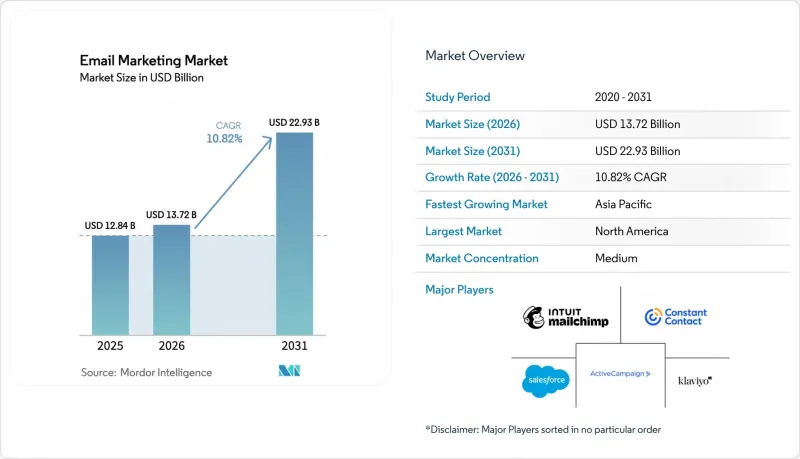
이메일 마케팅 시장 규모는 2025년에 128억 4,000만 달러로 평가되었습니다. 2026년 137억 2,000만 달러에서 2031년까지 229억 3,000만 달러에 이를 것으로 예측되며, 2026년부터 2031년에 걸쳐 CAGR 10.82%를 나타낼 전망입니다.
투자금 1달러당 평균 36달러의 안정적인 수익을 얻을 수 있기 때문에 프라이버시 규제 강화, 수신함 알고리즘 강화, 사용자들의 소셜 채팅 앱 사용 시간 증가 등의 상황에서도 브랜드는 계속 투자하고 있습니다. 벤더들은 자동화 및 생성형 AI를 도입하여 전달률을 유지하고 참여를 높이기 위해 노력하고 있으며, 중소기업(SME)은 On-Premise 소프트웨어의 비용과 유지보수 부담을 덜어주는 풍부한 기능의 클라우드 네이티브 제품군을 활용하고 있습니다. 북미의 DMARC 및 BIMI 인증으로의 빠른 전환, 아시아태평양의 급속한 전자상거래 기반 확대, 의료 분야에서 HIPAA를 준수하는 환자 경험에 대한 요구가 결합되어 향후 몇 년간 이메일 마케팅 시장의 성장세를 견인할 것으로 예측됩니다. 주요 5개 업체가 점유율을 지키기 위해 제로파티 데이터 수집, 크로스채널 연계, 다국어 분석에 투자하고 있어 경쟁은 여전히 치열합니다.
세계의 이메일 마케팅 시장 동향 및 인사이트
캠페인 자동화 및 오디언스 세분화
실시간 의사결정 엔진은 열람 이력, 예측 이탈 점수, LTV(Lifetime Value) 모델을 기반으로 메시지를 발송하게 되며, Klaviyo의 자동화 플로우를 도입한 사업자의 경우 단발성 발송에 비해 수신자 1인당 수익이 18배 증가했습니다. HubSpot의 Breeze AI는 목록 작성 시간을 40% 단축하고, Salesforce Einstein은 수동으로 목록을 작성하지 않고도 마이크로 부문을 클러스터링하여 브랜드가 대규모 개인화를 실현할 수 있도록 돕습니다. 노코드 자동화의 보급으로 데이터 사이언스 팀이 없는 중소기업도 활용할 수 있게 되어 이메일 마케팅 시장의 성장을 견인하고 있습니다. 원클릭 옵트아웃과 같은 컴플라이언스 요구사항이 표준 기능으로 내장되어 있어 사용자 경험을 유지하면서 규제 마찰을 줄일 수 있습니다.
참여도를 높이는 개인화 기능
역동적인 상품 블록과 카운트다운 타이머는 퀴즈와 선호도 센터의 제로 파티 데이터를 활용하는 예측형 경험으로 진화했습니다. Klaviyo 사용자에 따르면, 추천 엔진이 사용자의 검색 패턴에 맞는 상품을 제시함으로써 전환율이 15-25% 향상되었다고 합니다. Adobe Marketo Engage의 AI는 수신자별로 최적의 제목, 이미지, 전송 시간을 선택합니다. 한편, 메리어트 인터내셔널은 지역 타겟팅 오퍼를 통해 직접 예약이 12% 증가했다고 보고했습니다. 타사 쿠키와 모바일 식별자가 사라지면서 퍼스트 파티 전략의 중요성이 높아지는 가운데, 이메일 마케팅 시장에서의 인게이지먼트를 유지하기 위해 퍼스트 파티 전략의 중요성이 커지고 있습니다. 규제 산업에서는 HIPAA 및 PCI DSS의 요구 사항을 준수하고 명시적인 동의가 없는 한 엔진이 기밀 속성을 제외하도록 보장합니다.
배송률 문제 및 낮은 개봉률
수신함의 알고리즘은 참여도를 평가하고 스팸 신고를 억제하기 때문에 2025년에는 업계 평균 오픈율이 18%까지 하락하고 스팸 폴더로 분류되는 비율이 9% 증가했습니다. Apple Mail의 프라이버시 보호 기능으로 인해 전 세계 메시지의 절반 이상에서 픽셀 개봉이 숨겨져 있기 때문에 마케터들은 성공 지표를 클릭 수와 전환으로 전환할 수밖에 없습니다. Gmail과 Yahoo의 대량 발신자에 대한 요구 사항으로 인해 DMARC 준수가 의무화되어 목록 위생 관리, 이중 옵트인 및 BIMI 로고에 대한 투자가 촉진되고 있습니다. 이는 브랜드 아이덴티티를 보호하는 동시에 온보딩의 장벽이 되는 요소이기도 합니다.
부문 분석
2025년 솔루션은 이메일 마케팅 시장 점유율의 67.81%를 차지했으며, 이는 클라우드 제품군 및 On-Premise 툴킷에 대한 확고한 지출을 반영합니다. 그러나 기업의 합병과 컴플라이언스의 복잡성 증가에 따른 전환 지원 수요가 증가함에 따라 전문 서비스 및 관리 서비스는 CAGR 10.93%로 성장하여 전체 이메일 마케팅 시장의 성장세를 상회할 것으로 예측됩니다.
Intuit 산하의 Mailchimp와 같은 벤더들은 프리미엄 마이그레이션 서비스를 번들로 제공하여 업셀링을 촉진하고 있으며, 컨설팅 업체들은 제로파티 데이터 전략 워크숍을 활용하여 매출을 유지하고 있습니다. 새로운 프라이버시 및 인증 요구사항 증가로 인해 컴플라이언스 컨설팅 및 제공 가능성 감사에 대한 수요도 증가하고 있습니다. 의료 및 BFSI(은행, 금융, 보험) 등의 업계에서는 전문 서비스 제공업체가 HIPAA 및 PCI DSS를 준수하는 캠페인 설계를 제공하여 기밀성이 높은 통신이 규제 및 브랜드 가이드라인을 모두 준수하도록 보장합니다.
클라우드 솔루션은 2025년 이메일 마케팅 시장 규모의 88.62%를 차지했으며, 브랜드가 구독형 요금제, 탄력적인 용량, 지속적인 기능 출시에 중점을 두면서 CAGR 11.08%로 확대될 것으로 보입니다. 세일즈포스 마케팅 클라우드, 허브스팟, 클라비요는 커머스, 데이터웨어하우스, 광고 플랫폼 파트너에게 강력한 API를 제공함으로써 이러한 도입을 주도하고 있습니다.
그러나 On-Premise 구축은 여전히 중요성이 유지되고 있습니다. 특히 금융 서비스, 정부 기관, 국방 분야는 데이터 거주지 요건, 보안 및 규제 요건으로 인해 멀티테넌트 클라우드 인프라의 활용이 제한되기 때문입니다. Oracle 엘로콰(Oracle Eloqua)와 어도비 마케토(Adobe Marketo)는 엄격한 컴플라이언스 요건을 가진 조직에 On-Premise 또는 프라이빗 클라우드 옵션을 제공함으로써 이 틈새 시장을 계속 공략하고 있습니다. 두 가지 도입 모델이 공존하는 것은 업종과 지역을 불문하고 위험 허용 수준과 규제적 의무가 다양하다는 것을 반영합니다.
지역별 분석
2025년 북미는 전 세계 매출의 40.93%라는 압도적인 점유율을 차지했습니다. 미국에서는 DMARC 도입, 전송 시간 예측 엔진, 동의 관리 자동화를 우선순위로 두고 있습니다. 캐나다와 멕시코에서는 중소기업들이 합리적인 가격의 클라우드 퍼스트 제품군을 채택함에 따라 지역적 수요가 증가하고 있습니다.
유럽은 여전히 큰 시장 규모를 유지하고 있지만, 컴플라이언스 대응이 강조되고 있습니다. GDPR(EU 개인정보보호규정)은 특히 영국, 독일, 북유럽 국가들을 중심으로 개인정보 보호센터와 데이터 주체 접근 도구에 대한 투자를 촉진하고 있습니다. 남유럽의 신흥 D2C(Direct-to-Consumer) 브랜드는 다국어 템플릿과 현지화된 결제 연동을 활용하여 이메일 마케팅 시장에서 꾸준한 성장세를 유지하고 있습니다.
아시아태평양은 인도와 중국의 확장하는 전자상거래 생태계, 동남아시아의 핀테크 붐, 일본의 AI 기반 테스트 전환에 힘입어 CAGR 11.18%의 성장을 견인할 것으로 예측됩니다. 호주와 싱가포르는 지역적 마케팅 기술(MarTech)의 거점이 되고 있으며, 인도네시아와 베트남은 기존 시스템을 뛰어넘어 API 퍼스트 플랫폼으로 전환하고 있습니다. 중동 및 아프리카 및 라틴아메리카는 절대적인 규모에서는 뒤쳐져 있지만, 데이터 보호 규제 정비와 클라우드 인프라 보급에 따라 견조한 한 자릿수 중반의 성장률을 기록하고 있습니다.
기타 혜택 :
- 엑셀 형식 시장 예측(ME) 시트
- 3개월간 애널리스트 지원
자주 묻는 질문
목차
제1장 서론
제2장 조사 방법
제3장 주요 요약
제4장 시장 구도
제5장 시장 규모와 성장 예측
제6장 경쟁 구도
제7장 시장 기회와 향후 전망
KTH 26.05.29The Email marketing market size is projected to be USD 12.84 billion in 2025, USD 13.72 billion in 2026, and reach USD 22.93 billion by 2031, growing at a CAGR of 10.82% from 2026 to 203.
Consistent returns- averaging USD 36 for every dollar invested- keep brands invested even as privacy rules tighten, inbox algorithms grow stricter, and users spend more time on social chat apps. Vendors are embedding automation and generative artificial intelligence to preserve deliverability and raise engagement, while small and medium-sized enterprises (SMEs) enjoy feature-rich, cloud-native suites that remove the cost and maintenance burden of on-premise software. North America's early move to DMARC and BIMI authentication, Asia-Pacific's rapidly scaling e-commerce base, and healthcare's appetite for HIPAA-compliant patient journeys collectively reinforce a multiyear expansion path for the Email marketing market. Competitive intensity remains high as the leading five players invest in zero-party data capture, cross-channel orchestration, and multilingual analytics to defend share.
Global Email Marketing Market Trends and Insights
Automation of Campaigns And Audience Segmentation
Real-time decision engines now trigger messages off browsing histories, predictive churn scores, and lifetime-value models, driving 18-fold more revenue per recipient than one-time sends for merchants deploying Klaviyo's automated flows. HubSpot's Breeze AI trims creation time by 40%, and Salesforce Einstein clusters micro-segments without manual lists, letting brands personalize at scale. The democratization of no-code automation empowers SMEs that lack data-science teams, supporting the broader growth of the Email marketing market. Compliance obligations such as single-click opt-outs are now native, reducing regulatory friction while preserving user experience.
Personalization Capabilities To Enhance Engagement
Dynamic product blocks and countdown timers have evolved into predictive experiences that tap zero-party data from quizzes and preference centers. Klaviyo users report 15-25% conversion lifts when recommendation engines surface items aligned to browsing patterns. Adobe Marketo Engage's AI chooses the optimal subject line, image, and send time for each recipient, while Marriott International attributes a 12% rise in direct bookings to geo-targeted offers. First-party strategies gain importance as third-party cookies and mobile identifiers disappear, sustaining engagement within the Email marketing market. Regulated industries ensure engines exclude sensitive attributes unless explicit consent exists, aligning with HIPAA and PCI DSS mandates.
Deliverability Issues And Low Open Rates
Inbox algorithms reward engagement and punish spam complaints, driving average sector open rates down to 18% in 2025 and raising spam folder placement by 9%. Apple Mail Privacy Protection hides pixel opens for more than half the world's messages, forcing marketers to shift success metrics toward clicks and conversions. Bulk-sender requirements from Gmail and Yahoo make DMARC alignment mandatory, spurring investment in list hygiene, double opt-in, and BIMI logos that add onboarding friction even as they defend brand identity.
Other drivers and restraints analyzed in the detailed report include:
- Integration of Email-Marketing Tools With CRM And E-Commerce Stacks
- AI-Driven Predictive Send-Time Optimization
- Stringent Data-Privacy Regulations And Anti-Spam Acts
For complete list of drivers and restraints, kindly check the Table Of Contents.
Segment Analysis
Solutions captured 67.81% of the Email marketing market share in 2025, reflecting entrenched spend on cloud suites and on-premise toolkits. Yet professional and managed services are forecast to grow at 10.93% CAGR, exceeding the Email marketing market size trajectory as companies seek migration help after mergers and rising compliance complexity.
Vendors such as Intuit-owned Mailchimp bundle premium migration to accelerate upsell, and consultancies leverage zero-party data strategy workshops to defend billings. The proliferation of new privacy and authentication requirements has also driven up demand for compliance consulting and deliverability audits. In verticals such as healthcare and BFSI, specialized service providers offer HIPAA- and PCI DSS-compliant campaign design, ensuring that sensitive communications adhere to both regulatory and brand guidelines.
Cloud solutions controlled 88.62% of the Email marketing market size in 2025 and will climb at an 11.08% CAGR as brands value subscription pricing, elastic capacity, and continuous feature releases. Salesforce Marketing Cloud, HubSpot, and Klaviyo spearhead this adoption by exposing robust APIs to commerce, data-warehouse, and ad-platform partners.
However, on-premise deployments remain relevant- especially in financial services, government, and defense- where data residency, security, and regulatory requirements preclude the use of multi-tenant cloud infrastructure. Oracle Eloqua and Adobe Marketo continue to serve this niche, offering on-premise or private-cloud options for organizations with stringent compliance needs. The coexistence of both deployment models reflects the diversity of risk appetites and regulatory obligations across verticals and geographies.
The Email Marketing Market Report is Segmented by Type (Solutions and Services), Deployment (Cloud and On-Premise), Enterprise Size (Small and Medium-Sized Enterprises and Large Enterprises), End-User Vertical (Retail and E-Commerce, Travel and Hospitality, IT and Telecom, BFSI, Government, Healthcare, Education, and More), and Geography. The Market Forecasts are Provided in Terms of Value (USD).
Geography Analysis
North America held a commanding 40.93% of global revenue in 2025, with the United States prioritizing DMARC adoption, predictive send-time engines, and consent-management automation. Canada and Mexico extend regional demand as SMEs adopt affordable, cloud-first suites.
Europe remains sizable but compliance-heavy. GDPR drives investment in preference centers and subject-access tooling, especially in the United Kingdom, Germany, and the Nordics. Southern Europe's up-and-coming direct-to-consumer brands leverage multilingual templates and localized payment integrations, sustaining incremental gains in the Email marketing market.
Asia-Pacific leads growth at an 11.18% CAGR, powered by India's and China's expanding e-commerce ecosystems, Southeast Asia's fintech wave, and Japan's switch to AI-based testing. Australia and Singapore host regional martech hubs, while Indonesia and Vietnam leapfrog legacy systems straight to API-first platforms. The Middle East and Africa and Latin America trail in absolute size but post robust mid-single-digit gains as data-protection rules mature and cloud infrastructure spreads.
- Intuit Inc.
- Constant Contact
- Klaviyo Group
- ActiveCampaign LLC
- HubSpot Email Marketing
- Salesforce Marketing Cloud
- Adobe Marketo Engage
- Oracle Eloqua
- Sendinblue (Brevo)
- Campaign Monitor
- Drip Inc.
- AWeber Communications
- GetResponse
- VerticalResponse
- Dotdigital Group
- iContact Inc.
- Mailjet (Sinch AB)
- Moosend Ltd.
- SparkPost Ltd.
- SendGrid (Twilio)
Additional Benefits:
- The market estimate (ME) sheet in Excel format
- 3 months of analyst support
TABLE OF CONTENTS
1 INTRODUCTION
- 1.1 Study Assumptions and Market Definition
- 1.2 Scope of the Study
2 RESEARCH METHODOLOGY
3 EXECUTIVE SUMMARY
4 MARKET LANDSCAPE
- 4.1 Market Overview
- 4.2 Market Drivers
- 4.2.1 Personalization Capabilities to Enhance Engagement
- 4.2.2 Automation of Campaigns and Audience Segmentation
- 4.2.3 Integration of Email-Marketing Tools With CRM And E-Commerce Stacks
- 4.2.4 Growing ROI Recognition Versus Alternative Channels
- 4.2.5 AI-Driven Predictive Send-Time Optimization
- 4.2.6 Privacy-Centric Authentication Adoption (DMARC, BIMI)
- 4.3 Market Restraints
- 4.3.1 Deliverability Issues and Low Open Rates
- 4.3.2 Stringent Data-Privacy Regulations and Anti-Spam Acts
- 4.3.3 Apple Mail Privacy Protection Eroding Open-Rate Metrics
- 4.3.4 Gen Z Preference For Social-Messaging Platforms
- 4.4 Value Chain Analysis
- 4.5 Regulatory Landscape
- 4.6 Technological Outlook
- 4.7 Porter's Five Forces
- 4.7.1 Bargaining Power of Suppliers
- 4.7.2 Bargaining Power of Consumers
- 4.7.3 Threat of New Entrants
- 4.7.4 Threat of Substitute Products
- 4.7.5 Intensity of Competitive Rivalry
5 MARKET SIZE AND GROWTH FORECASTS (VALUE)
- 5.1 By Type
- 5.1.1 Solutions
- 5.1.2 Services
- 5.2 By Deployment
- 5.2.1 Cloud
- 5.2.2 On-Premise
- 5.3 By Enterprise Size
- 5.3.1 Small and Medium-sized Enterprises (SMEs)
- 5.3.2 Large Enterprises
- 5.4 By End-user Vertical
- 5.4.1 Retail and E-commerce
- 5.4.2 Travel and Hospitality
- 5.4.3 IT and Telecom
- 5.4.4 BFSI
- 5.4.5 Government
- 5.4.6 Healthcare
- 5.4.7 Education
- 5.4.8 Media and Entertainment
- 5.4.9 Other End-User Verticals
- 5.5 By Geography
- 5.5.1 North America
- 5.5.1.1 United States
- 5.5.1.2 Canada
- 5.5.1.3 Mexico
- 5.5.2 South America
- 5.5.2.1 Brazil
- 5.5.2.2 Argentina
- 5.5.2.3 Rest of South America
- 5.5.3 Europe
- 5.5.3.1 Germany
- 5.5.3.2 United Kingdom
- 5.5.3.3 France
- 5.5.3.4 Italy
- 5.5.3.5 Spain
- 5.5.3.6 Rest of Europe
- 5.5.4 Asia Pacific
- 5.5.4.1 China
- 5.5.4.2 Japan
- 5.5.4.3 India
- 5.5.4.4 South Korea
- 5.5.4.5 Rest of Asia Pacific
- 5.5.5 Middle East and Africa
- 5.5.5.1 United Arab Emirates
- 5.5.5.2 Saudi Arabia
- 5.5.5.3 South Africa
- 5.5.5.4 Nigeria
- 5.5.1 North America
6 COMPETITIVE LANDSCAPE
- 6.1 Market Concentration
- 6.2 Strategic Moves
- 6.3 Market Share Analysis
- 6.4 Company Profiles (includes Global-level Overview, Market-level Overview, Core Segments, Financials as available, Strategic Information, Market Rank/Share, Products and Services, and Recent Developments)
- 6.4.1 Intuit Inc.
- 6.4.2 Constant Contact
- 6.4.3 Klaviyo Group
- 6.4.4 ActiveCampaign LLC
- 6.4.5 HubSpot Email Marketing
- 6.4.6 Salesforce Marketing Cloud
- 6.4.7 Adobe Marketo Engage
- 6.4.8 Oracle Eloqua
- 6.4.9 Sendinblue (Brevo)
- 6.4.10 Campaign Monitor
- 6.4.11 Drip Inc.
- 6.4.12 AWeber Communications
- 6.4.13 GetResponse
- 6.4.14 VerticalResponse
- 6.4.15 Dotdigital Group
- 6.4.16 iContact Inc.
- 6.4.17 Mailjet (Sinch AB)
- 6.4.18 Moosend Ltd.
- 6.4.19 SparkPost Ltd.
- 6.4.20 SendGrid (Twilio)
7 MARKET OPPORTUNITIES AND FUTURE OUTLOOK
- 7.1 White-space and Unmet-need Assessment