|
시장보고서
상품코드
2044111
안티몬 : 시장 점유율 분석, 업계 동향 및 통계, 성장 예측(2026-2031년)Antimony - Market Share Analysis, Industry Trends & Statistics, Growth Forecasts (2026 - 2031) |
||||||
 Mordor Intelligence
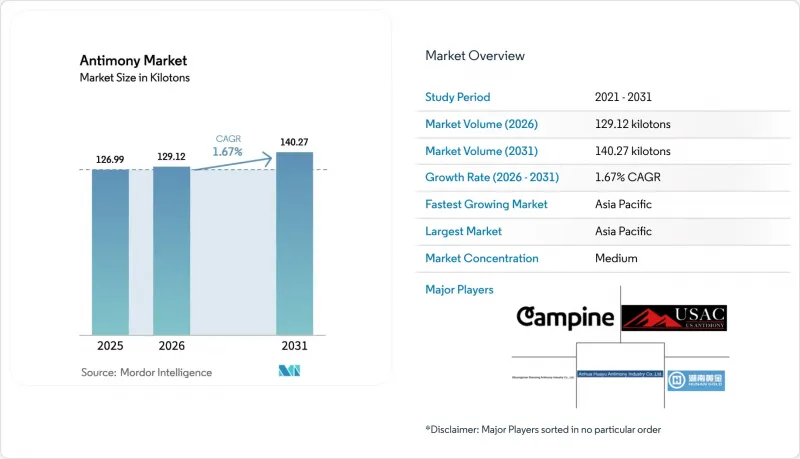
안티몬 시장 규모는 2025년에 126.99 킬로톤으로 평가되었습니다. 2026년 129.12 킬로톤에서 2031년까지 140.27 킬로톤에 이를 것으로 예상되며, 예측 기간(2026-2031년) CAGR은 1.67%를 나타낼 전망입니다.
급격한 가격 급등으로 중국 공급에 대한 구조적 의존도가 드러났습니다. 전략적 수요는 에너지 저장, 반도체 도핑, 방산 전자기기 등 안티몬의 야금학적, 전자적 특성을 대체할 수 있는 대체재가 거의 없는 분야로 계속 이동하고 있습니다. 유럽과 미국의 광산 회사, 정유사 및 정부는 2024년 12월 중국의 수출 금지 조치에 대응하기 위해 아이다호, 몬태나 및 호주에서 새로운 생산 능력을 확장하고 있습니다. 이 조치로 인해 벤치마크 가격이 두 배로 상승하여 수직 통합형 프로젝트가 촉진되었습니다. 한편, 유럽과 북미의 독성 규제 강화로 인해 무할로겐 난연제로의 전환이 점차 가속화되고 있으며, 이는 공급량 증가를 억제하는 동시에 고순도 제품 및 특수 등급에 대한 수요를 증가시키고 있습니다. 경쟁 차별화 요소는 비용에서 순도, 산지 및 공급 안정성, 특히 반도체 등급 소재의 경우 순도, 산지 및 공급 안정성으로 이동하고 있습니다.
세계의 안티몬 시장 동향 및 인사이트
아시아태평양의 그리드 규모 납축전지 및 액체 금속 전지의 확장에 대한 자료입니다.
유틸리티 규모의 축전 시스템이 점점 더 많은 안티몬 시장을 형성하고 있습니다. 2024년 2월, Ambri는 시리즈 D 자금 조달을 확보하여 Xcel Energy와 Vistra에 안티몬-납 음극을 채택한 액체 금속 배터리를 납품했습니다. 동남아시아 전역에서는 통신용 백업 전원으로 납축전지가 여전히 주류를 이루고 있지만, 딥 사이클 내구성을 높이기 위해 그리드용 합금에 안티몬을 첨가하고 있습니다. 중국에서는 전기화가 가속화되고 있음에도 불구하고 여전히 많은 수의 내연기관차가 존재하고 있으며, 이는 기준 수요를 뒷받침하여 안티몬 시장을 자동차 부문에 확고히 자리 잡게 하고 있습니다. 칼슘-주석 합금의 부상으로 배터리에서 안티몬 사용량이 감소할 수 있지만, 그리드 규모의 액체 금속 시스템은 모듈당 다량의 고순도 안티몬을 소비함으로써 이러한 추세를 상쇄하고 있습니다. 이러한 추세는 중기적으로 총 수요량을 증가시킬 뿐만 아니라, 엄격한 순도 기준을 충족하는 공급품의 가치를 높일 수 있습니다.
PET 수지의 붐으로 안티몬 촉매 사용 촉진
삼산화 안티몬은 폴리에틸렌 테레프탈레이트(PET) 생산의 90% 이상에서 주요 중합 촉매 역할을 합니다. 사우디아라비아와 베트남에서는 2027년까지 새로운 PET 생산시설이 가동될 예정입니다. 최근 Teijin의 삼원계 촉매 혼합물 특허는 반응 속도상의 이점을 유지하면서 잔류 안티몬을 줄이려는 업계의 노력을 뒷받침합니다. 그러나 규제 당국은 이를 예의주시하고 있습니다. 유럽화학물질청은 현재 식품접촉용 포장재의 허용 이행 한계치를 재평가했습니다. 이 심사로 인해 컴플라이언스 비용이 발생하며, 업계는 고급 제품을 위해 티타늄계 시스템으로 전환할 가능성이 있습니다. 낮은 설비 투자, 확립된 전문 지식으로 인해 현재 안티몬은 촉매로서 우위를 유지하고 있지만, 다운스트림 생산자들은 규제 위험을 줄이기 위해 적극적으로 대안을 모색하고 있습니다. 이러한 신중한 태도는 향후 2년 이상 안티몬 시장의 성장 전망을 억제할 것으로 보입니다.
불안정한 중국 수출 쿼터와 가격 급등
로테르담의 벤치마크 가격은 2023년 12월부터 2025년 2월까지 크게 급등했습니다. 이러한 급격한 상승으로 인해 컴파운더와 배터리 제조업체의 수익률은 압박을 받고 있으며, 이러한 비용을 전가하는 것이 어려워지고 있습니다. 유럽과 북미에서는 중소규모의 가공업체들이 이러한 현금 흐름의 압박을 직접적으로 받고 있으며, 가격이 안정될 때까지 생산을 중단하는 업체도 있습니다. 한국 아연(Korea Zinc)의 연간 공급량은 여전히 제한적이며, 전 세계 채굴 생산량의 극히 일부에 불과합니다. 이러한 공급의 한계로 인해 유럽과 미국의 바이어들은 중국의 정책 전환에 영향을 받기 쉬운 위치에 놓여 있습니다. 'Stibnite(Stibnite)'와 같은 프로젝트가 본격화되는 가운데, 현재 지속되고 있는 가격 변동은 예상 CAGR에 영향을 미칠 것으로 예측됩니다.
부문 분석
삼산화 안티몬은 PET 촉매 및 난연제로서의 확고한 역할을 반영하여 2025년 공급량의 56.48%를 차지하였습니다. 그러나 유럽에서 무할로겐 대체품으로의 전환으로 인해 성장 궤도에 제약이 생기고 있습니다. 오산화 안티몬은 특수 유리 및 태양광 발전 제조업체들이 우수한 탈색 및 정제 능력을 요구함에 따라 CAGR 2.5%로 성장하고 있습니다. 한국아연(Korea Zinc)이 제공하는 고순도 금속 잉곳은 군사 및 반도체 분야의 고순도 수요에 대응하고 있습니다. 납축전지용 합금은 칼슘-주석 배합의 부상으로 안티몬의 배합량이 감소하는 추세이지만, 그리드 규모의 축전지가 그 감소분을 상쇄하는 데 일조하고 있습니다. 또한, 불꽃놀이용으로 선호되는 삼황화 안티몬과 같은 틈새 제품은 높은 수익률을 자랑하지만 생산량은 극히 미미하여 안티몬 시장 내 다양한 동향을 보여주고 있습니다.
오산화 안티몬의 부상으로 특수 제품의 수익이 증가하고 있지만, 유럽과 북미 이외 지역에서는 삼산화 안티몬의 우위가 여전히 확고합니다. Teijin의 삼원계 촉매의 기술 발전은 반응 속도를 손상시키지 않고 전이를 억제함으로써 PET 분야에서 삼산화 안티몬의 지배력을 연장시킬 수 있습니다. 이 노력이 조금만 성공해도 세계 안티몬 수요의 상당 부분을 대체품으로부터 보호할 수 있을 것입니다. 따라서 안티몬 시장은 수량이 많고 규제의 영향을 받기 쉬운 삼산화 안티몬을 기반으로 오산화 안티몬의 급속한 성장과 큰 수익을 창출하는 틈새 고순도 잉곳 부문이 보완하는 것이 특징입니다.
난연제는 2025년 소비량의 55.02%를 차지했지만, 유럽과 미국에서는 그 우위를 잃어가고 있습니다. 세라믹 및 유리 분야는 태양광 발전용 유리의 미세화 및 안티몬을 첨가한 단결정 실리콘 덕분에 CAGR 3.3%로 성장하고 있습니다. PET 중합의 촉매 수요는 여전히 견고하지만 규제 압력에 민감합니다. Kg 단위로 측정되는 특수 전자 용도는 높은 수익률과 전략적 중요성을 가지고 있습니다. 이러한 용도 구성은 수량은 감소하지만 부가가치가 높은 분야로의 전환을 나타내며, 성숙한 경제권에서 난연제 취급량이 감소하더라도 총매출액의 완충재가 될 수 있습니다.
세라믹 분야 수요는 규제로 인한 역풍에 대한 헤지가 될 수 있습니다. 특히, 태양광 유리 제조업체들이 투명도 향상과 기포 제거를 위해 오산화 안티몬을 확보한 것이 그 요인으로 작용하고 있습니다. 배터리도 또 다른 헤지 수단이 될 수 있습니다. 자동차 시동기의 단위당 안티몬 사용량은 감소하는 추세이지만, 그리드 규모의 프로젝트에서는 모듈당 Kg 단위의 첨가량이 요구됩니다. 따라서 안티몬 시장은 다양한 수요 요인을 유지하여 단일 응용 분야로부터의 하방 위험을 완화하고 있습니다.
본 안티몬 시장 보고서는 제품 유형(금속 잉곳, 삼산화 안티몬, 오산화 안티몬, 합금, 기타), 광석 유형(스티브나이트, 기타), 용도(난연제, 배터리 등), 최종 이용 산업(플라스틱/폴리머, 자동차/운송 등), 지역(아시아태평양, 북미 등)별로 분류되어 있습니다. 등)로 분류되어 있습니다. 시장 예측은 수량(톤) 기준으로 제공됩니다.
지역별 분석
아시아태평양은 2025년 전 세계 생산량의 86.67%를 차지하며 CAGR 3.12%로 성장하고 있습니다. 2024년 중국은 안티몬을 정제했지만, 광석 부족과 규정 준수 비용에 직면하여 설비 용량의 3분의 1에 불과한 용량으로 운영되고 있었습니다. 인도의 플라스틱 및 오토바이 부문 수요 증가와 베트남의 PET 수요 급증과 함께 아시아태평양의 안티몬 시장에서의 중심적인 역할을 확고히 하고 있습니다. 국내 정제가 이루어지고 있음에도 불구하고 일본은 여전히 순 수입국이며, 주로 중국과 베트남에서 조달하고 있습니다. 한편, 한국의 Korea Zinc는 생산량을 증가시켜 점진적인 증산을 계획하고 있으며, 생산량의 일부는 유럽과 미국 시장으로 향할 것으로 예측됩니다.
북미에서는 공급 확대를 위한 준비가 진행 중입니다. Perpetua의 스티브나이트 광산 프로젝트와 미국 Antimony의 멕시코와 몬태나 주에서의 운영은 향후 몇 년 동안 국내 수요의 상당 부분을 충족시킬 준비가 되어 있습니다. 이 수요는 국방용 전자기기, 그리드 규모의 전력 저장 시스템, 반도체 팹 등의 분야가 주도하고 있으며, 특히 'CHIPS and Science Act(CHIPS and Science Act)'에 따른 국내 회귀 움직임에 힘입은 바 큽니다. 유럽은 수입 의존도가 높은 난연제에 대한 규제가 강화되면서 벨기에의 캄핀(Campine)과 같은 가공업체들은 재활용으로 전환을 추진하고 있습니다. 중동/아프리카/남미 지역에서는 볼리비아와 모로코가 공급 다변화에 중요한 역할을 하고 있지만, 두 나라의 생산량을 합해도 공급 완화 효과는 제한적입니다.
유럽과 미국공급원 다변화 노력에도 불구하고, 중국 제련소가 제련에서 규모의 경제의 혜택을 계속 누리고 있기 때문에 향후 몇 년 동안 아시아태평양 시장 점유율은 약간 감소할 것으로 예측됩니다. 그러나 강력한 공급망 구축이라는 정치적 동기에 힘입어 절대적인 물동량이 지역 수요 증가를 따라잡지 못하더라도, 더 많은 양의 안티몬 시장 거래량이 중국 이외의 경로를 통해 유통될 것으로 예측됩니다.
기타 혜택 :
- 엑셀 형식 시장 예측(ME) 시트
- 3개월간 애널리스트 지원
자주 묻는 질문
목차
제1장 서론
제2장 조사 방법
제3장 주요 요약
제4장 시장 구도
제5장 시장 규모와 성장 예측
제6장 경쟁 구도
제7장 시장 기회와 향후 전망
KTH 26.05.29The Antimony Market size was valued at 126.99 kilotons in 2025 and is estimated to grow from 129.12 kilotons in 2026 to reach 140.27 kilotons by 2031, at a CAGR of 1.67% during the forecast period (2026-2031).
A rapid price escalation exposed structural reliance on Chinese supply. Strategic demand continues to pivot toward energy storage, semiconductor doping, and defense electronics, where antimony's metallurgical and electronic properties have few substitutes. Western miners, refiners, and governments are scaling new capacity in Idaho, Montana, and Australia to counter China's December 2024 export ban, a move that doubled benchmark prices and spurred vertically integrated projects. Meanwhile, regulatory scrutiny over toxicology in Europe and North America is accelerating a gradual shift to halogen-free flame retardants, tempering volume growth but pushing value toward higher purity and specialty grades. Competitive differentiation is shifting away from cost and toward purity, provenance, and security of supply, especially for semiconductor-grade material.
Global Antimony Market Trends and Insights
Grid-Scale Lead-Acid and Liquid-Metal Battery Expansion in Asia-Pacific
Utility-scale storage is increasingly shaping the Antimony market. In February 2024, Ambri secured Series D financing and is set to deliver liquid-metal batteries, reliant on antimony-lead cathodes, to Xcel Energy and Vistra. While lead-acid batteries continue to dominate telecom backups throughout Southeast Asia, they incorporate antimony in their grid alloys to enhance deep-cycle durability. China's vast fleet of internal-combustion vehicles, even as electrification gains momentum, bolsters baseline demand, anchoring the Antimony market firmly in the automotive sector. Although the rise of calcium-tin alloys might reduce antimony usage in batteries, grid-scale liquid-metal systems counteract this by consuming significant amounts of high-purity antimony per module. This dynamic not only boosts aggregate volumes in the medium term but also enhances the value of supply adhering to stringent purity standards.
PET Resin Boom Boosting Sb-Catalyst Use
Antimony trioxide serves as the primary polymerization catalyst for over 90% of polyethylene terephthalate (PET) production. New PET facilities in Saudi Arabia and Vietnam are set to begin operations before 2027. Teijin's recent patent on ternary catalyst mixtures underscores the industry's push to reduce residual antimony while maintaining kinetic benefits. However, regulators are keeping a close watch. The European Chemicals Agency is currently reevaluating the permissible migration limits for food-contact packaging. This scrutiny introduces compliance costs, potentially steering the industry towards titanium-based systems for premium products. While low capital expenditure and established expertise currently uphold antimony's dominance as a catalyst, downstream producers are actively exploring alternatives to mitigate regulatory risks. This cautious approach tempers the growth outlook for the antimony market beyond the immediate two-year horizon.
Volatile Chinese Export Quotas and Price Spikes
Benchmark Rotterdam prices surged significantly from December 2023 to February 2025. This sharp rise has squeezed margins for compounders and battery makers, who find it challenging to pass on these costs. In Europe and North America, small and mid-sized processors are feeling the brunt of this cash-flow strain, with some even pausing production until prices stabilize. Korea Zinc's annual supply remains limited, accounting for a small fraction of the global mined output. This limited supply leaves Western buyers vulnerable to policy shifts in Beijing. As projects like Stibnite gear up, the ongoing volatility is projected to impact the forecasted CAGR.
Other drivers and restraints analyzed in the detailed report include:
- China Export Controls Driving Non-China Supply-Chain Investment
- Antimony Alloying in Next-Gen Calcium/Sodium Liquid-Metal Batteries
- Shift Toward Halogen-Free Flame Retardants in EU and NA
For complete list of drivers and restraints, kindly check the Table Of Contents.
Segment Analysis
Antimony trioxide held 56.48% of the 2025 volume, reflecting its entrenched roles in PET catalysis and flame retardancy. However, its growth trajectory faces constraints due to Europe's shift towards halogen-free alternatives. Antimony pentoxide is expanding at a 2.5% CAGR as specialty glass and photovoltaic manufacturers seek its superior decolorizing and fining capabilities. Metal ingots, boasting a premium purity from Korea Zinc, cater to the high-purity demands of the military and semiconductor sectors. While lead-acid battery alloys are seeing reduced antimony loadings due to the rise of calcium-tin formulations, grid-scale batteries are helping to offset this decline. Additionally, niche products like antimony trisulfide, favored in pyrotechnics, command high margins but contribute negligible tonnage, highlighting the diverse dynamics within the antimony market.
While pentoxide's ascent bolsters specialty revenues, trioxide's dominance remains unchallenged outside Europe and North America. Teijin's advancements in ternary catalysts could extend trioxide's reign in the PET sector by curbing migration without compromising kinetics. Even a slight success in this endeavor could insulate a significant portion of global antimony demand from imminent substitutions. Thus, the antimony market is characterized by a volume-heavy, regulation-sensitive trioxide foundation, complemented by the rapid growth of pentoxide and a niche high-purity ingot segment that drives significant profits.
Flame retardants consumed 55.02% of the 2025 volume, but that dominance is losing momentum in the West. Ceramics and glass are growing at a 3.3% CAGR thanks to photovoltaic glass fining and antimony-doped monocrystalline silicon. Catalyst demand in PET polymerization remains substantial but is sensitive to regulatory pressure. Specialty electronic uses, measured in kilograms, carry high margins and strategic significance. This application mix indicates a transition toward fewer but higher value streams, creating a cushion for aggregate revenues even if flame-retardant tonnage erodes in mature economies.
Ceramic demand provides a hedge against regulatory headwinds, particularly as solar-glass producers secure antimony pentoxide to improve clarity and bubble removal. Batteries offer another hedge: although per-unit antimony intensity is falling in automotive starters, grid-scale projects require kilogram-level loadings per module. Therefore, the Antimony market maintains diversified demand drivers that temper downside risk from any single application class.
The Antimony Market Report is Segmented by Product Type (Metal Ingot, Antimony Trioxide, Antimony Pentoxide, Alloys, and Other Product Types), Ore Type (Stibnite and Others), Application (Flame Retardants, Batteries, and More), End-User Industry (Plastics and Polymers, Automotive and Transportation, and More), and Geography (Asia-Pacific, North America, and More). The Market Forecasts are Provided in Terms of Volume (Tons).
Geography Analysis
Asia-Pacific held 86.67% of global volume in 2025 and is expanding at a 3.12% CAGR. In 2024, China refined antimony but operated at only one-third of its installed capacity, grappling with ore scarcity and compliance costs. Rising demand in India's plastics and two-wheeler sectors, coupled with Vietnam's PET surge, solidifies Asia-Pacific's central role in the Antimony market. Despite domestic refining, Japan remains a net importer, predominantly sourcing from China and Vietnam. Meanwhile, South Korea's Korea Zinc increased its output and plans a modest rise, with a portion of the production targeted for Western markets.
North America is gearing up for a supply expansion. Projects like Perpetua's Stibnite and operations by United States Antimony in Mexico and Montana are poised to meet a significant portion of domestic needs in the coming years. This demand is driven by sectors like defense electronics, grid-scale storage, and semiconductor fabs, especially with the reshoring push under the CHIPS and Science Act. While Europe relies heavily on imports, tightening regulations on flame retardants are prompting processors like Belgium's Campine to pivot towards recycling. In the Middle East-Africa/South America region, Bolivia and Morocco are key players in diversifying the supply, but their combined output offers only limited relief.
Despite Western diversification efforts, the Asia-Pacific market share is expected to decline slightly in the coming years, as Chinese smelters continue to benefit from economies of scale in refining. Yet, driven by political motivations for resilient supply chains, a larger portion of the Antimony market volumes is anticipated to flow through non-Chinese channels, even if the absolute tonnage doesn't keep pace with regional demand growth.
- Alkane Resources Ltd.
- AMG Advanced Metallurgical Group N.V.
- Belmont Metals Inc.
- Campine NV
- GUANGXI HUAYUAN METAL CHEMICAL CO., LTD.
- Hunan Gold Co., Ltd.
- Hunan Province Anhua Huayu Antimony Industry Co., Ltd.
- Koreazinc
- Lambert Metals International Limited
- Nihon Seiko Co., Ltd.
- Perpetua Resources
- SPMP (Strategic and Precious Metals Processing)
- SUZUHIRO CHEMICAL CO.,LTD.
- United States Antimony Corporation
- Xikuangshan Shanxing Antimony Industry Co., Ltd.
- Yiyang City Huachang Antimony Industry Co.,Ltd
- Youngsun (Guangdong Yuxing) Fire-Retardant New Material Co.
- Yunnan Muli Antimony Industry Co., Ltd.
Additional Benefits:
- The market estimate (ME) sheet in Excel format
- 3 months of analyst support
TABLE OF CONTENTS
1 Introduction
- 1.1 Study Assumptions and Market Definition
- 1.2 Scope of the Study
2 Research Methodology
3 Executive Summary
4 Market Landscape
- 4.1 Market Overview
- 4.2 Market Drivers
- 4.2.1 Grid-scale lead-acid and liquid-metal battery expansion in Asia-Pacific
- 4.2.2 PET resin boom boosting Sb-catalyst use
- 4.2.3 China export controls driving non-China supply-chain investment
- 4.2.4 Antimony alloying in next-gen calcium/sodium liquid-metal batteries
- 4.2.5 Semiconductor-grade Sb for 5G and quantum devices
- 4.3 Market Restraints
- 4.3.1 Volatile Chinese export quotas and price spikes
- 4.3.2 Shift toward halogen-free flame retardants in EU and NA
- 4.3.3 REACH/TSCA toxicology compliance costs
- 4.4 Value Chain Analysis
- 4.5 Production Analysis
- 4.6 Porter's Five Forces
- 4.6.1 Bargaining Power of Suppliers
- 4.6.2 Bargaining Power of Buyers
- 4.6.3 Threat of New Entrants
- 4.6.4 Threat of Substitutes
- 4.6.5 Degree of Competition
- 4.7 Supply Analysis
- 4.8 Regulatory Policy Analysis
- 4.9 Trade Analysis
- 4.10 Price Trend Analysis
- 4.11 Production Cost Analysis
5 Market Size and Growth Forecasts (Volume)
- 5.1 By Product Type
- 5.1.1 Metal Ingot
- 5.1.2 Antimony Trioxide
- 5.1.3 Antimony Pentoxide
- 5.1.4 Alloys
- 5.1.5 Other Product Types (Granules, Single Crystals, etc.)
- 5.2 By Ore type
- 5.2.1 Stibnite
- 5.2.2 Others
- 5.3 By Application
- 5.3.1 Flame Retardants
- 5.3.2 Batteries
- 5.3.3 Ceramics and Glass
- 5.3.4 Catalyst
- 5.3.5 Other Applications (Semiconductor, Defense, etc.)
- 5.4 By End-user Industry
- 5.4.1 Plastics and Polymers
- 5.4.2 Automotive and Transportation
- 5.4.3 Chemicals and Catalysts
- 5.4.4 Electronics and Semiconductor
- 5.4.5 Energy Storage and Utilities
- 5.4.6 Other Industries
- 5.5 By Geography
- 5.5.1 Asia-Pacifc
- 5.5.1.1 China
- 5.5.1.2 India
- 5.5.1.3 Japan
- 5.5.1.4 South Korea
- 5.5.1.5 ASEAN Countries
- 5.5.1.6 Rest of Asia-Pacific
- 5.5.2 North America
- 5.5.2.1 United States
- 5.5.2.2 Canada
- 5.5.2.3 Mexico
- 5.5.3 Europe
- 5.5.3.1 Germany
- 5.5.3.2 United Kingdom
- 5.5.3.3 France
- 5.5.3.4 Italy
- 5.5.3.5 Spain
- 5.5.3.6 Rest of Europe
- 5.5.4 South America
- 5.5.4.1 Brazil
- 5.5.4.2 Argentina
- 5.5.4.3 Chile
- 5.5.4.4 Rest of South America
- 5.5.5 Middle-East and Africa
- 5.5.5.1 Saudi Arabia
- 5.5.5.2 United Arab Emirates
- 5.5.5.3 South Africa
- 5.5.5.4 Rest of Middle-East and Africa
- 5.5.1 Asia-Pacifc
6 Competitive Landscape
- 6.1 Market Concentration
- 6.2 Strategic Moves
- 6.3 Market Share(%)/ Ranking Analysis
- 6.4 Company Profiles
- 6.4.1 Alkane Resources Ltd.
- 6.4.2 AMG Advanced Metallurgical Group N.V.
- 6.4.3 Belmont Metals Inc.
- 6.4.4 Campine NV
- 6.4.5 GUANGXI HUAYUAN METAL CHEMICAL CO., LTD.
- 6.4.6 Hunan Gold Co., Ltd.
- 6.4.7 Hunan Province Anhua Huayu Antimony Industry Co., Ltd.
- 6.4.8 Koreazinc
- 6.4.9 Lambert Metals International Limited
- 6.4.10 Nihon Seiko Co., Ltd.
- 6.4.11 Perpetua Resources
- 6.4.12 SPMP (Strategic and Precious Metals Processing)
- 6.4.13 SUZUHIRO CHEMICAL CO.,LTD.
- 6.4.14 United States Antimony Corporation
- 6.4.15 Xikuangshan Shanxing Antimony Industry Co., Ltd.
- 6.4.16 Yiyang City Huachang Antimony Industry Co.,Ltd
- 6.4.17 Youngsun (Guangdong Yuxing) Fire-Retardant New Material Co.
- 6.4.18 Yunnan Muli Antimony Industry Co., Ltd.
7 Market Opportunities and Future Outlook
- 7.1 Recycling of end-of-life lead-acid batteries
- 7.2 Development of domestic refining outside China
- 7.3 White-space and unmet-need assessment