

|
시장보고서
상품코드
2044137
에어로젤 시장 : 점유율 분석, 산업 동향 및 통계, 성장 예측(2026-2031년)Aerogel - Market Share Analysis, Industry Trends & Statistics, Growth Forecasts (2026 - 2031) |
||||||
 Mordor Intelligence
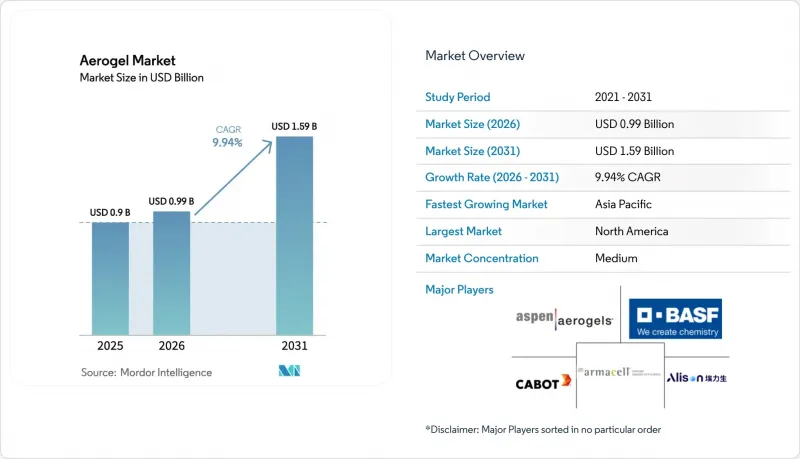
에어로젤 시장 규모는 2025년 9억 달러, 2026년 9억 9,000만 달러에서 2031년까지 15억 9,000만 달러로 확대될 것으로 예측되고 있으며 2026-2031년까지 연평균 복합 성장률(CAGR)은 9.94%를 나타낼 전망입니다.
에너지, 건설, 모빌리티 부문에서 초경량, 초단열 소재에 대한 수요가 증가하면서 성장 곡선이 가파르게 상승하고 있습니다. 순환 경제와 재활용 가능성에 대한 관심이 높아지면서 에어로젤은 큰 에너지 손실 없이 재생 가능한 소재라는 점에서 주목을 받고 있습니다. 아시아태평양의 액화천연가스(LNG) 자산에 대한 꾸준한 설비 투자, 미국, 캐나다, 유럽의 강화된 건축 에너지 규제, 전기자동차 배터리 안전 대책 개조가 빠르게 증가하면서 에어로젤 시장의 매출 성장을 뒷받침하고 있습니다. 주요 공급업체들은 생산 능력을 지속적으로 확대하고 있으며, 상압 건조 및 용제 재활용과 같은 공정 효율화 노력을 통해 기존 비용 측면의 단점을 점차 해소하고 있습니다.
세계 에어로젤 시장 동향 및 인사이트
재사용성과 재활용성을 통한 채용 확대
에어로젤은 여러 번 사용해도 구조적 무결성을 유지하기 때문에 사업자는 특별한 도구 없이도 파이프라인, 정유시설 또는 외벽에서 블랭킷과 입자를 회수할 수 있습니다. 해양 석유 생산에서 재사용된 에어로젤 매트는 최대 3번의 완전한 유지보수 주기를 거친 후에도 여전히 A1 등급의 내화 성능을 충족하는 것으로 확인되었습니다. 이를 통해 산업 사용자는 매립 처리 비용과 새로운 재료 구매 비용을 절감하여 전체 수명주기 비용을 줄일 수 있습니다. 또한, 재활용 가능성은 독일, 프랑스, 미국 일부 주에서 도입이 추진 중인 생산자책임재활용제도(EPR)의 규정에도 부합합니다. 정부 조달팀은 순환형 단열재를 사양서에 명시하는 경향이 증가하고 있으며, 이러한 움직임은 공공 인프라 입찰에서 에어로젤의 채택을 촉진하는 요인으로 작용하고 있습니다. 이를 종합하면, 회수 가능성과 정책적 지원으로 인해 과거 '낭비가 많다'는 우려를 해소하고, 산업용 유지보수 프로그램에서 에어로젤의 대상 시장이 확대되고 있습니다.
고성능 단열재에 대한 건설 수요 증가
2030년까지 건물 순 제로화를 달성해야 한다는 압박이 커지면서 대형 건설사들은 특히 난방 일수가 현저하게 높은 북유럽에 집중하고 있습니다. 건축가들은 에어로젤 플라스터에 주목하고 있으며, 밀도 200kg/m3 이하, λ값 15mW/m*K 이하의 실리카 블랭킷과 결합하면 두꺼운 벽 단면을 채택하지 않고도 엄격한 U값 목표를 달성할 수 있습니다. 노후화된 공동주택의 개보수에는 큰 비즈니스 기회가 있습니다. 예를 들어, 최근 덴마크에서 진행된 실험에서 벽돌 외벽에 25mm 에어로젤 페인트를 적용한 결과, 열 손실이 크게 감소하는 것이 입증되었습니다. 미국의 기후 구분 4-6의 경우, 현재 천연가스 가격을 고려할 때 라이프사이클 모델에서 투자 회수 기간이 짧다는 것을 알 수 있습니다. 이러한 성능 지표와 비용 효율성이 에어로젤 블랭킷에 대한 수요 급증, 특히 건축 외장재 부문 시장 성장을 주도하고 있습니다.
기존 단열재에 비해 높은 제조비용 절감
공정 최적화를 통한 지속적인 노력에도 불구하고, 납품 가격 기준으로 비교하면 실리카 블랭킷은 미네랄 울보다 평균 판매 가격이 더 높습니다. 기존 배치 공정에서 초임계 건조 및 용매 교환은 총 에너지 소비에 크게 기여하여 간접비를 증가시킵니다. 프로젝트 예산이 부족하면 중소 건설업체들은 보다 저렴한 폼 소재로 전환하는 경우가 많아 가격에 민감한 주택 부문의 물량 증가를 둔화시키고 있습니다. 2026년에 도입될 예정인 급속 사이클 상압 반응장치로 인해 에너지 소비가 감소할 것으로 예상되지만, 업계 전문가들은 2028년 이후에나 눈에 띄는 가격 수렴이 이루어질 것으로 전망하고 있습니다. 이러한 지연은 에어로젤 시장의 저수익성 건축 프로젝트에 대한 완전한 침투를 방해하고 있습니다.
부문 분석
2025년 기준, 실리카 에어로젤의 세계 수요는 전체 에어로젤 시장의 72.87%를 차지해, 이는 성숙한 제조거점과 광범위한 응용 분야에 대한 적합성에 의해 주도되고 있습니다. 실리카 블랭킷은 대규모 석유 및 가스 파이프 단열재 입찰을 계속 수주하고 있으며, 분말 유도체는 건축용 석고 단열 첨가제로서 보급이 확대되고 있습니다. 실리카계 에어로젤은 확장 가능한 졸루겔 화학, 풍부한 전구체 가용성, 탄화 레조르시놀-포름알데히드계와 비교하여 상대적으로 환경 부하가 적은 특성이 있습니다. 2031년 CAGR은 10.87%로 예측되며, 실리카 계열은 대량 생산되는 산업 부문에서 시장을 확대하는 전체 성장의 중심이 될 것으로 예측됩니다.
우수한 전도성으로 평가받는 카본 에어로젤은 슈퍼커패시터의 전극과 항공우주 항공기 내부의 EMI 차폐에 널리 보급되고 있습니다. 그러나 고온 열분해에 필요한 에너지가 방대하고, 유기 전구체 비용이 비싸기 때문에 본격적인 보급에는 아직 과제가 남아있습니다. 알루미나 에어로젤은 우수한 내산성으로 인해 가혹한 화학 처리 환경에서 틈새 시장을 점유하고 있습니다. Aspen Aerogels와 같은 제조업체는 2026년에 알루미나 생산 파일럿 라인을 추가했지만 상업적 생산량은 여전히 소규모에 머물러 있습니다. 고객이 열적, 전기적, 화학적 우선순위를 조정함에 따라 다재료 하이브리드 배합이 상용화 단계에 접어들면서 세계 시장에서 에어로젤 포트폴리오의 점진적인 다양화를 시사하고 있습니다.
2025년 에어로젤 시장 매출의 64.19%는 블랭킷 제품이 차지했습니다. 이는 정유사, LNG 사업자, 건물 개보수 팀이 배치의 용이성과 일관된 취급을 중요하게 생각하기 때문입니다. 사전 라미네이트 가공된 재킷은 설치 시간을 더욱 단축시켜 현장의 인건비를 절감할 수 있습니다. 블랭킷 제품의 침투율은 여전히 높지만, 시멘트계 석고 및 폴리머 마스터배치에 대한 분산성을 인정받아 미립자 에어로젤이 CAGR 10.92%로 가장 높은 성장이 예상됩니다. 제조업체는 완제품을 재설계할 필요 없이 분말의 배합 조정을 통해 열전도율과 밀도를 조정할 수 있습니다. 블록 및 패널 형태는 채광용 파사드 요소, 연구용 크라이오스탯과 같은 특수 용도에 사용되지만, 현재 에어로젤 시장 점유율에서 차지하는 비중은 극히 일부에 불과합니다.
연구개발 부문에서는 결합제를 제거하여 광학 투명도를 높이는 모놀리식 패널 공정에 대한 관심이 높아지고 있습니다. 스웨덴과 일본의 파일럿 라인에서 패널 제조 기술 개발이 성공적으로 진행되고 있습니다. 이러한 기술이 실용화되면 건축용 파사드 및 태양열 포집제 부문에 새로운 길을 열어 이미 다변화되고 있는 에어로젤 산업에 새로운 활력을 불어넣을 수 있습니다.
지역별 분석
북미는 2025년 에어로젤 시장에서 41.18%의 점유율을 차지하며 매출액 기준 1위를 유지했습니다. 이는 미국과 캐나다의 탄탄한 석유 및 가스 부문에 힘입어 평균을 상회하는 건축 개보수 활동으로 인해 강화되었습니다. 에너지 효율이 높은 상업용 건물에 대한 연방정부의 세제 혜택과 멕시코만 연안의 LNG 수출 터미널 건설 확대가 맞물려 대규모 대량 수주와 직결되고 있습니다. 이 지역의 성숙한 조달 관행과 확고한 법규 준수 문화는 고성능 소재의 채택을 가속화하고 있으며, 세계 에어로젤 시장 시장 역학에 대한 북미의 지속적인 영향력을 강조하고 있습니다.
유럽은 여전히 높은 가격대 수요의 중심지이며, 유럽 대륙의 엄격한 건축 에너지 법규와 전기 모빌리티의 조기 도입에 힘입은 바 큽니다. 독일, 이탈리아, 영국 등의 국가들은 대규모 개보수 프로그램에 공공 보조금을 투입하고 있으며, 미적 이유로 벽 두께를 제한해야 하는 역사적 건축물에서 입자 강화 석고에 대한 수요를 촉진하고 있습니다. 유럽 위원회의 '2025 리노베이션 웨이브(Renovation Wave)' 업데이트는 일관된 리노베이션 활동을 촉진하고 있으며, 건설 부문의 에어로젤 공급업체들은 안정적인 수주 파이프라인의 혜택을 누리고 있습니다. 동시에 노르웨이의 탄소 포집 인프라 강화는 고온 단열재에 대한 전문적인 틈새 시장을 개척하여 이 지역의 수익원을 확대되고 있습니다.
아시아태평양은 중국의 급속한 LNG 수입 확대, 한국의 배터리 제조 급증, 인도의 도시 매립지 건설 붐 등을 배경으로 2031년까지 연평균 10.36%의 연평균 복합 성장률(CAGR)로 가장 빠르게 성장하는 지역으로 부상하고 있습니다. 각국 정부는 성능 기준에 따른 건축 기준을 강화하고 있으며, 건축가들은 에어로젤이 우수한 성능을 발휘하는 얇고 높은 단열 성능(높은 R값)을 가진 구조물로 향하고 있습니다. 광동 앨리슨 테크놀로지와 같은 현지 단열재 제조업체는 에너지 절약형 소재 제품 라인에 대한 지방정부의 특혜를 획득하여 총 비용을 낮추고 접근성을 향상시켰습니다. 일본과 한국의 산업용 열 통합 프로그램의 시너지 효과와 동남아시아의 정유시설 개보수에 따른 수요 유입으로 아시아태평양 전체에서 에어로젤 시장이 확대되어 예측 기간 동안 이 지역이 북미와의 격차를 좁힐 수 있을 것으로 보입니다.
기타 혜택
- 엑셀 형태 시장 예측(ME) 시트
- 3개월간 애널리스트 지원
자주 묻는 질문
목차
제1장 서론
제2장 조사 방법
제3장 주요 요약
제4장 시장 구도
제5장 시장 규모와 성장 예측
제6장 경쟁 구도
제7장 시장 기회와 향후 전망
JHS 26.06.02The Aerogel Market size is projected to expand from USD 0.90 billion in 2025 and USD 0.99 billion in 2026 to USD 1.59 billion by 2031, registering a CAGR of 9.94% between 2026 to 2031.
Mounting demand for ultra-lightweight yet thermally robust materials in energy, construction, and mobility applications keeps the growth curve steep. Heightened focus on circularity and recyclability puts aerogels in a favorable spotlight because the material can be reclaimed without large energy penalties. Steady capital expenditure on liquefied natural gas assets across Asia-Pacific, stricter building-energy rules in the United States, Canada, and Europe, and a rapid uptick in electric-vehicle battery safety retrofits jointly sustain revenue expansion in the Aerogel market. Major suppliers continue to widen production capacity, while process-streamlining steps such as ambient-pressure drying and solvent recycling progressively chip away at historical cost disadvantages.
Global Aerogel Market Trends and Insights
Rise in Adoption Owing to Reusability and Recyclability
Aerogels maintain structural integrity even after multiple service cycles, letting operators reclaim blankets or particles from pipelines, refineries, or facades without specialized tools. In offshore oil production, reused aerogel mats have logged up to three full maintenance cycles while still meeting Class A1 fire ratings. Industrial users thus cut overall lifecycle costs as landfill expense and fresh material purchases decline. Recyclability also aligns with extended-producer-responsibility provisions being rolled out in Germany, France, and several U.S. states. Government procurement teams increasingly specify circular thermal insulants, a move that strengthens the purchasing case for aerogels in public infrastructure tenders. Taken together, salvage potential and policy nudges remove earlier hesitancy around perceived wastefulness and widen the addressable Aerogel market in industrial maintenance programs.
Growing Construction Demand for High-Performance Insulation
Under mounting pressure to achieve net-zero buildings by 2030, large contractors are particularly focused on Northern Europe, where heating-degree days are notably high. Architects are turning to aerogel plasters, which, combined with silica blankets that achieve λ-values below 15 mW/m*K at densities under 200 kg/m3, allow them to meet stringent U-factor targets without resorting to thick wall sections. There's a notable opportunity in retrofitting aging multifamily units; for instance, a recent trial in Denmark showcased a significant reduction in heat loss when a 25 mm aerogel render was applied over brick facades. In U.S. climate zones 4 to 6, life-cycle models indicate a short payback period, given the current natural-gas tariffs. Such performance metrics and cost efficiencies are driving a surge in demand for aerogel blankets, fueling significant growth in the market, particularly in building envelopes.
High Production Cost Versus Conventional Insulators
Despite ongoing efforts to optimize processes, silica blankets command higher average selling prices than mineral wool, when compared on a delivered basis. In traditional batch processes, supercritical drying and solvent exchange significantly contribute to total energy consumption, driving up overhead costs. When project budgets tighten, smaller construction contractors often pivot to more affordable foams, stunting volume growth in the price-sensitive residential sector. While the introduction of rapid-cycle ambient-pressure reactors in 2026 promises to reduce energy consumption, industry experts predict a noticeable price convergence won't materialize until after 2028. This delay hinders the Aerogel market's full integration into low-margin building projects.
Other drivers and restraints analyzed in the detailed report include:
- Energy-Efficiency Regulations in North America and Europe Spur Demand
- Expansion of LNG Infrastructure Across Asia-Pacific
- Limited Availability and Price Swings of Silica Precursors
For complete list of drivers and restraints, kindly check the Table Of Contents.
Segment Analysis
Global demand for silica aerogels stood at 72.87% of the total Aerogel market share in 2025, driven by a mature manufacturing base and broad application compatibility. Silica blankets continue to secure large oil and gas pipe insulation tenders, while powder derivatives advance as thermal additives in building plasters. The silica cohort benefits from scalable sol-gel chemistry, ample precursor availability, and a relatively benign environmental profile compared with carbonized resorcinol-formaldehyde systems. At a projected 10.87% CAGR to 2031, silica remains the backbone of overall growth, stretching the market in high-volume industrial segments.
Carbon aerogels, valued for superior electrical conductivity, gain traction in supercapacitor electrodes and EMI shielding for aerospace interiors. Still, high pyrolysis energy requirements and costly organic precursors restrain mass adoption. Alumina aerogels occupy a niche in aggressive chemical processing environments thanks to excellent acid resistance. Producers like Aspen Aerogels added a pilot alumina line in 2026, yet commercial volumes remain modest. As customers align thermal, electrical, and chemical priorities, multi-material hybrid formulations enter the commercialization funnel, hinting at gradual portfolio diversification inside the aerogel global market.
Blanket products generated 64.19% of the Aerogel market revenue in 2025 because refineries, LNG operators, and building retrofit teams value roll-out convenience and consistent handling. Pre-laminated jacketing further trims installation time, translating into lower field labor costs. Although blanket penetration stays strong, particle aerogels register the swiftest 10.92% CAGR forecast, fueled by their dispersibility in cementitious plasters and polymer masterbatches. Manufacturers can adjust thermal conductivity and density through powder integration, all without the need to redesign finished parts. While block and panel forms serve specialized roles-like daylight-transmitting facade elements and research-grade cryostats-they currently make up a small portion of the Aerogel market share.
There's a growing emphasis in research and development on monolithic panel processes, which eliminate binders for enhanced optical clarity. Pilot lines in Sweden and Japan have successfully advanced panel production techniques. If these techniques are scaled, they could open new avenues in architectural facades and solar thermal collectors, further energizing the already diverse Aerogel industry.
The Aerogel Market Report is Segmented by Type (Silica, Carbon, Alumina, and Other Types), Form (Blanket, Particle, Block, and Panel), Application (Thermal Insulation, Acoustic Insulation, and More), End-User Industry (Oil and Gas, Construction, Automotive, Marine, Aerospace, and Other End-User Industries), and Geography (Asia-Pacific, North America, Europe, and More). The Market Forecasts are Provided in Terms of Value (USD).
Geography Analysis
North America retained revenue leadership with a 41.18% share of the Aerogel market in 2025, anchored by a well-established oil and gas sector in the United States and Canada and reinforced by above-average construction retrofit activity. Federal tax incentives for energy-efficient commercial buildings, coupled with LNG export terminal build-outs along the Gulf Coast, translate directly into large blanket order books. The region's mature procurement practices and robust code-enforcement culture accelerate specification of high-performance materials, underscoring North America's continuing influence on global Aerogel market dynamics.
Europe remains a premium-priced demand center, propelled by the continent's stringent building-energy laws and early adoption of electrified mobility. Countries such as Germany, Italy, and the United Kingdom channel public subsidies into deep renovation programs, catalyzing demand for particle-enhanced plasters on heritage structures where wall thickness must stay limited for aesthetic reasons. With the European Commission's 2025 Renovation Wave update driving consistent renovation activity, aerogel suppliers in the construction sector benefit from a steady pipeline. Concurrently, Norway's bolstering of its carbon-capture infrastructure carves out specialized niches for high-temperature insulation, broadening the region's income avenues.
Asia-Pacific emerges as the fastest-growing cluster with a 10.36% CAGR through 2031, riding on China's rapid LNG import ramp-up, South Korea's battery-manufacturing surge, and India's urban-infill construction boom. Regional governments intensify performance-based building codes, pushing architects toward slim, high-R-value assemblies where aerogels excel. Local blanket manufacturers like Guangdong Alison Technology secure provincial incentives for energy-efficient material lines, lowering landed costs and improving accessibility. The compound effect of industrial heat-integration programs in Japan and South Korea, plus inflows from Southeast Asian refinery upgrades, broadens the aerogel market across Asia-Pacific, enabling the region to close the gap with North America over the forecast horizon.
- Acoustiblok, Inc.
- Active Aerogels
- Aerogel Technologies, LLC
- aerogel-it
- Armacell
- Aspen Aerogels, Inc.
- BASF
- Blueshift Materials Inc.
- Cabot Corporation
- ENERSENS
- Guangdong Alison Technology Co., Ltd.
- JIOS Aerogel
- Knauf Insulation
- Nano Tech Co., Ltd.
- Ningbo Surnano Aerogel Co., Ltd
- Porex
- Sino Aerogel
- Svenska Aerogel AB
- TAASI Corporation
- Thermablok Aerogels Ltd.
Additional Benefits:
- The market estimate (ME) sheet in Excel format
- 3 months of analyst support
TABLE OF CONTENTS
1 Introduction
- 1.1 Study Assumptions and Market Definition
- 1.2 Scope of the Study
2 Research Methodology
3 Executive Summary
4 Market Landscape
- 4.1 Market Overview
- 4.2 Market Drivers
- 4.2.1 Rise in adoption due to re-usability and recyclability
- 4.2.2 Growing construction demand for high-performance insulation
- 4.2.3 Energy-efficiency regulations in North America and Europe spur demand
- 4.2.4 Expansion of LNG infrastructure across Asia-Pacific
- 4.2.5 Emergence of EV-battery fire-protection blankets
- 4.3 Market Restraints
- 4.3.1 High production cost vs. conventional insulators
- 4.3.2 Limited availability / price swings of silica precursors
- 4.3.3 Competition from high-performance polymer foams in buildings
- 4.4 Value Chain Analysis
- 4.5 Porter's Five Forces
- 4.5.1 Bargaining Power of Suppliers
- 4.5.2 Bargaining Power of Buyers
- 4.5.3 Threat of New Entrants
- 4.5.4 Threat of Substitutes
- 4.5.5 Degree of Competition
5 Market Size and Growth Forecasts (Value)
- 5.1 By Type
- 5.1.1 Silica
- 5.1.2 Carbon
- 5.1.3 Alumina
- 5.1.4 Other Types
- 5.2 By Form
- 5.2.1 Blanket
- 5.2.2 Particle
- 5.2.3 Block
- 5.2.4 Panel
- 5.3 By Application
- 5.3.1 Thermal Insulation
- 5.3.2 Acoustic Insulation
- 5.3.3 Catalyst and Adsorbent
- 5.3.4 Battery and Energy Storage
- 5.3.5 Day-lighting and Translucent Panels
- 5.3.6 Other Applications
- 5.4 By End-user Industry
- 5.4.1 Oil and Gas
- 5.4.2 Construction
- 5.4.3 Automotive
- 5.4.4 Marine
- 5.4.5 Aerospace
- 5.4.6 Other End-user Industries
- 5.5 By Geography
- 5.5.1 Asia-Pacific
- 5.5.1.1 China
- 5.5.1.2 India
- 5.5.1.3 Japan
- 5.5.1.4 South Korea
- 5.5.1.5 Rest of Asia-Pacific
- 5.5.2 North America
- 5.5.2.1 United States
- 5.5.2.2 Canada
- 5.5.2.3 Mexico
- 5.5.3 Europe
- 5.5.3.1 Germany
- 5.5.3.2 United Kingdom
- 5.5.3.3 Italy
- 5.5.3.4 France
- 5.5.3.5 Rest of Europe
- 5.5.4 South America
- 5.5.4.1 Brazil
- 5.5.4.2 Argentina
- 5.5.4.3 Rest of South America
- 5.5.5 Middle-East and Africa
- 5.5.5.1 Saudi Arabia
- 5.5.5.2 United Arab Emirates
- 5.5.5.3 South Africa
- 5.5.5.4 Nigeria
- 5.5.5.5 Rest of Middle-East and Africa
- 5.5.1 Asia-Pacific
6 Competitive Landscape
- 6.1 Market Concentration
- 6.2 Strategic Moves
- 6.3 Market Share Analysis
- 6.4 Company Profiles {(includes Global level Overview, Market level overview, Core Segments, Financials as available, Strategic Information, Market Rank/Share for key companies, Products and Services, and Recent Developments)}
- 6.4.1 Acoustiblok, Inc.
- 6.4.2 Active Aerogels
- 6.4.3 Aerogel Technologies, LLC
- 6.4.4 aerogel-it
- 6.4.5 Armacell
- 6.4.6 Aspen Aerogels, Inc.
- 6.4.7 BASF
- 6.4.8 Blueshift Materials Inc.
- 6.4.9 Cabot Corporation
- 6.4.10 ENERSENS
- 6.4.11 Guangdong Alison Technology Co., Ltd.
- 6.4.12 JIOS Aerogel
- 6.4.13 Knauf Insulation
- 6.4.14 Nano Tech Co., Ltd.
- 6.4.15 Ningbo Surnano Aerogel Co., Ltd
- 6.4.16 Porex
- 6.4.17 Sino Aerogel
- 6.4.18 Svenska Aerogel AB
- 6.4.19 TAASI Corporation
- 6.4.20 Thermablok Aerogels Ltd.
7 Market Opportunities and Future Outlook
- 7.1 White-space and Unmet-need Assessment


