

|
시장보고서
상품코드
2044146
앰비언트 인텔리전스 시장 : 점유율 분석, 산업 동향 및 통계, 성장 예측(2025-2030년)Ambient Intelligence - Market Share Analysis, Industry Trends & Statistics, Growth Forecasts (2025 - 2030) |
||||||
 Mordor Intelligence
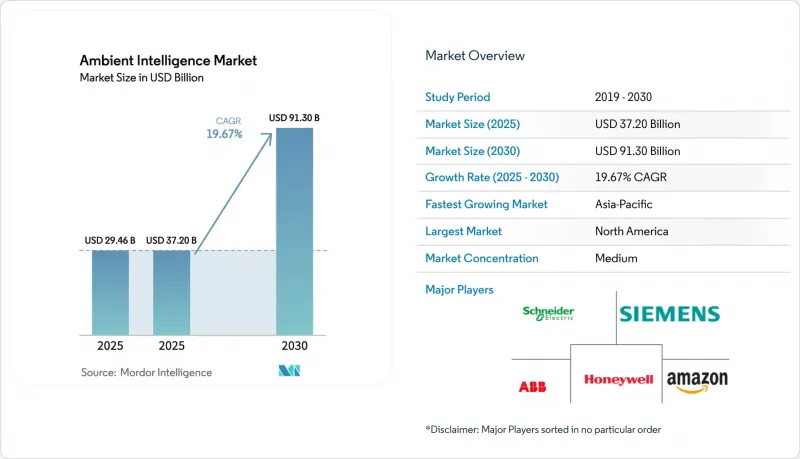
앰비언트 인텔리전스 시장 규모는 2026년 372억 달러에서 2031년까지 913억 달러에 이를 것으로 예측되며, 2026-2031년까지 CAGR 19.67%로 성장할 전망입니다.
10와트 이하의 엣지 추론 칩, 주요국의 주권적 AI 규제, 프라이버시 바이 디자인(Privacy by Design) 의무화 등이 상업적 도입을 가속화하고 있습니다. 벤더들은 임베디드 신경처리장치로 이를 대응하고 있으며, 서비스 제공업체들은 초기 도입을 넘어 확장된 예지보전 계약을 패키징하고 있습니다. 중국, 인도, 걸프 지역 국가들의 스마트시티 자본 프로그램은 민간 투자자들의 도입 위험을 낮추고 있으며, 미국의 원격 환자 모니터링에 대한 상환 코드가 의료 부문 수요를 확대시키고 있습니다. 가전 대기업들이 스마트홈 생태계를 상업용 건물에 적용함에 따라 경쟁 압력이 증가하고 있으며, 기존 산업 자동화 기업들은 컨트롤러에 부가가치 분석 기능을 통합해야 하는 상황에 직면해 있습니다.
세계 앰비언트 인텔리전스 시장 동향 및 인사이트
AI와 IoT 기기 보급
저전력 엣지 프로세서는 클라우드와의 왕복 통신에 따른 지연을 없애고 있으며, 이는 자동차, 산업, 의료 분야에서 필수적인 요소입니다. 현재 시판되는 스마트폰에는 센티미터 단위의 위치 측정이 가능한 초광대역 무선이 내장되어 있으며, 이는 소비자 하드웨어가 기업의 워크로드를 처리할 준비가 되어 있음을 보여줍니다. 모바일 OS에 페더럴 러닝을 도입하여 원시 데이터를 외부로 전송하지 않고도 모델을 개선할 수 있다는 것이 입증되어, 사무실 내 프라이버시를 보호하는 재실 감지 기술의 선례가 되고 있습니다. 메시 네트워크와 저전력 추론 기술을 통해 수년간의 배터리 수명을 실현하고, 센서 그리드는 최소한의 개보수 공사로 광활한 바닥을 커버할 수 있습니다. 결정론적 네트워크 표준도 이러한 발전과 융합되고 있으며, 환경 임계값 초과 시 밀리초 단위로 반응해야 하는 안전 인터록을 가능하게 하고 있습니다.
정부의 스마트시티 구상
중국은 교통, 대기질, 안전 분석 기능을 통합한 900여 개의 스마트시티 실증 사업에 1조 2,000억 위안(1,680억 달러)을 배정했습니다. 한편, 인도의 '스마트시티 미션'은 100개 도시 지역에 4,800억 루피(57억 6,000만 달러)를 배분했습니다. 사우디아라비아의 5,000억 달러 규모의 NEOM 프로젝트와 말레이시아 및 동남아시아의 소규모 경제권의 보조금은 디지털 도시 인프라에 대한 공공 부문의 노력을 뒷받침하고 있습니다. 이 프로그램들은 공통 데이터 플랫폼을 구축하고, 측정 가능한 에너지 절감 효과를 입증하며, 보완적인 민간 투자를 유치하고 있습니다. 현지 조달 요건과 데이터 주권 조항을 충족하는 벤더는 우선적인 접근 권한을 획득하고, 지역 내 판매 파이프라인을 가속화할 수 있습니다. 그 결과 만들어진 참고 사례는 상호운용성 프레임워크의 유효성을 입증하고, 이후 소규모 지자체에서도 이를 채택하여 주변지능 시장을 확대하는 계기가 되고 있습니다.
데이터 보안 및 프라이버시 문제
유럽 규제 당국은 2018-2025년 사이에 GDPR(EU 개인정보보호규정)에 따른 벌금으로 45억 유로(51억 달러)를 부과했습니다. 앰비언트 시스템은 모호한 동의 흐름과 과도한 데이터 보유로 인해 처벌 강화에 직면해 있습니다. 2024년 EU AI 법은 공공장소에서의 생체인증을 고위험군으로 분류하고, 수익화를 지연시키는 장기적인 적합성 평가를 의무화하고 있습니다. 미국의 의료 서비스 제공업체는 센서가 의도치 않게 보호 대상 건강 정보를 취득한 경우, HIPAA(의료보험 휴대성 및 책임에 관한 법률)에 따른 법적 책임에 직면하게 됩니다. 페더럴 러닝에서는 원시 데이터가 단말기에 보관되지만, 통합된 모델의 업데이트가 개인 데이터에 해당하는지 여부에 대해 규제 당국은 아직 명확히 밝히지 않아 법적 모호성이 발생하고 있습니다. 소비자의 인식이 높아짐에 따라 구매자는 상세한 옵트인 대시보드를 요구하고 있으며, 이는 개발 비용 증가와 판매 주기의 장기화를 초래하고 있습니다.
부문 분석
하드웨어는 2025년 매출의 59.61%를 차지해, 모든 앰비언트 배포의 기반이 되는 센서, 게이트웨이, 에지 서버에 대한 설비 투자가 이를 주도할 것으로 보입니다. 서비스 부문의 앰비언트 인텔리전스 시장 규모는 최종 사용자가 미션 크리티컬한 업무를 보호하기 위해 구독형 분석, 원격 진단, 지속적인 사이버 보안 패치 적용으로 전환함에 따라 CAGR 20.17%로 확대될 것으로 예측됩니다. 마이크로 전자기계 센서 및 블루투스 무선 모듈의 비용 하락과 추론 가속기의 대량 생산으로 인해 하드웨어의 수익률이 압박을 받고 있으며, 제조업체들은 소프트웨어와 지원을 통합한 솔루션을 제공하는 방향으로 나아가고 있습니다. 하고 있습니다.
서비스 수익은 알고리즘을 현지의 건축물 물리적 특성 및 거주자 행동에 맞게 조정하는 데 따른 복잡성으로부터도 혜택을 받고 있습니다. 공급자는 전문 지식, 규제 준수 관리, 성과 기반 에너지 보증을 번들로 제공함으로써 단일 사용 장비 판매보다 더 강력한 관계를 구축합니다. 기존 OEM과 분석 스타트업의 합병은 차별화의 핵심이 실리콘보다 매니지드 서비스로 제공되는 실용적인 인사이트에 있다는 미래 시장 환경을 예견하게 합니다.
블루투스 저에너지(Bluetooth Low Energy, BLE)는 2025년 기술 수익의 24.43%를 차지했으며, 이는 스마트폰과 비콘 네트워크의 보급률과 수년간의 배터리 수명을 실현할 수 있는 능력을 반영하고 있습니다. 한편, 초광대역(UWB)은 자동차 안전 기준과 창고 로봇의 위치 파악에 있어 30cm 이하의 정확도가 요구됨에 따라 2031년까지 연평균 복합 성장률(CAGR) 21.72%를 나타낼 것으로 예측됩니다. UWB와 관련된 주변 인텔리전스 시장 규모는 IEEE 802.15.4z 규격 준수에 따른 혜택을 누리고 있으며, 이는 신흥 자산 추적 생태계에서 멀티 벤더 간 상호 운용성을 촉진하고 있습니다.
기존 RFID는 미터 단위의 정확도로 충분한 공급망 용도에서 여전히 유용성을 유지하고 있습니다. 한편, 센서 융합 스택은 모션, 온도, 가스 감지기를 통합하여 상황 인식을 강화합니다. 엣지 소프트웨어 에이전트는 디바이스 간 대역폭과 전력 예산을 동적으로 조정하여 노드 수가 수천 개로 급증하는 상황에서도 네트워크의 내결함성을 최적화합니다. 콘크리트나 구조용 강재에 내장된 나노기술 기반 센서는 새로운 검사 워크플로우를 개척하고, 감성 컴퓨팅 모듈은 소매 및 의료 환경에서 실시간 감정 분석을 실현할 수 있습니다.
지역별 분석
북미는 2025년 전 세계 매출의 34.84%를 차지해, 스마트 빌딩의 조기 개보수, 연방 정부의 보조금, 원격 환자 모니터링을 지원하는 의료비 상환 코드에 힘입어 성장세를 이어갈 것으로 보입니다. 미국 지자체는 스마트시티 및 커뮤니티 기금 1억 6,000만 달러를 활용하여 탄소 배출량 및 운영 비용 절감을 입증하는 환경 용도 시범 사업을 실시했습니다. 캐나다의 프라이버시 보호 엣지 분석에 대한 투자는 캐나다의 AI 윤리 전략과 일치하며, 멕시코의 제조업 클러스터는 생산성을 향상시키고 니어쇼어링 경쟁을 강화하기 위해 산업용 IoT를 채택하고 있습니다. 이 지역을 특징짓는 것은 강력한 시스템 통합사업자 네트워크이며, 이는 도입 기간을 단축하고 다년간의 서비스 계약을 촉진하고 있습니다.
아시아태평양은 중국의 900개 이상의 스마트시티 실증 프로젝트, 인도의 4,800억 루피의 예산 배정, 한국의 21억 달러 규모의 스마트시티 펀드가 대규모 센서 구축을 위한 비옥한 토양을 조성하면서 2031년까지 연평균 복합 성장률(CAGR) 20.44%를 나타낼 것으로 예측됩니다. 일본의 '사회 5.0' 구상은 도시 계획과 재난 대응 전반에 앰비언트 인텔리전스을 통합하여 인간 중심의 통합적 설계를 입증하고 있습니다. 호주 및 뉴질랜드는 넷제로 건축으로 개조하는 데 주력하고 있으며, 입주자 분석을 활용하여 야심찬 탄소배출량 감축 목표를 달성하기 위해 노력하고 있습니다. 기술 표준의 분열과 데이터 현지화 관련 법규가 국경 간 조정을 복잡하게 만들고 있지만, 정부의 자본 지출과 급속한 도시화는 그 추진력을 유지하고 있습니다.
유럽의 성장은 온디바이스 처리를 권장하는 엄격한 프라이버시 및 에너지 지침에 의해 뒷받침되고 있습니다. 독일, 프랑스, 영국, 영국, 이탈리아, 스페인이 지역 지출의 대부분을 차지하고 있으며, 기업 부동산 소유주들이 점점 더 엄격해지는 건물 에너지 기준을 준수하기 위해 설비를 업데이트하고 있기 때문입니다. 중동의 그린필드 메가 프로젝트는 사우디아라비아의 5,000억 달러 규모의 'NEOM'과 아랍에미리트의 '스마트시티 2030' 구상을 필두로 계획 단계부터 환경 플랫폼을 통합하여 원활한 거주자 경험의 벤치마킹을 확립하고 있습니다. 아프리카와 남미는 새로운 기회가 창출되는 지역으로 부상하고 있으며, 모바일을 우선시하는 주민층이 고정 인프라를 뛰어넘어 제한된 지자체 예산에도 불구하고 기본적인 보안 및 환경 기능을 제공하는 배터리 구동형 센서 네트워크를 구축하고 있습니다.
기타 혜택
- 엑셀 형태 시장 예측(ME) 시트
- 3개월간 애널리스트 지원
자주 묻는 질문
목차
제1장 서론
제2장 조사 방법
제3장 주요 요약
제4장 시장 구도
제5장 시장 규모와 성장 예측
제6장 경쟁 구도
제7장 시장 기회와 향후 전망
JHS 26.06.02The ambient intelligence market size is expected to increase from USD 37.20 billion in 2026 to reach USD 91.30 billion by 2031, growing at a CAGR of 19.67% over 2026-2031.
Edge inference chips that consume less than 10 watts, sovereign-AI rules in major economies, and privacy-by-design mandates are accelerating commercial adoption. Hardware vendors are responding with embedded neural-processing units while service providers package predictive-maintenance contracts that stretch beyond initial installations. Smart-city capital programs in China, India, and the Gulf states are lowering deployment risk for private investors, and reimbursement codes for remote patient monitoring in the United States are widening healthcare demand. Competitive pressure is intensifying as consumer-electronics giants port smart-home ecosystems into commercial buildings, forcing industrial-automation incumbents to bundle value-added analytics with their controllers.
Global Ambient Intelligence Market Trends and Insights
Proliferation Of AI And IoT Devices
Low-power edge processors are eliminating latency linked to cloud round-trips, which is essential in automotive, industrial, and healthcare settings. Commercial smartphones now integrate ultra-wideband radios that provide centimetric positioning, demonstrating consumer hardware's readiness for enterprise workloads. Federated-learning rollouts on mobile operating systems have proven that models can improve without exporting raw data, setting precedents for privacy-preserving occupancy sensing in offices. Multi-year battery life achieved through mesh networking and power-efficient inference allows sensor grids to blanket large floorplates with minimal retrofit disruption. Deterministic networking standards are converging with these advances, enabling safety interlocks that must react within milliseconds when environmental thresholds are breached.
Government Smart-City Initiatives
China earmarked CNY 1.2 trillion (USD 168 billion) for more than 900 smart-city pilots that embed traffic, air-quality, and safety analytics, while India's Smart Cities Mission allocated INR 48,000 crore (USD 5.76 billion) across 100 urban centers. Saudi Arabia's USD 500 billion NEOM project, plus grants in Malaysia and smaller Southeast Asian economies, underscores public-sector commitment to digital urban infrastructure. These programs establish common data platforms, demonstrate measurable energy savings, and attract complementary private investments. Vendors that satisfy local content and data-sovereignty clauses gain preferential access, accelerating regional sales pipelines. The resulting reference sites validate interoperability frameworks that smaller municipalities later adopt, expanding the ambient intelligence market.
Data Security And Privacy Concerns
European regulators levied EUR 4.5 billion (USD 5.1 billion) in GDPR fines between 2018 and 2025, with ambient systems facing rising penalties for vague consent flows and excessive retention. The 2024 EU AI Act classifies public-space biometric identification as high risk, forcing lengthy conformity assessments that slow revenue conversion. U.S. healthcare providers confront HIPAA liability when sensors inadvertently capture protected health information. Although federated learning keeps raw data on-device, regulators have yet to clarify whether aggregated model updates count as personal data, creating legal ambiguity. Rising consumer awareness means buyers demand granular opt-in dashboards, raising development costs and elongating sales cycles.
Other drivers and restraints analyzed in the detailed report include:
- Demand For Energy-Efficient Smart Buildings
- Adoption Of Ambient-Assisted Living In Healthcare
- Lack Of Interoperability Standards
For complete list of drivers and restraints, kindly check the Table Of Contents.
Segment Analysis
Hardware retained 59.61% of 2025 revenue, driven by capital outlays on sensors, gateways, and edge servers that anchor every ambient deployment. The ambient intelligence market size for services is projected to expand at a 20.17% CAGR as end users pivot toward subscription analytics, remote diagnostics, and continuous cybersecurity patching that safeguard mission-critical operations. Cost declines in microelectromechanical sensors and Bluetooth radios, along with volume production of inference accelerators, are compressing hardware margins and nudging manufacturers toward integrated offerings that wrap software and support around their devices.
Services revenue also benefits from the complexity inherent in tuning algorithms to local building physics and occupant behavior. Providers bundle domain expertise, regulatory compliance management, and outcome-based energy guarantees, creating stickier relationships than one-time equipment sales. Mergers between traditional OEMs and analytics startups foreshadow a landscape where differentiation hinges less on silicon and more on actionable insights delivered as a managed service.
Bluetooth Low Energy accounted for 24.43% technology revenue in 2025, reflecting its ubiquity in smartphones and beacon networks that enable multi-year battery life. Ultra-wideband, however, is on track to post a 21.72% CAGR through 2031 as automotive safety mandates and warehouse-robot localization demand sub-30 centimeter accuracy. The ambient intelligence market size linked to ultra-wideband benefits from IEEE 802.15.4z compliance, which fosters multivendor interoperability in emerging asset-tracking ecosystems.
Legacy RFID maintains relevance in supply-chain applications that tolerate meter-level precision, while sensor-fusion stacks integrate motion, temperature, and gas detectors to enrich contextual awareness. Edge software agents dynamically balance bandwidth and power budgets among devices, optimizing network resilience as node counts surge into the thousands. Nanotechnology-enabled sensors embedded in concrete or structural steel open new inspection workflows, while affective-computing modules surface real-time sentiment analytics in retail and healthcare environments.
Ambient Intelligence Market Report is Segmented by Component (Hardware, Software, and Services), Technology (BLE, RFID, Sensors, Biometrics, UWB, and More), End-User (Residential, Retail, Healthcare, Industrial, Office, and More), Application (Building Management, AAL, Home Automation, Retail Analytics, Manufacturing IoT, Mobility, Safety, Energy, and More), and Geography. The Market Forecasts are Provided in Terms of Value (USD).
Geography Analysis
North America held 34.84% of global revenue in 2025, supported by early smart-building retrofits, federal grants, and healthcare reimbursement codes that underwrite remote patient monitoring. U.S. municipalities leveraged USD 160 million in Smart Cities and Communities funding to pilot ambient applications that showcase carbon and operational savings. Canadian investments in privacy-preserving edge analytics align with national AI-ethics strategies, while Mexico's manufacturing clusters adopt industrial IoT to lift productivity and shore up near-shoring competitiveness. A robust cadre of system integrators distinguishes the region, shortening deployment timelines and fostering multiyear service contracts.
Asia-Pacific is projected to post a 20.44% CAGR through 2031 as China's 900-plus smart-city pilots, India's INR 48,000 crore allocation, and South Korea's USD 2.1 billion smart-city fund create fertile ground for large-scale sensor rollouts. Japan's Society 5.0 agenda embeds ambient intelligence across urban planning and disaster response, demonstrating integrated human-centric design. Australia and New Zealand concentrate on net-zero building retrofits, using occupancy analytics to meet aggressive carbon targets. Technical-standard fragmentation and data-localization statutes complicate cross-border harmonization, yet government capital outlays and rapid urbanization sustain momentum.
Europe's growth is anchored by stringent privacy and energy directives that favor on-device processing. Germany, France, the United Kingdom, Italy, and Spain capture the bulk of regional expenditure as corporate real-estate owners upgrade to comply with increasingly rigorous building-energy codes. The Middle East's greenfield megaprojects, led by Saudi Arabia's USD 500 billion NEOM and the United Arab Emirates' Smart City 2030 blueprint, integrate ambient platforms from inception, setting benchmarks for seamless occupant experiences. Africa and South America are emerging opportunity zones where mobile-first populations leapfrog fixed infrastructure, deploying battery-powered sensor networks that deliver foundational security and environmental functions despite constrained municipal budgets.
- Schneider Electric SE
- Siemens Aktiengesellschaft
- Honeywell International Inc.
- ABB Ltd.
- Amazon.com, Inc.
- Koninklijke Philips N.V.
- Johnson Controls International plc
- Google LLC
- Apple Inc.
- Microsoft Corporation
- Samsung Electronics Co., Ltd.
- Robert Bosch GmbH
- Cisco Systems, Inc.
- Legrand S.A.
- Ingersoll Rand Inc.
- Tunstall Healthcare (UK) Ltd.
- CareTech AB
- GETEMED Medizin- und Informationstechnik AG
- Televic N.V.
- VITAPHONE GmbH
- Xiaomi Corporation
- Assisted Living Technologies, Inc.
Additional Benefits:
- The market estimate (ME) sheet in Excel format
- 3 months of analyst support
TABLE OF CONTENTS
1 INTRODUCTION
- 1.1 Study Assumptions and Market Definition
- 1.2 Scope of the Study
2 RESEARCH METHODOLOGY
3 EXECUTIVE SUMMARY
4 MARKET LANDSCAPE
- 4.1 Market Overview
- 4.2 Market Drivers
- 4.2.1 Proliferation of AI and IoT Devices
- 4.2.2 Government Smart-City Initiatives
- 4.2.3 Demand for Energy-Efficient Smart Buildings
- 4.2.4 Adoption of Ambient-Assisted Living in Healthcare
- 4.2.5 Federated Learning Enhancing On-Device Context Awareness
- 4.2.6 Integration of Ambient Intelligence with Digital Twins for Predictive Facility Management
- 4.3 Market Restraints
- 4.3.1 Data Security and Privacy Concerns
- 4.3.2 Lack of Interoperability Standards
- 4.3.3 High Contextual Bias Risks in AI Decision-Making
- 4.3.4 Limited On-Device Power Budget for Complex Inference in Legacy Buildings
- 4.4 Industry Value-Chain Analysis
- 4.5 Regulatory Landscape
- 4.6 Technological Outlook
- 4.7 Porter's Five Forces Analysis
- 4.7.1 Bargaining Power of Buyers
- 4.7.2 Bargaining Power of Suppliers
- 4.7.3 Threat of New Entrants
- 4.7.4 Threat of Substitutes
- 4.7.5 Competitive Rivalry
5 MARKET SIZE AND GROWTH FORECASTS (VALUE)
- 5.1 By Component
- 5.1.1 Hardware
- 5.1.2 Software and Solutions
- 5.1.3 Services
- 5.2 By Technology
- 5.2.1 Bluetooth Low Energy
- 5.2.2 RFID
- 5.2.3 Sensors
- 5.2.4 Software Agents
- 5.2.5 Affective Computing
- 5.2.6 Nanotechnology
- 5.2.7 Biometrics
- 5.2.8 Ultra-Wideband
- 5.2.9 Other Technologies
- 5.3 By End-user Industry
- 5.3.1 Residential
- 5.3.2 Retail
- 5.3.3 Healthcare
- 5.3.4 Industrial
- 5.3.5 Office Building
- 5.3.6 Automotive
- 5.3.7 Automotive
- 5.3.8 Education
- 5.3.9 Other End-user Industries
- 5.4 By Application
- 5.4.1 Smart Building Management
- 5.4.2 Ambient-Assisted Living
- 5.4.3 Smart Home Automation
- 5.4.4 Smart Retail Analytics
- 5.4.5 Smart Manufacturing and Industrial IoT
- 5.4.6 Smart Mobility and Transportation
- 5.4.7 Public Safety and Security
- 5.4.8 Energy Management
- 5.4.9 Environmental Monitoring
- 5.4.10 Other Applications
- 5.5 By Geography
- 5.5.1 North America
- 5.5.1.1 United States
- 5.5.1.2 Canada
- 5.5.1.3 Mexico
- 5.5.2 South America
- 5.5.2.1 Brazil
- 5.5.2.2 Argentina
- 5.5.2.3 Rest of South America
- 5.5.3 Europe
- 5.5.3.1 Germany
- 5.5.3.2 United Kingdom
- 5.5.3.3 France
- 5.5.3.4 Italy
- 5.5.3.5 Spain
- 5.5.3.6 Rest of Europe
- 5.5.4 Asia-Pacific
- 5.5.4.1 China
- 5.5.4.2 India
- 5.5.4.3 Japan
- 5.5.4.4 South Korea
- 5.5.4.5 Australia and New Zealand
- 5.5.4.6 Rest of Asia-Pacific
- 5.5.5 Middle East
- 5.5.5.1 Saudi Arabia
- 5.5.5.2 United Arab Emirates
- 5.5.5.3 Turkey
- 5.5.5.4 Rest of Middle East
- 5.5.6 Africa
- 5.5.6.1 South Africa
- 5.5.6.2 Nigeria
- 5.5.6.3 Egypt
- 5.5.6.4 Rest of Africa
- 5.5.1 North America
6 COMPETITIVE LANDSCAPE
- 6.1 Market Concentration
- 6.2 Strategic Moves
- 6.3 Market Share Analysis
- 6.4 Company Profiles (includes Global Level Overview, Market Level Overview, Core Segments, Financials as available, Strategic Information, Market Rank/Share, Products and Services, Recent Developments)
- 6.4.1 Schneider Electric SE
- 6.4.2 Siemens Aktiengesellschaft
- 6.4.3 Honeywell International Inc.
- 6.4.4 ABB Ltd.
- 6.4.5 Amazon.com, Inc.
- 6.4.6 Koninklijke Philips N.V.
- 6.4.7 Johnson Controls International plc
- 6.4.8 Google LLC
- 6.4.9 Apple Inc.
- 6.4.10 Microsoft Corporation
- 6.4.11 Samsung Electronics Co., Ltd.
- 6.4.12 Robert Bosch GmbH
- 6.4.13 Cisco Systems, Inc.
- 6.4.14 Legrand S.A.
- 6.4.15 Ingersoll Rand Inc.
- 6.4.16 Tunstall Healthcare (UK) Ltd.
- 6.4.17 CareTech AB
- 6.4.18 GETEMED Medizin- und Informationstechnik AG
- 6.4.19 Televic N.V.
- 6.4.20 VITAPHONE GmbH
- 6.4.21 Xiaomi Corporation
- 6.4.22 Assisted Living Technologies, Inc.
7 MARKET OPPORTUNITIES AND FUTURE OUTLOOK
- 7.1 White-Space and Unmet-Need Assessment


