|
시장보고서
상품코드
2044156
애플리케이션 보안 : 시장 점유율 분석, 업계 동향 및 통계, 성장 예측(2026-2031년)Application Security - Market Share Analysis, Industry Trends & Statistics, Growth Forecasts (2026 - 2031) |
||||||
 Mordor Intelligence
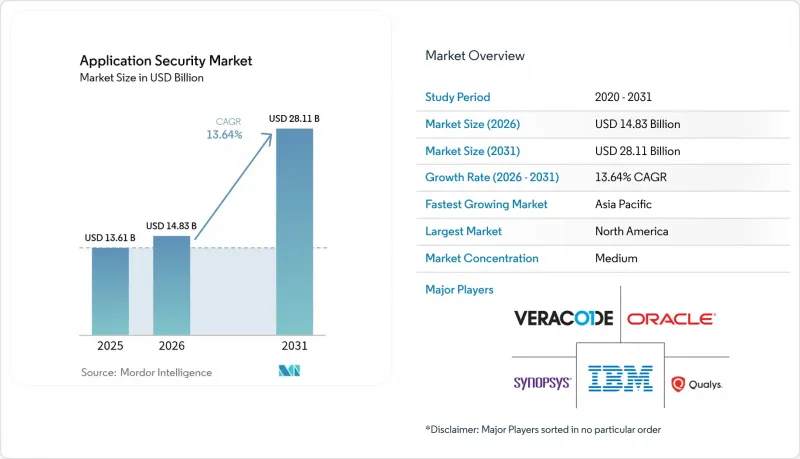
애플리케이션 보안 시장 규모는 2025년 136억 1,000만 달러로 평가되었습니다. 2026년 148억 3,000만 달러로 확대되어 2031년까지 281억 1,000만 달러에 이를 것으로 예측되며, 2026년부터 2031년에 걸쳐 CAGR 13.64%를 나타낼 전망입니다.
현재 CI(Continuous Integration) 파이프라인에는 커밋마다 코드 스캔이 내장되어 있으며, 개발, 스테이징, 프로덕션 각 계층에서 도구의 활용이 확대되고 있습니다. 미국 규제 당국이 2025년 웹 사고의 42%가 보안 대책이 미흡한 인터페이스와 관련이 있다고 지적한 이후, 기업들은 API를 의식한 테스트로 전환하고 있습니다. 2025년 3월 PCI-DSS 4.0 완전 준수 의무화 시한이 다가옴에 따라 구매 주기가 단축되고, 소프트웨어 구성 분석 및 런타임 보호 도입이 가속화되고 있습니다. 한편, 조직이 운영 중인 비즈니스 로직의 결함을 감지하고자 하는 가운데, 동적 및 대화형 테스트 스위트가 독립형 정적 분석 도구의 지위를 빼앗아가고 있습니다. 특히 대형 플랫폼 벤더들의 틈새 API, 컨테이너, 공급망 전문 업체 인수 등 합병은 경쟁 구도를 바꾸고 번들형 DevSecOps 제품군의 확장을 가져오고 있습니다.
세계의 애플리케이션 보안 시장 동향 및 인사이트
웹, 모바일 및 API 기반 공격 증가와 고도화
공격자들은 인증이 미흡한 API 엔드포인트, 결함이 있는 오브젝트 레벨 권한 관리, 과도한 데이터 노출 등의 취약점을 악용하여 경계 방어를 우회하는 사례가 증가하고 있습니다. 2024년판 OWASP API 보안 톱 10에서 지적된 취약점입니다. 2025년 금융 서비스 기업에서 공격자가 모바일 뱅킹 앱의 검증되지 않은 입력 파라미터를 악용한 결과, API를 악용한 부정 시도가 67% 급증했습니다. 그 결과, 기업들은 실행 중인 용도 내에서 악성 페이로드를 재생하는 동적 및 대화형 테스트를 도입하고, 모든 요청을 검사하는 실시간 게이트웨이와 결합하고 있습니다. 현재 규제 당국이 생체 인증과 암호화된 로컬 스토리지를 의무화함에 따라, 모바일 소프트웨어도 비슷한 조사를 받고 있으며, 애자일 팀은 각 스프린트 내에서 보안 검사를 예약해야 합니다. 데이터 유출 및 계정 탈취로 인한 임박한 비즈니스 위험으로 인해, 이 요인은 전체 애플리케이션 보안 시장에서 신규 지출의 가장 큰 원동력이 되고 있습니다.
DevSecOps 툴체인의 급속한 대중화
GitLab의 세계 조사에 따르면, 지속적 통합(CI) 및 지속적 제공(CD) 파이프라인에 내장된 자동화된 보안 검사로 인해 취약점 감지까지 걸리는 평균 시간이 2023년 21일에서 2025년 4일로 단축되었습니다. 현재 쿠버네티스 클러스터에는 심각한 결함이 있는 컨테이너를 차단하는 정책 엔진이 적용되어 코드가 병합되기 전에 업스트림 단계에서 수정 조치가 이루어지도록 하고 있습니다. 클라우드 제공업체는 인프라 설정 오류와 더불어 용도 계층의 취약점을 강조하는 네이티브 대시보드를 제공함으로써 개발자가 익숙한 콘솔에서 엔드투엔드 위험 상황을 파악할 수 있도록 하고 있습니다. 그럼에도 불구하고, 평균적인 조직은 이미 7개의 서로 다른 스캐너를 운영하고 있으며, 이로 인해 경고 피로와 통합 오버헤드가 발생하고 있습니다. 벤더들은 통합 오케스트레이션 플랫폼을 통해 이러한 문제를 해결하고 있습니다. 전반적으로, 보안 제어를 개발자의 워크플로우에 직접 통합함으로써 이용 가능한 기회가 확대되고, 애플리케이션 보안 시장 전체에서 라이선스의 복합적인 성장을 가속할 수 있습니다.
높은 총소유비용(TCO) 및 툴의 복잡성
미국 사이버보안연맹(NCSA)의 조사에 따르면, 2025년 기준 중소기업의 62%가 자동 테스트 도입의 가장 큰 장벽으로 비용을 꼽았다고 합니다. 라이선스 비용 외에도, 팀은 제한된 엔지니어를 투입하여 스캔 규칙을 설정하고, 출력된 결과를 티켓 관리 시스템에 통합하고, 수천 개의 감지 결과의 우선순위를 정해야 합니다. 주요 도시에서는 이러한 업무를 담당하는 엔지니어의 연봉이 12만 달러가 넘습니다. 통합 플랫폼으로의 마이그레이션 프로젝트는 12-18개월에 걸쳐 진행될 수 있으며, 이는 출시 주기를 방해하고 일부 기업이 현대화를 연기하도록 유도하고 있습니다. 종량제 클라우드 요금 체계는 예산의 변동성을 가져오고, 재정적 제약이 있는 조직의 계획을 더욱 복잡하게 만들고 있습니다. 그 결과, 잠재적 구매자들, 특히 중소기업들은 전면적인 도입을 미룰 수 있으며, 이는 전체 애플리케이션 보안 시장의 단기적인 성장을 둔화시킬 수 있습니다.
부문 분석
솔루션 부문은 2025년 매출의 61.48%를 차지했으며, 소스 관리 및 지속적인 통합 흐름과 원활하게 통합되는 플랫폼에 대한 수요가 지속해서 증가하고 있는 것으로 나타났습니다. 서비스 부문은 CAGR 13.67%로 성장하고 있습니다. 이는 조직이 침투 테스트, 경보 분류, 개발자의 스킬업을 세계 컨설팅 업체에 위탁하여 내부 인력 부족을 완화하고 있기 때문입니다. 전문 어드바이저가 복잡한 사용자 기반 라이선스 협상, 규칙 세트 설정, 감사에 대응할 수 있는 증거를 제공함으로써 제품 팀은 신속한 기능 출시에 전념할 수 있습니다.
매니지드 서비스는 자동화된 스캐닝과 24시간 365일 24시간 사람의 검증을 결합하여 이론적 결함보다 악용 가능성이 있는 발견을 우선순위를 매깁니다. 이는 엄격한 정보유출통지법의 적용을 받는 결제처리업체와 의료시스템에서 높은 평가를 받고 있는 모델입니다. 벤더들은 자문 시간을 엔터프라이즈 계약에 포함시킴으로써 소프트웨어 및 서비스의 경계를 모호하게 만들고, 고객을 장기 계약에 묶어두고 있습니다. 이러한 통합으로 인해 플랫폼에 대한 지출은 안정적으로 유지되는 반면, 애플리케이션 보안 시장 전체에서 사고 대응 및 교육과 같은 추가 서비스 도입이 가속화되고 있습니다.
클라우드 배포는 2025년 매출의 57.81%를 차지했으며, 아마존, 마이크로소프트, 구글의 개발자 콘솔 내 스캐너 통합에 힘입어 2031년까지 연평균 13.77%의 성장률로 확대될 것으로 전망됩니다. 코드 에디터 내에서 제공되는 실시간 피드백은 컨텍스트 전환이 필요 없어 지속적인 스캐닝을 촉진하고, 스타트업 및 소규모 팀에 적합한 종량제 경제성을 제공합니다.
On-Premise형 솔루션은 외부 코드 처리를 금지하는 에어갭 환경을 운영하는 은행이나 국방 기관에 여전히 필수적입니다. 하이브리드 모델이 부상하고 있으며, 중요도가 높은 모듈은 방화벽 내부에 컨테이너화된 테스트 엔진을 배치하고, 중요도가 낮은 마이크로서비스는 퍼블릭 클라우드에서 실행되는 하이브리드 모델이 등장하고 있습니다. 벤더들은 현재 두 가지 모드에서 동일한 기능 세트를 제공하고 있으며, 고객은 도구의 혼란 없이 단계적으로 전환할 수 있습니다. 규제상 데이터 주권 조항이 강화되는 가운데, 유연한 도입 형태는 애플리케이션 보안 시장에서 경쟁적 차별화 요소로 작용하고 있습니다.
애플리케이션 보안 시장은 구성 요소(솔루션 및 서비스), 구축 모드(클라우드 및 On-Premise), 조직 규모(중소기업 및 대기업), 보안 테스트 유형(SAST, DAST 등), 최종 사용자 산업(은행, 금융서비스 및 보험(BFSI), 헬스케어, 소매 및 전자상거래 등), 지역별로 세분화됩니다. 전자상거래 등), 지역별로 세분화되어 있습니다. 시장 예측은 금액(USD) 기준으로 제공됩니다.
지역별 분석
북미는 2025년 매출의 40.91%를 차지했으며, 연방정부 조달 시 벤더에게 소프트웨어 BOM(Bill of Materials) 제출을 의무화하는 대통령령 14028호에 힘입어 성장세를 이어갈 것으로 보입니다. 미국 사이버보안인프라보안청(CISA)은 2024년 보안 소프트웨어 표준을 발표하여 사실상 공공 부문 계약에서 애플리케이션 보안 조치가 필수 요건이 되었습니다. 벤처캐피털의 자금 지원으로 스타트업의 설립이 지속적으로 촉진되고 있으며, 기존 기업과 오픈소스 신규 진출기업 간의 경쟁이 심화되는 한편, 기능의 급속한 혁신이 진행되고 있습니다.
아시아태평양은 인도의 디지털 대출 규제와 인도네시아의 은행 현대화, 독립적인 보안 감사 및 'Secure by Design' 라이프사이클에 대한 요구로 인해 2031년까지 연평균 복합 성장률(CAGR) 13.83%로 가장 높은 성장률을 나타낼 것으로 예측됩니다. 중국의 '다층 보호 체계 2.0'은 용도 계층에서 암호화와 취약점 공개를 의무화하고 있으며, 국내 플랫폼은 개발 초기 단계부터 SAST 및 DAST 도구를 통합하도록 하고 있습니다. 일본, 한국, 호주의 컴플라이언스 변경은 지역적 수요를 더욱 통일시키고, 세계 벤더들이 로컬 데이터 레지던시 및 언어 팩을 추가하도록 유도하고 있습니다.
유럽에서는 2025년 1월부터 시행된 '디지털 운영 탄력성 법'의 혜택을 받고 있습니다. 이 법은 금융업계에 분기별 침투 테스트를 의무화하고, 버전 관리 수준의 감사 추적 도입을 촉진하고 있습니다. 앞으로 시행될 '사이버 복원력법'은 'Secure by Design' 의무를 단일 시장 내에서 판매되는 모든 소프트웨어로 확대하여 기존 규제 대상 업종을 넘어서는 범위로 적용 범위를 확대할 예정입니다. 중동 및 아프리카 시장은 아직 개발 중이지만, 사우디아라비아 및 아랍에미레이트의 소버린 클라우드 의무화로 인해 인증된 보안 도구와 결합된 현지 호스팅이 요구되면서 시장이 가속화되고 있습니다. 남미에서는 브라질과 멕시코의 금융 규제 당국이 PCI-DSS 4.0과 가이드라인을 일치시키고, 은행과 핀테크 기업들에게 지속적인 테스트를 독려하면서 도입이 서서히 진행되고 있습니다. 전반적으로 컴플라이언스 정합성이 각 지역의 동향을 수렴하고 있으며, 세계 애플리케이션 보안 시장을 확대되고 있습니다.
기타 혜택 :
- 엑셀 형식 시장 예측(ME) 시트
- 3개월간 애널리스트 지원
자주 묻는 질문
목차
제1장 서론
제2장 조사 방법
제3장 주요 요약
제4장 시장 구도
제5장 시장 규모와 성장 예측
제6장 경쟁 구도
제7장 시장 기회와 향후 전망
KTHThe application security market size is expected to increase from USD 13.61 billion in 2025 to USD 14.83 billion in 2026 and reach USD 28.11 billion by 2031, growing at a CAGR of 13.64% over 2026-2031.
Continuous integration pipelines now embed code scanning at every commit, multiplying tool usage across development, staging and production layers. Enterprises are pivoting toward API-aware testing after United States regulators highlighted that 42% of 2025 web incidents involved insecure interfaces. Deadlines such as the March 2025 mandate for full PCI-DSS 4.0 compliance compressed buying cycles, accelerating adoption of software composition analysis and runtime protection. Meanwhile, dynamic and interactive testing suites are displacing stand-alone static analyzers as organizations seek to detect business-logic flaws during live execution. Mergers, especially by large platform vendors buying niche API, container and supply-chain specialists, are reshaping competitive dynamics and expanding bundled DevSecOps suites.
Global Application Security Market Trends and Insights
Rising Volume And Sophistication Of Web, Mobile And API-Based Attacks
Attackers increasingly bypass perimeter controls by exploiting poorly authenticated API endpoints, broken object-level authorization and excessive data exposure, vulnerabilities flagged in the 2024 OWASP API Security Top 10. Financial services firms logged a 67% jump in API-driven fraud attempts during 2025 as adversaries manipulated unchecked input parameters in mobile banking apps. Enterprises consequently deploy dynamic and interactive testing that replay malicious payloads inside running applications, combined with real-time gateways inspecting every request. Mobile software faces similar scrutiny because regulators now mandate biometric authentication and encrypted local storage, forcing agile teams to schedule security scans within each sprint. The immediate business risk of data exfiltration and account takeover makes this driver the single largest catalyst for new spending across the application security market.
Rapid Adoption Of DevSecOps Toolchains
Automated security scans built into continuous integration and continuous delivery pipelines reduced median time to vulnerability detection from 21 days in 2023 to 4 days in 2025, as reported by GitLab's global survey. Kubernetes clusters now enforce policy engines that block containers containing critical flaws, pushing remediation upstream before code can merge. Cloud providers supply native dashboards highlighting application-layer weaknesses alongside infrastructure misconfigurations, giving developers an end-to-end risk posture within familiar consoles. Nevertheless, the average organization already runs seven distinct scanners, creating alert fatigue and integration overhead that vendors address through unified orchestration platforms. Overall, embedding security controls directly inside developer workflows expands addressable usage moments and fuels compounding license growth across the application security market.
High Total Cost Of Ownership And Tool Complexity
National Cyber Security Alliance research showed that 62% of small firms cited cost as the top barrier to automated testing in 2025. Beyond license fees, teams must allocate scarce engineers to configure scan rules, integrate outputs into ticketing systems and triage thousands of findings, roles commanding salaries above USD 120,000 in major hubs. Migration projects toward unified platforms can span 12-18 months, disrupting release cadences and prompting some businesses to defer modernization. Consumption-based cloud pricing introduces budget volatility, further complicating planning for cash-constrained organizations. As a result, potential buyers, particularly SMEs, may postpone full coverage, tempering short-term growth across the application security market.
Other drivers and restraints analyzed in the detailed report include:
- Expanding Regulatory Mandates (PCI-DSS 4.0, GDPR, DORA)
- Growth In Third-Party SaaS And API Integrations
- Global Shortage Of Secure-Coding Talent
For complete list of drivers and restraints, kindly check the Table Of Contents.
Segment Analysis
Solutions maintained 61.48% of 2025 revenue, confirming entrenched demand for platforms that integrate seamlessly with source control and continuous integration flows. The services segment is growing at a 13.67% CAGR because organizations delegate penetration testing, alert triage and developer upskilling to global consulting firms, mitigating in-house talent shortages. Professional advisers negotiate complex seat-based licenses, configure rule sets and deliver audit-ready evidence, freeing product teams to ship features faster.
Managed services also combine automated scans with 24/7 human validation, ranking exploitable findings over theoretical flaws, a model prized by payment processors and healthcare systems under strict breach-notification laws. Solutions vendors bundle advisory hours into enterprise agreements, blurring lines between software and services and locking clients into long-term contracts. This convergence keeps platform spending steady while accelerating uptake of add-on incident-response and training offerings across the application security market.
Cloud deployment held 57.81% of revenue in 2025 and is projected to compound at 13.77% through 2031, buoyed by Amazon, Microsoft and Google integrating scanners inside developer consoles. Real-time feedback delivered within code editors eliminates context switching, encouraging continuous scanning and facilitating pay-as-you-go economics ideal for startups and small teams.
On-premise solutions remain indispensable for banks and defense agencies operating air-gapped environments that prohibit external code processing. Hybrid models are rising, with containerized testing engines deployed behind firewalls for sensitive modules, while less critical microservices run in public clouds. Vendors now ship identical feature sets across both modes, allowing customers gradual migration without tooling disruption. As regulatory data-sovereignty clauses tighten, flexible deployment remains a competitive differentiator within the application security market.
Application Security Market is Segmented by Component (Solutions, and Services), Deployment Mode (Cloud, and On-Premises), Organization Size (SMEs, and Large Enterprises), Security Testing Type (SAST, DAST, and More), End-User Industry (BFSI, Healthcare, Retail and E-Commerce, and More), and Geography. The Market Forecasts are Provided in Terms of Value (USD).
Geography Analysis
North America accounted for 40.91% of 2025 revenue, propelled by Executive Order 14028, which obliges vendors to supply software bills of materials for federal procurement. The United States Cybersecurity and Infrastructure Security Agency published baseline secure-software standards in 2024, effectively making application security controls contractual requirements for public-sector deals. Venture capital funding fosters constant startup formation, intensifying competition among incumbents and open-source challengers while driving rapid feature innovation.
Asia-Pacific delivers the fastest 13.83% CAGR through 2031 as India's digital lending rules and Indonesia's banking modernization require independent security audits and secure-by-design lifecycles. China's Multi-Level Protection Scheme 2.0 enforces application-layer encryption and vulnerability disclosure, causing domestic platforms to embed SAST and DAST tooling from the earliest sprint. Compliance changes across Japan, South Korea and Australia further unify regional demand, prompting global vendors to add local data residency and language packs.
Europe benefits from the Digital Operational Resilience Act effective January 2025, mandating quarterly penetration testing for finance and pushing adoption of version-control-level audit trails. The forthcoming Cyber Resilience Act will extend secure-by-design duties to all software sold inside the single market, broadening scope beyond traditional regulated verticals. Middle East and Africa markets remain nascent but accelerate as sovereign-cloud mandates in Saudi Arabia and the United Arab Emirates require local hosting paired with certified security tooling. South America witnesses gradual uptake as financial regulators in Brazil and Mexico harmonize guidance with PCI-DSS 4.0, nudging banks and fintechs toward continuous testing. Collectively, compliance harmonization converges regional trajectories, enlarging the global application security market.
- IBM
- Synopsys Inc.
- Checkmarx
- Veracode (Thoma Bravo)
- Micro Focus
- Oracle Corporation
- Rapid7
- Qualys
- Palo Alto Networks
- Fortinet
- Trend Micro
- GitLab
- GitHub
- Snyk
- CrowdStrike
- Contrast Security
- WhiteHat Security (NTT)
- Positive Technologies
- SiteLock
- Mend (WhiteSource)
- ArmorCode
- Fasoo
- HCL Software (AppScan)
Additional Benefits:
- The market estimate (ME) sheet in Excel format
- 3 months of analyst support
TABLE OF CONTENTS
1 INTRODUCTION
- 1.1 Study Assumptions and Market Definition
- 1.2 Scope of the Study
2 RESEARCH METHODOLOGY
3 EXECUTIVE SUMMARY
4 MARKET LANDSCAPE
- 4.1 Market Overview
- 4.2 Market Drivers
- 4.2.1 Rising Volume and Sophistication of Web-, Mobile- and API-Based Attacks
- 4.2.2 Rapid Adoption of DevSecOps Toolchains
- 4.2.3 Expanding Regulatory Mandates (PCI-DSS 4.0, GDPR, DORA, etc.)
- 4.2.4 Growth in Third-Party SaaS and API Integrations
- 4.2.5 Mandatory SBOM Disclosure Post-US Executive Order 14028
- 4.2.6 AI-Generated Code Inflating Unknown Vulnerabilities
- 4.3 Market Restraints
- 4.3.1 High Total Cost of Ownership and Tool Complexity
- 4.3.2 Global Shortage of Secure-Coding Talent
- 4.3.3 False-Positive Overload Eroding Developer Trust
- 4.3.4 "Shift-Left Fatigue" and Tool Sprawl
- 4.4 Value Chain Analysis
- 4.5 Regulatory Landscape
- 4.6 Technological Outlook
- 4.7 Porter's Five Forces Analysis
- 4.7.1 Threat of New Entrants
- 4.7.2 Bargaining Power of Buyers
- 4.7.3 Bargaining Power of Suppliers
- 4.7.4 Threat of Substitutes
- 4.7.5 Competitive Rivalry
- 4.8 Impact of Macroeconomic Factors on the Market
5 MARKET SIZE AND GROWTH FORECASTS (VALUE)
- 5.1 By Component
- 5.1.1 Solutions
- 5.1.2 Services
- 5.2 By Deployment Mode
- 5.2.1 Cloud
- 5.2.2 On-Premise
- 5.3 By Organization Size
- 5.3.1 Small and Medium Enterprises (SMEs)
- 5.3.2 Large Enterprises
- 5.4 By Security Testing Type
- 5.4.1 Static Application Security Testing (SAST)
- 5.4.2 Dynamic Application Security Testing (DAST)
- 5.4.3 Interactive Application Security Testing (IAST)
- 5.4.4 Run-Time Application Self-Protection (RASP)
- 5.4.5 Software Composition Analysis (SCA)
- 5.5 By End-User Industry
- 5.5.1 BFSI
- 5.5.2 Healthcare
- 5.5.3 Retail and E-Commerce
- 5.5.4 Government and Defense
- 5.5.5 IT and Telecom
- 5.5.6 Education
- 5.5.7 Other End-User Industries
- 5.6 By Geography
- 5.6.1 North America
- 5.6.1.1 United States
- 5.6.1.2 Canada
- 5.6.1.3 Mexico
- 5.6.2 South America
- 5.6.2.1 Brazil
- 5.6.2.2 Argentina
- 5.6.2.3 Rest of South America
- 5.6.3 Europe
- 5.6.3.1 Germany
- 5.6.3.2 United Kingdom
- 5.6.3.3 France
- 5.6.3.4 Spain
- 5.6.3.5 Rest of Europe
- 5.6.4 Asia-Pacific
- 5.6.4.1 China
- 5.6.4.2 Japan
- 5.6.4.3 India
- 5.6.4.4 South Korea
- 5.6.4.5 Rest of Asia-Pacific
- 5.6.5 Middle East
- 5.6.5.1 Saudi Arabia
- 5.6.5.2 United Arab Emirates
- 5.6.5.3 Turkey
- 5.6.5.4 Rest of Middle East
- 5.6.6 Africa
- 5.6.6.1 South Africa
- 5.6.6.2 Nigeria
- 5.6.6.3 Egypt
- 5.6.6.4 Rest of Africa
- 5.6.1 North America
6 COMPETITIVE LANDSCAPE
- 6.1 Market Concentration
- 6.2 Strategic Moves
- 6.3 Market Share Analysis
- 6.4 Company Profiles (includes Global Level Overview, Market Level Overview, Core Segments, Financials as available, Strategic Information, Market Rank/Share, Products and Services, Recent Developments)
- 6.4.1 IBM
- 6.4.2 Synopsys Inc.
- 6.4.3 Checkmarx
- 6.4.4 Veracode (Thoma Bravo)
- 6.4.5 Micro Focus
- 6.4.6 Oracle Corporation
- 6.4.7 Rapid7
- 6.4.8 Qualys
- 6.4.9 Palo Alto Networks
- 6.4.10 Fortinet
- 6.4.11 Trend Micro
- 6.4.12 GitLab
- 6.4.13 GitHub
- 6.4.14 Snyk
- 6.4.15 CrowdStrike
- 6.4.16 Contrast Security
- 6.4.17 WhiteHat Security (NTT)
- 6.4.18 Positive Technologies
- 6.4.19 SiteLock
- 6.4.20 Mend (WhiteSource)
- 6.4.21 ArmorCode
- 6.4.22 Fasoo
- 6.4.23 HCL Software (AppScan)
7 MARKET OPPORTUNITIES AND FUTURE OUTLOOK
- 7.1 White-Space and Unmet-Need Assessment