

|
시장보고서
상품코드
2044158
플라스틱 성형기 시장 : 점유율 분석, 산업 동향 및 통계, 성장 예측(2026-2031년)Plastic Compounding Machinery - Market Share Analysis, Industry Trends & Statistics, Growth Forecasts (2026 - 2031) |
||||||
 Mordor Intelligence
플라스틱 성형기 시장 규모는 2025년 89억 1,000만 달러에서 2026년에는 94억 5,000만 달러로 확대되어 2031년까지 130억 9,000만 달러에 이를 것으로 예상되고 있으며 2026-2031년까지 CAGR 6.73%로 성장할 전망입니다.
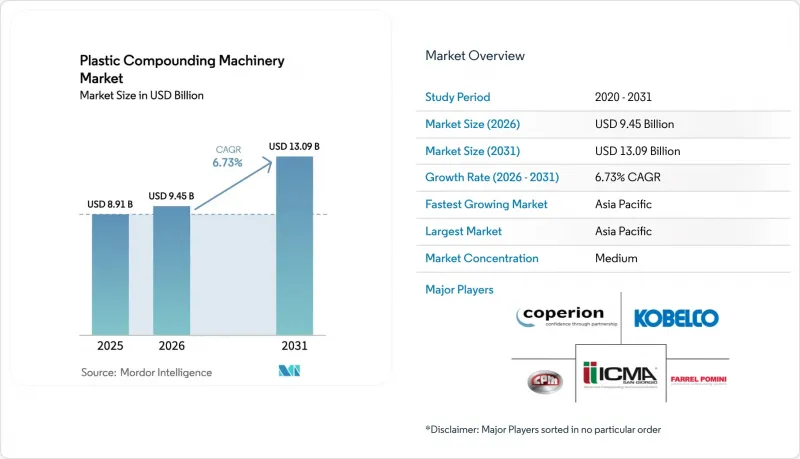
이러한 성장 궤적은 재활용 재료 함유량 규제 강화, 의료기기에 대한 추적성 요구 사항 증가, 전기자동차 배터리 공장 내 현장 성형 라인의 확산 등을 반영하고 있습니다. 현재 가공업체들은 전환 시간을 단축하고, 재생 수지의 배합률을 높이고, 클라우드에 연결된 예지보전 툴을 통합한 모듈식 트윈 스크류 스크류와 유성 롤러 시스템을 선호하고 있습니다. 중국의 개질 플라스틱 보급률이 세계 평균에 가까워짐에 따라 아시아태평양은 여전히 수요의 중심이 되고 있습니다. 한편, 유럽에서는 포장 폐기물에 대한 엄격한 규제로 인해 기술 혁신이 진행되고 있습니다. 경쟁사와의 차별화의 핵심은 스크류 요소 라이브러리, 합금의 가용성, 성형기가 새로운 배합을 신속하게 검증하고 고부가가치 첨가제를 절약할 수 있도록 도와주는 디지털 트윈 서비스입니다. 플라스틱 성형기 시장을 형성하는 주요 트렌드에는 경량화 및 재활용 가능한 포장으로의 전환, 의료용 트윈 스크류 압출기의 급속한 보급, 적층 가공용 필라멘트 라인의 상업화 등이 있습니다. 공급 개선 기술 및 기어 펌프의 통합으로 15-20%의 생산성 향상을 입증할 수 있는 장비 제조업체는 기존 단일 스크류 압출기를 대체하고 있습니다. 그러나 수백만 달러에 달하는 높은 가격, 긴 회수 기간, 특수 스크류 및 배럴 합금 공급망의 병목 현상으로 인해 설비 투자 모멘텀이 둔화되고 있습니다. 폴리머 가격의 변동은 수익률을 더욱 압박하고 있으며, 남미, 중동 및 아프리카의 자금난에 시달리는 컨버터들은 설비 갱신을 미루거나 리스 모델을 선택하게 되었습니다.
세계 플라스틱 성형기 시장 동향 및 인사이트
가볍고 재활용 가능한 포장재에 대한 전 세계 수요 급증
브랜드 소유주들은 유럽의 새로운 법규에 따라 2030년까지 30%-65%의 재활용 재료 함량을 목표로 하고 있으며, 이에 따라 필름 및 열성형 컨버터는 폴리머 사슬을 손상시키지 않고 라벨의 접착제, 잉크, 식품 잔여물을 제거할 수 있는 고용량 용융필터를 트윈 스크류 라인에 후장할 수 밖에 없게 되었습니다. 일본 경제산업성은 재활용 인프라에 300억 엔(1억 9,950만 달러)을 투자하여 자동차 및 전자제품 폐기물을 폐쇄회로(Closed Loop)로 처리하는 유성 롤러 압출기에 대한 설비투자를 촉진했습니다. 이 라인을 도입한 가공업체들은 완제품의 포장 중량을 최대 50%까지 줄이고, 장벽 성능을 유지하면서 운송 시 배출가스를 줄이고 있습니다. 고가의 여과장치 상각이 필요하기 때문에 수익률은 압박을 받지만, 셀프 와이핑 기능이 있는 트윈 스크류 설계로 세척 시간이 단축되고 처리 용량이 유지되어 재생수지의 할증분을 일부 상쇄할 수 있습니다. 재활용성을 기준으로 공급업체 평가를 도입하는 브랜드 소유주가 증가함에 따라 수요 증가로 인해 세계 CAGR이 1.2% 상승했습니다.
의료용 고분자 성형에서 이축압출기의 급속한 대중화
정형외과용 임플란트 제조업체들은 ASTM F648 및 ISO 13485의 추적성 조항에서 요구되는 일관된 분자량 분포와 전자 데이터 수집을 위해 배치 믹서에서 연속 트윈 스크류 압출 성형으로 전환하고 있습니다. 유럽연합(EU)의 의료기기 규정 2017/745는 가공업체가 모든 온도 설정값과 스크류 토크 값을 기록하도록 의무화하고 있으며, 인라인 근적외선 분광법과 자동 품질 대시보드가 장착된 압출기 주문이 가속화되고 있습니다. 일본과 독일공급업체가 제공하는 디지털 트윈 시뮬레이션은 엔지니어가 의료용 수지를 사용하지 않고도 나사 구성을 검증할 수 있도록 도와주며, 인증 검사 한 번당 수천 달러의 비용을 절감할 수 있습니다. CAGR 8.19%로 성장하고 있는 의료 헬스케어 부문의 최종 사용자들은 잔류 오염을 0.5% 이하로 유지하면서 배합을 빠르게 전환할 수 있는 중간 직경의 동방향 회전 나사를 선택하고 있습니다. 이러한 누적된 장점으로 인해 전체 시장 성장률은 0.9% 상승했습니다.
다품종 성형기의 고비용 설비 투자 및 긴 회수 기간
계량 피더, 사이드 스터핑 포트, 스트랜드 펠릿타이저를 갖춘 전자동 트윈 스크류 스크류 라인은 미화 1,500만 달러에서 3,500만 달러에 달하며, 이는 EBITDA 마진이 7% 이하로 운영되는 컨버터에 큰 부담이 될 수 있는 금액입니다. 브라질, 튀르키예, 남아프리카공화국에서는 상업 금융기관이 플라스틱 성형업을 성숙하고 고위험 사업으로 분류하고 소규모 가공업체가 보유하기 어려운 담보를 요구하고 있어 프로젝트 파이낸싱 대기 기간이 더욱 길어지고 있습니다. 현재 일부 유럽과 미국 공급업체들은 기계, 유지보수, 분석 기능을 월정액으로 패키징한 'EaaS(Equipment-as-a-Service)' 계약을 통해 검사를 도입하고 있지만, 북미와 서유럽 이외 지역에서의 도입률은 신규 설치 건수의 5% 이하에 그치고 있습니다. 우대 대출을 받을 수 없기 때문에 컨버터는 단일 스크류 스크류의 수명을 연장하고, 에너지 절약 효과가 15%를 초과하는 경우에도 업그레이드를 미루고 있습니다. 이로 인한 투자 부족으로 인해 예상 세계 CAGR은 0.7% 하락할 것으로 예측됩니다.
부문 분석
2025년 기준, 트윈 스크류 압출기는 플라스틱 성형기 시장의 모든 주요 지역에서 범용 혼합, 엔지니어링 플라스틱 및 반응성 압출 분야에서 범용성을 바탕으로 46.37%의 시장 점유율을 차지합니다. 역회전식은 PVC 파이프 및 프로파일 압출에 주로 사용되는 반면, 동회전식 모델은 고충진 마스터배치, 탈휘발성 처리, 엄격한 추적성 규정을 충족해야 하는 의료용 성형에 적용됩니다. 유성 롤러 기술은 현재 가장 빠르게 성장하는 틈새 시장으로 2031년 CAGR이 7.23%에 달할 전망입니다. 이는 특수 폴리머 제조업체가 열 열화 및 색상 변화를 방지하기 위해 낮은 전단 환경을 필요로 하기 때문입니다. 모듈식 롤러 배럴은 동급 트윈 스크류 방식에 비해 5배에서 10배의 표면적을 제공하며, 난연제 및 전도성 필러를 사용할 때에도 좁은 용융 온도대를 보장합니다. 가공업체가 기존 플랜트를 개조할 때, 공급 개선용 어태치먼트와 기어 펌프 모듈은 트윈스크류의 유용성을 유지하는 데 도움을 주며, 유럽과 일본의 전통 있는 공급업체들의 견조한 수주 파이프라인을 지원하고 있습니다.
높은 확장성으로 인해 파일럿 생산에서 대규모 생산에 이르기까지 반복적인 검증 검사 없이 공정의 동등성을 입증해야 하는 수탁 성형기들 사이에서 유성 롤러 시스템의 도입이 점차 확대되고 있습니다. 사업자는 현장에서 배럴 길이를 연장하거나 롤러 스핀들을 추가할 수 있으며, 체류 시간 분포를 유지하면서 변동하는 고객 수요에 맞추어 설비 용량을 조정할 수 있습니다. 한편, 단일 스크류 스크류 기계는 혼합 성능보다 가격 민감도가 우선시되는 복잡도가 낮은 컬러 농축액 희석 공정에서 여전히 사용되고 있으며, 간접적으로 기존 설비의 서비스 수익을 뒷받침하고 있습니다. 따라서 이 세 가지 주요 기계 유형이 공존함으로써 다층적인 장비 계층 구조가 유지되고, 경쟁은 적당히 집중되어 있지만, 지역 신규 시장 진출기업이 가격 중심의 계약을 체결할 수 있는 여지가 남아있습니다. 전반적으로, 다양한 기계 선호도로 인해 처리 능력대별 성장이 균형을 유지하여 플라스틱 성형기 시장을 격렬한 경기변동으로부터 보호하고 있습니다.
지역별 분석
아시아태평양은 2025년 40.43%의 점유율을 차지해, 중국의 성형수지 보급률이 전체 플라스틱 소비량의 50%로 증가함에 따라 2031년까지 연평균 7.79%의 성장률을 보일 것으로 예측됩니다. 장쑤성, 광둥성 등 중국 각 성에는 정부의 특혜, 대량의 수지 가용성, 전자 및 자동차 산업 거점과의 근접성 등의 이점을 누리는 멀티라인 성형 클러스터가 존재합니다. 일본이 300억 엔(1억 9,950만 달러)의 재활용 기금을 배정하면서 기존 단일 스크류 압출기의 교체가 가속화되고 있으며, 재생 플레이크 처리를 위해 트윈 벤트 배럴을 갖춘 동방향 회전 모델로 전환이 진행되고 있습니다. 인도와 동남아시아 국가들은 관세 중립적인 수출 플랫폼을 활용하여 다운스트림 부문에 대한 투자를 유치하고 있으며, 잦은 색상 변경과 적당한 재생 수지 배합에 대응할 수 있는 중용량 압출기에 대한 지역 수요를 확대되고 있습니다.
유럽의 설비 수주는 식품접촉용 포장재에 대해 30%-65%의 재활용재 함량 기준을 부과하고, 특정 불소계 첨가물을 금지하는 규정(EU) 2025/40의 시행 동향과 연동되어 있습니다. 독일과 이탈리아는 여전히 기계 제조의 거점이며, 유성 롤러식 및 고토크 트윈스크류식 유닛을 전 세계에 수출하고 있습니다. 한편, 프랑스, 스페인, 네덜란드에서는 고급 용융 여과 시스템을 갖춘 트윈 스크류 방식으로 개조하는 것을 우선시하고 있습니다. 영국에서는 확대 생산자 책임(EPR) 수수료 정산이 연기됨에 따라 일시적으로 컴플라이언스 비용이 감소하고 있으며, 국내 컨버터는 유럽 대륙의 기준을 준수할 때까지 일시적인 설비 투자 기회를 얻고 있습니다. 동유럽의 가공업체들은 유로화 기준의 설비 비용과 국내 수지 가격 변동 및 노동력 부족과 균형을 맞추면서 단계적으로 설비 업그레이드를 진행하고 있습니다.
북미는 풍부한 에탄계 원료와 긴밀하게 통합된 석유화학 산업 체인의 혜택을 누리고 있지만, 멕시코만 지역의 잦은 기상 이변과 불가항력적인 사건으로 인해 수지 공급의 불확실성을 초래하고 있습니다. 미국 성형기는 중서부 및 남동부 지역으로 생산 능력을 분산시켜 리스크를 헤지하고 있으며, 필요에 따라 이전이 가능한 모듈식 트윈 스크류 혼련기 수주를 늘리고 있습니다. USMCA(미국-멕시코-캐나다 협정)의 무역 보호 조치에 힘입어 캐나다와 멕시코 공장은 빠른 색상 변경과 추적성을 요구하는 자동차 계열 현지 법인에 공급하기 위해 중간 규모의 시스템을 구매하고 있습니다. 남미, 중동 및 아프리카는 여전히 높은 차입 비용과 환율 변동으로 인해 소규모 시장에 머물러 있지만, 브라질의 농업용 필름 수요, 사우디아라비아의 다운스트림 부문으로의 다각화, 남아공의 자동차 부품 프로젝트 등이 저가의 중국산 트윈 스크류 포장을 선호하는 국지적인 수요 집적지를 만들어 내고 있습니다. 전반적으로 지리적 분산은 전체 시장의 수익 변동을 완화하고 플라스틱 성형기 시장의 중기 꾸준한 성장 궤도를 강화했습니다.
기타 혜택
- 엑셀 형태 시장 예측(ME) 시트
- 3개월간 애널리스트 지원
자주 묻는 질문
목차
제1장 서론
제2장 조사 방법
제3장 주요 요약
제4장 시장 구도
제5장 시장 규모와 성장 예측
제6장 경쟁 구도
제7장 시장 기회와 향후 전망
JHS 26.06.02The plastic compounding machinery market size is expected to increase from USD 8.91 billion in 2025 to USD 9.45 billion in 2026 and reach USD 13.09 billion by 2031, growing at a CAGR of 6.73% over 2026-2031.
This growth trajectory reflects stricter recycled-content mandates, rising traceability requirements for medical devices, and the spread of on-site compounding lines within electric-vehicle battery plants. Processors now prioritize modular twin-screw and planetary-roller systems that shorten changeovers, enable higher reclaimed-resin loadings, and embed cloud-connected predictive-maintenance tools. Asia-Pacific remains the volume anchor as China's modified-plastics penetration climbs toward the global average, while Europe drives technology refreshes through aggressive packaging-waste regulations. Competitive differentiation hinges on screw-element libraries, alloy availability, and digital-twin services that help compounders validate new recipes quickly and conserve high-value additives. Key trends shaping the plastic compounding machinery market include the pivot to lightweight, recyclable packaging, the rapid uptake of medical-grade twin-screw extruders, and the commercialization of additive-manufacturing filament lines. Equipment builders able to demonstrate 15%-20% productivity gains through feed-enhancement technology or gear-pump integration are displacing legacy single-screw assets. Capital-expenditure momentum is tempered, however, by multi-million-dollar price tags, lengthy payback horizons, and supply-chain bottlenecks in specialty screw-barrel alloys. Polymer price volatility further compresses margins, prompting financially constrained converters in South America, the Middle East and Africa to defer upgrades or pursue leasing models.
Global Plastic Compounding Machinery Market Trends and Insights
Surge in Global Demand for Lightweight, Recyclable Packaging
Brand owners target 30%-65% recycled content by 2030 under new European law, forcing film and thermoforming converters to retrofit twin-screw lines with high-capacity melt filters that can remove label glue, ink, and food residue without degrading polymer chains. Japan's Ministry of Economy, Trade and Industry committed JPY 30 billion (USD 199.5 million) to recycling infrastructure, unlocking capex for planetary-roller extruders that process closed-loop automotive and electronics waste. Processors adopting these lines reduce finished-pack weight by up to 50%, trimming freight emissions while maintaining barrier performance. The need to amortize costly filtration equipment pressures margins, yet twin-screw designs with self-wiping elements shorten clean-out time and preserve throughput, partially offsetting recycled-resin premiums. As more brand owners invoke supplier scorecards tied to recyclability, the demand uplift contributes a 1.2-percentage-point boost to the global CAGR.
Rapid Adoption of Twin-Screw Extruders in Medical-Grade Polymer Compounding
Orthopedic-implant makers migrate from batch mixers to continuous twin-screw extrusion because ASTM F648 and ISO 13485 traceability clauses demand consistent molecular-weight distribution and electronic data capture. European Union Medical Device Regulation 2017/745 further obliges processors to log every temperature set-point and screw-torque value, accelerating orders for extruders with in-line near-infrared spectroscopy and automated quality dashboards. Digital-twin simulations offered by Japanese and German suppliers help engineers validate screw configurations without consuming medical-grade resin, saving thousands of dollars per qualification run. Medical and healthcare end users, growing at an 8.19% CAGR, therefore choose mid-diameter co-rotating screws that allow rapid formula changeovers with less than 0.5% residual contamination. The cumulative benefit adds 0.9 percentage points to overall market growth.
High Capex and Long Pay-Back Period for Multi-Component Compounders
Fully automated twin-screw lines with gravimetric feeders, side stuffing ports, and strand pelletizers range from USD 1.5 million to USD 3.5 million, a sum that strains converters operating on sub-7% EBITDA margins. In Brazil, Turkey, and South Africa, commercial lenders classify plastics compounding as mature and high-risk, demanding collateral that smaller processors seldom hold, further lengthening the project-finance queue. Some Western suppliers now pilot equipment-as-a-service contracts bundling machinery, maintenance, and analytics for a monthly fee, but adoption outside North America and Western Europe remains below 5% of new installations. Without concessional credit, converters stretch single-screw life cycles, deferring upgrades even when energy savings could exceed 15%. The resulting under-investment subtracts 0.7 percentage points from anticipated global CAGR.
Other drivers and restraints analyzed in the detailed report include:
- Growth in Additive-Manufacturing Filament Production Lines
- Regulatory Push for Recycled-Content Mandates in Europe and North America
- Supply-Chain Bottlenecks in Specialty Screw-Barrel Alloys
For complete list of drivers and restraints, kindly check the Table Of Contents.
Segment Analysis
Twin-screw extruders commanded 46.37% of the share in 2025, underscoring their versatility in commodity blends, engineered plastics, and reactive extrusion across every major region of the plastic compounding machinery market. Counter-rotating versions dominate PVC pipe and profile extrusion, whereas co-rotating models handle high-fill masterbatch, devolatilization, and medical-grade compounds that must meet strict traceability rules. Planetary-roller technology is now the fastest-growing niche at a 7.23% CAGR through 2031 because specialty-polymer producers need low-shear environments that prevent thermal degradation and color shift. Modular roller barrels deliver surface areas five to ten times larger than twin-screw equivalents, ensuring narrow melt-temperature bands even with flame-retardant or conductive fillers. As processors retrofit brownfield plants, feed-enhancement attachments and gear-pump modules help twin-screws retain relevance, sustaining healthy order pipelines for established European and Japanese suppliers.
Scalability is driving incremental adoption of planetary-roller systems among contract compounders that must prove process equivalence from pilot to large-scale runs without repeated validation tests. Operators can extend barrel length or add additional roller spindles in the field, aligning installed capacity with fluctuating customer demand while preserving residence-time distribution. Meanwhile, single-screw machines persist in low-complexity color-concentrate let-down where price sensitivity outweighs mixing performance, indirectly anchoring installed-base service revenues. The coexistence of three core machine archetypes therefore sustains a multi-tier equipment hierarchy, reinforcing moderately concentrated competition that nevertheless allows regional entrants to win price-sensitive contracts. Collectively, varied machinery preferences keep growth balanced across throughput bands, insulating the plastic compounding machinery market from severe cyclical swings.
The Plastic Compounding Machinery Market Report is Segmented by Machinery Type (Single-Screw, Twin-Screw, and More), Application Type (Plastics, Masterbatch Production, Specialty Polymers, Flooring Compounds, and More), End-User Industry (Packaging, Construction and Infrastructure, Medical and Healthcare, Automotive, Electronics, and More), and Geography. The Market Forecasts are Provided in Terms of Value (USD).
Geography Analysis
Asia-Pacific generated 40.43% of share in 2025, and the region is poised to grow at a 7.79% CAGR through 2031 as China's compounded-resin penetration climbs toward 50% of total plastics consumption. Chinese provinces such as Jiangsu and Guangdong host multi-line compounding clusters that benefit from state incentives, bulk resin availability, and proximity to electronics and automotive hubs. Japan's JPY 30 billion (USD 199.5 million) recycling-fund allocation accelerates replacement of legacy single-screw extruders with co-rotating models fitted with twin-vent barrels for recycled flake processing. India and Southeast Asian nations leverage tariff-neutral export platforms to attract downstream investment, expanding regional demand for mid-throughput extruders that can handle frequent color changes and moderate recycled-resin loadings.
Europe's equipment orders track the rollout of Regulation (EU) 2025/40, which imposes 30%-65% recycled-content thresholds and bans selected fluorinated additives in food-contact packs. Germany and Italy remain machinery-manufacturing strongholds that export planetary-roller and high-torque twin-screw units worldwide, while France, Spain, and the Netherlands prioritize twin-screw retrofits equipped with advanced melt-filtration systems. The United Kingdom briefly enjoys lower compliance costs due to deferred extended-producer-responsibility fees, giving domestic converters a temporary capital-expenditure window before alignment with continental standards. Eastern-European processors upgrade gradually, balancing euro-denominated equipment costs against domestic resin-price volatility and tight labor availability.
North America benefits from abundant ethane-based feedstocks and a tightly integrated petrochemical chain, yet frequent Gulf-Coast weather disruptions and force-majeure events inject resin-supply uncertainty. U.S. compounders hedge risk by distributing capacity across Midwest and Southeast corridors, driving orders for modular twin-screws that can relocate as needed. Canadian and Mexican plantscanchored by USMCA trade protectionscbuy mid-range systems to serve automotive transplants that demand rapid color changes and traceability. South America, the Middle East and Africa collectively remain smaller markets constrained by elevated borrowing costs and currency volatility, although Brazilian agricultural-film demand, Saudi downstream diversification, and South-African auto-component projects create localized hot spots that favor lower-cost Chinese twin-screw packages. Overall, geographic diversification helps smooth total-market revenue swings, reinforcing a steady medium-term growth path for the plastic compounding machinery market.
- Coperion GmbH
- CPM Extricom Extrusion GmbH
- Farrel Corporation
- ICMA San Giorgio S.p.A.
- Ikegai Corporation
- Kobe Steel, Ltd.
- KraussMaffei Group GmbH
- Nordson Corporation
- Randcastle Extrusion Systems, Inc.
- Technovel Corporation
- The Japan Steel Works, Ltd.
- Theysohn Extrusionstechnik GmbH
- Shibaura Machine Co., Ltd.
- TPV Compound S.r.l.
- Useon Extrusion Machinery Co., Ltd.
- Welset Plast Extrusions Pvt. Ltd.
- Leistritz Extrusionstechnik GmbH
- Buhler AG
- Entek Manufacturing, LLC
- Bausano and Figli S.p.A.
Additional Benefits:
- The market estimate (ME) sheet in Excel format
- 3 months of analyst support
TABLE OF CONTENTS
1 INTRODUCTION
- 1.1 Study Assumptions and Market Definition
- 1.2 Scope of the Study
2 RESEARCH METHODOLOGY
3 EXECUTIVE SUMMARY
4 MARKET LANDSCAPE
- 4.1 Market Overview
- 4.2 Market Drivers
- 4.2.1 Surge in Global Demand for Lightweight, Recyclable Packaging
- 4.2.2 Rapid Adoption of Twin-Screw Extruders in Medical-Grade Polymer Compounding
- 4.2.3 Growth in Additive Manufacturing Filament Production Lines
- 4.2.4 Regulatory Push for Recycled-Content Mandates in Europe and North America
- 4.2.5 Shift Toward Decentralised, On-Site Compounding in EV Battery Plants
- 4.2.6 Emergence of AI-Driven Predictive Maintenance Lowering Total Cost of Ownership
- 4.3 Market Restraints
- 4.3.1 High Capex and Long Pay-Back Period for Multi-Component Compounders
- 4.3.2 Supply-Chain Bottlenecks in Specialty Screw-Barrel Alloys
- 4.3.3 Volatility in Polymer Feedstock Prices
- 4.3.4 Skill Gap in Operating Industry 4.0-Enabled Lines
- 4.4 Industry Value Chain Analysis
- 4.5 Regulatory Landscape
- 4.6 Technological Outlook
- 4.7 Impact of Macroeconomic Factors on the Market
- 4.8 Porter's Five Forces Analysis
- 4.8.1 Threat of New Entrants
- 4.8.2 Bargaining Power of Suppliers
- 4.8.3 Bargaining Power of Buyers
- 4.8.4 Threat of Substitutes
- 4.8.5 Intensity of Competitive Rivalry
5 MARKET SIZE AND GROWTH FORECASTS (VALUE)
- 5.1 By Machinery Type
- 5.1.1 Single-Screw
- 5.1.2 Twin-Screw
- 5.1.2.1 Co-Rotating Twin-Screw
- 5.1.2.2 Counter-Rotating Twin-Screw
- 5.1.3 Planetary Roller
- 5.1.4 Other Machinery Types
- 5.2 By Application Type
- 5.2.1 Plastics
- 5.2.2 Masterbatch Production
- 5.2.3 Specialty Polymers
- 5.2.4 Flooring Compounds
- 5.2.5 Other Application Types
- 5.3 By End-User Industry
- 5.3.1 Packaging
- 5.3.2 Construction and Infrastructure
- 5.3.3 Medical and Healthcare
- 5.3.4 Automotive
- 5.3.5 Electronics
- 5.3.6 Chemicals
- 5.3.7 Other End-User Industries
- 5.4 By Geography
- 5.4.1 North America
- 5.4.1.1 United States
- 5.4.1.2 Canada
- 5.4.1.3 Mexico
- 5.4.2 South America
- 5.4.2.1 Brazil
- 5.4.2.2 Argentina
- 5.4.2.3 Chile
- 5.4.2.4 Rest of South America
- 5.4.3 Europe
- 5.4.3.1 United Kingdom
- 5.4.3.2 Germany
- 5.4.3.3 France
- 5.4.3.4 Italy
- 5.4.3.5 Spain
- 5.4.3.6 Rest of Europe
- 5.4.4 Asia-Pacific
- 5.4.4.1 China
- 5.4.4.2 India
- 5.4.4.3 Japan
- 5.4.4.4 South Korea
- 5.4.4.5 Australia
- 5.4.4.6 Rest of Asia-Pacific
- 5.4.5 Middle East and Africa
- 5.4.5.1 Middle East
- 5.4.5.1.1 Saudi Arabia
- 5.4.5.1.2 United Arab Emirates
- 5.4.5.1.3 Turkey
- 5.4.5.1.4 Rest of Middle East
- 5.4.5.2 Africa
- 5.4.5.2.1 South Africa
- 5.4.5.2.2 Nigeria
- 5.4.5.2.3 Rest of Africa
- 5.4.5.1 Middle East
- 5.4.1 North America
6 COMPETITIVE LANDSCAPE
- 6.1 Market Concentration
- 6.2 Strategic Moves
- 6.3 Market Share Analysis
- 6.4 Company Profiles (Includes Global Level Overview, Market Level Overview, Core Segments, Financials as Available, Strategic Information, Market Rank/Share, Products and Services, and Recent Developments)
- 6.4.1 Coperion GmbH
- 6.4.2 CPM Extricom Extrusion GmbH
- 6.4.3 Farrel Corporation
- 6.4.4 ICMA San Giorgio S.p.A.
- 6.4.5 Ikegai Corporation
- 6.4.6 Kobe Steel, Ltd.
- 6.4.7 KraussMaffei Group GmbH
- 6.4.8 Nordson Corporation
- 6.4.9 Randcastle Extrusion Systems, Inc.
- 6.4.10 Technovel Corporation
- 6.4.11 The Japan Steel Works, Ltd.
- 6.4.12 Theysohn Extrusionstechnik GmbH
- 6.4.13 Shibaura Machine Co., Ltd.
- 6.4.14 TPV Compound S.r.l.
- 6.4.15 Useon Extrusion Machinery Co., Ltd.
- 6.4.16 Welset Plast Extrusions Pvt. Ltd.
- 6.4.17 Leistritz Extrusionstechnik GmbH
- 6.4.18 Buhler AG
- 6.4.19 Entek Manufacturing, LLC
- 6.4.20 Bausano and Figli S.p.A.
7 MARKET OPPORTUNITIES AND FUTURE OUTLOOK
- 7.1 White-Space and Unmet-Need Assessment


