

|
시장보고서
상품코드
2044170
질산암모늄 시장 : 점유율 분석, 산업 동향 및 통계, 성장 예측(2026-2031년)Ammonium Nitrate - Market Share Analysis, Industry Trends & Statistics, Growth Forecasts (2026 - 2031) |
||||||
 Mordor Intelligence
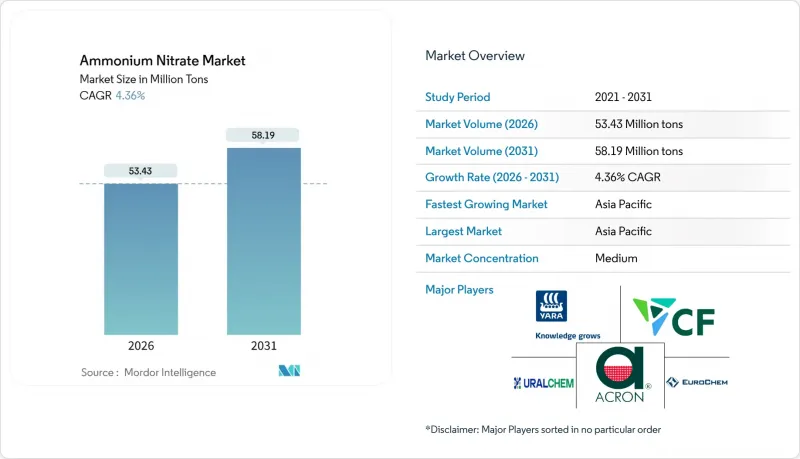
질산암모늄 시장 규모는 2026년에 5,343만 톤으로 추산 되고 있어 예측 기간(2026-2031년)에서 CAGR 4.36%로 성장을 지속하여, 2031년까지 5,819만 톤에 이를 것으로 전망되고 있습니다.
질산암모늄 시장은 탄소 국경 조정 조치 강화, 신흥 구리 및 니켈 기지 주변의 폭발물 생산 지역화, 영양분 방출 속도가 느린 코팅 입상 비료를 선호하는 정밀 농업의 확산과 같은 트렌드에 대응하고 있습니다. 광산 사업자는 더 깊은 광상을 채굴하기 위해 고에너지 배합을 지정하고 있으며, 블루 암모니아 및 그린 암모니아 프로젝트는 매립 탄소 보고의 대상이 되는 하류 질산염 제품의 비용 곡선을 재구성하고 있습니다. 야라, CF 인더스트리즈, OCI 등 기존 기업들은 지역 스타트업들이 틈새 재생 프로그램이나 방산분야를 위한 소규모의 유연한 생산설비를 구축하는 가운데, 자신들의 입지를 지키기 위해 저배출 원료에 대한 자본투입을 진행하고 있습니다. 질산암모늄 시장은 아시아태평양과 남미에서의 성장과 북미와 유럽에서의 규제적 역풍 사이에서 균형을 유지하고 있습니다.
세계 질산암모늄 시장 동향 및 인사이트
대규모 노천 광산에서 ANFO 및 에멀젼 폭약의 확대
노천 석탄, 구리, 리튬 광산은 굴착 밀도를 줄이고 표토 제거를 가속화하기 위해 고에너지 ANFO 및 에멀젼 혼합 폭약으로 전환하고 있으며, 기술 등급 질산암모늄의 소비가 증가하고 있습니다. 오리카의 4D 벌크 폭약 플랫폼은 에멀젼과 다공성 프릴을 결합하여 파쇄 효과를 최적화하고, 반출되는 암석 톤당 단위 비용을 최소화하며, 가변적인 에너지 출력을 제공합니다. 인도네시아의 니켈 라테라이트 광산 프로젝트와 칠레 고산지대의 구리 광산에서는 물의 침투로 인해 기존 연료유 혼합물이 열화되어 기존 ANFO 혼합물에 비해 광석 1톤당 20-30% 더 많은 질산암모늄이 필요합니다. 사우디의 SCCL은 라스 알 카이르에 연간 30만 톤의 기술 등급 공장을 건설할 계획이며, 이는 걸프 지역 생산자가 폭발물 조달을 현지화하여 아프리카의 광산 사업에 공급하고자 하는 것을 보여줍니다. 광산이 더 높은 회수율을 추구하는 가운데, 질산암모늄 시장은 농업 분야보다 가격 민감도가 낮은 수요 구조의 혜택을 누리고 있습니다.
세계 농업의 비료 수요 증가
인구 증가에 따라 질소 비료의 기초 수요가 증가하고 있지만 지역 간 격차는 여전히 존재합니다. 인도의 보조금 제도는 여전히 우레아를 우대하는 반면, 브라질 세라도 지역의 농부들은 토양 산성화에 대응하기 위해 질산칼슘 암모늄 질산칼슘으로 전환하고 있습니다. 유럽연합(EU)의 '팜 투 포크(Farm to Fork)' 전략은 정밀 농업 기술을 촉진하고 있으며, 이로 인해 판매업체들은 침출로 인한 손실을 줄이는 고분자 코팅 입상 질산암모늄으로 전환해야 합니다. 아르헨티나의 밀 생산자들은 2025년 환율 상승에 힘입어 질산암모늄 구매량을 8% 늘렸습니다. 이는 가격 변동이 기존의 작물 및 영양소 관행을 능가할 수 있다는 것을 보여줍니다. 따라서 질산암모늄 시장은 질소 비료의 원가뿐만 아니라 보조금 제도, 탄소 라벨링, 농법 차별화에 따라 달라질 수 있습니다. 코팅 제품 및 CAN 제품에 자문 서비스를 결합하는 공급업체는 이러한 불균일한 정책 환경에서 가격 결정력을 확보하고 있습니다.
질산암모늄의 보관 및 운송에 대한 엄격한 규정 적용
미국 주류-담배-화기-폭발물관리국(ATF)은 안전성에 대한 재검토를 통해 보관 기준을 강화했고, 많은 지방 유통업체들이 질산암모늄 재고를 줄이고 UAN으로 전환해야 했습니다. 캐나다의 폭발물 규정에 따라 농장 내 보관이 불가능하고, 잠금장치와 안전거리 확보가 의무화되어 있어 생산자들은 대량으로 배송되는 액체 비료로 전환하고 있습니다. 호주의 각 주별 구역 규정은 주거지로부터 500m 이내 신규 창고 설치를 금지하고 있어 도시 주변부에서의 유통이 축소되고 있습니다. 아시아에서는 규제가 비교적 느슨하지만, OECD 국가들의 컴플라이언스 비용 증가로 인해 질소 수요의 5-10%가 대체품으로 전환되고 있습니다. 따라서 질산암모늄 시장은 광활한 농지에서 비료로서의 매력을 떨어뜨리는 불균일한 규제 환경을 극복해야 합니다.
부문 분석
폭발물 시장은 CAGR 4.91%로 질산암모늄 시장 전체보다 거의 1% 포인트 더 높은 성장률을 보이고 있지만, 비료 시장은 요소로 대체되면서 성장이 둔화되고 있습니다. 칠레, 페루, 인도네시아의 구리 및 니켈 광산에서는 기존 ANFO(질산암모늄-불화암모늄 혼합폭약)에 비해 1회 폭파 시 25-35% 더 많은 기술 등급 질산염을 필요로 하는 에멀젼 혼합물을 사용하고 있으며, 이는 균일한 밀도를 가진 다공성 다공성 프릴에 대한 프리미엄 수요를 견인하고 있습니다.
비료 수요는 여전히 총량으로는 여전히 지배적이지만, 양극화가 진행되고 있습니다. 유럽에서는 영양 효율 규제 요건을 충족하는 고분자 코팅 입상 질산염에 대한 투자가 진행되고 있는 반면, 아시아에서는 보조금이 지급되는 요소에 의존하고 있으며, 질산암모늄은 특수 작물용으로만 제한적으로 사용되고 있습니다. 반면 폭약은 가격에 대한 민감도가 낮은 임베디드니다. 이는 발파의 불발로 인해 광산 비용이 급격히 상승하여 공급업체가 농업용 제품에 대해 톤당 20-30달러의 프리미엄 가격을 책정할 수 있기 때문입니다.
과립형 제품은 CAGR 5.66%로 가장 빠르게 성장하는 형태이지만, 다공성 프릴은 ANFO의 주요 원료로 2025년에도 여전히 총량의 60.25%를 차지했습니다. 정밀 살포기에는 균일한 입자 크기가 요구되며, 폴리머 코팅된 과립형 제품은 60-90일 동안 영양분을 방출하기 때문에 유럽의 '농장에서 식탁까지(Farm to Fork)' 목표에 부합합니다.
다공성 프릴은 연료유를 빠르게 흡수하고 벌크 시스템에서 안정적인 기폭 속도를 보장할 수 있기 때문에 폭발물 분야에서 우위를 유지하고 있습니다. Grupa Azoty와 같은 통합 생산 기업은 동일한 단지 내에서 두 가지 형태를 모두 생산함으로써 위험을 분산시키고, 광석 수출과 중부 유럽에서의 피복 비료 판매의 균형을 맞추고 있습니다.
"질산암모늄 시장 보고서는 용도(비료, 폭발물, 기타), 형태(다공성 프릴, 과립, 액체 용액/현탁액), 등급(농업 및 산업용), 최종 사용자 산업(농업, 광업, 방위산업, 기타 최종 사용자 산업), 지역(아시아태평양, 북미, 유럽, 남미, 중동 및 아프리카)로 분류되어 있습니다. 시장 예측은 수량(톤) 기준으로 제공됩니다.
지역별 분석
아시아태평양은 2025년 45.46%를 차지하며 세계 시장에서 선두를 유지하며 5.01%의 연평균 복합 성장률(CAGR)로 성장하고 있습니다. 이는 중국의 아프리카 및 라틴아메리카 광산으로의 기술 등급 수출과 인도의 우레아 의존에서 차별화된 질산염으로의 점진적인 전환에 힘입은 것입니다. 중국의 석탄 유래 암모니아는 여전히 가격 경쟁력이 있지만, 수출업체들은 광산용 프리미엄을 얻기 위해 다공성 프릴로 전환하고 있으며, 이로 인해 질산암모늄 시장공급이 폭발물 용도로 이동하는 경향이 강해지고 있습니다.
북미는 여전히 큰 시장 규모를 유지하고 있지만, ATF(농업용 저장세)의 규제로 인해 농장에서의 저장이 제한되어 있고, 유럽의 CBAM(탄소 국경 조정 메커니즘) 관련 바이어 수요를 충족시키기 위해 블루암모니아 프로젝트가 가동되기 시작했지만, 유통업체들은 벌크 UAN(요소 암모니아 질산염)으로 전환하고 있습니다. 캐나다의 칼륨 산업과 오일샌드 산업은 농업 분야의 역풍을 피하는 형태로 이 지역의 기술 등급 수요를 지탱하고 있습니다.
유럽에서는 고배출량 수입품에 페널티를 부과하는 CBAM 보고제도에 대응하기 위해 고심하고 있으며, 이로 인해 바이어들은 그루파 아조티의 타르노프 공장, 야라의 그린 암모니아 사업 등 국내 저탄소 공급처로 눈을 돌리고 있습니다. 남부 생산자들은 북아프리카에서 수입에 의존하는 반면, 북부 지역에서는 시장 점유율을 지키기 위해 탄소 포집 시설의 개보수에 투자하고 있습니다.
남미 시장 규모는 브라질의 대두 생산 확대와 칠레의 구리 광업에 의해 주도되고 있지만, 이 지역에는 통합 생산 능력이 부족하고 중동과 중국에서 다공성 프릴을 수입하고 있어 운임 변동 위험에 노출되어 있습니다.
중동 및 아프리카에서는 QAFCO 7과 같은 걸프 지역의 블루 암모니아 프로젝트가 2026년에 120만 톤의 저배출 원료를 추가하여 이 지역은 유럽 바이어들에게 배출 규제에 대응하는 헤지처로 자리매김하고 있습니다. 사우디에 건설 예정인 테크니컬 그레이드 플랜트, 남아공의 광산업에 의한 수요 증가는 다양한 수요기반을 더욱 풍부하게 하고 있습니다.
기타 특전:
- 엑셀 형식 시장 예측(ME) 시트
- 3개월간 애널리스트 지원
자주 묻는 질문
목차
제1장 서론
제2장 조사 방법
제3장 주요 요약
제4장 시장 구도
제5장 시장 규모와 성장 예측(금액 및 수량)
제6장 경쟁 구도
제7장 시장 기회와 향후 전망
JHS 26.06.02The Ammonium Nitrate Market size is estimated at 53.43 Million tons in 2026, and is expected to reach 58.19 Million tons by 2031, at a CAGR of 4.36% during the forecast period (2026-2031).
The ammonium nitrate market is responding to tighter carbon-border policies, localized explosive production near emerging copper and nickel hubs, and precision-agriculture adoption that favors coated granules with slower nutrient release. Mining operators are specifying higher-energy blends to unlock deeper ore bodies, while blue and green ammonia projects are reshaping the cost curve for downstream nitrates qualifying for embedded-carbon reporting. Incumbents such as Yara, CF Industries, and OCI are funneling capital into low-emission feedstock to defend their positions, as regional disruptors build smaller, flexible units that serve niche regenerative programs and defense channels. The ammonium nitrate market continues to balance growth in Asia-Pacific and South America against regulatory headwinds in North America and Europe.
Global Ammonium Nitrate Market Trends and Insights
Expansion of ANFO and Emulsion Explosives in Large-Scale Surface Mining
Surface coal, copper, and lithium operations are turning to higher-energy ANFO and emulsion blends that reduce drilling density and speed up overburden removal, increasing technical-grade ammonium nitrate consumption. Orica's 4D bulk-explosives platform combines emulsion with porous prills, offering variable energy output that tailors fragmentation and minimizes unit cost per ton of rock moved. Indonesia's nickel laterite projects and Chile's high-altitude copper pits require 20-30% more ammonium nitrate per ton of ore than older ANFO mixes because water ingress undermines conventional fuel-oil blends. Saudi Arabia's SCCL plans a 300,000 ton-per-year technical-grade plant at Ras Al Khair, demonstrating how Gulf producers intend to localize explosive inputs and serve African mining ventures. As mines chase higher recovery rates, the ammonium nitrate market benefits from a demand profile that is less price-sensitive than agriculture.
Increasing Demand for Fertilizers in Global Agriculture
Baseline nitrogen demand rises as populations grow, yet regional divergence persists: India's subsidy regime still favors urea, while Brazil's Cerrado growers move to calcium-ammonium-nitrate to counter soil acidification. The European Union's Farm to Fork strategy promotes precision technologies, pushing distributors toward polymer-coated granular ammonium nitrate that cuts leaching losses. Argentina's wheat producers lifted ammonium nitrate purchases 8% in 2025 on currency tailwinds, proving that price swings can override crop-nutrient traditions. The ammonium nitrate market, therefore, hinges on subsidy structures, carbon labeling, and agronomic differentiation rather than bulk nitrogen cost alone. Suppliers that bundle advisory services with coated or CAN products gain pricing power in this uneven policy landscape.
Stringent Regulations on Storage and Transport of Ammonium Nitrate
Following safety reviews, the US Bureau of Alcohol, Tobacco, Firearms, and Explosives shortened storage thresholds, compelling many rural distributors to drop ammonium nitrate inventories and pivot to UAN. Canada's Explosives Regulations impose locked magazines and setback distances that hinder on-farm storage, driving growers toward liquid solutions delivered in bulk. Australia's state zoning rules ban new depots within 500 meters of residences, shrinking distribution in peri-urban belts. While Asia maintains lighter oversight, the added compliance cost in OECD regions diverts 5-10% of nitrogen demand to substitutes. The ammonium nitrate market must therefore navigate uneven regulatory terrain that erodes its broad-acre fertilizer appeal.
Other drivers and restraints analyzed in the detailed report include:
- Decarbonised-Ammonia Projects Spurring Low-Carbon Nitrate Adoption
- Surge in Calcium-Ammonium-Nitrate Demand from Regenerative Farming Programs
- Availability of Substitute Nitrogen Fertilizers (Urea, UAN, Urea + NBPT)
For complete list of drivers and restraints, kindly check the Table Of Contents.
Segment Analysis
Explosives expand at a 4.91% CAGR, nearly a full point above the overall ammonium nitrate market, while fertilizers grow more slowly due to urea substitution. Copper and nickel mines in Chile, Peru, and Indonesia use emulsion blends that require 25-35% more technical-grade nitrate per blast than conventional ANFO, driving premium demand for porous prills with consistent density.
Fertilizer demand remains dominant in tonnage but is bifurcating: Europe invests in polymer-coated granular nitrate that satisfies nutrient-efficiency mandates, whereas Asia leans on subsidized urea, relegating ammonium nitrate to specialty crops. Explosives, by contrast, remain less price-sensitive because blasting misfires quickly inflate mining costs, allowing suppliers to command USD 20-30 per ton premiums over agricultural-grade product.
Granular product is the fastest-growing form at 5.66% CAGR, although porous prills still held 60.25% of volume in 2025 as the feedstock of choice for ANFO. Precision spreaders require uniform particle size, and polymer-coated granules extend nutrient release across 60-90 days, aligning with Europe's Farm to Fork goals.
Porous prills maintain dominance in explosives thanks to their ability to absorb fuel oil rapidly, ensuring stable detonation velocity in bulk systems. Integrated producers such as Grupa Azoty hedge bets by manufacturing both forms in the same complex, balancing mining exports with coated fertilizer sales in Central Europe.
The Ammonium Nitrate Market Report is Segmented by Application (Fertilizers, Explosives, and Other), Form (Porous Prills, Granular, and Liquid Solution/Suspension), Grade (Agricultural and Industrial), End-User Industry (Agriculture, Mining, Defense, and Other End-User Industries), and Geography (Asia-Pacific, North America, Europe, South America, and Middle East and Africa). Market Forecasts are Provided in Terms of Volume (tons).
Geography Analysis
Asia-Pacific led the global volume with 45.46% in 2025 and is advancing at a 5.01% CAGR, propelled by China's technical-grade exports to African and Latin American mines and India's gradual shift from urea dependence toward differentiated nitrates. China's coal-based ammonia remains cost-competitive, yet exporters increasingly upgrade to porous prills to capture mining premiums, reinforcing the ammonium nitrate market's supply pivot toward explosives.
North America held a substantial market volume, but ATF rules curtail on-farm storage, pushing distributors toward bulk UAN even as blue-ammonia projects come online to satisfy CBAM-linked buyers in Europe. Canada's potash and oil-sands industries sustain regional technical-grade demand that bypasses agricultural headwinds.
Europe grapples with CBAM reporting that penalizes high-emission imports, steering buyers toward domestic low-carbon supply such as Grupa Azoty's Tarnow plant and Yara's green-ammonia programs. Southern producers rely on North African imports, while Northern regions invest in carbon-capture retrofits to defend market share.
South America's market volume is driven by Brazil's soybean expansion and Chile's copper mining, yet the region lacks integrated capacity and imports porous prills from the Middle East and China, exposing it to freight volatility.
In the Middle East and Africa, Gulf blue-ammonia projects such as QAFCO 7 add 1.2 million tons of low-emission feedstock in 2026, positioning the region as a compliance hedge for European buyers. Saudi Arabia's forthcoming technical-grade unit and South Africa's mining uptake round out a diversified demand base.
- Abu Qir Fertilizers and Chemical Industries Company
- Acron
- Austin Powder
- Casale SA
- CF Industries Holdings, Inc.
- Dyno Nobel
- ENAEX
- EuroChem Group
- Fertiberia
- Grupa Azoty
- Hanwha Group
- MAXAMCORP HOLDING, SL
- Neochim Plc
- OCI
- Orica Limited
- OSTCHEM
- PJSC KuibyshevAzot
- Qatar Fertiliser Company (Q.P.S.C)
- San Corporation
- Sasol
- URALCHEM JSC
- Yara
Additional Benefits:
- The market estimate (ME) sheet in Excel format
- 3 months of analyst support
TABLE OF CONTENTS
1 Introduction
- 1.1 Study Assumptions and Market Definition
- 1.2 Scope of the Study
2 Research Methodology
3 Executive Summary
4 Market Landscape
- 4.1 Market Overview
- 4.2 Market Drivers
- 4.2.1 Surge in calcium-ammonium-nitrate demand from regenerative farming programs
- 4.2.2 Expansion of ANFO and emulsion explosives in large-scale surface mining
- 4.2.3 Rising controlled-blasting activity for shale-oil pipeline retrofits
- 4.2.4 Increasing demand for fertilizers in global agriculture
- 4.2.5 Decarbonised-ammonia projects spurring low-carbon nitrate adoption
- 4.3 Market Restraints
- 4.3.1 Stringent regulations on storage and transport of ammonium nitrate
- 4.3.2 Availability of substitute nitrogen fertilizers (urea, UAN, urea + NBPT)
- 4.3.3 Carbon-border-adjustment costs on high-emission ammonium nitrate
- 4.4 Value Chain Analysis
- 4.5 Porter's Five Forces
- 4.5.1 Bargaining Power of Suppliers
- 4.5.2 Bargaining Power of Buyers
- 4.5.3 Threat of New Entrants
- 4.5.4 Threat of Substitutes
- 4.5.5 Degree of Competition
5 Market Size and Growth Forecasts (Value and Volume)
- 5.1 By Application
- 5.1.1 Fertilizers
- 5.1.2 Explosives
- 5.1.3 Other Application (Gas Generators, Cold Packs, Pyrotechnics, Rocket Propulsion, and Industrial Processes)
- 5.2 By Form
- 5.2.1 Porous Prills
- 5.2.2 Granular
- 5.2.3 Liquid Solution / Suspension
- 5.3 By Grade
- 5.3.1 Agricultural Grade
- 5.3.2 Industrial Grade
- 5.4 By End-user Industry
- 5.4.1 Agriculture
- 5.4.2 Mining
- 5.4.3 Defense
- 5.4.4 Other End-user Industries (Automotive, Food Industry, Oil and Gas, Medical, and Construction)
- 5.5 By Geography
- 5.5.1 Asia-Pacific
- 5.5.1.1 China
- 5.5.1.2 India
- 5.5.1.3 Japan
- 5.5.1.4 South Korea
- 5.5.1.5 ASEAN Countries
- 5.5.1.6 Rest of Asia-Pacific
- 5.5.2 North America
- 5.5.2.1 United States
- 5.5.2.2 Canada
- 5.5.2.3 Mexico
- 5.5.3 Europe
- 5.5.3.1 Germany
- 5.5.3.2 United Kingdom
- 5.5.3.3 France
- 5.5.3.4 Italy
- 5.5.3.5 Spain
- 5.5.3.6 Nordic Countries
- 5.5.3.7 Rest of Europe
- 5.5.4 South America
- 5.5.4.1 Brazil
- 5.5.4.2 Argentina
- 5.5.4.3 Rest of South America
- 5.5.5 Middle East and Africa
- 5.5.5.1 Saudi Arabia
- 5.5.5.2 South Africa
- 5.5.5.3 Rest of Middle East and Africa
- 5.5.1 Asia-Pacific
6 Competitive Landscape
- 6.1 Market Concentration
- 6.2 Strategic Moves
- 6.3 Market Share(%)/Ranking Analysis
- 6.4 Company Profiles (includes Global level Overview, Market level overview, Core Segments, Financials as available, Strategic Information, Market Rank/Share for key companies, Products and Services, and Recent Developments)
- 6.4.1 Abu Qir Fertilizers and Chemical Industries Company
- 6.4.2 Acron
- 6.4.3 Austin Powder
- 6.4.4 Casale SA
- 6.4.5 CF Industries Holdings, Inc.
- 6.4.6 Dyno Nobel
- 6.4.7 ENAEX
- 6.4.8 EuroChem Group
- 6.4.9 Fertiberia
- 6.4.10 Grupa Azoty
- 6.4.11 Hanwha Group
- 6.4.12 MAXAMCORP HOLDING, SL
- 6.4.13 Neochim Plc
- 6.4.14 OCI
- 6.4.15 Orica Limited
- 6.4.16 OSTCHEM
- 6.4.17 PJSC KuibyshevAzot
- 6.4.18 Qatar Fertiliser Company (Q.P.S.C)
- 6.4.19 San Corporation
- 6.4.20 Sasol
- 6.4.21 URALCHEM JSC
- 6.4.22 Yara
7 Market Opportunities and Future Outlook
- 7.1 White-space and Unmet-Need Assessment
- 7.2 Development of Smart Explosives


