|
시장보고서
상품코드
2044171
인쇄회로기판 시장 : 점유율 분석, 업계 동향과 통계, 성장 예측(2026-2031년)Printed Circuit Board - Market Share Analysis, Industry Trends & Statistics, Growth Forecasts (2026 - 2031) |
||||||
 Mordor Intelligence
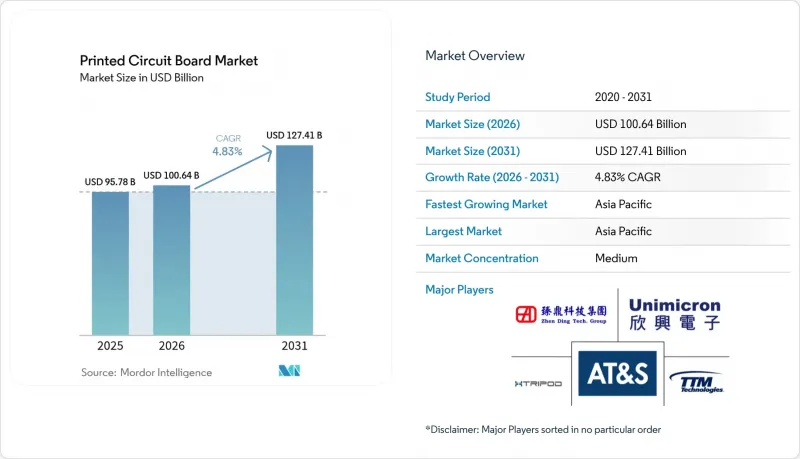
인쇄회로기판 시장 규모는 2025년에 957억 8,000만 달러, 2026년에 1,006억 4,000만 달러되어, 2031년까지 1,274억 1,000만 달러에 이를 것으로 예측되며, 예측 기간 중 연평균 복합 성장률(CAGR)은 4.83%가 됩니다.
수요는 전통적인 소비자 기기에서 인공지능(AI) 서버, 전기자동차(EV) 파워일렉트로닉스, 차세대 통신 네트워크와 같은 고부가가치 용도으로 이동하고 있으며, 이러한 용도는 더 많은 층수, 더 엄격한 공차, 고품질 유전체 재료를 갖춘 기판을 필요로 합니다. 요구하고 있습니다. 레인당 112Gbps 신호 전송으로 업그레이드하는 하이퍼스케일 데이터센터 사업자들은 현재 8층 스마트폰용 기판의 약 4배에 달하는 40층 이상의 백플레인을 주문하고 있습니다. 미국의 'CHIPS and Science Act'에 의한 인센티브와 유럽의 소버린 AI 규제로 대표되는 지역 정책으로 인해 북미와 중부 유럽에서의 신규 제조가 촉진되는 반면, 아시아태평양의 전통적인 규모의 우위는 상대적으로 감소하고 있습니다. 재료의 대체도 호재로 작용하고 있으며, 하이퍼스케일러가 800Gbps 및 1.6Tbps 광통신으로 전환함에 따라 초저손실 기판의 점유율이 확대되고 있습니다. 동시에 원자재 가격 변동과 폐수 규제 강화로 인해 범용 제조업체의 수익률이 압박을 받고 있으며, 인쇄회로기판 시장의 프리미엄 틈새 시장에 위치한 공급업체에게 유리한 산업 구조 조정이 진행 중입니다.
세계 인쇄회로기판 시장 동향 및 인사이트
AI 서버 및 고성능 컴퓨팅에 대한 수요 급증
하이퍼스케일 사업자들은 2025년 AI에 최적화된 서버 약 120만 대를 도입했습니다. 각 서버에는 8-16개의 GPU 가속기가 탑재되어 있으며, 소켓당 1.0kW 이상의 전력을 소비합니다. 이러한 플랫폼은 75μm 미만의 마이크로 비아, 레이저 천공에 의한 적층 비아, 액체 냉각식 콜드 플레이트로부터 열을 방출하는 내장형 열 비아를 갖춘 40-60층의 백플레인 사양을 요구하고 있습니다. 이러한 기판의 단가는 기존 서버 보드의 50달러에 비해 200달러를 초과하여 공차 범위를 충족시킬 수 있는 대만 전문 제조업체의 매출 총이익률을 확대되고 있습니다. AMD의 Instinct MI350 프로그램은 임베디드 배선 기판을 필요로 하는 칩렛 토폴로지를 채택하고 있으며, 2026년 이후에도 수요 증가를 주도하고 있습니다. 따라서 인쇄회로기판 시장은 레이어 수 증가와 고급 기판 구성의 다양화로 인해 직접적인 수요 증가를 누리게 될 것입니다.
EV용 파워 일렉트로닉스 부품의 급속한 확대
2025년에 인도되는 배터리 전기차에는 인버터, 충전기, 배터리 관리 유닛에 걸쳐 미화 150-200달러 상당의 PCB가 탑재되며, 이는 내연기관 모델 대비 2배에 달하는 금액입니다. 800V에서 스위칭하는 실리콘 카바이드(SiC) 전력 모듈은 175°C 이상의 접합부 온도를 발생시키기 때문에 설계자는 260°C 이상의 유리 전이 온도를 가진 폴리이미드 또는 세라믹 기판을 사용해야 하며, 400A를 흐르게 하기 위해 최대 210μm 두께의 동박을 사용해야 합니다. IATF 16949에 따른 자동차 등급 인증은 공급업체의 선택 폭을 좁히고, 기존 공급업체의 가격 결정력을 높이며, 금액 기준으로 PCB 시장을 확대시키고 있습니다.
구리 및 에폭시 수지 가격 변동이 장기화됨
2024년부터 2025년까지 칠레와 페루의 광산 가동 중단과 EV 수요에 대한 투기적 기대감이 겹치면서 구리 선물 가격은 톤당 8,200달러에서 1만 500달러 사이를 오갔습니다. 동박은 완성된 기판 비용의 최대 40%를 차지하기 때문에 현물 가격의 급등은 헤지 프로그램이 없는 중소형 아시아 제조업체의 수익률을 압박하고 있습니다. 2025년 대만 전구체 공장에서 화재가 발생하여 비스페놀 A의 생산량이 감소하면서 에폭시 수지 가격이 급등했습니다. 이로 인해 라미네이트 공급업체는 불가항력 조항을 발동하여 북미으로의 배송이 지연되었습니다. 이러한 가격 변동은 설비 투자 모델 수립을 복잡하게 만들고, PCB 시장의 단기적인 성장을 둔화시키고 있습니다.
부문 분석
2025년 표준 다층 기판은 자동차 차체 전자 및 산업용 드라이브가 견인차 역할을 하면서 인쇄회로기판 시장 점유율의 29.64%를 유지했습니다. 한편, 플렉서블 회로는 폴더블 스마트폰, 웨어러블 건강 모니터 및 얇은 자동차 내장 모듈이 3mm 미만의 굽힘 반경을 필요로 하기 때문에 2031년까지 연평균 복합 성장률(CAGR) 5.39%로 확대될 것으로 예측됩니다. 삼성 갤럭시 Z 시리즈만 해도 2025년에 1,000만 대가 출하될 예정이며, 각 단말기에는 일본 멕트론과 플렉슘이 공급하는 3장 이상의 폴리이미드 플렉스가 탑재되어 있습니다. 고밀도 배선 설계는 75µm 선폭으로 멀티 카메라 어레이를 지원할 수 있어 프리미엄 스마트폰의 사실상 표준이 되었습니다. IC 기판은 0.4mm의 볼 그리드 어레이와 10µm의 트레이스가 필요하기 때문에 8층 서버보드보다 4-5배 높은 가격대를 형성하고 있지만, 규모는 작지만 수익성이 높은 틈새 시장으로 자리매김하고 있습니다.
리지드 플렉스 구조는 내진동성과 공간절약성이 30-50%의 비용 프리미엄을 정당화하는 항공우주 분야와 체내 삽입형 의료기기 분야에서 점유율을 확대되고 있습니다. 금속 코어 기판과 세라믹 기판은 LED 헤드램프와 자동차 레이더에 채택되어 솔리드 스테이트 조명과 첨단 운전자 보조 시스템(ADAS)으로의 전환에 따른 혜택을 누리고 있습니다. 한편, 범용 4층 제품 생산 라인에서는 심천과 소주 공장의 가격 경쟁이 치열해지면서 수익률 압박에 직면해 있습니다. 한편, IPC-6012 클래스 3 또는 MIL-PRF-55110 인증을 획득한 특수 기판 제조업체는 국방 및 의료 분야 고객이 저등급 공급업체로 전환하지 않기 때문에 가격 측면에서 우위를 점하고 있습니다. 전반적으로 범용 제품의 생산량은 보합세인 반면, 플렉서블 기판, 리지드 플렉스 기판, IC 기판으로 구성비가 이동하고 있어 인쇄회로기판 시장 규모는 확대되고 있습니다.
지역별 분석
아시아태평양은 2025년 세계 생산량의 82.54%를 차지할 것으로 예상되며, 부품 조달, 도금 화학물질, 조립 라인이 한 곳에 모여 있는 광동성, 장쑤성, 주강 삼각주 지역의 통합 생태계에 힘입어 연간 4.86%의 성장이 예상됩니다. 대만은 첨단 기판 분야의 핵심을 담당하고 있으며, 유니미크론, 난야 PCB, 금속이 반도체 등급 클린룸을 운영하며 인텔과 대만 반도체 제조 회사(TSMC) 양사에 공급하고 있습니다. 중국 심천전로(Shennan Circuits)와 DSBJ는 스마트폰 HDI 생산량에서 우위를 점하고 있지만, 미국의 수출 규제로 인해 제조 설비의 병목현상에 직면해 있습니다. 일본의 이비덴, 신광전기, 명광전자는 비아 충진 및 표면처리 공정 특허를 활용하여 고가 제품인 고신뢰성 자동차용 및 산업용 기판에 주력하고 있습니다. 한국의 삼성전기와 LG이노텍은 기존에는 휴대폰용이 주를 이루었으나, 현재는 자동차용 레이더와 데이터센터용 기판에 대한 설비투자를 확대되고 있습니다.
북미는 2025년 인쇄회로기판 시장 규모의 약 8%를 차지했으며, 미국의 'CHIPS and Science Act'에 따른 세액 공제 및 국방 상쇄 조항에 따라 규모가 확대되고 있습니다. TTM 테크놀로지스는 항공전자 및 레이더 전용 리지드 플렉스 생산 라인에 1억 5,000만 달러를 뉴욕주에 투자하고 있습니다. 주요 방산 관련 기업들은 미션 크리티컬한 설계에 대해 국내 조달을 의무화하고 있으며, 애리조나 주와 캘리포니아의 소규모 전문 제조업체의 가동률을 높이고 있습니다. 멕시코는 마킬라도라(수출가공지역)의 지위를 활용하여 수입된 기판을 이용하여 서버와 통신기기를 조립하고 있으며, 이 경로를 통해 광범위한 지역 공급망 내에서 어느 정도의 생산량을 유지하고 있습니다. 캐나다의 사업 규모는 다품종 소량 생산의 산업 및 항공우주용 프로토타입에 국한되어 있습니다.
유럽은 2025년 생산량의 약 6%에 불과하지만, 첨단 기판에 대한 보조금과 자동차 안전 시스템용 이중 소싱을 촉진하는 430억 유로(507억 달러) 규모의 '유럽 칩법'의 혜택을 받고 있습니다. AT&:S의 오스트리아와 말레이시아의 분산 거점 전략은 위험 분산을 중시하는 독일 자동차 제조업체의 의도에 부합하는 것입니다. Schweizer Electronic은 애리조나 주에서 합작 투자를 검토하고 있으며, 이는 방위 및 의료 분야 고객 확보를 위한 대서양 횡단 노력을 반영하고 있습니다. 폴란드, 체코 등 동유럽 국가들은 낮은 인건비, 유럽연합(EU) 규제 준수 등을 내세워 중규모 다층 기판 생산에 매력적입니다. 기타 라틴아메리카, 중동 및 아프리카를 포함한 세계 다른 지역은 여전히 소규모로, 주로 아시아에서 최종 조립을 위해 기판을 수입하고 있습니다. 유럽의 RoHS, 미국의 TSCA와 같은 환경 규제는 전 세계적으로 통일된 재료 표준을 추진하고 있으며, 신흥 시장의 품질 기준을 간접적으로 끌어올리고 있습니다.
기타 특전:
- 엑셀 형식 시장 예측(ME) 시트
- 3개월간 애널리스트 지원
자주 묻는 질문
목차
제1장 서론
제2장 조사 방법
제3장 주요 요약
제4장 시장 구도
제5장 시장 규모와 성장 예측
제6장 경쟁 구도
제7장 시장 기회와 향후 전망
JHS 26.06.11The printed circuit board market size is projected to be USD 95.78 billion in 2025, USD 100.64 billion in 2026, and reach USD 127.41 billion by 2031, translating to a 4.83% CAGR over the forecast period. Demand is shifting from legacy consumer devices toward higher-value deployments in artificial-intelligence servers, electric-vehicle power electronics, and next-generation telecom networks, each of which specifies boards with more layers, tighter tolerances, and premium dielectric materials. Hyperscale data-center operators upgrading to 112 Gbps per-lane signaling now order 40-plus-layer backplanes that carry selling prices nearly four times those of eight-layer smartphone boards. Regional policy, led by United States CHIPS and Science Act incentives and European sovereign-AI mandates, is encouraging new fabrication in North America and Central Europe while tempering Asia-Pacific's historic scale advantage. Material substitution is another tail-wind, with ultra-low-loss substrates gaining share as hyperscalers shift to 800 Gbps and 1.6 Tbps optics. At the same time, raw-material volatility and tightening wastewater rules are thinning margins for commodity makers, prompting consolidation that should favor suppliers positioned in premium niches of the printed circuit board market.
Global Printed Circuit Board Market Trends and Insights
Surge in AI Server and High-Performance Computing Demand
Hyperscale operators deployed roughly 1.2 million AI-optimized servers in 2025, each integrating 8-16 GPU accelerators that draw more than 1.0 kW per socket. These platforms specify 40-to-60-layer backplanes with microvias under 75 μm, laser-drilled stacked vias, and embedded thermal vias that dissipate heat from liquid-cooled cold plates. Unit pricing for such substrates exceeds USD 200 compared with USD 50 for legacy server boards, expanding gross margins for Taiwanese specialists able to meet the tolerance window. AMD's Instinct MI350 program employs chiplet topologies that require embedded-trace substrates, driving incremental demand through 2026 and beyond. The printed circuit board market therefore captures a direct uplift from both higher layer counts and richer mixes of advanced substrates.
Accelerated EV Power Electronics Content
Battery-electric vehicles delivered in 2025 contained USD 150-200 worth of PCB content across inverters, chargers, and battery-management units, double that of internal-combustion models. Silicon-carbide power modules switching at 800 V create junction temperatures above 175 °C, forcing designers to adopt polyimide or ceramic boards with glass-transition values above 260 °C and thick copper foils up to 210 μm to carry 400 A. Automotive-grade validation under IATF 16949 narrows the supplier pool, increasing pricing power for incumbents and enlarging the PCB market in value terms.
Prolonged Copper and Epoxy-Resin Price Volatility
Copper futures oscillated between USD 8,200 and USD 10,500 per metric ton during 2024-2025 as mine disruptions in Chile and Peru collided with speculative EV demand. Because copper foil can represent up to 40% of finished-board cost, spot spikes erode margins for smaller Asian fabricators lacking hedging programs. Epoxy-resin prices jumped after a 2025 Taiwanese precursor plant fire cut bisphenol-A output, leading laminate suppliers to invoke force-majeure clauses that delayed shipments to North America. Such volatility complicates capital-investment models and dampens short-term growth in the PCB market.
Other drivers and restraints analyzed in the detailed report include:
- 5G and Emerging 6G Transition Boosting HDI Adoption
- Shift Toward Advanced IC Substrates for Chiplet Integration
- Escalating ESG Compliance Costs for Wastewater and PFAS Elimination
For complete list of drivers and restraints, kindly check the Table Of Contents.
Segment Analysis
Standard multilayer boards retained 29.64% printed circuit board market share in 2025, anchored by automotive body electronics and industrial drives. Flexible circuits, however, are set to expand at a 5.39% CAGR through 2031 as foldable smartphones, wearable health monitors, and thin automotive interior modules demand bend radii below 3 mm. Samsung's Galaxy Z series alone shipped 10 million units in 2025, each carrying three or more polyimide flexes supplied by Nippon Mektron and Flexium. High-density interconnect designs have become the de facto choice for premium handsets because 75 µm line widths accommodate multi-camera arrays. IC substrates remain a small but lucrative niche, priced four to five times higher than eight-layer server boards because they require 0.4 mm ball-grid arrays and 10 µm traces.
Rigid-flex constructions are carving share in aerospace and implantable medical devices where vibration resistance and space savings justify a 30-50% cost premium. Metal-core and ceramic boards serve LED headlamps and automotive radar, benefiting from the move to solid-state lighting and advanced driver-assistance systems. Commodity four-layer product runs face margin compression as Shenzhen and Suzhou factories compete aggressively on price. Conversely, specialty fabricators that hold IPC-6012 Class 3 or MIL-PRF-55110 certifications enjoy insulated pricing because defense and medical customers will not switch to lower-grade suppliers. Overall, the printed circuit board market size gains value as the mix shifts toward flex, rigid-flex, and IC substrates even while commodity unit volumes level off.
The Printed Circuit Board Market Report is Segmented by PCB Type (Standard Multilayer, High-Density Interconnect, Flexible Circuits, and More), Substrate Material (Glass Epoxy, High-Speed and Low-Loss, and More), End-User Industry (Consumer Electronics, Computing and Data Center, Telecommunications and 5G, Automotive and EV, Healthcare and Medical, and More), and Geography. The Market Forecasts are Provided in Terms of Value (USD).
Geography Analysis
Asia-Pacific accounted for 82.54% of global production in 2025 and is forecast to grow 4.86% annually, supported by integrated ecosystems in Guangdong, Jiangsu, and the Pearl River Delta where component sourcing, plating chemistry, and assembly lines co-locate. Taiwan anchors the advanced-substrate stack, with Unimicron, Nan Ya PCB, and Kinsus running semiconductor-grade clean rooms that feed both Intel and Taiwan Semiconductor Manufacturing Company. China's Shennan Circuits and DSBJ dominate smartphone HDI volumes but face tooling bottlenecks under United States export controls. Japan's Ibiden, Shinko Electric, and Meiko concentrate on high-reliability automotive and industrial boards, leveraging process patents in via fill and surface finish that command premium pricing. South Korean groups Samsung Electro-Mechanics and LG Innotek, historically captive to mobile phones, now channel capex toward automotive radar and data-center substrates.
North America captured roughly 8% printed circuit board market size in 2025 yet is scaling under United States CHIPS and Science Act tax credits and defense-offset clauses. TTM Technologies is investing USD 150 million in New York State for rigid-flex lines dedicated to avionics and radar. Defense primes stipulate domestic sourcing for mission-critical designs, raising utilization in smaller specialty shops across Arizona and California. Mexico leverages maquiladora status to assemble servers and telecom gear with imported boards, a conduit that keeps some volume inside the broader regional supply chain. Canada's footprint remains limited to high-mix, low-volume industrial and aerospace prototypes.
Europe held about 6% of 2025 volume yet benefits from the EUR 43 billion (USD 50.7 billion) European Chips Act that subsidizes advanced substrates and encourages dual sourcing for automotive safety systems. AT&S's Austrian and Malaysian split-site strategy aligns with German carmakers' preference for diversified risk. Schweizer Electronic is evaluating a joint venture in Arizona, reflecting trans-Atlantic attempts to secure defense and medical accounts. Eastern European countries such as Poland and the Czech Republic pitch lower labor costs plus European Union compliance, appealing for mid-range multilayer runs. Rest-of-world regions, including Latin America, Middle East and Africa, stay subscale, importing boards primarily from Asia for final assembly. Environmental regulations such as RoHS in Europe and TSCA in the United States drive uniform material standards worldwide, indirectly lifting quality benchmarks in emerging markets.
List of Companies Covered in this Report:
- Zhen Ding Technology Holding Ltd.
- Unimicron Technology Corp.
- Nippon Mektron Ltd.
- TTM Technologies Inc.
- Samsung Electro-Mechanics Co., Ltd.
- Compeq Manufacturing Co., Ltd.
- Tripod Technology Corporation
- Shennan Circuits Co., Ltd.
- Young Poong Electronics Co., Ltd.
- Ibiden Co., Ltd.
- HannStar Board Corp.
- AT&S AG
- LG Innotek Co., Ltd.
- Kinwong Electronic Co., Ltd.
- DSBJ (Dongshan Precision)
- Kingboard Holdings Ltd.
- Shinko Electric Industries Co., Ltd.
- Flexium Interconnect Inc.
- Nan Ya PCB Corp.
- Isola Group
Additional Benefits:
- The market estimate (ME) sheet in Excel format
- 3 months of analyst support
TABLE OF CONTENTS
1 INTRODUCTION
- 1.1 Study Assumptions and Market Definition
- 1.2 Scope of the Study
2 RESEARCH METHODOLOGY
3 EXECUTIVE SUMMARY
4 MARKET LANDSCAPE
- 4.1 Market Overview
- 4.2 Market Drivers
- 4.2.1 Surge in AI Server and High-Performance Computing Demand
- 4.2.2 Accelerated EV Power Electronics Content
- 4.2.3 5G and Emerging 6G Transition Boosting HDI Adoption
- 4.2.4 Shift Toward Advanced IC Substrates for Chiplet Integration
- 4.2.5 Re-shoring Incentives in U.S. and EU for Critical PCB Supply Chains
- 4.2.6 Adoption of Ultra-Low-Loss Materials for 112-224 Gbps Signalling
- 4.3 Market Restraints
- 4.3.1 Prolonged Copper and Epoxy Resin Price Volatility
- 4.3.2 Talent Shortages in Advanced PCB Design and Process Engineering
- 4.3.3 Escalating ESG Compliance Costs for Waste-Water and PFAS Elimination
- 4.3.4 Geopolitical Export Controls Limiting Advanced Substrate Equipment
- 4.4 Impact of Macroeconomic Factors on the Market
- 4.5 Industry Value Chain Analysis
- 4.6 Regulatory Landscape
- 4.7 Technological Outlook
- 4.8 Porter's Five Forces Analysis
- 4.8.1 Bargaining Power of Suppliers
- 4.8.2 Bargaining Power of Buyers
- 4.8.3 Threat of New Entrants
- 4.8.4 Threat of Substitutes
- 4.8.5 Competitive Rivalry
5 MARKET SIZE AND GROWTH FORECASTS (VALUE)
- 5.1 By PCB Type
- 5.1.1 Standard Multilayer (non-HDI)
- 5.1.2 Rigid 1-2 Sided
- 5.1.3 High-Density Interconnect (HDI)
- 5.1.4 Flexible Circuits (FPC)
- 5.1.5 IC Substrates (Package Substrates)
- 5.1.6 Rigid-Flex
- 5.1.7 Other PCB Types
- 5.2 By Substrate Material
- 5.2.1 Glass Epoxy (FR-4)
- 5.2.2 High-Speed and Low-Loss
- 5.2.3 Polyimide (PI)
- 5.2.4 Packaging Resins (BT and ABF)
- 5.2.5 Other Substrate Materials
- 5.3 By End-User Industry
- 5.3.1 Consumer Electronics
- 5.3.2 Computing and Data Centers
- 5.3.3 Telecommunications and 5G
- 5.3.4 Automotive and EV
- 5.3.5 Industrial and Power
- 5.3.6 Healthcare and Medical
- 5.3.7 Aerospace and Defense
- 5.3.8 Other End-User Industries
- 5.4 By Region
- 5.4.1 North America
- 5.4.1.1 United States
- 5.4.1.2 Rest of North America
- 5.4.2 Europe
- 5.4.2.1 Germany
- 5.4.2.2 United Kingdom
- 5.4.2.3 Italy
- 5.4.2.4 Rest of Europe
- 5.4.3 Asia-Pacific
- 5.4.3.1 China
- 5.4.3.2 Taiwan
- 5.4.3.3 Japan
- 5.4.3.4 India
- 5.4.3.5 South Korea
- 5.4.3.6 Southeast Asia
- 5.4.3.7 Rest of Asia-Pacific
- 5.4.4 Rest of World
- 5.4.1 North America
6 COMPETITIVE LANDSCAPE
- 6.1 Market Concentration
- 6.2 Strategic Moves
- 6.3 Market Share Analysis
- 6.4 Company Profiles (includes Global Level Overview, Market Level Overview, Core Segments, Financials as available, Strategic Information, Market Rank/Share, Products and Services, Recent Developments)
- 6.4.1 Zhen Ding Technology Holding Ltd.
- 6.4.2 Unimicron Technology Corp.
- 6.4.3 Nippon Mektron Ltd.
- 6.4.4 TTM Technologies Inc.
- 6.4.5 Samsung Electro-Mechanics Co., Ltd.
- 6.4.6 Compeq Manufacturing Co., Ltd.
- 6.4.7 Tripod Technology Corporation
- 6.4.8 Shennan Circuits Co., Ltd.
- 6.4.9 Young Poong Electronics Co., Ltd.
- 6.4.10 Ibiden Co., Ltd.
- 6.4.11 HannStar Board Corp.
- 6.4.12 AT&S AG
- 6.4.13 LG Innotek Co., Ltd.
- 6.4.14 Kinwong Electronic Co., Ltd.
- 6.4.15 DSBJ (Dongshan Precision)
- 6.4.16 Kingboard Holdings Ltd.
- 6.4.17 Shinko Electric Industries Co., Ltd.
- 6.4.18 Flexium Interconnect Inc.
- 6.4.19 Nan Ya PCB Corp.
- 6.4.20 Isola Group
7 MARKET OPPORTUNITIES AND FUTURE OUTLOOK
- 7.1 White-Space and Unmet-Need Assessment