

|
시장보고서
상품코드
2044189
레이저 센서 시장 : 점유율 분석, 산업 동향 및 통계, 성장 예측(2026-2031년)Laser Sensor - Market Share Analysis, Industry Trends & Statistics, Growth Forecasts (2026 - 2031) |
||||||
 Mordor Intelligence
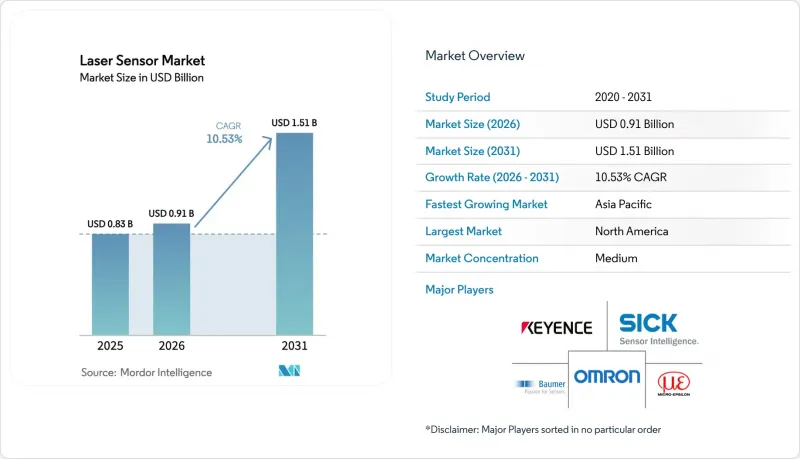
레이저 센서 시장 규모는 2025년 8억 3,000만 달러에서 2026년에는 9억 1,000만 달러로 확대되어 2026년부터 2031년까지 CAGR 10.53%로 성장을 지속하여, 2031년에는 15억 1,000만 달러에 이를 것으로 예측됩니다.
기계식 게이지는 오염의 위험이 있고, 비전 시스템은 삼각측량이나 비행시간법(ToF) 장치로 서브미크론 수준의 반복성을 보장할 수 없는 고정밀도가 요구되는 이용 사례에 대한 수요가 꾸준히 증가하고 있습니다. 전기자동차용 셀 적층, 첨단 반도체 패키징, 창고 자동화는 가장 영향력 있는 세 가지 도입 분야로, 사이클 타임과 수율 목표가 엄격해짐에 따라 각 분야는 설비 투자 예산에 큰 영향을 미치고 있습니다. 하드웨어 업그레이드의 경우, 현재 가장자리 분석과 다축 레이저 변위 측정 헤드를 결합하여 데이터 지연을 억제하고 ISO 10360 및 FDA 21 CFR Part 11의 추적성 요구 사항을 충족하는 것이 일반적입니다. 2025년 인화 인듐 에피택시 재료공급 부족을 겪은 후, 공급 측면의 회복력은 개선되고 있지만, 업체들은 여전히 중출력 어레이용 질화갈륨 이미터 인증을 추진하여 리스크를 헤지하고 있습니다.
세계 레이저 센서 시장 동향 및 인사이트
EV 배터리 조립의 정밀한 갭 해소로 레이저 변위 센서의 보급 가속화
전기자동차의 보급이 확대됨에 따라, 2025년에는 셀에서 팩까지의 조립 공차가 50미크론의 임계치 이하로 떨어질 것으로 예측됩니다. 청자색 공초점 센서는 현재 0.5 미크론의 재현성을 달성하여 호일 손상 위험이 있는 기계식 게이지를 대체하고 있습니다. 테슬라의 베를린 공장은 인라인 프로파일러를 도입한 후 재작업 작업을 12% 줄였고, 중국의 리튬 이온 대기업들이 GB/T 36276을 잇따라 도입하면서 수요는 더욱 확대되고 있습니다. 벤더들은 에지 분석 기능을 통합하고 50밀리초 이내에 피드백 루프를 닫아 서버 트래픽을 70% 감소시켜 유럽과 아시아 전역에 걸쳐 설계 채택을 이끌어냈습니다. 중국, 독일, 미국의 보조금 프로그램이 계속 추진력을 유지하면서 레이저 센서 시장 수요는 높은 수준을 유지하고 있습니다.
반도체 패키징의 3D AOI 확대가 3D 라인 센서 수요를 견인할 것입니다.
칩렛, 팬아웃 웨이퍼 레벨, 하이브리드 본딩의 각 노드에서는 ±10 마이크론 이내의 공면성 제어가 요구되는데, 이는 2차원 AOI에서는 경제적인 택트 타임으로 달성할 수 없는 영역입니다. 10kHz로 구조화된 빛을 투사하는 3차원 레이저 라인 센서는 웨이퍼 한 장당 200밀리초 이내로 0.1미크론의 Z축 해상도를 구현합니다. TSMC는 2025년에 300대 이상을 도입하고, 수율이 8% 포인트 향상되었다고 보고했습니다. 유럽의 '칩스법'에서는 CpK가 1.67을 초과하는 경우 보조금을 지급하고 있으며, 이를 통해 인라인 레이저 측정이 사실상 제도화되었습니다. 한편, 일본 경제산업성(METI)은 국내 계측기기를 위해 2,000억 엔(14억 달러)의 예산을 책정했습니다. 이러한 조치들이 복합적으로 작용하여 패키징 공장 내 레이저 센서 시장의 침투가 가속화되고 있습니다.
CMOS ToF 카메라의 대체품으로 인한 가격 압박
640×480의 해상도를 50달러 미만으로 제공하는 심도 맵 카메라는 80달러가 넘는 가격의 레이저 거리 센서를 위협하고 있습니다. 2025년에는 신형 청소 로봇의 68%가 ToF를 탑재했습니다. 공급업체들은 센서에 물체 분류 펌웨어를 번들로 제공함으로써 대응하고 있지만, 비용 중심적인 부문에서는 가격 탄력성이 카메라에 유리하게 작용하고 있습니다. 산업용 틈새 시장에서는 태양광의 영향을 덜 받고 서브mm급 정밀도를 가진 레이저가 여전히 우위를 점하고 있지만, 엔트리 레벨의 평균 판매 가격(ASP)이 전년 대비 8-10% 하락함에 따라 이 우위는 줄어들고 있습니다. 이러한 추세는 특히 아시아태평양의 가전 산업 중심지에서 레이저 센서 시장 예측 CAGR을 0.8% 낮출 것으로 예측됩니다.
부문 분석
2025년에는 하드웨어가 82.13%의 점유율을 차지했습니다. 이는 대당 6만-12만 달러에 달하는 다축 프로파일러에 대한 일회성 설비투자가 주도했습니다. 추적 가능한 교정, 예지보전 API, 센서 융합 소프트웨어의 애프터마켓이 확대되고 있으며, 공장이 계측 자산을 MES 플랫폼에 연결함에 따라 지속적인 예산을 확보하여 서비스 CAGR이 11.54%에 달하고 있습니다. 주요 업체들은 2026년 서비스 수익이 두 자릿수 성장을 보일 것이라고 발표했으며, 항공우주용 지그에서 ±10미크론의 정확도를 보장하는 계약이 프리미엄 가격을 견인하고 있다는 것을 뒷받침하고 있습니다. 구독 계약은 보통 3년에서 5년까지 지속되며, 벤더 락인(vendor lock-in)을 정착시키는 동시에 수익의 변동성을 평준화합니다.
소프트웨어는 결합조직과 같은 역할을 합니다. 점군 라이브러리, SPC 대시보드, AI 분류기는 원시 거리 측정 데이터를 실행 가능한 인사이트으로 변환하여 하드웨어의 수익률을 훨씬 뛰어넘는 평생 가치를 창출합니다. 타사 레이저와 상호 운용이 가능한 코그넥스의 2025년 라이선스(사용자당 미화 1,200달러)는 이러한 추세를 잘 보여줍니다. 한편, 신흥 시장에서는 연간 사용료보다 장비에 대한 설비투자(CAPEX)의 비율이 여전히 높고, 보급형 거리 측정 장비의 평균 판매가격(ASP)이 매년 6%씩 하락하고 있음에도 불구하고 하드웨어 판매량은 유지되고 있습니다. 이러한 복합적인 추세로 인해 서비스 부문은 광범위한 레이저 센서 시장에서 가장 높은 성장률을 보이는 분야가 되었습니다.
거리 및 거리 측정 장치는 2025년 기준 30.25%의 점유율을 유지하며, 충전 레벨, 최저 지상고, 크레인 충돌 방지 등의 용도로 자리매김하고 있습니다. 그러나 소포 허브, 바디 인 화이트 생산 라인, 타이어 공장에서 윤곽 매핑에 대한 요구 사항이 강화됨에 따라 프로파일링 및 라인 센서는 2031년까지 연평균 복합 성장률(CAGR) 11.71%를 나타낼 것으로 예측됩니다. 아마존이 8,000대프로파일러를 도입한 결과, 1년 동안 분류 오류가 14% 감소하면서 이 전환의 효과가 입증되었습니다. 변위 센서와 삼각측량 센서는 웨이퍼의 범프 높이 검사 등 속도보다 서브미크론 단위의 정밀 검사가 우선시되는 상황에서 여전히 필수적인 존재입니다.
가격 하락과 CMOS 카메라의 보급으로 기본적인 거리 측정 부문 수요는 감소하고 있지만, 눈부심 제거, 측정 범위, 모션 블러 내성 등 레이저가 카메라를 능가하는 분야에서는 산업용 구매자의 지지가 흔들리지 않고 있습니다. 또한, 프로파일러는 AI 엣지 모듈과 네이티브하게 통합되어 자율 피킹 및 치수 측정에 있어 선도적 우위를 점하고 있습니다. 이러한 장점으로 인해 프로파일링 기술은 창고 및 자동차 산업에서 레이저 센서 시장의 성장을 주도하고 있습니다.
지역별 분석
북미는 전기자동차(EV) 프로그램, 항공우주 분야의 품질 기준, 미국 내 120억 달러 규모의 창고 자동화 투자로 인해 2025년 시장 점유율 39.82%를 차지했습니다. FDA의 21 CFR Part 11은 제약 분야에서 추적 가능한 측정 기술을 촉진하고 있으며, 퀘벡과 온타리오의 캐나다 항공우주 생산 라인에서는 레이저 트래커로 전환하여 지그 소요 시간을 두 배로 줄였습니다. 멕시코의 니어쇼어링 붐으로 인해 2025년까지 1,800만 평방피트의 공장 면적이 증가할 것으로 예상되며, 그 중 상당수는 OEM의 공차를 충족시키기 위해 레이저 유도 용접 셀을 도입하고 있습니다.
아시아태평양은 중국, 일본, 한국이 스마트 팩토리 개조 및 반도체 패키징 라인에 보조금을 투입하면서 CAGR 12.01%로 가장 빠르게 성장하고 있는 지역입니다. 중국 공업정보화부(MIIT)가 계측 기술 업그레이드에 150억 위안(21억 달러)을 배정하고, 일본이 3D 검사 장비에 2,000억 엔(14억 달러)을 투자하면서 국내 반도체 제조 공장의 진입장벽이 낮아졌습니다. 인도에서는 2025년 4,500만 평방피트 규모의 신규 A급 창고 공간이 조성되고, 24시간 배송을 위한 레이저 탑재 AMR(자율 이동 로봇)의 도입이 진행되고 있어, 남아시아 전역에 레이저 센서 시장이 확대될 것으로 예측됩니다.
유럽에서는 IEC 60825 및 기계 지침으로 인해 오픈 라인에서 고출력 프로파일러의 도입이 제한되어 있기 때문에 성장이 더디게 진행되고 있습니다. 독일은 여전히 지역 수요의 62%를 차지하며 자동차 및 공작기계 부문을 주도하고 있습니다. 프랑스 ADEME의 5,000만 유로(5,400만 달러)의 보조금은 콜드체인 시설에 LiDAR 도입을 가속화하고 있으며, 영국의 항공우주산업 클러스터에서는 복합재 적층 결함 검출을 통한 비용 절감 효과를 얻고 있습니다. 중동 및 아프리카에서는 사우디의 NEOM 건설 메가 프로젝트를 통해 조기 진전을 보이고 있으며, 남미에서는 거시경제의 변동에도 불구하고 브라질의 자동차 산업 설비 증설에 따른 수혜를 받고 있습니다.
기타 특전:
- 엑셀 형식 시장 예측(ME) 시트
- 3개월간 애널리스트 지원
자주 묻는 질문
목차
제1장 서론
제2장 조사 방법
제3장 주요 요약
제4장 시장 구도
제5장 시장 규모와 성장 예측
제6장 경쟁 구도
제7장 시장 기회와 향후 전망
JHS 26.06.02The laser sensor market size is expected to grow from USD 0.83 billion in 2025 to USD 0.91 billion in 2026 and is forecast to reach USD 1.51 billion by 2031 at a 10.53% CAGR over 2026-2031. Robust demand stems from precision-critical use cases where mechanical gauges risk contamination and vision systems cannot match the sub-micron repeatability offered by triangulation and time-of-flight devices. Electric-vehicle cell stacking, advanced semiconductor packaging, and warehouse automation are the three most influential adoption vectors, each exerting measurable pull on capital budgets as cycle-time and yield targets tighten. Hardware upgrades now routinely pair edge analytics with multi-axis laser displacement heads, curbing data latency while satisfying ISO 10360 and FDA 21 CFR Part 11 traceability mandates. Supply-side resilience is improving after indium-phosphide epitaxy shortages in 2025, yet vendors still hedge risk by qualifying gallium-nitride emitters for mid-power arrays.
Global Laser Sensor Market Trends and Insights
Precision-Gap Closure in EV Battery Assembly Accelerates Laser Displacement Sensor Uptake
Wider adoption of electric vehicles forced cell-to-pack assembly tolerances beneath the 50-micron threshold in 2025. Blue-violet confocal sensors now reach 0.5-micron repeatability, displacing mechanical gauges that risk foil damage. Tesla's Berlin plant cut rework by 12% after installing inline profilers, and Chinese lithium-ion giants cascading GB/T 36276 compliance have multiplied demand further. Vendors embed edge analytics to close feedback loops within 50 milliseconds, reducing server traffic by 70% and securing design wins across Europe and Asia. Subsidy programs in China, Germany, and the United States sustain momentum, keeping laser sensor market demand elevated.
Expansion of 3-D AOI in Semiconductor Packaging Spurs 3-D Line Sensor Demand
Chiplet, fan-out wafer-level, and hybrid bonding nodes call for co-planarity control within +-10 microns, a regime unachievable for 2-D AOI at economical takt times. Three-dimensional laser line sensors projecting structured light at 10 kHz now deliver 0.1-micron z-resolution in <200 milliseconds per substrate. TSMC deployed more than 300 units in 2025, citing an 8-point yield boost. Europe's Chips Act links subsidies to CpK above 1.67, effectively institutionalizing inline laser metrology, while Japan's METI has earmarked JPY 200 billion (USD 1.4 billion) for domestic toolsets. These mandates collectively accelerate laser sensor market penetration in packaging fabs.
Price Pressure from CMOS ToF Camera Alternatives
Depth-map cameras delivering 640X480 resolution at <USD 50 threaten laser distance sensors priced more than USD 80 in consumer robotics. ToF attach rates reached 68% of new vacuum robots in 2025. Suppliers counter by bundling on-sensor object-classification firmware, but price elasticity favors cameras in cost-driven segments. Industrial niches still shield lasers thanks to sunlight immunity and sub-millimeter accuracy, yet year-on-year entry-level ASP compression of 8-10% narrows this moat. The dynamic trims 0.8 points from the projected laser sensor market CAGR, especially in Asia-Pacific's appliance hubs.
Other drivers and restraints analyzed in the detailed report include:
- Migration from Ultrasonic to Laser Range Sensors in Smart Warehouses
- Falling Solid-State LiDAR Costs Enable ToF Sensors in European AGVs
- Regulatory Constraints on Class 3B and Class 4 Power Emissions
For complete list of drivers and restraints, kindly check the Table Of Contents.
Segment Analysis
Hardware represented 82.13% of the share in 2025, driven by one-off capital purchases of multi-axis profilers that each list between USD 60,000 and USD 120,000. A growing aftermarket for traceable calibration, predictive maintenance APIs, and sensor-fusion software now captures recurring budgets as factories tie metrology assets to MES platforms, pushing services to an 11.54% CAGR. Major vendors publicized double-digit service revenue lifts in 2026, confirming that contracts guaranteeing +-10-micron accuracy across aerospace jigs command premium pricing. Subscription layers typically run three to five years, embedding vendor lock-in while smoothing earnings volatility.
Software is the connective tissue; point-cloud libraries, SPC dashboards, and AI classifiers turn raw range data into actionable insights, lifting lifetime value well beyond hardware margin. Cognex's 2025 license, enabling interoperability with third-party lasers at USD 1,200 per seat, illustrates the trend. Meanwhile, emerging markets still allocate more capex to devices than to annual fees, sustaining hardware volume even as ASPs decline 6% each year for entry-level distance units. The combined dynamic positions services as the highest-growth pocket inside the broader laser sensor market.
Distance and range devices retained a 30.25% share in 2025, entrenched in fill-level, ground-clearance, and crane anti-collision tasks. Profiling and line sensors, however, are charting a CAGR of 11.71% through 2031 as parcel hubs, body-in-white lines, and tire plants intensify contour-mapping requirements. Amazon's roll-out of 8,000 profilers cut mis-sorts by 14% in one year, validating the switch. Displacement and triangulation sensors remain critical where sub-micron scrutiny outranks speed, such as wafer bump height checks.
Price erosion and CMOS camera creep siphon volume from basic distance segments, but industrial buyers stay loyal where lasers beat cameras on glare rejection, range, and motion blur immunity. Profilers also integrate natively with AI edge modules, awarding them an early mover edge in autonomous picking and dimensioning. This advantage keeps profiling at the vanguard of laser sensor market size gains across warehousing and automotive.
The Laser Sensor Market Report is Segmented by Component (Hardware, Software, and Services), Sensor Type (Distance/Range, Displacement, and More), Measurement Range (Less Than 100 Mm, and More), Power Output (Less Than 1 MW, 1-100 MW, and More), Dimensionality (1D Point, 2D Area, and 3D Profile), End-User Industry (Electronics, Automotive, and More), and Geography. The Market Forecasts are Provided in Terms of Value (USD).
Geography Analysis
North America held 39.82% of the share in 2025 thanks to electric-vehicle programs, aerospace quality charters, and USD 12 billion in U.S. warehouse-automation spend. FDA 21 CFR Part 11 bolsters traceable metrology in pharmaceuticals, while Canadian aerospace lines in Quebec and Ontario trimmed jig times by double digits after switching to laser trackers. Mexico's near-shoring boom added 18 million ft2 of plant floor in 2025, many with laser-guided welding cells to satisfy OEM tolerances.
Asia-Pacific is the fastest-growing region at a 12.01% CAGR because China, Japan, and South Korea inject subsidies into smart-factory retrofits and chip packaging lines. China's MIIT earmarked CNY 15 billion (USD 2.1 billion) for metrology upgrades, and Japan's JPY 200 billion (USD 1.4 billion) allotment for 3-D inspection tooling lowers entry barriers for domestic fabs. India's 45 million ft2 of new Grade-A warehouse space in 2025 banks on laser-equipped AMRs for 24-hour delivery promises, extending the laser sensor market's footprint across South Asia.
Europe grows more slowly as IEC 60825 and the Machinery Directive restrict high-power profiler deployment on open lines. Germany still accounts for 62% of regional demand, leveraging automotive and machine-tool sectors. France's ADEME grants of EUR 50 million (USD 54 million) speed LiDAR adoption in cold-chain sites, and the U.K. aerospace corridor captures savings from composite layup defect detection. The Middle East and Africa see early traction through Saudi Arabia's NEOM construction mega-project, while South America benefits from Brazilian automotive tool-ups despite macro volatility.
List of Companies Covered in this Report:
- Keyence Corporation
- SICK AG
- OMRON Corporation
- Micro-Epsilon Messtechnik GmbH and Co. KG
- IFM Electronic GmbH
- Baumer Electric AG
- SmartRay GmbH
- Rockwell Automation Inc.
- Dimetix AG
- First Sensor AG (TE Connectivity)
- Banner Engineering Corp.
- Panasonic Industry Co.
- Cognex Corporation
- FARO Technologies Inc.
- Honeywell International Inc.
- Polytec GmbH
- OMS Corporation
- Teledyne DALSA
- Acuity Laser (Schmitt Measurement)
- Hokuyo Automatic Co. Ltd.
- Datalogic S.p.A.
- Lumentum Holdings Inc.
- Trimble Inc.
- Hexagon AB
Additional Benefits:
- The market estimate (ME) sheet in Excel format
- 3 months of analyst support
TABLE OF CONTENTS
1 INTRODUCTION
- 1.1 Study Assumptions and Market Definition
- 1.2 Scope of the Study
2 RESEARCH METHODOLOGY
3 EXECUTIVE SUMMARY
4 MARKET LANDSCAPE
- 4.1 Market Overview
- 4.2 Market Drivers
- 4.2.1 Precision-Gap Closure in EV Battery Assembly Accelerates Laser Displacement Sensor Uptake
- 4.2.2 Expansion of 3D AOI in Semiconductor Packaging Spurs 3D Line Sensor Demand
- 4.2.3 Migration from Ultrasonic to Laser Range Sensors in Smart Warehouses
- 4.2.4 Falling Solid-State LiDAR Costs Enable ToF Sensors in European AGVs
- 4.2.5 Photonics-Integrated Displacement Sensors for Flexible OLED Inspection
- 4.2.6 Quantum-Cascade Laser Metrology in Additive Manufacturing
- 4.3 Market Restraints
- 4.3.1 Price Pressure from CMOS ToF Camera Alternatives
- 4.3.2 Regulatory Constraints on Class 3B and 4 Power Emissions
- 4.3.3 Limited InP Epitaxy Capacity for High-Power VCSEL Arrays
- 4.3.4 Edge-Compute Thermal Load Limits Sensor Fusion in Autonomous Drones
- 4.4 Impact of Macroeconomic Factors on the Market
- 4.5 Industry Supply-Chain Analysis
- 4.6 Technological Outlook
- 4.7 Regulatory Landscape
- 4.8 Porter's Five Forces Analysis
- 4.8.1 Threat of New Entrants
- 4.8.2 Bargaining Power of Buyers
- 4.8.3 Bargaining Power of Suppliers
- 4.8.4 Threat of Substitutes
- 4.8.5 Intensity of Competitive Rivalry
5 MARKET SIZE AND GROWTH FORECASTS (VALUE)
- 5.1 By Component
- 5.1.1 Hardware
- 5.1.2 Software
- 5.1.3 Services
- 5.2 By Sensor Type
- 5.2.1 Distance / Range Sensors
- 5.2.2 Displacement Sensors
- 5.2.3 Profiling / Line Sensors
- 5.2.4 Vibration and Energy Sensors
- 5.2.5 Triangulation Sensors
- 5.2.6 Other Sensor Types
- 5.3 By Measurement Range
- 5.3.1 Less than 100 mm (Short-Range)
- 5.3.2 100-300 mm (Medium-Range)
- 5.3.3 Greater than 300 mm (Long-Range)
- 5.4 By Power Output
- 5.4.1 Less than 1 MW
- 5.4.2 1-100 MW
- 5.4.3 101-500 MW
- 5.4.4 Greater than 500 MW
- 5.5 By Dimensionality
- 5.5.1 1D Point Sensors
- 5.5.2 2D Area Sensors
- 5.5.3 3D Profile Sensors
- 5.6 By End-user Industry
- 5.6.1 Electronics Manufacturing
- 5.6.2 Automotive and Mobility
- 5.6.3 Aerospace and Aviation
- 5.6.4 Building and Construction
- 5.6.5 Healthcare and Medical Devices
- 5.6.6 Food and Beverage Processing
- 5.6.7 Logistics, Warehousing and Robotics
- 5.6.8 Other End-user Industries
- 5.7 By Geography
- 5.7.1 North America
- 5.7.1.1 United States
- 5.7.1.2 Canada
- 5.7.1.3 Mexico
- 5.7.2 South America
- 5.7.2.1 Brazil
- 5.7.2.2 Argentina
- 5.7.2.3 Rest of South America
- 5.7.3 Europe
- 5.7.3.1 Germany
- 5.7.3.2 United Kingdom
- 5.7.3.3 France
- 5.7.3.4 Italy
- 5.7.3.5 Rest of Europe
- 5.7.4 Asia-Pacific
- 5.7.4.1 China
- 5.7.4.2 Japan
- 5.7.4.3 South Korea
- 5.7.4.4 Australia
- 5.7.4.5 India
- 5.7.4.6 Rest of Asia-Pacific
- 5.7.5 Middle East and Africa
- 5.7.5.1 Middle East
- 5.7.5.1.1 Saudi Arabia
- 5.7.5.1.2 United Arab Emirates
- 5.7.5.1.3 Turkey
- 5.7.5.1.4 Rest of Middle East
- 5.7.5.2 Africa
- 5.7.5.2.1 South Africa
- 5.7.5.2.2 Egypt
- 5.7.5.2.3 Rest of Africa
- 5.7.5.1 Middle East
- 5.7.1 North America
6 COMPETITIVE LANDSCAPE
- 6.1 Market Concentration
- 6.2 Strategic Moves
- 6.3 Market Share Analysis
- 6.4 Company Profiles (Includes Global Level Overview, Market Level Overview, Core Segments, Financials as Available, Strategic Information, Market Rank/Share, Products and Services, and Recent Developments)
- 6.4.1 Keyence Corporation
- 6.4.2 SICK AG
- 6.4.3 OMRON Corporation
- 6.4.4 Micro-Epsilon Messtechnik GmbH and Co. KG
- 6.4.5 IFM Electronic GmbH
- 6.4.6 Baumer Electric AG
- 6.4.7 SmartRay GmbH
- 6.4.8 Rockwell Automation Inc.
- 6.4.9 Dimetix AG
- 6.4.10 First Sensor AG (TE Connectivity)
- 6.4.11 Banner Engineering Corp.
- 6.4.12 Panasonic Industry Co.
- 6.4.13 Cognex Corporation
- 6.4.14 FARO Technologies Inc.
- 6.4.15 Honeywell International Inc.
- 6.4.16 Polytec GmbH
- 6.4.17 OMS Corporation
- 6.4.18 Teledyne DALSA
- 6.4.19 Acuity Laser (Schmitt Measurement)
- 6.4.20 Hokuyo Automatic Co. Ltd.
- 6.4.21 Datalogic S.p.A.
- 6.4.22 Lumentum Holdings Inc.
- 6.4.23 Trimble Inc.
- 6.4.24 Hexagon AB
7 MARKET OPPORTUNITIES AND FUTURE OUTLOOK
- 7.1 White-space and Unmet-Need Assessment


