

|
시장보고서
상품코드
2044193
포인트 오브 케어(POC) 분자진단 시장 : 점유율 분석, 산업 동향 및 통계, 성장 예측(2026-2031년)Point-of-Care Molecular Diagnostics - Market Share Analysis, Industry Trends & Statistics, Growth Forecasts (2026 - 2031) |
||||||
 Mordor Intelligence
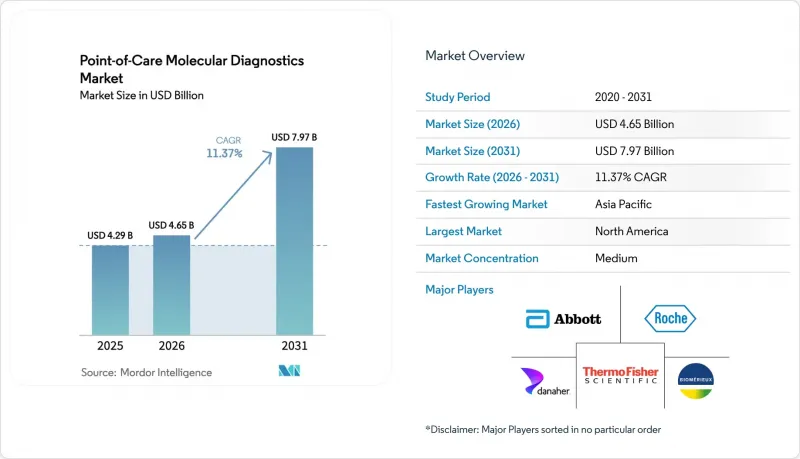
포인트 오브 케어(POC) 분자진단 시장 규모는 2025년에 42억 9,000만 달러로 평가되었고 2026년 46억 5,000만 달러에서 2031년까지 79억 7,000만 달러에 이를 것으로 예측되며, 예측 기간(2026-2031년) CAGR은 11.37%를 나타낼 전망입니다.
응급실, 약국, 병원의 '샘플-투-앤서(Sample to Answer, 검체에서 결과까지)형 기기 도입이 확대됨에 따라 결과 도출까지 걸리는 시간이 수일에서 수 분으로 단축되고 있으며, 이는 본 전망을 뒷받침하고 있습니다. 미국 생물의학첨단연구개발국(BARDA)이 주도하는 공공 부문 비축 이니셔티브는 공중보건 위협이 발생한 후 72시간 이내에 현장에 배치할 수 있는 분산형 플랫폼으로 조달을 전환하고 있습니다. 상온 운송이 가능한 동결건조 시약부터 기기 상태를 모니터링하는 AI 탑재 클라우드 대시보드에 이르기까지 기술의 성숙으로 소유비용이 계속 낮아지고 있어 소규모 진료소나 원격지 시설에도 도입할 수 있는 길이 열리고 있습니다. 이와 함께 미국, 유럽, 일본 규제 당국은 각각 CLIA 면제, IVDR 및 상환 경로를 확대하여 의사가 검체를 중앙 검사 기관에 위탁하는 대신 진료 현장에서 분자 패널 검사를 주문할 수 있는 새로운 경제적 인센티브를 제공합니다.
세계 포인트 오브 케어(POC) 분자진단 시장 동향 및 인사이트
감염성 질환의 부담 증가와 신속한 진단의 필요성
병원균의 식별이 늦어지면 경험적 항생제 사용으로 이어져 내성균의 발생을 가속화하고 병원 비용을 증가시킬 수 있습니다. 세계보건기구(WHO)는 2024년 동남아시아 전역에서 약제 내성 결핵 사례가 전년 대비 12% 증가했다고 보고했으며, 이에 따라 각국 보건부는 지역 병원에서 4시간 이내 결과 보고가 가능한 분자 감수성 검사를 의무화했습니다. Visby Medical의 가장 흔한 세 가지 성병에 대한 30분 PCR 패널은 미국 파일럿 클리닉에서 추적 불능률을 28%에서 5% 미만으로 낮추었습니다. 2024-2025년 시즌 동안 호흡기세포융합바이러스(RSV)로 인한 영유아의 입원 건수는 2019년 기준치보다 18% 증가하여 한 번의 검사로 RSV, 인플루엔자, SARS-CoV-2를 동시에 검출할 수 있는 다중 검사 패널에 대한 수요가 증가하였습니다. 미국 질병예방통제센터(CDC)는 2025년 실험실 대응 네트워크에 120개 지역 병원을 추가했습니다. 각 병원에는 집단감염 발생 시 검사기관의 병목현상을 피하기 위해 검체부터 결과까지 일관되게 처리할 수 있는 장비가 도입되어 있습니다.
정부 자금 및 팬데믹 대응 프로그램
연방 정부 기관은 COVID-19의 확산으로 중앙 집중식 처리 능력이 붕괴됨에 따라 2024년부터 2025년까지 장비와 카트리지 비축을 위해 12억 달러를 지원했습니다. 유럽의 HERA는 인구 5만 명 미만의 지방 병원에 플랫폼 도입을 위한 공동 자금으로 4억 유로(4억 3,000만 달러)를 배정했습니다. 일본에서는 POC 분자검사 결과가 2시간 이내에 격리 판단의 기준이 되는 경우, 검사 비용의 상환액을 1만 5,000엔(약 100달러)으로 인상했습니다. 이는 기존 대비 3배에 달하는 금액으로, 응급의료 부문의 현장 검사로의 전환을 촉진할 수 있습니다. NIH의 '진단 기술 신속 가속화(RARD)' 프로그램은 12개의 컨소시엄에 8,500만 달러를 배분하여 검체 채취, 추출, 증폭, 검출 과정을 1회용 카트리지로 통합하는 것을 목표로 하고 있습니다.
단편적인 상환 제도와 규제 장벽
미국 민간 보험사들 사이에서는 검사 1회당 25달러에서 90달러까지 다양한 수준의 보험금 지급이 이루어지고 있으며, 임상적 가치가 입증되었음에도 불구하고 가격의 불투명성이 진료소 도입의 걸림돌로 작용하고 있습니다. 유럽의 IVDR(체외진단용 의료기기 규정)은 제3자에 의한 적합성 평가를 의무화하고 있지만, C등급 의료기기의 인증을 받은 신고기관은 단 12개 기관에 불과하며, 심사 기간이 18개월 이상 소요되는 실정입니다. 인도에서는 수입된 POC 분자진단 플랫폼에 대해 현지 임상 검증을 의무화하고 있으며, 이로 인해 런칭 비용에 약 20만 달러가 추가되고 일정이 1년 연장됩니다. 2025년 'Health Affairs'지의 분석에 따르면, 보험 상환의 불확실성으로 인해 미국 외래 진료 현장에서의 POC 분자 검사 이용률은 외주 PCR에 비해 35% 낮은 것으로 나타났습니다.
지역별 분석
북미는 임상검사 수가표에 따른 중앙검사실 PCR 검사와의 상환 격차 해소 및 전략적 국가 비축에 5,000대의 FilmArray 시스템을 도입한 ASPR 계약 덕분에 2025년 매출의 43.64%를 차지했습니다. 캐나다의 1억 8,000만 캐나다 달러 규모의 이니셔티브는 원거리 원주민 시설에 '검체에서 결과까지' 장비를 도입하여 결핵 진단 기간을 14일에서 4시간으로 단축하여 지역 내 추진력을 강화했습니다. 그러나 민간 보험사의 분산화로 인해 외래에서의 도입 현황이 고르지 못한 상태이며, 동일한 검사라도 보험사에 따라 검사 가격이 4배 가까이 차이가 나고 있습니다.
아시아태평양은 CAGR 13.29%로 가장 빠르게 성장하고 있으며, 그 원동력은 중국의 120억 위안 규모의 마을 병원 현대화 사업과 인도의 콜드체인 부족을 피하기 위한 2차 POC 허브의 민관 협력에 의한 전개에 있습니다. 일본에서는 2시간 이내 격리 판단이 가능한 검사의 보험급여가 3배인 1만 5,000엔(100달러)으로 인상되면서 응급실에서의 도입이 가속화되었습니다. 한편, 동남아시아 국가 정부는 COVID-19로 인한 수출 병목현상을 겪으면서 세계은행의 융자를 활용해 카트리지 현지 생산에 나서고 있습니다. 호주는 FDA의 승인 일정에 맞추어 2024년 15개의 의료기기를 승인하고 다국적 기업의 진출을 유도하고 있습니다.
유럽, 중동 및 아프리카, 그리고 남미가 세계의 전체 그림을 구성하고 있습니다. 유럽에서 IVDR의 전면 시행은 품질관리 체계가 잘 갖춰진 기존 기업의 시장 점유율을 공고히 하는 한편, 18개월에 걸친 심사 지연으로 스타트업의 진입을 가로막고 있습니다. 독일에서는 개정된 보험 적용 일정에 따라 4만 곳의 일반 진료소에서 POC(현장 검사)를 통한 성병 검사가 보험 적용을 받을 수 있게 되었습니다. 한편, 세계 펀드의 보조금으로 사하라 사막 이남 아프리카에서는 HIV 및 간염 검사 카트리지가 보조금을 받고 있습니다. 브라질에서는 50개 1차 진료소에서 뎅기열 및 지카바이러스 검사 패널을 시범 운영했지만, 교육 이수율이 15%에 불과해 인력 부족으로 인해 분산형 도입이 여전히 제한적인 것으로 나타났습니다.
기타 특전:
- 엑셀 형식 시장 예측(ME) 시트
- 3개월간 애널리스트 지원
자주 묻는 질문
목차
제1장 서론
제2장 조사 방법
제3장 주요 요약
제4장 시장 구도
제5장 시장 규모와 성장 예측
제6장 경쟁 구도
제7장 시장 기회와 향후 전망
JHS 26.06.02The point-of-care molecular diagnostics market size was valued at USD 4.29 billion in 2025 and is estimated to grow from USD 4.65 billion in 2026 to reach USD 7.97 billion by 2031, at a CAGR of 11.37% during the forecast period (2026-2031).
The growing deployment of sample-to-answer instruments in emergency departments, pharmacies, and physician offices shortens result times from days to minutes, underpinning this outlook. Public-sector stockpiling initiatives, led by the U.S. Biomedical Advanced Research and Development Authority, are shifting procurement toward decentralized platforms that can be field-deployed within 72 hours of a public-health threat. Technology maturation from lyophilized reagents that tolerate room-temperature shipping to AI-enabled cloud dashboards that monitor instrument health continues to reduce ownership costs, opening the door for small clinics and remote facilities. In parallel, regulatory bodies in the United States, Europe, and Japan have expanded CLIA waiver, IVDR, and reimbursement pathways, respectively, providing physicians with new financial incentives to order molecular panels at the point of care rather than outsourcing samples to centralized laboratories.
Global Point-of-Care Molecular Diagnostics Market Trends and Insights
Growing Burden of Infectious Diseases and Need for Rapid Diagnosis
Delayed pathogen identification drives empiric antibiotic use, accelerates the development of resistance, and increases hospital costs. The World Health Organization documented a 12% year-over-year increase in drug-resistant tuberculosis cases across Southeast Asia in 2024, prompting ministries of health to mandate four-hour turnaround molecular susceptibility testing at district hospitals. Visby Medical's 30-minute PCR panel for the three most common sexually transmitted infections cut loss-to-follow-up from 28% to under 5% in U.S. pilot clinics. During the 2024-2025 season, infant hospitalizations for respiratory syncytial virus (RSV) exceeded the 2019 baseline by 18%, thereby increasing demand for multiplex panels that can simultaneously separate RSV, influenza, and SARS-CoV-2 in a single run. The Centers for Disease Control and Prevention added 120 community hospitals to its Laboratory Response Network in 2025, each equipped with sample-to-answer instruments to bypass reference-lab bottlenecks during outbreaks.
Government Funding and Pandemic Preparedness Programs
Federal agencies committed USD 1.2 billion during 2024-2025 to stockpile instruments and cartridges after centralized capacity collapsed under COVID-19 surges. Europe's HERA earmarked EUR 400 million (USD 430 million) to co-fund platform roll-outs in rural hospitals with fewer than 50,000 residents. Japan increased reimbursement to JPY 15,000 (approximately USD 100) per POC molecular test when results guide isolation within two hours, tripling prior rates and shifting emergency departments toward on-site testing. The NIH Rapid Acceleration of Diagnostics Technology program allocated USD 85 million across 12 consortia to compress sample collection, extraction, amplification, and detection into single-use cartridges.
Fragmented Reimbursement and Regulatory Hurdles
Reimbursement rates vary from USD 25 to USD 90 per test among U.S. private insurers, fostering price opacity that deters physician office adoption despite proven clinical value. Europe's IVDR requires third-party conformity assessments; however, only 12 notified bodies are accredited for Class C devices, which stretches review timelines beyond 18 months. India requires imported POC molecular platforms to undergo local clinical validation, which adds approximately USD 200,000 to launch costs and extends timelines by one year. A 2025 Health Affairs analysis quantified 35% lower utilization of POC molecular tests in U.S. ambulatory settings owing to reimbursement uncertainty compared with send-out PCR.
Other drivers and restraints analyzed in the detailed report include:
- Technological Advancements in Sample-To-Answer PCR Platforms
- Expansion of CLIA-Waived Multiplex Panels in Physician Offices
- High Cost of Consumables and Instruments
For complete list of drivers and restraints, kindly check the Table Of Contents.
Geography Analysis
North America generated 43.64% of 2025 revenue, thanks to reimbursement parity with central-lab PCR under the Clinical Laboratory Fee Schedule and to ASPR contracts that embedded 5,000 FilmArray systems in the Strategic National Stockpile. Canada's CAD 180 million initiative equipped remote Indigenous facilities with sample-to-answer instruments, trimming tuberculosis diagnosis from 14 days to four hours and reinforcing regional momentum. Yet private-payer fragmentation keeps ambulatory uptake uneven, with test prices swinging nearly fourfold across insurers for identical assays.
The Asia-Pacific is the fastest-growing region, with a 13.29% CAGR, driven by China's CNY 12 billion township-hospital modernization and India's public-private rollout of tier-2 POC hubs that bypass cold-chain deficits. Japan's reimbursement tripling to JPY 15,000 (USD 100) for two-hour isolation decisions accelerated emergency department adoption. At the same time, Southeast Asian governments work with World Bank loans to localize cartridge production after export bottlenecks during COVID-19. Australia harmonized approvals with FDA timelines, clearing 15 devices in 2024 and attracting multinational entrants.
Europe, the Middle East & Africa, along with South America, complete the global picture. Europe's full enforcement of the IVDR consolidates the market share of quality-system-strong incumbents but creates 18-month backlogs that deter start-ups. Germany's updated payer schedules now cover POC sexual-health tests across 40,000 GP clinics, while Global Fund grants subsidize HIV and hepatitis cartridges in Sub-Saharan Africa. Brazil piloted dengue and Zika panels in 50 primary-care clinics, recording training completion rates of only 15%, which highlights the workforce deficit that still limits decentralized adoption.
- Abbott Laboratories
- Beckton Dickinson
- Binx Health, Inc.
- bioMerieux
- Co-Diagnostics
- Danaher
- Roche
- Genedrive plc
- Hologic
- Meridian Bioscience
- Orasure Technologies
- Pfizer
- QIAGEN
- QuidelOrtho
- Siemens Healthineers
- T2 Biosystems
- Thermo Fisher Scientific
- Visby Medical Inc.
Additional Benefits:
- The market estimate (ME) sheet in Excel format
- 3 months of analyst support
TABLE OF CONTENTS
1 Introduction
- 1.1 Study Assumptions & Market Definition
- 1.2 Scope of the Study
2 Research Methodology
3 Executive Summary
4 Market Landscape
- 4.1 Market Overview
- 4.2 Market Drivers
- 4.2.1 Growing Burden of Infectious Diseases and Need for Rapid Diagnosis
- 4.2.2 Government Funding and Pandemic Preparedness Programs
- 4.2.3 Technological Advancements in Sample-to-Answer PCR Platforms
- 4.2.4 Expansion of CLIA-Waived Multiplex Panels in Physician Offices
- 4.2.5 Integration of AI-Driven Cloud Connectivity for Decentralized Testing
- 4.2.6 Shift Toward Home-Based Molecular Self-Testing Kits
- 4.3 Market Restraints
- 4.3.1 Fragmented Reimbursement and Regulatory Hurdles
- 4.3.2 High Cost of Consumables and Instruments
- 4.3.3 Supply-Chain Vulnerability of Microfluidic Cartridges
- 4.3.4 Data Privacy Concerns with Cloud-Connected POC Devices
- 4.4 Regulatory Outlook
- 4.5 Technological Outlook
- 4.6 Porter's Five Forces Analysis
- 4.6.1 Threat of New Entrants
- 4.6.2 Bargaining Power of Buyers
- 4.6.3 Bargaining Power of Suppliers
- 4.6.4 Threat of Substitutes
- 4.6.5 Intensity of Competitive Rivalry
5 Market Size & Growth Forecasts (Value, USD)
- 5.1 By Product & Service
- 5.1.1 Assays & Kits
- 5.1.2 Instruments / Analyzers
- 5.1.3 Software & Digital Services
- 5.2 By Application
- 5.2.1 Infectious Diseases
- 5.2.2 Oncology
- 5.2.3 Hematology
- 5.2.4 Prenatal & Neonatal Testing
- 5.2.5 Endocrinology
- 5.2.6 Pharmacogenomics & Companion Dx
- 5.2.7 Other Applications
- 5.3 By Technology
- 5.3.1 PCR-Based
- 5.3.2 INAAT
- 5.3.3 Other Technologies
- 5.4 By End User
- 5.4.1 Hospitals
- 5.4.2 Homecare Settings
- 5.4.3 Other End Users
- 5.5 Geography
- 5.5.1 North America
- 5.5.1.1 United States
- 5.5.1.2 Canada
- 5.5.1.3 Mexico
- 5.5.2 Europe
- 5.5.2.1 Germany
- 5.5.2.2 United Kingdom
- 5.5.2.3 France
- 5.5.2.4 Italy
- 5.5.2.5 Spain
- 5.5.2.6 Rest of Europe
- 5.5.3 Asia-Pacific
- 5.5.3.1 China
- 5.5.3.2 Japan
- 5.5.3.3 India
- 5.5.3.4 South Korea
- 5.5.3.5 Australia
- 5.5.3.6 Rest of Asia-Pacific
- 5.5.4 Middle East And Africa
- 5.5.4.1 GCC
- 5.5.4.2 South Africa
- 5.5.4.3 Rest of Middle East And Africa
- 5.5.5 South America
- 5.5.5.1 Brazil
- 5.5.5.2 Argentina
- 5.5.5.3 Rest of South America
- 5.5.1 North America
6 Competitive Landscape
- 6.1 Market Concentration
- 6.2 Market Share Analysis
- 6.3 Company Profiles (Includes Global Level Overview, Market Level Overview, Core Business Segments, Financials, Headcount, Key Information, Market Rank, Market Share, Products And Services, And Analysis Of Recent Developments)
- 6.3.1 Abbott
- 6.3.2 Becton, Dickinson and Company
- 6.3.3 Binx Health, Inc.
- 6.3.4 BioMerieux SA
- 6.3.5 Co-Diagnostics Inc.
- 6.3.6 Danaher
- 6.3.7 F. Hoffmann-La Roche Ltd
- 6.3.8 Genedrive plc
- 6.3.9 Hologic Inc.
- 6.3.10 Meridian Bioscience Inc.
- 6.3.11 OraSure Technologies Inc.
- 6.3.12 Pfizer Inc.
- 6.3.13 Qiagen N.V.
- 6.3.14 QuidelOrtho Corporation
- 6.3.15 Siemens Healthineers AG
- 6.3.16 T2 Biosystems Inc.
- 6.3.17 Thermo Fisher Scientific Inc.
- 6.3.18 Visby Medical Inc.
7 Market Opportunities & Future Outlook
- 7.1 White-Space & Unmet-Need Assessment


