

|
시장보고서
상품코드
2044222
페트병 시장 : 점유율 분석, 업계 동향과 통계, 성장 예측(2026-2031년)PET Bottles - Market Share Analysis, Industry Trends & Statistics, Growth Forecasts (2026 - 2031) |
||||||
 Mordor Intelligence
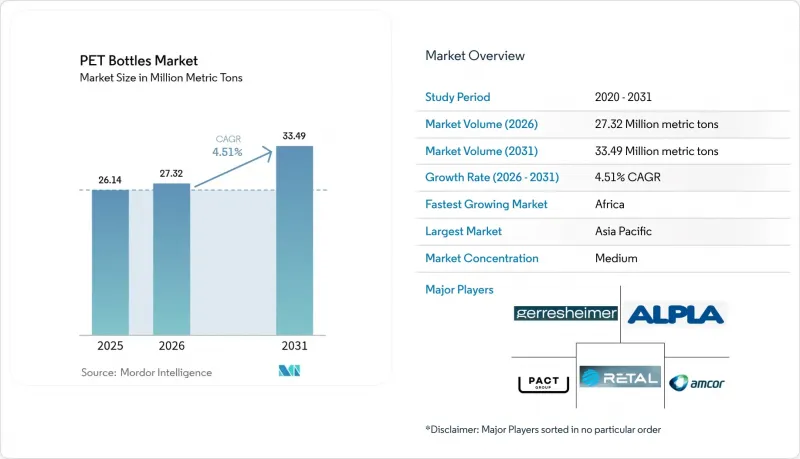
페트병 시장 규모는 2025년에 2,614만 톤에 이르고, 2026년에는 2,732만 톤으로 증가해, 2031년까지 3,349만 톤에 이를 것으로 예상되고 있어 2026년부터 2031년까지 CAGR 4.51%로 성장할 전망입니다.
수요 추이는 세 가지 구조적 요인을 반영하고 있습니다. 첫째, 브랜드가 주도하는 경량화, 충전 당 비용을 절감하고 온실 가스 배출을 줄이는 것입니다. 둘째, 재활용 재료의 사용을 상업적으로 필수적인 것으로 만드는 지역 전체의 규제입니다. 셋째, 식품 등급 rPET의 수율을 높이고 규정을 준수하는 공급을 보장하는 디지털 워터마킹 기술입니다. 음료 분야는 여전히 페트병 시장의 주축을 이루고 있지만, 제약 및 퍼스널케어 분야에서는 내충격성, 투명성, FDA(미국 식품의약국) 규제 준수 등으로 인해 PET가 유리를 대체하면서 상당한 성장이 예상되고 있습니다. 프리미엄 생수 및 에너지 음료 시장에서는 알루미늄 및 유리와의 경쟁이 심화되고 있지만, 대량 생산되는 생수 및 탄산음료에서는 PET가 여전히 비용 측면에서 우위를 점하고 있습니다. 지역별로 보면, 아시아태평양은 공급 규모와 가격 경쟁력을 제공하고, 북미와 유럽은 규제 혁신을 주도하고 있으며, 아프리카는 도시화가 진행되고 콜드체인에 대한 접근성이 확대됨에 따라 가장 빠르게 성장하는 수요 중심지로 부상하고 있습니다.
세계 페트병 시장 동향 및 인사이트
경량 패키지 채택 확대
설계 검토는 영구적인 수단이 되고 있습니다. 1g이라도 더 가벼워지면 수지 사용량, 운송 시 배출량, 그리고 생산자책임재활용(EPR) 비용을 줄일 수 있기 때문입니다. 새로운 프리폼 형태는 응력을 균일하게 분산시켜 재료를 15% 줄인 후에도 병은 상부 하중을 견딜 수 있습니다. 장비 공급업체는 실시간으로 벽 두께를 매핑하는 블로우 어시스트 알고리즘을 제공하여 핫필링 시 패널 붕괴를 방지합니다. 경량화 솔루션은 현재 안개(헤이즈)를 발생시키지 않고 최대 25%의 rPET를 배합할 수 있어 재생 소재 함유량 기준을 쉽게 충족할 수 있게 되었습니다. 소매업체들이 무게에 직접적으로 연동된 친환경 요금을 도입함에 따라 컨버터는 즉각적인 투자 회수를 기대할 수 있기 때문에 경량화는 투자 로드맵의 핵심 축이 되고 있습니다. 따라서 플라스틱 병 시장은 지속가능성과 비용 절감을 하나의 노력으로 통합하여 음료, 퍼스널케어 및 가정용 세제 분야에서 채택을 가속화하고 있습니다.
전 세계 생수 소비 급증
소비자들이 생수를 건강, 편의성, 맛의 중립성과 연관시키면서 포장된 식수는 청량음료보다 더 높은 성장세를 보이고 있습니다. 인도, 중국, 인도네시아의 경우, 도시 가구가 수돗물 품질을 신뢰하지 않고 장시간 출퇴근 시 휴대할 수 있는 형태를 원하기 때문에 판매량이 두 자릿수 성장을 기록하고 있습니다. 미국에서는 2024년까지 164억 갤런이 증가하여 일회용 페트병이 전체 카테고리의 약 70%를 차지할 것으로 예측됩니다. 중동의 관광 수요와 건조한 기후로 인해 연중 수요가 급증하고 있으며, 이는 생산 능력 확장 계획에 힘을 실어주고 있습니다. 아프리카의 도시화율은 2030년까지 60%를 넘어설 것으로 예상되며, 안전한 수돗물 공급이 인프라 투자를 따라잡지 못하는 지역에서 포장된 식수 보급률을 높이고 있습니다. 고급 탄산수 부문에서는 알루미늄 용기가 점유율을 높이고 있지만, 투명성, 안전성, 물류비용의 균형이 뛰어나 대량 생산으로 수익률이 낮은 식수에서는 여전히 PET가 주요 용기로 선택되고 있습니다.
일회용 플라스틱에 대한 환경 모니터링 강화
비정부기구(NGO)는 해양 쓰레기와 일회용 용기의 연관성을 알리는 캠페인을 강화하고 있으며, 소매업체에 리필 스테이션을 시험적으로 도입하거나 패키지 형태의 통합을 촉구하고 있습니다. 캐나다가 2024년 시행하는 특정 품목 금지 조치에서 PET는 제외되었으나, 이 면제는 높은 재활용 실적이 입증되어야 한다는 조건이 붙었습니다. 유럽의 식료품점들은 재사용이 가능한 포장재나 PCR(재활용 플라스틱) 함량이 높은 포장재를 우대하는 '에코스코어'를 선반 표시에 추가하여, 대응이 늦은 브랜드는 페널티 대상에 포함시키고 있습니다. 캘리포니아 주에서는 규제 위반에 대한 단계적 과징금 부과가 증가함에 따라, 탄탄한 rPET(재생 PET) 공급망을 갖추지 못한 컨버터(제조업체)에게 수익률 압박이 전가되고 있습니다. 따라서 여론이 조달, 선반 공간, 심지어 라이선스까지 좌우하는 플라스틱 병 시장에서 지속가능성 증명은 판매의 핵심 전제조건이 되고 있습니다.
부문 분석
음료는 2025년 수요의 63.23%를 차지하며 페트병 시장에서 핵심적인 위치를 확고히 하고 있습니다. 초고속 충진에 대한 지속적인 투자와 더불어 적극적인 경량화 및 테더형 캡 규제에 대한 대응은 생수 및 탄산음료에서 PET의 비용 및 성능적 우위를 강화하고 있습니다. 투명성과 디자인 자유도는 브랜드 가치를 뒷받침하고, 운송 시 배출량 감소는 소매업체들의 수용을 촉진하고 있습니다. 전자상거래를 통한 음료 판매가 확대되고 있는 지역에서는 PET의 높은 적재 효율이 물류 측면의 우위를 더욱 공고히 하고 있습니다. 탄산수 분야에서 알루미늄에 대한 관심이 증가하고 있는 대중 음료는 판매량의 안정성을 유지하고 있으며, 전체 컨버터 네트워크에서 공장 가동률의 기초를 지탱하고 있습니다.
의약품 분야는 절대 톤수로는 작지만 2031년까지 연평균 복합 성장률(CAGR) 5.34%의 가장 빠른 성장률을 나타낼 것으로 예측됩니다. 주사용 바이오 의약품, 기침 시럽, 영양 기능성 음료는 파손 방지와 운송 중량 감소를 위해 유리에서 PET로 전환이 진행되고 있습니다. 게레스하이머의 FDA 준수 저 IV 값 rPET 바이알은 재생 재료로도 엄격한 추출물 기준을 충족할 수 있다는 것을 입증하여 고수익 분야로의 진입을 가능하게 합니다. 제약용 rPET 원료공급이 제한적이어서 공급 제약이 지속되고 있으며, 버진 PET와의 가격 차이가 두 자릿수에 달하고 있습니다. 그러나 화학적 재활용 프로젝트로 인해 예측 기간 동안 기준 적합 수지공급량이 증가할 것으로 예상되며, 이를 통해 페트병 시장은 헬스케어 분야에서의 침투를 더욱 강화할 수 있을 것으로 예측됩니다.
2025년 플라스틱 병 시장 규모에서 연신 블로우 성형은 78.12%의 점유율을 차지했습니다. 이는 사출 성형 프리폼이 다수의 캐비티와 시간당 4만개 이상의 생산이 가능하기 때문에 식수 및 탄산음료 생산 라인에 필수적이기 때문입니다. 경량화 노력은 상부 하중 강도를 유지하면서 무게를 억제하는 프리폼의 재설계에 중점을 두고 있으며, 성능 저하 없이 최대 25%의 rPET를 배합하고 있습니다. OEM 업체들은 블로우 성형, 라벨링, 충전을 하나의 모노블록에 통합하여 재조립으로 인한 다운타임과 공장 설치 면적을 줄였습니다.
열성형 시장은 CAGR 4.71%로 성장하고 있습니다. 이는 퍼스널케어 및 식품 브랜드가 고급스러운 진열 효과를 위해 촉감이 좋은 엠보싱과 두꺼운 벽을 가진 넓은 입구의 용기를 추구하기 때문입니다. 이 공정은 대형 접착 라벨과 인몰드 장식에 대응할 수 있는 평면 패널을 성형하여 브랜드 차별화를 강화합니다. 사이클 시간은 스트레치 블로우 성형보다 짧지만, 새로운 서보 구동 인덱서 덕분에 그 차이가 줄어들어 중간 생산량의 화장품 및 견과류 버터 생산에서 열 성형이 상업적으로 실현 가능해졌습니다. 사출 성형은 여전히 프리폼 공급에 있어 필수적이지만, 압출 블로우 성형은 배리어성 요건이 덜 까다롭고 비용이 최우선인 세제 및 자동차 액체 분야에서 활용되고 있습니다. 이러한 기술의 공존은 페트병 시장의 다양한 사양 상황을 반영하고 있습니다.
'페트병 시장 보고서'는 최종 사용자 산업별(음료, 식품 등), 기술별(스트레치 블로우 성형, 사출 성형 등), 병 용량별(500ml 미만 등), 수지 유형별(버진 PET, 재생 PET), 지역별로 분류되어 있습니다. 시장 예측은 수량(백만 톤) 단위로 제시되어 있습니다.
지역별 분석
2025년 아시아태평양은 세계 총량의 39.21%를 차지했습니다. 이는 중국의 수출 지향형 컨버터와 인도의 중산층 소비 급증에 힘입은 것입니다. 중국 공장은 세계적으로 경쟁력 있는 비용으로 다국적 음료업체와의 계약에 대응하고 있으며, 도시 라이프스타일이 즉석음료를 선호하는 경향으로 국내 수요도 가속화되고 있습니다. 인도의 포장된 물 붐은 안전에 대한 우려와 편의점 네트워크의 확장으로 뒷받침되고 있으며, 정부의 플라스틱 폐기물 규제가 유럽의 재활용 함량 기준에 가까워지면서 현지의 rPET에 대한 투자가 촉진되고 있습니다. 일본의 엄격한 식품위생법은 의약품 및 기능성 음료용 프리미엄 PET를 촉진하고 있으며, 한국에서는 보증금 제도 도입으로 회수율이 85%를 넘어섰습니다. 폐기물 베일의 운송 규제는 공급 위험을 초래하지만, 중국과 일본의 화학적 재활용 능력 확대는 원료 공급 압력을 완화하고 지역 전체의 플라스틱 병 시장을 안정화시키는 것을 목표로 하고 있습니다.
아프리카는 2026년부터 2031년까지 연평균 복합 성장률(CAGR) 5.12%로 가장 빠르게 성장하는 지역이 될 것으로 예측됩니다. 케냐의 새로운 PET 공장은 부분적으로 태양광 발전으로 가동되고 있으며, 나이로비에서 다르에스살람에 이르는 회랑 지역을 커버하여 동아프리카 확장의 거점이 되고 있습니다. 남아공의 PETCO 프레임워크는 2024년까지 회수율을 65%까지 끌어올려 국내 rPET 공급을 가능하게 하고, 생산자들은 환율 변동에 영향을 덜 받게 됩니다. 나이지리아, 가나, 코트디부아르에서는 음료 다국적 기업들이 도시 소비 확대에 대응하기 위해 신규 충진 라인을 설립하고 있습니다. 불안정한 전력망과 제한된 콜드체인 인프라는 여전히 장벽으로 작용하고 있지만, 모듈식 플랜트 설계와 예비 발전기를 통해 가동 중단 시간을 줄이고 있습니다. 중동에서는 연중 내내 생수에 대한 수요가 지속되고 있으며, 사우디의 '비전 2030'은 수입품을 대체하기 위해 현지 제조에 대한 투자를 촉진하고 있습니다. 튀르키예는 유리한 무역협정과 석유화학 산업과의 근접성을 활용하여 유럽과 걸프협력회의(GCC) 지역으로 프리폼을 수출하는 가교 역할을 하고 있습니다.
북미와 유럽에서는 가치사슬을 재정의하는 규제 전환이 진행되고 있습니다. 독일의 회수율 98%를 벤치마킹하고 있으며, 프랑스에서 도입 예정인 예치금 제도도 유사한 구조를 모델로 하고 있습니다. 캘리포니아주 SB 54법은 재활용 소재 함유율에 대한 단계적 최소 기준을 부과하고 있으며, 컨버터는 세척 라인에 대한 공동 투자 및 장기적인 rPET 계약을 확보해야 합니다. 캐나다의 일회용 플라스틱 금지 조치에서 PET는 제외되어 있지만, 정책 입안자들은 회수율이 정체될 경우 기준을 재검토할 용의가 있음을 시사했습니다. 남미에서는 그 추이에 차이가 있습니다. 브라질의 통합 석유화학 부문은 경쟁력 있는 가격으로 버진 PET를 공급하고 있지만, 아르헨티나에서는 거시경제의 변동이 설비투자를 억제하고 있습니다. 멕시코는 니어쇼어링의 거점으로 부상하고 있으며, 관세 인하와 리드타임 단축을 원하는 미국 음료 브랜드에 대응하기 위해 마킬라도라(수출 가공 구역)의 프리폼 생산 능력을 확대되고 있습니다. 이러한 지역적 추세와 결합하여 페트병 시장은 지리적으로 분산된 상태를 유지하고 있으며, 성숙한 규제 프레임워크와 고성장 신흥 경제국과의 균형을 유지하고 있습니다.
기타 특전:
- 엑셀 형식 시장 예측(ME) 시트
- 3개월간 애널리스트 지원
자주 묻는 질문
목차
제1장 서론
제2장 조사 방법
제3장 주요 요약
제4장 시장 구도
제5장 시장 규모와 성장 예측
제6장 경쟁 구도
제7장 시장 기회와 향후 전망
JHS 26.06.11The pet bottles market size reached 26.14 million metric tons in 2025, is expected to increase to 27.32 million metric tons in 2026 and reach 33.49 million metric tons by 2031, growing at a CAGR of 4.51% from 2026 to 2031.
Demand progression reflects three structural forces: first, brand-led lightweighting that lowers cost per fill while cutting greenhouse-gas emissions, second, region-wide mandates that make recycled content commercially indispensable, and third, digital watermarking that lifts food-grade rPET yield and secures compliant supply. Beverage lines remain the backbone of the pet bottles market, yet pharmaceuticals and personal care deliver outsized growth because shatter resistance, clarity, and FDA compliance help PET displace glass. Competitive tension from aluminum and glass is gathering pace in premium water and energy drinks, still PET keeps its cost advantage in high-volume packaged water and carbonated soft drinks. Geographically, Asia-Pacific supplies scale and price competitiveness, North America and Europe anchor regulatory innovation, and Africa emerges as the fastest-growing demand center as urbanization broadens cold-chain access.
Global PET Bottles Market Trends and Insights
Increasing Adoption of Lightweight Packaging
Design revision has become a permanent lever because every gram eliminated reduces resin input, freight emissions, and extended producer responsibility fees. New preform geometries distribute stress uniformly, letting bottles withstand top-load forces even after a 15% material cut. Equipment suppliers offer blow-assist algorithms that map wall thickness in real time, preventing panel collapse during hot-fill. Lightweight solutions now incorporate up to 25% rPET without hazing, easing compliance with recycled-content quotas. As retailers introduce eco-modulated fees tied directly to weight, converters see immediate payback, making lightweighting a core pillar of investment road maps. The pet bottles market therefore embeds sustainability and cost savings in a single initiative, accelerating adoption across beverages, personal care, and household cleaners.
Surging Bottled Water Consumption Worldwide
Packaged hydration continues to outpace soft drinks as consumers associate bottled water with wellness, convenience, and flavor neutrality. India, China, and Indonesia are logging double-digit unit growth because urban households distrust tap quality and seek portable formats during lengthy commutes. The United States added 16.4 billion gallons in 2024, keeping single-serve PET at roughly 70% of category volume. Middle East tourism and an arid climate produce year-round demand spikes that reinforce capacity expansion plans. Africa's rising urbanization rate is expected to exceed 60% by 2030, amplifying packaged water penetration where safe municipal supply lags infrastructure investment. Although aluminum alternatives win share in boutique sparkling segments, PET remains the vessel of choice for bulk, low-margin water because it balances clarity, safety, and logistical economy.
Escalating Environmental Scrutiny of Single-Use Plastics
Non-governmental organizations intensify campaigns that link marine debris to single-use containers, motivating retailers to test refill stations and concentrate formats. Canada's 2024 ban on certain items excluded PET, yet the exemption is contingent on proven high recycling performance. European grocers add on-shelf eco-scores that favor reusable or high-PCR packages, nudging laggard brands into penalty zones. California's framework assigns escalating fees for non-compliance, transferring margin pressure to converters without robust rPET pipelines. Public perception therefore shapes procurement, shelf space, and even licensing, making sustainability credentials a core sales prerequisite within the pet bottles market.
Other drivers and restraints analyzed in the detailed report include:
- Policy-Led Push for Closed-Loop Recycling Infrastructure
- HolyGrail 2.0 Digital Watermarking Boosting Food-Grade Sorting Yield
- Gowing Preference for Aluminum and Glass Substitutes
For complete list of drivers and restraints, kindly check the Table Of Contents.
Segment Analysis
Beverages supplied 63.23% of 2025 demand, affirming their anchor status for the pet bottles market. Continuous investment in ultra-high-speed filling, coupled with aggressive lightweighting and tethered-closure compliance, fortifies PET's cost and performance edge in packaged water and carbonated soft drinks. Transparency and design freedom support brand equity, and lower transport emissions reinforce retailer acceptance. In regions where e-commerce beverages expand, PET's high stacking efficiency further solidifies its logistical advantage. Despite rising aluminum interest in sparkling water, mass-market beverages preserve volume stability, sustaining baseline plant utilization across converter networks.
Pharmaceuticals, although smaller in absolute tonnage, clock the fastest growth at a 5.34% CAGR to 2031. Injectable biologics, cough syrups, and nutraceutical beverages transition from glass to PET for shatter safety and lower shipping weight. Gerresheimer's FDA-compliant low-IV rPET vials demonstrate that recycled material can meet stringent extractables limits, unlocking premium margin segments. Supply remains constrained by limited pharmaceutical-grade rPET feedstock, pushing price spreads over virgin PET into double digits. However, chemical recycling projects promise increased availability of compliant resin during the forecast window, allowing the pet bottles market to deepen penetration within health care.
Stretch blow molding held 78.12% share of the 2025 pet bottles market size because injection-molded preforms enable high cavity counts and 40 000-plus bottle per hour outputs, critical for water and soda lines. Lightweighting advances focus on preform redesign that maintains top-load strength while curbing gram weight, integrating up to 25% rPET without performance loss. OEMs bundle blow, label, and fill into single monoblocs that reduce changeover downtime and factory footprint.
Thermoforming advances at 4.71% CAGR thanks to personal care and food brands pursuing wide-mouth jars with tactile embossing and thick walls for premium shelf appeal. The process shapes flat panels that accommodate large adhesive labels or in-mold decoration, enhancing brand differentiation. Although cycle times lag stretch blow molding, new servo-driven indexers narrow the gap, making thermoforming commercially viable for mid-volume cosmetics and nut-butter runs. Injection molding remains indispensable for preform supply, while extrusion blow molding serves detergents and automotive fluids where barrier needs are modest and cost sensitivity is paramount. The coexistence of technologies mirrors the diverse specification landscape of the pet bottles market.
The PET Bottles Market Report is Segmented by End-User Vertical (Beverages, Food, and More), Technology (Stretch Blow Molding, Injection Molding, and More), Bottle Capacity (Less Than 500 ML and More), Resin Type (Virgin PET, and Recycled PET), and Geography. The Market Forecasts are Provided in Terms of Volume (Million Metric Tons).
Geography Analysis
Asia-Pacific accounted for 39.21% of global volume in 2025, driven by China's export-oriented converters and India's middle-class consumption surge. Chinese plants serve multinational beverage contracts at globally competitive cost, and domestic demand accelerates as urban lifestyles favor ready-to-drink formats. India's packaged water boom rides on safety concerns and expanding convenience-store networks, while government plastic-waste rules begin to mirror European recycled-content thresholds, stimulating local rPET investment. Japan's rigorous Food Sanitation Act supports premium PET for pharma and functional drinks, and South Korea posts collection rates above 85% due to deposit incentives. Freight restrictions on waste bales pose supply risks, yet rising chemical recycling capacity in China and Japan aims to relieve feedstock pressure and stabilize the pet bottles market across the region.
Africa is forecast to be the fastest-growing territory at a 5.12% CAGR from 2026 to 2031. Kenya's new PET plant, powered partly by solar, anchors East African expansion, serving a corridor from Nairobi to Dar es Salaam. South Africa's PETCO framework raised collection to 65% in 2024, enabling domestic rPET supply that insulates producers from foreign exchange swings. Nigeria, Ghana, and Cote d'Ivoire attract beverage multinationals establishing greenfield filling lines to meet rising urban consumption. Inconsistent electricity grids and limited cold-chain infrastructure remain hurdles, yet modular plant designs and backup generators mitigate downtime. The Middle East sustains year-round bottled water demand, with Saudi Arabia's Vision 2030 channeling investment into local manufacturing to displace imports. Turkey functions as a bridge hub, exporting preforms to both Europe and the Gulf Cooperation Council, benefiting from favorable trade agreements and petrochemical proximity.
North America and Europe navigate regulatory transitions that redefine value chains. Germany's 98% collection sets the benchmark, and France's upcoming deposit scheme is modeled on identical architecture. California's SB 54 imposes graduated recycled-content floors, compelling converters to co-invest in wash lines or secure long-term rPET contracts. Canada's single-use plastics ban exempts PET, yet policymakers signal willingness to revisit criteria if recovery rates stall. South America shows divergent momentum: Brazil's integrated petrochemical sector supplies virgin PET competitively, while Argentina's macroeconomic volatility dampens capital spending. Mexico emerges as a nearshoring hub, expanding maquiladora preform capacity to serve U.S. beverage brands seeking tariff relief and shorter lead times. Collectively, these regional dynamics ensure the pet bottles market remains geographically diversified, balancing mature regulatory frameworks with high-growth emerging economies.
- Amcor plc
- ALPLA Werke Alwin Lehner GmbH & Co KG
- Gerresheimer AG
- PACT Group Holdings Ltd.
- Retal Industries Ltd.
- Resilux NV
- Greiner Packaging International GmbH
- Plastipak Holdings Inc.
- Graham Packaging Company LP
- Alpha Packaging LLC
- Manjushree Technopack Ltd.
- Silgan Plastics LLC (Silgan Holdings Inc.)
- Nampak Ltd.
- Altium Packaging LLC
- Apex Plastics (Plastic Industries, Inc.)
- Zhejiang Xinlei Packaging Co., Ltd.
- Shenzhen Zhenghao Plastic & Mold Co., Ltd.
- Comar LLC
- Container Corp. of Canada Ltd.
- Berry Global Group Inc.
Additional Benefits:
- The market estimate (ME) sheet in Excel format
- 3 months of analyst support
TABLE OF CONTENTS
1 INTRODUCTION
- 1.1 Study Assumptions and Market Definition
- 1.2 Scope of the Study
2 RESEARCH METHODOLOGY
3 EXECUTIVE SUMMARY
4 MARKET LANDSCAPE
- 4.1 Market Overview
- 4.2 Market Drivers
- 4.2.1 Increasing Adoption of Lightweight Packaging
- 4.2.2 Surging Bottled Water Consumption Worldwide
- 4.2.3 Policy-Led Push for Closed-Loop Recycling Infrastructure
- 4.2.4 HolyGrail 2.0 Digital Watermarking Boosting Food-Grade Sorting Yield
- 4.2.5 Deployment of AI-Driven Hot-Fill Barrier Additives for rPET Premium Drinks
- 4.2.6 Onsite Bottle-to-Bottle Micro Recycling Units at Beverage Filling Plants
- 4.3 Market Restraints
- 4.3.1 Escalating Environmental Scrutiny of Single-Use Plastics
- 4.3.2 Growing Preference for Aluminum and Glass Substitutes
- 4.3.3 Shortage of FDA-Compliant Low-IV rPET for Pharmaceutical Bottles
- 4.3.4 Freight Restrictions on Returnable Bale Flows Reducing rPET Supply
- 4.4 Industry Value / Supply-Chain Analysis
- 4.5 Regulatory Landscape
- 4.6 Technological Outlook
- 4.7 Porter's Five Forces Analysis
- 4.7.1 Bargaining Power of Suppliers
- 4.7.2 Bargaining Power of Buyers
- 4.7.3 Threat of New Entrants
- 4.7.4 Threat of Substitutes
- 4.7.5 Intensity of Competitive Rivalry
- 4.8 Pricing Analysis
- 4.9 Impact of Macroeconomic Factors on the Market
- 4.10 Assessment of the Impact of Geopolitical Developments on the Industry
5 MARKET SIZE AND GROWTH FORECASTS (VOLUME)
- 5.1 By End-user Vertical
- 5.1.1 Beverages
- 5.1.1.1 Packaged Water
- 5.1.1.2 Carbonated Soft Drinks
- 5.1.1.3 Fruit Juice
- 5.1.1.4 Energy Drinks
- 5.1.1.5 Other Beverages
- 5.1.2 Food
- 5.1.3 Personal Care
- 5.1.4 Household Care
- 5.1.5 Pharmaceuticals
- 5.1.6 Other End-user Verticals
- 5.1.1 Beverages
- 5.2 By Technology
- 5.2.1 Stretch Blow Molding
- 5.2.2 Injection Molding
- 5.2.3 Extrusion Blow Molding
- 5.2.4 Thermoforming
- 5.3 By Bottle Capacity
- 5.3.1 Less than 500 mL
- 5.3.2 501 mL - 1 L
- 5.3.3 1.01 L - 2 L
- 5.3.4 More than 2 L
- 5.4 By Resin Type
- 5.4.1 Virgin PET
- 5.4.2 Recycled PET (rPET)
- 5.5 By Geography
- 5.5.1 North America
- 5.5.1.1 United States
- 5.5.1.2 Canada
- 5.5.1.3 Mexico
- 5.5.2 South America
- 5.5.2.1 Brazil
- 5.5.2.2 Argentina
- 5.5.2.3 Rest of South America
- 5.5.3 Europe
- 5.5.3.1 United Kingdom
- 5.5.3.2 Germany
- 5.5.3.3 France
- 5.5.3.4 Spain
- 5.5.3.5 Italy
- 5.5.3.6 Rest of Europe
- 5.5.4 Asia-Pacific
- 5.5.4.1 China
- 5.5.4.2 India
- 5.5.4.3 Japan
- 5.5.4.4 Australia
- 5.5.4.5 South Korea
- 5.5.4.6 Rest of Asia-Pacific
- 5.5.5 Middle East
- 5.5.5.1 Saudi Arabia
- 5.5.5.2 United Arab Emirates
- 5.5.5.3 Turkey
- 5.5.5.4 Rest of Middle East
- 5.5.6 Africa
- 5.5.6.1 South Africa
- 5.5.6.2 Kenya
- 5.5.6.3 Rest of Africa
- 5.5.1 North America
6 COMPETITIVE LANDSCAPE
- 6.1 Market Concentration
- 6.2 Strategic Moves
- 6.3 Market Share Analysis
- 6.4 Company Profiles (includes Global Level Overview, Market Level Overview, Core Segments, Financials as available, Strategic Information, Market Rank/Share, Products and Services, Recent Developments)
- 6.4.1 Amcor plc
- 6.4.2 ALPLA Werke Alwin Lehner GmbH & Co KG
- 6.4.3 Gerresheimer AG
- 6.4.4 PACT Group Holdings Ltd.
- 6.4.5 Retal Industries Ltd.
- 6.4.6 Resilux NV
- 6.4.7 Greiner Packaging International GmbH
- 6.4.8 Plastipak Holdings Inc.
- 6.4.9 Graham Packaging Company LP
- 6.4.10 Alpha Packaging LLC
- 6.4.11 Manjushree Technopack Ltd.
- 6.4.12 Silgan Plastics LLC (Silgan Holdings Inc.)
- 6.4.13 Nampak Ltd.
- 6.4.14 Altium Packaging LLC
- 6.4.15 Apex Plastics (Plastic Industries, Inc.)
- 6.4.16 Zhejiang Xinlei Packaging Co., Ltd.
- 6.4.17 Shenzhen Zhenghao Plastic & Mold Co., Ltd.
- 6.4.18 Comar LLC
- 6.4.19 Container Corp. of Canada Ltd.
- 6.4.20 Berry Global Group Inc.
7 MARKET OPPORTUNITIES AND FUTURE OUTLOOK
- 7.1 White-space and Unmet-need Assessment


