

|
시장보고서
상품코드
2044247
NFT 게임 시장 : 점유율 분석, 업계 동향과 통계, 성장 예측(2026-2031년)NFT Gaming - Market Share Analysis, Industry Trends & Statistics, Growth Forecasts (2026 - 2031) |
||||||
 Mordor Intelligence
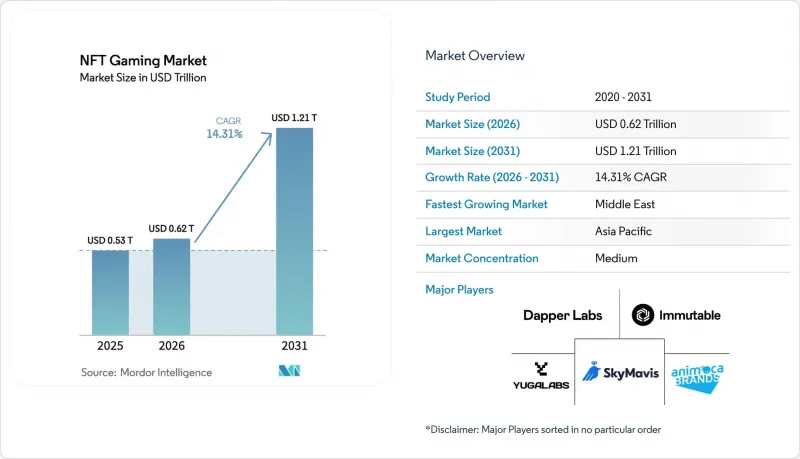
NFT 게임 시장 규모는 2025년 5,300억 달러, 2026년 6,200억 달러에서 2031년까지 1조 2,100억 달러로 확대한다고 예측되고 있어 2026년부터 2031년까지 연평균 복합 성장률(CAGR)은 14.31%를 나타낼 전망입니다.
이러한 빠른 성장은 블록체인 거래 비용의 하락, 벤처 자금 조달의 확대, 그리고 퍼블리셔와 기업의 경제 모델이 공유형으로 전환되고 있기 때문입니다. 레이어2 스케일링 기술을 통해 게임 경제의 유동성을 유지하는 소액결제가 가능해졌고, 메타버스 세계의 꾸준한 확장을 통해 대상 사용자층도 확대되고 있습니다. 기관 투자자들은 AAA급 퀄리티의 게임을 제공할 수 있는 스튜디오를 지원하고 있으며, NFT 게임 시장이 본격적인 생산 단계에 접어들었다는 확신이 강해지고 있습니다. 마지막으로, 아시아태평양과 중동의 지역 정책이 명확해짐에 따라 그동안 라이선싱에 대한 가이드라인을 기다리던 스튜디오의 출시 기간이 단축되고 있습니다.
세계 NFT 게임 시장 동향 및 인사이트
퍼블리셔와 기업의 분산형 가치 획득으로의 전환
스마트 컨트랙트를 통한 분배를 통해 현재 세컨더리 마켓 수익의 10%-30%가 자산을 획득한 기업에게 환원되어 기존 프리투플레이의 일방적인 수익 흐름을 대체하고 있습니다. Axie Infinity 사용자는 2025년 재판매 로열티로 13억 달러를 벌어들였으며, 이 수치는 22% 가격 조정 후에도 유지되었습니다. 위메이드의 위믹스 3.0 지원 타이틀은 유저들이 선호하는 70:30의 분배 비율을 채택해 월활성 유저 수를 420만 명으로 끌어올렸습니다. 이 설계 철학은 기업이 이익의 혜택을 누릴 수 있기 때문에 초기 수익화보다 사용자 정착을 우선시하는 것입니다. 정책 입안자들은 이러한 수익이 투자소득에 해당하는지 여부를 아직 정의하지 않아 유럽연합(EU) 내에서 일시적인 회색지대가 발생하고 있습니다. 그럼에도 불구하고, 이 방식은 보다 공정한 가치 분배에 대한 오랜 요구에 부응하는 것으로, 퍼블리셔들이 더 높은 참여 점수를 추구함에 따라 표준이 될 가능성이 높습니다.
메타버스와의 연계로 보급 가속화
디센트럴랜드(Decentraland)와 샌드박스(The Sandbox)와 같은 영구적인 가상 세계에서는 2025년에 1,800만 건의 고유 지갑 연결이 기록되어 2024년 대비 34% 증가했습니다. 아디다스, 코카콜라와 같은 브랜드 임차인이 디지털 부동산을 임대하면서 NFT는 단일 타이틀을 넘어선 실용성을 갖게 되었습니다. Yuga Labs는 2025년 3월 'Otherside' 민트 기간 동안 4억 2,000만 달러 상당의 토지 판매를 달성하여 IP를 넘나드는 수집가들의 구매력을 보여주었습니다. 이러한 융합은 게임 플레이 트레일러가 아닌 브랜드 이벤트를 통해 게임을 발견하는 캐주얼한 관객을 끌어들이고 있습니다. 디센트럴랜드의 이벤트 피크타임에 20fps 이하의 프레임 속도를 보이는 등 성능 병목현상이 여전히 존재하지만, 2026년 중반으로 예정된 언리얼 엔진 5로의 전환을 통해 처리 능력은 향상될 것으로 예측됩니다. 메타버스의 각 레이어가 성숙해짐에 따라, 앱이 아닌 사용자와 함께 움직이는 상호 운용 가능한 아바타, 무기, 부동산에 대한 수요는 점점 더 많아질 것입니다.
디지털 자산을 둘러싼 규제의 불확실성
미국 증권거래위원회(SEC)는 2025년 NFT 게임에 대해 14건의 집행 조치를 취해 3억 4,000만 달러의 합의금을 징수하고, 스튜디오에 마케팅 자료에서 투자 관련 문구를 삭제하도록 강제했습니다. 반면, 유럽연합(EU)의 MiCA(암호화폐 시장 규제) 프레임워크는 자금세탁방지(AML) 점검과 혁신의 균형을 맞춘 라이선싱 경로를 제공합니다. 한국은 8개의 블록체인 게임 사업자를 승인하고, 기업의 예치금에 대한 분리된 지갑과 보험 가입을 의무화하는 규정으로 컴플라이언스 청사진을 마련했습니다. 현재 일본에서는 NFT 마켓플레이스가 2차 거래를 가능하게 하는 경우, 암호화폐 거래소로 등록하도록 의무화되어 있어 소규모 팀에게는 부담이 가중되고 있습니다. 규제가 엄격하거나 모호한 지역에서는 서비스 출시가 늦어지고, 개발비용이 증가하면서 본래 급성장해야 할 NFT 게임 시장의 성장 곡선이 둔화되고 있습니다.
부문 분석
2025년 NFT 게임 시장 규모에서 모바일 게임은 46.19%의 압도적인 점유율을 차지했습니다. 스마트폰의 보급과 iOS와 안드로이드의 지갑 통합으로 인해 사용자 확보 프로세스가 효율화되고 있습니다. 기업들은 단시간 플레이를 선호하는 경향이 있지만, Mirandus와 같은 타이틀은 로컬 암호화폐 지갑 없이도 고화질 스트리밍이 가능하다는 것을 증명하고 있습니다. 설치당 획득 비용이 34달러로 낮기 때문에 마케팅 예산의 효율성은 유지되고 있지만, PC 부문에 비해 해지율이 높은 임베디드니다.
클라우드 게임은 지연시간을 20밀리초 미만으로 낮추는 5G의 보급에 힘입어 CAGR 15.31%로 가장 높은 성장률을 나타낼 것으로 예측됩니다. 서버 측에서 지갑을 관리함으로써 사용자들에게 블록체인의 복잡성을 숨기고, 편의성을 중시하는 기존 게이머들에게 클라우드는 가교 역할을 하고 있습니다. 콘솔 플랫폼이 NFT 게임 승인에 소극적인 가운데, 클라우드 서비스는 단일 구독으로 크로스 디바이스 플레이를 제공함으로써 그 공백을 메우고 있습니다. 최종 사용자의 하드웨어 요구 사항은 감소하지만, 개발자는 서버 비용을 최소화하기 위해 스마트 계약을 최적화해야 하며, 이는 2031년까지의 로드맵을 지배하는 기술적 과제가 될 것입니다.
2025년 롤플레잉 게임(RPG)은 NFT 게임 시장 점유율의 38.53%를 차지했습니다. 스토리의 깊이가 기업의 캐릭터 NFT 구매와 거래를 유도하여, 세션당 평균 47분이라는 긴 참여 주기를 이끌어 냈습니다. 장기적인 스토리 전개는 계절별 드롭을 가능하게 하며, 퍼블리셔는 토큰 공급량을 늘리지 않고도 수익을 창출할 수 있습니다. 또한, 몰입형 포맷은 온체인 거버넌스에도 적합하며, 보유자가 퀘스트 결과에 투표함으로써 커뮤니티의 정착도를 높이고 있습니다.
시뮬레이션 게임은 도시 건설 게임이나 농업 시뮬레이터에서 실제 자산을 토큰화하여 CAGR 15.84%로 성장하고 있습니다. 수동적 소득 루프는 가벼운 경제 샌드박스로 경험에 접근하는 비게이머 층을 끌어들이고 있습니다. VulcanVerse의 기업은 자원을 생산하는 토지 NFT를 스테이킹할 수 있으며, 익숙한 게임 플레이 루프에 DeFi와 같은 인센티브를 추가하고 있습니다. 수천 건의 소액 거래를 통해 고도의 경제적 균형을 유지하는 것은 디자인 팀에게 부담이 되지만, 그 대가로 핵심 RPG 팬층 이외의 확장 가능한 사용자층을 확보할 수 있다는 이점이 있습니다.
지역별 분석
아시아태평양은 2025년 매출의 41.74%를 차지해, 그 견인차 역할을 하는 것은 한국의 명확한 라이선스 제도와 일본의 블록체인 게임 사업자에 대한 개방적인 태도가 주요 요인으로 꼽힙니다. 승인까지 걸리는 시간을 예측할 수 있기 때문에 스튜디오는 이들 시장에서 먼저 서비스를 시작하고 마케팅 팀이 전 세계 출시를 조정할 수 있도록 하고 있습니다. 중국 내 NFT의 2차 유통 금지로 인해 '디지털 수집품'의 사양 변경이 불가피해졌지만, 텐센트는 규제를 준수하는 'Zixin Chain' 모델로 1,200만 명의 사용자를 확보하여 NFT 게임 시장이 엄격한 규제에도 적응할 수 있음을 보여주었습니다. 하고 있습니다.
중동은 2031년까지 연평균 복합 성장률(CAGR) 15.43%로 가장 빠르게 성장하는 지역입니다. 소버린 펀드는 2025년까지 웹3.0 게임 인프라에 10억 달러 이상을 투자하여 사우디의 NEOM과 UAE의 두바이 멀티 상품 센터 내 스튜디오 설립에 박차를 가하고 있습니다. 애니모카 브랜드는 아부다비에 지사를 설립하고, 무바달라와의 제휴를 통해 아랍권 개발자들이 경험 많은 퍼블리셔에 접근할 수 있는 기회를 제공하게 되었습니다.
북미는 SEC의 조치가 초기 토큰 발행에 타격을 입혔음에도 불구하고 2025년 매출의 28%를 차지했습니다. 에픽게임즈의 언리얼 엔진 내 지갑 툴킷은 기술적 장벽을 낮춰 기존 스튜디오가 자체 블록체인을 구축하지 않고도 실험을 할 수 있도록 돕고 있습니다. 유럽은 19%의 점유율을 차지하고 있으며, 스튜디오에 규칙에 기반한 시장 진입 경로를 제공하는 MiCA의 혜택을 누리고 있습니다. 남미는 현지 인플레이션을 헤지하는 스테이블 코인을 활용하여 7%의 기여도를 보였고, 아프리카의 4%의 점유율은 높은 모바일 보급률과 증가하는 송금 이용 사례와 함께 나이지리아와 남아공에서 발생했습니다. 각 지역마다 고유한 규제와 인프라 장벽이 존재하지만, 소유권 기반 플레이에 대한 세계 수요는 일관되게 유지되고 있으며, NFT 게임 산업의 광범위한 성장 스토리를 뒷받침하고 있습니다.
기타 특전:
- 엑셀 형식 시장 예측(ME) 시트
- 3개월간 애널리스트 지원
자주 묻는 질문
목차
제1장 서론
제2장 조사 방법
제3장 주요 요약
제4장 시장 구도
제5장 시장 규모와 성장 예측
제6장 경쟁 구도
제7장 시장 기회와 향후 전망
JHS 26.06.11The NFT gaming market size is projected to expand from USD 0.53 trillion in 2025 and USD 0.62 trillion in 2026 to USD 1.21 trillion by 2031, registering a 14.31% CAGR between 2026 and 2031.
The rapid growth flows from lower blockchain transaction costs, expanding venture funding, and the shift toward shared publisher-player economics. Layer-2 scaling now supports micro-payments that keep game economies fluid, while the steady rollout of metaverse worlds broadens the addressable audience. Institutional investors are backing studios that can deliver AAA-quality play, cementing confidence that the NFT gaming market is entering a production-grade era. Finally, regional policy clarity in Asia-Pacific and the Middle East is shortening time-to-launch for studios that previously waited on licensing guidance.
Global NFT Gaming Market Trends and Insights
Shift To Distributed Publisher-Player Value Capture
Smart-contract splits now route 10%-30% of secondary-market proceeds back to the players who minted or earned the assets, replacing the one-way revenue flow of traditional free-to-play. Axie Infinity users earned USD 1.3 billion from resale royalties in 2025, a figure that still held even after a 22% price correction. Wemade's Wemix 3.0 titles boosted monthly active users to 4.2 million by adopting a player-favoured 70-30 payout. The design philosophy puts retention ahead of upfront monetization because players own the upside. Policymakers have yet to define whether these flows qualify as investment income, creating a temporary gray zone inside the European Union. Even so, the mechanism answers long-standing calls for fairer value distribution and is likely to become standard as publishing houses chase higher engagement scores.
Metaverse Alignment Accelerating Uptake
Persistent virtual worlds such as Decentraland and The Sandbox logged 18 million unique wallet connections in 2025, a 34% rise over 2024. Brand tenants like Adidas and Coca-Cola lease digital real estate, giving NFTs utility that lasts outside a single title. Yuga Labs moved USD 420 million in land sales during the March 2025 Otherside mint, showing the purchasing power of cross-IP collectors. The convergence attracts casual spectators who discover gaming through branded events rather than gameplay trailers. Performance bottlenecks persist, evidenced by sub-20 fps rates during peak Decentraland events, but an Unreal Engine 5 migration scheduled for mid-2026 should lift capacity. As metaverse layers mature, they lock in demand for interoperable avatars, weapons, and real estate that travel with the user rather than the app.
Regulatory Uncertainty Over Digital Assets
The Securities and Exchange Commission pursued 14 enforcement actions against NFT games in 2025, extracting USD 340 million in settlements and forcing studios to strip investment language from marketing materials. By contrast, the European Union's MiCA framework offers a licensing path that balances AML checks with innovation. South Korea approved eight blockchain game operators under rules that mandate segregated wallets and insurance for player deposits, creating a compliance blueprint. Japan now requires NFT marketplaces to register as crypto-asset exchanges if they enable secondary trading, raising overhead for smaller teams. Regions with strict or ambiguous policies impose launch delays, inflating development costs and tempering the NFT gaming market's otherwise steep growth curve.
Other drivers and restraints analyzed in the detailed report include:
- Venture-Capital Funding Inflows to Blockchain Gaming
- Rising Play-To-Earn Monetization Preference
- Environmental Criticism of Proof-Of-Work Chains
For complete list of drivers and restraints, kindly check the Table Of Contents.
Segment Analysis
Mobile Gaming held a dominant 46.19% share of NFT gaming market size in 2025. Widespread smartphone ownership and wallet integrations inside iOS and Android streamline onboarding. Players gravitate to bite-sized sessions, yet titles such as Mirandus prove that high-fidelity streaming is viable without local crypto wallets. Lower acquisition costs, at USD 34 per install, keep marketing budgets efficient, although churn rates are higher than in PC segments.
Cloud Gaming is forecast to post the fastest 15.31% CAGR, powered by 5G rollouts that push latency under 20 milliseconds. Server-side wallet custody hides blockchain complexity from users, positioning cloud as a bridge for traditional gamers who value convenience. As console platforms hesitate to approve NFT games, cloud services fill the gap by offering cross-device play under a single subscription. Hardware requirements drop for end users, but developers must optimize smart contracts to minimize server costs, shaping a technical agenda that dominates roadmaps through 2031.
Role-Playing Games commanded 38.53% of NFT gaming market share in 2025. Narrative depth encourages players to buy and trade character NFTs, extending engagement cycles that average 47 minutes per session. Long story arcs support seasonal drops, letting publishers monetize without inflating token supply. The immersive format also lends itself to on-chain governance, where holders vote on quest outcomes, increasing community stickiness.
Simulation titles are expanding at a 15.84% CAGR as they tokenize real-world assets inside city builders and farm simulators. Passive income loops draw non-gamer demographics who approach the experience as a light economic sandbox. VulcanVerse players can stake land NFTs that yield resources, adding DeFi-like incentives within a familiar gameplay loop. Balancing advanced economies across thousands of micro-transactions stresses design teams, yet the upside is a scalable audience outside the core RPG fan base.
The NFT Gaming Market Report is Segmented by Platform (Mobile Gaming, PC Gaming, Console Gaming, and Cloud Gaming), Game Genre (Role-Playing Games, Strategy, Simulation, Sports, More Game Genres), Revenue Model (Play-To-Earn, Free-To-Play With NFT Micro-Transactions, and More), Blockchain (Ethereum, Binance Smart Chain, Polygon, and More), and Geography. The Market Forecasts are Provided in Terms of Value (USD).
Geography Analysis
Asia-Pacific held 41.74% of 2025 revenue, anchored by South Korea's clear licensing regime and Japan's open stance toward blockchain game operators. Studios launch first in these markets because approval timelines are predictable, letting marketing teams coordinate global rollouts. China's ban on secondary NFT trading forces modified "digital collectible" builds, yet Tencent still attracted 12 million users under the compliant Zhixin Chain model, illustrating that the NFT gaming market can adapt to heavy restrictions.
The Middle East is the fastest-growing region at a 15.43% CAGR through 2031. Sovereign funds placed more than USD 1 billion into Web3 gaming infrastructure during 2025, accelerating studio creation inside Saudi Arabia's NEOM and the UAE's Dubai Multi Commodities Centre. Animoca Brands opened an Abu Dhabi base and partnered with Mubadala, giving Arabic developers access to seasoned publishers.
North America delivered 28% of 2025 sales even as SEC actions shook early token launches. Epic Games' wallet toolkit inside Unreal Engine lowers technical barriers, encouraging traditional studios to experiment without building bespoke chains. Europe, at 19% share, benefits from MiCA, which gives studios a rules-based path to market. South America contributed 7% by leveraging stablecoins that hedge local inflation, while Africa's 4% share came from Nigeria and South Africa where high mobile penetration meets growing remittance use cases. Each territory presents unique regulatory or infrastructure hurdles, yet the global appetite for ownership-driven play remains consistent, supporting a broadly distributed growth story for the NFT gaming industry.
- Sky Mavis Pte Ltd
- Immutable Pty Ltd
- Yuga Labs Inc
- Animoca Brands Corporation Ltd
- Dapper Labs Inc
- Gala Games LLC
- Illuvium Labs Ltd
- Mythical Inc
- Wemade Co Ltd
- Netmarble Corporation
- Com2uS Holdings Corporation
- Decentraland Foundation
- Enjin Pte Ltd
- Sorare SAS
- Ubisoft Entertainment SA
- Electronic Arts Inc
- Epic Games Inc
- Splinterlands Inc
- Vulcan Forged Ltd
- Ozone Networks Inc (OpenSea)
Additional Benefits:
- The market estimate (ME) sheet in Excel format
- 3 months of analyst support
TABLE OF CONTENTS
1 INTRODUCTION
- 1.1 Study Assumptions and Market Definition
- 1.2 Scope of the Study
2 RESEARCH METHODOLOGY
3 EXECUTIVE SUMMARY
4 MARKET LANDSCAPE
- 4.1 Market Overview
- 4.2 Market Drivers
- 4.2.1 Shift to Distributed Publisher-Player Value Capture
- 4.2.2 Metaverse Alignment Accelerating Uptake
- 4.2.3 Venture-Capital Funding Inflows to Blockchain Gaming
- 4.2.4 Rising Play-to-Earn Monetization Preference
- 4.2.5 Layer-2 Scaling Slashing Transaction Costs
- 4.2.6 Interoperable NFT Standards Enabling Cross-Game Assets
- 4.3 Market Restraints
- 4.3.1 Regulatory Uncertainty Over Digital Assets
- 4.3.2 Environmental Criticism of Proof-of-Work Chains
- 4.3.3 Token Inflation Undermining In-Game Economies
- 4.3.4 On-Boarding Friction for Non-Crypto Gamers
- 4.4 NFT in Gaming, A Paradigm Shift
- 4.5 Adoption Trends Analysis
- 4.5.1 First-Generation NFT Titles
- 4.5.2 Second-Generation NFT plus P2E Titles
- 4.5.3 Third-Generation NFT plus P2E plus High-Fidelity Graphics
- 4.5.4 Fourth-Generation NFT plus P2E plus AAA Titles
- 4.6 Industry Value-Chain Analysis
- 4.7 Regulatory Landscape
- 4.8 Technological Outlook
- 4.9 Impact of Macroeconomic Factors
- 4.10 Porter's Five Forces Analysis
- 4.10.1 Threat of New Entrants
- 4.10.2 Bargaining Power of Buyers
- 4.10.3 Bargaining Power of Suppliers
- 4.10.4 Threat of Substitutes
- 4.10.5 Competitive Rivalry
- 4.11 Investment Analysis
5 MARKET SIZE AND GROWTH FORECASTS (VALUE)
- 5.1 By Platform
- 5.1.1 Mobile Gaming
- 5.1.2 PC Gaming
- 5.1.3 Console Gaming
- 5.1.4 Cloud Gaming
- 5.2 By Game Genre
- 5.2.1 Role-Playing Games (RPG)
- 5.2.2 Strategy
- 5.2.3 Simulation
- 5.2.4 Sports
- 5.2.5 Other Game Genres
- 5.3 By Revenue Model
- 5.3.1 Play-to-Earn (P2E)
- 5.3.2 Free-to-Play with NFT Micro-Transactions
- 5.3.3 Subscription plus NFT Perks
- 5.3.4 Hybrid Models
- 5.4 By Blockchain
- 5.4.1 Ethereum
- 5.4.2 Binance Smart Chain
- 5.4.3 Polygon
- 5.4.4 Other Blockchain Protocols
- 5.5 By Geography
- 5.5.1 North America
- 5.5.1.1 United States
- 5.5.1.2 Canada
- 5.5.1.3 Mexico
- 5.5.2 South America
- 5.5.2.1 Brazil
- 5.5.2.2 Argentina
- 5.5.2.3 Rest of South America
- 5.5.3 Europe
- 5.5.3.1 Germany
- 5.5.3.2 France
- 5.5.3.3 United Kingdom
- 5.5.3.4 Italy
- 5.5.3.5 Spain
- 5.5.3.6 Rest of Europe
- 5.5.4 Asia-Pacific
- 5.5.4.1 China
- 5.5.4.2 Japan
- 5.5.4.3 India
- 5.5.4.4 South Korea
- 5.5.4.5 Australia
- 5.5.4.6 Rest of Asia-Pacific
- 5.5.5 Middle East
- 5.5.5.1 Saudi Arabia
- 5.5.5.2 United Arab Emirates
- 5.5.5.3 Turkey
- 5.5.5.4 Rest of Middle East
- 5.5.6 Africa
- 5.5.6.1 South Africa
- 5.5.6.2 Egypt
- 5.5.6.3 Nigeria
- 5.5.6.4 Rest of Africa
- 5.5.1 North America
6 COMPETITIVE LANDSCAPE
- 6.1 Market Concentration
- 6.2 Strategic Moves
- 6.3 Market Share Analysis
- 6.4 Company Profiles (includes Global Level Overview, Market Level Overview, Core Segments, Financials as available, Strategic Information, Market Rank/Share, Products and Services, Recent Developments)
- 6.4.1 Sky Mavis Pte Ltd
- 6.4.2 Immutable Pty Ltd
- 6.4.3 Yuga Labs Inc
- 6.4.4 Animoca Brands Corporation Ltd
- 6.4.5 Dapper Labs Inc
- 6.4.6 Gala Games LLC
- 6.4.7 Illuvium Labs Ltd
- 6.4.8 Mythical Inc
- 6.4.9 Wemade Co Ltd
- 6.4.10 Netmarble Corporation
- 6.4.11 Com2uS Holdings Corporation
- 6.4.12 Decentraland Foundation
- 6.4.13 Enjin Pte Ltd
- 6.4.14 Sorare SAS
- 6.4.15 Ubisoft Entertainment SA
- 6.4.16 Electronic Arts Inc
- 6.4.17 Epic Games Inc
- 6.4.18 Splinterlands Inc
- 6.4.19 Vulcan Forged Ltd
- 6.4.20 Ozone Networks Inc (OpenSea)
7 MARKET OPPORTUNITIES AND FUTURE OUTLOOK
- 7.1 White-Space and Unmet-Need Assessment


