

|
시장보고서
상품코드
2061542
공중 급유기(탱커) 시장 : 시장 점유율 분석, 업계 동향 및 통계, 성장 예측(2026-2031년)Tanker Aircraft - Market Share Analysis, Industry Trends & Statistics, Growth Forecasts (2026 - 2031) |
||||||
 Mordor Intelligence
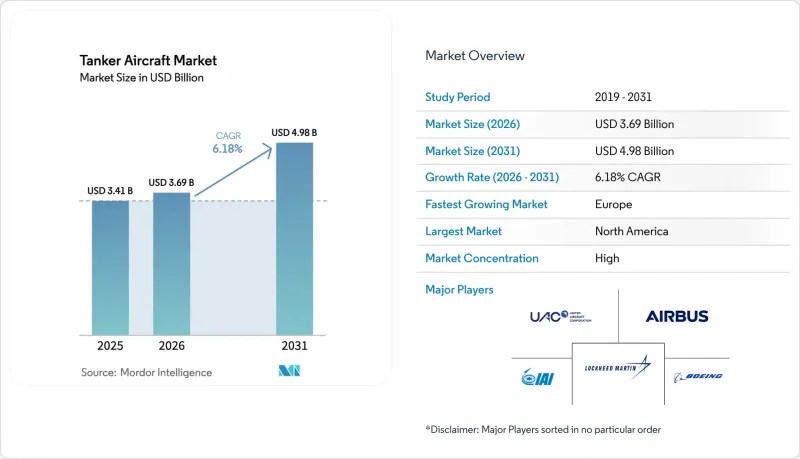
에 의하면, 공중 급유기(탱커) 시장 규모는 2025년 34억 1,000만 달러로 평가되었고, 2026년에는 36억 9,000만 달러로 추정되고, 2026-2031년 CAGR 6.18%로 성장을 지속할 전망이며, 2031년까지 49억 8,000만 달러에 이를 것으로 예측됩니다.
본 보고서는 시스템별(프로브 앤 드로게, 붐 급유, 자율형), 추진 방식별(터보프롭, 터보팬), 기체 유형별(유인, 무인), 판매 채널별(OEM, 애프터마켓), 지역별(북미, 유럽, 아시아태평양, 남미, 중동 및 아프리카)로 분류되어 있습니다. 시장 전망은 금액(달러) 기준으로 제시되어 있습니다.
세계의 공중 급유기(탱커) 시장 동향 및 인사이트
구형 기종의 격차를 해소하기 위해 기체 교체 프로그램이 운용 준비 태세를 가속화하고 있습니다.
공군이 노후화 및 통합상의 제약에 직면한 구형 기체를 대체하기 위해 신형 기체와 능력 도입을 우선시하는 가운데, 이 현대화 프로그램은 운용 태세의 기반이 되고 있습니다. KC-46 프로그램은 예산 동향보다 인증 일정이 납품 속도를 좌우할 수 있음을 보여주었으며, 2026년에는 새로운 과제가 대두되면서 생산 및 개조 계획에 대한 관심이 집중되었습니다. 구조적 문제로 인해 2025년에 일시 중단되었던 납품이 재개됨에 따라, 공중 급유기(탱커) 시장에서 운용사들이 가동률 목표를 달성하고자 하는 가운데, 안정적인 제조 및 시험 체계의 필요성이 부각되었습니다. 나토(NATO)의 다국적 MRTT 기단은 2029년까지 공동 운용 능력을 12대까지 지속적으로 확대하고 있으며, 이 모델은 소규모 참가국의 활용 기회를 늘리고, 공통된 구성으로 운용 시간을 분산시키는 것입니다. 2026년 프로그램 선정에는 재정적 신호도 반영되어 있으며, 미국은 차세대 공중 급유기(탱커) 연구에 제한적인 자금을 배정하는 한편, 미래 구상으로 이어지는 가교 역할을 할 단기적인 업그레이드 및 구매를 지속하고 있습니다. 한편, 유럽의 운용국들은 다국적 임무를 지원하고 5세대 수송기용 공동 인증 일정을 앞당기기 위해 A330 MRTT 규격에 부합하는 상호 운용 가능한 기단을 확충하고 있습니다.
아시아태평양의 국방비 지출이 장거리 전력 투사 인프라를 뒷받침하고 있습니다.
인도-태평양 전역에 걸친 작전 거리는 공중 급유기(탱커) 능력에 대한 지속적인 수요를 창출하고 있습니다. 계획 담당자들은 공격 및 초계 임무를 지원하기 위해 더 긴 이동 경로와 더 먼 거리의 공중 급유기(탱커) 전개 범위를 고려하고 있으며, 연료 보급 능력, 항속 거리, 그리고 동맹국의 수신기와의 상호 운용성이 균형을 이룬 플랫폼에 대한 중요성이 커지고 있습니다. 이는 연합 작전 시 공중 급유기(탱커) 시장에서 일관된 인증 및 규격에 부합하는 급유 장비가 요구되기 때문입니다. 프로그램이 발전함에 따라 자동화는 검증 단계에서 인증 단계로 넘어가고 있습니다. 그 예로, 싱가포르가 자동 붐 급유에 대한 완전한 인증을 획득한 것을 들 수 있으며, 이를 통해 전투기 급유기와 주야를 가리지 않는 작전 체제가 확립되었습니다. 각 지역의 유지 예산에서는 지원 기종 추가 및 데이터 링크 강화와 같은 업그레이드가 계속해서 우선시되고 있으며, 이를 통해 다기종 작전 시 발생하는 인증 병목 현상이 완화되고 있습니다. 2026년 미국 예산 문서는 플랫폼의 능력을 적의 사정거리 및 생존성 문제에 지속적으로 부합시켜야 할 필요성을 지적하고 있으며, 이에 따라 공중 급유기(탱커)의 현대화는 여전히 더 광범위한 부대 설계 옵션과 밀접하게 연계되어 있습니다.
인증 일정과 비용 초과가 납품 속도를 저해하고 있습니다.
고정 가격 계약과 복잡한 개조 절차는 프로그램에 추가 비용과 일정상의 부담을 초래하며, 이는 항공기 편대의 운용 가능 상태와 훈련 체계에 영향을 미칠 수 있습니다. 2026년, KC-46과 관련된 새로운 추가 비용 청구는 공중 급유기(탱커) 시장에서 운용에 필요한 납품 및 업그레이드를 유지하면서 고정 가격 하에서 시스템을 성숙시켜야 하는 과제를 부각시켰습니다. 생산 및 수령 속도는 중대한 결함의 해결, 각 군 및 규제 당국의 이해관계자간 조정이 필요한 인증 활동의 순서에도 영향을 받습니다. 시각 시스템 및 붐 제어의 개선은 5세대 수신기 운용에 있어 여전히 중요한 요건으로 남아 있으며, 따라서 배치 일정은 시험 캠페인 및 개조 작업의 진행 상황에 따라 좌우됩니다. 이러한 현실로 인해 계획 담당자들은 신규 조달과 유지 및 보수 사이의 균형을 맞추어야 하는 상황에 놓여 있으며, 프로그램이 인증 단계를 거쳐 진행되는 동안 훈련 및 임무 수행 능력이 저하되지 않도록 하고 있습니다. 전반적인 영향으로, 안전 제일의 검증과 단기적인 운영 수요 간의 균형을 맞추어야 하는 납품 일정이 형성되고 있습니다.
부문별 분석
2025년 기준으로 공중 급유는 공중 급유기 시장 규모의 64.37%를 차지했으며, 대형 수유기 운용에 적합한 높은 이송률이 이를 뒷받침하고 있습니다. 한편, 인증 기술의 발전에 따라 활용 사례가 확대됨에 따라, 자율형 구성은 2031년까지 연평균 성장률(CAGR) 9.65%로 성장할 것으로 전망됩니다. 고처리량을 위해 설계된 붐 시스템은 대형기나 항속거리 연장형 전투기 패키지에서 여전히 유리한 위치를 차지하고 있습니다. 자동화는 절차와 승무원 체제를 혁신하여 운용자의 업무 부담을 줄여주는 동시에, 안전 여력과 임무 일정을 개선하고 있습니다. 미 해군의 해상 무인 급유 로드맵은 무인기가 연료를 공급하는 동안 유인기가 주요 임무에 집중할 수 있는 가능성을 보여주고 있습니다. 포드식 시스템은 기존 전투기와의 통합성 및 다점 급유 능력 덕분에 해군과 유럽의 운용 기관들 사이에서 여전히 우위를 점하고 있습니다. 그러나 대규모 급유 임무나 첨단 함대에서는 붐 방식의 우위가 여전히 유지되고 있습니다.
전략적 공수 지원, 분산형 전투기 초계, 신속한 전용 급유와 같은 작전을 포괄하기 위해 공군은 두 가지 방식 모두를 필요로 하고 있으며, 혼합 방식의 미래가 부상하고 있습니다. 인증 템플릿의 발전에 따라 승인 기간이 단축됨에 따라, 자동화가 확대될 것으로 예측됩니다. 고도의 이미지 처리를 포함한 센서 융합을 통해 위치 파악 및 표적 포착의 안정성이 향상되어, 피로와 훈련 부담이 줄어들었습니다. 기내 네트워크 및 데이터 링크 증가에 따라, 공중 급유기(탱커)는 현재 비행 중 임무 조정 및 업데이트를 지원할 수 있게 되었으며, 연료 공급 능력뿐만 아니라 시스템 간 상호 운용성이 중요시되고 있습니다. 이러한 발전은 임무의 복잡성이 증가함에 따라, 붐 방식과 프로브 앤 드로우 방식 양쪽 시스템 모두에서 자율 기능 및 운영자 지원 기능이 확대되는 길을 열어주고 있습니다.
터보팬 항공기는 2025년 공중 급유기(탱커) 시장 점유율의 76.55%를 차지한 것으로 평가되었으며, 민간 여객기 생산 라인 및 공동 정비 거점 생태계의 지원을 받아 2031년까지 연평균 성장률(CAGR) 8.86%로 성장할 것으로 전망됩니다. 중형에서 대형 터보팬 항공기가 지닌 유지보수의 용이성과 긴 수명이라는 장점은 긴 임무 주기와 예측 가능한 정비 주기를 뒷받침하며, 이를 통해 항공기의 가동 중단 시간이 줄어들고 공중 급유기(탱커) 시장의 출격 횟수가 안정화됩니다. 터보프롭 항공기는 단거리 이착륙 운용 및 다목적 활용의 유연성 면에서 여전히 높은 평가를 받고 있습니다. 그럼에도 불구하고, 장거리 비행과 높은 순항 속도가 요구되는 전략적 공중 급유 임무에서는 대부분의 국가에서 터보팬 기체가 여전히 선호되고 있습니다. 각 OEM 업체들은 수명 주기의 중반에 해당하는 개량 패키지를 통해 연비 개선 및 전자 장비 업그레이드를 실시하고 있으며, 이를 통해 새로운 기체를 구매할 필요 없이 플랫폼의 수명을 연장하고, 출격당 비용을 절감하고 있습니다. 활주로 길이에 제약이 있는 경우, 2차 급유 임무를 담당하는 전술 수송기는 기동적인 작전이나 분산 배치에서 그 유용성을 유지하고 있습니다.
방위 분야와 민간 분야 고객 모두에게 서비스를 제공하는 공급망이 엔진, 랜딩 기어, 항공전자 장비 및 구조 부품 공급 기반을 뒷받침하고 있으며, 이를 통해 수십 년에 걸친 수명 주기 비용 관리가 가능해집니다. 민간 항공기와의 공통점 덕분에 예비 부품 및 정비 분야에서 규모의 경제가 실현되고 있으며, 다목적 정비 기지에서의 훈련 표준화도 촉진되고 있습니다. 한편, 급유 임무를 담당하는 전술 수송기는 견고한 훈련 장비 생태계를 활용함으로써 더 낮은 비용으로 승무원의 기량을 유지할 수 있으며, 기체가 노후화되더라도 임무 수행률 유지에 기여하고 있습니다. 그 결과, 전략적 임무에는 터보팬기가, 주력 기단을 보완하는 유연한 단거리 이착륙 임무에는 터보팬기와 터보프롭기의 혼합 편성이 여전히 주류를 이루고 있습니다.
지역별 분석
2025년, 북미는 공중 급유기(탱커) 시장 점유율의 34.47%를 차지했습니다. 이는 미국이 세계 최대의 항공기 보유 대수를 유지하고 현대화에 대한 투자를 지속했기 때문입니다. 이 지역의 우선 과제로는 원격 감시 및 연결성과 같은 핵심 시스템에 대한 인증 의존성 문제를 해결하는 것 외에도, 임무 수행률을 유지하기 위해 신규 조달과 개량 활동 간의 균형을 맞추는 것이 포함됩니다. 2026년 예산안은 단기적인 역량 강화에 자금을 투입하는 한편, 진화하는 생존성 요구에 부응하는 미래 개념의 성숙화를 위한 여지를 유지하는 '브릿지 전략'을 강화하고 있습니다. 또한, 도급업체는 평상시에도 더 큰 지원 역할을 수행하고 있으며, 이를 통해 훈련 시간의 선택 폭이 넓어지고 기체 운용 주기의 부담이 경감되고 있습니다. 이러한 조달, 유지관리 및 수주 역량의 결합이 해당 지역의 공중 급유기(탱커) 시장의 기반을 이루고 있습니다.
유럽은 가장 빠르게 성장하는 지역으로, 상호 운용성과 즉각적인 대응 능력을 강화하는 합동 작전 부대 및 국가 프로그램의 견인 아래 2031년까지 연평균 성장률(CAGR)이 8.16%를 나타낼 것으로 전망됩니다. 다국적 MRTT 부대가 2029년까지 12대로 확대됨에 따라, 여러 국가에 대한 접근성이 향상되고, 동맹국 간 작전 전반으로 확대 적용 가능한 장비, 훈련 및 인증 체계의 표준화가 촉진될 것입니다. 이번 훈련을 통해 급증 작전 시 공중 급유기(탱커)의 배치 밀도를 높일 필요가 있음이 부각되었으며, 혼성 비행대는 데이터 링크 호환성과 야간 작전 능력을 향상시켜 임무 수행 기회를 확대되고 있습니다. OEM 생산 계획 및 중기 개량 계획은 이 수요 곡선에 맞추어 설계되어 있으며, 공통 규격의 채택을 통해 공급 측의 인증 기간을 단축할 수 있습니다. 그 결과, 공중 급유기(탱커) 시장에서 국가 차원과 동맹 차원의 임무를 모두 지원하는 보다 견고한 운용 기반이 구축될 것입니다.
아시아태평양에서는 장거리 임무 프로파일 및 동맹 간 상호운용성 목표와 관련된 수요가 증가하는 한편, 각국은 기지 제약과 임무 구성을 고려하여 기체를 선정하고 있습니다. 싱가포르에서 완전히 승인된 자동 붐 급유 시스템에서 볼 수 있듯이, 인증된 자동화 기술이 해당 지역에서 차별화 요인으로 부상하고 있으며, 이는 장시간 작전 시 일관성을 높이고 승무원의 업무 부담을 줄이는 데 활용될 수 있습니다. 또한, 중기 개조 및 추가 급유기 인증도 주목받고 있으며, 대규모 자본 투자 프로그램을 실시하지 않고도 임무 수행의 유연성을 확대되고 있습니다. 광역적인 지역 전체에서 민간 항공기 개발 실적을 보유한 각 OEM 업체들은 정비 기지의 인프라와 예비 부품 생태계를 공유하고 있기 때문에 공중 급유기(탱커) 시장에서 임무 수행 태세를 유지하고 수명 주기 비용을 관리하는 데 있어 유리한 입장에 있습니다.
기타 혜택 :
- 엑셀 형식 시장 예측(ME) 시트
- 3개월간의 애널리스트 지원
자주 묻는 질문
목차
제1장 서론
제2장 조사 방법
제3장 주요 요약
제4장 시장 구도
제5장 시장 규모 및 성장 예측
제6장 경쟁 구도
제7장 시장 기회 및 향후 전망
AJY 26.06.22According to Mordor Intelligence, the tanker aircraft market size is expected to grow from USD 3.41 billion in 2025 to USD 3.69 billion in 2026 and is forecasted to reach USD 4.98 billion by 2031 at a 6.18% CAGR over 2026-2031.

This report is Segmented by System (Probe and Drogue, Boom Refueling, and Autonomous), Propulsion Type (Turboprop and Turbofan), Type (Manned and Unmanned), Point of Sale (OEM and Aftermarket), and Geography (North America, Europe, Asia-Pacific, South America, and Middle East and Africa). The Market Forecasts are Provided in Terms of Value (USD).
Global Tanker Aircraft Market Trends and Insights
Fleet Recapitalization Programs Accelerating Operational Readiness Amid Legacy Gaps
Recapitalization underpins readiness as air forces prioritize new airframes and capability insertions to replace legacy fleets that face age and integration constraints. The KC-46 program illustrates how certification timelines can govern delivery cadence more than appropriation trends, with 2026 marked by a new charge that kept attention on production and retrofit plans. Deliveries resumed after a 2025 halt due to structural findings, underscoring the need for stable manufacturing and test pipelines as operators aim to meet availability targets in the tanker aircraft market. NATO's Multinational MRTT Fleet continues to expand pooled capacity to 12 aircraft by 2029, a model that increases access for smaller contributors and spreads operating hours across a common configuration. Program choices in 2026 also reflect fiscal signaling, as the US allocates limited funds for next-generation tanker studies while continuing near-term upgrades and buys that bridge to future concepts. European operators, meanwhile, are adding interoperable fleets aligned with A330 MRTT standards that support multi-nation missions and speed joint certification timelines for fifth-generation receivers.
APAC Defense Expenditure Fueling Long-Range Power Projection Infrastructure
Operational distances across the Indo-Pacific drive sustained demand for tanker capacity, as planners account for longer transit profiles and more distant tanker orbits to support strike and patrol missions, extending the emphasis on platforms that balance fuel offload, range, and interoperability with allied receivers, because coalition operations require consistent clearances and compliant refueling hardware in the tanker aircraft market. As programs evolve, automation is moving from demonstration to certification, as evidenced by Singapore's full certification for automatic boom refueling, which anchors day-and-night operations with fighter receivers. Regional sustainment budgets continue to prioritize upgrades that add receiver types and datalink enhancements, which reduce certification bottlenecks during multi-asset missions. US budget documents in 2026 point to the continuing need to align platform capabilities with adversary range and survivability challenges, which keep tanker modernization closely tied to broader force design choices.
Certification Timelines and Cost Overruns Constraining Delivery Cadence
Fixed-price contracts and complex retrofit paths expose programs to financial charges and schedule pressure, which can ripple through fleet availability and training pipelines. In 2026, a new KC-46 charge underscored the challenge of maturing systems under firm pricing while sustaining deliveries and upgrades required for operational use in the tanker aircraft market. Production and acceptance pacing is also influenced by the resolution of critical deficiencies and by the sequencing of certification activities that must be coordinated across service and regulatory stakeholders. Visual systems and boom control improvements remain a key dependency for fifth-generation receiver operations, which keeps fielding milestones tied to test campaigns and retrofit slots. These realities push planners to balance new procurement with sustainment upgrades, so training and mission availability do not suffer while programs advance through certification gates. The overall effect is a delivery cadence that must balance safety-first validation with near-term operational needs.
Other drivers and restraints analyzed in the detailed report include:
- NATO Pooling Architectures Redefining European Strategic Autonomy
- Fifth-Generation Integration Demands Rewriting Boom-Operator Training and Certification
- Export Controls and Sovereignty Constraints Fragmenting Supply Chains
For complete list of drivers and restraints, kindly check the Table Of Contents.
Segment Analysis
Boom refueling captured 64.37% of the tanker aircraft market size in 2025, supported by high transfer rates that favor large receiver operations, while autonomous configurations are projected to grow at a 9.65% CAGR through 2031 as certification advances broaden use cases. Boom systems, engineered for high throughput, remain advantageous for heavy aircraft and extended-range fighter packages. Automation is shifting procedures and crew models, reducing operator workload and improving safety margins and mission timelines. The US Navy's roadmap for unmanned refueling at sea highlights the potential for redirecting manned aircraft to primary missions while unmanned assets deliver fuel. Podded systems retain an edge with naval and European operators due to their integration with existing fighters and multi-point refueling capabilities. However, boom dominance persists for large offload missions and advanced fleets.
A mixed-method future is emerging as air forces require both methods for operations spanning strategic airlift support, distributed fighter patrols, and quick-turn transit refuelings. Automation is expected to expand as certification templates evolve, shortening approval timelines. Sensor fusion, including advanced imaging, is enhancing positioning and contact stability, reducing fatigue and training demands. With more networks and data links onboard, tankers now support deconfliction and task updates while airborne, emphasizing system interoperability alongside fuel-offload capacity. These advancements pave the way for autonomy and operator-assist functions to grow across both boom and probe-and-drogue systems as mission complexity increases.
Turbofan platforms commanded 76.55% of the tanker aircraft market share in 2025 and are projected to grow at an 8.86% CAGR through 2031, supported by commercial airliner production lines and shared depot ecosystems. The underlying maintainability and time-on-wing advantages of mid to large turbofans support long mission cycles and predictable overhaul intervals, which reduce fleet downtime and stabilize sortie generation in the tanker aircraft market. Turboprop platforms remain valued for short-field operations and multi-role flexibility. Still, strategic refueling missions that require long range and high cruise speeds continue to favor turbofans for most national fleets. OEMs are adding fuel-burn improvements and electronics upgrades in mid-life packages, extending platform relevance and reducing per-sortie costs without requiring new airframe purchases. Where runway length is constrained, tactical transports with secondary tanking roles keep their utility for agile operations and dispersed basing.
Supply chains that serve both defense and commercial customers underpin the availability of engines, landing gear, avionics, and structures, thereby supporting lifecycle cost control over decades. Commercial heritage provides economies of scale in spares and maintenance, and supports standardization of training across mixed-use depots. Tactical transports that fill refueling roles meanwhile benefit from robust training device ecosystems that keep aircrew current at lower cost, which contributes to mission-ready rates even as airframes age. The net result is an installed base that remains biased toward turbofans for strategic missions and toward a mix of turbofans and turboprops for flexible, short-field assignments that complement mainline fleets.
Geography Analysis
North America accounted for 34.47% of the tanker aircraft market share in 2025 as the US sustained the largest global fleet and continued investments in modernization. The region's priorities include addressing certification dependencies on critical systems like remote vision and connectivity, as well as balancing new procurement with retrofit activity to sustain mission-ready rates. Budget documents in 2026 reinforce a bridge strategy that funds near-term capability improvements while maintaining room for future concept maturation aligned with evolving survivability needs. Contractors are also playing a larger supporting role in peacetime, which expands options for training hours and easing fleet utilization cycles. This blend of procurement, sustainment, and contracted capacity underpins the tanker aircraft market in the region.
Europe is the fastest-growing region, with an 8.16% CAGR through 2031, propelled by pooled fleets and national programs that strengthen interoperability and readiness. The Multinational MRTT fleet's expansion to 12 aircraft by 2029 enhances multi-country access and encourages standardization in equipment, training, and certification frameworks that can scale across allied operations. Exercises underscore the need for additional tanker density during surge operations, and mixed fleets are improving datalink compatibility and night operations to extend mission windows. OEM production plans and mid-life upgrade paths are designed to meet this demand curve, while common standards can shorten receiver certifications. The result is a stronger operating backbone that supports both national and alliance-level tasking in the tanker aircraft market.
Asia-Pacific adds demand linked to long-range mission profiles and allied interoperability aims, while individual nations calibrate fleet choices against basing constraints and mission mixes. Certified automation is emerging as a differentiator in the region, as seen with Singapore's fully approved automatic boom refueling, which can be leveraged to improve consistency and reduce crew workload during extended sorties. Mid-life upgrades and additional receiver certifications are also in focus, broadening mission flexibility without major capital programs. Across the broader region, OEMs with commercial heritage are well-positioned due to shared depot infrastructure and spares ecosystems that support mission readiness and lifecycle cost control in the tanker aircraft market.
- Airbus SE
- The Boeing Company
- Lockheed Martin Corporation
- Embraer S.A.
- Israel Aerospace Industries Ltd.
- United Aircraft Corporation (Rostec)
- Omega Air Refueling Services, Inc
Additional Benefits:
- The market estimate (ME) sheet in Excel format
- 3 months of analyst support
TABLE OF CONTENTS
1 INTRODUCTION
- 1.1 Study Assumptions and Market Definition
- 1.2 Scope of the Study
2 RESEARCH METHODOLOGY
3 EXECUTIVE SUMMARY
4 MARKET LANDSCAPE
- 4.1 Market Overview
- 4.2 Market Drivers
- 4.2.1 Fleet recapitalization programs (KC-46A, A330 MRTT) accelerating across US, NATO, and allies
- 4.2.2 Asia-Pacific defense spending and Indo-Pacific range requirements expanding tanker demand
- 4.2.3 NATO/European pooled capacity (MMF) and F-35 adoption driving interoperability
- 4.2.4 5th-gen integration and networked ops requiring advanced boom/drogue and connectivity
- 4.2.5 Contractor-operated AAR services for training, surge, and transits gaining traction
- 4.2.6 Autonomy and uncrewed tankers (MQ-25 pathfinding; A3R/auto-boom) enabling new CONOPS
- 4.3 Market Restraints
- 4.3.1 Certification/integration hurdles causing delays and cost overruns
- 4.3.2 Export controls/sovereignty limits on boom/RVS and mission systems tech transfer
- 4.3.3 High acquisition and life-cycle costs vs conversions/pooling/leases
- 4.3.4 SAF availability and environmental/airspace constraints on tanker ops
- 4.4 Value Chain Analysis
- 4.5 Regulatory Outlook
- 4.6 Technological Outlook
- 4.7 Porter's Five Forces Analysis
- 4.7.1 Bargaining Power of Suppliers
- 4.7.2 Bargaining Power of Buyers/Consumers
- 4.7.3 Threat of New Entrants
- 4.7.4 Threat of Substitute Products
- 4.7.5 Intensity of Competitive Rivalry
5 MARKET SIZE AND GROWTH FORECASTS (VALUE)
- 5.1 By System
- 5.1.1 Probe and Drogue
- 5.1.2 Boom Refueling
- 5.1.3 Autonomous
- 5.2 By Propulsion Type
- 5.2.1 Turboprop
- 5.2.2 Turbofan
- 5.3 By Type
- 5.3.1 Manned
- 5.3.2 Unmanned
- 5.4 By Point of Sale
- 5.4.1 OEM
- 5.4.2 Aftermarket
- 5.5 By Geography
- 5.5.1 North America
- 5.5.1.1 United States
- 5.5.1.2 Canada
- 5.5.1.3 Mexico
- 5.5.2 Europe
- 5.5.2.1 United Kingdom
- 5.5.2.2 France
- 5.5.2.3 Germany
- 5.5.2.4 Russia
- 5.5.2.5 Rest of Europe
- 5.5.3 Asia-Pacific
- 5.5.3.1 China
- 5.5.3.2 India
- 5.5.3.3 Japan
- 5.5.3.4 South Korea
- 5.5.3.5 Rest of Asia-Pacific
- 5.5.4 South America
- 5.5.4.1 Brazil
- 5.5.4.2 Rest of South America
- 5.5.5 Middle East and Africa
- 5.5.5.1 Middle East
- 5.5.5.1.1 Saudi Arabia
- 5.5.5.1.2 United Arab Emirates
- 5.5.5.1.3 Rest of Middle East
- 5.5.5.2 Africa
- 5.5.5.2.1 South Africa
- 5.5.5.2.2 Rest of Africa
- 5.5.5.1 Middle East
- 5.5.1 North America
6 COMPETITIVE LANDSCAPE
- 6.1 Market Concentration
- 6.2 Strategic Moves
- 6.3 Market Share Analysis
- 6.4 Company Profiles (includes Global level Overview, Market level Overview, Core Segments, Financials as available, Strategic Information, Market Rank/Share for key companies, Products and Services, and Recent Developments)
- 6.4.1 Airbus SE
- 6.4.2 The Boeing Company
- 6.4.3 Lockheed Martin Corporation
- 6.4.4 Embraer S.A.
- 6.4.5 Israel Aerospace Industries Ltd.
- 6.4.6 United Aircraft Corporation (Rostec)
- 6.4.7 Omega Air Refueling Services, Inc
7 MARKET OPPORTUNITIES AND FUTURE OUTLOOK
- 7.1 White-space and Unmet-Need Assessment


