

|
시장보고서
상품코드
2061560
유선 서비스 시장 : 시장 점유율 분석, 업계 동향 및 통계, 성장 예측(2026-2031년)Wireline Services - Market Share Analysis, Industry Trends & Statistics, Growth Forecasts (2026 - 2031) |
||||||
 Mordor Intelligence
에 의하면, 유선 서비스 시장 규모는 2025년에 138억 6,000만 달러로 평가되었고, 2026년 150억 6,000만 달러로 추정되고, 2031년까지 227억 8,000만 달러에 이를 것으로 예측되며, 예측 기간(2026-2031년) CAGR은 8.64%를 나타낼 전망입니다.
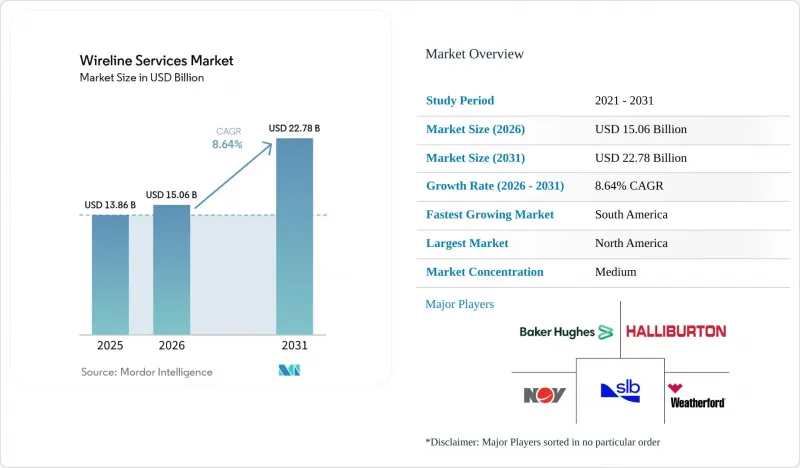
본 보고서는 유형별(전기 라인 및 슬릭 라인), 서비스 유형별(완공, 개입, 로깅, 천공, 파이프 회수), 홀 유형별(오픈 홀 및 케이싱 홀), 운영 지역별(육상 및 해상), 지역별(북미, 유럽, 아시아태평양, 남미, 중동 및 아프리카)로 분류되어 있습니다. 시장 규모 및 전망은 금액(달러) 기준으로 제시되어 있습니다.
세계의 유선 서비스 시장 동향 및 분석
시추공의 복잡화 및 고정밀 로깅에 대한 수요 증가
3km가 넘는 셰일 횡갱이나 고각도 해양 시추공의 경우, 지층 평가 시 1미터 미만의 정밀도가 요구됩니다. SLB의 Neuro와 같은 AI 기반 지오스티어링 플랫폼은 유정당 최대 25회의 자율적인 궤도 변경을 수행할 수 있어, 기존 스티어링 방식으로는 놓치기 쉬운 최적의 지점에 비트를 유지할 수 있습니다. 현재, 머신러닝 알고리즘은 92.7%의 분류 정확도로 암상을 분류하여 해석 주기를 수 시간 단축하고 있습니다. 정밀도의 향상은 불균일한 지층에서의 회수율을 직접적으로 높여주며, 와이어라인 데이터는 유전 개발 계획에 없어서는 안 될 요소가 되었습니다. 그 결과, 독자적인 분석 솔루션을 보유한 서비스 기업들이 고부가가치 계약을 수주하고 있습니다.
해저 심해 및 초심해 분야의 설비 투자 회복
브라질의 프레솔트층과 가이아나의 스타브로크 광구가 새로운 해양 개발 주기의 견인차 역할을 하고 있습니다. 페트로브라스는 복잡한 고압 및 고온(HPHT) 와이어라인을 포함한 8억 달러 규모의 통합 서비스 패키지를 발주함으로써, 기술적 진입 장벽이 매우 높다는 점을 여실히 보여주었습니다. 미국 규제 당국은 현재 새로운 HPHT 도구에 대해 제3자 검증을 의무화하고 있으며, 이로 인해 규정 준수 비용은 증가하지만 안전성은 향상됩니다. 심해에서 근무하는 와이어라인 작업자 및 자산의 일당은 육상 수준보다 40-60% 더 높으며, 이로 인해 인증 장비를 보유한 공급업체의 이익률이 향상되고 있습니다. 압력 범위가 20,000 psi를 초과하기 때문에 훈련 요건이 까다로워, 이 분야는 전 세계적으로 극소수공급업체로 한정되어 있습니다.
원유 가격 변동이 E&P 예산을 압박하고 있습니다.
브렌트유 가격이 배럴당 65달러 아래로 떨어지면, 중소규모의 탐사 및 생산(E&P) 기업들은 거의 즉각적으로 재량 지출을 줄입니다. 와이어라인 작업은 시추에 비해 생산에 미치는 영향이 덜 두드러지기 때문에 가장 먼저 연기되는 항목 중 하나입니다. 성과 기반 계약이나 변동 가격 모델로 인해 그 영향은 완화되지만, 서비스 수요는 분기 내 20-30% 변동할 가능성이 있습니다. 대형 종합 석유 기업들은 현재 자유 현금 흐름을 우선시하고 있으며, 그 결과 경기 침체기에는 시추 작업 일정이 축소되어 와이어라인의 기준 수요가 감소하고 있습니다.
부문별 분석
전기 라인(Electric Line) 부문은 2025년 매출의 64.60%를 차지했으며 연평균 성장률(CAGR) 9.12%로 성장하고 있습니다. 이러한 선도적 지위는 실시간 텔레메트리, 고대역폭 광섬유 코어, 그리고 멀티피직스 로깅 패키지와의 호환성 덕분입니다. 반면, 슬릭라인은 단순한 기계적 작업이나 저비용의 기존 유전(브라운필드) 작업에서는 유용하지만, 복잡한 유정에서 요구되는 정밀한 데이터 요구 사항을 충족시키기에는 어려움이 있습니다. 현재 디지털 전기 시스템에는 DAS 및 DTS 모듈이 탑재되어 있어 테라바이트 규모의 연속적인 시추공 정보를 생성합니다. AI 기반 분석과 결합함으로써, 작업자는 도구가 시추공 내에 있는 동안 천공 깊이나 유체 혼합 비율을 조정할 수 있으며, 이를 통해 비생산 시간을 줄이고 자극 효과를 높일 수 있습니다. 예측 기간 동안 워크플로우 자동화와 자율적인 지하 제어 기술로 인해 더 많은 작업이 전기 라인으로 전환될 것으로 예상되며, 이에 따라 와이어라인 서비스 시장의 핵심적 위상이 더욱 공고해질 것입니다.
전기 라인 사업자들은 리그업 작업을 신속하게 진행하고 인력을 절감할 수 있는 표준화된 툴 스트링의 이점도 누리고 있습니다. 클라우드 기반 데이터 파이프라인을 통해 로그 데이터가 몇 분 이내에 원격지의 자산 관리 팀으로 전송되므로, 분석 주기가 단축되고 출장 직원의 비용도 절감됩니다. 현재 많은 국영 석유 회사들이 입찰 서류에 실시간 데이터 관련 조항을 포함하고 있으며, 전기식 기술의 역량은 시장 진입의 최소 요건이 되고 있습니다. 슬릭라인은 저압 육상 유정이나 게이지 회수 용도로는 계속 사용되겠지만, 광섬유 비용의 하락과 디지털 슬릭라인의 보급에 따라 그 시장 점유율은 점차 줄어들 것으로 예측됩니다.
개입 서비스 시장은 연평균 성장률(CAGR) 9.60%로 확대될 전망이며, 2025년 시점에도 로깅이 유선 서비스 시장 점유율의 33.10%를 차지하고 있음에도 불구하고, 다른 모든 부문을 능가하는 성장률을 보일 것으로 예측됩니다. 각 운영사는 유전 수명을 연장하기 위한 생산 유지, 시멘트 주입 및 층간 격리 작업으로 자금을 전환하고 있습니다. 성숙한 셰일층에서 플러그 앤 퍼프(plug-and-perf) 방식의 재주입이 성공하면, 신규 시추 비용의 극히 일부만으로 생산량을 15-30% 증가시킬 수 있습니다. 개입 작업에서는 처리를 실시간으로 최적화하는 라이브 데이터 결정 엔진의 활용이 증가하고 있으며, 이를 통해 가치 제안이 한층 더 강화되고 있습니다.
시추 개시 시점과 저류층 관리에 있어 로깅은 여전히 필수적이지만, 일부 분지에서는 신규 시추량이 감소하고 있습니다. 플러그 앤 퍼프 설계가 표준화됨에 따라, 완공 작업의 이익률은 압박을 받고 있습니다. 케이싱 붕괴나 파이프 막힘으로 인해 유정 폐쇄가 우려되는 경우, 파이프 회수나 피싱은 틈새 시장이지만 필수적인 작업입니다. 이 모든 요소를 종합해 볼 때, 지속적인 최적화로의 전환이 보다 광범위한 유선 서비스 시장에서 중계 서비스의 뛰어난 성장 전망을 뒷받침하고 있습니다.
지역별 분석
2025년에 북미가 36.20%라는 압도적인 점유율을 차지하게 된 배경에는 타 지역을 압도하는 시추 장비 수와 디지털 로깅 서비스의 높은 보급률이 있습니다. 각 운영사는 AI를 활용한 지오스티어링 및 원격 제어 센터를 지속적으로 운영하고 있으며, 이를 통해 각 작업반의 효율을 30% 향상시켰습니다. 미국 멕시코만에서는 더 깊은 저류층에 대한 개발이 진행되고 있지만, 인력 부족과 엄격한 메탄 규제로 인해 운영 비용이 상승하고 있습니다. 캐나다에서 제안된 35%의 배출량 상한선은 오일샌드 개발 확대를 제한할 가능성이 있으며, 서비스 수요를 신규 유정 개발보다는 유정 건전성 점검 쪽으로 전환시킬 우려가 있습니다.
남미는 가장 매력적인 성장 스토리를 보여주고 있습니다. 브라질의 프레솔트 탄산염 암반층은 측정 깊이 8,000미터, 저부압 20,000 psi를 초과하는 경우가 있어, 각 와이어라인 작업은 기술적으로 까다로운 동시에 매우 수익성이 높은 작업이 됩니다. 페트로브라스는 현재 로깅, 개입, 모니터링 업무를 장기 협력 계약 하에 일괄 수행하고 있으며, 검증된 초고압 및 고온(HPHT) 실적을 보유한 업체를 우대하고 있습니다. 아르헨티나의 바카 무에르타 셰일층은 북미의 패드 시추 방식을 모방하고 있지만, 시추공 수는 여전히 뒤처져 있으며, 인프라가 성숙해짐에 따라 와이어라인 도입에 큰 여지가 남아 있습니다.
유럽 및 아시아태평양은 탄소중립 목표의 영향으로 한 자릿수 중반대의 성장세를 보이고 있습니다. 노르웨이 북해에서는 4D 지진 탐사로 보정된 케이싱 구멍 포화도 로깅을 활용해 기존 자산의 최적화가 진행되고 있는 반면, 중국 보하이 및 남중국해 심해 분지에서는 국내 에너지 안보에 대한 투자가 확대되면서 첨단 로깅 장비 조달을 위한 입찰이 진행되고 있습니다. 중동은 ADNOC의 기존 자산 현대화 및 쿠웨이트의 새로운 해양 개발 추진에 힘입어 여전히 생산량의 핵심 역할을 하고 있습니다. 아프리카의 상황은 제각각입니다. 나미비아에서의 새로운 발견이 전망을 밝게 하는 반면, 서아프리카 일부 지역에서는 치안 문제가 활동을 저해하고 있습니다.
기타 혜택 :
- 엑셀 형식 시장 예측(ME) 시트
- 3개월간의 애널리스트 지원
자주 묻는 질문
목차
제1장 서론
제2장 조사 방법
제3장 주요 요약
제4장 시장 구도
제5장 시장 규모 및 성장 예측
제6장 경쟁 구도
제7장 시장 기회 및 향후 전망
AJY 26.06.22According to Mordor Intelligence, the wireline services market size was valued at USD 13.86 billion in 2025 and estimated to grow from USD 15.06 billion in 2026 to reach USD 22.78 billion by 2031, at a CAGR of 8.64% during the forecast period (2026-2031).
This report is Segmented by Type (Electric Line and Slick Line), Service Type (Completion, Intervention, Logging, Perforation, and Pipe Recovery), Hole Type (Open Hole and Cased Hole), Deployment Location (Onshore and Offshore), and Geography (North America, Europe, Asia-Pacific, South America, and Middle East and Africa). The Market Sizes and Forecasts are Provided in Terms of Value (USD).
Global Wireline Services Market Trends and Insights
Rising well complexity & demand for high-precision logging
Shale laterals beyond 3 km and high-angle offshore wells require sub-meter accuracy in formation evaluation. AI-based geosteering platforms, such as SLB's Neuro, can complete as many as 25 autonomous trajectory changes per well, keeping the bit in sweet spots that conventional steering would miss. Machine-learning algorithms now classify lithology with 92.7% balanced accuracy, shaving hours from interpretation cycles. Enhanced precision directly lifts recovery factors in heterogeneous formations, making wireline data indispensable for field development planning. Service companies with proprietary analytics suites are therefore winning premium contracts.
Offshore deep-/ultra-deepwater CAPEX rebound
Pre-salt Brazil and Guyana's Stabroek block anchor the new offshore cycle. Petrobras awarded a USD 800 million integrated services package that includes complex HPHT wireline, underscoring the technical entry barriers. United States regulators now require third-party verification for novel HPHT tools, which raises compliance costs but improves safety. Deep-water day-rates for wireline crews and assets are 40-60% higher than their onshore equivalents, thereby boosting margins for providers with certified equipment. Training demands are steep because pressure envelopes surpass 20,000 psi, narrowing the field to a handful of global suppliers.
Crude-price volatility curbing E&P budgets
When Brent dips under USD 65 per barrel, small E&P companies trim discretionary spending almost immediately. Wireline intervention is among the first items deferred because its production impact is less visible than that of drilling. Although performance-based contracts and variable pricing models mitigate the impact, service demand can still fluctuate by 20-30% within a quarter. Larger integrated oil companies now prioritise free cash flow, leading to leaner completion schedules that compress baseline wireline volumes during downturns.
Other drivers and restraints analyzed in the detailed report include:
- Enhanced reservoir surveillance needs in mature fields
- Digital slickline adoption enabling real-time data
- Stringent decarbonisation / ESG regulations
For complete list of drivers and restraints, kindly check the Table Of Contents.
Segment Analysis
The electric-line segment captured 64.60% of 2025 revenue and is growing at a 9.12% CAGR. That leadership stems from real-time telemetry, high-bandwidth fiber-optic cores, and compatibility with multi-physics logging packages. By contrast, slickline holds value for simple mechanical tasks and low-cost brownfield work but struggles to meet precision data needs in complex wells. Digital electric systems now carry DAS and DTS modules that produce terabytes of continuous wellbore information. Coupled with AI-driven analytics, operators can adjust the perforation depth or fluid mix while the tool is still downhole, thereby reducing non-productive time and enhancing stimulation effectiveness. Over the forecast period, workflow automation and autonomous down-hole control are expected to tilt additional jobs toward electric line, reinforcing its central place in the wireline services market.
Electric-line providers also benefit from standardised tool strings that accelerate rig-up and reduce headcount. Cloud-based data pipelines ship logs to remote asset teams within minutes, shrinking analysis cycles and cutting travelling staff costs. Many national oil companies now incorporate real-time data clauses in tender documents, making electric capability a minimum entry requirement. Slickline will persist in low-pressure land wells and for gauge retrieval, yet its share is projected to erode incrementally as fibre-optic costs fall and digital slickline gains traction.
Intervention services are set to climb at a 9.60% CAGR, outperforming all other categories even though logging still commanded 33.10% of the wireline services market share in 2025. Operators are shifting funds toward production maintenance, cement squeeze, and zonal isolation work that lengthen field life. In mature shale, a successful plug-and-perf refrac can increase output by 15-30% at a fraction of the cost of drilling a new well. Intervention campaigns increasingly use live-data decision engines that optimize treatment in real-time, further strengthening the value proposition.
Logging remains critical at spud and during reservoir management, but the volume of new drills is moderating in several basins. Completion runs face margin pressure as plug-and-perf designs become standardised. Pipe recovery and fishing remain niche yet essential when collapsed casing or stuck pipe threatens abandonment. Taken together, the pivot towards continuous optimisation underpins the intervention's superior expansion outlook within the broader wireline services market.
Geography Analysis
North America's dominant 36.20% share in 2025 reflects its unmatched rig count and high uptake of digital logging services. Operators continue to run AI-assisted geosteering and remote operations centres that squeeze 30% more efficiency from each crew. The United States Gulf of Mexico seeks deeper reservoirs, but tight labour availability and stringent methane controls raise operating costs. Canada's proposed 35% emissions cap may constrain oil sands expansion, tilting service demand toward integrity inspection rather than new well deployment.
South America offers the most compelling growth story. Brazil's pre-salt carbonate columns can exceed 8,000 m measured depth and 20,000 psi bottom-hole pressure, making each wireline run both technically demanding and highly remunerative. Petrobras now bundles logging, intervention, and surveillance under long-term alliances that favour vendors with proven ultra-HPHT track records. Argentina's Vaca Muerta shale mirrors North American pad drilling yet still lags in well count, leaving significant runway for wireline uptake as infrastructure matures.
Europe and Asia-Pacific grow at a mid-single-digit pace under the shadow of net-zero targets. Norway's North Sea optimises mature assets via 4D seismic-calibrated cased-hole saturation logs, while China's Bohai and deep-water South China Sea basins invest in domestic energy security, opening tenders for advanced logging fleets. The Middle East remains a volume stronghold, driven by ADNOC's brownfield renewals and Kuwait's new offshore push. Africa is mixed: Namibia's discoveries brighten the outlook, whereas security issues curb activity in parts of West Africa.
- Baker Hughes Company
- Halliburton Company
- Schlumberger Limited
- Weatherford International PLC
- Superior Energy Services
- Expro Group
- Archer Ltd
- SGS S.A.
- C&J Energy Services Inc.
- Pioneer Energy Services Corp.
- NOV Inc.
- TechnipFMC plc
- Altus Intervention
- Nine Energy Service
- Patriot Well Solutions
- China Oilfield Services Limited (COSL)
- Nabors Industries Ltd.
- Trican Well Service Ltd.
- Core Laboratories N.V.
- Hunting PLC
Additional Benefits:
- The market estimate (ME) sheet in Excel format
- 3 months of analyst support
TABLE OF CONTENTS
1 Introduction
- 1.1 Study Assumptions & Market Definition
- 1.2 Scope of the Study
2 Research Methodology
3 Executive Summary
4 Market Landscape
- 4.1 Market Overview
- 4.2 Market Drivers
- 4.2.1 Rising well complexity & demand for high-precision logging
- 4.2.2 Offshore deep-/ultra-deepwater CAPEX rebound
- 4.2.3 Enhanced reservoir surveillance needs in mature fields
- 4.2.4 Digital slickline adoption enabling real-time data
- 4.2.5 NOC-led brownfield rejuvenation programs (MENA)
- 4.2.6 Miniaturised down-hole sensor integration (micro-wireline)
- 4.3 Market Restraints
- 4.3.1 Crude-price volatility curbing E&P budgets
- 4.3.2 Stringent decarbonisation/ESG regulations
- 4.3.3 Shortage of skilled high-pressure wireline crews
- 4.3.4 Limited supply of corrosion-resistant ultra-HPHT wire
- 4.4 Supply-Chain Analysis
- 4.5 Regulatory Landscape
- 4.6 Technological Outlook
- 4.7 Porter's Five Forces
- 4.7.1 Bargaining Power of Suppliers
- 4.7.2 Bargaining Power of Buyers
- 4.7.3 Threat of New Entrants
- 4.7.4 Threat of Substitutes
- 4.7.5 Competitive Rivalry
5 Market Size & Growth Forecasts
- 5.1 By Type
- 5.1.1 Electric Line
- 5.1.2 Slick Line
- 5.2 By Service Type
- 5.2.1 Completion
- 5.2.2 Intervention
- 5.2.3 Logging
- 5.2.4 Perforation
- 5.2.5 Pipe Recovery
- 5.3 By Hole Type
- 5.3.1 Open Hole
- 5.3.2 Cased Hole
- 5.4 By Deployment Location
- 5.4.1 Onshore
- 5.4.2 Offshore
- 5.5 By Geography
- 5.5.1 North America
- 5.5.1.1 United States
- 5.5.1.2 Canada
- 5.5.1.3 Mexico
- 5.5.2 Europe
- 5.5.2.1 Germany
- 5.5.2.2 United Kingdom
- 5.5.2.3 Norway
- 5.5.2.4 NORDIC Countries
- 5.5.2.5 Russia
- 5.5.2.6 Rest of Europe
- 5.5.3 Asia-Pacific
- 5.5.3.1 China
- 5.5.3.2 India
- 5.5.3.3 South Korea
- 5.5.3.4 ASEAN Countries
- 5.5.3.5 Australia
- 5.5.3.6 Rest of Asia-Pacific
- 5.5.4 South America
- 5.5.4.1 Brazil
- 5.5.4.2 Argentina
- 5.5.4.3 Colombia
- 5.5.4.4 Rest of South America
- 5.5.5 Middle East and Africa
- 5.5.5.1 Saudi Arabia
- 5.5.5.2 United Arab Emirates
- 5.5.5.3 South Africa
- 5.5.5.4 Nigeria
- 5.5.5.5 Egypt
- 5.5.5.6 Rest of Middle East and Africa
- 5.5.1 North America
6 Competitive Landscape
- 6.1 Market Concentration
- 6.2 Strategic Moves (M&A, Partnerships, PPAs)
- 6.3 Market Share Analysis (Market Rank/Share for key companies)
- 6.4 Company Profiles (includes Global level Overview, Market level overview, Core Segments, Financials as available, Strategic Information, Products & Services, and Recent Developments)
- 6.4.1 Baker Hughes Company
- 6.4.2 Halliburton Company
- 6.4.3 Schlumberger Limited
- 6.4.4 Weatherford International PLC
- 6.4.5 Superior Energy Services
- 6.4.6 Expro Group
- 6.4.7 Archer Ltd
- 6.4.8 SGS S.A.
- 6.4.9 C&J Energy Services Inc.
- 6.4.10 Pioneer Energy Services Corp.
- 6.4.11 NOV Inc.
- 6.4.12 TechnipFMC plc
- 6.4.13 Altus Intervention
- 6.4.14 Nine Energy Service
- 6.4.15 Patriot Well Solutions
- 6.4.16 China Oilfield Services Limited (COSL)
- 6.4.17 Nabors Industries Ltd.
- 6.4.18 Trican Well Service Ltd.
- 6.4.19 Core Laboratories N.V.
- 6.4.20 Hunting PLC
7 Market Opportunities & Future Outlook
- 7.1 White-space & Unmet-need Assessment


