
|
시장보고서
상품코드
2061611
승객용 비상 산소 공급 시스템 시장 : 시장 점유율 분석, 업계 동향 및 통계, 성장 예측(2026-2031년)Passenger Emergency Oxygen Deployment Systems - Market Share Analysis, Industry Trends & Statistics, Growth Forecasts (2026 - 2031) |
||||||
 Mordor Intelligence
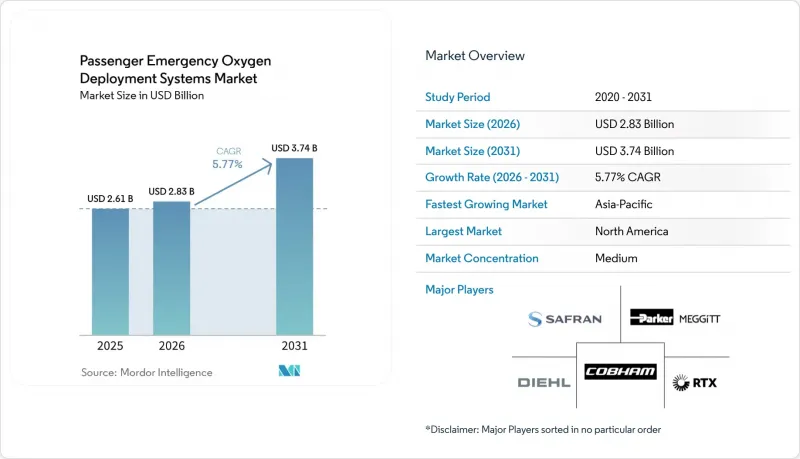
Mordor Intelligence에 의하면, 승객용 비상 산소 공급 시스템 시장 규모는 2025년 26억 1,000만 달러로 평가되었고, 2026년에는 28억 3,000만 달러로 추정되고, 2026-2031년 CAGR 5.77%로 성장을 지속할 전망이며, 2031년에는 37억 4,000만 달러에 이를 것으로 예측됩니다.
본 보고서는 시스템별(승객용 산소 시스템, 승무원용 산소 시스템), 항공기 유형별(민간 항공기, 군용기, 일반 항공기), 구성 요소별(산소 저장 서브시스템 등), 최종 사용자별(라인 핏, 레트로핏), 지역별(북미, 남미 등)로 분류되어 있습니다. 시장 전망은 금액(달러) 기준으로 제시되어 있습니다.
세계의 승객용 비상 산소 공급 시스템 시장 동향 및 분석
세계 여객 수송량의 급증
국제항공운송협회(IATA)에 따르면, 전 세계 승객 수는 2025년에 52억 명에 달한 것으로 평가되었으며, 2024년 대비 6.7% 증가했습니다. 신형 단일 통로 항공기 1대당 150-180개의 드롭다운식 마스크가 필요하며, 와이드바디 항공기의 경우 250-400개가 필요합니다. 에어버스는 2044년까지 전 세계 항공기 보유 대수가 2배인 49,210대에 달할 것으로 전망하고 있으며, 이에 따라 라인핏 수주에서 여객기용 비상 산소 공급 시스템에 대한 안정적인 수요가 확보될 것입니다. 특히 인도 및 남아시아에서의 성장이 두드러지며, 2043년까지 2,835대의 추가 도입이 예상되고 있어 장기적인 예비 부품 계약이 확보되어 있습니다. 승객 수 증가가 승무원 채용 속도를 앞지르고 있어, 항공사들은 기내에서 발생할 수 있는 의료 사고에 대응해야 할 위험이 커지고 있습니다. 그러나 많은 항공사는 수명이 더 긴 가스식 시스템보다 저비용의 화학식 산소 발생 장치를 계속 선택하고 있습니다. 이러한 불균형이 초기 도입과 규제 대응을 위한 교체 수요 모두를 뒷받침하고 있습니다.
FAA/EASA의 안전 규제 강화
2024-2025년, FAA는 3건의 중요한 항공 적합성 지침을 발령했습니다. 이는 2,600대의 B737용 발생 장치, 3,777개의 사프란/AVOX제 밸브, 그리고 8만 개의 보호용 호흡 장치에 영향을 미쳐 예정에 없던 교체를 필요로 하게 했으며, 승객용 비상 산소 공급 시스템 시장을 활성화시켰습니다. 이에 이어 EASA도 발전기의 과열 및 관련 위험에 대처하기 위한 지침을 발표했습니다. 여기에는 AD 2023-0209, 2024-0186 및 2024-0198이 포함됩니다. ICAO의 규제 조정에 따라, 이러한 규제는 2-3년 이내에 전 세계로 확대되어 아시아태평양 및 중동의 항공기 운항에 영향을 미치게 될 것입니다. 또한, FAA의 2025년 12월 지침에서는 장착 절차가 개정되고 훈련의 미비점이 지적되었으며, 통합 진단 기능을 갖춘 조종실 시스템의 업그레이드가 추진되었습니다. 이러한 동향은 종합적으로 볼 때 교체 주기를 앞당기고, 운항사의 예산을 규제 당국의 승인을 받은 검증된 공급업체로 전환하게 될 것입니다.
높은 인증 및 인가 비용
TSO-C99b 및 TSO-C78a 규격 준수를 위해서는 고도 시험실, 가연성 시험 및 인체공학 시험이 필요하며, 이에 소요되는 비용은 기종별로 200만 달러에서 500만 달러에 달할 전망입니다. EASA의 중복되는 ETSO 규정은 비용을 더욱 증가시킵니다. FAA 자문 회람 20-144A는 DO-326A 및 DO-356A에 기반한 사이버 보안 준수 요건을 추가하고 있으며, 이로 인해 일정이 장기화되고 중소 공급업체 간의 통합이 촉진되고 있습니다. 예를 들어, 사프란사의 EROS 제품군은 기존 승인 혜택을 누리고 있어 비용 면에서 경쟁 우위를 제공합니다. 이에 반해 Aerox사는 Omnigas사, Sky-Ox사, Fluid Power사를 인수하여 인증을 통합하는 한편, 고정비를 보다 폭넓은 제품 라인에 분산시키고 있습니다. 이러한 높은 비용은 신규 진입을 가로막고, 혁신적인 설계의 도입을 지연시키고 있습니다.
부문별 분석
승무원용 산소 공급 시스템 시장은 2031년까지 연평균 성장률(CAGR) 6.02%를 나타낼 것으로 예측되며, 이는 여객용 부문의 성장률을 상회할 것으로 보이지만, 절대 규모 면에서는 여전히 여객용 부문이 더 큽니다. 2025년 12월 FAA 항공기 감항 지침(AD)은 훈련의 미비점을 지적했으며, 이에 따라 각 항공사는 규정 준수 및 정비 효율을 높이기 위해 진단 기능을 갖춘 조종실용 레귤레이터의 도입을 추진하고 있습니다. 현재 군용기에 도입된 콜린스 에어로스페이스사의 cBRAG 시스템은 민간 인증을 기다리고 있는 첨단 기술의 한 예입니다. 그럼에도 불구하고, 2025년 매출의 68.12%는 여객기 객실이 차지했으며, 이는 기체당 최대 400개의 마스크가 필요한 와이드바디기가 주도하고 있습니다. 사프란사의 Hi-EFF 화학 발생 장치는 EASA(유럽항공안전청)로부터 열 폭주에 관한 경고가 발령되었음에도 불구하고, 낮은 유지 비용 덕분에 시장을 계속 독점하고 있습니다.
승무원의 산소 수요는 소형 기내 산소 생성 시스템(OBOGS) 카트리지의 시범 도입을 통해 더욱 충족되고 있습니다. 이러한 시설들은 고장의 영향을 조종실 내로 제한하기 위해, 규제 당국이 전체 객실 시스템을 승인하기 전의 시험장으로 활용되고 있습니다. 북미 및 유럽의 항공사들이 이러한 시험을 주도하고 있는 반면, 아시아태평양의 항공사들은 증가하는 수요에 대응하기 위해 여객기에 대한 일괄 도입에 주력하고 있습니다. 이러한 우선순위의 차이로 인해 두 하위 시장 모두에서 성장은 확실하지만, 기술 구성이나 인증 일정은 지역에 따라 크게 다릅니다.
일반 항공 시장은 2031년까지 연평균 성장률(CAGR) 6.24%를 달성할 것으로 예상되며, 이는 민간 및 군용 부문을 상회할 전망입니다. 그러나 민간 항공이 여전히 주류를 이루고 있으며, 2025년 수익의 74.35%를 차지하고 있습니다. 비즈니스 제트기 운항사들은 FAA의 고고도 운항 규정을 준수하기 위해 구형 걸프스트림 및 봄바르디아 기체를 개조하고 있으며, 그 개조 비용은 기체당 4만 달러에서 8만 달러에 달할 전망입니다. Aerox의 Omnigas 및 Sky-Ox 인수는 이 세분화된 시장의 통합을 목표로 하고 있습니다.
상업용 항공기 기단은 구매력이 훨씬 더 강하며, A321neo 및 B737 MAX 기종에는 라인핏 단계에서 30만-50만 달러 상당의 산소 공급 시스템이 탑재되어 있습니다. 라인핏의 주문량은 아시아태평양의 주문에 크게 집중되어 있습니다. 군사 부문은 여전히 OBOGS의 개발 일정에 좌우되고 있으며, 실전에서의 경험이 민간 항공용 옵션에 반영되는 속도는 완만합니다.
지역별 분석
북미는 2025년 매출의 34.17%를 차지했으며, 이는 장비의 노후화와 교체를 가속화하는 최근 FAA(연방항공청)의 내공성 지침에 힘입은 결과입니다. 덴버와 같이 고지대에 위치한 허브 공항을 운항하는 항공사들은 기내 고도 제한을 준수하기 위해 조절 장치를 업그레이드하고 있으며, 이로 인해 향후 5년간 12억-20억 달러 규모 시장 기회가 창출되고 있습니다. 해당 지역은 OBOGS 조사를 주도하고 있으며, 인증 획득 후 국내 공급업체들이 해당 기술을 민간 프로그램으로 이전할 수 있는 체제가 갖춰져 있습니다.
아시아태평양은 인도, 중국, 동남아시아에서 사상 최대 규모의 항공기 인도 실적을 바탕으로 6.08%라는 가장 높은 연평균 성장률(CAGR)을 기록하며 성장할 것으로 예측됩니다. 보잉사는 남아시아에서만 2,835대의 신규 항공기 도입이 있을 것으로 전망하고 있으며, 각 라인 피팅은 장기적인 예비 부품 수익원을 창출하게 될 것입니다. 중국민용항공국(CAAC)은 FAA 수준의 사이버 보안 심사를 의무화하고 있지는 않지만, 각 항공사는 유럽항공안전청(EASA)과 국제민간항공기구(ICAO)의 동향을 주시하고 있으며, 2027년 이후에는 규정 준수 단계가 도래하여, 추가적인 개조 수요를 유발할 가능성이 있음을 시사하고 있습니다.
유럽은 FAA의 규제 방식을 따르고 있으며, 최근 3건의 AD(항공기 안전 지시)가 발령된 데다 기체의 평균 연식이 11-13년인 점을 고려할 때, 발전기 교체가 시급하다는 점이 시사되고 있습니다. 중동에서는 기체가 비교적 신형이라는 점을 대규모 개조로 보완하고 있으며, 에미레이트 항공이 140대의 B777과 116대의 A380을 운용하고 있어 각 기체당 최대 400개의 마스크가 필요하므로, 개조에 대한 안정적인 수요가 예상됩니다. 남미와 아프리카 수요량은 적지만, 2028년까지는 세계 기준에 부합할 것으로 예상되며, 다소 늦은 감은 있으나 분명한 성장 기회가 기대됩니다.
기타 혜택 :
- 엑셀 형식 시장 예측(ME) 시트
- 3개월간의 애널리스트 지원
자주 묻는 질문
목차
제1장 서론
제2장 조사 방법
제3장 주요 요약
제4장 시장 구도
제5장 시장 규모 및 성장 예측
제6장 경쟁 구도
제7장 시장 기회 및 향후 전망
AJY 26.06.22According to Mordor Intelligence, the passenger emergency oxygen deployment systems market size is expected to grow from USD 2.61 billion in 2025 to USD 2.83 billion in 2026 and is forecast to reach USD 3.74 billion by 2031 at a 5.77% CAGR over 2026-2031.
This report is Segmented by System (Passenger Oxygen System, Crew Oxygen System), Aircraft Type (Commercial Aircraft, Military Aircraft, General Aviation Aircraft), Component (Oxygen Storage Sub-System, and More), End-User (Linefit, Retrofit), and Geography (North America, South America, and More). Market Forecasts are Provided in Terms of Value (USD).
Global Passenger Emergency Oxygen Deployment Systems Market Trends and Insights
Surging Global Passenger Traffic
According to the International Air Transport Association (IATA), global enplanements are projected to reach 5.2 billion in 2025, a 6.7% increase from 2024. Each new single-aisle aircraft requires 150-180 drop-down masks, while widebody aircraft need 250-400 units. Airbus forecasts that the global fleet will double to 49,210 aircraft by 2044, ensuring steady demand for passenger emergency oxygen deployment systems in linefit orders. Growth is particularly prominent in India and South Asia, with 2,835 additional aircraft expected by 2043, securing long-term spares contracts. As passenger volumes grow faster than crew hiring, airlines face increased exposure to in-flight medical events. However, many carriers continue to opt for low-cost chemical oxygen generators over longer-lasting gaseous systems. This imbalance supports demand for both initial installations and compliance-driven replacements.
Stricter FAA/EASA Safety Mandates
Between 2024 and 2025, the FAA issued three significant airworthiness directives affecting 2,600 B737 generators, 3,777 Safran/AVOX valves, and 80,000 protective-breathing units, necessitating unscheduled replacements and boosting the passenger emergency oxygen deployment systems market. EASA followed with directives addressing generator thermal runaway and related hazards, including AD 2023-0209, 2024-0186, and 2024-0198. ICAO harmonization ensures that these regulations will be extended globally within two to three years, impacting fleets in the Asia-Pacific and the Middle East. Additionally, the FAA's December 2025 directive amended donning procedures, highlighted training gaps, and drove cockpit-system upgrades with integrated diagnostics. These developments collectively accelerate replacement cycles and shift operator budgets toward established, regulator-approved suppliers.
High Certification and Qualification Costs
Compliance with TSO-C99b and TSO-C78a standards requires altitude-chamber, flammability, and human-factors testing, which costs between USD 2 million and USD 5 million per variant. EASA's duplicative ETSO regulations further increase costs. FAA Advisory Circular 20-144A adds cybersecurity compliance under DO-326A and DO-356A, extending timelines and encouraging consolidation among smaller suppliers. For example, Safran's EROS family benefits from grandfathered approvals, providing a competitive cost advantage. In response, Aerox has acquired Omnigas, Sky-Ox, and Fluid Power to pool certifications and distribute fixed costs across a broader product line. These high costs deter new entrants and delay the introduction of innovative designs.
Other drivers and restraints analyzed in the detailed report include:
- Accelerated Fleet-Modernization Cycles
- Commercial Adoption of OBOGS
- Expensive Retrofit Programs
For complete list of drivers and restraints, kindly check the Table Of Contents.
Segment Analysis
The crew oxygen systems market is projected to grow at a CAGR of 6.02% through 2031, surpassing the passenger segment's growth rate, although the latter remains larger in absolute terms. The December 2025 FAA Airworthiness Directive (AD) highlighted training deficiencies, prompting airlines to adopt diagnostic-equipped cockpit regulators to enhance compliance and maintenance efficiency. Collins Aerospace's cBRAG system, currently deployed in military fleets, exemplifies advanced technology awaiting civil certification. Despite this, passenger cabins accounted for 68.12% of the 2025 revenue, driven by widebody aircraft that require up to 400 masks per unit. Safran's Hi-EFF chemical generators continue to dominate the market despite EASA-issued thermal-runaway alerts, thanks to their low ownership costs.
Crew oxygen demand is further supported by test deployments of miniature On-Board Oxygen Generation System (OBOGS) cartridges, which limit the impact of failure to the cockpit, providing a testing ground for regulators before approving full-cabin systems. North American and European carriers are leading these trials, while Asia-Pacific operators focus on bulk passenger installations to meet rising demand. These differing priorities ensure growth in both sub-markets, though the technology mix and certification timelines vary significantly across regions.
General aviation is expected to achieve a CAGR of 6.24% through 2031, outpacing commercial and military segments. However, commercial aviation remains dominant, accounting for 74.35% of 2025 revenue. Business jet operators are retrofitting older Gulfstream and Bombardier models to comply with FAA altitude dispatch rules, with retrofit costs ranging from USD 40,000 to USD 80,000 per aircraft. Aerox's acquisitions of Omnigas and Sky-Ox aim to consolidate this fragmented market.
Commercial fleets exhibit stronger absolute spending power, with each A321neo or B737 MAX carrying USD 300,000 to USD 500,000 worth of oxygen systems at the linefit stage. Linefit volumes are heavily concentrated in orders from the Asia-Pacific region. The military segment remains tied to OBOGS maturity timelines, with lessons from combat applications translating slowly into civil aviation options.
Geography Analysis
North America accounted for 34.17% of 2025 revenue, driven by an aging fleet and recent FAA airworthiness directives that accelerate replacements. Operators serving high-elevation hubs, such as Denver, are upgrading regulators to maintain cabin altitude limits, creating a USD 1.2-2 billion opportunity over five years. The region leads OBOGS research, positioning domestic vendors to transition technology to civil programs once certification is achieved.
Asia-Pacific is expected to grow at the fastest CAGR of 6.08%, fueled by record aircraft deliveries in India, China, and Southeast Asia. Boeing forecasts 2,835 new aircraft for South Asia alone, with each linefit generating a long-term spares revenue stream. While the CAAC has yet to mandate FAA-level cybersecurity reviews, operators are monitoring developments from EASA and ICAO, indicating a potential compliance phase post-2027 that could drive additional retrofits.
Europe mirrors the FAA's regulatory approach, with three recent ADs and a fleet averaging 11-13 years in age, signaling imminent generator replacements. The Middle East offsets its younger fleet age with large-scale upgrades, as Emirates manages 140 B777s and 116 A380s, each requiring up to 400 masks, ensuring a steady pipeline of retrofits. South America and Africa contribute smaller volumes but are expected to align with global standards by 2028, providing a delayed but visible growth opportunity.
- Cobham Limited
- Safran SA
- RTX Corporation
- Parker Meggitt (Parker-Hannifin Corporation)
- Aeromedix, Inc.
- Precise Flight Inc.
- Diehl Stiftung & Co. KG
- Aerox Aviation Oxygen Systems
- Eaton Corporation plc
- Tronair
- Ventura Aerospace Inc.
- Essex Industries, Inc.
- Adams Rite Aerospace Inc.
- Rostec
- PFW Aerospace GmbH
- Caeli Nova AG
- Honeywell International Inc.
Additional Benefits:
- The market estimate (ME) sheet in Excel format
- 3 months of analyst support
TABLE OF CONTENTS
1 INTRODUCTION
- 1.1 Study Assumptions and Market Definition
- 1.2 Scope of the Study
2 RESEARCH METHODOLOGY
3 EXECUTIVE SUMMARY
4 MARKET LANDSCAPE
- 4.1 Market Overview
- 4.2 Market Drivers
- 4.2.1 Surging global passenger traffic
- 4.2.2 Stricter FAA/EASA safety mandates
- 4.2.3 Accelerated fleet-modernisation cycles
- 4.2.4 Commercial adoption of OBOGS
- 4.2.5 Smart-sensor predictive maintenance
- 4.2.6 PEODS for eVTOL and urban air mobility
- 4.3 Market Restraints
- 4.3.1 High certification and qualification costs
- 4.3.2 Expensive retrofit programmes
- 4.3.3 Sodium-chlorate supply risk
- 4.3.4 Cyber-hardening delays
- 4.4 Value Chain Analysis
- 4.5 Regulatory Landscape
- 4.6 Technological Outlook
- 4.7 Porter's Five Forces Analysis
- 4.7.1 Bargaining Power of Buyers
- 4.7.2 Bargaining Power of Suppliers
- 4.7.3 Threat of New Entrants
- 4.7.4 Threat of Substitutes
- 4.7.5 Competitive Rivalry
5 MARKET SIZE AND GROWTH FORECASTS (VALUE)
- 5.1 By System
- 5.1.1 Passenger Oxygen System
- 5.1.2 Crew Oxygen System
- 5.2 By Aircraft Type
- 5.2.1 Commercial Aircraft
- 5.2.2 Military Aircraft
- 5.2.3 General Aviation Aircraft
- 5.3 By Component
- 5.3.1 Oxygen Storage Sub-system
- 5.3.2 Oxygen Delivery Sub-system
- 5.3.3 Oxygen Masks and Dispensing Units
- 5.4 By End-User
- 5.4.1 Linefit
- 5.4.2 Retrofit
- 5.5 By Geography
- 5.5.1 North America
- 5.5.1.1 United States
- 5.5.1.2 Canada
- 5.5.1.3 Mexico
- 5.5.2 South America
- 5.5.2.1 Brazil
- 5.5.2.2 Rest of South America
- 5.5.3 Europe
- 5.5.3.1 United Kingdom
- 5.5.3.2 Germany
- 5.5.3.3 France
- 5.5.3.4 Russia
- 5.5.3.5 Rest of Europe
- 5.5.4 Asia-Pacific
- 5.5.4.1 China
- 5.5.4.2 India
- 5.5.4.3 Japan
- 5.5.4.4 South Korea
- 5.5.4.5 Rest of Asia-Pacific
- 5.5.5 Middle East and Africa
- 5.5.5.1 Middle East
- 5.5.5.1.1 Saudi Arabia
- 5.5.5.1.2 United Arab Emirates
- 5.5.5.1.3 Rest of Middle East
- 5.5.5.2 Africa
- 5.5.5.2.1 South Africa
- 5.5.5.2.2 Rest of Africa
- 5.5.5.1 Middle East
- 5.5.1 North America
6 COMPETITIVE LANDSCAPE
- 6.1 Market Concentration
- 6.2 Strategic Moves
- 6.3 Market Share Analysis
- 6.4 Company Profiles (includes Global level Overview, Market level overview, Core Segments, Financials as available, Strategic Information, Market Rank/Share for key companies, Products and Services, and Recent Developments)
- 6.4.1 Cobham Limited
- 6.4.2 Safran SA
- 6.4.3 RTX Corporation
- 6.4.4 Parker Meggitt (Parker-Hannifin Corporation)
- 6.4.5 Aeromedix, Inc.
- 6.4.6 Precise Flight Inc.
- 6.4.7 Diehl Stiftung & Co. KG
- 6.4.8 Aerox Aviation Oxygen Systems
- 6.4.9 Eaton Corporation plc
- 6.4.10 Tronair
- 6.4.11 Ventura Aerospace Inc.
- 6.4.12 Essex Industries, Inc.
- 6.4.13 Adams Rite Aerospace Inc.
- 6.4.14 Rostec
- 6.4.15 PFW Aerospace GmbH
- 6.4.16 Caeli Nova AG
- 6.4.17 Honeywell International Inc.
7 MARKET OPPORTUNITIES AND FUTURE OUTLOOK
- 7.1 White-space and Unmet-Need Assessment


