

|
시장보고서
상품코드
2061628
공간 유전체학 및 전사체학 시장 : 시장 점유율 분석, 업계 동향 및 통계, 성장 예측(2026-2031년)Spatial Genomics And Transcriptomics - Market Share Analysis, Industry Trends & Statistics, Growth Forecasts (2026 - 2031) |
||||||
 Mordor Intelligence
Mordor Intelligence에 의하면, 공간 유전체학 및 전사체학 시장 규모는 2025년 6억 7,000만 달러로 평가되었고, 2025년 7억 5,000만 달러에서 2030년까지 13억 5,000만 달러로 확대될 전망이며, 2025-2030년 연평균 복합 성장률(CAGR)은 12.40%를 나타낼 것으로 예측됩니다.
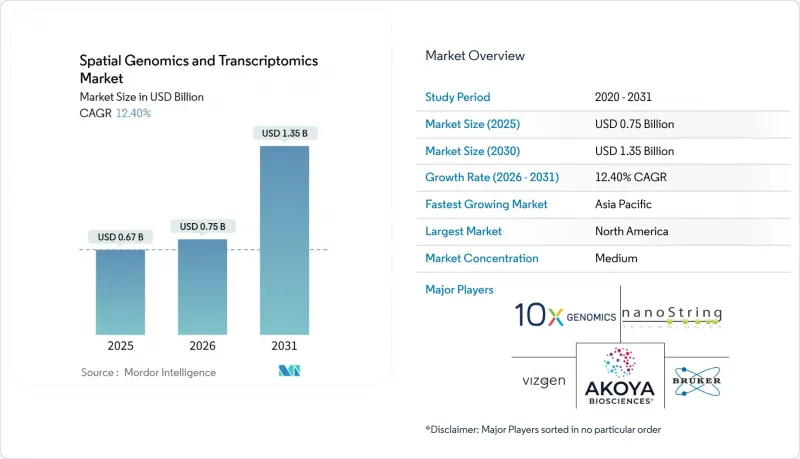
본 보고서는 기술별(공간 전사체학(시퀀싱 등) 및 공간 유전체학(인시투 시퀀싱 등)), 제품별(장비 등), 샘플 유형별(FFPE 조직 등), 용도별(종양학 등), 최종 사용자별(제약 기업 등), 지역별(북미, 유럽 등)로 분류되어 있습니다. 시장 규모 및 전망은 금액(달러) 기준으로 제시되어 있습니다.
세계의 공간 유전체학 및 전사체학 시장 동향과 인사이트
암 진단에서 공간 분석의 새로운 가능성
공간 분석 기술은 기존의 유전체학으로는 파악하기 어려웠던 종양 미세환경의 복잡성을 밝혀냄으로써, 암 진단을 혁신하고 있습니다. Visium HD 공간 전사체학을 활용한 최근 연구에서는 대장암에서 종양 촉진 기능을 가진 명확한 대식세포 아집단이 확인되었으며, 공간적 맥락이 치료 표적 전략에 어떤 영향을 미치는지 입증되었습니다. 단일 세포 수준에서 세포 간 상호작용을 매핑하는 이 기술의 능력 덕분에, 종양 전체의 유전적 특징이 아닌 공간적 바이오마커 시그니처를 바탕으로 환자에게 맞춤형 면역요법을 적용하는 정밀 종양학 접근이 가능해집니다. 임상 검증 연구에 따르면, 공간 전사체학은 간암의 치료 반응을 예측하고 교모세포종의 복잡한 종양 미세환경을 규명할 수 있으며, 이는 FDA의 동반 진단 개발 과정을 직접적으로 뒷받침합니다. 이 진단법의 활용 가능성은 연구 목적에 그치지 않고, 제약 기업들은 표적 치료에 가장 잘 반응할 가능성이 높은 환자 집단을 파악하기 위해 임상시험 설계에 공간 분석을 도입하고 있습니다. 공간 생물학과 AI 기반 병리 워크플로의 융합은 임상의들에게 종양 생물학 및 치료 저항성 메커니즘에 관한 전례 없는 인사이트를 제공함으로써, 암 진단에 혁명을 가져올 것으로 기대됩니다.
고해상도 이미징 및 바코딩 분야의 급속한 발전
이미징 해상도와 분자 바코딩 분야의 기술적 혁신 덕분에, 공간 전사체학의 역량은 현재의 한계를 넘어 확장되고 있습니다. 일루미나(Illumina)가 2025년 2월에 발표한 차세대 공간 전사체학 기술은 기존 솔루션에 비해 9배 더 넓은 포착 영역을 통해 세포 수준의 해상도를 보장하며, 단일 실험으로 수백만 개의 세포를 분석할 수 있게 해줍니다. 첨단 바코딩 기술을 통해 RNA와 단백질을 동시에 검출할 수 있게 되었습니다. Bio-Techne사의 프로테아제 프리 ‘RNAscope’ 멀티오믹스 워크플로는 조직의 형태를 유지하면서 종합적인 분자 프로파일링을 실현합니다. 이러한 발전은 공간 분석 분야의 중대한 병목 현상, 특히 임상 도입을 제한해 온 해상도와 처리량 간의 상충 관계라는 과제를 해결하기 위한 것입니다. 10x Genomics의 Visium HD와 같은 고해상도 플랫폼은 전체 전사체 프로파일링 기능을 유지하면서 세포 내 해상도를 구현함으로써, 연구자들이 질환 이해에 필수적인 희귀한 세포 표현형과 상호작용을 규명할 수 있도록 합니다.
임상검사실에서의 도입 지연
임상검사실에서의 도입이 지연되고 있는 이유는 공간 분석 워크플로우에는 전용 영상 하드웨어, 고도의 생물정보학 기술, 그리고 표준화된 조직 처리가 필요하기 때문입니다. 많은 시설에서는 설비 투자 예산이나 훈련을 받은 인력이 부족하여, 결과적으로 레퍼런스 센터에 의존할 수밖에 없는 실정입니다. 게다가 일부 시장에서는 공간 분석 검사에 대한 보험 급여 코드가 아직 정해지지 않아 투자 대비 효과를 제한하고 있습니다. 분석적 타당성과 임상적 유용성에 관한 규정이 점차 명확해지고 있지만, 검사실은 여전히 불확실한 승인 절차를 모색하고 있습니다. 프로토콜의 표준화가 정착되기 전까지는 검체 간의 편차가 결과의 재현성이나 작업자의 신뢰도를 저해할 가능성이 있습니다.
부문별 분석
2025년, 공간 전사체학은 공간 유전체학 및 전사체학 분야에서 54.80%의 시장 점유율을 차지했습니다. 이는 차세대 시퀀싱 인프라와의 호환성이 뛰어나며, 제약 기업의 검증 연구에서 널리 채택되고 있음을 보여줍니다. 이 부문에서는 Visium 및 Slide-seq와 같은 시퀀싱 기반 기법이 매출의 62%를 차지한 반면, MERFISH, seqFISH, Xenium과 같은 이미징 기반 접근 방식은 38%를 차지했습니다. 이러한 수익 구조는 세포 내 해상도 달성 및 전체 전사체 포괄성 간의 균형을 반영하고 있습니다. 이 시장에서 가장 빠르게 성장하고 있는 기술인 공간 유전체학은 2031년까지 연평균 성장률(CAGR) 14.00%를 나타낼 것으로 전망됩니다. 이는 크로마틴 구조를 유지하는 인시투 시퀀싱 기법에 힘입은 것으로, 이를 통해 발생학 및 질병 연구 분야에서 인핸서 및 프로모터 분석이 가능해집니다. 또한, 이 시장은 손상되지 않은 조직 내의 이소형을 규명하고, 신경학 및 발생생물학 분야에서의 용도를 확대하는 롱 리드 기술의 도입을 통해 형성되었습니다. 이미징과 시퀀싱을 통합한 다중 모달리티 포트폴리오를 제공하는 기업들은 고객들이 해상도 요구 사항과 처리량, 예산, 데이터 통합 능력 간의 조화를 점점 더 중요하게 여기게 됨에 따라 경쟁 우위를 확보할 수 있는 유리한 위치에 있습니다.
2025년에는 소모품이 총매출의 46.30%를 차지했습니다. 이는 공급업체가 일회성 장비 판매보다 시약이나 슬라이드 기반의 지속적인 수익원을 중시하는 방향으로 전략을 전환했음을 반영합니다. Visium 및 Xenium과 같은 플랫폼용 바코드 슬라이드의 매출 총이익률은 75%를 상회하며, 이는 장비의 적극적인 가격 전략을 뒷받침하여 도입 대수 확대와 생애 가치 극대화로 이어지고 있습니다. 북미 주요 학술 기관에서의 도입 포화 상태(대부분의 R1 대학이 최소 한 가지 이상의 공간 분석 플랫폼을 운영하고 있는 상황)로 인해, 초점은 장비 판매 확대에서 이용률 최적화와 소프트웨어 구독 확대로 옮겨가고 있습니다. 개별 조직 절편에서 얻은 데이터 양이 현재 2테라바이트를 초과함에 따라, 이미지 정렬, 분할, 공간 통계학을 아우르는 전문적인 분석에 대한 수요가 계약 갱신 및 확장의 중요한 원동력이 되고 있습니다.
소프트웨어 및 서비스는 가장 빠르게 성장하는 제품 카테고리이며, 2031년까지 연평균 성장률(CAGR)은 15.40%로 전망됩니다. 이러한 성장은 주로 클라우드 네이티브 파이프라인, 온보드 분석, 그리고 엔터프라이즈급 시각화에 대한 수요 증가에 힘입은 것입니다.
지역별 분석
2025년, 북미는 공간 유전체학 및 전사체학 시장의 41.02%를 차지했습니다. 이는 수많은 아틀라스 프로젝트를 지원하고 그 임상 적용을 가속화하는 NIH(미국 국립보건원)의 지속적인 자금 지원에 힘입은 결과입니다. 이 지역은 임상시험 분야에서 주도적인 위치를 차지하고 있으며, 2025년 공간 전사체학 시험의 대부분은 미국이 주도할 것으로 예상되는 가운데, 연구 병원, 바이오의약품 기업, 규제 체계를 연결하는 확고한 생태계가 두드러집니다. 또한, 북미 시장은 정보학 및 물류 분야에 대한 막대한 투자의 혜택을 누리고 있으며, 종양학 분야의 의사 결정에 필수적인 효율적인 처리 시간을 확보하고 있습니다. 여러 센터에 걸친 공동 노력을 통해 FFPE의 성능 및 분석 파이프라인에 대한 벤치마크가 표준화되어 편차가 줄어들었을 뿐만 아니라, 보험사와의 협력도 강화되고 있습니다.
아시아태평양은 공간 유전체학 및 전사체학 시장에서 가장 빠르게 성장하는 지역으로 꼽히며, 2031년까지의 연평균 성장률(CAGR)은 17.02%로 전망됩니다. 이러한 성장은 핵심 시설, 인재 육성, 데이터 플랫폼에 대한 투자를 진행하는 국가 프로그램에 의해 주도되고 있습니다. 2025년, 중국의 국가 중점 연구개발 프로그램은 주요 도시에 위치한 수많은 공간 플랫폼에 자금을 지원하여, 대학 병원 및 제약 업계에서 이러한 도구의 도입을 촉진했습니다. 일본 제약 업계는 종양학 및 면역학 분야에서 공간 기술의 활용을 확대하고 있는 반면, 지역 컨소시엄은 방법론과 메타데이터의 조화를 통해 전 세계적인 아틀라스 프로젝트에 기여하고 있습니다. 호주의 공간 데이터 커먼즈에 대한 투자를 통해 연구 그룹은 클라우드 기반 분석 도구에 접근할 수 있게 되었으며, 진입 장벽이 낮아지고 논문 발표까지의 기간이 단축되고 있습니다.
기타 혜택 :
- 엑셀 형식 시장 예측(ME) 시트
- 3개월간의 애널리스트 지원
자주 묻는 질문
목차
제1장 서론
제2장 조사 방법
제3장 주요 요약
제4장 시장 구도
제5장 시장 규모 및 성장 예측
제6장 경쟁 구도
제7장 시장 기회 및 향후 전망
AJY 26.06.22According to Mordor Intelligence, the spatial genomics and transcriptomics market size is projected to expand from USD 0.67 billion in 2025 and USD 0.75 billion in 2025 to USD 1.35 billion by 2030, registering a CAGR of 12.40% between 2025 to 2030.
This report is Segmented by Technology (Spatial Transcriptomics {Sequencing and More} and Spatial Genomics {In-Situ Sequencing, and More), Product (Instruments, and More), Sample Type (FFPE Tissue, and More), Application (Oncology, and More), End User (Pharmaceutica and More), and Geography (North America, Europe, and More). The Market Sizes and Forecasts are Provided in Terms of Value (USD).
Global Spatial Genomics And Transcriptomics Market Trends and Insights
Emerging Potential of Spatial Analyses as Cancer Diagnostics
Spatial analysis technologies are transforming cancer diagnostics by revealing the complexities of the tumor microenvironment that traditional genomics cannot capture. Recent studies using Visium HD spatial transcriptomics have identified distinct macrophage subpopulations with pro-tumor functions in colorectal cancer, demonstrating how spatial context influences therapeutic targeting strategies. The technology's ability to map cellular interactions at single-cell resolution enables precision oncology approaches that match patients to immunotherapies based on spatial biomarker signatures rather than bulk tumor genetics. Clinical validation studies show that spatial transcriptomics can predict treatment responses in liver cancer and characterize complex tumor microenvironments in glioblastoma, directly supporting FDA companion diagnostic development pathways. This diagnostic potential extends beyond research applications, with pharmaceutical companies integrating spatial analysis into clinical trial design to identify patient populations most likely to respond to targeted therapies. The convergence of spatial biology with AI-driven pathology workflows promises to revolutionize cancer diagnosis by providing clinicians with unprecedented insights into tumor biology and mechanisms of treatment resistance.
Rapid Advances in High-Resolution Imaging & Barcoding Chemistries
Technological breakthroughs in imaging resolution and molecular barcoding are expanding spatial transcriptomics capabilities beyond current limitations. Illumina's unveiling of next-generation spatial transcriptomics technology in February 2025 promises cellular resolution with capture areas nine times larger than existing solutions, enabling analysis of millions of cells in a single experiment. Advanced barcoding chemistries now support simultaneous RNA and protein detection, with Bio-Techne's protease-free RNAscope multiomics workflow preserving tissue morphology while enabling comprehensive molecular profiling. These advances address critical bottlenecks in spatial analysis, particularly the trade-off between resolution and throughput that has limited clinical adoption. High-definition platforms like 10x Genomics' Visium HD achieve subcellular resolution while maintaining whole-transcriptome profiling capabilities, enabling researchers to identify rare cellular phenotypes and interactions critical for disease understanding.
Slow Implementation Across Clinical Labs
Adoption in diagnostic laboratories lags because spatial workflows require specialized imaging hardware, advanced bioinformatics, and standardized tissue handling. Many facilities lack capital budgets and trained staff, forcing reliance on reference centers. Additionally, reimbursement codes for spatial assays remain undefined in several markets, limiting return on investment. Regulatory clarity around analytical validity and clinical utility is progressing, yet laboratories still navigate uncertain approval routes. Until protocol harmonization matures, sample-to-sample variability can hinder reproducibility of results and operator confidence.
Other drivers and restraints analyzed in the detailed report include:
- Advent of 4th-Generation Sequencing Platforms
- Growing Single-Cell Multi-Omics Adoption in Drug Discovery
- Entrenched Conventional Genomics Workflows
For complete list of drivers and restraints, kindly check the Table Of Contents.
Segment Analysis
In 2025, Spatial Transcriptomics captured 54.80% of the market share in the spatial genomics and transcriptomics segment, highlighting its compatibility with next-generation sequencing infrastructure and its extensive adoption in pharmaceutical validation studies. Within this segment, sequencing-based methods such as Visium and Slide-seq contributed 62% of the revenues, while imaging-based approaches like MERFISH, seqFISH, and Xenium accounted for 38%. This revenue split reflects the balance between achieving subcellular resolution and covering the whole transcriptome. Spatial Genomics, the fastest-growing technology in this market, is anticipated to grow at a 14.00% CAGR through 2031, driven by in-situ sequencing methods that maintain chromatin architecture, enabling enhancer-promoter analysis in developmental and disease research. The market is also being shaped by the adoption of long-read technologies, which resolve isoforms within intact tissues and expand applications in neurology and developmental biology. Companies offering multi-modality portfolios that integrate imaging and sequencing are well-positioned to gain a competitive advantage, as customers increasingly prioritize aligning resolution requirements with throughput, budget considerations, and data integration capabilities.
In 2025, consumables contributed 46.30% of total revenues, reflecting a strategic shift by vendors toward emphasizing reagent and slide-based annuities over one-time instrument sales. Gross margins on barcoded slides for platforms such as Visium and Xenium, exceeding 75%, drive aggressive pricing strategies for instruments to expand the installed base and maximize lifetime value. Saturation in the installed base across leading North American academic centers, where most R1 universities operate at least one spatial platform, has redirected focus from instrument growth to optimizing utilization and increasing software subscriptions. With data volumes from individual tissue sections now surpassing 2 terabytes, the demand for specialized analytics encompassing image registration, segmentation, and spatial statistics has become a critical driver for renewals and expansions.
Software & Services is the fastest-growing product category, with a projected 15.40% CAGR through 2031. This growth is primarily driven by rising demand for cloud-native pipelines, onboard analysis, and enterprise-level visualization.
Geography Analysis
In 2025, North America accounted for 41.02% of the spatial genomics and transcriptomics market, driven by consistent NIH funding that supports numerous atlas projects and accelerates their clinical application. The region leads in clinical experimentation, with the majority of spatial transcriptomics trials in 2025 being U.S.-sponsored, highlighting a well-established ecosystem connecting research hospitals, biopharmaceutical companies, and regulatory frameworks. Additionally, the market in North America benefits from significant investments in informatics and logistics, ensuring efficient turnaround times critical for oncology decision-making. Collaborative efforts across multiple centers are standardizing benchmarks for FFPE performance and analysis pipelines, reducing variability and enhancing payer engagement.
Asia-Pacific is positioned as the fastest-growing region in the spatial genomics and transcriptomics market, with a projected CAGR of 17.02% through 2031. This growth is fueled by national programs investing in core facilities, workforce training, and data platforms. In 2025, China's National Key R&D Program funded numerous spatial platforms across tier-1 cities, driving the adoption of these tools in academic hospitals and the pharmaceutical sector. Japan's pharmaceutical industry is expanding the use of spatial technologies in oncology and immunology, while regional consortia are contributing to global atlas projects by harmonizing methods and metadata. Australia's investment in spatial data commons is enabling research groups to access cloud-based analysis tools, reducing barriers to entry and accelerating publication timelines.
- 10x Genomics Inc.
- Akoya Biosciences Inc.
- Bionano Genomics
- Bio-Techne
- Bruker Corporation (NanoString Technologies)
- Dovetail Genomics (PerkinElmer)
- Roche
- Illumina
- Ionpath Inc.
- Leica Biosystems Nussloch GmbH (a Danaher company)
- Molecular Instruments Inc.
- Nucleai ltd.
- PacBio Inc.
- Parse Biosciences, Inc.
- Quantum-Si
- Rebus Biosystems Inc.
- Resolve Biosciences GmbH
- S2 Genomics Inc.
- Seven Bridges Genomics
- Singular Genomics System, Inc.
- Standard BioTools (Fluidigm)
- Ultivue Inc.
- Vizgen Inc.
Additional Benefits:
- The market estimate (ME) sheet in Excel format
- 3 months of analyst support
TABLE OF CONTENTS
1 Introduction
- 1.1 Study Assumptions & Market Definition
- 1.2 Scope of the Study
2 Research Methodology
3 Executive Summary
4 Market Landscape
- 4.1 Market Overview
- 4.2 Market Drivers
- 4.2.1 Emerging Potential of Spatial Analyses as Cancer Diagnostics
- 4.2.2 Rapid Advances in High-Resolution Imaging & Barcoding Chemistries
- 4.2.3 Advent of 4th-Generation Sequencing Platforms
- 4.2.4 Growing Single-Cell Multi-Omics Adoption in Drug Discovery
- 4.2.5 AI-Enabled Spatial Pathology Pipelines
- 4.2.6 FFPE-Compatible In-Situ Capture Chemistries
- 4.3 Market Restraints
- 4.3.1 Slow Implementation Across Clinical Labs
- 4.3.2 Entrenched Conventional Genomics Workflows
- 4.3.3 Data-Storage & Compute-Burden Scalability
- 4.3.4 Limited Barcoded Reagents for Non-Model Organisms
- 4.4 Supply-Chain Analysis
- 4.5 Regulatory Landscape
- 4.6 Technological Outlook
- 4.7 Porter's Five Forces Analysis
- 4.7.1 Threat of New Entrants
- 4.7.2 Bargaining Power of Buyers
- 4.7.3 Bargaining Power of Suppliers
- 4.7.4 Threat of Substitutes
- 4.7.5 Intensity of Competitive Rivalry
5 Market Size & Growth Forecasts (Value, USD)
- 5.1 By Technology
- 5.1.1 Spatial Transcriptomics
- 5.1.1.1 Sequencing-based
- 5.1.1.2 Imaging-based (MERFISH, seqFISH, Xenium, CARTANA)
- 5.1.2 Spatial Genomics
- 5.1.2.1 In-situ Sequencing
- 5.1.2.2 Fluorescence in situ Hybridization (FISH)
- 5.1.2.3 In-situ Capture
- 5.1.1 Spatial Transcriptomics
- 5.2 By Product
- 5.2.1 Instruments
- 5.2.2 Consumables
- 5.2.3 Software & Services
- 5.3 By Sample Type
- 5.3.1 FFPE Tissue
- 5.3.2 Fresh-Frozen Tissue
- 5.3.3 Organoids & 3-D Cell Cultures
- 5.4 By Application
- 5.4.1 Oncology
- 5.4.2 Neurology
- 5.4.3 Immunology & Infectious Diseases
- 5.4.4 Developmental Biology
- 5.4.5 Drug Discovery & Screening
- 5.4.6 Metabolic & Cardiovascular Research
- 5.5 By End-User
- 5.5.1 Pharmaceutical & Biotechnology Companies
- 5.5.2 Academic & Research Institutes
- 5.5.3 CROs & Diagnostic Labs
- 5.5.4 Others
- 5.6 By Geography
- 5.6.1 North America
- 5.6.1.1 United States
- 5.6.1.2 Canada
- 5.6.1.3 Mexico
- 5.6.2 Europe
- 5.6.2.1 Germany
- 5.6.2.2 United Kingdom
- 5.6.2.3 France
- 5.6.2.4 Italy
- 5.6.2.5 Spain
- 5.6.2.6 Rest of Europe
- 5.6.3 Asia-Pacific
- 5.6.3.1 China
- 5.6.3.2 India
- 5.6.3.3 Japan
- 5.6.3.4 Australia
- 5.6.3.5 South Korea
- 5.6.3.6 Rest of Asia-Pacific
- 5.6.4 Middle East and Africa
- 5.6.4.1 GCC
- 5.6.4.2 South Africa
- 5.6.4.3 Rest of Middle East and Africa
- 5.6.5 South America
- 5.6.5.1 Brazil
- 5.6.5.2 Argentina
- 5.6.5.3 Rest of South America
- 5.6.1 North America
6 Competitive Landscape
- 6.1 Market Concentration
- 6.2 Market Share Analysis
- 6.3 Company Profiles (includes Global level Overview, Market-level Overview, Core Segments, Financials, Strategic Information, Market Rank/Share, Products & Services, Recent Developments)
- 6.3.1 10x Genomics Inc.
- 6.3.2 Akoya Biosciences Inc.
- 6.3.3 Bionano Genomics
- 6.3.4 Bio-Techne Corporation
- 6.3.5 Bruker Corporation (NanoString Technologies)
- 6.3.6 Dovetail Genomics (PerkinElmer)
- 6.3.7 F. Hoffmann-La Roche Ltd
- 6.3.8 Illumina Inc
- 6.3.9 Ionpath Inc.
- 6.3.10 Leica Biosystems Nussloch GmbH (a Danaher company)
- 6.3.11 Molecular Instruments Inc.
- 6.3.12 Nucleai ltd.
- 6.3.13 PacBio Inc.
- 6.3.14 Parse Biosciences, Inc.
- 6.3.15 Quantum-Si
- 6.3.16 Rebus Biosystems Inc.
- 6.3.17 Resolve Biosciences GmbH
- 6.3.18 S2 Genomics Inc.
- 6.3.19 Seven Bridges Genomics
- 6.3.20 Singular Genomics System, Inc.
- 6.3.21 Standard BioTools (Fluidigm)
- 6.3.22 Ultivue Inc.
- 6.3.23 Vizgen Inc.
7 Market Opportunities & Future Outlook
- 7.1 White-space & Unmet-Need Assessment


