

|
시장보고서
상품코드
2061647
산업용 패브릭 시장 : 시장 점유율 분석, 업계 동향 및 통계, 성장 예측(2026-2031년)Industrial Fabric - Market Share Analysis, Industry Trends & Statistics, Growth Forecasts (2026 - 2031) |
||||||
 Mordor Intelligence
Mordor Intelligence에 의하면, 산업용 패브릭 시장 규모는 2025년에 1,532억 5,000만 달러로 평가되었고, 예측 기간(2025-2030년) CAGR 3.06%로 확대될 전망이며, 2025년 1,577억 2,000만 달러에서 2030년에는 1,833억 8,000만 달러에 이를 것으로 추정되고 있습니다.
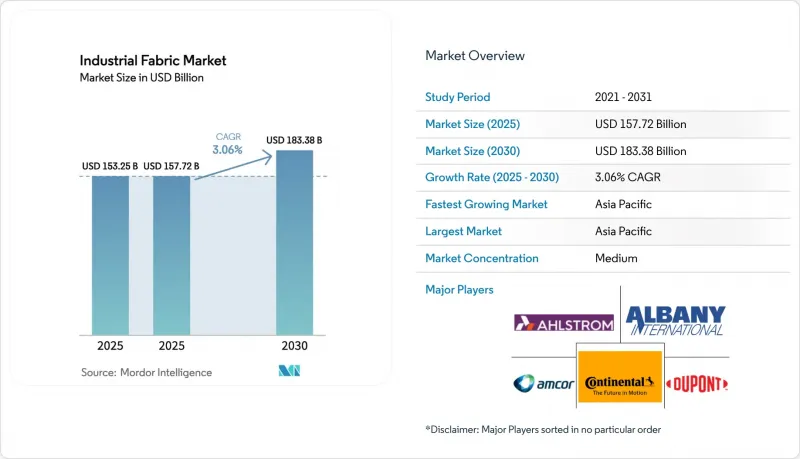
본 보고서는 섬유 유형별(유리섬유, 폴리아미드, 폴리에스터 등), 원단 구조별(직물, 부직포 등), 용도별(자동차 내장 트림, 컨베이어 벨트 등), 최종 사용자 산업별(자동차 및 운송, 광업 및 자재 운반 등), 지역별(아시아태평양, 북미 등)로 분류되어 있습니다. 시장 전망은 금액(달러) 기준으로 제시되어 있습니다.
세계의 산업용 패브릭 시장 동향 및 인사이트
내부 물류 분야에서 컨베이어 벨트 및 변속기 벨트에 대한 수요 증가
세계 전자상거래 물류 센터에서는 일일 주문 건수가 사상 최고치를 기록하고 있어, 컨베이어의 가동률 향상이 요구되고 있습니다. 이러한 수요의 급증으로 인해 아시아태평양의 대형 창고에서는 전례 없는 규모로 컨베이어 벨트 도입이 진행되고 있습니다. 칠레의 추키카마타 구리 광산에서는 스틸 코드 벨트보다 가볍고 에너지 효율이 뛰어난 케블라 보강 벨트를 사용하여 수명을 연장하고 있습니다. 폴리에스터 나일론으로 제작된 콘티넨탈의 ‘CONTIFLEX’ 시리즈는 넓은 폭과 높은 인장 강도를 특징으로 하며, 석탄 운송 분야에서 높은 신뢰성을 발휘하고 있습니다. 내유성이 있으며 FDA 기준을 준수하는 셈페릿의 ‘Transoil’ 커버는 식품 및 화학 플랜트에서 도입이 확대되고 있습니다. 동시에, 아시아 택배 허브에 대한 대규모 설비 투자 계획이 산업용 직물 시장의 성장을 뒷받침하고 있습니다.
육상 및 해상 풍력 터빈 블레이드를 위한 인프라 구축 추진
GE 바노바의 블레이드는 유리 섬유와 탄소섬유를 많이 사용하고 있어, 재료 수요의 급증을 주도하며 전 세계 E-글라스 생산량의 상당 부분을 차지하고 있습니다. 스퍼 캡에 탄소섬유를, 쉘에 유리 섬유를 결합한 하이브리드 적층 공법을 통해 경량화를 실현함으로써 허브 높이를 높여 연간 발전량 향상을 가능하게 하고 있습니다. 열가소성 수지로 제작된 루트 부위를 유도 용접을 통해 강철 인서트와 결합함으로써, 접착제 검사가 필요 없어지고 조립 시간이 단축됩니다. 또한, 후연부에 현무암 섬유와 아라미드 섬유를 전략적으로 사용함으로써, 수백만 회의 하중 주기를 견뎌야 하는 피로가 발생하는 주요 부위를 대상으로 하고 있습니다.
석유화학 원료 가격의 변동
2026년 2월, 동북아시아의 나프타 가격은 중동의 벤치마크 가격을 상회하는 수준까지 급등했습니다. 이러한 가격 상승에 더해, PTA 가격이 원유 가격 변동을 따라가지 못하고 있는 상황이 겹치면서 폴리에스터 단섬유의 이익률이 압박을 받았습니다. 2025년 중반 PTA 가격 하락으로 인해 중국 공장의 수익이 감소하여 5년 평균을 밑돌았습니다. 동시에, 지정학적 긴장으로 인해 걸프 연안 국가들의 나프타 수출이 제한되면서, 아시아의 구매자들은 비싼 가격에 유럽산 나프타를 조달할 수밖에 없게 되었습니다. 게다가 가격 차이가 줄어들면 인도와 인도네시아의 중소 공장은 직기의 가동률을 낮춤으로써 단기적인 섬유 수요를 억제하게 됩니다.
부문별 분석
아라미드는 높은 인장 강도와 분해 온도 임계값에 힘입어, 2026-2031년 예측 기간 동안 연평균 성장률(CAGR) 5.89%로 성장할 것으로 전망됩니다. 이러한 특성은 플래시 파이어용 보호복에 대한 NFPA 2112 규격을 충족할 뿐만 아니라, 스틸 코드 벨트의 대체품으로도 기능합니다. 칠레의 구리 광산에서는 케블라 벨트를 도입함으로써 에너지 소비량을 줄이고 수명을 연장하여, 총 소유 비용(TCO)을 대폭 절감하고 있습니다. 또한, 토와론의 경량성은 자동차용 보강재나 블레이드의 후연부 경량화에 활용되고 있습니다.
폴리에스터는 경쟁력 있는 가격과 중국의 강력한 생산 능력 덕분에 2025년 산업용 직물 시장에서 39.22%의 점유율을 차지했습니다. 폴리아미드는 에어백 등 고탄성률이 요구되는 분야에서 틈새 시장을 개척하고 있는 반면, 유리섬유는 풍력 터빈의 블레이드 쉘에 활용되고 있습니다. 또한, 높은 유리전이점으로 알려진 신흥 PEN 섬유는 커패시터 필름 분야에서 시장 점유율을 점차 확대되고 있습니다.
2025년, 직물 구조는 산업용 직물 시장의 45.28%를 차지한 것으로 평가되었으며, 2026-2031년 예측 기간 동안 연평균 성장률(CAGR) 4.21%로 성장할 것으로 전망됩니다. 이러한 성장은 주로 수지 사용량을 줄일 뿐만 아니라 강성도 높이는 다축 비꼬임 섬유(NCF) 원단 덕분입니다. SAERTEX사의 비꼬임 원단(NCF)은 스퍼 캡의 주요 선택지로 자리 잡고 있는 반면, Continental사의 Plylon Plus 벨트는 인열 저항성이 뛰어난 이중 트윌 직조를 채택하여 뛰어난 인장 강도를 자랑합니다.
부직포는 기가팩토리의 벽면 및 작업복에 있어 매우 중요한 역할을 하는 ISO 8 등급 클린룸용 부직포 덕분에 매출에서 큰 비중을 차지하고 있습니다. 서브미크론 입자의 포집률이 높아 수술용 마스크의 골드 스탠다드로 자리 잡은 멜트블로우 폴리프로필렌은 스펀본드 제품에 비해 고가대로 거래되고 있습니다. 니트 원단은 시장 세분화가 작은 편이며, 시트 커버에 신축성의 이점을 제공하지만, 직물과 같은 인장 강도는 갖추고 있지 않습니다.
지역별 분석
2025년, 아시아태평양은 산업용 직물 시장 매출의 41.14%라는 압도적인 점유율을 차지했으며, 2026-2031년 예측 기간 동안 연평균 성장률(CAGR) 5.67%로 증가할 것으로 전망됩니다. 세계 공급망의 핵심인 중국의 폴리에스터 단섬유 생산 능력은 해당 지역의 비용 곡선을 견고하게 뒷받침하고 있습니다. 원료의 안정적인 공급을 강화하기 위해 2025년에는 6개의 기가 스케일 프로젝트가 가동을 시작했습니다. 헝이(Hengyi), 통쿤(Tongkun), 중국석유화공(Sinopec) 등의 기업들은 사업 포트폴리오 다각화를 추진하며 에어백 및 클린룸용 부직포 생산 라인을 확충하고 있어, 해당 지역이 특수 제품으로 무게중심을 옮기고 있음을 여실히 보여주고 있습니다.
북미와 유럽은 수요의 상당 부분을 흡수하고 있을 뿐만 아니라, 전략적으로도 매우 중요한 위치를 차지하고 있습니다. 이는 ISO 8 등급 클린룸이 필요한 버지니아주, 미시간주 및 독일의 배터리 기가팩토리에서 대량의 부직포 패널을 소비하고 있다는 사실로 입증됩니다. 듀폰의 ‘타이벡 400 듀얼 TG’ 커버올은 EN 1149-5 정전기 방지 규격을 준수하며, 리튬 취급 구역을 위해 특별히 설계되었습니다. 셀 생산 능력을 확대하고 있는 폭스바겐의 잘츠기터 공장에서도 드라이룸용 원단에 대한 수요가 두드러집니다.
남미에서는 칠레와 페루에서의 광업 활동을 바탕으로 뚜렷한 수익 기여가 나타나고 있습니다. 이 광산들에서는 에너지 소비를 줄이고 수명을 연장하기 위해 케블라 벨트를 활용하고 있으며, 이는 이러한 추세를 뒷받침하고 있습니다. 시장에 크게 기여하고 있는 중동 및 아프리카에서는 사우디 아람코와 ADNOC가 자외선 저항성을 중시한 아라미드 호스 및 해양용 지오텍스타일의 사양을 수립했습니다. 또한, 남아프리카의 백금 및 석탄 광산에서는 연간 수백만 개가 넘는 벨트가 필요하며, 이로 인해 폴리에스터 직물의 소비가 더욱 증가하고 있습니다.
기타 혜택 :
- 엑셀 형식 시장 예측(ME) 시트
- 3개월간의 애널리스트 지원
자주 묻는 질문
목차
제1장 서론
제2장 조사 방법
제3장 주요 요약
제4장 시장 구도
제5장 시장 규모 및 성장 예측
제6장 경쟁 구도
제7장 시장 기회 및 향후 전망
AJY 26.06.26According to Mordor Intelligence, the industrial fabric market size was valued at USD 153.25 billion in 2025 and is estimated to grow from USD 157.72 billion in 2025 to reach USD 183.38 billion by 2030, at a CAGR of 3.06% during the forecast period (2025-2030).
This report is Segmented by Fiber Type (Fiberglass Yarn, Polyamide, Polyester, and More), Fabric Construction (Woven, Non-Woven, and More), Application (Automotive Interior Trim, Conveyor Belts, and More), End-User Industry (Automotive and Transportation, Mining and Material Handling, and More), and Geography (Asia-Pacific, North America, and More). The Market Forecasts are Provided in Terms of Value (USD).
Global Industrial Fabric Market Trends and Insights
Rising Demand for Conveyor and Transmission Belts in Intralogistics
Global e-commerce fulfillment centers are processing a record number of daily orders, underscoring the need for high conveyor uptime. This surge in demand has spurred unprecedented belt installations across megawarehouses in the Asia-Pacific region. At Chile's Chuquicamata copper mine, Kevlar-reinforced belts, which are lighter and more energy-efficient than their steel-cord counterparts, are enjoying an extended service life. Continental's CONTIFLEX series, crafted from polyester-nylon, features wide widths and high tensile ratings, making them reliable for transporting coal. Semperit's Transoil covers, which are oil-resistant and FDA-compliant, are making inroads in food and chemical plants. Concurrently, robust capital expenditure programs at Asian express-parcel hubs are fueling the growth of the industrial fabric market.
Infrastructure Push for On-Shore and Off-Shore Wind-Turbine Blades
GE Vernova's blades, which heavily utilize glass and carbon fiber, are driving a surge in material demand, capturing a significant slice of the global E-glass output. By incorporating carbon in spar caps and glass in shells, hybrid lay-ups achieve weight reductions, enabling taller hub heights and enhanced annual energy capture. Thermoplastic roots, when paired with steel inserts through induction welding, eliminate the need for adhesive inspections and reduce assembly time. Furthermore, the strategic use of basalt and aramid fibers in trailing edges targets fatigue-critical zones, which endure millions of load cycles.
Petrochemical Feedstock Price Volatility
In February 2026, Northeast Asia's naphtha prices surged past Middle-Eastern benchmarks. This uptick, coupled with PTA prices lagging behind crude fluctuations, squeezed polyester-staple margins. A mid-2025 dip in PTA prices led to diminished earnings for Chinese mills, falling short of their five-year average. Concurrently, geopolitical tensions curtailed Gulf naphtha exports, prompting Asian buyers to procure European cargoes at a premium. Furthermore, when price spreads tighten, smaller mills in India and Indonesia scale back loom utilization, tempering short-term fiber demand.
Other drivers and restraints analyzed in the detailed report include:
- High-Temperature Filtration Upgrades in Cement and Metal Plants
- Shift to Advanced Geotextiles for Climate-Resilient Infrastructure
- Transition Toward Bio-Based Technical Textiles Cannibalizing Synthetics
For complete list of drivers and restraints, kindly check the Table Of Contents.
Segment Analysis
Aramid is projected to expand at a CAGR of 5.89% through the forecast period of 2026-2031, driven by its high tensile strength and decomposition thresholds. These characteristics not only meet the NFPA 2112 standards for flash-fire apparel but also serve as a substitute for steel-cord belts. In Chilean copper mines, the adoption of Kevlar belts has led to reduced energy consumption and an extended lifespan, translating to notable savings in total cost-of-ownership. Twaron's lightweight properties are being leveraged to reduce weight in automotive reinforcements and blade trailing edges.
Polyester commands a 39.22% share of the industrial fabric market in 2025, thanks to its competitive pricing and China's strong production capabilities. Polyamide finds its niche in high-modulus applications such as airbags, while fiberglass is utilized for wind-blade shells. Additionally, emerging PEN fibers, known for their high glass-transition points, are carving a space in capacitor-film applications.
In 2025, woven architectures accounted for 45.28% of the industrial fabric market and are projected to grow at a CAGR of 4.21% during the forecast period of 2026-2031. This growth is largely attributed to multiaxial non-crimp fabrics, which not only reduce resin usage but also enhance stiffness. SAERTEX's non-crimp fabrics (NCFs) have become the preferred choice for spar caps, while Continental's Plylon Plus belts, with their rip-resistant dual-twill weaves, boast impressive tensile ratings.
Non-woven fabrics are capturing a significant revenue share, thanks to ISO 8 cleanroom fabrics that play pivotal roles in gigafactory walls and coveralls. Melt-blown polypropylene, the gold standard for surgical masks due to its high sub-micron capture rates, commands a premium over its spunbond counterpart. Knitted textiles, though a smaller market segment, provide stretch benefits for seat covers but lack the tensile strength of woven fabrics.
Geography Analysis
In 2025, the Asia-Pacific region commanded a dominant 41.14% share of the industrial fabric market revenue, with projections indicating a rise at a 5.67% CAGR through the forecast period of 2026-2031. China's polyester-staple capacity, a linchpin in the global supply chain, firmly anchors the region's cost curves. Bolstering feedstock security, six gigascale projects came online in 2025. Companies such as Hengyi, Tongkun, and Sinopec are diversifying their portfolios, ramping up production lines for airbags and cleanroom non-wovens, highlighting the region's pivot towards specialty products.
North America and Europe, while absorbing a significant portion of the demand, wield considerable strategic importance. This is underscored by the fact that battery gigafactories in Virginia, Michigan, and Germany, which require ISO 8 cleanrooms, consume a substantial volume of non-woven panels. DuPont's Tyvek 400 Dual TG coveralls, adhering to EN 1149-5 antistatic codes, are tailored for lithium-handling areas. Volkswagen's Salzgitter plant, which is augmenting cell capacity, also has a pronounced demand for dry-room fabrics.
In South America, driven by the mining activities in Chile and Peru, there is a notable revenue contribution. These mines, leveraging Kevlar belts for reduced energy consumption and extended lifespan, underscore the trend. In the Middle-East and Africa, where the market sees significant contributions, Saudi Aramco and ADNOC have made specifications for aramid hoses and offshore geotextiles, emphasizing UV stability. Moreover, South African platinum and coal pits have an annual demand for belts that surpasses millions, further driving the consumption of woven polyester.
- Ahlstrom
- Albany International Corp.
- Amcor
- Barnet
- Bridgestone Corporation
- Cerex Advanced Fabrics, Inc.
- Continental AG
- DuPont
- Fibertex Nonwovens A/S
- Fitesa SA and Affiliates
- Forbo Movement Systems
- Freudenberg Group
- Habasit
- Huesker International
- KCWW
- Shawmut Corporation
- Toray Industries Inc.
Additional Benefits:
- The market estimate (ME) sheet in Excel format
- 3 months of analyst support
TABLE OF CONTENTS
1 Introduction
- 1.1 Study Assumptions and Market Definition
- 1.2 Scope of the Study
2 Research Methodology
3 Executive Summary
4 Market Landscape
- 4.1 Market Overview
- 4.2 Market Drivers
- 4.2.1 Rapidly growing application in automotive lightweighting
- 4.2.2 Rising demand for conveyor and transmission belts in intralogistics
- 4.2.3 Infrastructure push for on-shore and off-shore wind-turbine blades
- 4.2.4 High-temperature filtration upgrades in cement and metal plants
- 4.2.5 Shift to advanced geotextiles for climate-resilient infrastructure
- 4.3 Market Restraints
- 4.3.1 Petrochemical feedstock price volatility
- 4.3.2 Transition toward bio-based technical textiles cannibalizing synthetics
- 4.3.3 Self-healing elastomer power-transmission belts
- 4.4 Value Chain Analysis
- 4.5 Porter's Five Forces
- 4.5.1 Threat of New Entrants
- 4.5.2 Bargaining Power of Buyers
- 4.5.3 Bargaining Power of Suppliers
- 4.5.4 Threat of Substitutes
- 4.5.5 Degree of Competition
5 Market Size and Growth Forecasts (Value)
- 5.1 By Fiber Type
- 5.1.1 Fiberglass yarn
- 5.1.2 Polyamide
- 5.1.3 Polyester
- 5.1.4 Aramid
- 5.1.5 Nylon
- 5.1.6 Other Fiber Types (Rayon, PEN)
- 5.2 By Fabric Construction
- 5.2.1 Woven
- 5.2.2 Non-woven
- 5.2.3 Knitted
- 5.3 By Application
- 5.3.1 Automotive Interior Trim
- 5.3.2 Conveyor Belts
- 5.3.3 Transmission Belts
- 5.3.4 Fire Protective Apparel
- 5.3.5 Other Application (Industrial Filtration, etc.)
- 5.4 By End-User Industry
- 5.4.1 Automotive and Transportation
- 5.4.2 Mining and Material Handling
- 5.4.3 Oil and Gas
- 5.4.4 Construction
- 5.4.5 Food Processing
- 5.4.6 Energy (Wind and Solar)
- 5.4.7 Healthcare and Hygiene
- 5.4.8 Other End-User Industries (Agriculture, etc.)
- 5.5 By Geography
- 5.5.1 Asia-Pacific
- 5.5.1.1 China
- 5.5.1.2 India
- 5.5.1.3 Japan
- 5.5.1.4 South Korea
- 5.5.1.5 Rest of Asia-Pacific
- 5.5.2 North America
- 5.5.2.1 United States
- 5.5.2.2 Canada
- 5.5.2.3 Mexico
- 5.5.3 Europe
- 5.5.3.1 Germany
- 5.5.3.2 United Kingdom
- 5.5.3.3 France
- 5.5.3.4 Italy
- 5.5.3.5 Rest of Europe
- 5.5.4 South America
- 5.5.4.1 Brazil
- 5.5.4.2 Argentina
- 5.5.4.3 Rest of South America
- 5.5.5 Middle-East and Africa
- 5.5.5.1 Saudi Arabia
- 5.5.5.2 South Africa
- 5.5.5.3 Rest of Middle-East and Africa
- 5.5.1 Asia-Pacific
6 Competitive Landscape
- 6.1 Market Concentration
- 6.2 Strategic Moves
- 6.3 Market Share(%)/Ranking Analysis
- 6.4 Company Profiles (includes Global level Overview, Market level overview, Core Segments, Financials as available, Strategic Information, Products and Services, Recent Developments)
- 6.4.1 Ahlstrom
- 6.4.2 Albany International Corp.
- 6.4.3 Amcor
- 6.4.4 Barnet
- 6.4.5 Bridgestone Corporation
- 6.4.6 Cerex Advanced Fabrics, Inc.
- 6.4.7 Continental AG
- 6.4.8 DuPont
- 6.4.9 Fibertex Nonwovens A/S
- 6.4.10 Fitesa SA and Affiliates
- 6.4.11 Forbo Movement Systems
- 6.4.12 Freudenberg Group
- 6.4.13 Habasit
- 6.4.14 Huesker International
- 6.4.15 KCWW
- 6.4.16 Shawmut Corporation
- 6.4.17 Toray Industries Inc.
7 Market Opportunities and Future Outlook
- 7.1 White-space and Unmet-need Assessment
- 7.2 Growth of battery gigafactories requiring clean-room non-wovens


