

|
시장보고서
상품코드
2061649
목재 방부제 : 시장 점유율 분석, 업계 동향 및 통계, 성장 예측(2026-2031년)Wood Preservatives - Market Share Analysis, Industry Trends & Statistics, Growth Forecasts (2026 - 2031) |
||||||
 Mordor Intelligence
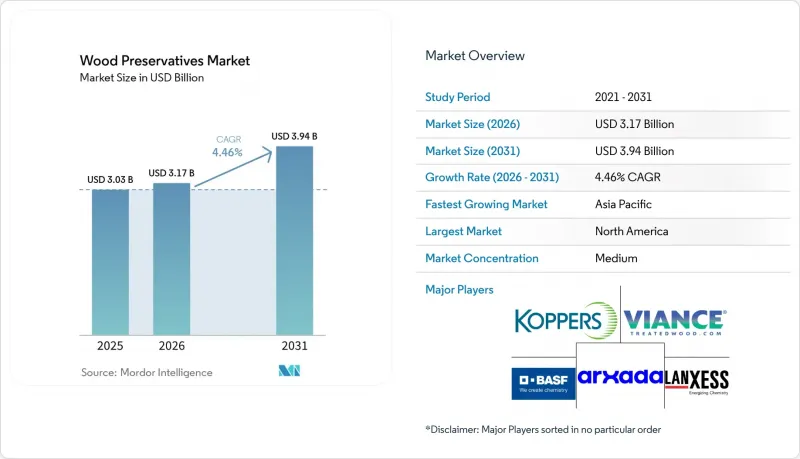
Mordor Intelligence에 의하면, 목재 방부제 시장 규모는 2025년 30억 3,000만 달러로 평가되었습니다. 2026년에는 31억 7,000만 달러로 확대되어 2026년부터 2031년에 걸쳐 CAGR은 4.46%를 나타내, 2031년까지 39억 4,000만 달러에 이를 것으로 예측됩니다.
본 보고서는 기술별(수성 기술, 유성 기술, 기타 신기술), 최종 사용자 산업별(주택 건설, 상업·공공시설, 인프라 등), 그리고 지역별(아시아태평양, 북미, 유럽, 남미, 중동 및 아프리카)로 분류되어 있습니다. 시장 전망은 금액(달러) 기준으로 제시되어 있습니다.
세계의 목재 방부제 시장 동향과 인사이트
주택 및 인프라 프로젝트 분야의 건설 붐
각국 정부는 도로, 철도, 유틸리티 프로젝트에 계속해서 막대한 예산을 투입하고 있으며, 이러한 지출은 단독주택 착공 건수의 회복과 맞물려 골조용 목재, 데크용 목재, 중목재 분야의 방부제 소비를 끌어올리고 있습니다. 인도의 국가 인프라 계획에는 2025년까지 1조 4,000억 달러가 배정되었으며, 그 대부분은 재활용 침목 및 교량 부재의 사용을 규정하고 있습니다. 중국에서는 부동산 부문의 역풍이 지속되는 가운데서도, 크레오소트나 구리-크롬계 약제를 사용한 기존 철도의 개보수 공사가 계속되고 있습니다. 미국에서는 2025년에 단독주택 준공 건수가 증가한 데다, 파티오, 퍼골라, 시선 차단용 울타리 등의 개조 비용이 아졸계 구리 방부제 및 미세 분말 구리 처리 목재 수요를 끌어올렸습니다. 이 요인은 전체 연평균 성장률(CAGR)에 1.8%를 기여하고 있으며, 인프라 프로젝트가 계획 단계에서 실행 단계로 넘어감에 따라 그 영향은 중기적으로 정점에 달할 것으로 예측됩니다.
친환경 수성 및 구리계 시스템으로의 전환
펜타클로로페놀의 규제 및 사용 금지와 크롬화 구리 비소의 사용 제한으로 인해, 수용성 구리 화합물로 전환되는 추세가 가속화되고 있습니다. 미국 환경보호청(EPA)의 2022년 명령에 따라 2027년 2월까지 펜타클로로페놀의 사용이 중단되며, 유틸리티체는 나프텐산 구리 및 미세 입자화 구리 처리된 전신주의 인증을 의무적으로 받아야 합니다. 1마이크론 미만의 미세 입자는 용해된 구리염에 비해 침출량이 측정 가능한 수준보다 낮아, 살균력을 저해하지 않으면서 수생 독성을 감소시킵니다. Arxada사의 Preserve 시리즈는 CA-C 및 CA-B 제품에서 96.1%의 재생 구리 함유율을 달성하여, 방부제 선정이 그린빌딩 프로그램의 순환 경제 크레딧 요건과 부합하도록 하고 있습니다. 유럽 규제 당국이 구리의 수생 M 계수를 10으로 분류하는 가운데, 혁신적인 기업들은 유효 부하율을 낮추는 캡슐화 방출 플랫폼으로 이에 대응하고 있습니다. 아시아태평양과 라틴아메리카의 기준이 EU 및 미국의 기준에 가까워짐에 따라, 이 요인은 장기적으로 성장률을 1.2% 끌어올리는 요인이 될 것입니다.
CCA, PCP, 크레오소트 및 VOC 제한에 대한 엄격한 금지 또는 규제
미국 환경보호청(EPA)은 2022년에 펜타클로로페놀 사용 중단을 최종 결정하고, 2027년 2월까지 재고를 소진함으로써 70년에 걸친 전신주용 규격에 종지부를 찍었습니다. 크롬화 구리 비소산염은 엄격한 폐기 규정에 따라 제한된 산업용도로만 사용이 허용되는 반면, 크레오소트는 유럽연합(EU)의 ‘잔류성 유기 오염 물질 규제(POPs 규제)’에 따라 유사한 제한을 받고 있습니다. 도료에 대한 VOC 상한 규제로 인해, 배합 개발자들은 새로운 연구 개발 비용을 들여 수성계 용제로 전환해야 하는 상황에 직면해 있습니다. 현재 EU의 살생물제 규제에서는 발암성 물질, 변이원성 물질, 내분비계 교란 물질, 그리고 분해가 매우 어렵고 이동성이 높은 물질이 배제되고 있으며, 이로 인해 신규 유효 성분의 승인에 소요되는 기간이 길어지고 비용이 증가하고 있습니다. 이러한 조치들이 복합적으로 작용하여, 단계적 폐지 시한과 실증 시험의 병목 현상이 겹치게 됨에 따라, 단기적으로는 연평균 성장률(CAGR)이 1.1% 하락하게 됩니다.
부문별 분석
2025년, 목재 방부제 시장에서 수성 시스템은 압도적인 79.05%의 점유율을 차지했으며, 2031년까지 연평균 성장률(CAGR) 4.31%로 확대될 것으로 전망됩니다. 이러한 우위는 미세 분말화된 구리 입자에서 비롯됩니다. 미분화된 구리 입자는 용해성 염에 비해 유효 성분의 용출량이 30%에서 50% 적기 때문에 그로 인해 더욱 엄격한 수생 독성 기준을 충족할 수 있습니다. 2025년, 수성 제품은 목재 방부제 시장 규모에서 25억 달러를 차지하며 가장 큰 비중을 차지했으며, 유성 유효 성분으로부터의 지속적인 대체가 진행됨에 따라 그 성장세는 확고해지고 있습니다. 나머지 시장 점유율은 유성 화학물질, 주로 크레오소트와 식물성 오일 혼합물이 차지하고 있지만, 북미와 유럽연합(EU)에서의 단계적 폐지 시한이 다가옴에 따라 판매량 감소 압박에 직면해 있습니다. 그러나 크레오소트는 높은 내구성과 중하중 내성이 요구되는 철도 침목이나 해양 구조물에서는 여전히 중요한 역할을 하고 있으며, 이러한 경우 엄격한 독성 관리가 정당화됩니다.
현재 2세대 수성 제품에는 가격 변동을 헤지하고 친환경 건축물로서의 평가를 높이는 재활용 구리 원료가 포함되어 있습니다. Arxada사의 Wolman E 시리즈는 BARamine 기술을 활용하여 구리 아졸을 안정화하고 휘발을 억제합니다. 붕산염 확산제는 포유류에 대한 독성이 낮고 접착제와의 궁합이 좋은 점이 내후성보다 우수하기 때문에 실내 골조재 분야에서 보급이 확대되고 있습니다. 생물 유래 테르펜과 나노 구리 분산액은 아직 파일럿 규모에 머물러 있으며, 여러 관할 구역에 걸친 승인 절차가 보급을 저해하고 있습니다. 예측 기간 동안 수성 부문은 목재 방부제 시장 점유율을 더욱 확대할 것으로 예상되며, 이는 효과성과 환경 보전을 동시에 달성하는 화학 기술로의 결정적인 전환을 반영하고 있습니다.
지역별 분석
북미는 2025년에 전 세계 매출의 36.14%를 차지했으며, 이는 전신주의 확고한 설치 기반과 외장재로 가압 처리 목재를 사용하는 기존 주택 재고가 뒷받침하고 있습니다. 미국의 유틸리티체들은 2027년 2월 펜타클로로페놀(EPA.GOV) 규제가 종료됨에 앞서, 나프텐산 구리 및 미세 분말 구리 전주의 현장 검증을 계속해 왔습니다. 캐나다의 임업 부문은 방부 처리 목재의 안정적인 공급원 역할을 하고 있으며, 한편 멕시코에서는 확대되는 중산층이 울타리 및 데크에 대한 수요를 뒷받침하고 있습니다. 유럽에서는 여전히 ‘생물살상제 규정(BPR)’에 따른 엄격한 심사가 특징이며, 이는 규정 준수 비용을 증가시키는 한편 혁신을 촉진하고 있습니다. 유럽 수요의 대부분은 독일, 프랑스, 영국이 차지하고 있으며, Arxada사가 2023년 영국에서 Tanasote에 대한 BPR 승인을 획득한 것은 새로운 구리-유 하이브리드 제품의 발전 방향을 보여주는 사례입니다.
아시아태평양은 더욱 빠른 성장 궤도에 올라섰으며, 중국과 인도가 가공된 침목 및 하중 지지용 목재를 사용하는 철도 및 교량 프로젝트에 인프라 지출을 집중하고 있어 연평균 성장률(CAGR) 5.72%의 성장이 예상됩니다. 인도의 국가 인프라 계획에서는 예산을 효율적으로 활용하고 프로젝트 일정을 앞당기기 위해 가공 목재가 대량으로 사용되고 있습니다. 마찬가지로, 중국의 연안 항만 확장 사업도 선박용 등급의 말뚝 자재에 의존하고 있습니다. 일본에서는 송전망과 철도 인프라의 노후화로 인해 대규모 목조 중층 아파트의 선구적인 사례가 되는 한편, 꾸준한 교체 주기가 형성되고 있습니다. 아세안 국가들에서는 비용 효율이 높은 유성 방부제가 선호되지만, 환경 규제가 강화됨에 따라 수요는 점차 수성 시스템으로 전환될 것입니다. 남미의 전망은 브라질의 ‘Minha Casa Minha Vida’ 주택 프로그램과 아르헨티나의 농업 인프라 확충에 달려 있지만, 중동 및 아프리카에서는 재정적 제약으로 인해 상승 여력이 제한적입니다.
이러한 요인들이 복합적으로 작용하여 다양한 수요 구조가 형성되고 있습니다. 북미와 유럽은 규제가 엄격한 고부가가치 시장이며, 아시아태평양은 가장 강력한 판매량 성장이 예상됩니다. 한편, 라틴아메리카, 중동 및 아프리카는 거시경제의 안정 여부에 따라 달라지기는 하지만 잠재적인 가치를 제공합니다.
기타 혜택 :
- 엑셀 형식 시장 예측(ME) 시트
- 3개월간의 애널리스트 지원
자주 묻는 질문
목차
제1장 서론
제2장 조사 방법
제3장 주요 요약
제4장 시장 구도
제5장 시장 규모 및 성장 예측
제6장 경쟁 구도
제7장 시장 기회 및 향후 전망
KTH 26.06.19According to Mordor Intelligence, the wood preservatives market size is expected to grow from USD 3.03 billion in 2025 to USD 3.17 billion in 2026 and is forecast to reach USD 3.94 billion by 2031 at a 4.46% CAGR over 2026-2031.
This report is Segmented by Technology (Water-Based Technologies, Oil-Based Technologies, and Other Emerging Technologies), End-User Industry (Residential Construction, Commercial and Institutional Buildings, Infrastructure, and More), and Geography (Asia-Pacific, North America, Europe, South America, and the Middle East and Africa). The Market Forecasts are Provided in Terms of Value (USD).
Global Wood Preservatives Market Trends and Insights
Construction Boom in Residential and Infrastructure Projects
Governments continue to channel sizable budgets into road, rail, and public works pipelines, and that spending dovetails with a rebound in single-family housing starts to lift preservative consumption across framing lumber, decking, and heavy timbers. India's National Infrastructure Pipeline has earmarked USD 1.4 trillion through 2025, much of which specifies treated sleepers and bridge components. China sustains legacy railway upgrades that draw on creosote and copper-chrome formulations even as property-sector headwinds persist. In the United States, completions for detached housing improved in 2025, while renovation spending on patios, pergolas, and privacy fences pushed demand for copper-azole and micronized-copper lumber. The driver adds 1.8 percentage points to the overall CAGR, with influence peaking in the medium term as infrastructure projects move from planning to execution.
Shift Toward Eco-Friendly Water-Based and Copper-Based Systems
Regulatory bans on pentachlorophenol and usage caps on chromated copper arsenate have accelerated the transition toward water-dispersible copper compounds. The US Environmental Protection Agency's 2022 order ends pentachlorophenol by February 2027, forcing utility companies to certify copper naphthenate and micronized-copper poles. Micronized particles below 1 micron exhibit measurably lower leaching than dissolved copper salts, reducing aquatic toxicity without sacrificing fungicidal power. Arxada's Preserve range achieves 96.1% recycled-copper content in CA-C and CA-B products, aligning preservative selection with circular-economy credits in green-building programs. As European regulators classify copper with an aquatic M-factor of 10, innovators respond with encapsulated-release platforms that trim effective loading rates. The driver supplies a 1.2 percentage-point uplift to growth over the long run as standards in Asia-Pacific and Latin America converge on EU and U.S. norms.
Stringent Bans or Restrictions on CCA, PCP, Creosote, and VOC Limits
The U.S. Environmental Protection Agency finalized pentachlorophenol's cancellation in 2022, eliminating inventory by February 2027 and ending a seven-decade utility-pole standard. Chromated copper arsenate remains confined to restricted industrial uses under exacting disposal rules, while creosote faces parallel limits in the European Union's Persistent Organic Pollutants Regulation. VOC caps in coatings push formulators toward water carriers that demand fresh R&D outlays. The EU Biocidal Products Regulation now screens out carcinogens, mutagens, endocrine disruptors, and very persistent, very mobile substances, extending timeframes and raising costs for every new active. Collectively, these actions shave 1.1 percentage points off the CAGR in the near term as phase-out dates collide with field-trial bottlenecks.
Other drivers and restraints analyzed in the detailed report include:
- Growth in Outdoor Living (Decking, Fencing, and Landscaping)
- Durability Needs for Utility Poles, Rail Sleepers, and Marine Piles
- Volatility in Copper and Commodity Biocide Feedstock Prices
For complete list of drivers and restraints, kindly check the Table Of Contents.
Segment Analysis
Water-based systems accounted for a commanding 79.05% share of the wood preservatives market in 2025 and are forecast to rise at a 4.31% CAGR through 2031. This leadership springs from micronized-copper particles that leach 30% to 50% less active ingredient than dissolved salts, thereby meeting tougher aquatic-toxicity thresholds. In 2025, the water-based portion represented the largest single component of the wood preservatives market size at USD 2.5 billion, and ongoing substitution away from oil-borne actives cements its trajectory. The residual share belongs to oil-borne chemistries, chiefly creosote and vegetable-oil blends, which face volume pressure as phase-out deadlines arrive in North America and the European Union. Yet creosote still claims relevance for rail sleepers and marine structures where high-retention, heavy-duty protection justifies elevated toxicity management.
Second-generation water-based offerings now integrate recycled-copper feedstocks that hedge price swings and burnish green-building credentials. Arxada's Wolman E line leverages BARamine technology to stabilize copper azole and slow volatilization. Borate diffusions flourish in interior framing where low mammalian toxicity and adhesive compatibility trump weather durability. Bio-derived terpenes and nano-copper dispersions hover in pilot scale, their path impeded by multi-jurisdictional approvals. Over the forecast horizon, the water-based segment is expected to secure more share of wood preservatives market size, reflecting a decisive tilt toward chemistries that reconcile efficacy with environmental stewardship.
Geography Analysis
North America generated 36.14% of global sales in 2025, underpinned by a mature installed base of utility poles and a housing stock that embraces pressure-treated lumber for exterior applications. US utilities continued field verification of copper naphthenate and micronized-copper poles ahead of the February 2027 pentachlorophenol sunset EPA.GOV. Canada's forestry sector provides a reliable supply of preservative-grade lumber, while Mexico's growing middle class sustains fencing and decking activity. Europe remains defined by stringent Biocidal Products Regulation scrutiny, which both inflates compliance costs and fosters innovation. Germany, France, and the United Kingdom account for the majority of European demand, and Arxada's 2023 GB BPR authorization for Tanasote underscores the pathway for new copper-oil hybrids.
Asia-Pacific is on a faster track, poised to grow at a 5.72% CAGR as China and India concentrate infrastructure spending on rail and bridge programs that specify treated sleepers and load-bearing timbers. India's National Infrastructure Pipeline draws heavily on treated wood to stretch budgets and accelerate project timelines. China's coastal port expansions likewise depend on marine-grade pilings. Japan's aging grid and rail infrastructure create steady replacement cycles even as the nation pioneers mass-timber mid-rise apartments. ASEAN economies favor cost-effective oil-borne preservatives, but environmental codes are tightening and will gradually channel demand toward water-based systems. South America's outlook hinges on Brazil's Minha Casa Minha Vida housing program and Argentina's farm infrastructure expansion, while fiscal constraints moderate upside in the Middle East and Africa.
The combined dynamics yield a diversified demand map: North America and Europe present high-regulation, high-value environments; Asia-Pacific offers the strongest volume growth; Latin America, the Middle East, and Africa supply option value that hinges on macroeconomic stability.
- Advance Agrisearch Limited
- Arch Wood Protection (Arxada)
- Artemis Biotech
- BASF
- BERKEM
- Changchun New Sunlight Wood Products Co., Ltd.
- Copper Care Wood Preservatives, Inc.
- Dolphin Bay
- Impra Wood Protection Ltd.
- Jubilant Ingrevia Limited
- Koppers Performance Chemicals
- Kurt Obermeier GmbH & Co. KG
- LANXESS
- Nisus Corporation
- Remmers International
- Timber Treat
- TIMBERLIFE (Pty) Ltd.
- Viance
- Wolman Wood & Fire Protection GmbH
- Wuhan Hombo Industrial Co.,Ltd
- Wykamol Group Ltd.
Additional Benefits:
- The market estimate (ME) sheet in Excel format
- 3 months of analyst support
TABLE OF CONTENTS
1 Introduction
- 1.1 Study Assumptions & Market Definition
- 1.2 Scope of the Study
2 Research Methodology
3 Executive Summary
4 Market Landscape
- 4.1 Market Overview
- 4.2 Market Drivers
- 4.2.1 Construction boom in residential and infrastructure projects
- 4.2.2 Shift toward eco-friendly water-based and copper-based systems
- 4.2.3 Growth in outdoor living (decking, fencing, and landscaping)
- 4.2.4 Durability needs for utility poles, rail sleepers, and marine piles
- 4.2.5 Emergence of carbon-negative mass-timber buildings needing advanced protection
- 4.3 Market Restraints
- 4.3.1 Stringent bans/restrictions on CCA, PCP, Creosote, and VOC limits
- 4.3.2 Volatility in copper and commodity biocide feedstock prices
- 4.3.3 Fire-retardant CLT coatings reducing demand for deep-soak treatments
- 4.4 Value Chain Analysis
- 4.5 Regulatory Landscape (REACH, EPA, BPR, CPCB, GB/T)
- 4.6 Technological Outlook (nano-copper, bio-borates, encapsulated actives)
- 4.7 Porter's Five Forces
- 4.7.1 Threat of New Entrants
- 4.7.2 Bargaining Power of Suppliers
- 4.7.3 Bargaining Power of Buyers
- 4.7.4 Threat of Substitutes
- 4.7.5 Industry Rivalry
5 Market Size & Growth Forecasts (Value)
- 5.1 By Technology
- 5.1.1 Water-based Technologies
- 5.1.1.1 Micronized Copper Systems
- 5.1.1.2 Chromated Copper Arsenate (legacy/phase-out markets)
- 5.1.1.3 Borates (indoor use)
- 5.1.1.4 Other Technologies (Bio-based and Nano-formulated Preservatives)
- 5.1.2 Oil-based Technologies
- 5.1.2.1 Pentachlorophenol
- 5.1.2.2 Creosote
- 5.1.2.3 Other Oil Based Technologies (Vegetable-oil Carriers and Hybrid Oils)
- 5.1.3 Other Emerging Technologies
- 5.1.1 Water-based Technologies
- 5.2 By End-user Industry
- 5.2.1 Residential Construction
- 5.2.2 Commercial and Institutional Buildings
- 5.2.3 Infrastructure (utility poles, rail, bridges, and ports)
- 5.2.4 Industrial Facilities
- 5.3 By Geography (Value)
- 5.3.1 Asia-Pacifc
- 5.3.1.1 China
- 5.3.1.2 India
- 5.3.1.3 Japan
- 5.3.1.4 South Korea
- 5.3.1.5 ASEAN Countries
- 5.3.1.6 Rest of Asia-Pacific
- 5.3.2 North America
- 5.3.2.1 United States
- 5.3.2.2 Canada
- 5.3.2.3 Mexico
- 5.3.3 Europe
- 5.3.3.1 Germany
- 5.3.3.2 United Kingdom
- 5.3.3.3 France
- 5.3.3.4 Italy
- 5.3.3.5 Russia
- 5.3.3.6 Rest of Europe
- 5.3.4 South America
- 5.3.4.1 Brazil
- 5.3.4.2 Argentina
- 5.3.4.3 Rest of South America
- 5.3.5 Middle East and Africa
- 5.3.5.1 Saudi Arabia
- 5.3.5.2 South Africa
- 5.3.5.3 Rest of Middle East and Africa
- 5.3.1 Asia-Pacifc
6 Competitive Landscape
- 6.1 Market Concentration
- 6.2 Strategic Moves
- 6.3 Market Share(%)/Ranking Analysis
- 6.4 Company Profiles (includes Global level Overview, Market level overview, Core Segments, Financials as available, Strategic Information, Market Rank/Share, Products & Services, Recent Developments)
- 6.4.1 Advance Agrisearch Limited
- 6.4.2 Arch Wood Protection (Arxada)
- 6.4.3 Artemis Biotech
- 6.4.4 BASF
- 6.4.5 BERKEM
- 6.4.6 Changchun New Sunlight Wood Products Co., Ltd.
- 6.4.7 Copper Care Wood Preservatives, Inc.
- 6.4.8 Dolphin Bay
- 6.4.9 Impra Wood Protection Ltd.
- 6.4.10 Jubilant Ingrevia Limited
- 6.4.11 Koppers Performance Chemicals
- 6.4.12 Kurt Obermeier GmbH & Co. KG
- 6.4.13 LANXESS
- 6.4.14 Nisus Corporation
- 6.4.15 Remmers International
- 6.4.16 Timber Treat
- 6.4.17 TIMBERLIFE (Pty) Ltd.
- 6.4.18 Viance
- 6.4.19 Wolman Wood & Fire Protection GmbH
- 6.4.20 Wuhan Hombo Industrial Co.,Ltd
- 6.4.21 Wykamol Group Ltd.
7 Market Opportunities & Future Outlook
- 7.1 White-space & Unmet-need Assessment
- 7.2 Fiscal incentives for bio-derived preservatives in EU & selected U.S. states


