

|
시장보고서
상품코드
2061663
드론 센서 시장 : 시장 점유율 분석, 업계 동향 및 통계, 성장 예측(2026-2031년)Drone Sensor - Market Share Analysis, Industry Trends & Statistics, Growth Forecasts (2026 - 2031) |
||||||
 Mordor Intelligence
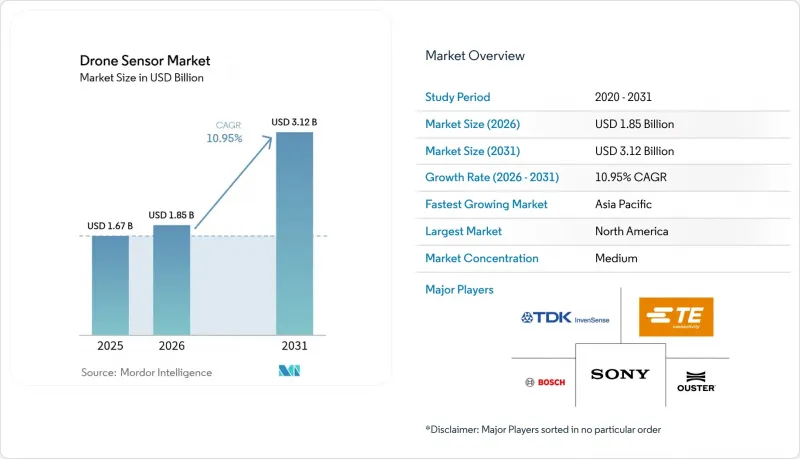
Mordor Intelligence에 의하면, 드론 센서 시장 규모는 2025년 16억 7,000만 달러로 평가되었고, 2026년에는 18억 5,000만 달러로 추정되고, 2026-2031년 CAGR 10.95%로 성장을 지속할 전망이며, 2031년에는 31억 2,000만 달러에 이를 것으로 예측됩니다.
본 보고서는 유형별(관성 센서, 이미지 센서 등), 플랫폼 유형별(수직 이착륙(VTOL) 등), 용도별(항법 및 위치 파악, 충돌 회피 등), 최종 사용자 산업별(국방 및 보안, 농림업 등), 지역별(북미, 유럽, 아시아태평양 등)로 분류되어 있습니다. 시장 전망은 금액(달러) 기준으로 제시되어 있습니다.
세계의 드론 센서 시장 동향 및 인사이트
자율 비행에 대응하는 센서 융합에 대한 수요 증가
자율 비행에서는 GPS를 사용할 수 없는 공간에서도 정확도를 유지하기 위해 관성 센서, 시각 센서, 거리 측정 센서로부터의 협동적인 입력이 필요합니다. 멀티 센서 융합을 통해 단일 센서의 기준치와 비교했을 때 내비게이션 오차율이 최대 67% 감소하여, BVLOS(시야 외 비행)의 신뢰성이 향상됩니다. 따라서 드론 제조업체들은 개발 주기를 단축하기 위해 IMU, 카메라, LiDAR를 묶어 미리 검증된 센서 세트를 선호하여 채택했습니다. 또한, 상업용 통신 사업자들도 민간 항공의 안전 기준을 충족하는 이중화 전략을 채택하고 있으며, 이로 인해 퓨전 지원 모듈에 대한 프리미엄 수요가 더욱 높아지고 있습니다.
급속한 소형화와 SWaP 최적화
MEMS IMU는 3mm×3mm 크기의 패키지 내에서 전술급 성능을 달성하여, 10g 미만의 나노 드론에 탑재할 수 있게 되었습니다. 3D 칩 스태킹을 포함한 첨단 패키징 기술을 통해 부품 수와 전력 소비가 감소했습니다. 그 결과, 효율이 10배 향상되어 배터리 무게를 늘리지 않고도 비행 지속 시간을 연장할 수 있었습니다. 각 제조업체들은 열 밀도를 상쇄하기 위해 새로운 방열 소재를 채택하고, 콤팩트한 케이스 내에서 센서의 정확도를 유지함으로써 드론 센서 시장의 발전을 뒷받침하고 있습니다.
MEMS IMU의 높은 온도 드리프트
온도 변동에 따라 표준 가속도계의 드리프트 계수가 7µg/°C에 달하여 복잡한 보정이 필요해졌기 때문에 시스템 비용과 전력 소비가 증가했습니다. 듀얼 폐쇄 루프 제어와 온칩 히터 덕분에 안정성은 향상되었지만, 무게와 설계상의 오버헤드가 증가했습니다. 장시간 임무에서는 누적 편차 오차의 영향을 받기 쉬우므로, 고정밀 측량 분야에서 MEMS의 도입이 제한되어 드론 센서 시장의 과제로 대두되어 왔습니다.
부문별 분석
2025년, 관성 센서는 드론 센서 시장 점유율의 31.75%를 차지했습니다. 이는 모든 기체의 안정화와 항법에서 필수적인 역할을 수행하기 때문입니다. 고성능 IMU에는 바이어스 보정과 온도 보정이 내장되어 있어, 변화하는 기후 조건에서도 신뢰성을 유지합니다. 가격 하락에도 불구하고, 이 부문은 안정적인 가치를 유지했습니다. 이는 새로운 플랫폼 각각이 여전히 여러 개의 관성 노드를 필요로 했기 때문입니다. LiDAR 유닛의 출하 대수는 뒤처졌지만, 연평균 성장률(CAGR) 12.35%를 기록했습니다. 이는 3D 매핑, 장애물 회피 및 지형 추종 작업에 적용된 점을 반영한 것입니다.
정밀도 향상과 부품 가격 하락에 힘입어 LiDAR의 잠재 시장은 중형 상용 항공기 군으로 확대되었습니다. 단일 광자 및 플래시 아키텍처는 장거리에서도 센티미터 수준의 해상도를 구현하여, 복도 점검이나 고밀도 도시 지역에서의 임무에 적합해졌습니다. 이미지 센서는 항공 사진 및 보안 감시에 활용되었습니다. 반면, 기압 센서는 고도 유지 기능을 위한 이중화 기능을 제공했습니다. 신흥 가스 분석 페이로드는 환경 모니터링의 틈새 시장에 진출했으나, 드론 센서 시장에 대한 기여도는 여전히 미미한 수준에 머물러 있었습니다.
VTOL(수직 이착륙) 설계는 2025년 매출의 57.90%를 차지한 것으로 평가되었으며, 이는 즉각적인 이륙 능력과 호버링 안정성 덕분에 센서 조정 및 탑재체 교체가 용이해진 점이 반영된 결과입니다. 멀티로터 기체 역시 인프라 점검 및 영상 제작에 필수적인 정밀한 웨이포인트 임무를 지원합니다. 고정익 항공기는 기동성보다 항속 거리가 중시되는 장거리 매핑 분야에서 여전히 그 중요성을 유지해 왔으나, 도시 지역에서의 활용 사례가 증가함에 따라 시장 점유율이 정체기에 접어들면서 드론 센서 시장 동향을 형성했습니다.
하이브리드 틸트로터기는 VTOL의 편의성과 공기역학적 순항 효율을 결합함으로써 연평균 성장률(CAGR) 13.85%를 기록했습니다. 이러한 플랫폼은 로터와 주익 간의 복잡한 전환 모드를 갖추고 있어, 정교한 비행 제어 센서가 필요했습니다. 각 벤더사는 전환 단계를 관리하기 위해 이중화된 IMU, 자력계 및 고정밀 기압계를 탑재했습니다. 따라서 센서 제조업체는 동적인 장착 방향에 맞추어 보정된 통합 패키지를 배치했습니다.
지역별 분석
북미는 2025년 매출의 37.25%를 차지했으며, 이는 조기 규제 명확화와 견조한 국방 조달을 반영한 것입니다. 연방항공청(FAA)의 규정 제정으로 확실성이 확보되었으며, 원격 식별(Remote ID)을 지원하는 항공 전자 장비에 대한 투자가 촉진되었습니다. 또한 미국은 국내 조달을 우선시하며, 애리조나주와 텍사스주의 MEMS 파운드리 업체들에 대해 안보 공급 프로그램의 일환으로 센서 생산을 확대하도록 장려함으로써 드론 센서 시장을 강화했습니다.
유럽에서는 유럽항공안전청(EASA)이 BVLOS(시야 외 비행) 기준의 조화를 위한 노력을 추진하는 가운데, 이 기술이 꾸준히 보급되는 모습을 보였습니다. 독일과 프랑스는 재생에너지 점검에 드론을 도입했으며, 영국은 해상 국경 감시에 주력했습니다. 플랫폼 제조업체는 데이터 처리에 관한 GDPR(EU 개인정보보호규정) 및 사이버 보안 요건을 충족하기 위해 해당 지역의 LiDAR 전문 기업을 활용했습니다.
아시아태평양은 중국의 제조 생태계와 일본, 한국, 인도에서의 기업 활용 확대에 힘입어 연평균 성장률(CAGR) 11.75%를 기록하며 다른 모든 지역을 앞질렀습니다. 중국의 OEM 제조업체는 대량이며 저비용의 센서 세트를 출하했으나, 지정학적 긴장으로 인해 동남아시아 및 호주로의 사업 다각화가 가속화되었습니다. 인도의 농업용 드론에 대한 보조금 덕분에 도입이 더욱 확대되고 있으며, 국내 스타트업 기업들이 다중 스펙트럼 카메라와 AI 칩을 결합해 작물 수확량 증대에 힘쓰고 있습니다. 남미와 아프리카의 신흥 시장은 여전히 발전 단계에 있지만, 규제 체계가 마련된다면 인프라 모니터링 분야에서 큰 잠재력을 보여주고 있습니다.
기타 혜택 :
- 엑셀 형식 시장 예측(ME) 시트
- 3개월간의 애널리스트 지원
자주 묻는 질문
목차
제1장 서론
제2장 조사 방법
제3장 주요 요약
제4장 시장 구도
제5장 시장 규모 및 성장 예측
제6장 경쟁 구도
제7장 시장 기회 및 향후 전망
AJY 26.06.26According to Mordor Intelligence, the drone sensor market size is expected to grow from USD 1.67 billion in 2025 to USD 1.85 billion in 2026 and is forecast to reach USD 3.12 billion by 2031 at 10.95% CAGR over 2026-2031.
This report is Segmented by Type (Inertial Sensors, Image Sensors, and More), Platform Type (Vertical Take-Off and Landing (VTOL), and More), Application (Navigation and Positioning, Collision Avoidance, and More), End-User Industry (Defense and Security, Agriculture and Forestry, and More), and Geography (North America, Europe, Asia-Pacific, and More). The Market Forecasts are Provided in Terms of Value (USD).
Global Drone Sensor Market Trends and Insights
Rising Autonomy-Ready Sensor-Fusion Demand
Autonomous flight requires coordinated input from inertial, visual, and ranging sensors to maintain accuracy in GPS-denied spaces. Multi-sensor fusion cuts navigation error rates by up to 67% relative to single-sensor baselines, improving BVLOS reliability. Drone makers, therefore, favored pre-validated sensor suites that bundled IMUs, cameras, and LiDAR to shorten development cycles. Commercial operators also adopted redundancy strategies that met civil aviation safety expectations, reinforcing premium demand for fusion-ready modules.
Rapid Miniaturisation and SWaP Optimisation
MEMS IMUs reached tactical-grade performance inside 3 mm X 3 mm packages, enabling integration into nano-drones under 10 g. Advanced packaging, including 3D chip stacking, reduced component counts, and power draw. The resulting 10-fold efficiency gains prolonged flight endurance without increasing battery mass. Manufacturers incorporated novel heat-dissipation materials to offset thermal density, preserving sensor accuracy in compact frames, supporting advancements in the drone sensor market.
High Thermal Drift in MEMS IMUs
Temperature swings pushed drift coefficients to 7 µg/°C in standard accelerometers, forcing complex compensation that raised system cost and power draw. Dual closed-loop control and on-chip heaters improved stability but added weight and design overhead. Long-duration missions remained sensitive to cumulative bias errors, limiting MEMS adoption in high-precision surveying, posing a challenge to the drone sensor market.
Other drivers and restraints analyzed in the detailed report include:
- Mandatory Remote-ID Compliance Deadlines
- Precision-Agriculture Push for Multispectral Sensing
- Rare-Earth Magnetics Supply Bottlenecks
For complete list of drivers and restraints, kindly check the Table Of Contents.
Segment Analysis
In 2025, inertial sensors accounted for 31.75% of the drone sensor market share, owing to their indispensable role in stabilization and navigation across every airframe. Advanced IMUs incorporated bias correction and thermal calibration, sustaining reliability in variable climates. Despite price compression, the segment maintained steady value because each new platform still required multiple inertial nodes. LiDAR units trailed in volume but posted a 12.35% CAGR, reflecting adoption in 3D mapping, obstacle avoidance, and terrain-following tasks.
Accuracy improvements and falling component prices widened LiDAR's addressable market into mid-tier commercial fleets. Single-photon and flash architectures offered centimeter-level resolution at longer ranges, making them viable for corridor inspection and high-density urban missions. Image sensors served aerial photography and security surveillance. In contrast, barometric pressure sensors provided redundancy for altitude hold functions. Emerging gas-analysis payloads entered environmental monitoring niches, though their contribution to the drone sensor market remained small.
VTOL designs held 57.90% of 2025 revenue, reflecting immediate take-off capability and hover stability that simplified sensor alignment and payload swapping. Multi-rotor airframes also support precise waypoint missions essential for infrastructure inspection and cinematic work. Fixed-wing aircraft retained relevance for long-range mapping where endurance trumped agility, but their share plateaued as urban use cases multiplied, shaping trends in the drone sensor market.
Hybrid tilt-rotor concepts recorded a 13.85% CAGR by combining VTOL convenience with aerodynamic cruise efficiency. These platforms presented complex hand-off regimes between rotors and wings, demanding sophisticated flight-control sensors. Vendors embedded redundant IMUs, magnetometers, and high-rate barometers to manage transition phases. Sensor makers, therefore, positioned integrated packages calibrated for dynamic mounting orientations.
Geography Analysis
North America generated 37.25% of 2025 revenue, reflecting early regulatory clarity and strong defense procurement. The Federal Aviation Administration's rule-making provided certainty that guided investment in Remote ID-ready avionics. The United States also prioritized domestic sourcing, encouraging MEMS foundries in Arizona and Texas to scale sensor production under secure-supply programs, strengthening the drone sensor market.
Europe registered steady adoption as EASA progressed toward harmonized BVLOS standards. Germany and France deployed drones for renewable-energy inspections, while the United Kingdom focused on maritime border surveillance. Platform makers leveraged regional LiDAR specialists to meet GDPR and cybersecurity requirements for data handling.
Asia-Pacific outpaced all regions with a 11.75% CAGR, supported by China's manufacturing ecosystem and rising enterprise use in Japan, South Korea, and India. Chinese OEMs shipped high-volume, low-cost sensor sets, but geopolitical tensions accelerated diversification into Southeast Asia and Australia. India's agri-drone subsidies further widened adoption, with domestic startups pairing multispectral cameras and AI chips to boost crop yields. Emerging markets in South America and Africa remained nascent but demonstrated high potential for infrastructure monitoring once regulatory paths mature.
- Bosch Sensortec GmbH (Robert Bosch GmbH)
- Sony Semiconductor Solutions Corporation
- TE Connectivity Corporation
- InvenSense (TDK Corporation)
- Ouster, Inc.
- Trimble Inc.
- Teledyne Technologies Incorporated
- Sparton Corporation
- KVH Industries, Inc.
- Garmin Ltd.
- u-blox AG
- ams-OSRAM AG
- OMNIVISION
- LeddarTech Holdings Inc.
- Infineon Technologies AG
- Septentrio N.V.
Additional Benefits:
- The market estimate (ME) sheet in Excel format
- 3 months of analyst support
TABLE OF CONTENTS
1 INTRODUCTION
- 1.1 Study Assumptions and Market Definition
- 1.2 Scope of the Study
2 RESEARCH METHODOLOGY
3 EXECUTIVE SUMMARY
4 MARKET LANDSCAPE
- 4.1 Market Overview
- 4.2 Market Drivers
- 4.2.1 Rising autonomy-ready sensor-fusion demand
- 4.2.2 Rapid miniaturisation and SWaP optimisation
- 4.2.3 Mandatory Remote-ID compliance deadlines
- 4.2.4 Precision-agriculture push for multispectral sensing
- 4.2.5 Energy-efficient edge-AI co-processor integration
- 4.2.6 Commercial roll-out of mm-wave imaging radar
- 4.3 Market Restraints
- 4.3.1 High thermal drift in MEMS IMUs
- 4.3.2 Rare-earth magnetics supply bottlenecks
- 4.3.3 Spectrum-sharing regulations for 60 GHz radar
- 4.3.4 Short life-cycles due to rapid sensor-interface obsolescence
- 4.4 Value Chain Analysis
- 4.5 Technological Outlook
- 4.6 Regulatory Landscape
- 4.7 Porter's Five Forces Analysis
- 4.7.1 Bargaining Power of Suppliers
- 4.7.2 Bargaining Power of Buyers
- 4.7.3 Threat of New Entrants
- 4.7.4 Threat of Substitutes
- 4.7.5 Intensity of Rivalry
5 MARKET SIZE AND GROWTH FORECASTS (VALUE)
- 5.1 By Sensor Type
- 5.1.1 Inertial Sensors (IMU, Gyro, Accelerometer)
- 5.1.2 Image Sensors
- 5.1.3 Speed and Distance Sensors
- 5.1.4 Position Sensors
- 5.1.5 Pressure and Differential Barometric Sensors
- 5.1.6 Altimeter
- 5.1.7 Flow
- 5.1.8 LiDAR Sensors
- 5.1.9 Others
- 5.2 By Platform Type
- 5.2.1 Vertical Take-Off and Landing (VTOL)
- 5.2.2 Fixed-wing
- 5.2.3 Hybrid
- 5.3 By Application
- 5.3.1 Navigation and Positioning
- 5.3.2 Collision Avoidance
- 5.3.3 Aerial Mapping and Surveying
- 5.3.4 Environmental and Atmospheric Monitoring
- 5.3.5 Payload Handling and Delivery Assistance
- 5.3.6 Others (Cinematography, Inspection)
- 5.4 By End-user Industry
- 5.4.1 Defense and Security
- 5.4.2 Agriculture and Forestry
- 5.4.3 Energy and Utilities
- 5.4.4 Construction and Mining
- 5.4.5 Consumer
- 5.4.6 Logistics and Warehousing
- 5.4.7 Environmental Research and Conservation
- 5.4.8 Media and Entertainment
- 5.4.9 Others
- 5.5 By Geography
- 5.5.1 North America
- 5.5.1.1 United States
- 5.5.1.2 Canada
- 5.5.1.3 Mexico
- 5.5.2 Europe
- 5.5.2.1 Germany
- 5.5.2.2 United Kingdom
- 5.5.2.3 France
- 5.5.2.4 Russia
- 5.5.2.5 Rest of Europe
- 5.5.3 Asia-Pacific
- 5.5.3.1 China
- 5.5.3.2 Japan
- 5.5.3.3 India
- 5.5.3.4 South Korea
- 5.5.3.5 Australia
- 5.5.3.6 Rest of Asia-Pacific
- 5.5.4 South America
- 5.5.4.1 Brazil
- 5.5.4.2 Rest of South America
- 5.5.5 Middle East and Africa
- 5.5.5.1 Middle East
- 5.5.5.1.1 United Arab Emirates
- 5.5.5.1.2 Saudi Arabia
- 5.5.5.1.3 Turkey
- 5.5.5.1.4 Rest of Middle East
- 5.5.5.2 Africa
- 5.5.5.2.1 South Africa
- 5.5.5.2.2 Rest of Africa
- 5.5.5.1 Middle East
- 5.5.1 North America
6 COMPETITIVE LANDSCAPE
- 6.1 Market Concentration
- 6.2 Strategic Moves
- 6.3 Market Share Analysis
- 6.4 Company Profiles (includes Global-level Overview, Market-level Overview, Core Segments, Financials as available, Strategic Information, Market Rank/Share, Products and Services, Recent Developments)
- 6.4.1 Bosch Sensortec GmbH (Robert Bosch GmbH)
- 6.4.2 Sony Semiconductor Solutions Corporation
- 6.4.3 TE Connectivity Corporation
- 6.4.4 InvenSense (TDK Corporation)
- 6.4.5 Ouster, Inc.
- 6.4.6 Trimble Inc.
- 6.4.7 Teledyne Technologies Incorporated
- 6.4.8 Sparton Corporation
- 6.4.9 KVH Industries, Inc.
- 6.4.10 Garmin Ltd.
- 6.4.11 u-blox AG
- 6.4.12 ams-OSRAM AG
- 6.4.13 OMNIVISION
- 6.4.14 LeddarTech Holdings Inc.
- 6.4.15 Infineon Technologies AG
- 6.4.16 Septentrio N.V.
7 MARKET OPPORTUNITIES AND FUTURE OUTLOOK
- 7.1 White-space and Unmet-need Assessment


