

|
시장보고서
상품코드
2061687
약물 전달 기기 시장 : 시장 점유율 분석, 업계 동향 및 통계, 성장 예측(2026-2031년)Drug Delivery Devices - Market Share Analysis, Industry Trends & Statistics, Growth Forecasts (2026 - 2031) |
||||||
 Mordor Intelligence
Mordor Intelligence에 의하면, 약물 전달 기기 시장 규모는 2025년에 1,363억 5,000만 달러로 평가되었고, 2026년 1,453억 달러로 추정되고, 2031년까지 2,094억 달러에 이를 것으로 예측되며, 예측 기간(2026-2031년) CAGR은 7.58%를 나타낼 전망입니다.
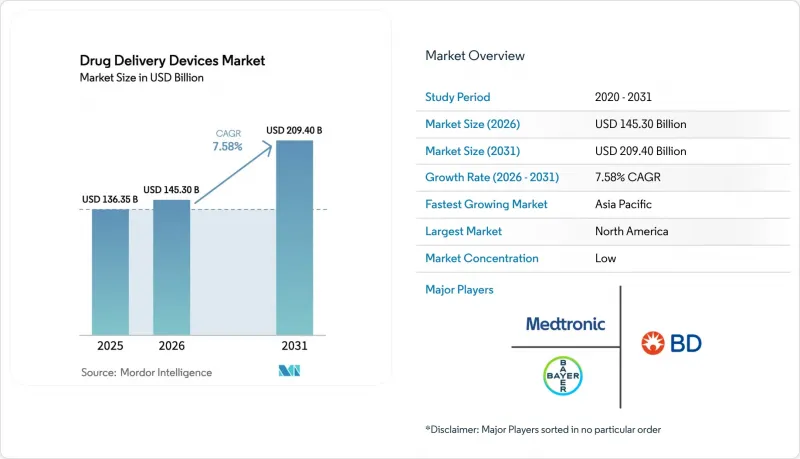
본 보고서는 투여 경로별(경구, 주사, 흡입, 경피, 비강, 안과), 기기 유형별(사전 충전 주사기, 자동 주사기, 스마트 및 연결 기기, 흡입기 및 네뷸라이저 등), 최종 사용자별(병원, 기타), 치료 분야별(종양학, 기타), 지역별(북미, 기타)로 분류되어 있습니다. 시장 전망은 금액(달러) 기준으로 제시되어 있습니다.
세계의 약물 전달 기기 시장 동향 및 인사이트
만성 질환의 부담 증가가 장기 치료를 촉진하고 있습니다.
2024년에는 비전염성 질환이 전 세계 사망 원인의 74%를 차지했으며, 이에 따른 경제적 부담은 매년 7조 달러를 넘어섰습니다. 2024년 당뇨병 환자 수는 성인 5억 3,700만 명에 달한 것으로 평가되었고, 2030년까지 6억 4,300만 명으로 증가할 것으로 전망되는데, 특히 중저소득 국가에서 급격한 증가가 예상됩니다. 이러한 역학적 상황으로 인해 제약 기업들은 수십 년에 걸쳐 빈번한 투여가 필요한 유지 요법으로 방향을 전환하고 있으며, 이는 약물 전달 기기 시장에서 안정적인 수요를 창출하고 있습니다. 미국의 연간 의료비 3조 8,000억 달러 중 이미 90%가 만성 질환 치료에 쓰이고 있기 때문에 보험사들은 응급실 방문을 줄이는 의료기기를 지원하고 있습니다. 질환군마다 적합한 투여 방법이 다르기 때문에 프리필드 주사기, 경피 패치, 이식형 펌프 등 다양한 제품 포트폴리오를 제공하는 공급업체는 여러 적응증을 아우르는 비즈니스 기회를 포착할 수 있습니다.
고도의 투여 방법이 필요한 생물학적 제제 및 바이오시밀러의 보급
2025년에는 바이오의약품이 의약품 매출의 30%를 차지할 것으로 예상되며, 암 면역요법과 단일클론항체의 성장에 힘입어 저분자 의약품에 비해 약 2배의 속도로 시장 규모가 확대되고 있습니다. 온도에 대한 민감성이나 응집 위험으로 인해, 투여량의 정확성을 보장하는 프리필드 주사기, 자동 주사기, 펌프의 역할이 더욱 중요해지고 있습니다. 바이오시밀러는 규제 당국이 오리지널 의약품과 동등한 투여 시스템을 요구하기 때문에 관련 기기 수요를 증가시킵니다. 이로 인해 장치 설계가 고정화되어 전환 비용이 발생합니다. 암젠은 공급 충격의 악영향을 보여주고 있습니다. 대체 기기가 상호 승인되지 않았기 때문에 주사기 공급 부족은 즉시 시장 점유율을 잠식합니다. 숨겨진 바늘 추가, 주사력 감소 또는 투여량 확인 신호를 제공할 수 있는 기기 공급업체는 처방집에서 우선순위가 높아져, 약물 전달 기기 시장에서의 기회를 확대할 것입니다.
엄격한 무균성 및 규정 준수 비용
복합 제품은 이중으로 감독 대상이 되기 때문에 승인 절차가 길어지고, 검증 시험이 두 배로 늘어납니다. 프리필드 주사기의 무균성 보증에는 라인당 최대 24개월과 500만 달러가 소요될 수 있습니다. 2024년에 발부된 23건의 FDA 경고장은 기존 제조업체들 사이에서도 무균성 결함이 지적되었음을 여실히 보여주었습니다. 2024년에 전면 시행된 EU 의료기기 규정은 제조업체에 기존 제품의 재인증을 의무화하고 있어, 신제품 출시를 9개월 늦추고 있습니다. 중소기업들은 이러한 과정에 필요한 자금 조달에 어려움을 겪고 있으며, 그 결과 강력한 규정 준수 체계를 갖춘 다국적 기업들을 중심으로 약물 전달 기기 시장이 재편되고 있습니다.
부문별 분석
패치로 전환하는 추세는 환자들의 호르몬 치료 및 백신 접근성을 확대하고 있으며, 통증 없는 투여를 선호하는 사용자들의 경향을 반영하고 있습니다. 흡입 요법은 신속한 폐 흡수를 활용하여 간을 통한 대사를 피할 수 있기 때문에 천식이나 만성폐쇄성폐질환(COPD) 치료에 여전히 필수적입니다. 2024년 FDA가 네피-에피네프린 스프레이를 승인하고, 주사 바늘을 사용하지 않는 아나필락시스 치료 옵션이 도입됨에 따라 비강 투여 방식이 새로운 주목을 받았습니다.
주사 투여 경로는 바이오의약품 분야에서 주류를 이루며, 콜드체인 물류의 상당 부분을 차지하고 있습니다. 그러나 자동 주사기의 도입으로 인해 바이알과 주사기 형태가 시장에서 점차 밀려나고 있습니다. 이는 바늘이 숨겨져 있고 투여량을 확인할 수 있는 기능 덕분에 복약 순응도가 향상되기 때문입니다. 안구 내 임플란트 덕분에 망막 질환 치료 시 주사 횟수가 월 1회에서 반년에 한 번으로 줄어들어 삶의 질이 향상되고 있습니다. 투여 경로의 선택은 환자 중심의 접근 방식이며, 실제 임상 현장에서의 복약 순응도 향상에 대한 효과를 입증한 의료기기 제조업체가 높이 평가받고 있습니다. 생체이용률에 관한 데이터가 축적됨에 따라, 경피 흡수 기술과 관련된 약물 전달 기기 시장 규모는 더욱 확대될 전망입니다.
지급 기관은 복약 순응도에 대한 증거를 중요하게 여기며, 이것이 커넥티드 자동 주사기의 20-30%에 달하는 단가 프리미엄을 정당화하고 있습니다. 사전 충전 주사기는 규제 당국에 대한 신청 절차를 간소화함으로써 바이오의약품 시장 출시를 뒷받침하고 있지만, 투여 빈도가 높은 분야에서는 자동 주사기가 시장 점유율을 확대되고 있습니다. 경피 패치는 마이크로니들 기술의 혁신으로 혜택을 보고 있지만, 약물 방출 스텐트는 장기적인 치료 성과가 개선된 생체 흡수성 스캐폴드로부터의 경쟁 압박에 직면해 있습니다.
삽입형 펌프는 척수강 내 바클로펜 투여와 같은 매우 특수한 수요를 충족시키고 있지만, 입원 비용 절감으로 인해 보험 급여 환경은 여전히 양호합니다. 무침 제트 인젝터와 체외 펌프는 '신흥' 범주에 속하며, 3상 임상시험을 거쳐 발전하고 있습니다. 각 제약사가 자체 개발 역량을 구축할지, 아니면 SHL Medical과 같은 전문 기업으로부터 턴키 플랫폼을 라이선싱할지 논의하는 가운데, 의료기기 분야의 경쟁은 치열해지고 있습니다. 수직 통합은 지적 재산을 보호할 수 있지만, 규제 위험을 증가시킵니다. 이곳에서의 전략적 선택은 각 플랫폼과 관련된 약물 전달 기기 시장 규모를 재조정하는 결과를 가져올 것입니다.
지역별 분석
북미는 2025년에 전 세계 매출의 41.64%를 차지한 것으로 평가되었으며, 프리미엄 가격 책정과 연결형 기기의 적용 범위를 지속적으로 확대하는 메디케어 정책에 힘입고 있습니다. 또한, FDA의 획기적 의료기기 프로그램도 승인을 가속화하여 해당 지역에서의 조기 출시를 뒷받침하고 있습니다. 캐나다는 미국으로부터 파급 효과를 누리고 있지만, 멕시코의 제네릭 의약품 제조업체들은 수입품과 경쟁하기 위해 첨단 배송 시스템을 도입하고 있습니다. 지급 기관들이 비용 대비 효과 기준을 강화하고 있어 성장은 둔화되고 있지만, 이 지역은 단가가 가장 높기 때문에 여전히 약물 전달 기기 업계의 주요 수익원으로 자리 잡고 있습니다.
2026-2031년 아시아태평양은 가장 빠르게 성장하는 지역이 될 것입니다. 이는 중국의 현지화 추진과 인도의 바이오시밀러 분야에서의 강점이 뒷받침하고 있습니다. 중국은 2024년에 47종의 복합 제품을 승인하고, 국내 생산에 대해 세액 공제를 제공합니다. 인도의 한 제조업체는 SHL 메디컬과 제휴하여 신흥 시장을 겨냥한 펜형 주사기를 개발하고 있습니다. 일본은 약물 복용 준수 데이터에 대해 추가 보상을 지급하는 가치 기반 모델로 전환하고 있으며, 이로 인해 커넥티드 시스템에 대한 수요가 발생하고 있습니다. 한국이나 호주와 같은 소규모 경제권은 동남아시아로의 규제 관문 역할을 수행하며, 시장 출시까지의 기간을 단축하고 있습니다.
유럽에서는 보상 제도가 분절되어 있고, 의료기기 규정(MDR)이 막대한 행정적 부담을 부과하고 있어 성장이 완만합니다. 독일, 프랑스, 영국 3개국에서 지역 매출의 60%를 차지하고 있지만, 프랑스의 의료기술평가기관은 현재 프리미엄 가격 승인 전에 실세계 데이터(REW)의 제출을 요구하고 있습니다. ESG 요건으로 인해 폴리머 주사기의 조기 도입이 촉진되면서, 탈탄소화를 입증할 수 있는 공급업체들이 혜택을 보고 있습니다. 중동에서는 걸프협력회의(GCC) 회원국들이 석유 수입을 바탕으로 고가 의료기기를 구매하고 있습니다. 사하라 이남 아프리카에서는 여전히 시장 보급률이 낮은 편이지만, 가나에서 진행 중인 마이크로니들 백신 시범 사업은 비약적인 발전 가능성을 시사하고 있습니다. 남미에서는 브라질의 공적 의료 제도가 주도적인 역할을 하고 있지만, 이로 인해 이익률이 압박받고 있는 반면, 아르헨티나의 경제 변동으로 인해 콜드체인에 대한 투자가 정체되어 있습니다. 메르코수르(남미 공동시장) 전체 차원의 규제 조화가 시장 규모 확대로 이어질 가능성은 있지만, 그 일정은 여전히 불투명합니다.
기타 혜택 :
- 엑셀 형식 시장 예측(ME) 시트
- 3개월간의 애널리스트 지원
자주 묻는 질문
목차
제1장 서론
제2장 조사 방법
제3장 주요 요약
제4장 시장 구도
제5장 시장 규모 및 성장 예측
제6장 경쟁 구도
제7장 시장 기회 및 향후 전망
AJY 26.06.22According to Mordor Intelligence, the drug delivery devices market size was valued at USD 136.35 billion in 2025 and is estimated to grow from USD 145.30 billion in 2026 to reach USD 209.40 billion by 2031, at a CAGR of 7.58% during the forecast period (2026-2031).
This report is Segmented by Route of Administration (Oral, Injectable, Inhalation, Transdermal, Nasal, Ocular), Device Type (Prefilled Syringes, Auto-Injectors, Smart/Connected Devices, Inhalers & Nebulizers, and More), End User (Hospitals, and More), Therapeutic Area (Oncology, and More), and Geography (North America, and More). The Market Forecasts are Provided in Terms of Value (USD).
Global Drug Delivery Devices Market Trends and Insights
Rising Chronic-Disease Burden Fueling Long-Term Therapeutics
Non-communicable diseases caused 74% of global deaths in 2024, and their economic burden surpassed USD 7 trillion each year. Diabetes prevalence reached 537 million adults in 2024 and will likely rise to 643 million by 2030, with rapid growth in low- and middle-income countries. Such epidemiology guides drug makers toward maintenance therapies that require frequent administration over decades, creating steady demand in the drug delivery devices market. Health systems already spend 90% of the United States' USD 3.8 trillion annual outlay on chronic-disease care, so payers support devices that cut emergency visits. As different disease clusters prefer distinct modalities, suppliers that offer diverse portfolios-prefilled syringes, transdermal patches, and implantable pumps-capture cross-indication opportunities.
Proliferation of Biologics & Biosimilars Needing Advanced Delivery
Biologics accounted for 30% of pharmaceutical sales in 2025 and are expanding roughly twice as fast as small molecules, propelled by oncology immunotherapies and monoclonal antibodies. Temperature sensitivity and aggregation risk elevate the role of prefilled syringes, autoinjectors, and pumps that assure dose accuracy. Biosimilars amplify device demand because regulators require comparable delivery systems to the originator, locking in device design and creating switching costs. Amgen demonstrates the downside of supply shocks; any syringe shortfall immediately erodes market share because alternative devices are not cross-approved. Device suppliers that can add hidden needles, lower injection force, or dose-confirmation cues gain formulary preference, widening opportunity in the drug delivery devices market.
Stringent Sterility & Regulatory Compliance Costs
Combination products face dual oversight, extending approval cycles and multiplying validation studies. Sterility assurance for prefilled syringes may consume up to 24 months and USD 5 million per line. Twenty-three FDA warning letters in 2024 highlighted sterility lapses, even among incumbents. The EU Medical Device Regulation, fully enforced in 2024, forces manufacturers to re-certify legacy products and has stretched launches by nine months. Smaller firms struggle to fund these processes, which consolidates the drug delivery devices market around multinationals with deep compliance teams.
Other drivers and restraints analyzed in the detailed report include:
- Shift Toward Self-Administration & Home Healthcare Models
- Smart / Connected Devices Improving Adherence & Traceability
- High R&D and Manufacturing Capital Intensity
For complete list of drivers and restraints, kindly check the Table Of Contents.
Segment Analysis
The shift toward patches broadens patient access to hormone therapy and vaccines, reflecting users' preference for painless administration. Inhalation remains essential for asthma and COPD, leveraging rapid pulmonary absorption and avoiding hepatically mediated degradation. Nasal delivery earned fresh awareness when the FDA cleared neffy epinephrine spray in 2024, introducing a needle-free anaphylaxis option.
Injectable routes dominate biologics and account for the bulk of cold-chain logistics. However, autoinjector adoption is cannibalizing vial-and-syringe formats because hidden needles and dose confirmation improve adherence. Ocular implants now reduce injection frequency for retinal diseases from monthly to semiannual, enhancing quality of life. Route selection has become a patient-centric exercise, rewarding device firms that validate real-world adherence benefits. As bioavailability data mature, the drug delivery devices market size linked to transdermal technologies is likely to expand further.
Payors value adherence evidence, justifying the 20-30% unit premium for connected autoinjectors. Prefilled syringes underpin biologic launches because they ease regulatory filings, although autoinjectors capture share where dose frequency is high. Transdermal patches benefit from microneedle innovation, while drug-eluting stents face competitive pressure from bioresorbable scaffolds with improved long-term outcomes.
Implantable pumps fill ultra-niche needs such as intrathecal baclofen, yet reimbursement remains favorable due to hospitalization savings. Needle-free jet injectors and on-body pumps occupy an "emerging" category and are advancing through pivotal trials. Device-type competition intensifies as pharmaceutical firms debate whether to build in-house capabilities or license turnkey platforms from specialists like SHL Medical. Vertical integration can protect intellectual property but magnifies regulatory exposure. Strategic choices here will recalibrate the drug delivery devices market size associated with each platform.
Geography Analysis
North America held 41.64% of global revenue in 2025, supported by premium pricing and Medicare policies that routinely expand coverage for connected devices. The FDA Breakthrough Devices Program also accelerates approvals, incentivizing early launches in the region. Canada benefits from U.S. spillover, while Mexican generics producers adopt advanced delivery systems to compete with imports. Growth is moderating as payers impose stricter cost-effectiveness thresholds, but the region remains the profit engine for the drug-delivery devices industry because unit prices are highest there.
Asia-Pacific is the fastest-growing region from 2026-2031, buoyed by China's localization push and India's biosimilar prowess. China approved 47 combination products in 2024 and offers tax credits for domestic production. Indian manufacturers collaborate with SHL Medical to develop pen injectors for emerging markets. Japan shifts toward value-based models that pay premiums for adherence data, creating pull for connected systems. Smaller economies such as South Korea and Australia serve as regulatory gateways to Southeast Asia, shortening go-to-market timelines.
Europe grows more slowly because reimbursement is fragmented and the Medical Device Regulation imposes heavy administrative loads. Germany, France, and the United Kingdom jointly contribute 60% of regional sales, with France's health technology assessment body now demanding real-world evidence before granting premium prices. ESG mandates foster early adoption of polymer syringes, which boosts suppliers that can demonstrate decarbonization. In the Middle East, Gulf Cooperation Council countries buy premium devices backed by oil revenue. Sub-Saharan Africa remains underpenetrated, although Ghana's microneedle vaccine pilots hint at leapfrog potential. South America is led by Brazil's public system, which squeezes margins, while Argentina's economic volatility stalls cold-chain investment. Regulatory harmonization across Mercosur could unlock scale, but timelines remain uncertain.
- Amgen
- Baxter
- Beckton Dickinson
- Eli Lilly and Company
- Enable Injections
- Gerresheimer
- Insulet
- Johnson & Johnson
- medmix AG
- Medtronic
- Nipro
- Novo Nordisk
- Pfizer
- SCHOTT
- SHL Medical
- Stevanato Group
- Teva Pharmaceutical Industries
- Terumo
- West Pharmaceutical Services
- Ypsomed
- Tandem Diabetes Care
Additional Benefits:
- The market estimate (ME) sheet in Excel format
- 3 months of analyst support
TABLE OF CONTENTS
1 Introduction
- 1.1 Study Assumptions & Market Definition
- 1.2 Scope of the Study
2 Research Methodology
3 Executive Summary
4 Market Landscape
- 4.1 Market Overview
- 4.2 Market Drivers
- 4.2.1 Rising Chronic-Disease Burden Fueling Long-Term Therapeutics
- 4.2.2 Proliferation of Biologics & Biosimilars Needing Advanced Delivery
- 4.2.3 Shift Toward Self-Administration & Home Healthcare Models
- 4.2.4 Smart / Connected Devices Improving Adherence & Traceability
- 4.2.5 Microneedle Patch Rollouts for Mass Vaccination in LMICs
- 4.2.6 ESG-Driven Switch to Polymer & Bio-Based Syringes
- 4.3 Market Restraints
- 4.3.1 Stringent Sterility & Regulatory Compliance Costs
- 4.3.2 High R&D And Manufacturing Capital Intensity
- 4.3.3 Cyber-Security Recalls of Connected Infusion Systems
- 4.3.4 Specialty-Glass Supply Bottlenecks Disrupting Availability
- 4.4 Supply-Chain Analysis
- 4.5 Regulatory Landscape
- 4.6 Technological Outlook
- 4.7 Porter's Five Forces Analysis
- 4.7.1 Threat of New Entrants
- 4.7.2 Bargaining Power of Suppliers
- 4.7.3 Bargaining Power of Buyers
- 4.7.4 Threat of Substitutes
- 4.7.5 Intensity of Competitive Rivalry
5 Market Size & Growth Forecasts (Value)
- 5.1 By Route of Administration
- 5.1.1 Oral
- 5.1.2 Injectable
- 5.1.3 Inhalation
- 5.1.4 Transdermal
- 5.1.5 Nasal
- 5.1.6 Ocular
- 5.2 By Device Type
- 5.2.1 Prefilled Syringes
- 5.2.2 Auto-injectors
- 5.2.3 Smart / Connected Devices
- 5.2.4 Inhalers & Nebulizers
- 5.2.5 Transdermal Patches
- 5.2.6 Drug-eluting Stents
- 5.2.7 Implantable Pumps
- 5.2.8 Others
- 5.3 By End User
- 5.3.1 Hospitals
- 5.3.2 Ambulatory Surgery Centers & Clinics
- 5.3.3 Home Healthcare Settings
- 5.3.4 Others
- 5.4 By Therapeutic Area
- 5.4.1 Oncology
- 5.4.2 Diabetes
- 5.4.3 Auto-immune Disorders
- 5.4.4 Cardiovascular Diseases
- 5.4.5 Infectious Diseases
- 5.4.6 Others
- 5.5 By Geography
- 5.5.1 North America
- 5.5.1.1 United States
- 5.5.1.2 Canada
- 5.5.1.3 Mexico
- 5.5.2 Europe
- 5.5.2.1 Germany
- 5.5.2.2 United Kingdom
- 5.5.2.3 France
- 5.5.2.4 Italy
- 5.5.2.5 Spain
- 5.5.2.6 Rest of Europe
- 5.5.3 Asia-Pacific
- 5.5.3.1 China
- 5.5.3.2 Japan
- 5.5.3.3 India
- 5.5.3.4 Australia
- 5.5.3.5 South Korea
- 5.5.3.6 Rest of Asia-Pacific
- 5.5.4 Middle East & Africa
- 5.5.4.1 GCC
- 5.5.4.2 South Africa
- 5.5.4.3 Rest of Middle East & Africa
- 5.5.5 South America
- 5.5.5.1 Brazil
- 5.5.5.2 Argentina
- 5.5.5.3 Rest of South America
- 5.5.1 North America
6 Competitive Landscape
- 6.1 Market Concentration
- 6.2 Market Share Analysis
- 6.3 Company Profiles (includes Global level Overview, Market level overview, Core Segments, Financials as available, Strategic Information, Market Rank/Share for key companies, Products and Services, and Recent Developments)
- 6.3.1 Amgen Inc.
- 6.3.2 Baxter International Inc.
- 6.3.3 Becton Dickinson & Company
- 6.3.4 Eli Lilly and Company
- 6.3.5 Enable Injections
- 6.3.6 Gerresheimer AG
- 6.3.7 Insulet Corporation
- 6.3.8 Johnson & Johnson
- 6.3.9 medmix AG
- 6.3.10 Medtronic plc
- 6.3.11 Nipro Corporation
- 6.3.12 Novo Nordisk A/S
- 6.3.13 Pfizer Inc.
- 6.3.14 SCHOTT AG
- 6.3.15 SHL Medical
- 6.3.16 Stevanato Group
- 6.3.17 Teva Pharmaceutical Industries
- 6.3.18 Terumo Corporation
- 6.3.19 West Pharmaceutical Services
- 6.3.20 Ypsomed Holding AG
- 6.3.21 Tandem Diabetes Care, Inc.
7 Market Opportunities & Future Outlook
- 7.1 White-space & Unmet-Need Assessment


