

|
시장보고서
상품코드
2061690
아시아태평양의 항공기 조명 : 시장 점유율 분석, 업계 동향 및 통계, 성장 예측(2026-2031년)Asia-Pacific Aircraft Lighting - Market Share Analysis, Industry Trends & Statistics, Growth Forecasts (2026 - 2031) |
||||||
 Mordor Intelligence
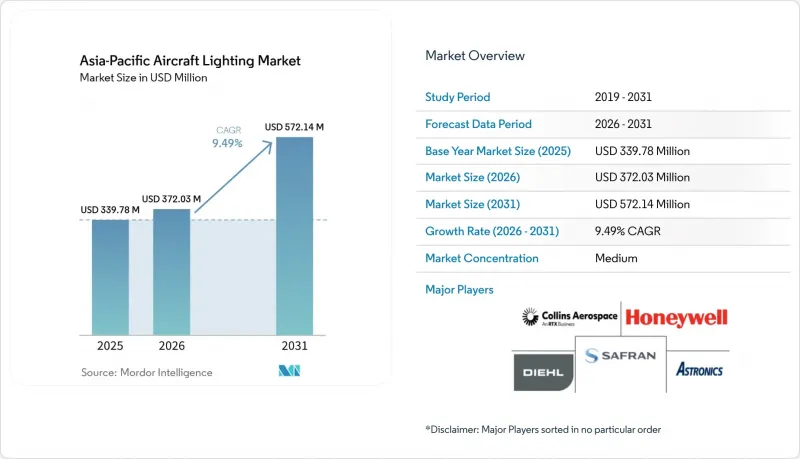
Mordor Intelligence에 의하면, 아시아태평양의 항공기 조명 시장 규모는 2025년 3억 3,978만 달러로 평가되었습니다. 2026년에는 3억 7,203만 달러로 확대되어 2026년부터 2031년에 걸쳐 CAGR은 9.49%를 나타내, 2031년에는 5억 7,214만 달러에 이를 것으로 예측됩니다.
본 보고서는 조명 유형(실내 조명 및 실외 조명), 항공기 유형(나로우바디기, 와이드바디기, 리저널 제트, 비즈니스 제트 등), 설치 형태(라인 핏 및 레트로핏), 기술(LED, 형광등 등), 그리고 지역(중국, 인도, 일본, 한국, 호주, 싱가포르 등)별로 분류되어 있습니다. 시장 전망은 금액(달러) 기준으로 제시되어 있습니다.
아시아태평양의 항공기 조명 시장 동향 및 인사이트
아시아태평양 상업용 항공기 기단에서 지속되고 있는 LED 개조 열풍
이 지역의 항공사들은 전력 소비 절감, 정비 주기 연장, 기내 분위기 개선을 목표로 LED로 전환하는 작업을 가속화하고 있으며, 여러 항공사는 항공기 가동 중단 시간을 최소화하기 위해 사전 인증을 받은 키트를 표준화하고 있습니다. 아스트로닉스사는 2025년 4분기 민간 수송기 부문 매출이 전년 동기 대비 18.5% 증가했다고 보고했으며, 이는 개조 프로젝트와 관련된 조명 및 안전 제품에 대한 강력한 수요를 입증하고 있습니다. 플러그 앤 플레이 방식의 설치가 매우 중요하다는 사실이 입증되었으며, STG Aerospace에 따르면 주요 에어버스 기종용 liTeMood 키트는 6시간 이내에 설치가 가능해, 이를 통해 항공사들은 정기 정비 기간에 맞추어 업그레이드를 실시할 수 있게 됩니다. 항공사들은 LED 솔루션의 긴 수명과 제어 편의성을 추가적인 촉진요인으로 꼽고 있으며, 조광이 가능한 조명은 브랜드 이미지 연출을 돕고, 기존 기술에 비해 예정에 없던 교체 횟수를 줄일 수 있습니다. 에어 인디아는 2026년 1월, 자사 최초의 라인핏 B787-9 기종에 차크라를 모티브로 한 무드 조명을 도입했습니다. 이 회사는 2027년 중반까지 B787-8 기종 26대의 개조를 완료할 방침이며, 이는 회사의 다양한 기종 구성 전반에 걸쳐 웰빙을 중시하는 조명으로의 광범위한 전환을 시사합니다. 싱가포르항공의 수년에 걸친 A350 개조 프로그램(예산 11억 싱가포르 달러/8억 6,920만 달러)은 아시아태평양의 풀서비스 항공사(FSC)들이 어느 정도 규모로 객실을 개편하고 있는지를 보여주고 있으며, 조명 업그레이드는 더 대규모의 내장 개조 프로그램에 포함되어 있습니다.
OEM 각사가 추진하는 경량이며 에너지 효율이 높은 객실 및 외장 시스템
항공기 제조업체와 1차 공급업체들은 신형 항공기 프로그램에 가볍고 전력 효율이 높은 조명 장치를 탑재하고 있으며, 이를 통해 항공사들이 운항 중인 모든 항공기에 적용하려는 새로운 기준을 정립하고 있습니다. 에어버스는 기체가 중요한 수명 주기의 전환점을 맞이함에 따라 A350의 대대적인 개조 물결에 대비하고 있으며, 객실 리뉴얼과 연계하여 인도되는 모든 기체에서 승객 경험을 표준화할 수 있도록 지원하는 무드 조명 소프트웨어 등의 업그레이드 옵션을 마련해 두고 있습니다. 콜린스(Collins)를 비롯한 각 Tier 1 공급업체들은 에어버스, 보잉 및 지역 항공기 플랫폼을 대상으로 라인 핏(line-fit) 지원 LED 솔루션을 제공하며, 예측 유지보수를 지원하는 디지털 전원 및 제어 아키텍처를 보완하고 있습니다. 중국의 항공기 프로그램이 지역용 협폭기 시장 점유율을 확대함에 따라, 현지 파트너십 등을 통해 라인 핏 단계에서 선정된 각 공급업체들은 LED 부품과 관련된 다년간의 예비 부품 및 서비스 수익 기반을 확립하고 있습니다.
운항 사업자에게 발생하는 초기 개조 비용과 운항 중단 시간
LED 키트, 설치 비용 및 수익 기회 손실에 따른 초기 현금 지출은 일일 운항률이 높은 항공사들에게 여전히 역풍으로 작용하고 있습니다. LCC(저비용 항공사)는 운항 중단 기간에 특히 민감하기 때문에 협폭기(narrow-body)의 경우 6시간 이내의 정비 옵션이 지지를 얻고 있습니다. 또한, 거시경제 상황이 악화되거나 엔진 및 부품의 주문 잔고로 인해 정비 충당금이 증가하는 경우, 자금 조달이나 대차대조표상의 제약도 기내 투자 시기에 영향을 미칩니다. 각 항공사는 개조 작업을 정기 점검과 병행하고, 설계 및 규제 관련 절차를 효율화하는 보완형식인증(STC) 패키지를 활용함으로써 이러한 비용을 절감하고자 노력하고 있습니다. 그럼에도 불구하고 중소규모 항공사들은 자금을 확보하기 위해 조명 개조를 미루는 경향이 있어, 프리미엄 객실을 수익원으로 삼는 풀서비스 항공사(FSC)에 비해 도입 속도가 더딘 임베디드니다. 그러나 시간이 지남에 따라 연료비와 정비비 절감 효과로 인해 투자 회수 전망이 개선되고, 항공기에 정기적인 가동 중단 기간이 발생할 경우 더 광범위한 도입이 이루어지게 될 것입니다.
부문별 분석
2025년에는 실내 조명 시스템이 61.55%의 점유율을 차지했습니다. 이는 웰니스 및 브랜딩을 지원하는 무드 조명, 앰비언트 조명, 독서등, 비상 대피 경로 안내 조명의 활용이 활발함을 반영하고 있습니다. 아시아태평양의 항공기 조명 시장에서는 각 항공사가 조절 가능한 객실 조명을 표준화하고 있으며, 수면 주기 개선과 장거리 비행 시 서비스 제공 시점을 시간대에 맞는 분위기에 맞추는 것을 목표로 하고 있습니다. 비상 및 출구 조명은 확립된 인증과 전 세계적인 도입 실적을 바탕으로, 포토루미네스런스 및 LED 솔루션이 주도하는 규제 대상 틈새 시장으로 자리매김하고 있습니다. 아시아태평양의 항공기 조명 시장에는 화장실 및 갤리 작업용 조명의 업그레이드도 포함되어 있으며, 대규모 개조 작업의 일환으로 이루어지는 이러한 사소한 변경 사항들이 승무원의 업무 흐름 개선과 고객 만족도 향상에 기여하고 있습니다. 조종실 조명은 매출 규모 면에서는 여전히 작지만, 신뢰성과 인체공학적 관점에서 매우 중요하며, 정확한 빔 제어와 긴 수명이 주요 선정 기준이 되고 있습니다.
외장 시스템 시장은 당국의 시인성 및 충돌 방지 기준 강화와 함께, 저전력 LED로 크세논 및 할로겐 유닛을 대체하는 추세가 확산됨에 따라 2031년까지 연평균 성장률(CAGR) 9.89%로 가장 빠른 성장이 예상됩니다. 각 공급업체는 안정적인 광도 특성과 긴 수명을 갖춘 항행등, 위치등, 착륙등, 활주등, 스트로브등 솔루션을 제공함으로써, 예정에 없던 교체 작업을 줄이고 항공기의 운항 지속을 가능하게 하고 있습니다. 브랜드 이미지를 중시한 로고 조명과 주익 점검등은 특히 야간 운항이 많은 항공사들 사이에서 그 신뢰성과 뛰어난 색 재현성으로 주목받고 있습니다. 디지털 캐빈 전원 공급 장치 및 모니터링 시스템과 결합함으로써, 외부용 LED 패키지는 라인 유지보수를 간소화하고 혼합 기종에서 필요한 예비 부품의 유형을 줄여줍니다. 아시아태평양의 항공사들은 이러한 변화를 안전 및 지속가능성 목표와 연계하여, 예측 기간 동안 신규 장비 도입(라인 핏)과 개조(레트로핏) 모두에서 견조한 수요가 있을 것으로 전망하고 있습니다.
협폭기(narrow-body)는 2025년 매출의 56.76%를 차지했으며, 단거리 노선의 운항 빈도, 노선 밀도 및 기단 표준화로 인해 객실 및 외장용 LED 업그레이드는 투자 수익률(ROI)이 높은 우선순위 과제로 대두되고 있습니다. 에너지 효율을 높이고 유지보수 빈도를 줄여주는 이 키트는 아시아태평양의 항공기 조명 시장에서 운항 주기가 잦은 단일 통로 항공기에 특히 매력적입니다. 이중 통로 항공기는 프리미엄 장거리 노선에 취항하고 있으며, 분위기 조명이 측정 가능한 브랜드 가치를 창출하고 웰빙을 중시하는 포지셔닝을 뒷받침하기 때문에 기내 시스템에 대한 항공기당 지출액이 높습니다. 아시아태평양의 항공기 조명 시장은 독서등이나 수명이 긴 액센트 조명 등, 기존 객실을 신규 도입 기종에 맞추어 개조하는 와이드바디기 개조 사업을 통해 더욱 확대되고 있습니다.
지역 제트기 시장은 지방 도시 간 노선이 확대되고 정부가 교통망 확충을 추진하고 있는 만큼, 2031년까지 연평균 성장률(CAGR)이 10.95%로 가장 높은 성장세를 보일 것으로 전망됩니다. 이는 소형 캐빈이나 제한된 전력 예산에 맞추어 설계된 소형 LED 솔루션에 유리한 상황입니다. 비즈니스 제트는 규모는 작지만 프리미엄급 시장으로, 맞춤형 조명과 첨단 기술의 신속한 도입으로 인해 지출액이 일반 민항기 평균을 상회하고 있습니다. 헬리콥터 운항에서는 가혹한 환경에 대응할 수 있는 견고한 외부 조명이 요구되는 반면, UAV(무인 항공기)에서는 진화하는 규제를 충족하는 경량 충돌 방지 비콘에 관심이 쏠리고 있습니다. 납품 지연이 지속되는 가운데, 해당 분야의 항공사들은 효율성을 높이고 승객 경험을 유지하기 위해 개보수에 주력하고 있으며, 플랫폼에 관계없이 조명 수요는 견조한 추세를 보이고 있습니다.
기타 혜택 :
- 엑셀 형식 시장 예측(ME) 시트
- 3개월간의 애널리스트 지원
자주 묻는 질문
목차
제1장 서론
제2장 조사 방법
제3장 주요 요약
제4장 시장 구도
제5장 시장 규모 및 성장 예측
제6장 경쟁 구도
제7장 시장 기회 및 향후 전망
KTH 26.06.19According to Mordor Intelligence, the asia-Pacific aircraft lighting market size is expected to grow from USD 339.78 million in 2025 to USD 372.03 million in 2026, and is forecasted to reach USD 572.14 million by 2031 at a 9.49% CAGR over 2026-2031.
This report is Segmented by Lighting Type (Interior Lighting and Exterior Lighting), Aircraft Type (Narrowbody Aircraft, Widebody Aircraft, Regional Jets, Business Jets, and More), Fit (Linefit and Retrofit), Technology (LED, Fluorescent, and More), and Geography (China, India, Japan, South Korea, Australia, Singapore, and More). The Market Forecasts are Provided in Terms of Value (USD).
Asia-Pacific Aircraft Lighting Market Trends and Insights
Sustained LED-retrofit wave across APAC commercial fleets
Airlines across the region accelerated LED upgrades to cut power draw, extend maintenance intervals, and refresh cabin ambiance, with several operators standardizing on pre-certified kits to minimize aircraft downtime. Astronics reported 18.5% year-over-year growth in commercial transport sales in Q4 2025, underscoring strong demand for lighting and safety products tied to retrofit pipelines. Plug-and-play installation has proven central, with STG Aerospace indicating that liTeMood kits for major Airbus platforms can be installed in under six hours, enabling carriers to align upgrades with scheduled maintenance windows. Operators cite the long service life and controllability of LED solutions as additional drivers, as tunable lighting supports brand scenes and reduces unscheduled replacements compared with legacy technologies. Air India introduced chakra-inspired mood lighting on its first linefit B787-9 in January 2026. The airline is committed to retrofitting 26 B787-8 aircraft by mid-2027, signaling a broad shift toward wellness-aligned lighting across its mixed fleet. Singapore Airlines' multi-year A350 retrofit program, budgeted at SGD 1.1 billion (USD 869.20 million), illustrates the scale at which Asia-Pacific full-service carriers (FSCs) are refreshing cabins, with lighting upgrades embedded in larger interior programs.
OEM push for lighter, energy-efficient cabin and exterior systems
Airframers and Tier-1 suppliers are embedding lighter, power-efficient lighting into new-build programs, thereby setting a new standard that operators seek to mirror across the in-service fleet. Airbus is preparing an A350 retrofit wave as aircraft age toward key thresholds, with upgrade options such as mood-lighting software that aligns with cabin refreshes and helps standardize the passenger experience across deliveries. Collins and other Tier-1s provide linefit-ready LED solutions across Airbus, Boeing, and regional platforms, complementing digital power and control architectures that support predictive maintenance. As Chinese programs gain share in regional narrowbody demand, suppliers embedded at the linefit level, including through local partnerships, anchor multi-year spares-and-services revenue for LED components.
Up-front retrofit cost and grounding time for operators
The initial cash outlay for LED kits, installation labor, and lost revenue hours remains a headwind for carriers that run high daily utilization. LCCs are particularly sensitive to grounding time, which is why under-six-hour installation options are gaining traction on narrowbodies. Financing and balance-sheet constraints also shape timing for cabin investments when macro conditions tighten or when engine and component backlogs push up maintenance reserves. Airlines try to mitigate these costs by aligning retrofits with planned checks and by using supplemental type certificate packages that streamline engineering and regulatory steps. Even so, smaller operators may defer lighting retrofits to conserve cash, which slows adoption compared with FSCs that monetize premium cabins. Over time, fuel and maintenance savings improve the payback case, supporting broader uptake once aircraft have scheduled downtime.
Other drivers and restraints analyzed in the detailed report include:
- Regulatory mandates on emergency/exit lighting performance
- Record aircraft production backlogs at Airbus and COMAC
- Complex DO-160/EASA CS-25 certification hurdles
For complete list of drivers and restraints, kindly check the Table Of Contents.
Segment Analysis
Interior lighting systems held 61.55% share in 2025, reflecting strong use of mood lighting, ambient washes, reading lights, and emergency pathfinding that support wellness and branding. Airlines in the Asia-Pacific aircraft lighting market are standardizing tunable cabin lighting to improve sleep cycles and align service touchpoints with time-of-day scenes on long-haul flights. Emergency and exit lighting remains a regulated niche, led by photoluminescent and LED solutions, supported by established approvals and an extensive global installed base. The Asia-Pacific aircraft lighting market also includes lavatory and galley task-lighting upgrades, where small changes improve crew workflow and customer satisfaction as part of broader refurbishments. Cockpit lighting remains smaller in revenue but critical in reliability and human factors, where precise beam control and longevity are key selection criteria.
Exterior systems are expected to post the fastest growth, with a 9.89% CAGR through 2031, as authorities enforce visibility and anti-collision thresholds and power-efficient LEDs replace xenon and halogen units. Suppliers offer navigation, position, landing, taxi, and strobe solutions with stable photometrics and long life to cut unscheduled removals and keep aircraft in service. Branding-oriented logo lighting and wing inspection lights gain attention for reliability and color accuracy, especially for carriers with high night operations. Combined with digital cabin power and monitoring, exterior LED packages simplify line maintenance and reduce the variety of spares within mixed fleets. Asia-Pacific carriers link these changes to safety and sustainability goals, building a strong pipeline for both linefit and retrofit over the forecast horizon.
Narrowbodies captured 56.76% of 2025 revenues as short-haul frequency, route density, and fleet standardization make cabin and exterior LED upgrades a high-ROI priority. kits that improve energy efficiency and reduce maintenance touchpoints are particularly attractive for high-cycle single-aisle aircraft in the Asia-Pacific aircraft lighting market. Twin-aisle aircraft serve premium long-haul routes, where mood lighting creates measurable brand value and supports wellness positioning, leading to higher per-aircraft spend for interior systems. The Asia-Pacific aircraft lighting market is further reinforced by widebody refreshes that align legacy cabins with new deliveries, including reading lights and long-lasting accent lighting.
Regional jets are poised for the highest growth, with a 10.95% CAGR through 2031, as secondary-city links expand and governments promote connectivity, which benefits compact LED solutions tailored to smaller cabins and lower power budgets. Business jets remain a smaller but premium segment where bespoke lighting and fast tech adoption push spend above commercial averages. Helicopter operations require ruggedized exterior lights for demanding environments, while UAVs draw interest for lightweight anti-collision beacons that meet evolving rules. As delivery delays persist, operators across these categories are leaning on retrofits to improve efficiency and preserve the passenger experience, keeping lighting demand steady across platforms.
List of Companies Covered in this Report:
- Honeywell International Inc.
- Collins Aerospace (RTX Corporation)
- Safran S.A.
- Diehl Stiftung & Co. KG
- Astronics Corporation
- KOITO MANUFACTURING CO., LTD.
- Oxley Group
- Bruce Aerospace Inc.
- Madelec Aero SAS
- S.E.L.A. Lighting Systems
- Luminator Technology Group
- Cobalt Aerospace Group Limited
- Lufthansa Technik AG
- Aveo Engineering Group, s.r.o.
- Precise Flight, Inc.
- PWI, Inc.
Additional Benefits:
- The market estimate (ME) sheet in Excel format
- 3 months of analyst support
TABLE OF CONTENTS
1 INTRODUCTION
- 1.1 Study Assumptions and Market Definition
- 1.2 Scope of the Study
2 RESEARCH METHODOLOGY
3 EXECUTIVE SUMMARY
4 MARKET LANDSCAPE
- 4.1 Market Overview
- 4.2 Market Drivers
- 4.2.1 Sustained LED-retrofit wave across Asia-Pacific commercial fleets
- 4.2.2 OEM push for lighter, energy-efficient cabin and exterior systems
- 4.2.3 Regulatory mandates on emergency/exit lighting performance
- 4.2.4 Record aircraft production backlogs at Airbus and COMAC
- 4.2.5 Smart human-centric mood lighting to boost passenger wellness
- 4.2.6 Refurbishment cycles among low-cost carriers (LCCs) after COVID-19
- 4.3 Market Restraints
- 4.3.1 Up-front retrofit cost and grounding time for operators
- 4.3.2 Complex DO-160/EASA CS-25 certification hurdles
- 4.3.3 Semiconductor and specialty-LED supply-chain volatility
- 4.3.4 EMI/EMC compliance issues in high-density cabins
- 4.4 Value Chain Analysis
- 4.5 Regulatory Landscape
- 4.6 Technological Outlook
- 4.7 Porter's Five Forces Analysis
- 4.7.1 Threat of New Entrants
- 4.7.2 Bargaining Power of Buyers
- 4.7.3 Bargaining Power of Suppliers
- 4.7.4 Threat of Substitutes
- 4.7.5 Intensity of Competitive Rivalry
5 MARKET SIZE AND GROWTH FORECASTS (VALUE)
- 5.1 By Lighting Type
- 5.1.1 Interior Lighting
- 5.1.1.1 Cabin Lighting
- 5.1.1.2 Cockpit Lighting
- 5.1.1.3 Emergency and Exit Lighting
- 5.1.1.4 Cargo/Baggage Lighting
- 5.1.2 Exterior Lighting
- 5.1.2.1 Navigation and Position Lights
- 5.1.2.2 Landing and Taxi Lights
- 5.1.2.3 Anti-Collision and Strobe Lights
- 5.1.2.4 Logo and Wing Inspection Lights
- 5.1.1 Interior Lighting
- 5.2 By Aircraft Type
- 5.2.1 Narrowbody Aircraft
- 5.2.2 Widebody Aircraft
- 5.2.3 Regional Jets
- 5.2.4 Business Jets
- 5.2.5 Helicopters
- 5.2.6 Unmanned Aerial Vehicles (UAVs)
- 5.3 By Fit
- 5.3.1 Linefit
- 5.3.2 Retrofit
- 5.4 By Technology
- 5.4.1 Light-Emitting Diode (LED)
- 5.4.2 Fluorescent
- 5.4.3 Incandescent/Halogen
- 5.5 By Geography
- 5.5.1 China
- 5.5.2 India
- 5.5.3 Japan
- 5.5.4 South Korea
- 5.5.5 Australia
- 5.5.6 Singapore
- 5.5.7 Vietnam
- 5.5.8 Rest of Asia-Pacific
6 COMPETITIVE LANDSCAPE
- 6.1 Market Concentration
- 6.2 Strategic Moves
- 6.3 Market Share Analysis
- 6.4 Company Profiles (includes Global level Overview, Market level overview, Core Segments, Financials as available, Strategic Information, Market Rank/Share for key companies, Products and Services, and Recent Developments)
- 6.4.1 Honeywell International Inc.
- 6.4.2 Collins Aerospace (RTX Corporation)
- 6.4.3 Safran S.A.
- 6.4.4 Diehl Stiftung & Co. KG
- 6.4.5 Astronics Corporation
- 6.4.6 KOITO MANUFACTURING CO., LTD.
- 6.4.7 Oxley Group
- 6.4.8 Bruce Aerospace Inc.
- 6.4.9 Madelec Aero SAS
- 6.4.10 S.E.L.A. Lighting Systems
- 6.4.11 Luminator Technology Group
- 6.4.12 Cobalt Aerospace Group Limited
- 6.4.13 Lufthansa Technik AG
- 6.4.14 Aveo Engineering Group, s.r.o.
- 6.4.15 Precise Flight, Inc.
- 6.4.16 PWI, Inc.
7 MARKET OPPORTUNITIES AND FUTURE OUTLOOK
- 7.1 White-space and Unmet-Need Assessment


