|
시장보고서
상품코드
2061713
자궁 매니퓰레이션 기기 : 시장 점유율 분석, 업계 동향 및 통계, 성장 예측(2026-2031년)Uterine Manipulation Devices - Market Share Analysis, Industry Trends & Statistics, Growth Forecasts (2026 - 2031) |
||||||
 Mordor Intelligence
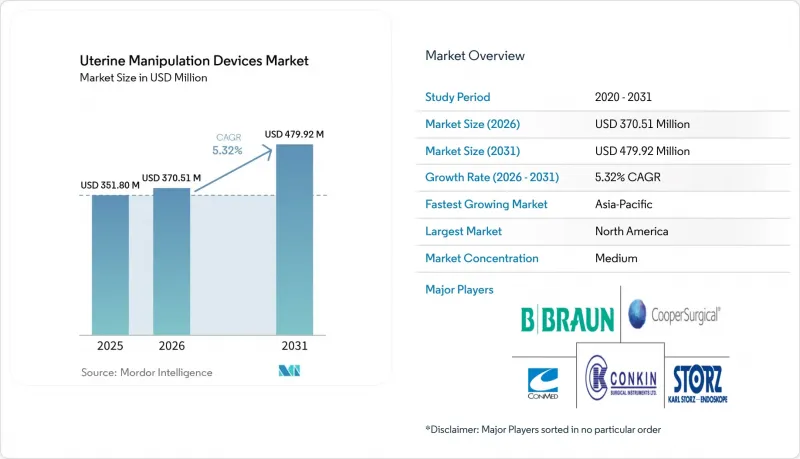
Mordor Intelligence에 의하면, 자궁 매니퓰레이션 기기 시장 규모는 2025년에 3억 5,180만 달러로 평가되었습니다. 2026년 3억 7,051만 달러에서 2031년까지 4억 7,992만 달러에 이를 것으로 예상되며, 예측 기간(2026-2031년) CAGR은 5.32%를 나타낼 전망입니다.
본 보고서는 제품 유형(일회용, 재사용 가능, 하이브리드), 끝부분의 움직임(고정/정적, 관절식·기울기 가능, 가동식), 수술 방법(전복강경 자궁적출술, 로봇 보조 자궁적출술 등), 최종 사용자(병원, 외래수술센터(ASC), 산부인과 전문 클리닉), 지역(북미 등)에 따라 분류되어 있습니다. 시장 전망은 금액(달러) 기준으로 제시되어 있습니다.
세계의 자궁 매니퓰레이션 기기 시장 동향 및 인사이트
저침습 자궁적출술의 적용 확대
복강경 자궁적출술 시행률은 2015년 11.3%에서 2020년에는 52.7%로 상승했으며, 외과 의사의 자신감과 환자의 희망이 단기 입원 및 통증 경감으로 전환됨에 따라, 2022년부터 2023년에 걸쳐 약 58-62%까지 계속 상승했습니다. 시각화 도구의 고도화와 무선 복강경 수술을 통해 수술 작업 효율이 향상됨에 따라, 병원들은 로봇 콘솔에 대응하는 다방향 가동식 자궁 조작기에 대한 투자를 확대되고 있습니다. 메디케어의 시설 중립형 지급 제도는 외래 자궁 적출 수술을 장려하고 있으며, 이로 인해 ASC(외래수술센터(ASC))는 당일 퇴원이 가능하도록 하는 효율적인 장비 도입을 서둘러야 하는 상황에 놓여 있습니다. 수술 후 조기 회복(ERAS) 프로토콜에서는 조직 손상 및 출혈을 최소화하는 기구가 더욱 중요시되고 있으며, 이에 따라 고품질 조작기에 대한 수요가 증가하고 있습니다.
감염 위험 감소를 위한 일회용 멸균 기구로의 전환
CDC 지침에서 오염 위험으로 인해 일회용 제품을 재처리해서는 안 된다고 경고함에 따라, 병원들은 일회용 조작기로의 전환을 가속화하고 있습니다. 올림푸스사의 MAJ-891 리콜 및 FDA의 재처리 관련 경고로 인해 감시가 강화됨에 따라, 구매 담당자들은 단가가 비싸더라도 멸균이 완료되어 즉시 사용 가능한 기구를 우선적으로 선택하고 있습니다. EU의 포장 폐기물 지침은 도입 절차를 복잡하게 만들고 있으며, 공급업체에게 일회용 제품의 재활용 경로 또는 지속 가능한 소재 사용을 입증할 것을 요구하고 있습니다. 증례 수가 적은 의료기관에서는 멸균 장치에 대한 초기 투자 비용이 1증례당 비용 절감액을 상회하기 때문에 여전히 일회용 기구가 비용 대비 효과가 높은 것으로 간주됩니다. 한편, 환자 수가 많은 병원에서는 감염 관리와 경비 사이의 균형을 고려한 하이브리드 방식을 검토하고 있습니다.
의료기기와 관련된 천공 및 소송 우려
자궁 천공은 자궁경 검사 시 1%, 특정 자궁 내 시술 시에는 최대 4%의 비율로 발생하고 있으며, 이는 의료 과실 소송이나 보험료 인상을 초래하고 있습니다. 로봇 수술 기구로 인한 열 손상을 주장하는 소송으로 인해, 매니퓰레이터를 포함한 모든 부속 기기에 대한 감시가 강화되었으며, 위험 회피 성향이 강한 외과의사들은 오랜 기간 안전 실적을 쌓아온 확고한 브랜드를 선호하는 추세입니다. 로봇 시스템에 대한 시정 조치를 요구하는 FDA의 경고장은 규정 준수 압박을 더욱 가중시키고 있습니다. 현재 병원에서는 자격 인증 및 시뮬레이션 훈련을 강화하고 있어, 익숙하지 않은 조작기 설계의 도입이 지연되고 있습니다. 미국의 판례에 따르면, 일회용 기기를 재처리하는 병원에 제조업체와 동등한 책임이 부과되므로, 엄격한 검증 절차가 문서화되어 있지 않은 한 재사용을 자제하도록 되어 있습니다.
부문별 분석
널리 보도된 오염 사고로 인해 감염 관리에 대한 경각심이 높아진 결과, 2025년에는 일회용 자궁 조작 기기가 시장 점유율의 54.02%를 차지했습니다. 병원에서는 고비용이 드는 수술 후 감염이나 복잡한 멸균 감사에 대비한 안전장치로서 일회용 조작기를 활용하고 있습니다. 그러나 수천 건의 수술로 멸균 장치 비용을 상각할 수 있는 가동률이 높은 의료 기관의 경우, 재사용 가능한 기구가 여전히 매력적입니다. 이에 대해 제조업체는 폐기물 감축과 비용 간의 균형을 맞추기 위해, 5-10회의 멸균 주기를 지원하는 하이브리드형·한정 사용 모델로 대응하고 있습니다. 이 틈새 시장은 연평균 성장률(CAGR) 6.05%를 나타낼 것으로 예측되며, 자궁 조작 기기 시장 전체보다 빠른 속도로 성장할 것으로 전망됩니다.
플루오로엘라스토머 소재의 혁신 덕분에 재사용 가능한 샤프트는 성능 저하 없이 1,000회 이상의 증기 멸균 주기를 견딜 수 있게 되어, 수명 주기 비용을 절감하는 동시에 실리콘 부족에 대한 내성을 높이고 있습니다. 핸들에 내장된 RFID 칩은 멸균 횟수와 온도 노출을 기록하고, 해당 데이터를 병원의 자산 관리 플랫폼으로 전송함으로써 예방 정비 경보를 발동시킵니다.
2025년에는 외과의사들이 복잡한 로봇 수술 및 복강경 수술에서 더 넓은 가동 범위를 요구하게 되면서, 관절식 틸트 팁형 기기가 시장을 독점하여 자궁 조작 기기 시장 규모의 47.55%를 차지했습니다. 고정 칩형 모델은 간편하고 가격이 저렴하여 단순한 시술에서는 여전히 주류로 사용되고 있지만, 골반 심부를 노출하는 데 필요한 각도를 확보할 수 없습니다. 폴리머 재질의 조인트와 케이블 구동 방식을 채택한 플렉서블 팁 매니퓰레이터는 3D 영상과 연동하여 자궁의 위치를 실시간으로 윤곽을 그려낼 수 있기 때문에 연평균 성장률(CAGR) 6.44%로 가장 높은 성장세가 예상됩니다.
로봇과의 통합은 새로운 기대를 불러일으키고 있습니다. 자동화된 ‘팔로우 미’ 알고리즘이 자궁의 위치를 카메라 움직임에 맞추어 조정함으로써, 재위치에 소요되는 시간과 보조자의 피로를 최소화합니다. 초기 임상시험에서 학술용 프로토타입이 수술 시간을 12% 단축한 것으로 나타났으며, 이는 반복되는 사례를 통해 외과의사의 선호도를 학습하는 미래형 스마트 매니퓰레이터의 가능성을 시사합니다. 자궁 조작 기기 시장은 기계 공학, 센서, 소프트웨어를 융합하여 수술 건수가 많은 부인과 종양학 팀이 선호하는 직관적이고 인체공학에 기반한 솔루션을 제공하는 공급업체들에게 계속해서 혜택을 주고 있습니다.
지역별 분석
북미는 로봇 기술의 조기 도입, 안정적인 보험 급여, 그리고 펠로우십 연수를 이수한 최소 침습 부인과 외과 의사들의 긴밀한 네트워크를 바탕으로, 2025년에도 자궁 시술 기기 시장 점유율 41.90%를 유지했습니다. 미국의 병원에서는 4K 영상 표시에 대응하는 관절식 센서 탑재 기기로의 교체가 일상적으로 이루어지고 있는 반면, ASC(외래수술센터(ASC)) 체인은 회전율을 높이는 일회용 키트 수요를 주도하고 있습니다.
유럽에서는 고령화에 따른 자궁 적출술 수요 증가와, EU 폐기물 지침을 준수하여 재사용 가능하거나 하이브리드형 수술 기구로의 전환을 촉진하는 지속가능성 관련 법규로 인해, 이 기술이 꾸준히 보급되고 있습니다. 지역 조달 컨소시엄은 탄소 중립적인 제조 공정을 갖춘 공급업체를 우대하고 있으며, 바이오 폴리머로 만든 손잡이와 재활용 가능한 포장재의 연구 개발을 촉진하고 있습니다.
아시아태평양은 자궁 시술 기기 시장의 성장 동력이며, 중국, 인도, 한국의 ASC(외래수술센터(ASC)) 급속한 건설, 도시 중산층의 확대, 그리고 로봇 플랫폼에 대한 정부 자금 지원에 힘입어 2031년까지 연평균 성장률(CAGR) 7.55%를 나타낼 것으로 전망됩니다. 중국의 2선 도시 외과의사들은 현지 유통 파트너십을 통해 수입된 가성비 높은 일회용 제품을 사용하여 복강경 자궁적출술을 점점 더 많이 시행하고 있으며, 이로 인해 프리미엄 브랜드의 이익률은 압박을 받고 있지만 판매량은 증가하고 있습니다.
남미에서는 브라질과 멕시코를 필두로 도입이 서서히 진행되고 있으나, 수입 가격에 영향을 미치는 환율 변동으로 인해 제약을 받고 있습니다. 중동 및 아프리카에서는 걸프 연안 국가들의 민간 병원 그룹 투자와, 호환 가능한 조작기가 필요한 턴키 방식의 로봇 수술실을 포함한 대규모 헬스시티 구상과 관련하여 점진적인 성장이 나타나고 있습니다. 사하라 이남 아프리카에서 기부금으로 운영되는 여성 건강 프로그램에서는 기본적인 고정형 의료기기가 때때로 조달되고 있지만, 그 수량은 여전히 소규모에 그치고 있습니다.
기타 혜택 :
- 엑셀 형식 시장 예측(ME) 시트
- 3개월간의 애널리스트 지원
자주 묻는 질문
목차
제1장 서론
제2장 조사 방법
제3장 주요 요약
제4장 시장 구도
제5장 시장 규모 및 성장 예측
제6장 경쟁 구도
제7장 시장 기회 및 향후 전망
KTH 26.06.22According to Mordor Intelligence, the uterine manipulation devices market size was valued at USD 351.80 million in 2025 and is estimated to grow from USD 370.51 million in 2026 to reach USD 479.92 million by 2031, at a CAGR of 5.32% during the forecast period (2026-2031).
This report is Segmented by Product Type (Disposable, Reusable, Hybrid), Tip Movement (Fixed/Static, Articulating Tiltable, Flexible), Procedure (Total Laparoscopic Hysterectomy, Robotic-Assisted Hysterectomy, and More), End User (Hospitals, Ambulatory Surgical Centers, Specialty Gynecology Clinics), and Geography (North America and More). The Market Forecasts are Provided in Terms of Value (USD).
Global Uterine Manipulation Devices Market Trends and Insights
Rising adoption of minimally invasive hysterectomy procedures
Laparoscopic hysterectomy rates climbed from 11.3% in 2015 to 52.7% by 2020, and continued rising to approximately 58-62% by 2022-2023 as surgeon confidence and patient preference shifted toward shorter hospital stays and reduced pain. Enhanced visualization tools and wireless laparoscopy improve surgical ergonomics, prompting hospitals to invest in uterine manipulators with multi-plane articulation matched to robotic consoles. Medicare's site-neutral payments encourage outpatient hysterectomy, pushing ASCs to procure efficient devices that enable same-day discharge. Enhanced Recovery After Surgery protocols further prioritize instruments that minimize tissue trauma and bleeding, reinforcing demand for premium manipulators.
Shift toward single-use sterile devices to cut infection risk
Hospitals accelerate the move to disposable manipulators after CDC guidance warned that single-use items should not be reprocessed because of contamination risks. The Olympus MAJ-891 recall and FDA reprocessing warnings intensified scrutiny, prompting purchasing managers to favor sterile, ready-to-use instruments despite higher unit pricing. EU packaging-waste directives complicate adoption, requiring suppliers to demonstrate recycling pathways or sustainable materials for disposables. Low-volume centers still find disposables cost-effective because capital outlays for sterilizers outweigh per-case savings, while high-volume hospitals weigh hybrid options that balance infection control and expense.
Device-related perforation & litigation concerns
Uterine perforation occurs in 1% of hysteroscopic procedures and up to 4% in certain intrauterine interventions, stoking malpractice claims and insurance premiums. Lawsuits alleging thermal injury from robotic instrumentation have heightened scrutiny of all accessory devices, including manipulators, leading risk-averse surgeons to prefer established brands with long safety records. FDA warning letters demanding corrective actions on robotic systems add compliance pressures; hospitals now reinforce credentialing and simulation training, slowing adoption of unfamiliar manipulator designs. Legal precedent in the United States places manufacturer-equivalent liability on hospitals that reprocess single-use devices, discouraging reuse unless strict validation is documented.
Other drivers and restraints analyzed in the detailed report include:
- Increasing prevalence of fibroids & gynecologic cancers
- New reimbursement codes boosting laparoscopic surgery uptake
- Inconsistent reprocessing rules for reusable devices
For complete list of drivers and restraints, kindly check the Table Of Contents.
Segment Analysis
Disposable designs accounted for 54.02% of uterine manipulation devices market share in 2025 thanks to heightened infection-control vigilance after well-publicized contamination events. Hospitals view single-use manipulators as an insurance policy against costly surgical site infections and complex sterility audits. Yet reusable instruments still appeal to high-volume centers that amortize sterilization equipment over thousands of cases. Manufacturers respond with hybrid, limited-use models that support 5-10 cycles, balancing waste reduction and cost; this niche is forecast for 6.05% CAGR, outpacing the overall uterine manipulation devices market.
Innovations in fluoro-elastomer materials allow reusable shafts to withstand more than 1,000 steam cycles without degradation, lowering life-cycle cost and boosting resilience against silicone shortages. RFID chips embedded in handles log sterilization counts and temperature exposure, feeding data into hospital asset-management platforms that trigger preventive maintenance alerts.
Articulating tiltable-tip devices dominated, representing 47.55% of uterine manipulation devices market size in 2025 as surgeons sought broader range of motion for complex robotic and laparoscopic cases. Fixed-tip models remain staples in straightforward procedures due to simplicity and lower price, but lack the angles needed for deep pelvic exposure. Flexible-tip manipulators-using polymer joints and cable drives-are forecast to post the fastest 6.44% CAGR because they pair with 3D imaging for real-time contouring of uterine position.
Robotic integration layers new expectations: automated "follow-me" algorithms match uterine displacement to camera movements, minimizing repositioning time and assistant fatigue. Academic prototypes cut operative time by 12% in early trials, pointing to future smart manipulators that learn surgeon preferences over repeated cases. The uterine manipulation devices market continues to reward suppliers that fuse mechanics, sensors and software into an intuitive ergonomic package preferred by high-volume gynecologic oncology teams.
Geography Analysis
North America preserved 41.90% uterine manipulation devices market share in 2025 on the back of early robotic adoption, robust reimbursement and a dense network of fellowship-trained minimally invasive gynecologic surgeons. U.S. hospitals routinely upgrade to articulating, sensor-enabled devices compatible with 4K visualization, while ASC chains drive volume for disposable kits that streamline turnover.
Europe follows with steady uptake as aging demographics push hysterectomy demand and sustainability legislation nudges hospitals toward reusable or hybrid manipulators meeting EU waste directives. Regional procurement consortia reward suppliers demonstrating carbon-neutral manufacturing processes, spurring R&D into biopolymer handles and recyclable packaging.
Asia-Pacific is the uterine manipulation devices market's growth engine, projected at 7.55% CAGR through 2031, propelled by rapid ASC construction, urban middle-class expansion and government funding for robotic platforms in China, India and South Korea. Surgeons in tier-2 Chinese cities increasingly perform laparoscopic hysterectomy using cost-effective disposables imported under local distribution partnerships, squeezing margins for premium brands but expanding unit volumes.
South America shows gradual adoption with Brazil and Mexico leading, constrained by currency volatility affecting import pricing. Middle East & Africa post incremental gains tied to private-sector hospital group investment in Gulf states and large-scale health-city initiatives, which include turnkey robotic suites requiring compatible manipulators. Donor-funded women's health programs in sub-Saharan Africa occasionally procure basic fixed-tip devices, but volumes remain modest.
- The Cooper Companies
- Karl Storz
- Olympus
- Richard Wolf
- Cook Group
- B. Braun
- Laborie Medical Technologies
- Applied Medical Resources
- Conmed
- Purple Surgical International
- Utah Medical Products
- ClearView Medical
- Halder Medical
- Mangeshkar Surgical
- Aesculap
Additional Benefits:
- The market estimate (ME) sheet in Excel format
- 3 months of analyst support
TABLE OF CONTENTS
1 Introduction
- 1.1 Study Assumptions & Market Definition
- 1.2 Scope of the Study
2 Research Methodology
3 Executive Summary
4 Market Landscape
- 4.1 Market Overview
- 4.2 Market Drivers
- 4.2.1 Rising adoption of minimally invasive hysterectomy procedures
- 4.2.2 Shift toward single-use sterile devices to cut infection risk
- 4.2.3 Increasing prevalence of fibroids & gynecologic cancers
- 4.2.4 New reimbursement codes boosting laparoscopic surgery uptake
- 4.2.5 Proliferation of ambulatory surgery centers in Asia-Pacific
- 4.2.6 Robotic-ready articulating manipulators enhance ergonomics
- 4.3 Market Restraints
- 4.3.1 Device-related perforation & litigation concerns
- 4.3.2 Inconsistent reprocessing rules for reusable devices
- 4.3.3 Supply-chain tightness for medical-grade silicone & polymers
- 4.3.4 EU plastics-waste rules curbing single-use adoption
- 4.4 Value / Supply-Chain Analysis
- 4.5 Regulatory Landscape
- 4.6 Technological Outlook
- 4.7 Porter's Five Forces
- 4.7.1 Threat of New Entrants
- 4.7.2 Bargaining Power of Suppliers
- 4.7.3 Bargaining Power of Buyers
- 4.7.4 Threat of Substitutes
- 4.7.5 Intensity of Competitive Rivalry
5 Market Size & Growth Forecasts
- 5.1 By Product Type (Value)
- 5.1.1 Disposable Uterine Manipulators
- 5.1.2 Reusable Uterine Manipulators
- 5.1.3 Hybrid Devices
- 5.2 By Tip Movement (Value)
- 5.2.1 Fixed / Static Tip
- 5.2.2 Articulating Tiltable Tip
- 5.2.3 Flexible Tip
- 5.3 By Procedure (Value)
- 5.3.1 Total Laparoscopic Hysterectomy
- 5.3.2 Robotic-Assisted Hysterectomy
- 5.3.3 Tubal Ligation & Fertility
- 5.3.4 Endometrial Cancer Surgery
- 5.3.5 Myomectomy & Fibroid Removal
- 5.3.6 Other Gynecologic Surgeries
- 5.4 By End User (Value)
- 5.4.1 Hospitals
- 5.4.2 Ambulatory Surgical Centers
- 5.4.3 Specialty Gynecology Clinics
- 5.5 By Geography (Value)
- 5.5.1 North America
- 5.5.1.1 United States
- 5.5.1.2 Canada
- 5.5.1.3 Mexico
- 5.5.2 Europe
- 5.5.2.1 Germany
- 5.5.2.2 United Kingdom
- 5.5.2.3 France
- 5.5.2.4 Italy
- 5.5.2.5 Spain
- 5.5.2.6 Rest of Europe
- 5.5.3 Asia-Pacific
- 5.5.3.1 China
- 5.5.3.2 India
- 5.5.3.3 Japan
- 5.5.3.4 South Korea
- 5.5.3.5 Australia
- 5.5.3.6 Rest of Asia-Pacific
- 5.5.4 South America
- 5.5.4.1 Brazil
- 5.5.4.2 Argentina
- 5.5.4.3 Rest of South America
- 5.5.5 Middle East and Africa
- 5.5.5.1 GCC
- 5.5.5.2 South Africa
- 5.5.5.3 Rest of Middle East and Africa
- 5.5.1 North America
6 Competitive Landscape
- 6.1 Market Concentration
- 6.2 Market Share Analysis
- 6.3 Company Profiles (includes Global level Overview, Market level overview, Core Segments, Financials as available, Strategic Information, Market Rank/Share for key companies, Products & Services, and Recent Developments)
- 6.3.1 CooperSurgical Inc.
- 6.3.2 KARL STORZ SE & Co. KG
- 6.3.3 Olympus Corporation
- 6.3.4 Richard Wolf GmbH
- 6.3.5 Cook Medical LLC
- 6.3.6 B. Braun Melsungen AG
- 6.3.7 Laborie Medical Technologies
- 6.3.8 Applied Medical Resources
- 6.3.9 CONMED Corporation
- 6.3.10 Purple Surgical International
- 6.3.11 Utah Medical Products Inc.
- 6.3.12 ClearView Medical
- 6.3.13 Halder Medical
- 6.3.14 Mangeshkar Surgical
- 6.3.15 Aesculap AG
7 Market Opportunities & Future Outlook
- 7.1 White-space & Unmet-Need Assessment