
|
시장보고서
상품코드
2061917
바닥 연마기 : 시장 점유율 분석, 업계 동향 및 통계, 성장 예측(2026-2031년)Floor Grinding Machine - Market Share Analysis, Industry Trends & Statistics, Growth Forecasts (2026 - 2031) |
||||||
 Mordor Intelligence
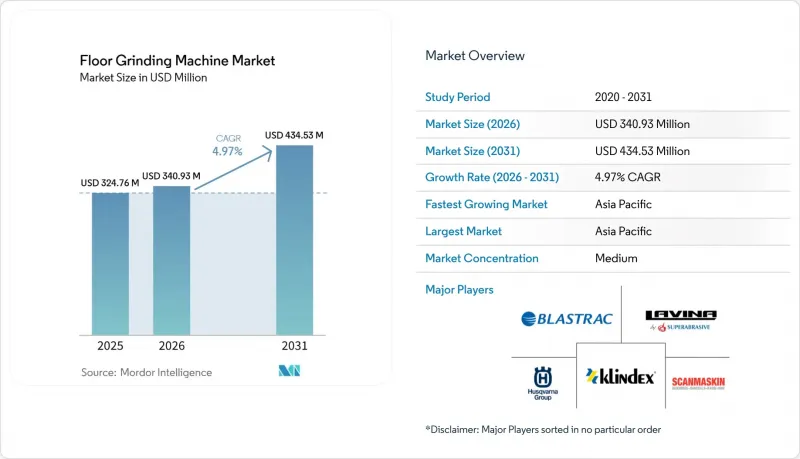
Mordor Intelligence에 의하면, 바닥 연마기 시장 규모는 2025년 3억 2,476만 달러로 평가되었습니다. 2026년에는 3억 4,093만 달러로 확대되어 2031년까지 4억 3,453만 달러에 이를 것으로 예상되고 있어 2026년부터 2031년에 걸쳐 CAGR은 4.97%를 나타낼 전망입니다.
본 보고서는 작동 방식(핸드헬드, 워크비하인드, 기타), 연마 방식(습식, 건식), 제품 유형(싱글 및 듀얼 헤드 그라인더, 쓰리 및 포 헤드 그라인더, 기타), 최종 사용자 분야(상업, 산업, 기타), 지역(북미, 남미, 유럽, 아시아태평양, 중동 및 아프리카)별로 분류되어 있습니다. 시장 전망은 금액(달러) 기준으로 제시되어 있습니다.
세계의 바닥 연마기 시장 동향 및 분석
연마 콘크리트 바닥의 인기 상승
미국의 비주거용 건축 착공액은 2026년 1월 전년 동기 대비 53.3% 증가한 803억 달러를 기록하며, 대규모 시설에서의 지속적인 기초 공사 활동을 뒷받침하는 견실한 사업 계획을 보여주고 있습니다. 데이터센터에 대한 지출은 2025년에 32% 증가할 것으로 예상되며, 2026년에는 26%, 2027년에는 17% 성장할 것으로 전망되는데, 이는 내구성이 뛰어나고 유지보수 부담이 적은 슬래브가 필요한 하이퍼스케일 프로젝트에서 고사양 연마 콘크리트에 대한 수요를 뒷받침하고 있습니다. AIA가 수주액 부진이 장기화되고 있으며 공사 연기가 광범위하게 보고되고 있다고 밝힌 가운데, 발주처는 계속해서 리스크 관리를 실시하고 있으며, 이에 따라 시공사는 자재 사용량을 줄이고 공사 기간을 단축하는 방안에 주력하고 있습니다. 연마 콘크리트 시스템은 자재 소비량을 줄이고 공사 기간을 단축합니다. 또한, 공급업체의 자료에 따르면, 두꺼운 코팅이나 긴 경화 기간을 피하는 표면 처리 방법을 통해 에너지와 공정 시간을 대폭 절감할 수 있는 것으로 나타났습니다. ACI 310.1-20 규격은 마감 수준 및 시공 절차에 관한 명확한 기준을 제시하며, 대규모 연방 정부 및 상업 건축물의 조달을 표준화하는 데 기여하고 있습니다. 노동력은 여전히 제약 요인으로 작용하고 있으며, 숙련공의 만성적인 부족으로 인해 바닥 연마기 시장에서는 작업 공정을 줄이고 현장 인력을 최소화하는 공정 설계 및 장비 선정에 대한 관심이 높아지고 있습니다.
창고 및 물류 인프라 확충
창고 건설은 팬데믹으로 인한 급증 이후 점차 정상화되고 있습니다. 2026년에는 단기적인 성장 둔화가 예상되고, 2027년에는 완만한 개선이 전망됨에 따라, 활동은 광범위한 신규 건설보다는 선별적인 개보수 쪽으로 전환되고 있습니다. 이러한 둔화세에도 불구하고, 전체 건축 지출에서 전자상거래 및 물류 자산이 차지하는 비중은 2019년 대비 확대되고 있으며, 보수 주기에 따라 슬래브 보수, 연마, 에폭시 오버레이에 대한 수요가 지속적으로 발생하고 있습니다. 중국에서는 2025년에 인프라 및 토지 공급의 주요 지표가 감소한 반면, 민간 인프라 투자는 소폭 증가했습니다. 이러한 투자 구성은 내구성이 뛰어난 바닥면과 엄격한 표면 처리 기준이 요구되는 물류 단지나 냉장 창고에 유리하게 작용하고 있습니다. 성숙한 아시아 시장에서 에너지 효율화를 목표로 하는 개보수 프로그램에서는 공조, 조명, 외피 개보수를 통해 상당한 비용 절감 효과가 입증되었으며, 이러한 프로젝트에서는 접착력이 중요한 마감 작업을 위해 그라인더에 의존하는 슬래브 바탕 처리 공정이 빈번하게 포함됩니다. 계약업체들은 입찰 가격 조정 및 조기 구매 결정을 통해 관세 리스크에 대한 헤지를 지속하고 있으며, 이러한 움직임은 플로어 그라인더 시장의 차량 교체 시기 및 표면 처리 패키지에 배정되는 가동 능력에 영향을 미치고 있습니다. 관리된 환경에서는 이음매가 없고 세척이 용이한 바닥재에 대한 규정 준수 요건이 여전히 엄격하며, 미국의 연방 수지계 바닥재 규격은 물류 관련 시설의 자재 및 공정 선택에 계속해서 영향을 미치고 있습니다.
업무용 장비의 높은 초기 투자 비용
2026년 초에도 건설 기계 가격 지수는 여전히 높은 수준을 유지했으며, 이로 인해 새로운 그라인더나 집진 시스템에 대한 투자 회수 기간이 길어지고 있습니다. 캐나다에서는 건설용 기계 및 설비 가격도 상승세를 보이고 있으며, 이로 인해 중소규모 도급업체들의 도입 장벽이 더욱 높아지고 있습니다. 많은 기업들이 관세 및 관세안에 대응하여 입찰 가격과 조달 시기를 조정하고 있으며, 이러한 움직임이 바닥 연마기 시장 전체의 장비 교체 속도에 영향을 미치고 있습니다. 인증 자격 취득 및 연수는 초기 비용을 증가시키고 있으며, 특히 주 차원의 프로그램의 경우 수업료와 시간적 부담이 정해져 있어 현장 일정과의 조정이 필요합니다. 크레인 운전사에게 실무 경력 증명이나 시험을 의무화하고 있는 주들은 안전 기준을 유지하고 있는 반면, 지반 정비 과정에서 중장비 운용을 확대해야 하는 기업들에게는 진입 장벽을 높이고 있습니다. 또한, 공급업체가 공개한 정보에 따르면, 2024년 건설기계 사업에서는 이익률 압박이 예상되며, 총소유비용(TCO) 결정에 있어 소모품과 서비스의 역할이 더욱 중요해지고 있습니다.
부문별 분석
2025년, 보행형 그라인더는 57.34%의 시장 점유율을 차지했으며, 이러한 입지는 바닥 연마기 시장에서 철거 작업과 연마 작업 간의 전환 시간을 단축시켜 주는 점, 개조 작업의 경제성, 그리고 작업자의 폭넓은 숙련도 덕분에 유지되고 있습니다. 승용 플랫폼은 대규모 물류 시설의 개보수나 데이터센터의 바닥 면 등, 높은 처리 능력이 요구되는 환경에서 선호되고 있습니다. 이러한 환경에서는 작업 범위가 넓기 때문에 높은 초기 투자가 정당화되지만, 많은 작업 팀에게 인력 확보는 여전히 제약 요인으로 남아 있습니다. 공급업체들이 작업자의 위험 노출을 줄이고 보다 안정적인 생산성을 제공하는 시스템을 도입함에 따라, 원격 조종형 및 자율 주행형 기종은 2031년까지 연평균 6.12%의 성장률을 보일 것으로 전망됩니다. 2026년에 공개된 자율형 컴팩터와 커넥티드 자산 플랫폼은 현장 자동화의 방향성을 제시하고 있으며, 이는 향후 바닥 관리 장비의 제어 및 안전 기능에 영향을 미칠 것으로 보입니다. 휴대용 모델이나 엣지 가공에 특화된 모델은 기둥이나 벽 근처에서 수행되는 특수 작업을 담당하여 작업자의 피로를 줄여줄 뿐만 아니라, 바닥 연마기 업계에서 모서리 부분의 작업 효율을 높여줍니다.
이러한 구성은 바닥 연마기 시장에서 도급업체들이 보다 간소화된 교육 과정과 감독 부담이 적은 플랫폼을 선호하도록 유도하는 지속적인 인력 확보 문제를 반영하고 있습니다. 원격 제어는 추락 위험을 방지하고 피로로 인한 작업 시간을 줄이는 데 도움이 되며, 이는 시공사 및 발주처의 안전 및 생산성 목표와 부합합니다. 각 벤더사는 일관된 성과를 뒷받침하고, 단기 프로젝트에서 재작업 가능성을 줄여주는 지침, 분진 억제, 텔레매틱스 기능을 지속적으로 통합하고 있습니다. 원격 제어형 및 자율 주행형을 포함한 기타 바닥 연마기 시장 규모는 2031년까지 연평균 성장률(CAGR) 6.12%로 확대될 것으로 예상되며, 이에 따라 사용자 인터페이스 및 지원 생태계에 대한 요구 수준이 높아지고 있습니다. 2026년이 다가옴에 따라, 교육 체계와 자율화의 단계적 도입 사이에서 균형을 잘 맞추는 기업들이 복잡한 표면 처리 패키지에서 수익성을 유지하는 데 있어 가장 유리한 입지를 차지하게 될 것입니다.
건식 연마기는 HEPA 등급의 집진 기능과 바닥 연마기 시장에서 민감한 환경 내의 공기질을 유지하는 고효율 분리 기술을 바탕으로, 2025년에는 64.81%의 시장 점유율을 차지했습니다. 관리된 공간이나 미션 크리티컬한 공간에서 사용되는 수지계 바닥재에 관한 연방 규격은 분진 억제 및 표면 프로파일 요건을 강화하고 있으며, 이는 건식 연마 설비와 잘 부합합니다. 습식 연마 시스템은 시장 규모는 작지만, 교량 상판 보수 및 투수성 포장 사업으로 인해 공기 중의 실리카를 억제해야 하는 슬러리 대응 하도 처리 수요가 지속될 것으로 예상에 따라, 2031년까지 연평균 6.23%의 성장률을 보일 것으로 전망됩니다. 지방 자치 단체의 투자 계획과 콘크리트 및 철근에 관한 주 차원의 비용 변경은 바닥 연마기 시장에서 특정 준비 및 연마 작업에 습식 방식을 빈번히 채택하는 유틸리티 파이프라인을 더욱 확대시키고 있습니다.
물 탱크가 내장되어 있고 내식성 보호 장치가 갖춰진 이 장비의 설계는 전환 시간을 단축하고 청소 작업을 줄여줍니다. 이에 따라 현장 상황이 허락하는 한, 습식 사이클의 활용이 확대되고 있습니다. 전기 부품공급 부족으로 인해 두 방식 모두에서 장비 납기가 지연될 가능성이 있으며, 계약업체들로부터 2026년 표면 처리 일정에까지 영향을 미치는 지연이 보고되고 있습니다. 바닥 연마기 업계는 환경 규제 및 일정 요구 사항에 맞추어 공정을 지속적으로 선택하고 있으며, 의료시설이나 반도체 시설에서는 집진 및 여과 성능이 공정 결정의 중요한 요소가 되는 경우가 많습니다. 습식 연마 분야의 바닥 연마기 시장 규모는 공공 인프라 유지 관리 및 지방자치단체의 도로 재포장 계획에 힘입어 2031년까지 연평균 성장률(CAGR) 6.23%를 나타낼 전망입니다.
지역별 분석
아시아태평양은 2025년에 43.21%로 1위를 차지했으며, 연평균 성장률(CAGR) 6.47%를 나타낼 것으로 전망됩니다. 이러한 비중은 해당 지역의 바닥 연마기 시장에서 일부 지역에서는 정부 주도의 인프라 수요가 위축되고 있음에도 불구하고, 물류, 제조 및 공공시설 자산 분야의 보수 수요가 견조함을 반영하고 있습니다. 2025년 중국 통계에 따르면, 특정 인프라 및 토지 공급 부문에서는 감소세가 나타난 반면, 민간 인프라 투자는 증가했으며, 이는 내부 개보수나 특정 분야를 대상으로 한 확장에 중점을 둔, 보다 세분화된 프로젝트 구성을 시사합니다. 일본이 발표한 사무실 에너지 개보수 평가에서는 코팅 및 마감 공정을 위한 슬래브 기초 처리를 포함한 성능 개선의 여지가 강조되고 있습니다. 지역별 제품 전략에는 공급업체가 성장 분야 및 규정 준수 요건에 대응하는 과정에서 집진 기능과 공구 생태계의 고도화가 포함되어 있습니다. 아시아태평양의 바닥 연마기 시장 규모는 물류 허브 및 정밀 제조 분야에 대한 지속적인 투자의 혜택을 받고 있으며, 이러한 분야에서는 분진 대책과 재현성 있는 표면 프로파일이 프로젝트 성공의 핵심 요소입니다.
북미에서는 2026년 비주거용 건설 시장이 호조를 보이며 출발한 반면, 바닥 연마기 시장의 일부 상업 부문에 대해서는 향후 몇 년간의 전망이 신중한 편이며, 단기적인 변동이 예상됩니다. 데이터센터는 주요 성장 동력으로, 2027년까지 두 자릿수 성장이 지속될 것으로 예상되며, 이에 따른 수요가 고품질의 연마 및 코팅 작업을 뒷받침하고 있습니다. 댈러스 등의 도시 계획과 브룩필드 등의 교외 지역에서 진행되는 프로젝트를 통해, 기계적인 기초 처리가 필요한 보도, 도로, 녹지 및 주차장에서의 지속적인 작업이 증가하고 있습니다. 또한, 교량 및 교각 보수 사업도 토목 공사 분야에서 습식 연마에 대한 수요를 뒷받침하고 있습니다. 노동력 부족은 여전히 처리 능력에 광범위한 제약 요인으로 작용하고 있으며, 건설 기계 가격 지수는 2026년 바닥 연마기 시장의 자본 계획 수립에 지침이 될 투입 비용 상승을 뒷받침하고 있습니다.
유럽에서는 2026년과 2027년에 공공시설에 대한 수요가 증가할 전망인 가운데, 리모델링 주기와 수지계 바닥재의 의무화가 핵심적인 역할을 하고 있으며, 코팅 공급업체들은 민감한 실내 용도를 위해 저VOC이며 EN 규격을 준수하는 시스템을 구축하고 있습니다. 수지계 바닥재에 관한 미국 연방 규격은 관련 시설에서 자주 참조되고 있으며, 접착성과 습기 조건에 대한 철저한 고려가 일관된 하도 처리 워크플로우를 뒷받침하고 있습니다. 주요 업체들은 바닥 연마기 시장에서 유럽의 기준과 지속가능성 우선 과제에 부합하는 전동화, 집진, 자동화 기능에 대한 투자를 지속하고 있습니다. 캐나다의 기계 가격 지수는 여전히 높은 수준을 유지하고 있으며, 기업들로부터 숙련공 부족 현상이 지속되고 있다는 보고가 나오고 있어, 가격과 노동력이 앞으로도 유럽 및 대서양 횡단 프로젝트의 실행 여건을 좌우할 것임을 시사하고 있습니다.
기타 혜택 :
- 엑셀 형식 시장 예측(ME) 시트
- 3개월간의 애널리스트 지원
자주 묻는 질문
목차
제1장 서론
제2장 조사 방법
제3장 주요 요약
제4장 시장 구도
제5장 시장 규모 및 성장 예측
제6장 경쟁 구도
제7장 시장 기회 및 향후 전망
KTH 26.06.19According to Mordor Intelligence, the floor grinding machine market size is expected to increase from USD 324.76 million in 2025 to USD 340.93 million in 2026 and reach USD 434.53 million by 2031, growing at a CAGR of 4.97% over 2026-2031.
This report is Segmented by Mode of Operation (Handheld, Walk-Behind, and More), Grinding Mechanism (Wet, Dry), Product Type (Single- & Dual-Head Grinders, Three- & Four-Head Grinders, and Others), End-User Vertical (Commercial, Industrial, and More), and Geography (North America, South America, Europe, Asia-Pacific, and Middle East and Africa). The Market Forecasts are Provided in Terms of Value (USD).
Global Floor Grinding Machine Market Trends and Insights
Growing Popularity of Polished Concrete Flooring
Nonresidential construction starts in the United States show a 53.3% year-over-year increase to USD 80.3 billion in January 2026, signaling a strong pipeline that supports sustained floor preparation activity in large facilities. Data center spending rose 32% in 2025 and is poised to grow by 26% in 2026 and 17% in 2027, which anchors demand for high-spec polished concrete in hyperscale projects that require durable, low-maintenance slabs. Owners continue to manage risk as the AIA reports a prolonged period of weaker billings along with broad reports of postponements, which keep contractors focused on methods that cut material use and compress schedules. Polished concrete systems cut material consumption and speed up schedules, and vendor documentation shows significant energy and program-time savings for surface preparation paths that avoid heavy toppings and long cure windows. The ACI 310.1-20 specification provides a clear framework for finish levels and process steps, which helps standardize procurement on large federal and commercial builds. Labor remains the binding constraint, and persistent craft shortages keep interest high in process designs and equipment choices that reduce passes and contain on-site headcount in the floor grinding machine market.
Expansion of Warehouse and Logistics Infrastructure
Warehouse construction is normalizing after the pandemic surge as near-term growth remains muted in 2026 with modest improvement projected for 2027, which shifts activity toward selective upgrades rather than broad new footprints. Even with that moderation, the share of e-commerce and logistics assets in overall building spending expanded compared to 2019, and retrofit cycles keep recurring demand for slab repair, grinding, and epoxy overlays. In China, headline infrastructure and land supply metrics contracted in 2025 while private infrastructure investment edged up, an investment mix that favors logistics parks and cold storage where hard-wearing surfaces and surface preparation standards are tightly specified. Energy-focused renovation programs in mature Asia markets document significant savings from HVAC, lighting, and envelope upgrades, and those projects frequently incorporate slab preparation stages that rely on grinders for adhesion-critical finishes. Contractors continue to hedge tariff exposure through bid adjustments and earlier purchasing decisions, a behavior that influences fleet refresh timing and the capacity available for surface preparation packages in the floor grinding machine market. Compliance expectations for seamless, cleanable surfaces remain high in controlled environments, and U.S. federal resinous-flooring specifications continue to influence material and process choices in logistics-linked facilities.
High Initial Capital Investment for Professional Equipment
Pricing indices for construction machinery remain elevated in early 2026, which extends payback periods for new grinders and dust extraction systems. In Canada, machinery and equipment prices for construction end uses also trend higher, which compounds acquisition hurdles for smaller contractors. Many firms adjusted bids and procurement timing in response to tariffs and proposed duties, and that behavior impacts the cadence of fleet refresh across the floor grinding machine market. Certification and training add to upfront costs, including state-level programs with defined tuition and time commitments that must be managed against job-site schedules. States that require documented experience and examinations for crane operators preserve safety baselines but increase hurdles for companies that need to scale heavy-equipment operations in surface preparation. Vendor disclosures also show margin pressure in construction equipment businesses in 2024, which reinforces the role of consumables and services in total cost of ownership decisions.
Other drivers and restraints analyzed in the detailed report include:
- Rising Commercial and Industrial Renovation Activity
- Increasing Demand for Decorative and Stained Concrete Floors
- Shortage of Trained and Experienced Operators
For complete list of drivers and restraints, kindly check the Table Of Contents.
Segment Analysis
Walk-behind grinders held 57.34% in 2025, a position sustained by retrofit economics and broad operator familiarity that reduces changeover time across removal and polishing tasks in the floor grinding machine market. Ride-on platforms are favored for high-throughput environments such as large logistics retrofits and data center slabs, where coverage targets justify higher capital, although staff availability remains a constraint for many crews. Remote-controlled and autonomous variants are projected to grow at 6.12% through 2031 as suppliers introduce systems that reduce operator exposure and provide steadier productivity. Autonomous compactors and connected asset platforms showcased in 2026 highlight the direction of jobsite automation that will influence floor equipment controls and safety features over time. Handheld and edge-focused models fill specialty roles near columns and walls, reducing manual fatigue and extending the life of corner work in the floor grinding machine industry.
This mix reflects persistent hiring challenges that push contractors to favor platforms with simpler training paths and less intensive supervision in the floor grinding machine market. Remote controls help address fall hazards and reduce fatigue hours, which aligns with safety and productivity objectives at prime contractors and owners. Vendors continue to integrate guidance, dust control, and telematics features that support consistent outcomes and lower rework probability on fast-track jobs. The floor grinding machine market size for others, including remote-controlled and autonomous variants, is projected to expand at a 6.12% CAGR through 2031, which sets a higher bar for user interfaces and support ecosystems. As 2026 progresses, firms that balance training pipelines with incremental autonomy adoption are best positioned to protect margins on complex surface preparation packages.
Dry grinding machines commanded 64.81% share in 2025, supported by HEPA-grade dust extraction and highly efficient separation that maintains air quality in sensitive environments within the floor grinding machine market. Federal specifications for resinous flooring in controlled and mission-critical spaces reinforce dust containment and surface profile requirements that align well with dry grinding setups. Wet grinding systems, although smaller in base, are projected to grow at 6.23% through 2031 as bridge-deck rehabilitation and permeable pavement programs sustain demand for slurry-compatible preparation where airborne silica must be suppressed. Municipal investment rounds and state-level cost changes in concrete and reinforcing steel add to the public-works pipeline that often uses wet methods for specific prep and polishing tasks in the floor grinding machine market.
Equipment designs with integrated water tanks and corrosion-resistant guards improve changeover time and reduce cleanup, which supports broader use of wet cycles where jobsite conditions permit. Electrical component bottlenecks can slow equipment deliveries for both mechanisms, and contractors report delays that ripple into surface preparation timelines in 2026. The floor grinding machine industry continues to match mechanism choices to environmental controls and schedule needs, with dust extraction and filtration performance often determining the method for healthcare and semiconductor facilities. The floor grinding machine market size for wet grinding is set to advance at a 6.23% CAGR through 2031, supported by public infrastructure maintenance and municipal resurfacing plans.
Geography Analysis
Asia-Pacific led with 43.21% in 2025 and is projected to grow at a 6.47% CAGR, and that combination reflects strong retrofit demand in logistics, manufacturing, and institutional assets despite a softer backdrop for state-led infrastructure in parts of the region in the floor grinding machine market. China's 2025 statistics show declines in certain infrastructure and land supply categories while private infrastructure investment increased, which points to a more granular project mix that emphasizes interior upgrades and targeted expansions. Japan's published evaluations of office energy retrofits highlight the scope for performance upgrades that often include slab preparation for coatings and finishes. Regional product strategies include upgraded dust extraction and tool ecosystems as suppliers align with growth pockets and compliance needs. The floor grinding machine market size in Asia-Pacific benefits from ongoing investments in logistics hubs and sensitive manufacturing, where dust control and repeatable surface profiles are central to project success.
North America exhibits near-term volatility with a strong start to 2026 in nonresidential construction alongside cautious multi-year forecasts for several commercial categories in the floor grinding machine market. Data centers are a primary bright spot with sustained double-digit growth through 2027, and that activity anchors high-spec polish and coating work. City programs in places like Dallas and project rounds in suburbs such as Brookfield add recurring work in sidewalks, streets, and green parking areas that require mechanical preparation. Bridge and pier repair initiatives also support wet grinding demand within civil scopes. Labor constraints remain a widespread limiter on throughput, and pricing indices for construction machinery underline higher input costs that guide capital planning in 2026 in the floor grinding machine market.
In Europe, renovation cycles and resinous-flooring mandates play central roles as institutional facilities move higher in 2026 and 2027, and coatings suppliers document low-VOC, EN-standard-compliant systems for sensitive interior uses. U.S. federal specifications for resinous flooring are frequently referenced across allied facilities, and their emphasis on bonding and moisture conditions supports consistent preparation workflows. Leading vendors continue to invest in electrification, dust extraction, and automated features that align with European standards and sustainability priorities in the floor grinding machine market. Canadian machinery price indices remain elevated, and firms report ongoing craft shortages, which indicates that pricing and labor will continue to shape European and transatlantic project delivery conditions.
- Husqvarna Group
- Blastrac
- Superabrasive (Lavina)
- Klindex
- Scanmaskin
- SASE Company
- HTC Floor Systems
- Bartell Global (Diamatic)
- WerkMaster
- Xingyi Polishing
- High-Tech Grinding System
- Ronlon Machinery
- Schwamborn
- National Flooring Equipment
- Terrco
- CS Unitec
- NSS Enterprises
- Trelawny Surface Preparation
- Heger Diamond Tools
- EDCO (Equipment Development Co.)
Additional Benefits:
- The market estimate (ME) sheet in Excel format
- 3 months of analyst support
TABLE OF CONTENTS
1 Introduction
- 1.1 Study Assumptions & Market Definition
- 1.2 Scope of the Study
2 Research Methodology
3 Executive Summary
4 Market Landscape
- 4.1 Market Overview
- 4.2 Market Drivers
- 4.2.1 Growing Popularity of Polished Concrete Flooring
- 4.2.2 Expansion of Warehouse and Logistics Infrastructure
- 4.2.3 Rising Commercial and Industrial Renovation Activity
- 4.2.4 Increasing Demand for Decorative and Stained Concrete Floors
- 4.2.5 Growth in Epoxy and Resinous Flooring Installations
- 4.2.6 Infrastructure Maintenance and Concrete Repair Programs
- 4.3 Market Restraints
- 4.3.1 High Initial Capital Investment for Professional Equipment
- 4.3.2 Shortage of Trained and Experienced Operators
- 4.3.3 Physical Demands and Operator Fatigue Issues
- 4.3.4 High Consumable Costs Impacting Project Economics
- 4.4 Value / Supply-Chain Analysis
- 4.5 Regulatory Landscape
- 4.6 Technological Outlook
- 4.7 Industry Attractiveness - Porter's Five Forces
- 4.7.1 Threat of New Entrants
- 4.7.2 Bargaining Power of Suppliers
- 4.7.3 Bargaining Power of Buyers
- 4.7.4 Threat of Substitutes
- 4.7.5 Competitive Rivalry
- 4.8 Equipment Size and Application Segmentation Dynamics
- 4.9 Regional Market Maturity and Technique Adoption
5 Market Size & Growth Forecasts (Value, In USD Billion)
- 5.1 By Mode of Operation
- 5.1.1 Handheld
- 5.1.2 Walk-Behind
- 5.1.3 Ride-On
- 5.1.4 Others (Remote-Controlled/Autonomous)
- 5.2 By Grinding Mechanism
- 5.2.1 Wet Grinding Machines
- 5.2.2 Dry Grinding Machines
- 5.3 By Product Type
- 5.3.1 Single- & Dual-Head Grinders
- 5.3.2 Three- & Four-Head Grinders
- 5.3.3 Other Configurations (Custom / Multi-Head Configurations, specialized, etc.)
- 5.4 By End-user Vertical
- 5.4.1 Commercial
- 5.4.2 Industrial
- 5.4.3 Residential
- 5.4.4 Others (Institutional, Infrastructure (Airports, Hospitals, etc.))
- 5.5 By Geography
- 5.5.1 North America
- 5.5.1.1 United States
- 5.5.1.2 Canada
- 5.5.1.3 Mexico
- 5.5.2 South America
- 5.5.2.1 Brazil
- 5.5.2.2 Argentina
- 5.5.2.3 Peru
- 5.5.2.4 Rest of South America
- 5.5.3 Europe
- 5.5.3.1 United Kingdom
- 5.5.3.2 Germany
- 5.5.3.3 France
- 5.5.3.4 Italy
- 5.5.3.5 Spain
- 5.5.3.6 BENELUX (Belgium, Netherlands, and Luxembourg)
- 5.5.3.7 NORDICS (Denmark, Finland, Iceland, Norway, and Sweden)
- 5.5.3.8 Rest of Europe
- 5.5.4 Asia-Pacific
- 5.5.4.1 China
- 5.5.4.2 India
- 5.5.4.3 Japan
- 5.5.4.4 Australia
- 5.5.4.5 South Korea
- 5.5.4.6 ASEAN (Indonesia, Thailand, Philippines, Malaysia, Vietnam)
- 5.5.4.7 Rest of Asia-Pacific
- 5.5.5 Middle East and Africa
- 5.5.5.1 Saudi Arabia
- 5.5.5.2 United Arab Emirates
- 5.5.5.3 Qatar
- 5.5.5.4 Kuwait
- 5.5.5.5 Turkey
- 5.5.5.6 Egypt
- 5.5.5.7 South Africa
- 5.5.5.8 Nigeria
- 5.5.5.9 Rest of Middle East and Africa
- 5.5.1 North America
6 Competitive Landscape
- 6.1 Market Concentration
- 6.2 Strategic Moves
- 6.3 Market Share Analysis
- 6.4 Company Profiles (includes Global level Overview, Market level overview, Core Segments, Financials as available, Strategic Information, Products & Services, and Recent Developments)
- 6.4.1 Husqvarna Group
- 6.4.2 Blastrac
- 6.4.3 Superabrasive (Lavina)
- 6.4.4 Klindex
- 6.4.5 Scanmaskin
- 6.4.6 SASE Company
- 6.4.7 HTC Floor Systems
- 6.4.8 Bartell Global (Diamatic)
- 6.4.9 WerkMaster
- 6.4.10 Xingyi Polishing
- 6.4.11 High-Tech Grinding System
- 6.4.12 Ronlon Machinery
- 6.4.13 Schwamborn
- 6.4.14 National Flooring Equipment
- 6.4.15 Terrco
- 6.4.16 CS Unitec
- 6.4.17 NSS Enterprises
- 6.4.18 Trelawny Surface Preparation
- 6.4.19 Heger Diamond Tools
- 6.4.20 EDCO (Equipment Development Co.)
7 Market Opportunities & Future Outlook
- 7.1 White-space & Unmet-need Assessment