

|
시장보고서
상품코드
2061975
모링가 성분 : 시장 점유율 분석, 산업 동향 및 통계 데이터, 성장 예측(2026-2031년)Moringa Ingredients - Market Share Analysis, Industry Trends & Statistics, Growth Forecasts (2026 - 2031) |
||||||
 Mordor Intelligence
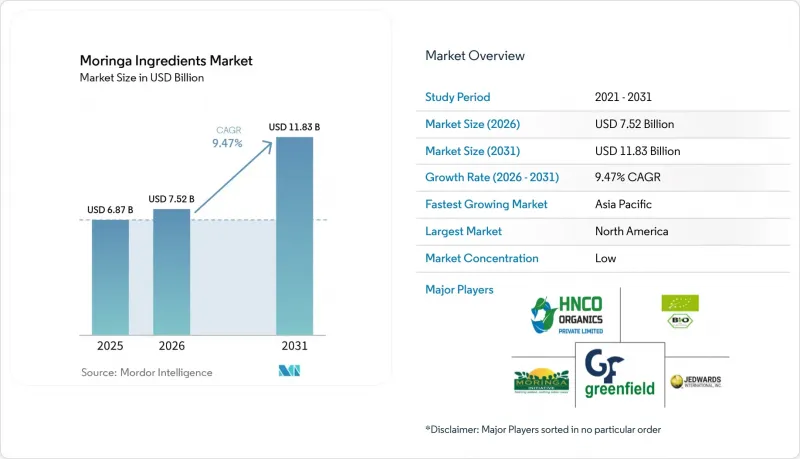
Mordor Intelligence에 의하면, 모링가 성분 시장 규모는 2025년에 68억 7,000만 달러로 평가되었습니다. 2026년 75억 2,000만 달러에서 2031년까지 118억 3,000만 달러에 이를 것으로 예상되며, 예측 기간(2026-2031년) CAGR은 9.47%를 나타낼 전망입니다.
본 보고서는 원료별(잎, 꽃, 씨앗, 꼬투리, 기타), 용도별(식품 및 음료, 영양보조식품, 의약품, 퍼스널케어 및 화장품, 동물사료, 기타), 지역별(북미, 유럽, 아시아·태평양, 남미, 중동 및 아프리카)로 분류되어 있습니다. 시장 전망은 금액(달러) 및 수량(톤) 단위로 제시되어 있습니다.
세계의 모링가 성분 시장 동향 및 인사이트
자연산이며 영양이 풍부한 슈퍼푸드에 대한 소비자들의 인기가 높아지고 있습니다.
식물 유래 및 클린 라벨 영양 식품에 대한 소비자의 인기가 높아지면서, 모링가 성분에 대한 수요가 증가하고 있습니다. 이는 합성 첨가물이나 과도하게 가공된 식품에 대한 회의적인 시각이 강해짐에 따라 수요가 확대되고 있기 때문입니다. 모링가는 영양 밀도가 높으며, 중량 대비 오렌지의 7배에 달하는 비타민 C, 우유의 17배에 달하는 칼슘, 시금치의 25배에 달하는 철분을 함유하고 있어, 단순한 단일 영양소 추출물이 아닌 기능성 전체 식품 원료로서의 입지를 확고히 하고 있습니다. 그러나 배합 담당자들은 여전히 풍미 측면에서 과제에 직면해 있습니다. 함유율이 3-4%를 초과하면 뚜렷한 쓴맛이 나기 때문에 캡슐화 기술을 도입하거나 스피루리나, 바오밥나무 등 궁합이 좋은 식물 성분과 혼합하는 것이 권장됩니다. 지속가능성을 위한 노력 또한 시장에서의 매력을 높이고 있습니다. 예를 들어, True Moringa사는 2025년 8월, 가나의 300에이커 부지에 1,000만 그루째 나무를 심었다고 발표했습니다. 이를 통해 3만 5,000톤 이상의 이산화탄소가 고정된 것으로 보고되었으며, 프리미엄 소매 채널에서 재생 농업이 지닌 이야기가 점점 더 중요한 역할을 하고 있음이 부각되고 있습니다.
허브 및 아유르베다 기반 웰니스 솔루션에 대한 높은 수요
아유르베다와 같은 전통적인 웰니스 체계는 특히 남아시아 및 디아스포라가 주도하는 시장에서 증거 기반의 뉴트라슈티컬(기능성 식품)이라는 틀 안에서 점점 더 재정의되고 있습니다. 인도의 ‘NutriBharat&2047’ 이니셔티브는 해당국의 뉴트라슈티컬 분야에서의 야심찬 목표를 실현하기 위한 우선 식물로 모링가, 강황, 아슈와간다를 꼽고 있습니다. 이를 위해 추출물의 품질을 표준화하기 위해 정부가 지원하는 작물 생산 회랑과 생리활성 성분 가공 허브가 활용되고 있습니다. 이 전략은 2025년에 시작된 우타르프라데시 주의 ‘모링가 미션’과 같은 지역 프로그램에도 반영되어 있습니다. 이 프로그램에서는 ‘갈 바기야’ 계획에 따라 무료 묘목을 배포하고, 학교 급식 프로그램에 모링가를 도입했습니다. 이는 NFHS-5 데이터에 따르면, 해당 주에서 생후 6개월부터 5세까지의 아동 중 67%와 15세에서 49세 사이의 여성 중 50%가 앓고 있는 빈혈을 예방하기 위한 조치의 일환입니다. 상업적인 측면에서는 유서 깊은 아유르베다 기업들이 디지털 및 클린 라벨 시장으로 사업을 확장하고 있습니다. 예를 들어, 바이디야나트 아유르베다사는 2026년 2월, 아마존, 플립카트, 지오마트를 통해 200그램에 215루피인 ‘인증 유기농 모링가 파우더’를 출시했습니다. 한편, 규제 당국의 감독도 강화되고 있으며, 인도의 AYUSH부는 건강 관련 효능 표시에 대해 무작위 대조 시험을 의무화하고 있어, 제조업체에 대한 규정 준수 기대가 높아지고 있습니다.
모링가 재배에 따른 높은 생산 및 가공 비용
모링가는 적은 투자로도 기후 변화에 강한 작물로 알려져 있지만, 수출 기준을 충족하는 품질을 확보하기 위해서는 여전히 막대한 비용이 소요되어 소규모 생산자들에게는 장벽이 되고 있습니다. 서유럽 프리미엄 시장에서 요구되는 유기농 인증에는 농장당 연간 1,200-3,500달러의 비용이 드는 반면, 해충 방제 수단이 제한적이기 때문에 유기농 재배의 수확량은 기존 재배 방식에 비해 15-20% 낮은 것으로 추정됩니다. 수확 후 인프라에도 막대한 투자가 필요하며, 중규모 사업에서 온도 조절이 가능한 건조 시스템을 도입하는 데 약 180만-190만 루피(약 2만 2,000달러)의 비용이 들기 때문에 많은 농가들은 품질이 낮은 햇볕 건조 방식에 의존할 수밖에 없는 상황입니다. 인도의 ‘국가 원예 미션’이나 ‘PM-Kisan’과 같은 제도를 통해 자본 비용의 30-40%가 보조될 가능성이 있지만, 그 이용 기회는 여전히 고르지 않은 상태이며, IndexBox의 추산에 따르면 인도의 모링가 잎 생산량 중 국제 수출 기준을 충족하는 것은 고작 30-40%에 불과합니다. 가격 격차도 시장을 더욱 복잡하게 만들고 있는데, 수출용 유기농 모링가 분말은 국제 시장에서 1kg당 700-1,200루피에 판매되는 반면, 국내 시장에서는 180-250루피에 그치고 있습니다. 재정적 압박은 Ancient GreenFields와 같은 통합형 사업자에서 특히 두드러집니다. 이 회사는 인증 및 품질 관리 비용 증가에 더해, 저비용 아프리카산 공급업체와의 경쟁으로 인해 2025 회계연도(FY25) 매출이 22% 감소해 9,860만 루피를 기록했다고 보고했습니다.
부문별 분석
잎을 원료로 한 제품 형태는 여전히 이 카테고리의 주력이며, 캡슐, 스무디 블렌드, 바 및 음료에 첨가하는 방식이 성장을 주도하고 있습니다. 2025년에는 모링가 성분 시장 점유율의 42.47%를 잎 분말이 차지했습니다. 유기농 인증, 제3자 기관의 검사, 투명한 조달에 주력하는 기업들은 일상적으로 소비되는 그린 블렌드나 휴대하기 편리한 스틱 팩을 통해 소매 파트너들의 지지를 얻고 있으며, 이를 통해 미국과 유럽의 일반 가정에서 시장 점유율을 유지하고 있습니다. 모링가 성분 업계에서는 단백질 강화 및 입자 크기 조절을 통해, 각 브랜드가 수분 보충 음료 및 시리얼 기반 스낵의 맛과 분산성을 관리함으로써, 마스킹제를 사용하지 않고도 일관된 소비자 경험을 제공합니다. 스무디부터 맛을 내는 조미료에 이르기까지 다양한 이용 사례로 인해, 유통 채널이나 계절에 관계없이 수요가 안정적이기 때문에 판매량은 여전히 잎 형태에 집중되어 있습니다. 모링가 성분 업계에서 수확 시기, 건조 곡선, 최종 분쇄 공정을 관리하는 통합 공급업체는 신뢰할 수 있는 수분 함량, 색상 및 생리활성 성분의 특성을 갖춘 분말을 제공할 수 있으며, 각 브랜드의 전 세계 제품 포트폴리오 전반에 걸쳐 규모 확장이 가능합니다.
종자 유래 원료 시장은 2031년까지 연평균 성장률(CAGR) 10.47%를 기록하며 성장할 것으로 전망됩니다. 이는 임상적 효과 및 지속가능성에 관한 이야기가, 모링가 유래 유효 성분을 함유한 에센스, 시술 후 케어 제품, 피부 장벽 기능 지원 제품에 대한 소비자의 구매 의욕을 높여주고 있기 때문입니다. 식물 유래 제품 형태에서 그 가치 제안은 프리미엄 화장품에 중점을 두고 있습니다. 고순도 씨앗 오일이나 업사이클링된 씨앗 케이크에서 추출한 유효 성분은 안정성, 텍스처, 그리고 친환경적인 지속가능성 스토리를 추구하는 제형 개발자들의 관심을 끌고 있습니다. 화장품용 종자 유래 유효 성분이 프리미엄 가치를 발휘하는 것은 안정성 시험에서 재현성 있는 성능을 보였으며, 유럽 소매 시장의 요구에 부응하는 소규모 농가로부터의 조달 실적이 있기 때문입니다. 이에 따라 업사이클링된 추출물이 신제품 기획의 핵심으로 자리 잡고 있습니다. 이러한 상황에서 씨앗을 원료로 한 제품 형태는 모링가 성분 시장 규모 확대에 기여하고 있습니다. 그 이유는 2026년부터 2031년까지의 성장 전망이 고가 제품군 및 여러 국가에서의 더모코스메틱 라인 확장과 밀접하게 연관되어 있기 때문입니다. 브랜드들이 완벽한 추적 가능성과 문서화된 지속가능성을 추구하는 가운데, 농학, 수확 후 관리, 검증된 추출 공정을 통합한 공급업체들은 성장과 수익성 양면에서 단순한 상품 거래 모델을 계속해서 능가할 것입니다.
지역별 분석
북미는 2025년 매출의 37.87%를 차지했으며, 이는 유기농 및 클린 라벨에 대한 주장이 쇼핑객과 카테고리 바이어들에게 충분히 이해되고 있는 성숙한 소매 생태계를 뒷받침하고 있습니다. 미국에서는 모링가를 주성분으로 하는 캡슐, 블렌드 및 조리용 제품을 취급하는 전국 규모의 식료품점, 자연식품 체인점, 전문 소매점을 통해 시장 규모가 확대되고 있으며, 이러한 소매망의 확장이 일반 소비자층을 대상으로 한 가정 내 보급과 재구매를 뒷받침하고 있습니다. 모링가 성분 시장은 예방 의학에 대한 지역적 관심 덕분에 혜택을 보고 있습니다. 이는 간편한 섭취 방법과 신뢰할 수 있는 검사 결과를 보장하는 캡슐 형태가 진열 계획의 필수 조건이 되고 있다는 점과 일치합니다. 2025년과 2026년에 발생한 리콜 사건은 구매업체공급업체 검증, 환경 모니터링, 그리고 검증된 살균 공정에 대한 관심을 높였으며, 이러한 요소들은 수입업체의 실사 및 우선적인 조달 관계에 즉각적인 영향을 미치고 있습니다. cGMP, HACCP 문서, 로트 단위 검사를 핵심 차별화 요인으로 삼는 브랜드는 재입고 주기에서 소매업체와의 협상력을 높이고 있으며, 이러한 추세는 2026년까지도 상품 취급 결정에 계속 영향을 미칠 것으로 보입니다. 북미의 모링가 성분 시장 점유율은 규모와 문서화, 그리고 신속한 품질 관리의 균형을 유지할 수 있는 신뢰할 수 있는 브랜드와 통합 공급업체들에 의해 뒷받침되고 있습니다.
유럽에서는 더욱 엄격한 규제 요건과 함께, 표준화된 유효 성분, 유기농 인증, 소규모 생산자의 추적 가능성을 중시하는 프리미엄화 추세가 확산되고 있습니다. 모링가 잎 분말이나 씨앗 오일은 처방 개발자나 전문 소매업체에게는 친숙한 원료이지만, 새로운 형태의 원료나 품종에 대해서는 여전히 엄격한 신규 식품 심사 및 안전성 심사를 거쳐야 하며, 이로 인해 출시 시기나 규정 준수 비용 산정에 영향을 미치고 있습니다. 클린 뷰티를 추구하는 브랜드들은 피부 장벽 기능 강화 및 항염증 효과를 강조하는 스토리라인을 통해, 모링가 유래 오일과 업사이클링된 추출물의 효능을 입증하고 있습니다. 이 접근 방식에서는 프리미엄 SKU의 경우, 원산지가 문서화되어 있으며, 재현성이 있는 체외 시험 결과와 사용 시 효과가 입증된 점이 높이 평가됩니다. 식품 분야 전반에 걸쳐 오염 물질 및 잔류 농약에 관한 규제는 필수 조건이므로, 업스트림 공정의 관리 및 검사에 투자하는 수출업체는 유럽 시장 진출에 있어 우위를 점하게 됩니다. 따라서 유럽의 모링가 성분 시장은 엄격한 제품 스토리를 기대하는 소매업체와 소비자들에게, 추적 가능성과 지속가능성이 어필하는 고부가가치 형태로 편중되고 있습니다. 이러한 구조로 인해 북미에 비해 판매량 증가세는 완만하지만, 특히 화장품 및 프리미엄 웰니스 분야에서 더 높은 가격 책정이 가능해졌습니다.
아시아태평양은 가장 빠르게 성장하고 있는 지역으로, 2031년까지의 연평균 성장률(CAGR)은 12.85%로 예측됩니다. 이는 인도가 모링가를 공공 프로그램 및 국내 소매 시장에 정착시키기 위해 재배, 수거, 영양 관련 노력을 추진하고 있기 때문입니다. 주 차원의 식목 사업 및 영양 지원 정책을 통해 공급이 확대되고 있으며, 농가의 참여도 촉진되고 있습니다. 한편, 수출 기관은 생산자가 EU나 미국의 요건을 충족할 수 있도록 서류 작성 및 품질 관리 절차를 정해 두고 있습니다. 모링가 성분 시장은 기능성 식품 및 건강기능식품에 대한 국내의 관심이 높아짐에 따라 혜택을 보고 있으며, 이에 따라 가공업체들은 수출용 분말 및 표준화 추출물을 생산하기 위해 건조, 분쇄, 검사 능력을 향상시켜야 할 필요성이 대두되고 있습니다. 아시아태평양 외에도 중동 및 아프리카에서는 북미와 유럽의 규정 준수 및 지속가능성 요건에 맞추어 설계된 대규모 재배 및 가공 거점을 갖추고, 수출 시장을 겨냥한 통합 프로젝트의 확대가 시작되고 있습니다. 이러한 프로젝트들은 기후 변화에 대한 회복력, 일자리 창출, 재생 농업이라는 목표가 추적 가능성과 사회적 영향에 대한 프리미엄 구매자들의 기대와 부합함으로써, 모링가 성분 시장의 기반을 형성하고 있습니다. 지역의 역량이 성숙해짐에 따라, 아시아태평양(APAC) 및 중동 및 아프리카(MEA)에서 공급되는 원료들이 프리미엄 수입 기준을 충족하게 되면서, 이 부문이 일반 분말에서 인증받고 표준화된 원료로 전환되는 추세가 가속화될 것입니다.
기타 혜택 :
- 엑셀 형식 시장 예측(ME) 시트
- 3개월간의 애널리스트 지원
자주 묻는 질문
목차
제1장 서론
제2장 분석 방법
제3장 주요 요약
제4장 시장 구도
제5장 시장 규모 및 성장률 예측
제6장 경쟁 구도
제7장 시장 기회 및 향후 동향
KTH 26.06.24According to Mordor Intelligence, the moringa ingredients market size was valued at USD 6.87 billion in 2025 and estimated to grow from USD 7.52 billion in 2026 to reach USD 11.83 billion by 2031, at a CAGR of 9.47% during the forecast period (2026-2031).
This report is Segmented by Source (Leaf, Flowers, Seeds, Pods, Others), Application (Food and Beverages, Dietary Supplements, Pharmaceuticals, Personal Care and Cosmetics, Animal Feed, Others), and Geography (North America, Europe, Asia-Pacific, South America, Middle East and Africa). The Market Forecasts are Provided in Terms of Value (USD) and Volume (Tons).
Global Moringa Ingredients Market Trends and Insights
Rising consumer preference for natural and nutrient-rich superfoods
Growing consumer preference for plant-based and clean-label nutrition is driving demand for moringa ingredients, as increasing skepticism toward synthetic additives and ultra-processed foods fuels demand. Moringa's high nutritional density, containing 7 times more vitamin C than oranges, 17 times more calcium than milk, and 25 times more iron than spinach on a gram-for-gram basis, positions it as a functional whole-food ingredient rather than a standalone nutrient extract. However, formulators continue to face flavor challenges, as inclusion levels above 3-4% can introduce noticeable bitterness, encouraging the use of encapsulation technologies and blending with complementary botanicals such as spirulina and baobab. Sustainability positioning is also strengthening market appeal; for example, True Moringa announced in August 2025 that it had planted its 10 millionth tree across 300 acres in Ghana, reportedly sequestering more than 35,000 metric tons of CO2, highlighting the growing role of regenerative agriculture narratives in premium retail channels.
Strong demand for herbal and ayurvedic wellness solutions
Traditional wellness systems such as Ayurveda are increasingly being repositioned within evidence-based nutraceutical frameworks, particularly across South Asia and diaspora-driven markets. India's NutriBharat@2047 initiative identifies moringa, turmeric, and ashwagandha as priority botanicals for the country's nutraceutical ambitions, supported by government-backed crop corridors and bioactive processing hubs to ensure standardized extract quality. This strategy is reflected in regional programs such as Uttar Pradesh's "Moringa Mission," launched in 2025, which distributed free saplings under the Ghar-Bagiya scheme and incorporated moringa into school meal programs to address anemia, affecting 67% of children aged 6 months to 5 years and 50% of women aged 15-49 in the state, according to NFHS-5 data. Commercially, established Ayurvedic companies are expanding into digital and clean-label channels; for instance, Baidyanath Ayurved launched Certified Organic Moringa Powder in February 2026 at INR 215 for 200 grams through Amazon, Flipkart, and JioMart. At the same time, regulatory scrutiny is increasing, with India's Ministry of AYUSH requiring randomized controlled trials for health-related claims, raising compliance expectations for manufacturers.
High production and processing costs associated with moringa cultivation
Despite moringa's reputation as a low-input and climate-resilient crop, achieving export-grade quality remains cost-intensive, creating barriers for smallholder producers. Organic certification required for premium Western markets can cost between USD 1,200 and USD 3,500 annually per farm, while organic yields are estimated to be 15-20% lower than conventional output due to limited pest-control options. Post-harvest infrastructure also requires significant investment, with controlled-temperature drying systems costing approximately INR 18-19 lakh (~USD 22,000) for mid-scale operations, leading many farmers to rely on lower-quality sun-drying methods. Although schemes such as India's National Horticulture Mission and PM-Kisan can subsidize 30-40% of capital costs, access remains uneven, and IndexBox estimates that only 30-40% of Indian moringa leaf production meets international export standards. Price disparities further complicate the market, with export-grade organic moringa powder selling for INR 700-1,200 per kg internationally compared to INR 180-250 domestically. Financial pressure is particularly visible among integrated players such as Ancient GreenFields, which reported a 22% revenue decline in FY25 to INR 9.86 crore due to rising certification and quality-control expenses combined with competition from lower-cost African suppliers.
Other drivers and restraints analyzed in the detailed report include:
- Increasing adoption of moringa extracts in cosmetic and personal care products
- Rising awareness of moringa's antioxidant and immunity-boosting benefits
- Risk of adulteration and contamination in low-quality moringa products
For complete list of drivers and restraints, kindly check the Table Of Contents.
Segment Analysis
Leaf-derived formats remain the workhorse of the category, led by capsules, smoothie blends, and fortification systems in bars and beverages, and leaf powder held 42.47% of the moringa ingredients market share in 2025. Companies that lean into organic certifications, third-party testing, and transparent sourcing have found receptive retail partners for everyday green blends and on-the-go stick packs, which sustain household-level penetration in the United States and Europe. In the moringa ingredients industry, protein enrichment and particle-size control help brands manage taste and dispersibility for hydration beverages and cereal-based snacks, creating consistent user experiences without masking agents. Volume still clusters in leaf formats because multi-category use cases, from smoothies to savory seasonings, keep demand consistent across channels and seasons. In the moringa ingredients industry, integrated suppliers who control harvest maturity, drying curves, and final milling can deliver powders with reliable moisture, color, and bioactive fingerprints that scale across brands' global portfolios.
Seed-derived ingredients are projected to grow at 10.47% CAGR to 2031 as clinical and sustainability narratives reinforce willingness to pay for serums, post-procedure care, and barrier-support products that incorporate moringa-based actives. For seed-derived formats, the value proposition tilts toward premium cosmetics, where high-purity seed oil and upcycled seed-cake actives appeal to formulators who need stability, texture, and clean sustainability stories. Cosmetics-facing seed actives draw their premium from reproducible performance in stability testing and from verified smallholder sourcing that aligns with European retail demands, which places upcycled extracts at the center of new product briefs. Within this context, seed-derived formats help expand the moringa ingredients market size because their 2026-2031 growth outlook is linked to higher ticket prices and multi-country launches in dermocosmetic lines. As brands push for complete traceability and documented sustainability, suppliers that integrate agronomy, post-harvest controls, and validated extraction will keep outpacing commodity-only models in both growth and profitability.
Geography Analysis
North America accounted for 37.87% of revenue in 2025, underscoring a mature retail ecosystem in which organic and clean-label claims are well understood by shoppers and category buyers. The United States drives scale through national grocers, natural food chains, and specialty retailers that list moringa-forward capsules, blends, and culinary-use formats, and this retail reach supports household penetration and repeat usage among mainstream audiences. The moringa ingredients market also benefits from regional emphasis on preventive health, which aligns with capsule formats that promise simple dosing and credible testing as table stakes in planograms. The recalls of 2025 and 2026 intensified buyers' focus on supplier verification, environmental monitoring, and validated kill steps, which have immediate implications for importer diligence and favored sourcing relationships. Brands that treat cGMP, HACCP documentation, and lot-level testing as core differentiators gained leverage with retailers during restocking cycles, and that dynamic should continue to shape listing decisions through 2026. The moringa ingredients market share in North America remains anchored by trusted brands and integrated suppliers who can balance scale with documentation and responsive quality management.
Europe advances under stricter regulatory expectations and premiumization trends that reward standardized actives, certified-organic status, and smallholder traceability. While moringa leaf powder and seed oil are familiar to formulators and specialty retailers, new ingredient forms and species still pass through rigorous novel-food and safety reviews, which influence launch timing and cost-of-compliance calculations. Brands pursuing clean beauty have validated moringa-derived oils and upcycled extracts in barrier-support and anti-inflammatory storylines, a path that rewards documented origin and repeatable in-vitro or in-use signals for premium SKUs. Across food categories, contaminant and pesticide-residue rules are non-negotiable, so exporters that invest in upstream controls and testing have an edge in winning European distribution. The moringa ingredients market in Europe therefore skews toward higher-value formats where traceability and sustainability resonate with retailers and shoppers who expect rigorous product stories. That configuration translates to slower unit growth than North America but stronger price realization, particularly in cosmetics and premium wellness.
Asia-Pacific is the fastest-growing region, with a projected 12.85% CAGR through 2031 as India advances cultivation, aggregation, and nutrition missions that normalize moringa in public programs and domestic retail. State-level planting initiatives and nutrition schemes are expanding supply and building farmer participation, while export bodies define procedures for documentation and quality that prepare producers for EU and U.S. requirements. The moringa ingredients market also benefits from growing domestic interest in functional foods and supplements, which encourages processors to upgrade drying, milling, and testing capacity for export-grade powder and standardized extracts. Beyond APAC, the Middle East and Africa have begun to scale integrated projects that target export markets, with large-scale plantings and processing footprints designed around North American and European compliance and sustainability mandates. These projects anchor the moringa ingredients market where climate resilience, job creation, and regenerative agriculture targets align with premium buyer expectations on traceability and social impact. As regional capabilities mature, more lots from APAC and MEA should clear premium import thresholds, accelerating the category's shift from commodity powder to certified, standardized ingredients.
- Ancient GreenFields (Grenera) Pvt Ltd
- HNCO Organics Pvt Ltd
- Bio Moringa Oleifera GmbH
- Jedwards International Inc.
- Moringa Initiative Ltd.
- Holistic Solutions Ltd
- Earth Expo Company
- Grenera Nutrients PVT
- PT Moringa Indonesia Fangardana (MORIFA)
- Green Virgin Products LLC
- Moringa Malawi
- Mevive International
- Moringa Farms
- NaturaleBio
- Now Foods
- Sunfood Superfoods
- Aduna Superfoods
- Dominate Industries
- Bio Nutrients India Pvt. Ltd.
- Only Natural Inc.
Additional Benefits:
- The market estimate (ME) sheet in Excel format
- 3 months of analyst support
TABLE OF CONTENTS
1 INTRODUCTION
- 1.1 Study Assumptions and Market Definition
- 1.2 Scope of the Study
2 RESEARCH METHODOLOGY
3 EXECUTIVE SUMMARY
4 MARKET DYNAMICS
- 4.1 Market Overview
- 4.2 Market Drivers
- 4.2.1 Rising Consumer Preference for Natural and Nutrient-Rich Superfoods
- 4.2.2 Strong Demand for Herbal and Ayurvedic Wellness Solutions
- 4.2.3 Increasing Adoption of Moringa Extracts in Cosmetic and Personal Care Products
- 4.2.4 Rising Awareness of Moringa's Antioxidant and Immunity-Boosting Benefits
- 4.2.5 Growing Demand for Plant-Based Proteins and Clean-Label Ingredients
- 4.2.6 Technological Advancements in Moringa Processing and Ingredient Extraction
- 4.3 Market Restraints
- 4.3.1 High Production and Processing Costs Associated with Moringa Cultivation
- 4.3.2 Regulatory Challenges Related to Ingredient Approval and Labeling Standards
- 4.3.3 Risk of Adulteration and Contamination in Low-Quality Moringa Products
- 4.3.4 Lack of Standardization in Product Quality and Active Ingredient Content
- 4.4 Supply Chain Analysis
- 4.5 Regulatory Landscape
- 4.6 Technological Outlook
- 4.7 Porter's Five Forces
- 4.7.1 Threat of New Entrants
- 4.7.2 Bargaining Power of Buyers/Consumers
- 4.7.3 Bargaining Power of Suppliers
- 4.7.4 Threat of Substitute Products
- 4.7.5 Intensity of Competitive Rivalry
5 MARKET SIZE AND GROWTH FORECASTS (VALUE AND VOLUME)
- 5.1 By Source
- 5.1.1 Leaf
- 5.1.2 Flowers
- 5.1.3 Seeds
- 5.1.4 Pods
- 5.1.5 Others
- 5.2 By Application
- 5.2.1 Food and Beverages
- 5.2.2 Dietary Supplements
- 5.2.3 Pharmaceuticals
- 5.2.4 Personal Care and Cosmetics
- 5.2.5 Animal Feed
- 5.2.6 Others
- 5.3 By Geography
- 5.3.1 North America
- 5.3.1.1 United States
- 5.3.1.2 Canada
- 5.3.1.3 Mexico
- 5.3.1.4 Rest of North America
- 5.3.2 Europe
- 5.3.2.1 Germany
- 5.3.2.2 United Kingdom
- 5.3.2.3 Italy
- 5.3.2.4 France
- 5.3.2.5 Spain
- 5.3.2.6 Netherlands
- 5.3.2.7 Rest of Europe
- 5.3.3 Asia-Pacific
- 5.3.3.1 China
- 5.3.3.2 India
- 5.3.3.3 Japan
- 5.3.3.4 Australia
- 5.3.3.5 Rest of Asia-Pacific
- 5.3.4 South America
- 5.3.4.1 Brazil
- 5.3.4.2 Argentina
- 5.3.4.3 Rest of South America
- 5.3.5 Middle East and Africa
- 5.3.5.1 South Africa
- 5.3.5.2 Saudi Arabia
- 5.3.5.3 United Arab Emirates
- 5.3.5.4 Rest of Middle East and Africa
- 5.3.1 North America
6 COMPETITIVE LANDSCAPE
- 6.1 Market Concentration
- 6.2 Strategic Moves
- 6.3 Market Ranking Analysis
- 6.4 Company Profiles (includes Global level Overview, Market level overview, Core Segments, Financials, Strategic Information, Market Rank/Share, Products and Services, Recent Developments)
- 6.4.1 Ancient GreenFields (Grenera) Pvt Ltd
- 6.4.2 HNCO Organics Pvt Ltd
- 6.4.3 Bio Moringa Oleifera GmbH
- 6.4.4 Jedwards International Inc.
- 6.4.5 Moringa Initiative Ltd.
- 6.4.6 Holistic Solutions Ltd
- 6.4.7 Earth Expo Company
- 6.4.8 Grenera Nutrients PVT
- 6.4.9 PT Moringa Indonesia Fangardana (MORIFA)
- 6.4.10 Green Virgin Products LLC
- 6.4.11 Moringa Malawi
- 6.4.12 Mevive International
- 6.4.13 Moringa Farms
- 6.4.14 NaturaleBio
- 6.4.15 Now Foods
- 6.4.16 Sunfood Superfoods
- 6.4.17 Aduna Superfoods
- 6.4.18 Dominate Industries
- 6.4.19 Bio Nutrients India Pvt. Ltd.
- 6.4.20 Only Natural Inc.


