
|
시장보고서
상품코드
2061978
살조제 : 시장 점유율 분석, 업계 동향 및 통계, 성장 예측(2026-2031년)Algaecides - Market Share Analysis, Industry Trends & Statistics, Growth Forecasts (2026 - 2031) |
||||||
 Mordor Intelligence
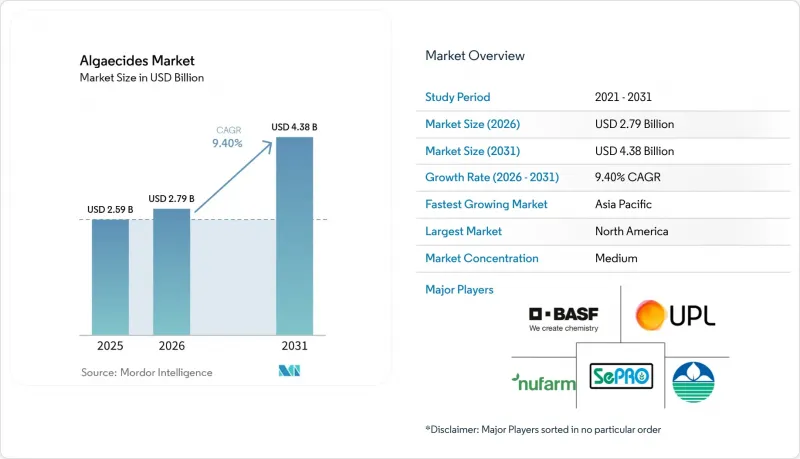
Mordor Intelligence에 의하면, 살조제 시장 규모는 2025년 25억 9,000만 달러로 평가되었습니다. 2026년에는 27억 9,000만 달러로 확대되어 2031년까지 43억 8,000만 달러에 이를 것으로 예측되며, 2026년부터 2031년에 걸쳐 CAGR 9.4%를 나타낼 전망입니다.
본 보고서는 유형별(구리계, 과산화물계 등), 형태별(액체 및 입상/펠릿), 용도별(관개용수 처리, 양식 연못 및 레이스웨이, 가축용 음용수 등), 최종 사용자별(작물 재배, 양식업자 등), 지역별(북미, 남미, 유럽 등)로 분류되어 있습니다. 시장 전망은 금액(달러) 기준으로 제시되어 있습니다.
세계의 살조제 시장 동향 및 인사이트
관개용 저수지에서 미세조류의 이상 증식이 심각해지고 있습니다.
극심한 폭염과 영양염류 유출 증가로 인해, 미세 관개 및 점적 관개 시스템에 물을 공급하는 저수지에서 시아노박테리아의 증식에 최적의 조건이 조성되고 있습니다. 미국 환경보호청(EPA)의 원격 감지 도구는 현재 2,192개의 호수와 습지에 대해 거의 실시간으로 꽃피기 경보를 제공합니다. 그 결과, 많은 생산자들이 계절별 집중 처리 방식에서 벗어나, 다기능이며 즉효성이 있는 살조제를 활용한 연중 유지 관리 프로그램으로 전환하고 있습니다. 캘리포니아주의 2025년 센트럴 밸리 조사에 따르면, 모니터링 대상 호수의 거의 절반에서 부영양화가 확인되었으며, 이에 따라 구리가 포함되지 않은 약제에 대한 새로운 카운티 비용 분담 보조금이 도입되었습니다. 제제 제조업체에 따르면, 수요가 가장 높은 곳은 특산 작물이 재생수에 의존하고 있어 에미터 유량을 2% 이내의 변동 범위 내에서 유지해야 하는 지역입니다. 이러한 농업적·규제적 변화로 인해 조류 관리는 긴급 대응에서 일상적인 운영 비용으로 전환되고 있습니다.
폐쇄형 수산 양식 시스템(RAS)의 확대
순환식 양식 시스템(RAS)을 활용하는 육상 양식장에서는 처리수의 최대 99%를 재이용하고 있습니다. 그러나 이러한 폐쇄형 시스템은 질소와 탄소도 가두어 두기 때문에 조류 매트가 지속적으로 형성되는 원인 중 하나가 되고 있습니다. 『Bioresource Technology Reports』의 2025년 리뷰에서는 미세조류 바이오필터가 용존 영양분의 최대 90%를 제거할 수 있다는 점이 강조되었습니다. 그럼에도 불구하고, 운영 측은 수로와 센서를 청결하게 유지하기 위해 여전히 살조제를 사용하고 있습니다. 중국, 인도, 에콰도르 등의 국가에서 새우와 연어를 양식하는 농가들은 1세제곱미터당 100Kg을 초과하는 사육 밀도에 대응할 수 있는 시설을 확대하고 있으며, 조류의 이상 증식이 억제되지 않으면 산소 결핍의 위험이 높아집니다. 금융 기관은 자금을 지원하기 전에 문서화된 수질 관리 절차를 의무화하고 있으며, 프로젝트의 재무 계획에는 화학약품 예산이 포함되어 있습니다. 자금 조달, 생물 보안, 일상 업무 사이에 존재하는 이러한 구조적 연관성 덕분에 RAS의 성장은 살조제 시장에서 꾸준한 판매량 증가를 이끄는 원동력이 되고 있습니다.
UV 및 초음파 조류 제어 장치 도입
자외선 조사나 초음파 공명과 같은 비화학적 해결책은 엄격한 방류 허가를 준수해야 하는 사업자에게 매력적입니다. 그러나 상업적 규모로 도입할 경우, 그 설비 투자 비용이 5만 달러를 초과하는 경우가 종종 있습니다. 예를 들어, 뉴질랜드의 연어 양식장에 Hydro Synergy를 도입한 결과, 45일 이내에 그물에 달라붙는 이물질이 감소했을 뿐만 아니라 수작업으로 인한 청소 비용도 절감되었습니다. 이러한 장점이 있음에도 불구하고, 그 성능은 수질(투명도)이나 유속의 영향을 받습니다. 탁도가 높은 지역에서는 초음파 에너지가 급격히 감쇠하기 때문에 많은 이용자들이 예비용으로 액체 살조제를 비치해 두고 있습니다. 이러한 설비의 투자 대비 효과는 주로 인건비가 높은 경우나, 허가료에 화학물질 배출에 대한 과태료가 부과되는 상황에서 향상됩니다. 이러한 제약으로 인해 광대한 관개 수역이나 개방형 저수지에 이러한 장치를 도입하는 데 지연이 발생하고 있으며, 그 결과 살조제 시장 전체에 미치는 영향은 제한적입니다.
부문별 분석
2025년 기준으로 구리계 살조제는 살조제 시장 점유율의 38%를 차지하며 가장 큰 점유율을 기록했습니다. 이는 주로 대규모 관개 농장에 적합한 비용으로 광범위한 방제가 가능하기 때문입니다. 캘리포니아주와 유럽집행위원회가 더 엄격한 배출 기준을 도입하고 있음에도 불구하고, 구리계 살조제의 우위는 여전히 살조제 시장 전체에 영향을 미치며, 기존 화학제품을 선호하는 경향을 보이고 있습니다. 킬레이트화된 구리 착물과 서방형 과립은 잔류 효과를 높여, 시용자가 기존 설비를 대폭 변경하지 않고도 더욱 엄격한 수질 규제를 준수할 수 있게 해줍니다. 대형 유통업체들은 검증된 유효 성분을 우선시하는 조달 계약을 활용하여, 구리 농축제를 제초제나 살충제와 세트로 판매하고 있습니다.
과산화물을 주성분으로 하는 살조제 시장 규모는 2026년부터 2031년에 걸쳐 연평균 성장률(CAGR) 9.8%라는 가장 높은 성장률을 기록하며 확대될 것으로 전망됩니다. 이러한 제제는 유기농 재료 심사 기관(OMRI)의 목록에 등재되어 있으며, 구리를 포함하지 않는 잔류 프로파일 덕분에, 배수 허가상 금속 사용이 제한되는 특수 작물, 골프장 및 순환식 양식 시스템에 적용할 수 있게 되었습니다. 4급 암모늄계 및 엔도타르계 제품은 포유류에 대한 독성이 낮으며, 신속한 살균 효과가 필요한 연못이나 부화장 등 특수한 용도에 적합합니다. 보존 기간 연장 및 접촉 시간 장기화를 도모하기 위해 과산화물의 안정화에 주력하는 공급업체들은 이익률을 높이고, 고가 부문에서 시장의 점진적인 성장을 주도할 것으로 예측됩니다.
액체 제품은 비료 관개 펌프나 인라인 주입기를 원활하게 통과할 수 있고, 생산자가 스마트폰으로 투여량을 실시간으로 조절할 수 있다는 점 덕분에 2025년 매출 전망에서 시장 점유율 56.8%를 차지하며 가장 높은 비중을 기록했습니다. 이 방식은 정밀 제어 장치와의 호환성이 뛰어나기 때문에 대규모 과수원이나 온실 시설에서는 조류 방제와 비료 시비 일정을 동기화할 수 있어 낭비와 노동력을 줄일 수 있습니다. 게다가, 액체는 레이스웨이 내에서 빠르게 퍼집니다. 이는 수분 이상 지속되는 용존산소 농도의 저하를 허용할 수 없는 초고밀도 양식장에 있어 중요한 요소입니다. 또한, 봉지나 펠릿에 비해 보관 공간이 필요 없는 농축액 드럼에 대한 선호는 판매점 창고의 높은 재고 회전율에 힘입어 더욱 강화되고 있습니다.
과립형/펠릿형 살조제 시장 규모는 2026년부터 2031년에 걸쳐 연평균 성장률(CAGR) 10.7%라는 가장 높은 성장률을 기록하며 확대되고 있습니다. 이 제품은 살포가 용이하다는 점 덕분에 주택 소유자 협회, 잔디 관리 담당자 및 지자체 호수 관리팀에 의해 널리 채택되고 있습니다. 서방형 코팅을 통해 유효 성분이 수 주간에 걸쳐 제어된 형태로 방출되므로, 현장 방문 빈도가 줄어들고 탱크로리 취급과 관련된 보험상 책임도 최소화됩니다. 캡슐화된 구리 입자제 또한 배수 중의 최고 농도를 낮추는 데 도움이 되며, 사업자는 효능을 저해하지 않으면서 총 최대 일일 부하량(TMDL) 제한을 충족할 수 있게 됩니다. 또한, 제제 제조업체는 접촉 시 용해되는 발포정 시험을 진행하고 있으며, 이는 분제의 편의성과 액제의 즉효성을 모두 갖추고 있어, 조류 방제제 시장의 중규모 저수지 부문에서 새로운 기회를 창출할 가능성이 있습니다.
지역별 분석
2025년, 북미는 살조제 시장 점유율의 43.7%를 차지하며 가장 큰 점유율을 기록했습니다. 이는 주로 캘리포니아에서 텍사스에 이르는 광범위한 관개 시스템 덕분입니다. 이러한 시스템은 저수지의 저수량에 의존하고 있지만, 여름철에는 수온이 급격히 상승하여 조류의 이상 증식을 유발하고, 이로 인해 살수 노즐의 유량이 제한되는 원인이 됩니다. 미국 환경보호청(EPA)의 2026년 농약 일반 허가 규정에서는 생물학적 리간드 모델 준수가 의무화되어 있으며, 물의 경도 및 pH 값에 따라 구리 농도를 조절하는 정밀 주입 장치의 도입이 생산자들에게 권장되고 있습니다. 캐나다에서는 브리티시컬럼비아주의 연어 및 송어 양식장에서 잔류물을 남기지 않고 양식용 수로를 정화하기 위해 과산화수소의 펄스 주입 방식을 활용한 실험을 진행하고 있습니다. 한편, 오대호 지역의 지자체 호수 관리 구역에서는 화학 물질을 사용하지 않는 레크리에이션용 수역을 원하는 시민들의 요구에 부응하기 위해 초음파식 부유대를 도입하고 있습니다.
아시아태평양은 중국이 155만 톤의 새우 생산 목표를 제시한 점과 인도의 내륙 잉어 양식 시스템 확대에 힘입어, 2026년부터 2031년에 걸쳐 연평균 성장률(CAGR) 8.5%라는 가장 높은 성장률을 기록하며 성장하고 있습니다. 초집약형 바이오플록 수조나 순환식 시스템은 담수 사용량을 줄이는 한편, 영양분을 농축시키고 있는데, 이로 인해 조류의 지속적인 이상 증식이 유발되고 있어, 살조제 살포는 양식 관리의 일상적인 작업이 되었습니다. 해당 지역의 규제 체계는 여전히 일관성이 부족합니다. 예를 들어, 중국에서는 식용 조직 내 구리 잔류량에 대한 제한이 설정되어 있는 반면, 인도의 연안 양식국은 면허 갱신 시 화학물질 사용 현황을 심사하고 있습니다. 이러한 규제 환경 하에서는 종합적인 자료를 보유한 대형 다국적 기업들이 현지 승인 획득에 있어 우위를 점하고 있습니다.
유럽, 남미, 중동 및 아프리카는 합쳐서 나머지 시장 점유율을 차지하고 있으며, 각 지역은 서로 다른 요인의 영향을 받고 있습니다. 유럽에서는 산업 배출 지침에 따라 구리 배출에 대한 규제가 강화되고 있으며, 네덜란드의 온실 양식 수로나 노르웨이의 스몰트 부화장에서 과산화수소의 사용이 증가하고 있습니다. 남미에서는 연간 149만 톤을 생산하는 에콰도르의 새우 양식장에서 감시 비용이 저렴하다는 이유로 주로 기존의 구리가 사용되고 있습니다. 그러나 미국으로 수출하는 가공업체들은 구매자의 감사 요건을 충족하기 위해 수확 전에 과산화수소로 세척하는 경우가 많습니다.
기타 혜택 :
- 엑셀 형식 시장 예측(ME) 시트
- 3개월간의 애널리스트 지원
자주 묻는 질문
목차
제1장 서론
제2장 조사 방법
제3장 주요 요약
제4장 시장 구도
제5장 시장 규모 및 성장 예측
제6장 경쟁 구도
제7장 시장 기회 및 향후 전망
KTH 26.06.26According to Mordor Intelligence, the algaecides market size is projected to grow from USD 2.59 billion in 2025 to USD 2.79 billion in 2026 and reach USD 4.38 billion by 2031, registering a CAGR of 9.4% during 2026-2031.
This report is Segmented by Type (Copper-Based, Peroxide-Based, and More), by Form (Liquid and Granular/Pellet), by Application (Irrigation Water Treatment, Aquaculture Ponds and Raceways, Livestock Drinking Water, and More), by End User (Crop Farming, Aquaculture Producers, and More), and by Geography (North America, South America, Europe, and More). The Market Forecasts are Provided in Terms of Value (USD).
Global Algaecides Market Trends and Insights
Escalating Micro-Algae Blooms in Irrigation Reservoirs
Intense heat waves and increased nutrient runoff have created optimal growth conditions for cyanobacteria in reservoirs supplying micro and drip irrigation systems. The Environmental Protection Agency's remote-sensing tools now provide near-real-time bloom alerts for 2,192 lakes. As a result, many growers are transitioning from seasonal shock treatments to full-season maintenance programs that utilize fast-acting algaecides with multi-mode activity. According to California's 2025 Central Valley survey, eutrophic conditions were identified in nearly half of the monitored lakes, prompting the introduction of new county cost-share grants for copper-free chemistries. Formulators indicate that demand is highest in areas where specialty crops rely on recycled water and require emitter flow to remain within a 2% variance. These agronomic and regulatory changes are shifting algae management from an emergency response to a routine operational expense.
Expansion of Closed-Loop Aquaculture Systems (RAS)
Land-based farms utilizing recirculating aquaculture systems (RAS) recycle up to 99% of process water. However, these closed systems also retain nitrogen and carbon, which contribute to persistent algal mat formation. A 2025 review in Bioresource Technology Reports highlighted that microalgae biofilters can remove up to 90% of dissolved nutrients. Despite this, operators continue to use algaecides to maintain clear raceways and sensors. Shrimp and salmon producers in countries such as China, India, and Ecuador are expanding facilities designed for stocking densities exceeding 100 kilograms per cubic meter, increasing the risk of oxygen depletion if algal blooms are not controlled. Capital lenders mandate documented water-quality protocols before releasing funds, embedding chemical budgets into project financial plans. This structural connection between financing, biosecurity, and daily operations positions RAS growth as a consistent volume driver for the algaecides market.
Adoption of UV and Ultrasonic Algae-Control Devices
Non-chemical solutions, such as ultraviolet irradiation and ultrasonic resonance, are attractive to operators adhering to strict discharge permits. However, their capital costs often exceed USD 50,000 for commercial-scale applications. For instance, Hydro Synergy installations in New Zealand salmon farms reduced net fouling within 45 days and lowered manual cleaning costs. Despite these benefits, their performance is influenced by water clarity and flow rates. In areas with high turbidity, ultrasonic energy dissipates rapidly, prompting many users to maintain liquid algaecides as a backup. The return on investment for these devices improves primarily in scenarios where labor costs are high or permit fees impose penalties for chemical discharge. These limitations have slowed the adoption of such devices in broad-acre irrigation and open reservoirs, thereby moderating their overall impact on the algaecides market.
Other drivers and restraints analyzed in the detailed report include:
- Rise in Copper Price Hedging Driving Alternative Chemistries
- Legalization of Non-Food Cash Crops Demands Clear Water Quality
- Copper Discharge Limits in Europe and California are Tightening
For complete list of drivers and restraints, kindly check the Table Of Contents.
Segment Analysis
Copper-based algaecides accounted for the largest 38% of the algaecides market share in 2025, primarily due to their broad-spectrum control at a cost suitable for large irrigated farms. Their dominance continues to influence the overall algaecides market, favoring traditional chemistry, even as California and the European Commission implement stricter discharge limits. Chelated copper complexes and slow-release granules enhance residual activity, enabling applicators to comply with stricter water-quality regulations without requiring significant changes to existing equipment. Larger distributors are bundling copper concentrates with herbicides and insecticides, leveraging procurement contracts that favor established active ingredients.
The algaecides market size for peroxide is projected to grow at the fastest CAGR of 9.8% from 2026 to 2031. Their inclusion in the Organic Materials Review Institute (OMRI) listings and copper-free residue profiles enables these formulations to penetrate specialty crops, golf courses, and recirculating aquaculture systems, where discharge permits limit the use of metals. Quaternary ammonium and endothall products cater to niche applications, such as ponds and hatcheries, requiring rapid knockdown with low mammalian toxicity. Suppliers focusing on stabilizing peroxide for extended shelf life and prolonged contact time are projected to increase margins, driving incremental market growth within premium price segments.
Liquid accounted for the largest 56.8% of the market share for the projected 2025 revenue due to its seamless flow through fertigation pumps and inline injectors, enabling growers to adjust dosage rates in real time via smartphones. The compatibility of this format with precision controllers allows large orchards and greenhouse complexes to synchronize algae control with nutrient schedules, reducing waste and labor. Additionally, liquids disperse quickly in raceways, a critical factor for super-intensive shrimp farms that cannot tolerate dissolved oxygen dips lasting more than a few minutes. The preference for concentrate drums, which require less shelf space compared to bags or pellets, is further supported by tight inventory turnover at dealer warehouses.
The algaecides market size for granular/pellet is growing at the fastest CAGR of 10.7% from 2026 to 2031, driven by adoption among homeowners' associations, turf managers, and municipal lake crews due to their ease of broadcasting. Slow-release coatings provide controlled release of active ingredients over several weeks, reducing the frequency of site visits and minimizing insurance liabilities associated with tanker handling. Encapsulated copper granules also help lower peak effluent concentrations, enabling operators to meet Total Maximum Daily Load (TMDL) limits without compromising efficacy. Additionally, formulators are testing effervescent tablets that dissolve upon contact, combining the convenience of granular formulations with the rapid action of liquids, which could unlock new opportunities in the mid-size reservoir segment of the algaecides market.
Geography Analysis
North America accounted for the largest 43.7% of the algaecides market share in 2025, primarily due to extensive irrigation systems spanning from California to Texas. These systems depend on reservoir storage, which warms rapidly during summer, fostering algal blooms that restrict emitter flow. The Environmental Protection Agency's 2026 Pesticide General Permit requires compliance with the Biotic Ligand Model, encouraging growers to adopt precision injectors that adjust copper levels based on water hardness and pH readings. In Canada, salmon and trout hatcheries in British Columbia are experimenting with hydrogen-peroxide pulses to clear raceways without leaving residues. Meanwhile, municipal lake districts in the Great Lakes region are deploying ultrasonic rafts to meet public demand for chemical-free recreational waters.
The Asia-Pacific region is advancing at a fastest CAGR of 8.5% from 2026 to 2031, driven by China's target of achieving 1.55 million metric tons of shrimp production and India's increasing inland carp farming systems. Super-intensive biofloc tanks and recirculating systems are reducing freshwater usage but concentrating nutrients, which sustain continuous algal blooms, making algaecide application a routine part of aquaculture management. Regulatory frameworks in the region remain inconsistent. For instance, China imposes limits on copper residues in edible tissues, while India's Coastal Aquaculture Authority reviews chemical usage during license renewals. This regulatory environment provides larger multinational companies with comprehensive dossiers an advantage in obtaining local approvals.
Europe, South America, the Middle East, and Africa collectively account for the remaining market share, each influenced by distinct factors. In Europe, the Industrial Emissions Directive imposes stricter controls on copper discharge, leading to increased adoption of peroxide in Dutch greenhouse canals and Norwegian smolt hatcheries. In South America, Ecuador's shrimp ponds, producing 1.49 million metric tons annually, predominantly use conventional copper due to its low monitoring costs . However, processors exporting to the United States often employ peroxide flushes before harvest to meet buyer audit requirements.
- BASF SE
- UPL Limited
- Nufarm Limited
- Arxada AG
- SePRO Corporation
- BioSafe Systems, LLC
- Innovative Water Care, LLC
- Earth Science Laboratories, Inc.
- WaterIQ Technologies, Inc.
- Enviro Tech Chemical Services, Inc.
- Oreq Corporation
- Lake Restoration, Inc.
- Aquatic Biologists, Inc.
- Clariant AG
- Alligare, LLC
Additional Benefits:
- The market estimate (ME) sheet in Excel format
- 3 months of analyst support
TABLE OF CONTENTS
1 Introduction
- 1.1 Study Assumptions and Market Definition
- 1.2 Scope of the Study
2 Research Methodology
3 Executive Summary
4 Market Landscape
- 4.1 Market Overview
- 4.2 Market Drivers
- 4.2.1 Escalating micro-algae blooms in irrigation reservoirs
- 4.2.2 Expansion of closed-loop aquaculture systems (RAS)
- 4.2.3 Rise in copper price hedging driving alternative chemistries
- 4.2.4 Legalization of non-food cash crops demands clear water quality
- 4.2.5 Integration of algaecide dosing with precision fertigation systems
- 4.2.6 Insurance rebates for farms with proactive algae-control protocols
- 4.3 Market Restraints
- 4.3.1 Adoption of UV and ultrasonic algae-control devices
- 4.3.2 Copper discharge limits in Europe and California are tightening
- 4.3.3 Growing consumer push for chemical-free produce labels
- 4.3.4 Volatility in raw-material availability for peroxide formulations
- 4.4 Regulatory Landscape
- 4.5 Technological Outlook
- 4.6 Porter's Five Forces Analysis
- 4.6.1 Threat of New Entrants
- 4.6.2 Bargaining Power of Suppliers
- 4.6.3 Bargaining Power of Buyers
- 4.6.4 Threat of Substitutes
- 4.6.5 Intensity of Competitive Rivalry
5 Market Size and Growth Forecasts (Value)
- 5.1 By Type
- 5.1.1 Copper-based
- 5.1.2 Quaternary Ammonium Compounds
- 5.1.3 Peroxide-based
- 5.1.4 Other Types
- 5.2 By Form
- 5.2.1 Liquid
- 5.2.2 Granular/Pellet
- 5.3 By Application
- 5.3.1 Irrigation Water Treatment
- 5.3.2 Aquaculture Ponds and Raceways
- 5.3.3 Livestock Drinking Water
- 5.3.4 Ornamental and Golf Course Ponds
- 5.3.5 Field Runoff Ditches
- 5.4 By End User
- 5.4.1 Crop Farming
- 5.4.2 Aquaculture Producers
- 5.4.3 Livestock Operations
- 5.4.4 Turf and Ornamental Growers
- 5.5 By Geography
- 5.5.1 North America
- 5.5.1.1 United States
- 5.5.1.2 Canada
- 5.5.1.3 Rest of North America
- 5.5.2 South America
- 5.5.2.1 Brazil
- 5.5.2.2 Argentina
- 5.5.2.3 Rest of South America
- 5.5.3 Europe
- 5.5.3.1 Germany
- 5.5.3.2 France
- 5.5.3.3 Italy
- 5.5.3.4 United Kingdom
- 5.5.3.5 Spain
- 5.5.3.6 Russia
- 5.5.3.7 Rest of Europe
- 5.5.4 Asia-Pacific
- 5.5.4.1 China
- 5.5.4.2 India
- 5.5.4.3 Japan
- 5.5.4.4 South Korea
- 5.5.4.5 Australia
- 5.5.4.6 Rest of Asia-Pacific
- 5.5.5 Middle East
- 5.5.5.1 Saudi Arabia
- 5.5.5.2 United Arab Emirates
- 5.5.5.3 Rest of Middle East
- 5.5.6 Africa
- 5.5.6.1 South Africa
- 5.5.6.2 Egypt
- 5.5.6.3 Rest of Africa
- 5.5.1 North America
6 Competitive Landscape
- 6.1 Market Concentration
- 6.2 Strategic Moves
- 6.3 Market Share Analysis
- 6.4 Company Profiles (Includes Global level Overview, Market level overview, Core Segments, Financials as available, Strategic Information, Market Rank/Share for key companies, Products and Services, and Recent Developments)
- 6.4.1 BASF SE
- 6.4.2 UPL Limited
- 6.4.3 Nufarm Limited
- 6.4.4 Arxada AG
- 6.4.5 SePRO Corporation
- 6.4.6 BioSafe Systems, LLC
- 6.4.7 Innovative Water Care, LLC
- 6.4.8 Earth Science Laboratories, Inc.
- 6.4.9 WaterIQ Technologies, Inc.
- 6.4.10 Enviro Tech Chemical Services, Inc.
- 6.4.11 Oreq Corporation
- 6.4.12 Lake Restoration, Inc.
- 6.4.13 Aquatic Biologists, Inc.
- 6.4.14 Clariant AG
- 6.4.15 Alligare, LLC