
|
시장보고서
상품코드
2061992
에이전트형 AI 개발 플랫폼 : 시장 점유율 분석, 산업 동향 및 통계 데이터, 성장 예측(2026-2031년)Agentic AI Development Platform - Market Share Analysis, Industry Trends & Statistics, Growth Forecasts (2026 - 2031) |
||||||
 Mordor Intelligence
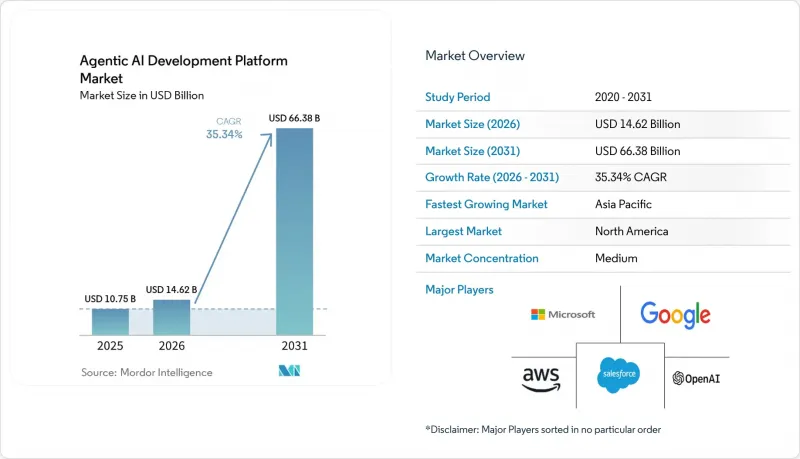
Mordor Intelligence에 의하면, 에이전트형 AI 개발 플랫폼 시장 규모는 2025년 107억 5,000만 달러로 평가되었습니다. 2026년 146억 2,000만 달러로 확대되고 2026년부터 2031년에 걸쳐 CAGR은 35.34%를 나타내, 2031년에는 663억 8,000만 달러에 이를 것으로 예측됩니다.
본 보고서는 구성 요소(플랫폼 소프트웨어, 오케스트레이션 미들웨어, 평가·안전 도구 등), 도입 형태(퍼블릭 클라우드, 프라이빗 클라우드, On-Premise 등), 최종 사용자 산업 분야(의료 및 생명과학 등), 조직 규모(대기업, 중소기업) 및 지역별로 분류되어 있습니다. 시장 전망은 금액(달러) 기준으로 제시되어 있습니다.
세계의 에이전트형 AI 개발 플랫폼 시장 동향과 인사이트
코파일럿에서 자율적인 워크플로 오케스트레이션으로의 전환
자율적인 오케스트레이션은 기존의 코파일럿 도구와 현재의 에이전트형 AI 개발 플랫폼 시장 사이에서 가장 뚜렷한 차이점을 보여줍니다. 코파일럿은 주로 프롬프트나 권장 사항을 제공하는 반면, 자율형 에이전트는 인간의 개입을 대폭 줄이면서 작업 계획, 도구 실행, 결과 확인, 그리고 다음 조치 조정을 수행합니다. 이 운영 모델에는 전용 런타임, 더욱 강력한 상태 관리, 그리고 기업 시스템 전반에 걸친 작업에 대한 보다 엄격한 제어가 필요합니다. ServiceNow는 2026년에 자사의 ‘Autonomous Workforce’가 직원들의 IT 요청의 90% 이상을 처리하고, 매달 1억 건 이상의 고객 사례를 해결했다고 보고했습니다. 이는 현재 엔터프라이즈용 에이전트 도입에 기대되는 운영 규모를 보여줍니다. 일단 워크플로가 선택한 런타임을 중심으로 구축되면, 통합 테스트, 재훈련, 워크플로 검증을 반복적으로 수행해야 하므로 대체 솔루션으로 전환하기가 어려워집니다.
LLM의 추론 능력, 도구 활용 및 다중 에이전트 프레임워크의 급속한 발전
모델과 프레임워크의 성능 향상으로 인해, 운영 환경에서 조건부 워크플로우를 안정적으로 실행할 수 있게 되면서 에이전트형 AI 개발 플랫폼 시장도 발전하고 있습니다. AdaptOrch 프레임워크에 대한 조사 결과, 토폴로지를 고려한 스케줄링을 통해 정적 오케스트레이션 기준선과 비교하여 12-23%의 성능 향상이 확인되었으며, 특히 도구를 순차적으로 사용하거나 분기 로직이 필요한 작업에서 가장 큰 효과를 거두었습니다. DOVA 프레임워크에 관한 2026년의 또 다른 연구에 따르면, 적응형 사고 프로토콜을 통해 불필요한 확장 추론을 생략함으로써 일상적인 작업에서 추론 비용이 40-60% 감소한 것으로 밝혀졌습니다. 모델의 출력이 수렴함에 따라, 구매자들은 단일 기반 모델 공급업체를 비교하는 것보다 토폴로지 설계, 메모리 관리, 작업 조정에 더 많은 시간을 할애하고 있습니다. 이로 인해, 하이퍼스케일러가 더 광범위한 모델 접근성을 제공하더라도, 에이전트형 AI 개발 플랫폼 시장에서 전문 런타임 벤더들이 자사의 입지를 지킬 수 있게 되었습니다.
자율 에이전트의 거버넌스, 감사 가능성 및 보안상의 취약점
자율 에이전트는 기존의 제어 수단으로는 따라잡을 수 없는 여러 시스템에 걸쳐 작동하기 때문에 보안상의 우려는 여전히 에이전트형 AI 개발 플랫폼 시장에서 가장 뚜렷한 걸림돌 중 하나로 남아 있습니다. 2025년에 발표된 MIT AI 에이전트 지수에 따르면, 조사 대상이었던 200개의 실제 가동 중인 에이전트 중 행동 검증에 암호 서명을 사용한 것은 단 1개에 불과했으며, 이는 현재의 감사 가능성에 여전히 한계가 있음을 여실히 드러냈습니다. OWASP는 2026년에 ‘MCP 보안 톱 10’을 발표하며, 도구 출력에 의한 프롬프트 주입이나 지나치게 광범위한 메모리 접근 권한과 같은 위험 요소를 공식적으로 지목했습니다. 이러한 문제로 인해, 기업의 보안 팀은 프로덕션 환경에서의 사용을 승인하기 전에, 추적 기능, 롤백 제어 및 정책 기반 액세스 강제 적용을 요구하고 있습니다. 이러한 통제 능력을 입증하지 못하는 공급업체는 규제 대상 고객을 대상으로 할 때, 판매 주기가 길어지거나 개념 검증(PoC) 비용이 증가하는 문제에 직면하는 경우가 많습니다.
부문별 분석
2025년, 플랫폼 소프트웨어는 에이전트형 AI 개발 플랫폼 시장 점유율의 76.39%를 차지했으며, 이는 지출이 여전히 오케스트레이션 엔진, 에이전트 런타임 및 LLM 게이트웨이 계층에 집중되어 있음을 보여줍니다. 기업들은 이 계층을 핵심 인프라로 간주했기 때문에 구현 생태계가 완전히 확장되기 전부터 장기적인 플랫폼 계약을 우선시하는 구매 행태가 나타났습니다. 이 패턴은 인접한 도구보다 기본적인 제어 및 워크플로우의 신뢰성이 더 중요시되는 시장 주기의 초기 단계에 해당합니다. 또한, 이는 에이전트형 AI 개발 플랫폼 시장에서 플랫폼을 선정하는 과정이 일반적인 소프트웨어 구매에 비해 평가 기간이 길고, 전환 장벽이 높은 경향이 있는 이유를 설명해 줍니다.
전문 서비스 시장은 2031년까지 연평균 성장률(CAGR) 36.14%를 기록하며 성장할 것으로 전망됩니다. 이는 도입 과정에서 여전히 커넥터 작업, 메모리 스키마 설계, 거버넌스 정책 설정 및 시스템 간 인증 계획이 필요하기 때문입니다. 적응형 오케스트레이션에 관한 조사 결과, 토폴로지를 고려한 에이전트 관리를 통해 정적 시스템에 비해 12-23%의 성능 향상이 가능함이 밝혀졌으며, 이러한 연구 결과가 아키텍처 설계 및 튜닝 지원에 대한 수요를 뒷받침하고 있습니다. MCP 및 에이전트 간 프로토콜의 도입이 확대됨에 따라, 크로스 프로토콜 어댑터와 상호 운용성 계층의 가치가 높아지고 있으며, 오케스트레이션 미들웨어의 중요성도 커지고 있습니다. 또한, 구매자들이 생산 환경의 에이전트에 대해 더욱 강력한 검증, 모니터링 및 정책 테스트를 요구함에 따라, 평가 및 보안 확보를 위한 도구들도 선택적 애드온에서 필수 조달 요건으로 전환되고 있습니다.
2025년, 퍼블릭 클라우드는 에이전트형 AI 개발 플랫폼 시장 규모의 52.61%를 차지하며, 많은 기업의 도입 과정에서 기본적인 출발점이 되었습니다. 하이퍼스케일러가 제공하는 관리형 런타임은 모델 접근, 오케스트레이션 도구, 인프라 제어가 단일 환경에 통합되어 있었기 때문에 구매자에게는 프로덕션 환경으로의 전환을 가속화하는 수단이 되었습니다. 마이크로소프트는 Azure AI Foundry가 2025년 한 분기 동안 100조 토큰 이상을 처리했다고 발표했으며, 이는 초기 기업 수요가 얼마나 퍼블릭 클라우드 인프라에 집중되어 있었는지를 여실히 보여주고 있습니다. 퍼블릭 클라우드의 장점은 많은 조직이 보다 엄격한 데이터 상주 요건이나 지연 시간 제어가 필요한 위치를 결정하기 전에, 위험이 낮은 시범 운영부터 시작했다는 사실에서도 드러납니다.
더 많은 구매자가 데이터 소스, 운영 체제 및 규제 대상 워크로드와 가까운 곳에서 에이전트를 실행하게 됨에 따라, 하이브리드 및 엣지 배포는 2031년까지 연평균 성장률(CAGR) 36.09%를 나타낼 것으로 예측됩니다. 이러한 추세는 산업 분야, 공공 부문의 환경, 그리고 왕복 지연이나 데이터 전송 규정으로 인해 중앙 집중식 클라우드 처리가 현실적으로 어려운 분야에서 가장 두드러집니다. AWS는 2026년, 관리형 에이전트 하네스 플랫폼인 ‘Bedrock AgentCore’와 관리형 멀티에이전트 파이프라인에 대한 조기 대응을 통해 이 분야를 확대했습니다. 또한, UiPath도 2026년 5월에 공공 부문 환경을 위한 On-Premise 지원 기능을 출시했는데, 이는 주권형 및 에어갭형 배포가 에이전트형 AI 개발 플랫폼 업계에서 뚜렷한 한 분야로 자리 잡고 있음을 보여줍니다. 금융 서비스 및 의료 분야에서는 여전히 프라이빗 클라우드가 가장 중요하게 여겨지고 있습니다. 이러한 분야에서는 시스템 오브 레코드와의 밀접한 연계성과 완벽한 감사 추적이 여전히 도입 설계의 핵심 요소로 남아 있기 때문입니다.
지역별 분석
북미는 2025년 에이전트형 AI 개발 플랫폼 시장 점유율의 38.73%를 차지하며, 매출 측면에서 주도적인 위치를 유지했습니다. 이 지역은 하이퍼스케일러의 인프라, 대규모 기업 소프트웨어 구매자 기반, 그리고 자율적인 거버넌스를 장려하는 규제 환경의 혜택을 누리고 있습니다. 마이크로소프트는 2025년 기준으로 7만 개 이상의 기업이 Azure AI Foundry를 도입했다고 밝혔으며, 이를 통해 해당 기업 고객 기반의 규모를 여실히 보여주고 있습니다. OpenAI는 2026년 3월에 기업용 플랫폼 ‘Frontier’를 출시했으며, HP, Intuit, Oracle, Uber 등이 이를 도입했습니다. ServiceNow가 2026년 AWS Marketplace에서 10억 달러 규모의 거래를 기록한 것은 클라우드 마켓플레이스가 주요 유통 채널로 자리 잡고 있음을 보여줍니다.
아시아태평양은 중국의 기업 도입, 인도의 생산성 향상을 위한 도입, 그리고 일본의 실용적인 도입에 힘입어 2031년까지 연평균 성장률(CAGR) 36.34%를 기록하며 성장할 것으로 전망됩니다. NTT 도코모 비즈니스는 2026년에 기업 고객을 대상으로 200종의 에이전트를 제공할 계획이며, 이는 일본 내에서의 체계적인 도입을 반영한 것입니다. 한국은 반도체 제조 및 금융 서비스 분야에서 발전하고 있으며, 데이터 주권에 대한 우려를 해소하기 위해 프라이빗 클라우드 모델이 도입되고 있습니다. 해당 지역에서는 실험 단계에서 본격적인 워크플로우 및 규정 준수를 중시하는 모델로 전환이 진행되고 있습니다.
유럽의 규제 강화가 에이전트형 AI 개발 플랫폼 시장을 형성하고 있습니다. 고위험 시스템에 대한 EU AI법의 시행은 2026년 8월에 시작되며, 디지털 운영 복원력법에 따른 감사 가능성 강화도 동시에 추진되고 있습니다. 독일, 영국, 프랑스는 대규모 기업 기반과 규정 준수 분야에 대한 투자를 통해 도입을 주도하고 있습니다. 유럽연합 집행위원회의 자료에 따르면, EU AI법에 대응하기 위한 기업의 도입 예산은 18개월 동안 210만-450만 유로(237만-509만 달러)에 달할 전망입니다. 남미에서는 조기 도입이 진행되고 있으며, 브라질과 아르헨티나에서 그 기세가 더욱 거세지고 있습니다. 중동 및 아프리카는 UAE, 사우디아라비아, 남아프리카공화국, 이집트가 주도하는 국가 주도의 AI 투자, 통신 분야에서의 도입, 그리고 은행업에서의 활용 사례를 통해 성장하고 있지만, 2031년까지는 다른 지역에 비해 지출 규모가 낮은 수준을 유지할 것으로 전망됩니다.
기타 혜택 :
- 엑셀 형식 시장 예측(ME) 시트
- 3개월간의 애널리스트 지원
자주 묻는 질문
목차
제1장 서론
제2장 분석 방법
제3장 주요 요약
제4장 시장 구도
제5장 시장 규모 및 성장률 예측
제6장 경쟁 구도
제7장 시장 기회 및 향후 전망
KTH 26.06.22According to Mordor Intelligence, the agentic AI development platform market size is expected to grow from USD 10.75 billion in 2025 to USD 14.62 billion in 2026 and is forecast to reach USD 66.38 billion by 2031 at 35.34% CAGR over 2026-2031.
This report is Segmented by Component (Platform Software, Orchestration Middleware, Evaluation and Safety Tools, and More), Deployment (Public Cloud, Private Cloud, On-Premises, and More), End-User Industry (Healthcare and Life Sciences, and More), Organization Size (Large Enterprises, and Small and Med-Size Enterprises), and Geography. The Market Forecasts are Provided in Terms of Value (USD).
Global Agentic AI Development Platform Market Trends and Insights
Shift From Copilots to Autonomous Workflow Orchestration
Autonomous orchestration marks the clearest break between earlier copilot tools and the current agentic AI development platform market. Copilots mainly provide prompts and recommendations, while autonomous agents plan tasks, invoke tools, check results, and adjust their next actions with much less human input. That operating model requires a dedicated runtime, stronger state management, and tighter control over actions across enterprise systems. ServiceNow reported in 2026 that its Autonomous Workforce handled more than 90% of employee IT requests and resolved more than 100 million customer cases each month, which shows the operational scale now expected from enterprise agent deployments. Once workflows are built around a chosen runtime, replacement becomes difficult because integration testing, retraining, and workflow validation must be repeated.
Rapid Improvement in LLM Reasoning, Tool Use, and Multi-Agent Frameworks
The agentic AI development platform market has also advanced, as model and framework performance now enable more reliable completion of conditional workflows in production. Research on the AdaptOrch framework showed that topology-aware scheduling improved performance by 12-23% over static orchestration baselines, with the strongest gains in tasks that require sequential tool use and branching logic. A separate 2026 study on the DOVA framework found that adaptive thinking protocols reduced inference costs by 40-60% on routine tasks by skipping unnecessary extended reasoning. As model outputs converge, buyers are spending more time comparing topology design, memory management, and task coordination than comparing a single foundation model vendor. This is helping specialized runtime vendors in the agentic AI development platform market defend their position even when hyperscalers offer broader model access.
Governance, Auditability, and Security Gaps in Autonomous Agents
Security concerns remain one of the clearest brakes on the agentic AI development platform market because autonomous agents act across multiple systems where traditional controls were not designed to follow them. The MIT AI Agent Index reported in 2025 that only 1 of 200 reviewed production agents used cryptographic signing for action verification, underscoring the continued limitations of current auditability. OWASP published its MCP Security Top 10 in 2026 and formalized risks such as prompt injection via tool outputs and overly broad memory-retrieval permissions. These issues prompt enterprise security teams to request lineage tracking, rollback controls, and policy-based access enforcement before approving live use. Vendors that cannot show these controls often face longer sales cycles and higher proof-of-concept costs in regulated accounts.
Other drivers and restraints analyzed in the detailed report include:
- Falling Deployment Friction Through Low-Code Builders And Managed Agent Runtimes
- Rising Demand For Governed AI In Regulated Verticals
- Legacy-System Integration Complexity And Unclear ROI Beyond Narrow Workflows
For complete list of drivers and restraints, kindly check the Table Of Contents.
Segment Analysis
Platform software accounted for 76.39% of the agentic AI development platform market share in 2025, which shows that spending still centers on orchestration engines, agent runtimes, and LLM gateway layers. Enterprises treated this layer as core infrastructure, so buying behavior favored long-term platform commitments before implementation ecosystems had fully scaled. This pattern fits an early-cycle market where foundational control and workflow reliability matter more than adjacent tools. It also explains why platform decisions in the agentic AI development platform market tend to carry longer evaluation windows and higher switching barriers than many standard software purchases.
Professional services are projected to grow at a 36.14% CAGR through 2031, as deployment still requires connector work, memory schema design, governance policy setup, and cross-system authentication planning. Research on adaptive orchestration showed that topology-aware agent management can deliver 12-23% performance gains over static systems, and that finding is feeding demand for architecture design and tuning support. Orchestration middleware is gaining relevance as MCP and agent-to-agent protocol adoption increases the value of cross-protocol adapters and interoperability layers. Evaluation and safety tools are also moving from optional add-ons toward procurement requirements as buyers seek stronger validation, monitoring, and policy testing for production agents.
Public cloud captured 52.61% of the agentic AI development platform market size in 2025, making it the default starting point for many enterprise deployments. Managed runtimes from hyperscalers gave buyers a faster path to production because model access, orchestration tools, and infrastructure controls were already bundled in a single environment. Microsoft stated that Azure AI Foundry processed more than 100 trillion tokens in a single quarter in 2025, highlighting the extent to which early enterprise demand remained concentrated on public cloud infrastructure. The public cloud lead also reflects the fact that many organizations began with lower-risk pilots before deciding where stricter residency or latency controls were needed.
Hybrid and edge deployments are projected to grow at 36.09% CAGR through 2031 as more buyers run agents closer to data sources, operating systems, and regulated workloads. That push is strongest in industrial settings, public-sector environments, and sectors where round-trip latency or data-transfer rules make centralized cloud processing less practical. AWS expanded this path in 2026 with Bedrock AgentCore, a managed agent-harness platform, and early support for managed multi-agent pipelines. UiPath also released on-premises support for public-sector environments in May 2026, which shows that sovereign and air-gapped deployments are becoming a distinct part of the agentic AI development platform industry. Private cloud continues to matter most in financial services and healthcare, where system-of-record proximity and full audit trails remain central to deployment design.
Geography Analysis
North America held 38.73% of the agentic AI development platform market share in 2025, maintaining its revenue leadership. The region benefits from hyperscaler infrastructure, a large enterprise software buyer base, and a regulatory environment favoring voluntary governance. Microsoft reported over 70,000 Azure AI Foundry customer organizations in 2025, highlighting the scale of its enterprise base. OpenAI launched its Frontier enterprise platform in March 2026 with adopters like HP, Intuit, Oracle, and Uber. ServiceNow's USD 1 billion in AWS Marketplace transactions in 2026 indicates cloud marketplaces are becoming key distribution channels.
Asia-Pacific is projected to grow at 36.34% CAGR through 2031, driven by enterprise deployment in China, productivity-led adoption in India, and practical implementation in Japan. NTT Docomo Business planned to offer 200 agent types to enterprise customers in 2026, reflecting structured deployments in Japan. South Korea is advancing in semiconductor manufacturing and financial services, with private cloud models addressing data-sovereignty concerns. The region is transitioning from experimentation to production workflows and compliance-focused models.
Europe's tighter regulations are shaping the agentic AI development platform market. The EU AI Act enforcement for high-risk systems began in August 2026, alongside increased auditability under the Digital Operational Resilience Act. Germany, the UK, and France lead deployments due to large enterprise bases and compliance spending. European Commission data shows enterprise adaptation budgets of EUR 2.1-4.5 million (USD 2.37-5.09 million) over 18 months for EU AI Act readiness. South America shows early adoption, with Brazil and Argentina gaining traction. The Middle East and Africa are growing through sovereign AI investments, telecom deployments, and banking use cases, led by the UAE, Saudi Arabia, South Africa, and Egypt, though spending remains lower than in other regions through 2031.
- Microsoft Corporation
- Amazon Web Services, Inc.
- Google LLC
- OpenAI, L.L.C.
- Anthropic PBC
- Salesforce, Inc.
- ServiceNow, Inc.
- International Business Machines Corporation
- Oracle Corporation
- SAP SE
- UiPath, Inc.
- Databricks, Inc.
- Snowflake Inc.
- C3.ai, Inc.
- Dataiku, Inc.
- LangChain, Inc.
- LlamaIndex, Inc.
- Kore.ai, Inc.
- Aisera, Inc.
- Stack AI, Inc.
Additional Benefits:
- The market estimate (ME) sheet in Excel format
- 3 months of analyst support
TABLE OF CONTENTS
1 INTRODUCTION
- 1.1 Study Assumptions and Market Definition
- 1.2 Scope of the Study
2 RESEARCH METHODOLOGY
3 EXECUTIVE SUMMARY
4 MARKET LANDSCAPE
- 4.1 Market Overview
- 4.2 Market Drivers
- 4.2.1 Shift From Copilots to Autonomous Workflow Orchestration
- 4.2.2 Rapid Improvement in LLM Reasoning, Tool Use, and Multi-Agent Frameworks
- 4.2.3 Falling Deployment Friction Through Low-Code Builders and Managed Agent Runtimes
- 4.2.4 Rising Demand for Governed AI in Regulated Verticals
- 4.2.5 Standardization Around MCP and Emerging Agent-to-Agent Protocols
- 4.2.6 ERP and Workflow-System Modernization Creating a New Agent Control Plane Opportunity
- 4.3 Market Restraints
- 4.3.1 Governance, Auditability, and Security Gaps in Autonomous Agents
- 4.3.2 Legacy-System Integration Complexity and Unclear ROI Beyond Narrow Workflows
- 4.3.3 Token-Intensive Inference Economics and Agent-Sprawl FinOps Pressure
- 4.3.4 Evaluation Gaps for Multi-Agent Systems and Weak Traceability of Agent Memory
- 4.4 Impact of Macroeconomic Factors on the Market
- 4.5 Industry Value Chain Analysis
- 4.6 Regulatory Landscape
- 4.7 Technological Outlook
- 4.8 Porter's Five Forces Analysis
- 4.8.1 Bargaining Power of Suppliers
- 4.8.2 Bargaining Power of Buyers
- 4.8.3 Threat of New Entrants
- 4.8.4 Threat of Substitutes
- 4.8.5 Intensity of Competitive Rivalry
5 MARKET SIZE AND GROWTH FORECASTS (VALUE)
- 5.1 By Component
- 5.1.1 Platform Software
- 5.1.2 Orchestration Middleware
- 5.1.3 Evaluation and Safety Tools
- 5.1.4 Professional Services
- 5.2 By Deployment Model
- 5.2.1 Public Cloud
- 5.2.2 Private Cloud
- 5.2.3 On-premises
- 5.2.4 Hybrid and Edge
- 5.3 By End-user Industry
- 5.3.1 BFSI
- 5.3.2 Healthcare and Life Sciences
- 5.3.3 Retail and E-Commerce
- 5.3.4 Manufacturing
- 5.3.5 Media and Entertainment
- 5.3.6 Government and Public Sector
- 5.3.7 Other End-user Industries
- 5.4 By Organization Size
- 5.4.1 Large Enterprises
- 5.4.2 Small and Mid-size Enterprises (SMEs)
- 5.5 By Geography
- 5.5.1 North America
- 5.5.1.1 United States
- 5.5.1.2 Canada
- 5.5.1.3 Mexico
- 5.5.2 South America
- 5.5.2.1 Brazil
- 5.5.2.2 Argentina
- 5.5.2.3 Rest of South America
- 5.5.3 Europe
- 5.5.3.1 United Kingdom
- 5.5.3.2 Germany
- 5.5.3.3 France
- 5.5.3.4 Italy
- 5.5.3.5 Spain
- 5.5.3.6 Rest of Europe
- 5.5.4 Asia-Pacific
- 5.5.4.1 China
- 5.5.4.2 Japan
- 5.5.4.3 India
- 5.5.4.4 South Korea
- 5.5.4.5 Rest of Asia-Pacific
- 5.5.5 Middle East and Africa
- 5.5.5.1 Middle East
- 5.5.5.1.1 United Arab Emirates
- 5.5.5.1.2 Saudi Arabia
- 5.5.5.1.3 Rest of Middle East
- 5.5.5.2 Africa
- 5.5.5.2.1 South Africa
- 5.5.5.2.2 Egypt
- 5.5.5.2.3 Rest of Africa
- 5.5.5.1 Middle East
- 5.5.1 North America
6 COMPETITIVE LANDSCAPE
- 6.1 Market Concentration
- 6.2 Strategic Moves
- 6.3 Market Share Analysis
- 6.4 Company Profiles (includes Global Level Overview, Market Level Overview, Core Segments, Financials as available, Strategic Information, Market Rank/Share, Products and Services, Recent Developments)
- 6.4.1 Microsoft Corporation
- 6.4.2 Amazon Web Services, Inc.
- 6.4.3 Google LLC
- 6.4.4 OpenAI, L.L.C.
- 6.4.5 Anthropic PBC
- 6.4.6 Salesforce, Inc.
- 6.4.7 ServiceNow, Inc.
- 6.4.8 International Business Machines Corporation
- 6.4.9 Oracle Corporation
- 6.4.10 SAP SE
- 6.4.11 UiPath, Inc.
- 6.4.12 Databricks, Inc.
- 6.4.13 Snowflake Inc.
- 6.4.14 C3.ai, Inc.
- 6.4.15 Dataiku, Inc.
- 6.4.16 LangChain, Inc.
- 6.4.17 LlamaIndex, Inc.
- 6.4.18 Kore.ai, Inc.
- 6.4.19 Aisera, Inc.
- 6.4.20 Stack AI, Inc.
7 MARKET OPPORTUNITIES AND FUTURE OUTLOOK
- 7.1 White-Space and Unmet-Need Assessment