|
시장보고서
상품코드
2062022
전기자동차용 플라스틱 : 시장 점유율 분석, 산업 동향 및 통계 데이터, 성장 예측(2026-2031년)Electric Vehicle Plastics - Market Share Analysis, Industry Trends & Statistics, Growth Forecasts (2026 - 2031) |
||||||
 Mordor Intelligence
Mordor Intelligence에 의하면, 전기자동차용 플라스틱 시장 규모는 2025년 39억 2,000만 달러로 평가되었습니다. 2026년에는 50억 1,000만 달러로 확대되어 2031년까지 173억 2,000만 달러에 이를 것으로 예측되며, 2026-2031년 CAGR은 28.16%를 나타낼 전망입니다.
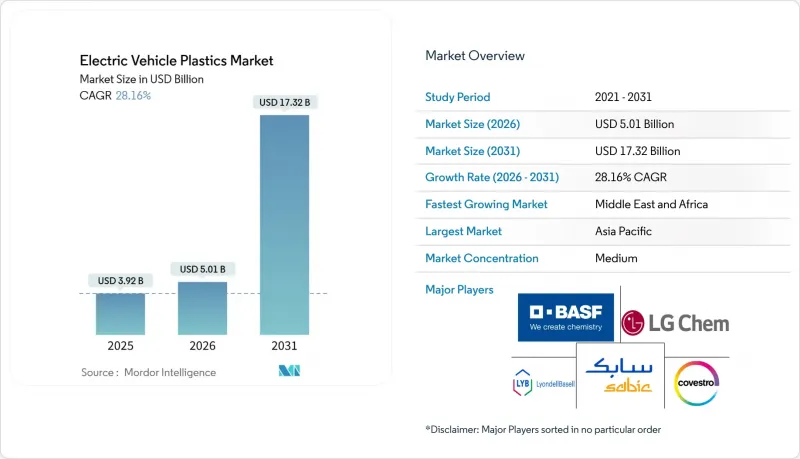
본 보고서는 수지 유형(폴리프로필렌 등), 가공 방법(사출 성형, 블로우 성형 등), 차량 구동 방식(배터리식 전기차(BEV) 등), 용도(외장·내장), 지역(아시아태평양, 북미, 유럽, 남미, 중동 및 아프리카)별로 분류되어 있습니다. 시장 전망은 금액(달러) 기준으로 제시되어 있습니다.
세계의 전기자동차용 플라스틱 시장 동향 및 인사이트
전 세계 전기차 생산 대수와 보급 확대
2025년 전 세계 전기차 판매 대수는 중국의 1,290만 대가 주도한 덕분에 전년 대비 20% 증가한 2,070만 대를 기록했습니다. 이러한 규모 확대로 인해 소재 인증 기간이 24개월에서 12개월로 단축됨에 따라, 수지 공급업체들은 여러 OEM과 동시에 등급 사전 승인을 진행해야 하는 상황에 놓이게 되었습니다. 이러한 급증으로 인해 구동 방식별 수요가 세분화되면서, 컴파운더들은 배터리식 전기차(BEV)용 모듈에 사용되는 프리미엄 폴리카보네이트와 하이브리드차용 트림에 사용되는 비용 효율을 중시한 ABS를 모두 재고로 확보할 수밖에 없는 상황에 처해 있습니다. 2026년부터 BEV(배터리 전기차) 1대당 최대 5.6 크레딧이 할당되는 중국의 듀얼 크레딧 제도에 따라, 주강 삼각주 지역에서는 이미 난연성 폴리아미드의 현물 시장에서 공급 부족 현상이 발생하고 있습니다. Tier 1 공급업체의 추산에 따르면, 전기차(EV)가 100만 대 증가할 때마다 1만 2,000-1만 5,000톤의 엔지니어링 플라스틱이 소비되며, 이러한 비율은 2028년까지 유지될 것으로 전망됩니다.
주행 거리 연장을 위해서는 경량화가 필수적입니다.
배터리 트레이에서 알루미늄을 유리섬유 강화 폴리아미드로 대체함으로써, 1대당 8-12kg의 경량화가 가능해지며, WLTP 기준 주행 거리를 2-3km 연장할 수 있습니다. 이는 주요 심리적 장벽을 극복하기에 충분한 수치입니다. BASF의 UL 94 V-0 인증을 획득한 ‘Ultramid Advanced N3U42G6’를 사용하면, 절연 안전성을 저해하지 않으면서 800V 커넥터 하우징의 무게를 15% 더 줄일 수 있습니다. 이러한 필요성은 동유럽에서 더욱 커지고 있으며, 이 지역 구매자의 62%가 여전히 ‘주행 거리에 대한 불안’을 가장 큰 걸림돌로 꼽고 있습니다. 경량화는 서스펜션에도 영향을 미칩니다. 강철 링크를 PA66-GF50 재질의 부품으로 교체하여 비현가 질량을 줄이고, 더 소형화된 댐퍼를 채택함으로써 2-3kg의 추가 경량화가 가능해집니다. 2026년 1월부터 시행된 중국의 2톤 차량에 대한 15.1kWh/100km 규제는 실질적으로 최소 3가지 차량 시스템에서 폴리머로의 대체를 의무화하는 것입니다.
고성능 엔지니어링 폴리머(PEEK, PPS)의 높은 비용
PEEK와 PPS의 가격은 각각 45-65달러/kg, 18-28달러/kg인 반면, PA6-GF는 3.5-5.5달러/kg이므로, 이러한 고기능성 폴리머의 용도는 200°C 이상의 내열성이 요구되는 커넥터나 슬롯 라이너 등으로 제한되어 있습니다. 도레이의 PPS는 2024년부터 2026년에 걸쳐 연평균 성장률(CAGR) 7%를 기록했으나, 각 OEM 업체들이 사용량을 200그램 미만의 부품으로 제한하고 있어 전 세계 생산량은 15킬로톤 미만에 그치고 있습니다. 생산 측면에서의 경제성은 여전히 불리한 상황에 놓여 있습니다. 불활성 분위기에서 320℃에서 진행하는 PEEK 합성은 PA66에 비해 비용이 12배 더 많이 듭니다. 2024년, PEEK를 PPA로 대체하는 시험은 폭스바겐의 145°C 열 사이클 시험을 통과하지 못했습니다. 비용 압박은 인도에서 가장 심각하며, 2만 5,000달러 이하의 BEV 가격대에서는 유전율 여유를 15% 희생하고 PA9T로 전환할 수밖에 없는 상황입니다.
부문별 분석
폴리우레탄은 2025년 전기자동차용 플라스틱 시장 규모에서 33.15%의 점유율을 유지했습니다. 이는 셀-투-팩형 배터리에서 구조용 폼 및 포팅재로서의 이중 기능을 반영한 것입니다. 헌츠맨(Huntsman)사의 ‘Shokless 2.0’ 폼은 두께 12mm로 UL 94 V-0 규격을 충족하며, 못 관통 시험에서 열 전파를 차단함으로써 CATL의 ‘Qilin’ 배터리 사업을 수주했습니다. 폴리아미드는 예측 기간(2026-2031년) 동안 연평균 성장률(CAGR) 29.31%를 나타낼 것으로 예측되며, BASF의 ‘Ultramid Endure’ 시험 결과에 따르면 PA66 대신 PA6가 채택될 전망입니다. PA6는 더 낮은 온도에서 가공이 가능하며, 사이클 타임을 12% 단축하고, 가수분해 수명을 10만 시간 이상으로 연장합니다.
폴리카보네이트는 10%대 중반 시장 점유율을 유지하며, 투명 배터리 커버 및 파노라마 루프 분야에서 우위를 점하고 있습니다. 코베스트로의 바이오 유래 비율 50%인 ‘마크로론 RE’는 2025년에 BMW 및 메르세데스-벤츠로부터 수주를 확보했습니다. ABS는 PP에 비해 밀도가 15% 낮다는 단점이 있음에도 불구하고, 여전히 내장 트림의 주력 소재로 자리 잡고 있습니다. 트리네소의 PCR(재활용 플라스틱) 함유율 30%인 ‘에머지 3000’은 OEM 각사가 25%의 재생 소재 사용 의무를 추구하는 가운데, 유럽에서 지지를 넓혀가고 있습니다. SABIC의 Stamax와 같은 장섬유 유리 강화 PP는 현재 9kg짜리 배터리 인클로저를 원샷 성형하고 있으며, 비용 효율을 중시하는 프로그램에서는 PA66에 한계가 있습니다. 니치 엔지니어링 플라스틱인 PEEK, PPS, LCP는 전기자동차용 플라스틱 시장 점유율 합계가 5% 미만이지만, 800V 커넥터나 슬롯 라이너에는 여전히 필수적입니다. Syensqo사의 Ajedium PEEK 덕분에 Lucid사의 3모터 탑재 모델인 ‘Air Sapphire’에서는 절연재를 30% 더 얇게 만들 수 있게 되었습니다.
사출 성형은 2025년에 전기자동차용 플라스틱 시장의 45.20%를 차지했으며, 고전압 커넥터에 필수적인 ±0.03mm의 공차 요건으로 인해 예측 기간(2026-2031년) 동안 연평균 성장률(CAGR) 29.45%를 나타낼 전망입니다. 엥겔의 전동식 e-motion 프레스는 사출 중량의 편차를 해소하여, 폭스바겐의 츠비카우 공장에서 2025년에 배터리 트레이 생산량을 33% 늘릴 수 있었습니다. 압출 성형(시장 점유율 약 25%)은 케이블 피복 분야에서 주류를 이루고 있으며, 에보닉의 Vestamid HTplus는 PA 외층과 TPU 내층을 공압출함으로써 -40°C에서도 유연성을 유지하고 있습니다.
블로우 성형은 여전히 액체 저장용기를 위한 틈새 시장이지만, 열성형은 대형 인테리어 패널에 사용되고 있으며, 90초의 사이클 타임이 사출 성형의 금형 비용을 상회하고 있습니다. 압축 성형된 SMC 소재의 언더바디 실드는 알루미늄보다 2배 높은 비강성을 발휘하지만, 3-5분의 경화 주기가 필요합니다. 적층 가공(AM) 시장 점유율은 아직 낮은 편이지만, Vexma사의 MJF 방식으로 제작된 PA12 프로토타입 덕분에 금형 리드타임이 12주에서 48시간으로 단축되어 OEM의 검증 주기가 가속화되고 있습니다.
지역별 분석
2025년에는 아시아·태평양 지역이 전기자동차용 플라스틱 시장 규모의 43.20%를 차지하며 시장을 주도했습니다. 이는 중국의 NEV 생산 대수 1,176만 대와 전 세계 인계 난연제 생산 능력의 70%를 차지하는 수직 통합 체제에 힘입은 결과입니다. 광둥성에 위치한 Kingfa의 10만 톤 규모 PA 생산 시설은 현재 BYD의 블레이드 배터리와 CATL의 Qilin 팩에 원료를 공급하고 있으며, 이로 인해 해당 지역의 차량 1대당 폴리머 사용량이 22% 증가했습니다. 일본은 25-40%의 가격 프리미엄이 붙는 고부가가치 PPS 및 바이오 PC 등급을 공급하고 있는 반면, 한국의 LG화학은 현대·기아자동차의 800V E-GMP용 폴리카보네이트 생산 능력을 여수에서 3만 톤 증설했습니다. 인도는 타타의 전기차 생산 확대에 대응하기 위해 코베스트로가 2025년에 푸네에 건설할 PU 시스템 하우스를 통해 투자를 유치하고 있으며, 태국은 2030년까지 72만 5,000대의 전기차를 생산하는 것을 목표로 하는 컴파운딩 공장에 대해 8년간의 면세 조치를 제공합니다.
북미에서는 인플레이션 억제법(IRA)의 국내 조달률 50% 규정이 호재로 작용하면서, BASF가 미시간주에서 1억 5,000만 달러를 투자해 PA(폴리아미아) 생산을 확대하고, 듀폰은 델라웨어주에 2만 5,000톤 규모의 PA66 생산 라인을 신설했습니다. USMCA(미국·멕시코·캐나다 협정)에 따라 멕시코에서 이루어지는 컴파운딩은 ‘국내’ 생산으로 간주되므로, 세라니즈의 케레타로 공장은 GM의 울티움(Ultium) 배터리 팩에 부품을 공급할 수 있게 됩니다. 캐나다의 저온 내성 요건에 따라, 포드의 F-150 라이트닝에는 랭세스의 듀레탄 PA6가 채택되었습니다. EPA의 2027-2032년 규제에 따라, 미국의 폴리머 수요는 연간 최대 22만 톤 증가할 가능성이 있습니다.
유럽은 재활용 분야에서 여러 과제에 직면해 있습니다. FR-PA는 재활용 과정을 한 번 거칠 때마다 15-25%의 인성을 잃지만, 규정 2023/1542에 따르면 2027년까지 63%를 회수해야 합니다. 랑크세스는 폭스바겐의 ID 시리즈를 위해 독일에서 연간 8킬로톤 규모의 PA6-PCR 생산 라인을 가동한 반면, 아르케마의 바이오 PA11은 르노와 스텔란티스의 스코프 3 목표 달성을 위한 대책으로 활용되고 있습니다. 브렉시트 이후 영국은 TCA(무역·협력 협정)에 따른 10%의 관세를 피하기 위해 EU 규정을 준수하고 있으며, 재규어 랜드로버는 45%의 현지 조달률 기준을 충족해야만 합니다. 북유럽의 BEV(배터리식 전기차) 보급으로 인해 1인당 폴리머 사용량은 증가하고 있지만, 러시아의 전기차 시장은 연간 5,000대 미만으로 여전히 무시할 수 있는 규모입니다.
중동 및 아프리카는 연평균 성장률(CAGR) 29.51%를 기록하며 가장 빠른 성장세를 보이고 있습니다. 루시드사의 제다 공장(연간 생산량 15만 5,000대)과 UAE가 제시한 2050년까지 전기차 판매 비중 50%라는 목표가, 지역적 성장을 뒷받침하는 현지 조달 규정을 촉발하고 있습니다. 브라질의 35% 수입 관세로 인해 BASF는 과라팅게타에서 연간 15킬로톤 규모의 생산 확대를 추진하고 있습니다. 남아프리카공화국의 계획 정전은 성형 비용에 1kg당 0.15-0.25달러를 추가 부담하게 하여, 해당 국가의 인건비 경쟁력을 약화시키고 있습니다.
기타 혜택 :
- 엑셀 형식 시장 예측(ME) 시트
- 3개월간의 애널리스트 지원
자주 묻는 질문
목차
제1장 서론
제2장 분석 방법
제3장 주요 요약
제4장 시장 구도
제5장 시장 규모 및 성장률 예측
제6장 경쟁 구도
제7장 시장 기회 및 향후 전망
KTH 26.06.24According to Mordor Intelligence, the electric vehicle plastics market size is expected to increase from USD 3.92 billion in 2025 to USD 5.01 billion in 2026 and reach USD 17.32 billion by 2031, growing at a CAGR of 28.16% over 2026-2031.
This report is Segmented by Resin Type (Polypropylene, and More), Processing Method (Injection Molding, Blow Molding, and More), Vehicle Propulsion Type (Battery Electric Vehicles (BEVs), and More), Application (Exterior and Interior), and Geography (Asia-Pacific, North America, Europe, South America, and the Middle East and Africa). The Market Forecasts are Provided in Terms of Value (USD).
Global Electric Vehicle Plastics Market Trends and Insights
Rising Global EV Production and Adoption
Global electric-vehicle sales climbed to 20.7 million units in 2025, a 20% jump year-on-year, anchored by China's 12.9 million units. Such a scale compresses material-qualification windows from 24 to 12 months, pushing resin suppliers to pre-approve grades with multiple OEMs in parallel. The surge fragments demand by propulsion architecture, forcing compounders to stock both premium polycarbonate for battery-electric modules and cost-sensitive ABS for hybrid trims. China's dual-credit scheme, worth up to 5.6 credits per BEV in 2026, is already creating spot shortages of flame-retardant polyamide in the Pearl River Delta. Tier-one suppliers calculate that every additional million EVs consumes 12,000-15,000 tons of engineering plastics, a ratio expected to hold through 2028.
Lightweighting Imperative to Extend Range
Replacing aluminum with glass-fiber-reinforced polyamide in battery trays cuts 8-12 kg per vehicle, extending range 2-3 km under WLTP, enough to shift models past key psychological thresholds. BASF's UL 94 V-0-rated Ultramid Advanced N3U42G6 lets designers remove a further 15% mass from 800-V connector housings without losing dielectric safety. The imperative intensifies in Eastern Europe, where 62% of shoppers still cite range anxiety as the top barrier. Lightweighting cascades into suspension: swapping steel links for PA66-GF50 trims unsprung mass, enabling smaller dampers that shave another 2-3 kg. China's 15.1 kWh/100 km cap for a 2-ton car, effective January 2026, essentially mandates polymer substitution in at least three vehicle systems.
High Cost of Advanced Engineering Polymers (PEEK, PPS)
PEEK and PPS trade at USD 45-65/kg and USD 18-28/kg, respectively, versus USD 3.5-5.5/kg for PA6-GF, restricting their use to connectors and slot liners that must survive greater than or equal to 200°C. Toray's PPS grew at 7% CAGR between 2024 and 2026, yet it stays below 15 kilotons global volume because OEMs ration usage to sub-200 gram parts. Production economics remain unfavorable: PEEK synthesis at 320°C under inert atmosphere drives costs 12-fold above PA66. Substitution trials replacing PEEK with PPA failed Volkswagen's 145°C thermal-cycling tests in 2024. Cost pressure is most acute in India, where less than or equal to USD 25,000 BEV price points force a shift to PA9T, sacrificing 15% dielectric margin.
Other drivers and restraints analyzed in the detailed report include:
- Tightening CO2/Efficiency Regulations
- Cell-to-Pack Designs Need Flame-Retardant Housings
- End-of-Life Recycling and Material-Compatibility Gaps
For complete list of drivers and restraints, kindly check the Table Of Contents.
Segment Analysis
Polyurethane retained 33.15% share of the electric vehicle plastics market size in 2025, reflecting its dual function as structural foam and potting for cell-to-pack batteries. Huntsman's Shokless 2.0 foam passed UL 94 V-0 at 12 mm and secured CATL's Qilin battery business by halting thermal propagation in nail-penetration tests. Polyamide is projected to expand at a 29.31% CAGR for the forecast period (2026-2031), displacing PA66 with PA6 that processes at lower temperatures, trims cycle time 12%, and extends hydrolysis life beyond 100,000 hours per BASF Ultramid Endure trials.
Polycarbonate holds mid-teens share and wins transparent battery covers and panoramic roofs, with Covestro's 50% bio-attributed Makrolon RE landing BMW and Mercedes orders in 2025. ABS remains the interior trim workhorse despite a 15% density penalty versus PP; Trinseo's 30% PCR Emerge 3000 is gaining European traction as OEMs chase 25% recycled mandates. Long-glass-fiber PP, such as SABIC's Stamax, now molds 9-kg battery enclosures in a single shot, challenging PA66 in some cost-driven programs. Niche engineering plastics, PEEK, PPS, and LCP, collectively under 5% electric vehicle plastics market share, remain indispensable for 800-V connectors and slot liners; Syensqo's Ajedium PEEK enabled 30% thinner insulation on Lucid's tri-motor Air Sapphire.
Injection molding accounted for 45.20% electric vehicle plastics market share in 2025 and is poised to rise at 29.45% CAGR during the forecast period (2026-2031), owing to +-0.03 mm tolerances essential for HV connectors. Engel's all-electric e-motion presses eliminated shot-weight variability, enabling Volkswagen's Zwickau plant to boost battery-tray output 33% in 2025. Extrusion (~25% share) dominates cable sheathing; Evonik's Vestamid HTplus co-extrudes PA outer/TPU inner layers to maintain flexibility to -40°C.
Blow-molding remains a niche for fluid reservoirs, while thermoforming serves large interior panels where 90s cycles trump injection's tooling cost. Compression-molded SMC underbody shields offer specific stiffness 2 times that of aluminum but suffer 3-5 min cure cycles. Additive manufacturing still has less share, yet Vexma's MJF-printed PA12 prototypes cut tool lead-time from 12 weeks to 48 h, accelerating OEM validation loops.
Geography Analysis
Asia-Pacific dominated with 43.20% of the electric vehicle plastics market size in 2025, buoyed by China's 11.76 million NEV output and vertical integration into 70% of global phosphorus FR capacity. Kingfa's 100 kilotons PA facility in Guangdong now feeds BYD's blade battery and CATL's Qilin pack, lifting regional polymer content per vehicle by 22%. Japan contributes high-value PPS and bio-PC grades with 25-40% price premiums, while South Korea's LG Chem added 30 kilotons of polycarbonate at Yeosu for Hyundai-Kia's 800 V E-GMP. India lures investment via Covestro's 2025 Pune PU system house to serve Tata's EV ramp, and Thailand offers eight-year tax holidays for compounding plants geared to 725,000-unit EV output by 2030.
North America gains from the Inflation Reduction Act's 50% domestic-content rule that anchored BASF's USD 150 million PA expansion in Michigan and DuPont's 25 kilotons PA66 line in Delaware. Mexican compounding under USMCA fulfills "domestic" status, letting Celanese's Queretaro plant feed GM's Ultium packs. Canada's cold-soak needs drive Lanxess Durethan PA6 adoption in Ford's F-150 Lightning. EPA 2027-2032 rules could lift the United States polymer demand by up to 220 kilotons/year.
Europe faces recycling hurdles: FR-PA loses 15-25% toughness after one loop, yet Regulation 2023/1542 mandates 63% collection by 2027. Lanxess opened an 8 kilotons PA6-PCR line in Germany for VW's ID series, while Arkema's bio-based PA11 answers Scope 3 goals at Renault and Stellantis. Post-Brexit United Kingdom aligns with EU rules to dodge 10% tariffs under the TCA, forcing Jaguar Land Rover to meet 45% local-content thresholds. Nordic BEV saturation lifts per-capita polymer intensity, whereas Russia's sub-5,000-unit EV market remains immaterial.
The Middle East and Africa show the fastest pace at 29.51% CAGR; Lucid's 155,000-unit Jeddah plant and UAE's 50% EV-sales target by 2050 trigger local-content rules favoring regional compounding. Brazil's 35% import tariff spurs BASF's 15 kilotons PA expansion in Guaratingueta. South Africa's load-shedding adds USD 0.15-0.25/kg to molding costs, eroding its labor edge.
- Asahi Kasei Corporation
- BASF
- Borealis GmbH
- Celanese Corporation
- Covestro AG
- Dow
- DuPont
- Envalior
- Evonik Industries AG
- Huntsman International LLC
- INEOS AG
- Kingfa Science & Technology Limited
- LANXESS
- LG Chem
- LyondellBasell Industries Holdings B.V.
- Rohm GmbH
- RTP Company
- SABIC
- Solvay S.A.
- TORAY INDUSTRIES, INC.
- Sumitomo Chemical Co., Ltd.
Additional Benefits:
- The market estimate (ME) sheet in Excel format
- 3 months of analyst support
TABLE OF CONTENTS
1 Introduction
- 1.1 Study Assumptions and Market Definition
- 1.2 Scope of the Study
2 Research Methodology
3 Executive Summary
4 Market Landscape
- 4.1 Market Overview
- 4.2 Market Drivers
- 4.2.1 Rising global EV production and adoption
- 4.2.2 Lightweighting imperative to extend range
- 4.2.3 Tightening CO2/efficiency regulations
- 4.2.4 Cell-to-pack designs need flame-retardant housings
- 4.2.5 Demand for dielectric-robust polymers for greater than or equal to 800 V systems
- 4.3 Market Restraints
- 4.3.1 High cost of advanced engineering polymers (PEEK, PPS)
- 4.3.2 End-of-life recycling and material-compatibility gaps
- 4.3.3 Supply volatility of phosphorus-based FR additives
- 4.4 Value Chain Analysis
- 4.5 Regulatory Landscape
- 4.6 Porter's Five Forces
- 4.6.1 Bargaining Power of Suppliers
- 4.6.2 Bargaining Power of Buyers
- 4.6.3 Threat of New Entrants
- 4.6.4 Threat of Substitutes
- 4.6.5 Competitive Rivalry
5 Market Size and Growth Forecasts (Value)
- 5.1 By Resin Type
- 5.1.1 Polypropylene (PP)
- 5.1.2 Polyamide (PA)
- 5.1.3 Polycarbonate (PC)
- 5.1.4 Acrylonitrile-Butadiene-Styrene (ABS)
- 5.1.5 Polyurethane (PU)
- 5.1.6 Polyvinyl Chloride (PVC)
- 5.1.7 Other Engineering Plastics (PEEK, PPS, etc.)
- 5.2 By Processing Method
- 5.2.1 Injection Molding
- 5.2.2 Extrusion
- 5.2.3 Blow Molding
- 5.2.4 Thermoforming
- 5.2.5 Compression Molding
- 5.2.6 Additive Manufacturing/3-D Printing
- 5.3 By Vehicle Propulsion Type
- 5.3.1 Battery Electric Vehicles (BEVs)
- 5.3.2 Plug-in Hybrid Electric Vehicles (PHEVs)
- 5.3.3 Hybrid Electric Vehicles (HEVs)
- 5.4 By Application
- 5.4.1 Exterior Components
- 5.4.2 Interior Components
- 5.5 By Geography
- 5.5.1 Asia-Pacific
- 5.5.1.1 China
- 5.5.1.2 India
- 5.5.1.3 Japan
- 5.5.1.4 South Korea
- 5.5.1.5 ASEAN Countries
- 5.5.1.6 Rest of Asia-Pacific
- 5.5.2 North America
- 5.5.2.1 United States
- 5.5.2.2 Canada
- 5.5.2.3 Mexico
- 5.5.3 Europe
- 5.5.3.1 Germany
- 5.5.3.2 United Kingdom
- 5.5.3.3 France
- 5.5.3.4 Italy
- 5.5.3.5 Spain
- 5.5.3.6 Russia
- 5.5.3.7 NORDIC Countries
- 5.5.3.8 Rest of Europe
- 5.5.4 South America
- 5.5.4.1 Brazil
- 5.5.4.2 Argentina
- 5.5.4.3 Rest of South America
- 5.5.5 Middle-East and Africa
- 5.5.5.1 Saudi Arabia
- 5.5.5.2 United Arab Emirates
- 5.5.5.3 South Africa
- 5.5.5.4 Rest of Middle-East and Africa
- 5.5.1 Asia-Pacific
6 Competitive Landscape
- 6.1 Market Concentration
- 6.2 Strategic Moves
- 6.3 Market Share (%)/Ranking Analysis
- 6.4 Company Profiles (includes Global level Overview, Market level overview, Core Segments, Financials as available, Strategic Information, Products and Services, and Recent Developments)
- 6.4.1 Asahi Kasei Corporation
- 6.4.2 BASF
- 6.4.3 Borealis GmbH
- 6.4.4 Celanese Corporation
- 6.4.5 Covestro AG
- 6.4.6 Dow
- 6.4.7 DuPont
- 6.4.8 Envalior
- 6.4.9 Evonik Industries AG
- 6.4.10 Huntsman International LLC
- 6.4.11 INEOS AG
- 6.4.12 Kingfa Science & Technology Limited
- 6.4.13 LANXESS
- 6.4.14 LG Chem
- 6.4.15 LyondellBasell Industries Holdings B.V.
- 6.4.16 Rohm GmbH
- 6.4.17 RTP Company
- 6.4.18 SABIC
- 6.4.19 Solvay S.A.
- 6.4.20 TORAY INDUSTRIES, INC.
- 6.4.21 Sumitomo Chemical Co., Ltd.
7 Market Opportunities and Future Outlook
- 7.1 White-space and Unmet-Need Assessment
- 7.2 Growth in bio-based and recyclable plastics
- 7.3 High-performance plastics for solid-state batteries