|
시장보고서
상품코드
2062037
생물합리 농약 시장 : 시장 점유율 분석, 업계 동향 및 통계, 성장 예측(2026-2031년)Biorationals - Market Share Analysis, Industry Trends & Statistics, Growth Forecasts (2026 - 2031) |
||||||
 Mordor Intelligence
Mordor Intelligence에 의하면, 생물합리 농약 시장 규모는 2025년에 94억 달러로 평가되었고, 2026년 106억 8,000만 달러로 추정되고, 2031년까지 199억 3,000만 달러에 이를 것으로 예측되며, 예측 기간(2026-2031년) CAGR은 13.3%를 나타낼 전망입니다.
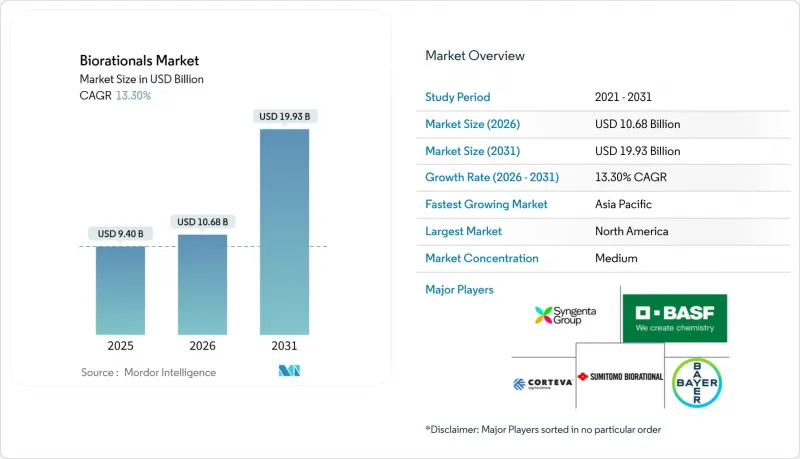
본 보고서는 제품 유형별(미생물 유래, 식물 유래, 세미케미컬 유래, 기타), 원료별(세균, 균류, 기타), 작물 유형별(곡류, 과일 및 채소, 기타), 제형별(액체, 건조), 시용 방법별(엽면 살포, 기타), 지역별(북미, 유럽, 기타)로 분류되어 있습니다. 시장 전망은 금액(달러) 기준으로 제시되어 있습니다.
세계의 생물합리 농약 시장 동향 및 분석
잔류량이 많은 합성 농약에 대한 규제상 금지 조치
최대 잔류 기준치(MRL)의 엄격한 시행으로 인해 화학 농약의 선택지가 좁아지면서, 작물 보호에 대한 지출이 재분배되고 있습니다. 미국 환경보호청(EPA)의 2025년 폐지 목록에서 미국 옥수수 및 대두 재배 프로그램의 주류를 이루던 네오니코티노이드계 및 유기인계 농약이 제외됨에 따라, 바실러스 투린젠시스(Bacillus thuringiensis)와 메타리지움 아니소플리아에(Metarhizium anisopliae) 제품에 즉각적인 시장 기회가 생겼습니다. 유럽연합(EU)의 농약 규제에서는 다양한 식품 및 사료 제품에 대해 최대 잔류 기준치(MRL)가 정해져 있습니다. 특정 농약 기준치가 정의되어 있지 않은 경우, 기본 임계값인 0.01 mg/kg이 적용되며, 거래되는 농산물의 허용 잔류 수준을 최소화함으로써 생물합리 농약 제품으로의 전환을 촉진하고 있습니다.
식품 소매업체의 무농약 농산물에 대한 수요
대형 식품 소매업체들은 공급업체와의 계약에 제3자 기관을 통한 잔류물 검사를 포함하고 있습니다. 2025년 10월, 미국 월마트는 2027년까지 자사 브랜드 식품에서 합성 착색료 및 기타 첨가물을 제거할 계획을 발표했습니다. 이러한 움직임은 더 깨끗하고 투명한 원료 기준을 요구하는 소비자의 기대와 소매업체의 전략 모두에서 일어나고 있는 광범위한 변화를 반영하고 있습니다. 코스트코와 테스코의 이러한 기준이 하류 지역 도매업체들로까지 확산되고 있습니다. 수확 후 매대에 진열되기까지 며칠밖에 걸리지 않는 베리류, 잎채소, 과수류에서는 이러한 압박이 특히 심해, 기준을 충족하지 못할 위험이 높아지고 있습니다. 조기에 기준을 준수한 생산자는 도매 가격에서 프리미엄을 확보할 수 있으며, 또한 일본의 수입 기준이 강화됨에 따라 아시아태평양의 수출 거점에 대한 인센티브가 더욱 높아지고 있습니다.
화학 농약에 비해 토양 잔류성이 낮습니다.
많은 미생물 유래 및 식물 유래 유효 성분은 며칠 만에 분해되기 때문에 여러 번 재살포해야 하므로 운영 비용이 증가합니다. 바실러스 투링겐시스(Bacillus thuringiensis)는 강한 햇빛 아래에서는 72시간 이내에 효능의 절반을 잃지만, 이에 비해 네오니코티노이드계 농약은 2-3주 동안 방제 효과가 지속됩니다(4). 캡슐화된 메탈리디움 포자는 생존 기간을 연장했지만, 이러한 기술은 아직 주류가 아닙니다. 제제 기술의 보급이 확대되기 전까지는 자외선 양이 많은 지역에서 헥타르당 비용이 우선시되는 한, 생산자들은 계속해서 합성 농약에 의존할 것으로 보입니다.
부문별 분석
미생물 기반 솔루션은 2025년 매출의 52%라는 최대 시장 점유율을 차지했으며, 풍부한 현장 데이터와 확립된 규제 채널을 통해 그 지배적인 위치를 유지하고 있습니다. 세미오케미컬 제품 시장 규모는 작지만, 자율 비행 드론이 과수원 및 포도밭 전역에 페로몬 살포 장치를 배치함에 따라 2026-2031년 연평균 성장률(CAGR) 19.8%라는 가장 빠른 성장세를 보일 것으로 예측됩니다. 식물 유래 제제는 수확 전 대기 기간이 0일인 특수 틈새 시장에 계속해서 기여하는 한편, 미생물 대사 산물과 생장 조절제로 구성된 '기타' 부문은 발효 수율의 향상과 함께 점유율을 서서히 확대되고 있습니다.
다중 균주 제품으로의 전환이 경쟁사 벤치마킹을 재편하고 있습니다. 바실러스, 트리코데르마, 스트렙토마이세스를 중심으로 구성된 컨소시엄은 기능적 중복성을 제공하여 산성 토양과 알칼리성 토양 모두에서 일관된 효능을 보장합니다. 세미오케미칼은 정밀 살포용 하드웨어를 활용하여 인건비를 절감하고, 다년생 작물 재배에서 규모의 경제를 실현합니다. 반면, 식물 유래 제제는 공급 차질의 영향을 받기 쉬우며, 높은 추출 비용으로 인해 광활한 곡물 농장에서의 보급이 제한되고 있습니다. 컨소시엄 시장 포지셔닝과 드론 대응 페로몬 제제에 대한 전략적 투자가 생물합리 농약 시장 전망 승자를 결정지을 것으로 보입니다.
박테리아는 산업 규모의 발효를 통한 경제성과 곤충, 균류, 선충에 대한 광범위한 적용 가능성을 바탕으로 2025년 매출의 39%를 차지했으며 가장 큰 시장 점유율을 기록했습니다. 바이러스 유래 약제는 현재 틈새 시장으로 분류되지만, 해충의 내성을 극복하는 CRISPR(클러스터화된 규칙적으로 간격이 있는 짧은 팔미로 반복 서열) 강화 바쿠로바이러스에 힘입어, 2026-2031년 연평균 성장률(CAGR) 22.3%라는 가장 빠른 속도로 확대될 것으로 예측됩니다. 곤충 병원성 곰팡이와 식물 추출물 부문은 여전히 큰 시장 점유율을 유지하고 있지만, 특정 관할 구역에서는 제형화 및 규제 측면에서 어려움을 겪고 있습니다.
세포 배양 기술의 발전으로 바이러스 생산 비용이 낮아졌으며, 생태계에 부수적인 영향을 미치지 않으면서 숙주 특이성을 정밀하게 제어할 수 있게 되었습니다. 캡슐화 기술 덕분에 곰팡이 포자의 생존 기간이 연장되어, 표준 살포 주기에 맞추어 사용할 수 있게 되었습니다. 식물 추출물은 유기농 인증 시장에서 수요가 있지만, 유럽연합(EU)에서는 엄격한 독성학적 심사가 이루어지고 있어 시장 출시까지의 기간이 길어지고 있습니다. 세균, 곰팡이, 바이러스를 아우르는 균형 잡힌 포트폴리오는 내성 사이클의 발생이나 규제상의 불확실성에 대한 헤지 역할을 하여, 생물합리 농약 시장에서 포트폴리오의 회복력을 강화합니다.
지역별 분석
북미는 2025년 기준 44%의 매출 점유율을 유지했으며, 화학 농약에 대한 규제 감독 강화와 친환경 농업 관행에 대한 공공 자금 지원 확대에 힘입어 지속 가능한 농업 분야에서 강력한 성장세를 보이고 있습니다. 이와 동시에, 미국 환경보호청(EPA)은 바이오 농약 등 더 안전한 대체품의 보급과 규제를 지속하고 있으며, 미국 농무부(USDA)는 화학 비료 사용량 감축을 촉진하는 보전 및 재생 농업 이니셔티브에 막대한 자금을 투자하고 있습니다.
유럽에서는 유럽연합(EU) 내의 엄격한 농약 규제와 지속가능성 정책에 따라 작물 보호 체계가 점차 구축되고 있어 시장이 확대되고 있습니다. 독일과 프랑스는 유기농업의 의무화와 소매업체의 잔류 기준 강화 등을 통해 이를 주도하고 있습니다. 잡초는 여전히 작물 수확량을 저해하는 주요 요인이며 생태계와 인간의 건강에 악영향을 미칠 가능성이 있지만, 한편으로는 합성 제초제가 환경과 규제에 미치는 영향에 대한 우려도 계속해서 커지고 있습니다. 그 결과, 생태학적 원칙에 기반하여 화학물질 사용을 줄이는 '농업생태학적 잡초 관리(AWM)'가 지속 가능한 대안으로 부상하고 있습니다. 식물 추출물에 대한 신청 서류는 유럽 식품안전청(EFSA)의 심사 기간이 길어지는 경향이 있지만, 독성 검사 데이터를 선제적으로 제출하는 기업은 선구자로서의 우위를 확보하고 있습니다.
아시아태평양은 2026-2031년 연평균 성장률(CAGR) 15.4%를 기록할 전망이며, 가장 빠르게 성장할 지역입니다. 중국은 2026-2030년 제15차 5개년 계획의 일환으로 주요 농업 이니셔티브를 발표했으며, 한편 인도의 유기농 경작지는 420만 헥타르에 달했습니다. 중국은 향후 몇 년 동안 과일 및 채소에 대한 농약 사용량을 10% 줄이는 것을 목표로 하고 있습니다. 인도에서는 주마다 승인 제도가 제각각이라 제품 출시가 지연되는 문제에 직면해 있지만, 잔류물 제로 수출을 목표로 하는 국가적 방침이 콩류 및 향신료 부문에서의 도입을 촉진하고 있습니다. 동남아시아에서는 콜드체인의 부족으로 인해 여전히 미생물에 의한 유통기한이 제한되고 있으며, 이로 인해 현지에서 발효시킨 제품이나 상온 보관이 가능한 식물성 제품에 시장 기회가 생기고 있습니다.
기타 혜택
- 엑셀 형식 시장 예측(ME) 시트
- 3개월간의 애널리스트 지원
자주 묻는 질문
목차
제1장 서론
제2장 조사 방법
제3장 주요 요약
제4장 시장 구도
제5장 시장 규모 및 성장 예측
제6장 경쟁 구도
제7장 시장 기회 및 향후 전망
AJY 26.06.22According to Mordor Intelligence, the biorationals market size was valued at USD 9.4 billion in 2025 and estimated to grow from USD 10.68 billion in 2026 to reach USD 19.93 billion by 2031, registering a CAGR of 13.3% during the forecast period (2026-2031).
This report is Segmented by Product Type (Microbial-Based, Botanical-Based, Semiochemical-Based, and More), by Source (Bacteria, Fungi, and More), by Crop Type (Cereals and Grains, Fruits and Vegetables, and More), by Formulation (Liquid and Dry), by Mode of Application (Foliar Spray and More), and by Geography (North America, Europe, and More). The Market Forecasts are Provided in Terms of Value (USD).
Global Biorationals Market Trends and Insights
Regulatory Bans on High-Residue Synthetic Pesticides
Heightened maximum-residue-level enforcement is shrinking the chemical toolkit and redirecting crop-protection spending. The Environmental Protection Agency (EPA) 2025 cancellation list removed neonicotinoids and organophosphates that dominated United States corn and soybean programs, creating immediate openings for Bacillus thuringiensis and Metarhizium anisopliae products. The European Union's pesticide regulation establishes Maximum Residue Levels (MRLs) for a broad range of food and feed products. When no specific pesticide limit is defined, a default threshold of 0.01 mg/kg is applied, ensuring minimal allowable residue levels in traded agricultural goods, driving a transition toward biorationals.
Demand for Residue-Free Produce from Food Retailers
Large grocers have embedded third-party residue testing into supplier contracts. In October 2025, Walmart U.S. revealed plans to eliminate synthetic dyes and several other additives from its private-label food products by 2027. This move reflects a broader shift in both consumer expectations and retailer strategies toward cleaner, more transparent ingredient standards. Comparable standards at Costco and Tesco are cascading downstream to regional distributors. The pressure is acute in berries, leafy greens, and tree fruits that move from harvest to shelf in days, increasing the risk of failure. Early-adopter growers secure wholesale price premiums, and Japan's tighter import tolerances amplify incentives in Asia-Pacific export hubs.
Lower Field Persistence Relative to Chemicals
Many microbial and botanical actives degrade within days, requiring multiple reapplications and raising operational costs. Bacillus thuringiensis loses half its potency within 72 hours under high solar radiation, compared with two to three weeks of protection from neonicotinoids[4]. Encapsulated Metarhizium spores extended viability, but such technologies are not yet mainstream. Until formulation advances scale, growers in high-ultraviolet geographies will continue to rely on synthetic standards when cost per hectare dictates.
Other drivers and restraints analyzed in the detailed report include:
- Government Subsidies for Sustainable Agriculture Tools
- Rapid Commercial Success of Microbial Consortia Products
- Fragmented Global Registration Pathways
For complete list of drivers and restraints, kindly check the Table Of Contents.
Segment Analysis
Microbial-based solutions generated the largest market share of 52% of 2025 revenue, protecting their dominant position through extensive field data and well-known regulatory pathways. Semiochemical products, although representing a smaller base, are anticipated to register the fastest growth at 19.8% CAGR 2026-2031, as autonomous drones deploy pheromone dispensers across orchards and vineyards. Botanical formulations continue to serve specialty niches that demand zero-day pre-harvest intervals, whereas the "others" category of microbial metabolites and growth regulators captures incremental share as fermentation yields improve.
The shift toward multi-strain products is reshaping competitive benchmarks. Consortia built around Bacillus, Trichoderma, and Streptomyces deliver functional redundancy, ensuring consistent efficacy across acidic and alkaline soils. Semiochemicals leverage precision-application hardware to lower labor cost, unlocking scale in perennial crops. Botanicals remain exposed to supply shocks, and high extraction costs limit penetration in broad-acre cereals. Strategic investment in consortia positioning and drone-compatible pheromone formats will define future winners in the biorationals market.
Bacteria contributed the largest market share, 39% of 2025 revenue, underpinned by industrial-scale fermentation economics and versatility against insects, fungi, and nematodes. Virus-derived agents hold niche status today, yet are anticipated to expand at a fastest rate of 22.3% CAGR during 2026-2031, propelled by clustered regularly interspaced short palindromic repeats (CRISPR) enhanced baculoviruses that overcome pest resistance. Fungal entomopathogens and plant-extract categories retain significant shares but face formulation and regulatory headwinds in certain jurisdictions.
Cell-culture advances are lowering viral production costs, enabling precise control of host-specificity without collateral ecosystem effects. Encapsulation technologies extend fungal spore viability to match standard spray intervals. Plant extracts appeal to certified-organic markets but undergo rigorous toxicology scrutiny in the European Union, inflating time to market. Balanced portfolios spanning bacteria, fungi, and viruses hedge against resistance cycles and regulatory uncertainty, reinforcing portfolio resilience in the biorationals market.
Geography Analysis
North America remains the largest revenue share at 44% in 2025 and has shown strong momentum toward sustainable agriculture, driven by tightening regulatory oversight on chemical pesticides and increased public funding for environmentally friendly farming practices. In parallel, the U.S. Environmental Protection Agency continues to promote and regulate safer alternatives, such as biopesticides, while the United States Department of Agriculture has committed significant funding to conservation and regenerative agriculture initiatives that encourage reduced chemical inputs.
Europe is growing due to its crop protection landscape, which is increasingly shaped by stringent pesticide regulations and sustainability policies within the European Union. Germany and France spearhead adoption through organic-farming mandates and retailer residue clamps. Weeds remain a major constraint on crop yields and can negatively affect ecosystems and human health, while concerns over the environmental and regulatory impacts of synthetic herbicides continue to rise. Consequently, Agroecological Weed Management (AWM) is emerging as a sustainable alternative that relies on ecological principles and reduced chemical use. While botanical-extract dossiers face longer European Food Safety Authority reviews, companies that front-load toxicology data secure first-mover advantages.
Asia-Pacific is the fastest-growing region at 15.4% CAGR from 2026 to 2031, as China has announced major agricultural initiatives as part of its 15th Five-Year Plan for 2026-2030, while India's organic acreage reached 4.2 million hectares. China aims to reduce pesticide use on fruits and vegetables by 10% in the coming years. India wrestles with fragmented state approvals that slow launches, yet national residue-free export ambitions drive adoption in pulses and spices. Cold-chain shortages still constrain microbial shelf life in Southeast Asia, creating space for locally fermented products and room-temperature stable botanicals.
- Sumitomo Biorational Company LLC (Valent BioSciences)
- Bayer AG
- Syngenta Crop Protection AG
- BASF
- Corteva Agriscience
- FMC Corporation
- UPL
- Koppert
- Rovensa Next
- Certis Biologicals
- Novozymes A/S, part of Novonesis Group
- Pro Farm Group Inc.
- Vestaron Corporation
- Biobest
Additional Benefits:
- The market estimate (ME) sheet in Excel format
- 3 months of analyst support
TABLE OF CONTENTS
1 Introduction
- 1.1 Study Assumptions and Market Definition
- 1.2 Scope of the Study
2 Research Methodology
3 Executive Summary
4 Market Landscape
- 4.1 Market Overview
- 4.2 Market Drivers
- 4.2.1 Regulatory bans on high-residue synthetic pesticides
- 4.2.2 Demand for residue-free produce from food retailers
- 4.2.3 Government subsidies for sustainable agriculture tools
- 4.2.4 Rapid commercial success of microbial consortia products
- 4.2.5 Adoption of drone-enabled ultra-low-volume biological spraying
- 4.2.6 CRISPR-tailored biocontrol strains targeting invasive pests
- 4.3 Market Restraints
- 4.3.1 Lower field persistence relative to chemicals
- 4.3.2 Fragmented global registration pathways
- 4.3.3 Shortage of cold-chain infrastructure in emerging markets
- 4.3.4 Supply risk for rare botanical actives
- 4.4 Regulatory Landscape
- 4.5 Technological Outlook
- 4.6 Porter's Five Forces Analysis
- 4.6.1 Threat of New Entrants
- 4.6.2 Bargaining Power of Suppliers
- 4.6.3 Bargaining Power of Buyers
- 4.6.4 Threat of Substitutes
- 4.6.5 Intensity of Competitive Rivalry
5 Market Size and Growth Forecasts (Value)
- 5.1 By Product Type
- 5.1.1 Microbial-based
- 5.1.2 Botanical-based
- 5.1.3 Semiochemical-based
- 5.1.4 Other Product Types
- 5.2 By Source
- 5.2.1 Bacteria
- 5.2.2 Fungi
- 5.2.3 Viruses
- 5.2.4 Plant Extracts
- 5.2.5 Biochemical Semiochemicals
- 5.3 By Crop Type
- 5.3.1 Cereals and Grains
- 5.3.2 Fruits and Vegetables
- 5.3.3 Oilseeds and Pulses
- 5.3.4 Other Crop Types
- 5.4 By Formulation
- 5.4.1 Liquid
- 5.4.2 Dry
- 5.5 By Mode of Application
- 5.5.1 Foliar Spray
- 5.5.2 Seed Treatment
- 5.5.3 Soil Treatment
- 5.5.4 Post-harvest
- 5.6 By Geography
- 5.6.1 North America
- 5.6.1.1 United States
- 5.6.1.2 Canada
- 5.6.1.3 Mexico
- 5.6.1.4 Rest of North America
- 5.6.2 South America
- 5.6.2.1 Brazil
- 5.6.2.2 Argentina
- 5.6.2.3 Rest of South America
- 5.6.3 Europe
- 5.6.3.1 Germany
- 5.6.3.2 France
- 5.6.3.3 Russia
- 5.6.3.4 Rest of Europe
- 5.6.4 Asia-Pacific
- 5.6.4.1 China
- 5.6.4.2 India
- 5.6.4.3 Japan
- 5.6.4.4 Rest of Asia-Pacific
- 5.6.5 Middle East
- 5.6.5.1 Saudi Arabia
- 5.6.5.2 Turkey
- 5.6.5.3 Rest of Middle East
- 5.6.6 Africa
- 5.6.6.1 South Africa
- 5.6.6.2 Kenya
- 5.6.6.3 Rest of Africa
- 5.6.1 North America
6 Competitive Landscape
- 6.1 Market Concentration
- 6.2 Strategic Moves
- 6.3 Market Share Analysis
- 6.4 Company Profiles (Includes Global level Overview, Market level overview, Core Segments, Financials as available, Strategic Information, Market Rank/Share for key companies, Products and Services, and Recent Developments)
- 6.4.1 Sumitomo Biorational Company LLC (Valent BioSciences)
- 6.4.2 Bayer AG
- 6.4.3 Syngenta Crop Protection AG
- 6.4.4 BASF
- 6.4.5 Corteva Agriscience
- 6.4.6 FMC Corporation
- 6.4.7 UPL
- 6.4.8 Koppert
- 6.4.9 Rovensa Next
- 6.4.10 Certis Biologicals
- 6.4.11 Novozymes A/S, part of Novonesis Group
- 6.4.12 Pro Farm Group Inc.
- 6.4.13 Vestaron Corporation
- 6.4.14 Biobest