|
시장보고서
상품코드
2062063
화재 시험 시장 : 점유율 분석, 업계 동향과 통계, 성장 예측(2026-2031년)Fire Testing - Market Share Analysis, Industry Trends & Statistics, Growth Forecasts (2026 - 2031) |
||||||
 Mordor Intelligence
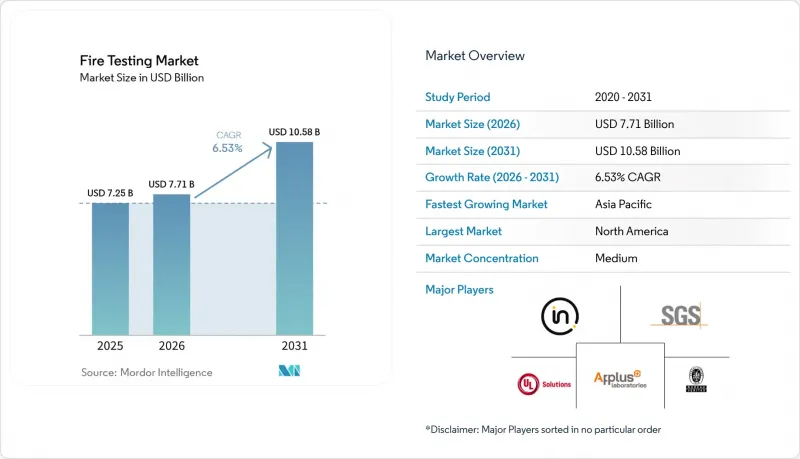
Mordor Intelligence에 의하면, 화재 시험 시장 규모는 2025년 72억 5,000만 달러에서 2026년에는 77억 1,000만 달러로 확대되어 2026년부터 2031년까지 CAGR 6.53%로 성장을 지속하여, 2031년에는 105억 8,000만 달러에 이를 것으로 예측됩니다.
본 보고서는 서비스 유형(내화 시험, 가연성 시험 등), 시험 방법(실규모 화로 시험, 소규모 및 벤치 시험 등), 최종 이용 산업(건축 및 건설, 운송 등), 재료 유형(구조 부재, 방화 코팅 등) 및 지역별로 분류되어 있습니다. 시장 전망은 금액(달러) 기준으로 제시되어 있습니다.
세계 화재 시험 시장 동향 및 분석
더 엄격한 방화 규제 및 법규의 시행
북미, 유럽, 아시아태평양의 화재 규제 강화는 여전히 화재 시험 시장을 지탱하는 가장 큰 구조적 요인으로 작용하고 있습니다. NFPA 855의 2026년판에서는 배터리 에너지 저장 시스템에 대해 ANSI/CAN/UL 9540A에 기반한 대규모 화재 시험을 의무화하고 있으며, 이에 따라 구매자들은 더 제한적인 제품 수준의 검사보다는 설치 단계에서의 검증을 요구하게 되었습니다. 유럽에서도 건설제품규정(CPR)의 틀에 기반한 위임규정의 개정을 통해, 건설제품에 대한 화재 분류 및 내화 성능에 관한 규정이 강화되었습니다. ISO 834-1:2025에 따라 2025년 5월에 내화 시험의 일반 요건이 개정되었으며, 이에 따라 시험소 및 제조업체는 개정된 절차, 계측 장비 점검 및 보고 관행을 준수해야 합니다. ISO/IEC 17025는 여전히 게이트키핑 인증 기준이며, 공인된 인증을 보유하지 않은 시험소는 많은 용도에서 규제상 효력을 갖는 시험 결과를 발행할 수 없습니다. 이러한 조합 덕분에 수요는 견조한 추세를 보이고 있으며, 가격도 안정적입니다. 왜냐하면 화재 시험 시장은 단순한 체크리스트에 기반한 선언뿐만 아니라, 문서화된 성능 증거에 점점 더 의존하고 있기 때문입니다.
건설 및 인프라 개보수 활동 증가
건설 및 리모델링 공사 증가는 화재 시험 시장 전체 수요를 뒷받침하고 있지만, 리모델링 프로젝트는 신축 공사와는 다른 업무 부담을 초래하고 있습니다. 기존 타워, 주거 단지, 상업시설의 경우, 외장 시스템, 칸막이, 문, 도장 또는 단열 패키지가 변경될 때 광범위한 재시험이 필요한 경우가 많습니다. 2024년 9월에 발표된 ‘그렌펠 타워 조사 2단계 보고서’는 외벽 화재 시험의 체계적인 결함을 밝혀냈으며, 이에 따라 영국 전역에서 보수 작업이 활발히 진행되었습니다. 이러한 변화로 인해 대규모 파사드 시스템에 대한 평가 수요가 증가하고 있습니다. 특히, 소유주나 규제 당국은 개별 재료에 대한 주장이 아니라 실제 설치 조건을 반영한 시스템 성능의 증명을 요구하기 때문입니다. 또한, 건설 제품에 관한 EU의 개정된 규정 체계는 제조업체들이 CE 마크가 부착된 제품의 지속적인 적합성을 확보하려는 과정에서 정기적인 시험 수요를 뒷받침하고 있습니다. 2025년 5월 인터텍이 브라질의 TESIS를 인수한 것은 주요 TIC 그룹들이 남미의 건설 주도형 시험 수요를 일시적인 회복이 아닌 지속적이고 장기적인 성장 기회로 인식하고 있음을 보여줍니다.
실제 규모 적합성 시험의 높은 비용과 복잡성
실제 규모에 따른 적합성 시험 업무는 여전히 화재 시험 시장에서 가장 뚜렷한 운영상의 걸림돌로 남아 있습니다. 이는 서비스 제공업체와 고객 모두가 막대한 자본 비용과 준비 비용에 직면해 있기 때문입니다. 2026년 3월에 발간된 ANSI/CAN/UL 9540A 제6판에서는 외함 설계나 가스 성분이 폭발 위험을 초래하는 배터리 에너지 저장 시나리오에 대해, 부록 C에 따른 대규모 연소 시험이 의무화되었습니다. SGS는 2026년 5월, 이 개정판에 따라 일부 프로그램에서 초기 단계의 CFD 해석이 사실상 필수 조건이 되었다고 지적했으며, 이로 인해 실기 시험 예약조차 하기 전에 더 많은 계획 기간이 필요하게 되었습니다. 제조업체가 대형 용광로, 첨단 계측 장비, 여러 개의 모형, 그리고 반복적인 설비 검증을 필요로 하는 경우, 비용 부담은 더욱 커집니다. 일부 주요 시장에서는 인증 대기 기간이 이미 수년에 달하고 있으며, 이는 지연 비용이 직접적인 시험 비용과 거의 동등한 손실을 초래할 수 있음을 의미합니다. 이러한 압박은 재무 기반이 더 탄탄하고 장기적인 제품 계획 기간을 갖춘 대형 기존 기업에는 유리하게 작용하는 반면, 중소규모의 신규 진출기업은 상품화 지연 위험이 높아집니다.
부문별 분석
2025년 기준으로, 서비스 유형별 내화 시험 시장에서 내화 시험은 37.32%의 점유율을 차지하고 있으며, 이는 많은 건축자재 및 수동적 방화 시스템에 있어 내화 시험이 기본 요건으로서의 역할을 수행하고 있음을 입증합니다. 벽, 바닥, 문, 칸막이, 기둥 및 기타 구조 요소는 공인된 화로를 이용한 검증 없이는 규제 대상 프로젝트에 채택되지 않는 경우가 많기 때문에 내화 시험은 여전히 핵심적인 위치를 차지하고 있습니다. ISO 834-1:2025는 2025년 5월 건축 구조 요소에 관한 국제 시험 절차를 개정함으로써 그 핵심적인 역할을 한층 더 강화했습니다. 가연성 시험은 여전히 두 번째로 큰 서비스 분야로 자리 잡고 있습니다. 이는 섬유, 폴리머, 케이블, 건축자재가 소비자용 및 산업용을 불문하고 여전히 반응 스크리닝이 필요하기 때문입니다. 또한, 화재 감지 시스템에 대한 시험에 대해서도 데이터센터 수요가 증가하고 있습니다. 데이터센터에서는 장비가 밀집해 배치되어 있기 때문에 특정 열적 및 공간적 조건 하에서 감지 및 소화 시스템이 의도한 대로 작동함을 입증해야 합니다.
연기 및 독성 시험 시장은 2026년부터 2031년까지 연평균 성장률(CAGR) 7.27%를 나타낼 것으로 예측되며, 화재 시험 시장에서 가장 빠르게 성장하는 서비스 분야가 될 것입니다. 영국 건축 안전 규제 당국은 2025년 9월 주요 검토 보고서를 발표하며, 현행 규제 실무와 현대 건축물에 사용되는 합성 폴리머에서 발생하는 연소 가스의 위험성 사이에 괴리가 있음을 지적했습니다. 이 문제는 철도나 대중교통 분야에서 더욱 두드러지는데, 해당 분야에서는 국가 건축 기준이 그다지 명확하지 않았던 시기부터 사업자들이 연기의 독성을 실질적인 안전 문제로 다루어 왔습니다. 그 결과, 신소재에 대해서는 두 가지 유형의 시험을 실시하는 경우가 늘고 있습니다. 이는 고객이 제품을 승인하기 전에 구조적 내화 성능에 대한 증거와 연소 가스 평가 결과를 모두 점점 더 요구하고 있기 때문입니다. 연기 및 독성에 관한 전문적인 시험 역량은 이와 같은 속도로 확대되지 않고 있으므로, 향후 몇 년간 이 하위 부문은 화재 시험 시장에서 더욱 강력한 전략적 입지를 차지하게 될 것입니다.
2025년에도 실규모 노 시험은 시험 방법 부문에서 40.51%의 점유율을 유지하고 있으며, 이는 물리적 검증이 여전히 화재 시험 시장의 핵심적인 방법임을 보여줍니다. 주요 건축 기준 및 인증 절차의 상당수는 여전히 사람이 거주하는 구조물에 사용되는 조립품이나 구성 부품에 대해 직접적인 화로 시험을 통한 증거를 요구하고 있습니다. 이러한 요건은 진입 장벽을 높이고 있습니다. 왜냐하면 인증을 받은 대형 로에는 막대한 자본 예산과 전문 인력, 그리고 다양한 제품 범주에 대응하기 위한 여러 가지 시험 방향이 필요하기 때문입니다. Warringtonfire사의 Birchwood Park 연구소는 3,000만 달러를 투자해 2025년 1월에 개소할 예정이며, 대규모 용광로 설비를 계획하고 있습니다. 이 시설은 이전의 홈즈필드 로드(Holmesfield Road) 거점과 비교해 유럽 내 내화 시험 처리 능력을 80% 향상시키도록 설계되었습니다. 콘 칼로리미터, 분젠 버너 및 관련 기법은 제조업체가 비용이 더 많이 드는 실규모 시험 프로그램으로 넘어가기 전에 재료를 선별하는 데 도움이 되므로, 소규모 시험 및 벤치 시험은 여전히 중요합니다.
시험 방법 부문에서 컴퓨터 시뮬레이션 및 모델링은 2026년부터 2031년까지 연평균 성장률(CAGR) 7.41%로 가장 높은 성장세를 보일 것으로 전망됩니다. 사우스웨스트 리서치 인스티튜트는 CFD 화재 모델링을 통해 본격적인 물리적 검증에 착수하기 전에 위험 패턴을 파악함으로써, 비용이 많이 드는 시험의 반복 횟수를 줄일 수 있음을 입증했습니다. UL 9540A 제6판에 따라, 일부 배터리 에너지 저장 프로그램에서 초기 단계의 모델링이 대규모 화재 위험 대책의 실질적인 일부가 됨에 따라, 이 역할은 인증 워크플로우 내에서 점차 공식화되고 있습니다. 화재 반응 시험은 매출 기준으로는 여전히 가장 규모가 작은 시험 방법 범주에 속하지만, 시장 진입의 지표로서 자발적인 분류가 점점 더 빈번하게 활용됨에 따라 케이블 및 가구 분야에서 주목을 받고 있습니다. 화재 시험 업계에서는 시험 방법의 구성이, 물리적 시험만을 통한 검증에서 시뮬레이션을 활용하여 일정 관리, 설계 옵션, 최초 합격률을 향상시키는 하이브리드 프로그램으로 점차 전환되고 있습니다.
지역별 분석
2025년, 북미는 전 세계 화재 시험 시장의 32.95%를 차지하며 가장 큰 비중을 차지하는 지역이 되었습니다. 미국은 NFPA 코드, UL 규격 및 국제 건축 기준(IBC)으로 구성된 체계적인 틀을 통해 이러한 위상을 유지하고 있으며, 이 기준들은 건축, 산업, 운송 각 분야에 정기적인 시험 의무를 부과하고 있습니다. 캐나다는 CSA 관련 규격 및 인증 절차를 통해 안정적인 수요를 창출하고 있는 반면, 멕시코는 니어쇼어링에 따른 생산 확대와 관련 규정 준수 요건의 혜택을 누리고 있습니다. DEKRA Certification Inc.는 2025년 12월 31일부터 발효되는 32개의 추가 시험 규격에 대해 OSHA의 인증을 획득했습니다. 이는 인증 기관들이 해당 지역 내 인증 범위 확대를 위해 얼마나 적극적으로 경쟁하고 있는지를 보여줍니다. 또한, NFPA 855에 따라 2026년 설치 규정 체계에 대규모 화재 시험이 포함됨에 따라, 북미는 배터리 에너지 저장 시스템(BESS) 시험 수요 측면에서도 선두에 서 있습니다.
유럽은 데이터 제공과 관련하여 지역별 점유율이 공개되지는 않았지만, 화재 시험 시장에서 가장 발전된 시험소 클러스터 중 하나로 자리매김하고 있습니다. 독일, 영국, 프랑스가 핵심을 이루는 국내 시장을 형성하고 있는데, 이는 CE 관련 제품 유통 경로와 EN(유럽 표준)에 기반한 시험 방법이 긴밀한 시험 환경을 조성하고 있기 때문입니다. 그레넬 타워 조사 2단계 보고서는 영국 내 외벽 및 파사드 시스템에 대한 시험 수요를 촉진시켰으며, 그 효과는 BS 8414 및 EN 관련 활동 모두에 파급되고 있습니다. 또한, 유럽은 인증 시험소의 비교적 높은 집중도라는 이점을 누리고 있으며, 이는 국내 규정 준수 대응과 국경을 초월한 제품 인증 모두에 대응할 수 있게 해줍니다. 남미는 여전히 소규모 지역 시장이지만, 인터텍이 2025년 5월 상파울루의 TESIS를 인수하며 시장에 진출함에 따라 브라질이 주요 성장 동력으로 부상하고 있습니다.
아시아태평양은 2026년부터 2031년까지 연평균 성장률(CAGR) 7.35%를 기록하며, 화재 시험 시장에서 가장 빠르게 성장하는 지역이 될 것으로 전망됩니다. 중국, 인도, 일본, 한국 및 동남아시아 국가들은 건축 규제를 강화하는 동시에 제조 관련 인증 수요도 확대하고 있으며, 이는 모든 서비스 분야의 성장을 뒷받침하고 있습니다. 호주에서는 CSIRO 노스라이드의 통합이 진행됨에 따라 단기적인 생산 능력 제약에 직면해 있지만, 젠슨 휴즈는 2024년 말 기존 워링턴 파이어 호주 사업을 리브랜딩함으로써 전이된 수요를 흡수할 수 있는 유리한 위치에 있습니다. 중동 및 아프리카는 여전히 GCC(걸프협력회의)의 건설 프로그램에 의존하고 있으며, 사우디아라비아의 ‘비전 2030’ 프로젝트나 UAE의 스마트시티 개발에서는 국제 규격 및 걸프 국가 기준에 따른 적합성이 계속해서 요구되고 있습니다.
기타 혜택:
- 엑셀 형식 시장 예측(ME) 시트
- 3개월간의 애널리스트 지원
자주 묻는 질문
목차
제1장 서론
제2장 조사 방법
제3장 주요 요약
제4장 시장 구도
제5장 시장 규모와 성장 예측
제6장 경쟁 구도
제7장 시장 기회와 향후 전망
JHS 26.06.19According to Mordor Intelligence, the fire testing market size is expected to grow from USD 7.25 billion in 2025 to USD 7.71 billion in 2026 and is forecast to reach USD 10.58 billion by 2031 at 6.53% CAGR over 2026-2031.
This report is Segmented by Service Type (Fire Resistance Testing, Flammability Testing, and More), Testing Method (Full-Scale Furnace Testing, Small-Scale and Bench Testing, and More), End-Use Industry (Building and Construction, Transportation, and More), Material Type (Structural Components, Fire-Protective Coatings, and More), and Geography. The Market Forecasts are Provided in Terms of Value (USD).
Global Fire Testing Market Trends and Insights
Stricter Fire Safety Regulations and Code Enforcement
Stricter fire rules across North America, Europe, and Asia-Pacific remain the strongest structural force supporting the fire testing market. The 2026 edition of NFPA 855 now mandates large-scale fire testing under ANSI/CAN/UL 9540A for battery energy storage systems, which pushes buyers toward installation-level validation instead of narrower product-level checks. Europe has also tightened fire classification and fire resistance rules for construction products through updated delegated regulations tied to the Construction Products Regulation framework. ISO 834-1:2025 updated the general requirements for fire resistance testing in May 2025, which means laboratories and manufacturers must align with revised procedures, instrumentation checks, and reporting practices. ISO/IEC 17025 remains the gatekeeping accreditation standard, so laboratories without recognized accreditation cannot issue test results with regulatory standing in many applications. This combination supports steady demand and firmer pricing because the fire testing market increasingly depends on documented performance evidence rather than checklist-based declarations alone.
Rising Construction and Infrastructure Retrofit Activity
Rising construction and retrofit work are sustaining demand across the fire testing market, but retrofit projects are creating a different workload than new buildings. Existing towers, residential blocks, and commercial properties often need broad retesting when cladding systems, partitions, doors, coatings, or insulation packages are changed. The Grenfell Tower Inquiry Phase 2 report, published in September 2024, exposed systemic failures in external wall fire testing and intensified remediation activity across the United Kingdom. That shift has increased demand for large-scale facade system evaluation, especially where owners and regulators now want proof that system performance reflects real installation conditions rather than isolated material claims. The revised EU framework for construction products is also sustaining recurring test demand as manufacturers seek continued compliance for CE-marked products. Intertek's May 2025 acquisition of TESIS in Brazil showed that leading TIC groups see construction-led testing demand in South America as a durable, long-cycle growth opportunity rather than a short-lived rebound.
High Cost and Complexity of Full-Scale Compliance Testing
Full-scale compliance work remains the clearest operational brake on the fire testing market because both providers and customers face high capital and preparation costs. ANSI/CAN/UL 9540A 6th Edition, published in March 2026, introduced mandatory large-scale deflagration testing under Annex C for battery energy storage scenarios where enclosure design and gas composition create explosion risk. SGS noted in May 2026 that the new Edition also makes early-stage CFD work a practical prerequisite for some programs, which adds planning time before a physical test can even be booked. The cost burden is even heavier where manufacturers need large furnaces, advanced instrumentation, multiple mockups, and repeated setup verification. Certification queues in several major markets already stretch into multi-year windows, which means delay costs can become nearly as damaging as the direct testing bill. That pressure tends to favor large incumbents with stronger balance sheets and longer product planning horizons, while smaller challengers face a higher risk of commercialization delays.
Other drivers and restraints analyzed in the detailed report include:
- Higher Fire-Safety Validation Needs in Automotive and Transportation Systems
- Growing Outsourcing of Accredited Third-Party Fire Testing
- Lack of Cross-Laboratory Standard Harmonization
For complete list of drivers and restraints, kindly check the Table Of Contents.
Segment Analysis
Fire resistance testing held a 37.32% share of the fire testing market by service type in 2025, which confirms its role as the baseline requirement for many building products and passive protection systems. Fire resistance work remains central because walls, floors, doors, partitions, columns, and other structural elements often cannot move into regulated projects without recognized furnace-based validation. ISO 834-1:2025 reinforced that central role by updating the global testing procedure for elements of building construction in May 2025. Flammability testing remained the second-largest service area because textiles, polymers, cables, and construction materials still need reaction screening across consumer and industrial uses. Fire detection system testing is also seeing stronger demand from data centers, where dense equipment layouts require proof that detection and suppression systems perform as intended under specific thermal and spatial conditions.
Smoke and toxicity testing is forecast to grow at a 7.27% CAGR from 2026 to 2031, which makes it the fastest-expanding service line in the fire testing market. The UK Building Safety Regulator published a major review in September 2025 that highlighted the gap between current regulatory practice and the combustion gas hazards created by synthetic polymers used in modern buildings. That issue is even more visible in rail and transit, where operators have long treated smoke toxicity as a practical safety issue even when national building rules were less explicit. The result is a growing two-test pattern for newer materials, because clients increasingly need both structural fire resistance evidence and combustion gas assessment before approving a product. Specialized capacity for smoke and toxicity work is not scaling at the same pace, which gives this sub-segment a stronger strategic position within the fire testing market over the next several years.
Full-scale furnace testing retained a 40.51% share of the testing method segment in 2025, which shows that physical validation remains the core method in the fire testing market. Most major building codes and certification pathways still require direct furnace evidence for assemblies and components that are used in occupied structures. That requirement creates a high barrier to entry because accredited large furnaces need large capital budgets, specialized staff, and multiple orientations for different product categories. Warringtonfire's Birchwood Park laboratory opened in January 2025 as a USD 30 million facility with major planned furnace capacity, and the site was designed to raise European fire resistance throughput by 80% versus its prior Holmesfield Road operation. Small-scale and bench testing remain important because cone calorimeter, Bunsen burner, and related methods help manufacturers screen materials before moving into more expensive full-scale programs.
Computer simulation and modeling are forecast to record the fastest CAGR at 7.41% from 2026 to 2031 within the testing method segment. Southwest Research Institute has shown how CFD fire modeling can reduce costly test iterations by identifying hazard patterns before full physical validation begins. That role is becoming more formal inside certification workflows because the 6th Edition of UL 9540A makes early-stage modeling a practical part of large-scale deflagration risk preparation for some battery energy storage programs. Reaction-to-fire testing remains the smallest method category by revenue, yet it is gaining traction in cable and furniture applications as voluntary classification is used more often as a market entry signal. Within the fire testing industry, the method mix is shifting from physical-only validation toward hybrid programs that use simulation to improve scheduling, design choices, and first-time pass rates.
Geography Analysis
North America held 32.95% of the global fire testing market in 2025, which made it the largest regional contributor. The United States supports that position through a dense framework of NFPA codes, UL standards, and the International Building Code that creates recurring test obligations across buildings, industry, and transport. Canada adds steady demand through CSA-linked standards and certification pathways, while Mexico is benefiting from manufacturing expansion tied to nearshoring and related compliance needs. DEKRA Certification Inc. received OSHA recognition for 32 additional test standards effective December 31, 2025, which shows how aggressively accredited bodies are competing to widen recognized scope in the region. North America is also at the forefront of battery energy storage testing demand after NFPA 855 moved large-scale fire testing into the installation code pathway for 2026.
Europe remained one of the most developed laboratory clusters within the fire testing market, even though a regional share was not disclosed in the input. Germany, the United Kingdom, and France form the core national markets because CE-related product pathways and EN-based methods create a dense testing environment. The Grenfell Tower Inquiry Phase 2 report accelerated external wall and facade system testing demand in the United Kingdom, and that effect has flowed into both BS 8414 and EN-linked activity. Europe also benefits from a relatively high concentration of accredited laboratories, which helps it serve both domestic compliance and cross-border product qualification. South America is still a smaller regional base, but Brazil stands out as the main growth anchor after Intertek entered the market through its May 2025 acquisition of TESIS in Sao Paulo.
Asia-Pacific is forecast to be the fastest-growing region in the fire testing market at a 7.35% CAGR from 2026 to 2031. China, India, Japan, South Korea, and Southeast Asian economies are all tightening building rules while also expanding manufacturing-linked certification demand, which supports growth across service types. Australia faces a near-term capacity constraint as the CSIRO North Ryde consolidation progresses, and Jensen Hughes is well placed to capture redirected demand after rebranding the former Warringtonfire Australia business in late 2024. The Middle East and Africa region remains tied to GCC construction programs, where Saudi Arabia's Vision 2030 projects and UAE smart-city developments continue to require compliance under international and Gulf-referenced standards.
- Intertek Group plc
- SGS SA
- UL LLC
- Applus+ Laboratories
- Bureau Veritas
- TAceV SAceD
- TAceV Rheinland
- DEKRA SE
- Eurofins Scientific
- Element Materials Technology
- Vetrotech Saint-Gobain International AG
- FM Global
- NGC Testing Services
- Underwriters Laboratories of Canada
- Kiwa NV
- CSA Group
- ALS Limited
- Thomas Bell-Wright International
- Trox SE
- System Laboratories UK
- Ignito Labs
- BRE Global
- Labtest Certification Inc.
- QAI Laboratories
- Govmark Fire Testing
Additional Benefits:
- The market estimate (ME) sheet in Excel format
- 3 months of analyst support
TABLE OF CONTENTS
1 INTRODUCTION
- 1.1 Study Assumptions and Market Definition
- 1.2 Scope of the Study
2 RESEARCH METHODOLOGY
3 EXECUTIVE SUMMARY
4 MARKET LANDSCAPE
- 4.1 Market Overview
- 4.2 Market Drivers
- 4.2.1 Stricter Fire Safety Regulations and Code Enforcement
- 4.2.2 Rising Construction and Infrastructure Retrofit Activity
- 4.2.3 Higher Fire-Safety Validation Needs in Automotive and Transportation Systems
- 4.2.4 Growing Outsourcing of Accredited Third-Party Fire Testing
- 4.2.5 UL 9540A Edition 5 Expanding Battery Energy Storage System Fire Testing Scope
- 4.2.6 UK Shift Toward EN-Based System Testing for External Wall Assemblies
- 4.3 Market Restraints
- 4.3.1 High Cost and Complexity of Full-Scale Compliance Testing
- 4.3.2 Lack of Cross-Laboratory Standard Harmonization
- 4.3.3 Australia Fire Testing Capacity Loss From the CSIRO North Ryde Closure
- 4.3.4 Standards Gaps in Fire Stopping, Structural Timber, and Smoke Toxicity
- 4.4 Industry Value Chain Analysis
- 4.5 Regulatory Landscape
- 4.6 Technological Outlook
- 4.7 Porter's Five Forces Analysis
- 4.7.1 Bargaining Power of Suppliers
- 4.7.2 Bargaining Power of Buyers
- 4.7.3 Threat of New Entrants
- 4.7.4 Threat of Substitutes
- 4.7.5 Intensity of Competitive Rivalry
- 4.8 Assessment of Macroeconomic Trends on the Market
5 MARKET SIZE AND GROWTH FORECASTS (VALUE)
- 5.1 By Service Type
- 5.1.1 Fire Resistance Testing
- 5.1.2 Flammability Testing
- 5.1.3 Smoke and Toxicity Testing
- 5.1.4 Fire Detection System Testing
- 5.1.5 Other Service Types
- 5.2 By Testing Method
- 5.2.1 Full-Scale Furnace Testing
- 5.2.2 Small-Scale and Bench Testing
- 5.2.3 Computer Simulation and Modelling
- 5.2.4 Reaction-to-Fire Testing
- 5.3 By End-Use Industry
- 5.3.1 Building and Construction
- 5.3.2 Transportation
- 5.3.2.1 Automotive
- 5.3.2.2 Aerospace
- 5.3.2.3 Rail
- 5.3.2.4 Marine
- 5.3.3 Electrical and Electronics
- 5.3.4 Industrial Manufacturing
- 5.3.5 Consumer Goods and Furniture
- 5.3.6 Oil and Gas and Mining
- 5.3.7 Other End-Use Industries
- 5.4 By Material / Sample Type
- 5.4.1 Structural Components
- 5.4.2 Fire-Protective Coatings
- 5.4.3 Cables and Wires
- 5.4.4 Fabrics and Textiles
- 5.4.5 Polymers and Plastics
- 5.4.6 Other Materials / Sample Types
- 5.5 By Geography
- 5.5.1 North America
- 5.5.1.1 United States
- 5.5.1.2 Canada
- 5.5.1.3 Mexico
- 5.5.2 South America
- 5.5.2.1 Brazil
- 5.5.2.2 Argentina
- 5.5.2.3 Rest of South America
- 5.5.3 Europe
- 5.5.3.1 Germany
- 5.5.3.2 United Kingdom
- 5.5.3.3 France
- 5.5.3.4 Italy
- 5.5.3.5 Spain
- 5.5.3.6 Rest of Europe
- 5.5.4 Asia-Pacific
- 5.5.4.1 China
- 5.5.4.2 Japan
- 5.5.4.3 India
- 5.5.4.4 South Korea
- 5.5.4.5 ASEAN
- 5.5.4.6 Rest of Asia-Pacific
- 5.5.5 Middle East and Africa
- 5.5.5.1 Middle East
- 5.5.5.1.1 Saudi Arabia
- 5.5.5.1.2 United Arab Emirates
- 5.5.5.1.3 Turkey
- 5.5.5.1.4 Rest of the Middle East
- 5.5.5.2 Africa
- 5.5.5.2.1 South Africa
- 5.5.5.2.2 Nigeria
- 5.5.5.2.3 Rest of Africa
- 5.5.5.1 Middle East
- 5.5.1 North America
6 COMPETITIVE LANDSCAPE
- 6.1 Market Concentration
- 6.2 Strategic Moves
- 6.3 Market Share Analysis
- 6.4 Company Profiles (includes Global level Overview, Market level overview, Core Segments, Financials as available, Strategic Information, Market Rank/Share for key companies, Products and Services, and Recent Developments)
- 6.4.1 Intertek Group plc
- 6.4.2 SGS SA
- 6.4.3 UL LLC
- 6.4.4 Applus+ Laboratories
- 6.4.5 Bureau Veritas
- 6.4.6 TAceV SAceD
- 6.4.7 TAceV Rheinland
- 6.4.8 DEKRA SE
- 6.4.9 Eurofins Scientific
- 6.4.10 Element Materials Technology
- 6.4.11 Vetrotech Saint-Gobain International AG
- 6.4.12 FM Global
- 6.4.13 NGC Testing Services
- 6.4.14 Underwriters Laboratories of Canada
- 6.4.15 Kiwa NV
- 6.4.16 CSA Group
- 6.4.17 ALS Limited
- 6.4.18 Thomas Bell-Wright International
- 6.4.19 Trox SE
- 6.4.20 System Laboratories UK
- 6.4.21 Ignito Labs
- 6.4.22 BRE Global
- 6.4.23 Labtest Certification Inc.
- 6.4.24 QAI Laboratories
- 6.4.25 Govmark Fire Testing
7 MARKET OPPORTUNITIES AND FUTURE OUTLOOK
- 7.1 White-space and Unmet-Need Assessment