|
시장보고서
상품코드
2062114
미세 다공성 단열재 시장 : 시장 점유율 분석, 업계 동향 및 통계, 성장 예측(2026-2031년)Microporous Insulation - Market Share Analysis, Industry Trends & Statistics, Growth Forecasts (2026 - 2031) |
||||||
 Mordor Intelligence
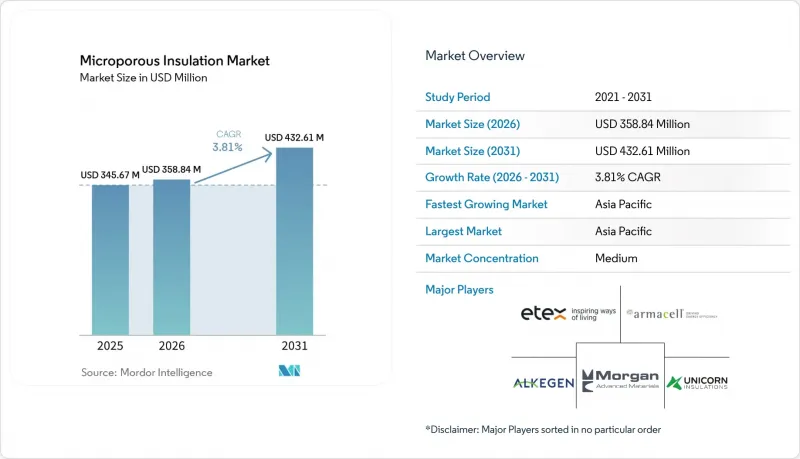
Mordor Intelligence에 의하면, 미세 다공성 단열재 시장 규모는 2025년 3억 4,567만 달러로 평가되었고, 2026년 3억 5,884만 달러로 추정되고, 2031년까지 4억 3,261만 달러로 확대될 전망이며, 2026-2031년 연평균 복합 성장률(CAGR)은 3.81%를 나타낼 것으로 예측됩니다.
본 보고서는 소재 유형별(실리카계 등), 형태별(패널 및 보드, 튜브 및 파이프 커버 등), 사용 온도 범위별(600°C 이하, 600-1000°C, 1000°C 이상), 최종 사용자 산업별(자동차, 석유화학 및 화학 제조, 기타), 지역별(아시아태평양, 북미, 기타)로 분류되어 있습니다. 시장 전망은 금액(달러) 기준으로 제시되어 있습니다.
세계의 미세 다공성 단열재 시장 동향 및 분석
항공우주 및 석유 및 가스 분야의 경량화 및 공간 절약에 대한 수요 :
해상 플랫폼과 와이드바디 항공기는 엄격한 중량 제한 하에 운용되고 있으며, 1kg 증가만으로도 운용 비용에 영향을 미칩니다. 카타르의 루야(Ruya) 프로젝트에 사용된 AIS 그룹의 ContraFlame MS200 미세 다공성 베를리판은 기존 미네랄 울에 비해 488톤의 강재를 절감하면서도 0.25 W/(m²·K)라는 열 외피 요건을 충족했습니다. 아스펜 에어로겔(Aspen Aerogel)사의 'Cryogel Z' 블랭킷은 LNG 파이프의 외경을 24% 축소하고, 1미터당 1.83톤의 구조용 강재 사용량을 줄였으며, 설치 공기를 30% 단축했습니다. FAA의 14 CFR 25.856 규정에 따르면, 나셀의 단열재는 4분 동안 화염의 침투를 견뎌야 하며, 이에 따라 항공사들은 유리섬유 매트를 실리카 에어로겔 블랭킷으로 교체하여 나셀의 무게를 12-18kg 줄였습니다. 해저 가스 파이프라인에는 에어로겔을 충전한 파이프 인 파이프 시스템이 채택되어 있습니다. 이 시스템은 40km에 달하는 타이백 구간에서 150바의 정수압을 견디며 압축 붕괴가 발생하지 않아, 경제적인 적용 범위를 확대되고 있습니다. 트윈애이스 항공기 프로그램에서는 항공기 수명 기간 동안 중량을 1kg 줄일 때마다 약 3,000달러의 연료비 절감 효과가 예상되어, 첨단 단열 솔루션의 비용 효율성이 부각되고 있습니다.
에너지 효율이 높은 극저온 및 LNG 인프라 구축
새로운 액화천연가스(LNG) 재기화 터미널의 처리 능력은 2025년까지 연간 5,000만 톤(tpa) 증가할 것으로 예상되며, 그 중 3분의 2는 중국과 인도에 위치할 전망입니다. 각 사이트에는 일일 증발률을 0.05% 미만으로 억제하도록 설계된 진공 재킷 방식 또는 미세 다공질 시스템이 도입되어 있습니다. 인도에서는 석유천연가스규제위원회(PNGRB)가 수소로 인한 강재의 취화 현상을 해결하기 위해, 극저온 조건에서 열전도율 0.03 W/m·K 미만의 단열재 사용을 의무화하는 '2025년 블렌드 로드맵'을 발표했습니다. 한편, 일본 경제산업성(METI)은 2026년 고베와 요코하마의 액체수소(LH2) 수입 터미널 건설을 위해 370억 엔(2억 5,000만 달러)을 예산에 반영했습니다. 이 터미널들에는 고진공 상태에서 0.001 W/m*K를 달성할 수 있는 가변 밀도 다층 단열재가 채택될 예정입니다. 현대중공업은 환상형 틈새를 에어로겔 분말로 채워 보일오프를 0.15%로 낮춘 20,000m³ 규모의 LH2 운반선 시제선을 개발했습니다. 또한, 암모니아 분해 기술을 도입한 중동의 비료 플랜트에서는 현재, 구형 탱크의 형상에 적합하면서도 액체 암모니아의 침투를 방지하는 유연한 미세 다공성 블랭킷이 지정되어 있습니다.
가혹한 열 사이클 조건 하에서의 내구성 문제
ASTM C1171 및 C1512 시험에 따르면, 실리카계 보드는 200°C에서 800°C 사이에서 50회의 열 사이클을 반복한 후, 압축 강도의 최대 15%를 잃을 수 있습니다. 이에 따라 유리 및 세라믹 공장에서는 더 높은 파괴 인성을 제공하는 알루미나 복합 소재로의 전환이 진행되고 있습니다. ASTM C1303에 따라 실시된 수열 노화 시험에서 중량비 8%의 흡습이 확인되었으며, 그 결과 열전도율이 0.020 W/m·K에서 0.035 W/m·K로 저하되고, 수명이 30% 단축되는 것으로 밝혀졌습니다. 극저온용 블랭킷은 -200°C 이하의 온도에서 미세한 균열이 발생하기 쉬운 경향이 있으나, 이 문제는 유연한 바인더를 사용함으로써 부분적으로 해결되었습니다. 단, 이러한 바인더를 사용하면 열전도율이 10-15% 상승합니다. 미국기계학회(ASME) 제3부 규격이 적용되는 원자로의 경우, 40년 동안 최대 1메가그레이(MGy)의 방사선 안정성이 요구되므로, 유기 바인더를 함유한 많은 제품이 제외됩니다. 이러한 기계적 및 환경적 스트레스로 인해, 주기적인 사용이나 고방사선 환경이 수반되는 용도에서의 채택이 제한되고 있습니다.
부문별 분석
에어로겔 등급은 2026-2031년 미세 다공성 단열재 시장 규모에서 연평균 성장률(CAGR) 4.68%를 기록했습니다. 이는 수소 액화 플랜트에서 요구되는 0.02 W/m*K 미만의 열적 성능과 20%의 경량화 수요에 힘입은 결과입니다. 2025년 매출의 44.66%를 실리카계 소재가 차지했습니다. 이는 평방미터당 8-12달러의 원가 구조와 확립된 공급망에 힘입은 결과입니다. 2메가파스칼(MPa) 이상의 압축 강도와 알칼리성 슬래그에 대한 내성이 필요한 내화 라이닝용으로 설계된 알루미나계 패널은 40-60%의 가격 프리미엄이 책정되었으나, 특정 고객들은 이를 수용했습니다.
업계의 관심은 실리콘 질화물(Si3N4)이나 알루미늄 산화물-이산화규소(Al2O3-SiO2) 복합재와 같은 세라믹 에어로겔로 점차 옮겨가고 있습니다. 이 소재들은 1,200℃에서 0.015 W/m·K 미만의 열전도율을 달성하여, 태양열 집열기나 가스 터빈에 대한 용도가 기대되고 있습니다. 그러나 생산 능력의 제약은 여전히 지속되고 있으며, 에어로겔 담요의 정격 생산량은 2025년에 약 5,000만 제곱미터에 달할 것으로 전망됩니다. Aspen Aerogels, Cabot가 지원하는 Yangu, Armacell 등 주요 기업들이 이 생산량의 3분의 2에 가까운 비중을 차지했습니다. 한편, 동남아시아의 바이오실리카 시범 공장의 연간 생산량은 2,000톤 미만에 그쳐, 아직 상업적인 수익성을 확보하지 못하고 있습니다. 비용은 높지만, 에어로겔의 성능적 우위는 2031년까지 미세 다공성 단열재 시장에서 시장 점유율 확대를 지속적으로 뒷받침하고 있습니다.
2025년 기준으로 패널 및 보드는 미세 다공성 단열재 시장 점유율의 41.13%를 차지했으며, 이는 강성과 하중 지지 능력이 요구되는 정유시설 개보수 및 용광로 벽체용 수요에 힘입은 결과입니다. 블랭킷 및 플렉서블 매트는 액화천연가스(LNG) 파이프 단열재, 해저 타이백, 항공기 나셀 등의 용도로 인해 연평균 성장률(CAGR) 4.25%를 나타낼 것으로 예측됩니다. 이러한 용도에서는 우수한 성형성 덕분에 현장 작업량이 30% 감소하며, 파이프 1미터당 강재 중량이 1.83톤 줄어듭니다. 난방, 환기, 공조(HVAC) 시스템에 사용되는 배관 자재는 공장에서 시공된 방습층의 이점을 누리고 있어, 이를 통해 현장 작업 공수를 15-20% 절감할 수 있습니다.
분말이나 과립은 진공 단열 패널이나 이중벽 탱크에 사용되며, 진공 조건에서는 0.03 W/m·K의 열전도율을 달성하지만, 대기압 하에서는 그 효과가 사라집니다. 미국 냉난방공조학회(ASHRAE) 90.1-2022 등의 규제 기준에서는 R-30 등급의 덕트 성능이 의무화되어 있어, 이에 따라 단열재에 대한 수요가 증가하고 있습니다. 이 성능은 75mm 두께의 엘라스토머 폼 대신 25mm 두께의 에어로겔 층을 사용함으로써 달성할 수 있습니다. 그러나 사용 후 처리 문제는 여전히 남아 있습니다. 분산된 분말은 재활용을 복잡하게 만들고 처리 비용을 증가시키지만, 블랭킷이나 패널은 새롭게 도입되고 있는 수거 프로그램과의 호환성이 높습니다.
지역별 분석
아시아태평양은 2025년 미세 다공성 단열재 시장 규모의 42.21%를 차지했으며, 2031년까지 연평균 성장률(CAGR) 4.23%로 성장할 것으로 전망됩니다. 주요 요인으로는 인도의 444억 루피(4억 7,290만 달러) 규모의 그린 수소 이니셔티브, 중국의 50억 위안(7억 2,000만 달러) 규모의 충칭 에어로겔 프로젝트, 그리고 일본의 액화수소(LH2) 터미널에 대한 370억 엔(2억 3,000만 달러) 투자 등이 꼽히며, 이러한 요인들이 맞물려 0.005 W/m*K 미만의 단열 솔루션에 대한 수요를 뒷받침하고 있습니다. 중국에서 미세다공성 담요의 매출액은 2026년 71억 5,000만 위안(10억 3,000만 달러)에서 2033년까지 158억 3,000만 위안(22억 9,000만 달러)로 증가할 것으로 예상되며, 연평균 성장률(CAGR)은 12.02%가 될 것입니다. 장쑤 한신톈청과 내몽골 랑잉 등의 기업들은 10만 입방미터의 신규 생산 능력을 확충함으로써 이러한 성장에 기여하고 있습니다.
북미 및 유럽에서는 생산량 증가세가 완만하지만, 특수 등급 제품의 도입과 엄격한 규제 준수를 통해 높은 부가가치를 유지하고 있습니다. 독일의 1억 2,000만 유로(1억 3,804만 달러) 규모의 수소 터미널 지원금, 미국 환경보호청(EPA)의 합성 유기화학 제조 산업(SOCMI) 준수 프로젝트, 그리고 미국 냉난방 공조 공학회(ASHRAE)의 규격 개정이 이 지역에서의 프리미엄 가격 책정을 뒷받침하고 있습니다. 아스펜 에어로겔스가 2026년 3분기에 북해에서 수주한 해저 프로젝트는 거시적인 총 판매량 증가세가 여전히 둔화되고 있음에도 불구하고 고성능 단열 솔루션에 대한 수요가 지속되고 있음을 여실히 보여주고 있습니다.
남미, 중동 및 아프리카는 시장 점유율은 작지만, 특정 부문, 특히 석유 및 가스 및 재생에너지 분야에서 성장이 예상됩니다. 사우디아라비아의 NEOM, 아랍에미리트(UAE)의 수소 얼라이언스, 브라질의 프레솔트층 개량과 같은 프로젝트에서는 에어로겔 시스템을 활용하여 해상 설비의 무게를 줄이고 열효율을 높이고 있습니다. 또한, 남아프리카공화국의 유기 랭킨 사이클(ORC) 시범 프로젝트에서는 미세 다공성 단열재를 폐열 회수 시스템에 통합하고 있으며, 이는 석탄에 의존하는 에너지망에서도 이 기술이 점차 도입되고 있음을 보여줍니다.
기타 혜택 :
- 엑셀 형식 시장 예측(ME) 시트
- 3개월간의 애널리스트 지원
자주 묻는 질문
목차
제1장 서론
제2장 조사 방법
제3장 주요 요약
제4장 시장 구도
제5장 시장 규모 및 성장 예측
제6장 경쟁 구도
제7장 시장 기회 및 향후 전망
AJY 26.06.22According to Mordor Intelligence, the microporous insulation market size is projected to expand from USD 345.67 million in 2025 and USD 358.84 million in 2026 to USD 432.61 million by 2031, registering a CAGR of 3.81% between 2026 to 2031.
This report is Segmented by Material Type (Silica-Based, and More), Form Factor (Panels and Boards, Tubes and Pipe Covers, and More), Operating Temperature Range (Up To 600°C, 600-1000°C, Above 1000°C), End-User Industry (Automotive, Petrochemical and Chemical Manufacturing, and More), and Geography (Asia-Pacific, North America, and More). The Market Forecasts are Provided in Terms of Value (USD).
Global Microporous Insulation Market Trends and Insights
Lightweight and Space-Saving Demand in Aerospace and O&G
Offshore platforms and wide-body aircraft operate under strict weight constraints, where every additional kilogram impacts operating costs. AIS Group's ContraFlame MS200 microporous belly pan, used in Qatar's Ruya project, reduced 488 tons of steel compared to traditional mineral wool while meeting a thermal envelope requirement of 0.25 W/(m2*K). Aspen Aerogels' Cryogel Z blankets reduced LNG pipe outer diameters by 24%, lowering structural steel usage by 1.83 tons per meter and reducing installation schedules by 30%. The FAA's 14 CFR 25.856 regulation requires nacelle thermal barriers to resist flame penetration for four minutes, prompting airlines to replace fiberglass mats with silica-aerogel blankets, reducing nacelle weight by 12-18 kg. Subsea gas pipelines are adopting aerogel-filled pipe-in-pipe systems capable of withstanding 150-bar hydrostatic pressure over 40-km tiebacks without compressive collapse, extending economic reach. Twin-aisle aircraft programs estimate fuel savings at approximately USD 3,000 per kilogram of weight reduction over the aircraft's lifespan, highlighting the cost benefits of advanced insulation solutions.
Energy-Efficient Cryogenic and LNG Infrastructure Build-Out
New liquefied natural gas (LNG) regasification terminals are projected to add 50 million tons per annum (tpa) by 2025, with two-thirds of this capacity located in China and India. Each site is implementing vacuum-jacketed or microporous systems designed to limit boil-off rates to below 0.05% per day. In India, the Petroleum and Natural Gas Regulatory Board (PNGRB) has issued a 2025 blending roadmap mandating insulation with thermal conductivity below 0.03 W/m*K under cryogenic conditions to address hydrogen-induced steel embrittlement. Meanwhile, Japan's Ministry of Economy, Trade and Industry (METI) has allocated JPY 37 billion (USD 250 million) in 2026 for liquid hydrogen (LH2) import terminals in Kobe and Yokohama, which will utilize variable-density multilayer insulation capable of achieving 0.001 W/m*K under high vacuum. Hyundai Heavy Industries has developed a 20,000-m3 LH2 carrier prototype that reduces boil-off to 0.15% by using aerogel powder to fill annular gaps. Additionally, Middle Eastern fertilizer plants adopting ammonia cracking technologies are now specifying flexible microporous blankets that prevent liquid-ammonia permeation while adapting to the shape of spherical tanks.
Durability Issues Under Severe Thermal Cycling
ASTM C1171 and C1512 tests indicate that silica-based boards can lose up to 15% of their compressive strength after 50 thermal cycles between 200°C and 800°C. This has led glass and ceramics plants to transition toward alumina composites, which offer higher fracture toughness. Hydrothermal aging tests conducted per ASTM C1303 reveal a moisture uptake of 8% by weight, resulting in a decline in thermal conductivity from 0.020 to 0.035 watts per meter-kelvin (W/m*K) and reducing life expectancy by 30%. Cryogenic blankets are susceptible to micro-cracking at temperatures below -200°C, an issue partially addressed by the use of flexible binders, though these binders increase thermal conductivity by 10-15%. In nuclear reactors governed by the American Society of Mechanical Engineers (ASME) Section III, radiation stability requirements of up to 1 megagray (MGy) over 40 years exclude many products with organic binders. These mechanical and environmental stresses limit adoption in applications involving cyclic or high-radiation conditions.
Other drivers and restraints analyzed in the detailed report include:
- Stricter Safety and Emission Regulations
- Hydrogen-Liquefaction and LH2 Bunkering Projects
- Raw-Material Price Volatility
For complete list of drivers and restraints, kindly check the Table Of Contents.
Segment Analysis
Aerogel grades recorded a 4.68% compound annual growth rate (CAGR) in the microporous insulation market size between 2026 and 2031, driven by demand from hydrogen-liquefaction plants for sub-0.02 W/m*K thermal performance and 20% weight reduction. Silica-based materials accounted for 44.66% of 2025 revenue, supported by a cost structure of USD 8-12 per square meter and established supply chains. Alumina-based panels, designed for refractory linings requiring compressive strengths above 2 megapascals (MPa) and resistance to alkaline slag, commanded 40-60% price premiums, which specific clients accepted.
Industry focus is shifting towards ceramic aerogels, such as silicon nitride (Si3N4) and aluminum oxide-silicon dioxide (Al2O3-SiO2) composites, which achieve thermal conductivity below 0.015 W/m*K at 1,200 degrees Celsius, offering potential applications in solar receivers and gas turbines. However, capacity constraints persist, with nameplate aerogel blanket production reaching approximately 50 million square meters in 2025. Key players, including Aspen Aerogels, Cabot-backed Yangu, and Armacell, accounted for nearly two-thirds of this output. Meanwhile, bio-silica pilot plants in Southeast Asia produced less than 2,000 tons per annum (tpa), falling short of commercial viability. Despite higher costs, the performance advantages of aerogels continue to support their market share growth in the Microporous Insulation Market through 2031.
Panels and boards represented 41.13% of the microporous insulation market share in 2025, supported by refinery retrofits and furnace walls requiring rigid, load-bearing capabilities. Blankets and flexible mats are expected to grow at a Compound Annual Growth Rate (CAGR) of 4.25%, driven by applications such as Liquefied Natural Gas (LNG) pipe wraps, subsea tiebacks, and aviation nacelles, where their conformability reduces field labor by 30% and decreases steel weight by 1.83 tons per pipe-meter. Tube sections used in Heating, Ventilation, and Air Conditioning (HVAC) systems benefit from factory-applied vapor barriers, which reduce onsite labor by 15-20%.
Powders and granules are used in vacuum-insulated panels and double-wall tanks, achieving thermal conductivity of 0.03 W/m*K under vacuum conditions but losing effectiveness at atmospheric pressure. Regulatory standards, such as the American Society of Heating, Refrigerating and Air-Conditioning Engineers (ASHRAE) 90.1-2022, are driving increased demand for blankets by mandating R-30 duct performance, which can be achieved with 25 mm aerogel layers instead of 75 mm elastomeric foams. However, end-of-life challenges remain: dispersed powders complicate recycling and increase abatement costs, while blankets and panels are more compatible with emerging take-back programs.
Geography Analysis
Asia-Pacific accounted for 42.21% of the microporous insulation market size in 2025 and is projected to grow at a compound annual growth rate (CAGR) of 4.23% through 2031. Key factors include India's INR 44,400 million (USD 472.90 million) green-hydrogen initiative, China's CNY 5 billion (USD 0.72 billion) Chongqing aerogel project, and Japan's JPY 37 billion (USD 0.23 billion) investment in liquid hydrogen (LH2) terminals, collectively supporting demand for sub-0.005 W/m*K insulation solutions. In China, revenue from microporous blankets is expected to increase from CNY 7.15 billion (USD 1.03 billion) in 2026 to CNY 15.83 billion (USD 2.29 billion) by 2033, reflecting a CAGR of 12.02%. Companies such as Jiangsu Hanxin Tiancheng and Inner Mongolia Langying are contributing to this growth by adding 100,000 cubic meters of new production capacity.
North America and Europe demonstrate slower volume growth but maintain higher value density due to the adoption of specialty grades and compliance with stringent regulations. Germany's EUR 120 million (USD 138.04 million) hydrogen-terminal grants, Environmental Protection Agency (EPA) Synthetic Organic Chemical Manufacturing Industry (SOCMI) compliance projects, and updates to American Society of Heating, Refrigerating and Air-Conditioning Engineers (ASHRAE) codes support premium pricing in these regions. Aspen Aerogels' third-quarter 2026 subsea project win in the North Sea highlights the continued demand for high-performance insulation solutions, even as overall macro volume growth remains subdued.
South America and the Middle East-Africa regions contribute smaller market shares but exhibit growth in specific segments, particularly in oil-and-gas and renewable energy applications. Projects such as Saudi Arabia's NEOM, the United Arab Emirates' (UAE) hydrogen alliance, and Brazil's pre-salt retrofits leverage aerogel systems to reduce offshore weight and enhance thermal efficiency. Additionally, South Africa's organic Rankine cycle (ORC) pilot project integrates microporous insulation with waste-heat recovery systems, indicating the gradual adoption of this technology in coal-dependent energy grids.
- Alkegen
- Archello
- ARMACELL
- Aspen Aerogels Inc.
- BASF
- Cabot Corporation
- EIKA, S.COOP
- Elmelin Ltd.
- Enersens
- Etex Group
- Isolation Materials Ltd.
- Isolite Insulating Products Co., Ltd.
- Johns Manville
- Luyang Energy-Saving Materials Co., Ltd.
- Momentive
- Morgan Advanced Materials plc
- ROCKWOOL A/S
- Saint-Gobain
- Unicorn Insulations
- Zotefoams plc
Additional Benefits:
- The market estimate (ME) sheet in Excel format
- 3 months of analyst support
TABLE OF CONTENTS
1 Introduction
- 1.1 Study Assumptions and Market Definition
- 1.2 Scope of the Study
2 Research Methodology
3 Executive Summary
4 Market Landscape
- 4.1 Market Overview
- 4.2 Market Drivers
- 4.2.1 Lightweight and space-saving demand in aerospace and O&G
- 4.2.2 Energy-efficient cryogenic and LNG infrastructure build-out
- 4.2.3 Stricter safety and emission regulations
- 4.2.4 Hydrogen-liquefaction and LH2 bunkering projects
- 4.2.5 Thermal-runaway barriers for solid-state battery gigafactories
- 4.3 Market Restraints
- 4.3.1 Durability issues under severe thermal cycling
- 4.3.2 Raw-material price volatility (fumed silica, opacifiers)
- 4.3.3 End-of-life recycling complexity and landfill restrictions
- 4.4 Value Chain Analysis
- 4.5 Porter's Five Forces
- 4.5.1 Bargaining Power of Suppliers
- 4.5.2 Bargaining Power of Buyers
- 4.5.3 Threat of New Entrants
- 4.5.4 Threat of Substitutes
- 4.5.5 Competitive Rivalry
5 Market Size and Growth Forecasts (Value)
- 5.1 By Material Type
- 5.1.1 Silica-based
- 5.1.2 Aerogel-based
- 5.1.3 Alumina-based
- 5.2 By Form Factor
- 5.2.1 Panels and Boards
- 5.2.2 Tubes and Pipe Covers
- 5.2.3 Blocks / Sheets
- 5.2.4 Blankets and Flexible Mats
- 5.2.5 Powder / Granules
- 5.3 By Operating Temperature Range
- 5.3.1 Up to 600 °C
- 5.3.2 600 - 1 000 °C
- 5.3.3 Above 1 000 °C
- 5.4 By End-user Industry
- 5.4.1 Automotive
- 5.4.2 Petrochemical and Chemical Manufacturing
- 5.4.3 HVAC and Refrigeration
- 5.4.4 Oil and Gas Operators
- 5.4.5 Power Generation (thermal, solar, nuclear)
- 5.4.6 Aviation Industry
- 5.5 By Geography
- 5.5.1 Asia-Pacific
- 5.5.1.1 China
- 5.5.1.2 India
- 5.5.1.3 Japan
- 5.5.1.4 South Korea
- 5.5.1.5 Rest of Asia-Pacific
- 5.5.2 North America
- 5.5.2.1 United States
- 5.5.2.2 Canada
- 5.5.2.3 Mexico
- 5.5.3 Europe
- 5.5.3.1 Germany
- 5.5.3.2 United Kingdom
- 5.5.3.3 France
- 5.5.3.4 Italy
- 5.5.3.5 Rest of Europe
- 5.5.4 South America
- 5.5.4.1 Brazil
- 5.5.4.2 Argentina
- 5.5.4.3 Rest of South America
- 5.5.5 Middle-East and Africa
- 5.5.5.1 Saudi Arabia
- 5.5.5.2 United Arab Emirates
- 5.5.5.3 South Africa
- 5.5.5.4 Rest of Middle-East and Africa
- 5.5.1 Asia-Pacific
6 Competitive Landscape
- 6.1 Market Concentration
- 6.2 Strategic Moves
- 6.3 Market Share (%)/Ranking Analysis
- 6.4 Company Profiles (includes Global Overview, Market Overview, Core Segments, Financials, Strategic Information, Products and Services, and Recent Developments)
- 6.4.1 Alkegen
- 6.4.2 Archello
- 6.4.3 ARMACELL
- 6.4.4 Aspen Aerogels Inc.
- 6.4.5 BASF
- 6.4.6 Cabot Corporation
- 6.4.7 EIKA, S.COOP
- 6.4.8 Elmelin Ltd.
- 6.4.9 Enersens
- 6.4.10 Etex Group
- 6.4.11 Isolation Materials Ltd.
- 6.4.12 Isolite Insulating Products Co., Ltd.
- 6.4.13 Johns Manville
- 6.4.14 Luyang Energy-Saving Materials Co., Ltd.
- 6.4.15 Momentive
- 6.4.16 Morgan Advanced Materials plc
- 6.4.17 ROCKWOOL A/S
- 6.4.18 Saint-Gobain
- 6.4.19 Unicorn Insulations
- 6.4.20 Zotefoams plc
7 Market Opportunities and Future Outlook
- 7.1 White-space and Unmet-need Assessment