

|
시장보고서
상품코드
2062167
페인트 박리제 : 시장 점유율 분석, 산업 동향 및 통계 데이터, 성장 예측(2026-2031년)Paint Remover - Market Share Analysis, Industry Trends & Statistics, Growth Forecasts (2026 - 2031) |
||||||
 Mordor Intelligence
Mordor Intelligence에 의하면, 페인트 박리제 시장 규모는 2025년 14억 9,000만 달러로 평가되었습니다. 2026년에는 15억 8,000만 달러로 확대되어 2026-2031년 CAGR은 5.93%를 나타내, 2031년까지 21억 1,000만 달러에 이를 것으로 예측됩니다.
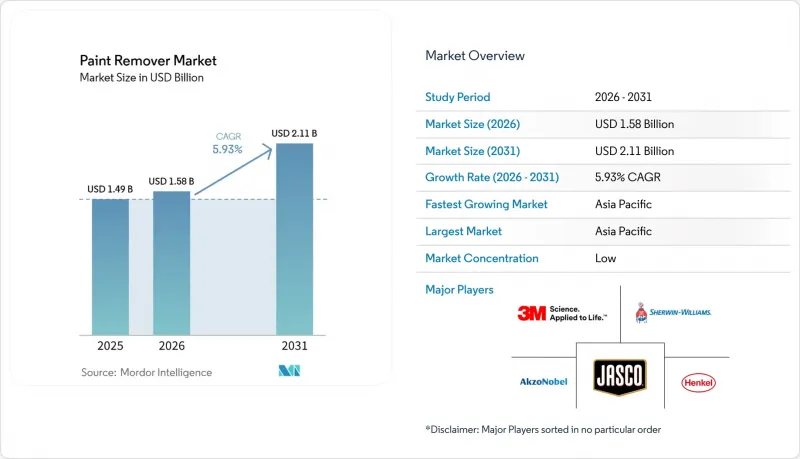
본 보고서는 제품 유형(용제계 박리제, 바이오계 박리제 등), 형태(액체, 젤, 페이스트 등), 용도(주택용 DIY, 상업용 건물 유지보수 등), 최종 사용자 산업(건설, 운송 등), 지역(아시아태평양, 북미, 유럽, 남미, 중동 및 아프리카)별로 분류되어 있습니다. 시장 전망은 금액(달러) 기준으로 제시되어 있습니다.
세계의 페인트 박리제 시장 동향 및 인사이트
메틸렌 클로라이드에 대한 규제상 금지 조치
2024년 5월, 미국 환경보호청(EPA)은 2025년 5월까지 메틸렌클로라이드의 소비자용 사용을 단계적으로 폐지하고, 2026년 4월까지 대부분의 상업용 용도에 대해서도 동일한 조치를 취할 것이라는 규정을 발표했습니다. 이러한 규제로 인해 제제 제조업체들은 대두 메틸 에스테르, d-리모넨, 가성 알칼리 혼합물 등의 대체재를 모색해야 하는 상황에 놓여 있습니다. 특정 제한적인 면제 용도를 유지하는 기업은 공학적 대책과 실시간 대기 모니터링을 실시해야 할 의무가 있으며, 이로 인해 규정 준수 비용이 약 15-20% 증가할 것으로 예측됩니다. 2026년 초에 재개된 제5순회항소법원의 소송으로 인해, 일부 바이오 생산 능력에 대한 투자에 차질이 발생하고 있습니다. 또한, 식품 가공 분야에서 이 용매에 대한 FDA의 관련 조치는 연방 차원의 더 광범위한 전환을 시사하며, 코팅 밸류체인 내에서 대체재를 도입하는 속도를 가속화하고 있습니다.
리모델링·리노베이션 붐
중국은 5만 3,000곳의 노후화된 도시 주택단지를 개보수할 계획을 세우고 있으며, 2028년까지 광범위한 외벽 도장 벗겨짐을 보수하고 재도장하는 작업을 추진하고 있습니다. 미국에서는 하버드대학교 주택연구공동센터가, 지은 지 40년이 넘은 노후 주택 증가를 배경으로, 2026년까지 리모델링 지출이 견조한 추세를 보일 것으로 전망하고 있습니다. 상업용 빌딩의 유지보수 예산은 저VOC 및 생분해성 박리제 사용을 의무화하는 그린빌딩 인증 기준을 준수함에 따라 증가하고 있습니다. 또한, 소셜 미디어의 동향에 영향을 받아 가구 복원에 대한 관심이 높아지면서, 실내에서 사용하기에 더 안전한 것으로 여겨지는 젤이나 페이스트 형태의 제품에 대한 수요가 증가하고 있습니다.
VOC 규제로 인해 용제 사용이 제한됨
캘리포니아주 사우스코스트 대기질 관리구는 페인트 박리제의 VOC 함량 상한선을 50 g/L로 설정하고, 기존의 메틸렌클로라이드 및 N-메틸피롤리돈 함유제의 사용을 제한하고 있습니다. 미국 북동부 및 EU의 산업 배출 규제에 따른 유사한 규제로 인해, 아세톤, 디메틸카보네이트 또는 수성 시스템으로의 배합 변경이 진행되고 있습니다. 그러나 이러한 대체품들은 갤런당 가격이 20-30% 더 비쌉니다. 공급업체들은 연구개발(R&D) 주기의 장기화에 직면해 있는 반면, 전국적인 유통업체들은 다양한 규제를 준수하기 위해 광범위한 SKU를 관리해야 하며, 이로 인해 물류 비용이 증가하고 있습니다.
부문별 분석
2025년 기준으로, 용제계 제품은 매출액 점유율의 48.22%를 차지했습니다. 그러나 규정 준수 비용 증가와 소비자들의 저취 제품에 대한 선호도 변화로 인해 바이오 대체재에 대한 수요가 증가하고 있으며, 이 시장은 연평균 6.44%의 성장률을 보이고 있습니다. 바이오 부문에서는 대두 메틸 에스테르 젤 등의 제품이 전자상거래 채널에서 인기를 끌고 있습니다. 이 제품들은 유효한 작용 시간 성능을 유지하면서도 주 정부의 VOC 규정을 충족하고 있습니다. 가성 제품은 pH 값이 높아 도막의 분해를 촉진하기 때문에 중공업용 박리 분야에서 여전히 널리 사용되고 있습니다. 그러나 부식성 슬러지의 처리 비용 상승이 과제로 대두되고 있습니다. 효소 제제는 작용 시간이 길어 기질의 손상을 방지하면서도 VOC 및 독성 문제를 피할 수 있기 때문에 문화재 보존 분야에서 틈새 시장을 차지하고 있습니다.
아세톤이나 디메틸카보네이트에 독자적인 계면활성제를 배합한 2세대 용제 제품군은 원자재 비용 상승으로 인해 이익률이 압박받는 과제에 직면해 있습니다. 반면, 대두나 감귤류에서 추출한 바이오 원료는 일부 지역에서 농업 보조금의 혜택을 받고 있습니다. EPA 규정 및 EU의 REACH 규정에 따른 규제 면제로 인해, 식물 유래 용매가 시장 점유율을 확대할 기회가 생기고 있습니다. 그러나 d-리모넨공급은 감귤류 수확량 변동의 영향을 받기 쉬운 상황이 계속되고 있습니다.
2025년에는 액상 제품이 매출의 35.45%를 차지했습니다. 이는 주로 저점도와 신속한 헹굼이 필요한 자동 분사 및 침지 공정에 적합하기 때문입니다. 현재부터 2031년까지 페이스트 및 젤 제품의 연평균 성장률은 6.47%로 전망됩니다. 이는 항공우주, 선박, 주택용 DIY 분야에서 수직 패널에 밀착되며 처짐이 적은 유변학적 특성에 대한 수요가 주도하는 현상입니다. 점도 변화형 개질제는 도막 두께 증가, 접촉 시간 연장, 그리고 1제곱미터당 작업 시간 단축에 기여합니다. 보잉이나 에어버스 등 항공우주 제조업체의 매뉴얼에서는 밀폐된 격납고 내의 VOC 배출 문제를 해결하기 위해 젤 형태의 스트리퍼 사용을 지정하고 있으며, 이에 따라 MRO 데포에서는 액체 제품 외에도 페이스트 제품 SKU도 취급하게 되었습니다.
에어로졸은 부분 보수에 사용되지만, 추진제 규제로 인해 어려움을 겪고 있으며, 이로 인해 제조 비용이 10-15% 증가하고 있습니다. 산업용 분말의 경우 여전히 선택의 폭이 좁으며, 현장에서 농축액을 혼합하는 것은 운송 비용 절감에 도움이 되지만, 작업자의 교육이 필요합니다. 페이스트 형태의 슬러리는 취급이 간편하고, 액체 비산 사고에 대처하기 위한 OSHA의 안전 감사에 부합하며, 유출 위험이 낮다는 장점이 있습니다.
지역별 분석
2025년 기준으로 아시아태평양은 전 세계 매출의 44.28%를 차지했으며, 2031년까지 연평균 6.93%의 성장률이 예상됩니다. 이러한 성장은 중국의 주택 개보수 및 인도의 자동차 보유 대수 증가에 기인합니다. 일본의 산업 부문에서는 화학물질 소비량에 상응하도록 열분해 서비스 도입이 추진되고 있습니다. 한국에서는 조선소가 선체 개조 시 해양용 박리제 수요를 주도하고 있습니다. 동남아시아 국가들에서는 건물 개보수 예산이 증가하고 있으며, 현지 공급업체들은 팜유를 원료로 한 바이오 젤을 개발하고 있습니다.
북미에서는 EPA의 메틸렌클로라이드 사용 금지 등 규제 변경으로 인해 제품 포트폴리오의 개편이 가속화되고 있습니다. 캘리포니아주의 VOC(휘발성 유기 화합물) 50g/L 상한 규제가 제품 시장에 변화를 가져오고 있으며, 북동부 주들에서도 유사한 규제가 도입되고 있습니다. 미국의 주택 평균 연식이 40년을 넘기 때문에 주택 수리비는 여전히 큰 비중을 차지하고 있습니다. 항공우주 분야의 MRO(정비·수리·오버홀) 역량 확대가 젤 제품 수요 증가에 기여하고 있습니다. 캐나다와 멕시코에서는 자동차 생산에 따른 국경을 넘는 수요에 대응하고 있지만, 수입 특수 화학제품에 대한 잠재적인 관세 위험은 여전히 우려 사항으로 남아 있습니다.
유럽에서는 산업 배출 지침 및 REACH 규정에 따라 기존 용매에서 벗어나는 추세가 가속화되고 있습니다. 독일에서는 내연 기관차의 보유 대수 덕분에 재도장용 제품의 소비가 발생하고 있습니다. 영국에서는 인프라 정비 사업을 통해 상업시설의 유지보수 활동이 증가하고 있습니다. 프랑스와 이탈리아에서는 문화재 복원 시 pH 중성 젤이 선호되고 있습니다. 스페인의 관광 부문에서는 호텔 도색 주기가 유지되고 있으며, 동유럽에서는 산업의 현대화에 따른 완만한 성장이 나타나고 있습니다. 남미에서는 브라질이 주요 수요 시장으로 자리 잡고 있으며, 환율 변동이 조달 전략에 영향을 미치고 있습니다. 중동에서는 사우디아라비아의 인프라 프로젝트를 통해 성장이 나타나고 있지만, 사하라 이남 아프리카에서는 물류상의 과제가 여전히 남아 있습니다.
기타 혜택 :
- 엑셀 형식 시장 예측(ME) 시트
- 3개월간의 애널리스트 지원
자주 묻는 질문
목차
제1장 서론
제2장 분석 방법
제3장 주요 요약
제4장 시장 구도
제5장 시장 규모 및 성장률 예측
제6장 경쟁 구도
제7장 시장 기회 및 향후 전망
KTH 26.06.24According to Mordor Intelligence, the paint remover market size is expected to grow from USD 1.49 billion in 2025 to USD 1.58 billion in 2026 and is forecast to reach USD 2.11 billion by 2031 at 5.93% CAGR over 2026-2031.
This report is Segmented by Product Type (Solvent-Based Removers, Bio-Based Removers, and More), Form (Liquid, Gel, Paste, and More), Application (Residential DIY, Commercial Building Maintenance, and More), End-User Industry (Construction, Transportation, and More), and Geography (Asia-Pacific, North America, Europe, South America, Middle-East and Africa). Market Forecasts are Provided in Terms of Value (USD).
Global Paint Remover Market Trends and Insights
Regulatory Bans on Methylene Chloride
In May 2024, the EPA announced a rule to phase out consumer use of methylene chloride by May 2025, with most commercial applications to follow by April 2026. This regulation is driving formulators to explore alternatives such as soy methyl ester, d-limonene, and caustic blends. Companies maintaining certain limited exempted uses are required to implement engineering controls and real-time air monitoring, which is projected to increase compliance costs by approximately 15-20%. Litigation in the Fifth Circuit, reopened in early 2026, has introduced delays in some bio-based capacity investments. Furthermore, the FDA's related action against the solvent in food processing indicates a broader federal shift, prompting faster substitution within coatings value chains.
Renovation and Remodeling Boom
China plans to upgrade 53,000 aging urban residential complexes, with initiatives to strip and repaint extensive facade areas by 2028. In the U.S., Harvard's Joint Center for Housing Studies anticipates remodeling expenditures to remain steady through 2026, driven by an aging housing stock exceeding 40 years. Maintenance budgets in commercial buildings are increasing to comply with green-building certifications, which require the use of low-VOC, biodegradable strippers. Additionally, the growing interest in furniture restoration, influenced by social media trends, is driving demand for gel and paste products considered safer for indoor use.
VOC Limits Constrain Solvents
California's South Coast Air Quality Management District has implemented a cap on paint-remover VOC content at 50 g/L, restricting the use of traditional methylene chloride and N-methyl-pyrrolidone blends. Similar regulations in the U.S. Northeast and under the EU's Industrial Emissions rules are driving reformulation efforts toward acetone, dimethyl carbonate, or water-based systems. These alternatives, however, are priced 20-30% higher on a per-gallon basis. Suppliers are encountering longer R&D cycles, while national distributors are managing a broader range of SKUs to comply with varying regulations, which is increasing logistics costs.
Other drivers and restraints analyzed in the detailed report include:
- Automotive Refinish Demand
- Aerospace and Marine Refurbishment
- Health-Liability Litigation
For complete list of drivers and restraints, kindly check the Table Of Contents.
Segment Analysis
In 2025, solvent-based products accounted for 48.22% of the revenue share. However, increasing compliance costs and a shift in consumer preference toward low-odor profiles are driving demand for bio-based alternatives, which are growing at an annual rate of 6.44%. Within the bio-based segment, products such as soy-methyl-ester gels are gaining traction in e-commerce channels. These products meet state VOC regulations while maintaining effective dwell-time performance. Caustic products continue to be widely used in the heavy industrial stripping segment due to their high pH, which facilitates rapid film breakdown. However, rising disposal fees for corrosive sludge present a challenge. Enzymatic formulations occupy a niche in the heritage conservation segment, as their extended dwell times help prevent substrate damage while avoiding VOC and toxicity concerns.
Second-generation solvent lines, which incorporate acetone or dimethyl carbonate with proprietary surfactants, face challenges related to higher raw material costs that narrow profit margins. In contrast, bio-based feedstocks derived from soy and citrus benefit from agricultural subsidies in several regions. Regulatory exemptions under the EPA rule and EU REACH provide opportunities for plant-derived solvents to increase their market share. However, the supply of d-limonene remains vulnerable to fluctuations in citrus crop yields.
In 2025, liquids represented 35.45% of the revenue, primarily due to their suitability for automated spray or dip operations that require low viscosity and quick rinse-off. Between now and 2031, paste and gel variants are expected to grow at a rate of 6.47%, driven by demand from aerospace, marine, and residential DIY sectors for non-sag rheology that adheres to vertical panels. Thixotropic modifiers contribute to increased film thickness, extended contact duration, and reduced labor hours per square meter. Manuals from aerospace manufacturers such as Boeing and Airbus are specifying gel strippers to address VOC emissions in enclosed hangars, leading MRO depots to include paste SKUs alongside liquids.
Aerosols are used for spot repairs but face challenges due to propellant restrictions, which increase manufacturing costs by 10-15%. Powders remain a limited option in industrial applications, where on-site concentrate mixing helps reduce freight costs but requires operator training. Paste sludge is simpler to handle and poses a lower spill risk, aligning with OSHA safety audits that address liquid splash incidents.
Geography Analysis
In 2025, the Asia-Pacific region represented 44.28% of global revenue and is expected to grow at a rate of 6.93% through 2031. This growth is attributed to residential upgrades in China and the increasing vehicle parc in India. Japan's industrial sector is advancing thermal-decomposition services to align with chemical consumption. In South Korea, shipyards are driving demand for marine strippers during hull refurbishments. Southeast Asian countries are increasing budgets for building upgrades, while local suppliers are utilizing palm-oil feedstocks to develop bio-based gels.
In North America, regulatory changes, such as the EPA's ban on methylene chloride, are driving portfolio turnover. California's 50 g/L VOC cap is altering the product landscape, with similar restrictions being implemented in Northeastern states. Residential repair spending remains significant due to the median age of U.S. homes exceeding 40 years. Aerospace MRO capacity expansions are contributing to higher demand for gel volumes. Canada and Mexico are addressing cross-border demand from automotive production, although potential tariff risks on imported specialty chemicals remain a concern.
In Europe, the Industrial Emissions Directive and REACH authorizations are accelerating the shift away from legacy solvents. Germany is generating refinish consumption from its internal combustion engine vehicle stock. The United Kingdom is increasing commercial maintenance activities through infrastructure programs. In France and Italy, heritage restorations are favoring pH-neutral gels. Spain's tourism sector is maintaining hotel repaint cycles, while Eastern Europe is seeing moderate growth tied to industrial upgrades. In South America, Brazil is the primary market for demand, with currency fluctuations influencing sourcing strategies. The Middle East is experiencing growth from infrastructure projects in Saudi Arabia, although logistical challenges persist in sub-Saharan Africa.
- 3M
- Akzo Nobel N.V.
- BASF
- Citristrip
- DuPont
- Franmar
- Hempel A/S
- Henkel AG & Co. KGaA
- Jasco
- Kleanstrip
- Nippon Paint Holdings Co., Ltd.
- PPG Industries, Inc.
- RPM International Inc.
- The Sherwin-Williams Company
Additional Benefits:
- The market estimate (ME) sheet in Excel format
- 3 months of analyst support
TABLE OF CONTENTS
1 Introduction
- 1.1 Study Assumptions & Market Definition
- 1.2 Scope of the Study
2 Research Methodology
3 Executive Summary
4 Market Landscape
- 4.1 Market Overview
- 4.2 Market Drivers
- 4.2.1 Regulatory Bans on Methylene Chloride
- 4.2.2 Renovation and Remodeling Boom
- 4.2.3 Automotive Refinish Demand
- 4.2.4 Aerospace and Marine Refurbishment
- 4.2.5 Hybrid Laser-chemical Systems Adoption
- 4.3 Market Restraints
- 4.3.1 VOC-limits Constrain Solvents
- 4.3.2 Health-liability Litigation
- 4.3.3 Rise of Mechanical and Laser Stripping
- 4.4 Value Chain Analysis
- 4.5 Porter's Five Forces
- 4.5.1 Threat of New Entrants
- 4.5.2 Bargaining Power of Suppliers
- 4.5.3 Bargaining Power of Buyers
- 4.5.4 Threat of Substitutes
- 4.5.5 Competitive Rivalry
5 Market Size & Growth Forecasts (Value)
- 5.1 By Product Type
- 5.1.1 Solvent-based Removers
- 5.1.2 Bio-based Removers
- 5.1.3 Caustic-based Removers
- 5.1.4 Acidic Removers
- 5.1.5 Others
- 5.2 By Form
- 5.2.1 Liquid
- 5.2.2 Gel
- 5.2.3 Paste
- 5.2.4 Aerosol
- 5.2.5 Powder
- 5.3 By Application
- 5.3.1 Residential DIY
- 5.3.2 Commercial Building Maintenance
- 5.3.3 Industrial Equipment Repair
- 5.3.4 Automotive Refinish
- 5.3.5 Aerospace and Marine
- 5.3.6 Furniture Restoration
- 5.4 By End-user Industry
- 5.4.1 Construction
- 5.4.2 Transportation
- 5.4.3 Manufacturing
- 5.4.4 Consumer Goods
- 5.5 By Geography
- 5.5.1 Asia-Pacific
- 5.5.1.1 China
- 5.5.1.2 Japan
- 5.5.1.3 India
- 5.5.1.4 South Korea
- 5.5.1.5 Rest of Asia-Pacific
- 5.5.2 North America
- 5.5.2.1 United States
- 5.5.2.2 Canada
- 5.5.2.3 Mexico
- 5.5.3 Europe
- 5.5.3.1 Germany
- 5.5.3.2 United Kingdom
- 5.5.3.3 France
- 5.5.3.4 Italy
- 5.5.3.5 Spain
- 5.5.3.6 Rest of Europe
- 5.5.4 South America
- 5.5.4.1 Brazil
- 5.5.4.2 Argentina
- 5.5.4.3 Rest of South America
- 5.5.5 Middle-East and Africa
- 5.5.5.1 Saudi Arabia
- 5.5.5.2 South Africa
- 5.5.5.3 Rest of Middle-East and Africa
- 5.5.1 Asia-Pacific
6 Competitive Landscape
- 6.1 Market Concentration
- 6.2 Strategic Moves
- 6.3 Market Share(%)/Ranking Analysis
- 6.4 Company Profiles (includes Global Overview, Market Overview, Core Segments, Financials, Strategic Information, Products and Services, and Recent Developments)
- 6.4.1 3M
- 6.4.2 Akzo Nobel N.V.
- 6.4.3 BASF
- 6.4.4 Citristrip
- 6.4.5 DuPont
- 6.4.6 Franmar
- 6.4.7 Hempel A/S
- 6.4.8 Henkel AG & Co. KGaA
- 6.4.9 Jasco
- 6.4.10 Kleanstrip
- 6.4.11 Nippon Paint Holdings Co., Ltd.
- 6.4.12 PPG Industries, Inc.
- 6.4.13 RPM International Inc.
- 6.4.14 The Sherwin-Williams Company
7 Market Opportunities & Future Outlook
- 7.1 White-space & Unmet-need Assessment


